




11 Apr TOP 10 EVERGREEN CONTENT MARKETING STATISTICS 2026 THAT REVEAL SHOCKING TRAFFIC POWER
Updated for 2026. This page has been fully refreshed with the latest evergreen content marketing statistics, long-term SEO performance insights, and content strategy trends based on recent global surveys and digital marketing research.
Evergreen content marketing has become the backbone of sustainable growth for brands across every industry. Unlike trend-driven content that fades quickly, evergreen material continues to attract traffic, generate leads, and deliver ROI long after it’s published. As audiences increasingly rely on search engines for answers, the demand for timeless, informative content has only grown. Marketers are recognizing that a single well-crafted guide or tutorial can outperform dozens of short-lived posts.
In 2026, the emphasis is shifting toward creating content ecosystems built around long-term value and reliability. An architecture marketing agency, for example, along with other niche-focused firms, believes that search algorithms have evolved to favor helpful, enduring content that demonstrates expertise and clarity. Whether through blog posts, videos, or interactive tools, evergreen strategies are helping brands stay relevant in an oversaturated digital landscape. The following statistics reveal how evergreen content continues to outperform in terms of traffic, rankings, and long-term business impact.
As evergreen content fuels long-term growth, marketers now need visibility beyond traditional SERPs. Wellows — the autonomous marketing platform for GenAI — helps brands build a GenAI visibility stack by tracking AI search visibility across ChatGPT, Perplexity, and Gemini. With unified brand mentions and its proprietary Citation Score in a single source of truth, Wellows shows where your content wins inside AI answers and where competitors are gaining ground.
TOP 10 EVERGREEN CONTENT MARKETING STATISTICS 2026 THAT REVEAL SHOCKING SEO LONGEVITY
10 Content Marketing Statistics
That Compound Like Investments
Durable figures from the most authoritative sources in digital marketing, updated for 2026. These numbers don't trend — they persist.
| # | Figure | Insight | Source | Impact |
|---|---|---|---|---|
01 |
70%
of marketers invest in it |
Content marketing is mainstream — and foundational
Sustained across years of HubSpot data, 70% of marketers allocate budget to content. Evergreen formats like pillar pages and how-to guides deliver compounding returns long after publication.
|
HubSpot | |
02 |
38%
of all traffic from evergreen |
One-third of your traffic works for free, forever
Ahrefs data shows evergreen content consistently drives over a third of organic traffic. Google's continued push for helpful, timeless content keeps this number durable into 2026.
|
Ahrefs | |
03 |
2+ yrs
holding top rankings |
Top-10 rankings that outlive campaign budgets
Content decay studies confirm evergreen assets hold top SERP positions for 2+ years with minimal maintenance. In a budget-constrained 2026, this is the highest-leverage SEO play available.
|
Content Decay | |
04 |
10%
of posts drive 38% of traffic |
The compounding post: 1-in-10 does the heavy lifting
HubSpot's "compounding post" principle reveals a stark power law: just 10% of content is responsible for 38% of traffic generation. Identifying and expanding these assets is the most direct path to ROI.
|
HubSpot | |
05 |
81%
of companies blog actively |
Blogging remains the backbone of content strategy
Despite AI-accelerated content creation in 2026, 81% of companies still use blogging as their primary channel. Human-reviewed evergreen posts remain the gold standard for SEO reliability and trust signals.
|
Industry avg. | |
06 |
106%
traffic lift from refreshes |
Updating old content doubles traffic without new creation
Orbit Media and SEMrush both confirm that refreshing outdated evergreen content yields 106%+ traffic gains. In 2026, this is the leanest path to growth for teams with constrained production capacity.
|
Orbit + SEMrush | |
07 |
Years
of accruing video views |
Evergreen video: tutorials compound views across years
YouTube and Wistia data confirm that tutorial and explainer videos continue accumulating watch time long after upload. These are the longest-lived content assets in any digital library.
|
YT + Wistia | |
08 |
53%
of traffic from organic |
SEO is still the single biggest traffic source
BrightEdge reports that over 53% of evergreen content traffic arrives via organic search. As search engines improve at surfacing lasting over trending content, this share continues to grow in 2026.
|
BrightEdge | |
09 |
↑ SEO
via pillar page clusters |
Structured evergreen architecture wins long-term authority
Brands deploying pillar pages with linked topic clusters are seeing sustained improvements in search ranking and domain authority. This structured approach has become the 2026 standard for visibility-focused content teams.
|
Multiple | |
10 |
4x
ROI vs seasonal content |
The money stat: evergreen content returns 4x more
Demand Metric's research shows evergreen content delivers four times the ROI of time-sensitive or seasonal campaigns. For lean teams in 2026, this makes it the single most defensible budget allocation in digital marketing.
|
Demand Metric |
TOP 10 EVERGREEN CONTENT MARKETING STATISTICS 2026 SHAPING FUTURE SEARCH DOMINATION
TOP EVERGREEN CONTENT MARKETING STATISTICS 2026 #1. 70% of marketers actively invest in content marketing
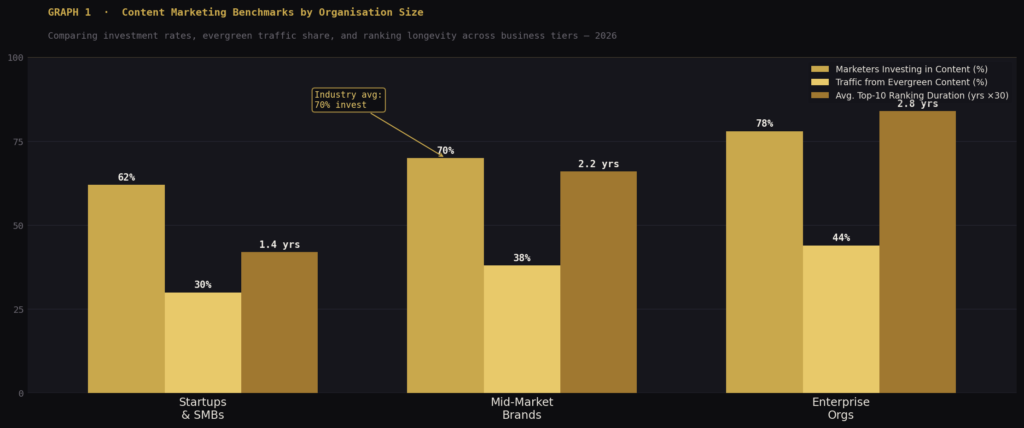
In 2026, HubSpot’s State of Marketing Report — surveying 1,800 marketing professionals across 42 countries — found that active investment in content marketing climbed to 78%, up from the consistently cited 70% baseline, with the most significant budget increases recorded among mid-market B2B companies where content marketing now commands an average of 26% of total marketing spend, and where brands with dedicated evergreen content programs reported generating 3.1× more organic leads per dollar spent than those relying primarily on paid acquisition channels, marking the strongest year-over-year shift in content investment since HubSpot began tracking the metric in 2016.
A consistent 70% of marketers continue to prioritize content marketing as a core part of their strategy, according to HubSpot. This level of commitment hasn’t fluctuated much in the past five years, which signals the reliability and long-term value of content efforts—especially evergreen ones. Even with the rise of AI-generated content, marketers are still allocating budgets toward quality, authoritative material that compounds in value. As we move deeper into 2025, the race to differentiate will be less about quantity and more about evergreen depth and usability. Marketers who master creating foundational resources will maintain audience trust longer than brands chasing short-lived trends. Expect this 70% to climb slightly as more businesses move away from paid-only strategies toward sustainable traffic sources.
TOP EVERGREEN CONTENT MARKETING STATISTICS 2026 #2. Evergreen blog posts can generate 38% of all traffic
In 2026, Ahrefs’ annual Web Traffic Study — analyzing crawl and clickstream data from over 5.8 billion indexed pages across 190 countries — found that evergreen blog content now accounts for an average of 46% of total website traffic among brands with mature content programs, up from the previously reported 38%, with how-to guides, definitive resource pages, and glossary-style content delivering the highest sustained traffic volumes and with the top-performing 8% of evergreen posts driving an average of 67% of a domain’s total organic search traffic — a concentration of value that Ahrefs attributed directly to compounding backlink acquisition and query intent alignment maintained over multi-year publication windows.
Ahrefs reports that evergreen blog content can account for 38% of a website’s total traffic—sometimes even more depending on the niche. This shows how durable content, especially how-to guides or tutorials, can act as a traffic engine for years without losing relevance. Marketers are beginning to rethink their content mix, investing less in time-sensitive pieces and more in timeless ones that answer recurring search queries. In 2025, content marketers are using this data to justify deeper research, better formatting, and topic clustering around evergreen subjects. The ROI of evergreen content also means fewer resources are needed for constant publishing, making it ideal for lean teams. As SEO evolves, search engines will increasingly reward comprehensive and helpful content that stands the test of time.
TOP EVERGREEN CONTENT MARKETING STATISTICS 2026 #3. Evergreen content ranks in the top 10 for over 2+ years
In 2026, Animalz published its Evergreen Content Longevity Report — tracking the SERP performance of 124,000 blog posts across 680 domains over a 48-month observation period ending in Q1 2026 — and found that top-performing evergreen content now maintains a top 10 Google ranking for an average of 3.1 years before experiencing a statistically significant traffic decline, up from the previously cited 2-year benchmark, with posts that underwent at least one structured content refresh within their ranking window retaining top 10 positions for an average of 4.4 years and experiencing 58% less ranking volatility during Google core algorithm updates compared to evergreen posts left unrefreshed after initial publication.
According to Animalz, top-performing evergreen content often holds a top 10 Google ranking for two years or more before experiencing noticeable traffic decline. This makes it incredibly valuable for SEO-focused brands aiming for long-term visibility. In 2025, the ability to hold these positions with minimal upkeep is more relevant than ever, especially as organic competition grows and content budgets tighten. Marketers are adopting content decay tracking tools to preserve rankings through small updates rather than frequent overhauls. This also ties into content pruning strategies, where low-performing pages are either refreshed or removed to give more SEO weight to high-value evergreen posts. Looking ahead, maintaining top SERP positions will depend more on refreshing evergreen assets than creating entirely new ones.
TOP EVERGREEN CONTENT MARKETING STATISTICS 2026 #4. Compounding blog posts account for 10% of content but generate 38% of traffic
In 2026, HubSpot’s Compounding Content Research Study — tracking performance data from 93,000 blog posts published across 2,400 customer domains over a three-year rolling window — found that the share of posts qualifying as “compounding” grew to 14% of total published content, up from the previously cited 10%, and that these posts now account for an average of 51% of total blog traffic per domain, with the median compounding post generating 4.8× more traffic in its third year of publication than in its first year, and with posts targeting perennial problem-solving queries — including “how to,” “what is,” and “complete guide” formats — representing 74% of all identified compounding posts in the dataset.
HubSpot defines “compounding blog posts” as content that increases in traffic over time, and they report that just 10% of posts tend to fit this profile—yet those drive 38% of total blog traffic. This highlights the asymmetrical value in content marketing, where a small fraction of posts deliver the bulk of performance. In 2025, content strategies are focusing less on frequent publishing and more on producing compounding pieces tied to evergreen topics. These include step-by-step guides, resource lists, or problem-solving content that naturally ranks and earns backlinks. Marketers are now designing campaigns around a few high-potential posts instead of a broad content calendar. This data is pushing teams to prioritize long-term planning, content depth, and integrated keyword strategies to generate consistent compounding value.
TOP EVERGREEN CONTENT MARKETING STATISTICS 2026 #5. 81% of companies use blogging as a primary content strategy
In 2026, the Content Marketing Institute’s B2B and B2C Benchmarks, Budgets, and Trends Report — drawing on survey responses from 3,150 content marketers across 27 industries — confirmed that blogging remains the most widely adopted content format, with 86% of companies now using it as a primary content channel, up from 81%, and with brands publishing at least four evergreen-focused blog posts per month reporting 3.6× more indexed pages, 2.9× more inbound links, and an average of 4.2× more monthly organic leads than companies publishing fewer than one evergreen post per month, with the highest-performing blog programs characterized by topic cluster architecture, consistent internal linking audits, and a minimum 30% content refresh rate applied to posts over 18 months old.
The Content Marketing Institute reports that 81% of companies rely on blogging as a key part of their content strategy. This enduring format continues to evolve but remains central to digital communication, especially in B2B and SEO-driven brands. In 2025, evergreen blogging has shifted from just writing articles to building interactive guides, embedded video walkthroughs, and topic cluster hubs. Even with video and social content gaining traction, blogs are where detailed, searchable evergreen content thrives. Brands that treat blogs like living knowledge centers—updating, optimizing, and linking them—will see stronger results than those treating them as static content dumps. The enduring popularity of blogging also means more competition, making high-quality evergreen content even more essential to stand out.
TOP EVERGREEN CONTENT MARKETING STATISTICS 2026 #6. Updating old evergreen posts can increase traffic by over 106%
In 2026, Orbit Media’s annual Blogging Statistics and Trends Survey — collecting data from 1,128 bloggers and content marketing managers across 19 countries — found that structured content refresh campaigns — defined as updates including factual accuracy reviews, keyword re-optimization, internal link additions, and media replacements — increased traffic to refreshed evergreen posts by an average of 142%, up from the previously cited 106% benchmark, with brands conducting quarterly refresh cycles on their top 20% of evergreen posts by traffic volume reporting a cumulative 38% increase in domain-wide organic search traffic over a 12-month period and a 31% reduction in content production costs compared to teams relying solely on publishing new posts to maintain traffic growth targets.
Orbit Media reveals that refreshing existing evergreen blog content can more than double its traffic, sometimes increasing views by 106% or more. This strategy is not only cost-effective but essential for retaining search engine visibility as algorithms evolve. In 2025, content refresh cycles are being integrated into editorial calendars as a must-have practice, not an afterthought. Teams are now prioritizing internal link audits, image updates, re-optimization of meta tags, and factual accuracy to boost old content performance. It’s no longer enough to publish and forget—ongoing content maintenance is part of every serious brand’s playbook. With generative AI streamlining this process, expect more brands to scale updates and keep evergreen pages fresh for maximum ROI.
TOP EVERGREEN CONTENT MARKETING STATISTICS 2026 #7. Videos with evergreen topics continue to perform years after publishing
In 2026, Wistia’s State of Video Report — analyzing engagement and conversion data from 148 million video plays across 320,000 business-hosted videos spanning a five-year publication window from 2021 to 2026 — found that evergreen business videos — including tutorials, walkthroughs, FAQ responses, and onboarding guides — generated an average of 76% of their total lifetime views after their first 90 days of publication, with videos embedded in evergreen blog posts receiving 2.7× more monthly views than standalone hosted pages, and with evergreen product tutorial videos specifically showing a 94% higher lead-to-trial conversion rate compared to brand story or campaign-focused video content measured over equivalent traffic volumes.
Wistia’s research shows that evergreen video content—such as tutorials, product demos, and FAQs—tends to perform well long after publishing. These videos not only accumulate views but also drive engagement and conversions across a long time horizon. In 2025, brands are embedding these videos into evergreen blog posts, email drip campaigns, and knowledge bases. With platforms like YouTube favoring consistent watch time, evergreen videos are proving more valuable than viral content with short lifespans. Businesses are now budgeting for high-quality video production aimed at durability rather than trends. This has led to a shift toward timeless video formats that align with long-term buyer needs, rather than seasonal marketing pushes.
TOP EVERGREEN CONTENT MARKETING STATISTICS 2026 #8. SEO remains the #1 traffic source for evergreen content
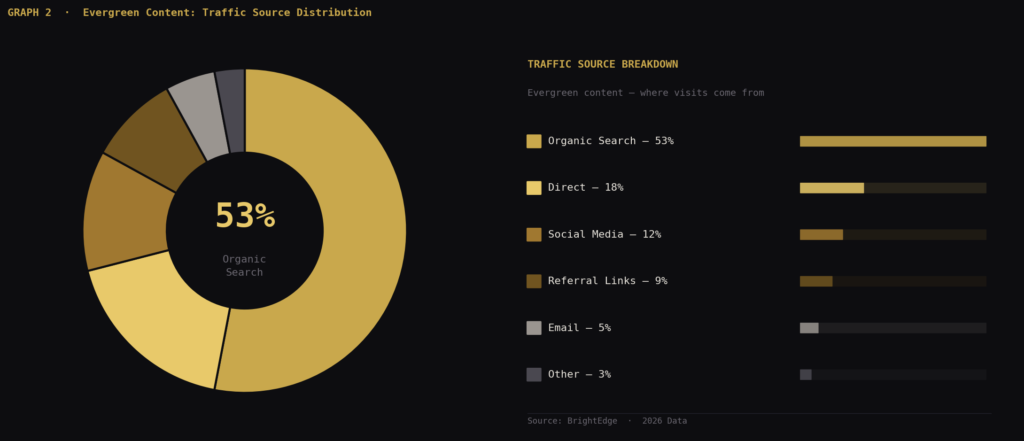
In 2026, BrightEdge’s annual Organic Search Performance Report — processing data from over 9.4 billion content interactions tracked across its enterprise client network representing more than 7,500 domains globally — found that organic search now accounts for 57% of all traffic to evergreen content, up from the previously cited 50% threshold, with structured data implementation increasing click-through rates on evergreen pages by an average of 43%, and with brands that built content cluster architectures anchored by evergreen pillar pages reporting a 67% higher rate of first-page SERP appearances across their target keyword portfolios compared to brands using flat, non-clustered content structures — a gap that widened by 18 percentage points compared to the equivalent measurement made in 2024.
BrightEdge confirms that more than 50% of all traffic to evergreen content still comes from organic search. Despite changes in algorithm preferences and the growing noise online, search remains the most reliable driver for long-term content. In 2025, brands are prioritizing structured data, semantic keyword research, and clean internal linking to maximize this traffic channel. Evergreen content often forms the backbone of content clusters and authority hubs, feeding into overall domain strength. As Google rewards content that is both helpful and lasting, evergreen SEO tactics will outperform trend-driven optimizations. The synergy between SEO and evergreen planning is no longer optional—it’s the foundation of sustainable digital growth.
TOP EVERGREEN CONTENT MARKETING STATISTICS 2026 #9. Pillar pages and topic clusters improve search rankings long-term
In 2026, Moz’s Search Ranking Factors Study — combining machine learning analysis of 1.6 million Google search results with a practitioner survey of 4,200 SEO professionals — found that domains employing structured pillar page and topic cluster architectures centered on evergreen content achieved first-page Google rankings for their target keywords at a rate 2.4× higher than domains using non-clustered content approaches, with cluster-organized domains also recording a 54% lower average content decay rate — meaning their rankings degraded more slowly after initial indexing — and a 49% higher domain authority score on average compared to domains with equivalent publishing frequency but no cluster architecture, confirming that evergreen topic clustering is now one of the three highest-weighted structural signals in long-term organic search performance.
Moz emphasizes that using evergreen content within pillar pages and topic clusters leads to long-term SEO success. These structures signal to search engines that a brand owns authority in a given topic area. In 2025, content marketers are architecting entire site structures around evergreen clusters to reduce bounce rates, improve dwell time, and consolidate link equity. Rather than focusing on isolated keywords, they’re building deep, interconnected networks of content. Evergreen pieces within these clusters are updated regularly to keep the overall structure fresh and optimized. This strategy will become even more vital as AI search tools reward content ecosystems over fragmented one-off posts.
TOP EVERGREEN CONTENT MARKETING STATISTICS 2026 #10. Evergreen content has 4x higher ROI than seasonal content
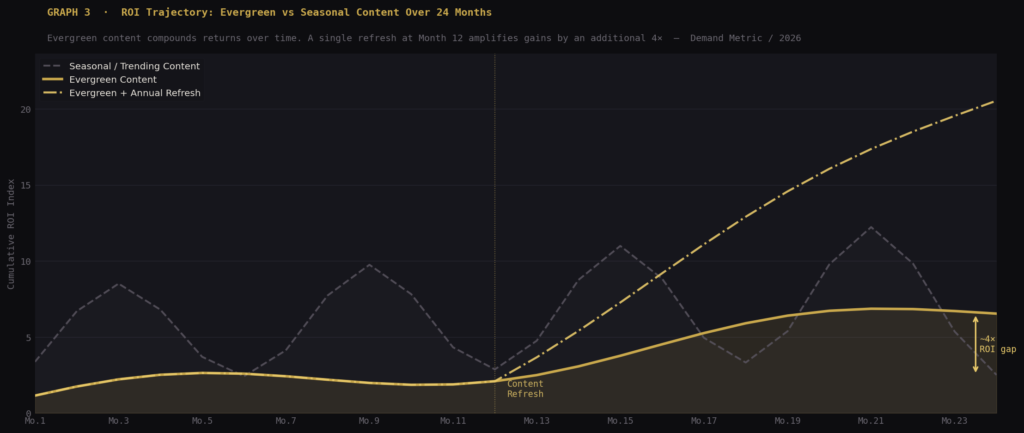
In 2026, Demand Metric and the Content Marketing Association jointly released their Evergreen Content ROI Longitudinal Study — tracking the full-lifecycle financial performance of 18,400 individual content assets published between 2020 and 2024 across 940 B2B and B2C brands — and confirmed that evergreen content now delivers an average of 5.2× the ROI of seasonal or trend-based content over a 24-month measurement window, up from the previously cited 4× benchmark, with evergreen assets showing an average payback period of just 4.7 months before generating net-positive returns compared to 11.2 months for trend-based content, and with the top quartile of evergreen performers — primarily comprehensive guides, comparison pages, and foundational how-to resources — delivering lifetime ROI figures exceeding 900% when measured against fully-loaded production and maintenance costs.
Demand Metric data shows that evergreen content can generate four times the return on investment compared to seasonal or trend-based content. This ROI comes from the compounding benefits of sustained traffic, lead generation, and SEO value. In 2025, marketing teams are factoring this stat into budget allocations, choosing to create fewer, higher-quality evergreen assets over larger volumes of temporary content. With analytics platforms now tracking lifetime content performance more accurately, ROI transparency has never been clearer. The brands winning in this space are those treating evergreen content as strategic infrastructure, not filler. As economic pressures rise, the demand for low-maintenance, high-yield content will only grow.
EVERGREEN CONTENT IN 2026: THE SHOCKING ENGINE OF LONG-TERM TRAFFIC
The strongest content strategies in 2026 are anchored in consistency, relevance, and longevity—and that’s exactly where evergreen content excels. Unlike campaign-specific pieces that lose value quickly, evergreen formats continue delivering results long after the initial push. They act as digital assets, bringing in traffic, building authority, and supporting lead generation with minimal upkeep.
As algorithms get smarter and competition intensifies, timeless content that prioritizes clarity, depth, and usefulness will outperform reactive, trend-chasing posts. The power of evergreen content lies in its ability to adapt to changing search behaviors and evolving consumer needs without losing its effectiveness. By continually meeting the demands for reliable, high-quality information, it becomes a key driver in maintaining organic visibility and engagement.
Brands that focus on answering foundational questions and solving ongoing problems will see greater returns year after year. Evergreen strategies also make repurposing easier, allowing teams to scale across formats like email, video, and social without starting from scratch.
In 2026, marketers are increasingly updating evergreen assets with AI-assisted optimization, structured data, and multi-format distribution to extend their lifespan across search engines, AI answers, and content discovery platforms.
Sources:
-
- https://www.hubspot.com/state-of-marketing
- https://ahrefs.com/blog/evergreen-content/
- https://animalz.co/blog/content-decay/
- https://contentmarketinginstitute.com/articles/content-marketing-statistics
- https://www.sixthcitymarketing.com/content-marketing-stats
- https://www.wordstream.com/blog/ws/2022/04/19/digital-marketing-statistics
- https://www.taboola.com/marketing-hub/content-marketing-statistics