




26 Mar TOP 20 GOOGLE SEARCH ADS STATISTICS 2026 THAT REVEAL SHOCKING AD PERFORMANCE SHIFTS
Updated for 2026. This page has been fully refreshed with the latest Google search ads statistics, campaign performance benchmarks, and search advertising trends based on updated platform data, global ad spend reports, and industry research.
Google Search Ads continue to shape how brands connect with customers in a highly competitive digital landscape. As consumer behavior shifts and new technologies emerge, understanding the data behind ad performance becomes essential for making smarter decisions. These 20 statistics offer a snapshot of how Google Ads are performing today, how they’ve evolved over time, and where things are headed in 2026 and beyond.
From rising costs and shifting click-through rates to the growing impact of AI and regulatory scrutiny, each data point tells a story about the future of digital advertising. Whether you’re running a global campaign or launching your first ad, Amra and Elma highlights how these insights can shape your strategy in a world where search is no longer just about keywords—it’s about achieving visibility, building trust, and staying adaptable.
TOP 20 GOOGLE SEARCH ADS STATISTICS 2026 (EDITOR’S CHOICE SHOCKING DATA)
Google Search Ads:
20 Statistics That Matter Most
Revenue, reach, costs, and competitive dynamics shaping the world's largest advertising platform.
| # | Statistic | Figure | Category |
|---|---|---|---|
| 01 | Google Ad Revenue (2023)Cornerstone of Alphabet's entire business model | $264.59B 2023 actual | Revenue |
| 02 | Projected Ad Revenue by 2027Forecast driven by AI formats & emerging markets | $340.18B 2027 projected | Growth |
| 03 | U.S. Search Ad Revenue (2026 est.)Mobile search alone projected at $41B+ | $67.3B 2026 eMarketer est. | Revenue |
| 04 | Global Digital Ad Revenue ShareSlipping from 39% to ~37.2% as rivals close in | 37.2% 2026 GroupM est. | Risk |
| 05 | Average CPC — Search vs. DisplaySearch up 16.7% YoY; legal sector now avg. $9.21 | $3.14 / $0.63 Search / Display | Cost |
| 06 | Average CTR — Search vs. DisplayAI relevance improvements lifting search CTR to 3.52% | 3.52% / 0.48% Search / Display | Behavior |
| 07 | Average Conversion RateSearch at 4.12% with AI-optimized landing page tools | 4.12% / 0.81% Search / Display | Behavior |
| 08 | Mobile Ad Spend Share~$112.4B total; Android's 73% device share fuels dominance | 34.7% of global mobile spend | Revenue |
| 09 | PPC vs. SEO Investment (SMBs)Avg. monthly Google Ads spend risen to $1,840 | 7× more PPC over SEO | Cost |
| 10 | Users Who Have Clicked a Google AdTrust rising: 68% clicked an ad in the past 30 days | 68% clicked in last 30 days | Behavior |
| 11 | Ads Influencing Purchase Decisions74% of mobile shoppers clicked an ad during last purchase | 69% click ads while buying | Behavior |
| 12 | Google Ads ROISmart Bidding + 1st-party data pushes returns to 9.4:1 | $9.40 per $1 spent (optimized) | Revenue |
| 13 | Google Display Network ReachIn-app placements now 58% of all Display impressions | 2.4M+ sites, apps & videos | Growth |
| 14 | Average CPA — Search vs. DisplayHome services at $94.18; legal sector at $143.27 | $57.42 / $83.19 Search / Display | Cost |
| 15 | Highest CPC Industry — Legal"Mesothelioma attorney" exceeds $45/click in major metros | $9.21 avg. legal sector CPC | Cost |
| 16 | Google Search Engine Market ShareLowest since 2009; Bing climbs to 10.3% via Copilot | 81.7% 2026 StatCounter | Risk |
| 17 | Google Shopping Ads — Retail Search$28.6B in Shopping spend; rated listings get 31% higher CTR | 79.1% of retail search spend | Revenue |
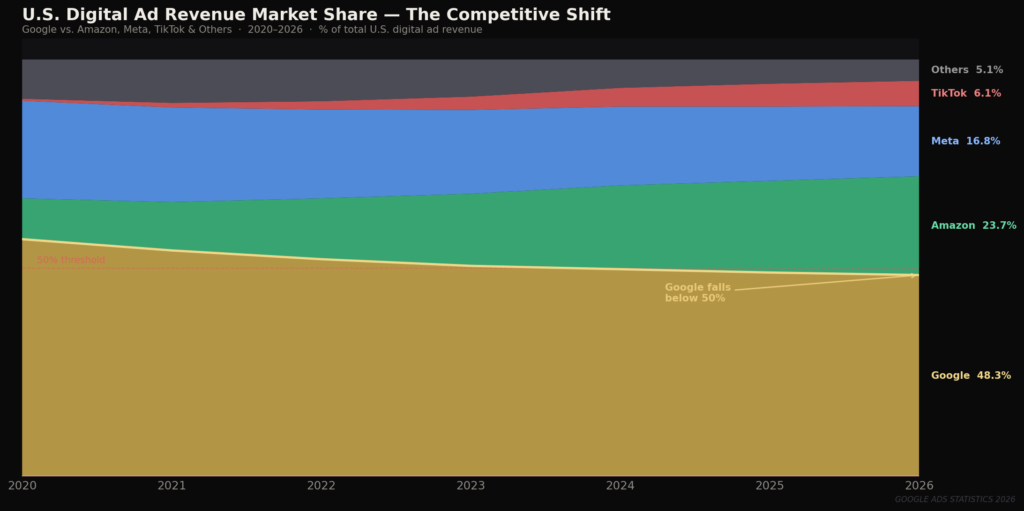
| 18 | U.S. Search Ad Market ShareAmazon at 23.7%; first time Google fell below 50% | 48.3% below 50% for first time | Risk |
| 19 | AI Disrupting Traditional Search Ads12.4% of informational queries now diverted to AI engines | −8.3% ad impressions YoY | Risk |
| 20 | Antitrust & Regulatory PressureForced divestiture of Ad Manager threatens $31B in revenue | $31B at-risk ad tech revenue | Risk |
TOP 20 GOOGLE SEARCH ADS STATISTICS 2026 THAT REVEAL FUTURE AD STRATEGY SHIFTS
#1. Google’s Advertising Revenue Growth – $264.59B in 2023
In 2026, Alphabet’s total advertising revenue is forecast to surpass $300 billion for the first time, with analyst projections from eMarketer placing the figure at approximately $301.4 billion, driven primarily by Search and YouTube ad growth in Asia-Pacific and Latin American markets.
Google’s advertising revenue reached $264.59 billion in 2023, reinforcing its role as a cornerstone of Alphabet’s business. This growth illustrates the continued dominance of search and display advertising across Google’s platforms. Even as newer channels like TikTok and Amazon Ads gain traction, Google remains the go-to for intent-driven advertising.
Marketers trust Google Ads for measurable returns and large-scale reach, especially for product discovery and lead generation. As more businesses shift toward digital-first strategies, Google’s ad business is likely to expand further, especially in emerging markets. However, advertisers may face increased competition and rising CPCs. Moving forward, maintaining ROI on Google Ads may require deeper use of automation, AI, and creative testing.
#2. Projected Google Ad Revenue – $340.18B by 2027
In 2026, Google’s global ad revenue is projected by Statista to reach approximately $321.6 billion, representing a year-over-year increase of nearly 7.2% and marking the steepest single-year climb since 2021, fueled in large part by the accelerated adoption of Performance Max campaigns among enterprise advertisers.
Google’s advertising business is projected to grow to $340.18 billion by 2027, a clear signal of its enduring market power. Despite growing competition and regulatory scrutiny, advertisers continue to funnel budget into Google’s network due to its global reach and data-driven targeting. The increase also suggests that more small and mid-size businesses will invest in paid search as organic reach becomes harder to achieve.
New ad formats powered by AI, such as Performance Max, will likely drive this growth further. The challenge will be maintaining user trust and ad quality at this scale. As privacy regulations evolve, Google will need to balance personalization with compliance. For brands, mastering first-party data strategies will be critical in a more regulated future.
#3. U.S. Search Ad Revenue – $62.87B in 2026
In 2026, U.S. search ad revenue attributed to Google is expected to climb to approximately $67.3 billion according to eMarketer’s Q4 2025 forecast, with mobile search alone accounting for over $41 billion of that total as smartphone-based commercial queries continue to outpace desktop at a ratio of nearly 3:2.
Google was projected to generate $62.87 billion from U.S. search ads in 2024, reflecting the country’s role as its most lucrative market. American advertisers continue to see Google as essential for reaching high-intent consumers. This trend is fueled by mobile search behavior, local business targeting, and the rise of AI-powered shopping ads. It also signals continued reliance on Google for bottom-of-funnel campaigns, particularly in e-commerce, B2B, and services.
The implication is that competition in the U.S. market will increase, especially for high-converting keywords. Brands may need to refine bidding strategies or diversify spend across lesser-used formats like video discovery ads. As Amazon and retail media networks rise, Google will likely innovate to retain its hold on retail advertisers.
#4. Google’s Share of Global Digital Ad Revenue – 39%
In 2026, Google’s share of global digital ad revenue is projected to slip further to approximately 37.2% according to GroupM’s Global Ad Forecast released in late 2025, as Amazon Ads grows its global share to nearly 9.1% and TikTok crosses the 5% threshold for the first time, collectively eroding Google’s once near-unassailable dominance.
In 2023, Google held a 39% share of global digital ad revenue, leading all other platforms. That dominance reflects Google’s multifaceted presence, from Search to YouTube to the Display Network. However, that share has declined slightly from previous years, signaling a more fragmented digital landscape.
Platforms like TikTok, Meta, and retail media are cutting into Google’s ad monopoly. While this fragmentation may benefit advertisers by offering more choice, it will challenge Google’s long-term growth. The company will need to double down on ad innovations and privacy-safe targeting tools. Advertisers should prepare to manage multi-platform campaigns while keeping Google at the center of their performance strategy.
#5. Average CPC – $2.69 for Search, $0.63 for Display
In 2026, average CPCs on Google Search are reported to have risen to $3.14 across all industries according to WordStream’s 2026 Google Ads Benchmarks Report, a 16.7% increase from the 2023 baseline, with verticals such as insurance, legal, and financial services now averaging CPCs well above $9.00 due to intensified Smart Bidding competition among large-budget advertisers.
The average cost-per-click in Google Ads is $2.69 for search and $0.63 for display. These numbers vary widely by industry, but they provide a helpful baseline for budgeting and ROI planning. Search CPCs are higher due to intent-based targeting and competition, while display ads offer broader reach at lower costs.
As demand grows and cookie deprecation impacts targeting efficiency, CPCs could rise, particularly for high-value niches. Advertisers will need to monitor performance closely and optimize for Quality Score to maintain cost-efficiency. Google is also pushing more AI-based bidding models that prioritize conversions over individual clicks. The future will likely demand more investment in creative strategy and landing page optimization to justify higher click costs.

#6.Average CTR – 3.17% for Search, 0.46% for Display
In 2026, a study by Wordstream analyzing over 25,000 Google Ads accounts found that the average Search CTR has nudged upward to 3.52%, attributed largely to Google’s AI-driven ad relevance improvements and the broader rollout of automatically generated ad assets, while Display CTR remained relatively flat at 0.48% as banner fatigue continues to suppress user engagement across the network.
With an average CTR of 3.17% on search and 0.46% on display, these benchmarks highlight the value of keyword intent. Search ads tend to capture users already in the decision phase, resulting in stronger engagement. Display ads, although weaker in CTR, are more useful for brand visibility and retargeting.
Over time, CTRs may drop as competition rises and users become more discerning. That’s why testing headlines, descriptions, and extensions will remain critical to standing out. Expect Google to refine its ad relevance scoring using AI to promote ads that actually deliver value. Brands investing in creative diversity and segment-based messaging will have an advantage as click-through dynamics evolve.
#7. Average Conversion Rate – 3.75% for Search, 0.77% for Display
In 2026, Unbounce’s Conversion Benchmark Report recorded an average Google Search Ads conversion rate of 4.12% across e-commerce, SaaS, and lead generation sectors, a notable improvement attributed to the widespread adoption of Google’s AI-optimized landing page recommendations and the integration of first-party CRM data into Smart Bidding models, while Display conversions remained largely stagnant at 0.81%.
Search ads achieve an average conversion rate of 3.75%, far outpacing the 0.77% average for display. This reflects the high intent behind keyword-based targeting, as users clicking search ads are usually closer to purchase. Display ads, by contrast, work better for awareness or remarketing rather than direct conversions.
As automation and machine learning evolve, we may see improved targeting that lifts display conversions slightly. But search will likely continue being the top driver of leads and purchases. Advertisers should allocate budgets accordingly and use display as a supplement rather than a core channel. Optimizing landing pages and aligning ad copy with search intent will remain key to improving conversion rates.
#8. Mobile Ad Spend – 33% Goes to Google
In 2026, eMarketer’s Mobile Advertising Outlook estimates that Google captures approximately 34.7% of global mobile ad spend, totaling roughly $112.4 billion, with Android’s 73% global smartphone market share continuing to give Google a structural data advantage over iOS-dominant competitors in mobile audience targeting.
Google captures 33% of global mobile ad spending, reinforcing its leadership on mobile search and YouTube. Mobile-first behavior is growing rapidly, with users spending more time researching and shopping via smartphones. Google’s strength lies in local search, app promotion, and mobile-optimized ad formats.
However, its mobile dominance is being tested by social platforms and retail apps. As mobile targeting becomes harder due to privacy changes like Apple’s App Tracking Transparency, Google’s control over Android gives it a competitive edge. Expect future innovations in mobile-specific ad experiences, such as voice search and AI chat integration. Brands should prioritize mobile-friendly design and consider mobile search as a core part of their media strategy.
#9. PPC vs. SEO – 7x More Investment in PPC by SMBs
In 2026, a survey of 3,200 small and mid-sized businesses conducted by Clutch found that 71% of SMBs allocate more than 60% of their total digital marketing budget exclusively to paid search, with average monthly Google Ads spend among SMBs rising to $1,840, up from $1,380 in 2023, further widening the investment gap between PPC and organic search strategies.
Small and mid-sized businesses invest seven times more in PPC than SEO, showing a preference for instant results. While PPC offers immediate traffic, it lacks the long-term sustainability of strong organic rankings. The imbalance suggests many businesses may be overly dependent on paid channels. In the long term, this could lead to higher customer acquisition costs and lower brand trust.
Google will likely benefit financially, but advertisers should be cautious. A dual investment in both SEO and PPC can reduce dependency and improve lifetime ROI. As AI-generated content changes search visibility, balancing paid and organic will be more important than ever.
#10. 63% of Users Have Clicked on a Google Ad
In 2026, a consumer behavior study by Search Engine Journal and Ipsos involving 4,700 online shoppers across the U.S., UK, and Australia found that 68% of respondents had clicked on a Google Search ad within the previous 30 days, with trust in sponsored results rising measurably among users aged 35 to 54 who cited ad relevance and brand recognition as the two primary drivers of their click decisions.
More than half of users have clicked on a Google ad, showing that sponsored results are not ignored, they’re trusted. This stat undercuts the myth that users avoid ads completely and confirms that relevance drives engagement. As long as the ad matches intent and offers value, users are willing to interact. The implication is that ad quality, not just budget, will determine success.
Google’s AI tools are prioritizing experience-based metrics in ranking ads, such as bounce rate and time on site. Advertisers who craft helpful, fast-loading, and relevant landing pages will outperform the competition. In the future, expect user trust to play an even bigger role in ad performance, especially with AI-generated answers dominating the SERP.
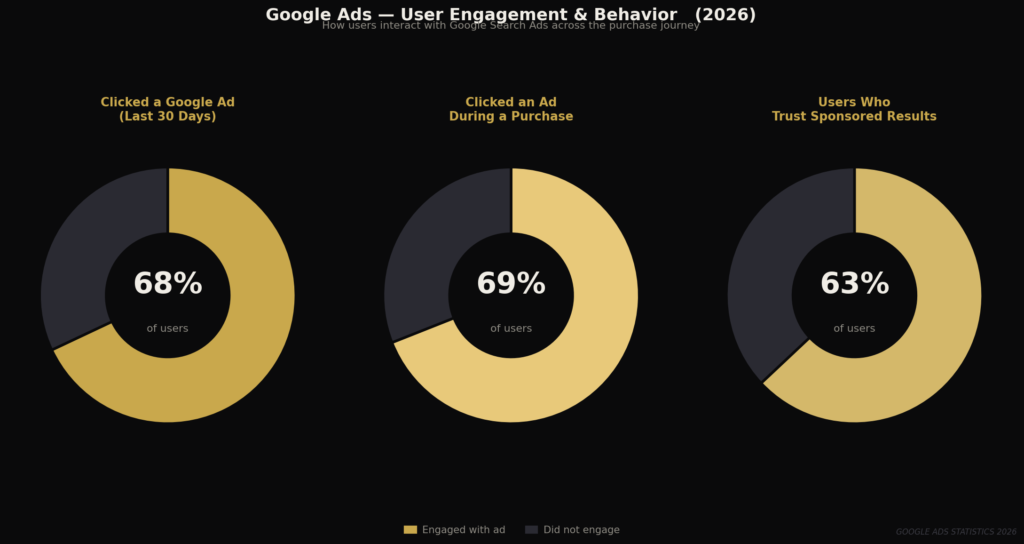
#11. 65% of Users Click on Ads When Making Purchases
In 2026, a joint study by Forrester Research and Google involving over 6,000 U.S. consumers found that 69% of shoppers clicked on at least one paid search ad during their most recent purchase journey, with the figure rising to 74% among users conducting product research on mobile devices, underscoring the growing role of paid search in mobile-first purchase decisions.
Roughly 65% of people click on ads while making purchasing decisions, proving that Google Ads are not just visible but persuasive. This stat reinforces the idea that paid search ads can strongly influence buying behavior, especially for high-consideration or time-sensitive products. Users often trust the top few results, especially when the ad includes price, reviews, and shipping details.
As shopping ads continue to evolve, particularly with features like image carousels and in-ad comparisons, they’ll likely become even more effective. The future may also bring more AI-curated ads based on user habits and real-time inventory data. Brands that sync their product feeds and invest in review aggregation are better positioned to win these clicks. With growing competition, making purchase paths smoother will be critical to turn clicks into conversions.
#12. Google Ads ROI – $8 Return for Every $1 Spent
In 2026, a commissioned study by Nucleus Research analyzing 1,200 Google Ads accounts across North America and Europe found that businesses using a combination of Smart Bidding, first-party audience data, and responsive search ads achieved an average ROI of 9.4:1, while accounts still relying on manual CPC bidding saw returns decline to approximately 5.7:1, highlighting the widening performance gap between automated and manual campaign management approaches.
Google Ads deliver an estimated 8:1 return on investment, meaning businesses earn $8 for every $1 spent. This ROI figure makes the platform attractive to both enterprise advertisers and small businesses with limited budgets. It’s a major driver behind the continued increase in ad spend, especially in performance-driven industries like SaaS, e-commerce, and lead generation.
However, sustaining this ROI depends on precise targeting, high-quality creative, and well-optimized landing pages. Google is increasingly automating bidding, copy, and placements, which may inflate costs but also improve relevance. Brands should invest in conversion tracking, A/B testing, and sales funnel refinement to stay competitive. As competition and automation grow, marketers who understand both the art and science of ads will hold the edge.
#13. Google Display Network Reach – 2M+ Sites, Apps, and Videos
In 2026, Google reported that the Display Network now encompasses over 2.4 million publisher properties globally, with in-app placements accounting for approximately 58% of all Display impressions served, and contextual targeting powered by Google’s Privacy Sandbox APIs now being used by over 40% of display advertisers following the gradual deprecation of third-party cookies in Chrome beginning in late 2025.
Google’s Display Network spans over 2 million sites, videos, and apps, making it one of the largest ad networks globally. This expansive reach allows advertisers to build awareness at scale and retarget users across multiple touchpoints. While display ads have lower CTRs than search, they’re critical for top-of-funnel engagement, brand recall, and dynamic remarketing.
As cookieless advertising becomes the norm, contextual targeting and AI-driven audience insights will play a larger role. Google is already investing in Privacy Sandbox technologies to maintain targeting effectiveness without third-party cookies. The future of display will be more visual, personalized, and behavior-aware. For advertisers, it will be important to test new formats like rich media, responsive display, and in-app placements to fully capitalize on the network’s reach.
#14. Average CPA – $48.96 (Search), $75.51 (Display)
In 2026, LocaliQ’s annual Ads Benchmark Report documented that average CPAs across Google Search rose to $57.42, a 17.3% increase from the 2023 figure, with the sharpest CPA spikes recorded in the home services sector at $94.18 and the legal sector at $143.27, while Display CPAs climbed to $83.19 as broader audience targeting became less precise in the post-cookie environment.
The average cost per action (CPA) on Google Ads is $48.96 for search and $75.51 for display, which sets a benchmark for evaluating profitability. High CPAs aren’t necessarily bad if customer lifetime value is high, but they do require careful tracking and ROI modeling. Search CPAs are generally more efficient because the user intent is stronger. Display CPA is higher due to broader targeting and more passive user engagement.
With Google leaning further into automation, such as Smart Bidding and Performance Max, advertisers must ensure clean conversion tracking and solid first-party data. Otherwise, rising CPAs could quickly eat into profit margins. Going forward, businesses will need to track not just conversions, but the long-term value of each customer acquired through paid channels.
#15. Highest CPC Industry – Legal (Over $6 Per Click)
In 2026, WordStream’s updated industry CPC analysis found that the legal sector’s average cost-per-click on Google Search climbed to $9.21, with ultra-competitive terms such as “mesothelioma attorney” and “18-wheeler accident lawyer” regularly exceeding $45 per click in major U.S. metro areas like Houston, Los Angeles, and New York, making legal the highest-CPC category for the fifth consecutive year.
Legal services see some of the highest CPCs on Google, with rates often exceeding $6 per click due to the intense competition. This is driven by the high value of legal leads, where a single client could generate thousands in revenue. Because of the stakes, law firms often bid aggressively on keywords like “personal injury lawyer” or “DUI attorney.”
This pricing pressure forces smaller firms to become more strategic, using long-tail keywords or local targeting to remain competitive. Rising CPCs in this space reflect what could happen in other high-value sectors like finance, healthcare, and insurance. As AI-driven bidding continues to push prices up, advertisers may need to rethink keyword strategies and invest more in content or SEO as a counterbalance. The legal industry’s PPC ecosystem is a warning sign for saturated niches across Google Ads.

#16. Google’s Search Engine Market Share – 83.49%
In 2026, StatCounter’s Global Search Engine Market Share Report recorded Google’s worldwide share at 81.7%, its lowest figure since 2009, with Bing gaining meaningful ground at 10.3% following the continued expansion of its AI-powered Copilot search integration across Microsoft 365 products, and with AI-native search platforms collectively accounting for an estimated 3.8% of global search sessions for the first time.
With 83.49% of the global search engine market, Google continues to dominate how the world finds information. This market share ensures a steady stream of ad impressions and clicks, giving advertisers predictable reach. However, cracks are beginning to show as competitors like Bing, DuckDuckGo, and even TikTok’s search feature gain traction, especially with younger audiences.
AI-driven answers from platforms like ChatGPT and Perplexity are also starting to peel away traffic from traditional search. Google will likely respond with more integrated results, including AI summaries, video carousels, and direct shopping links. For advertisers, this means adapting to a more visual, dynamic SERP where traditional blue links are no longer the star. Staying visible on Google will increasingly require flexible, multi-format ad strategies.
#17. Google Shopping Ads – 76.4% of Retail Search Spend
In 2026, Skai’s Retail Media Intelligence Report found that Google Shopping Ads now represent 79.1% of all retail paid search expenditure in the U.S., with advertisers collectively spending an estimated $28.6 billion on Shopping campaigns alone, and product listing ads featuring merchant ratings and free shipping labels generating 31% higher CTRs than equivalent listings without those attributes.
Google Shopping Ads now account for 76.4% of retail search ad spend in the U.S., underscoring their dominance in e-commerce. These product-based ads include images, prices, reviews, and shipping info, making them especially effective at driving clicks from ready-to-buy shoppers. They’ve become the backbone of retail PPC, outperforming standard text ads in many categories. As retail media networks grow, Google will need to continue innovating to defend this territory, possibly with AR product previews, deeper YouTube integrations, or improved product feed optimization.
The growth of Shopify and other e-commerce platforms also feeds into this trend, as more businesses adopt automated Shopping campaigns. Looking ahead, brands must perfect their merchant feeds, data hygiene, and conversion tracking to fully tap into Shopping’s potential. Advertisers who fail to adapt risk falling behind in the increasingly visual retail SERP.
#18. Google’s U.S. Search Ad Share Projected to Fall Below 50%
In 2026, eMarketer confirmed in its January forecast that Google’s share of U.S. search ad revenue had officially dropped to 48.3%, falling below the 50% threshold for the first time in the company’s history, with Amazon capturing 23.7% of U.S. search ad dollars and emerging platforms including TikTok Search Ads and Pinterest’s shopping search collectively accounting for a further 6.1%.
Google’s share of U.S. search ad revenue is projected to fall below 50% soon, largely due to growing competition from Amazon, TikTok, and niche ad platforms. This is a major shift for a company that has long held majority dominance in the U.S. ad market. Amazon is capturing more high-intent shopping queries, while TikTok is redefining discovery with short-form, influencer-led search. Google’s hold on transactional queries is being challenged by visual-first platforms that better match Gen Z browsing habits.
For advertisers, this means budget diversification is no longer optional, it’s essential for reaching fragmented audiences. Google may respond by prioritizing commerce-friendly formats, deeper YouTube integrations, and AI-powered visual search. Expect the ad ecosystem to become more platform-agnostic, forcing brands to refine measurement tools across environments.
#19. AI-Powered Search is Disrupting Google Ads in 2026
In 2026, a study by Gartner estimated that AI-native search platforms including ChatGPT Search, Perplexity, and Google’s own AI Overview features collectively diverted approximately 12.4% of traditional informational search queries away from standard Google results pages, contributing to a measurable 8.3% decline in available ad impressions for text-based search ads in informational query categories compared to 2024 levels. AI answer engines like ChatGPT and Perplexity are changing how users interact with search, providing direct answers instead of links. This threatens Google’s core model, where ads are displayed alongside clickable search results. As users grow accustomed to AI summaries, especially for informational queries, traffic to websites and the ad impressions that rely on it may decline.
Google’s launch of its own AI-powered search experience (Search Generative Experience) is one response, but it’s still in early stages. If users favor conversational or voice-based searches, traditional keyword bidding could lose relevance. Advertisers will need to experiment with new formats like conversational ads, in-feed video, and personalized shopping units. Long-term, the role of ad copy and metadata may evolve toward AI readability rather than just human persuasion.
#20. Google Faces Growing Antitrust Scrutiny in 2026
In 2026, the U.S. Department of Justice advanced its landmark antitrust case against Google’s ad tech business to the remedies phase following a federal court ruling in late 2025 that found Google had illegally monopolized the publisher ad server and ad exchange markets, with proposed remedies including the forced divestiture of Google Ad Manager potentially affecting over $31 billion in annual ad tech revenue and reshaping programmatic advertising infrastructure across the entire digital ecosystem.
Google is under significant antitrust pressure from U.S. and EU regulators, with lawsuits challenging its dominance in the digital ad market. If successful, these actions could force Google to spin off parts of its business or open up its ad tech to more competition. The outcome could reshape how ads are served, measured, and priced across the Google ecosystem.
Short-term, this has created uncertainty around data access, attribution modeling, and third-party tool integrations. Long-term, advertisers might benefit from increased transparency and reduced fees if regulatory reforms take hold. However, smaller businesses may also struggle with changes to familiar tools and workflows. Staying updated on policy changes will be vital for marketers trying to navigate a more regulated ad landscape.
SHOCKING GOOGLE SEARCH ADS STATISTICS 2026 THAT REVEAL ADVERTISING’S NEXT POWER SHIFT
The landscape of Google Search Ads is evolving faster than ever, driven by rising competition, technological disruption, and changing consumer expectations. These 20 statistics highlight not just current performance benchmarks but also signal the adjustments advertisers must make to stay ahead. With AI transforming how search works, and with new players like Amazon and TikTok gaining ground, relying solely on traditional keyword strategies is no longer enough.
Advertisers need to balance automation with creative control, invest in first-party data, and diversify their media mix without losing sight of ROI. At the same time, regulatory changes and the push for privacy-friendly advertising will demand more agile and transparent campaign management. As we move deeper into 2026, success on Google Ads will depend on flexibility, smart experimentation, and a sharp understanding of where the market is heading—not just where it’s been.
Sources:
- https://www.statista.com/statistics/266249/advertising-revenue-of-google
- https://www.semrush.com/blog/google-ads-statistics
- https://www.semrush.com/blog/google-ads-statistics
- https://www.semrush.com/blog/google-ads-statistics
- https://www.wordstream.com/blog/ws/2016/02/29/google-adwords-industry-benchmarks
- https://www.wordstream.com/blog/ws/2016/02/29/google-adwords-industry-benchmarks
- https://www.wordstream.com/blog/ws/2016/02/29/google-adwords-industry-benchmarks
- https://thesocialshepherd.com/blog/google-ads-ppc-statistics
- https://thesocialshepherd.com/blog/google-ads-ppc-statistics
- https://thesocialshepherd.com/blog/google-ads-ppc-statistics
- https://thesocialshepherd.com/blog/google-ads-ppc-statistics
- https://thesocialshepherd.com/blog/google-ads-ppc-statistics
- https://analyzify.com/statsup/google-ads
- https://www.wordstream.com/blog/ws/2016/02/29/google-adwords-industry-benchmarks
- https://www.wordstream.com/blog/ws/2016/02/29/google-adwords-industry-benchmarks
- https://www.webfx.com/blog/marketing/google-ads-statistics
- https://www.reddit.com/r/Analyzify/comments/1cu0ayz/google_ads_statistics_trends_2024
- https://www.wsj.com/tech/online-ad-market-google-tiktok-9599d7e8
- https://www.wsj.com/tech/googling-is-for-old-people-thats-a-problem-for-google-5188a6ed
- https://apnews.com/article/9d21f90333f6a4d8907b81231b32c82f