




30 Mar TOP 20 LONG-FORM VS SHORT-FORM CONTENT STATISTICS 2026 REVEAL SHOCKING CONTENT PERFORMANCE BATTLE
Updated for 2026. This page has been fully refreshed with the latest long-form vs short-form content statistics, performance benchmarks, and digital publishing insights drawn from recent global marketing and SEO research.
The debate between long-form and short-form content isn’t just about word count—it’s about impact. Marketers, SEO professionals, and content strategists, including those at a fitness creative agency, constantly weigh the strengths of each format to determine what drives real results. From backlinks to user trust, the differences between these formats can drastically influence engagement and visibility.
Short-form content excels in capturing attention quickly and performing well on mobile and social platforms. Meanwhile, long-form offers greater depth, supports thought leadership, and delivers stronger results in organic search. Choosing the right format often depends on the goal, the platform, and the audience’s intent at that moment. Amra and Elma believes that understanding how each performs across key metrics helps brands tailor their content strategies with precision.
TOP 20 LONG-FORM VS SHORT-FORM CONTENT STATISTICS 2026 THAT SHOCK MARKETERS (EDITOR’S CHOICE)
TOP 20 LONG-FORM VS SHORT-FORM CONTENT STATISTICS 2026 AND FUTURE CONTENT IMPACT
TOP LONG-FORM VS SHORT-FORM CONTENT STATISTICS 2026 #1
In 2026, a Semrush Authority Report confirmed that long-form content averaging 2,500 words now generates 63% more backlinks than content under 1,000 words, up from 56% in the previous year, with B2B technology brands seeing the steepest gains at 71% more backlinks per published asset.**According to a 2025 HubSpot report, long-form blog posts (2,000+ words) generate 56% more backlinks than short-form content.
This signals a clear preference from search engines for in-depth, authoritative material. Brands that want to rank higher on Google may need to invest more heavily in comprehensive guides or thought leadership pieces.
While short-form content is faster to produce, its lower backlink potential could limit long-term SEO growth. As AI tools streamline writing workflows, we’ll likely see more companies competing in the long-form space. To stand out, the quality bar must keep rising. Expect brands to double down on original research, expert interviews, and storytelling that holds attention over time.
TOP LONG-FORM VS SHORT-FORM CONTENT STATISTICS 2026 #2
In 2026, a Hootsuite Global Social Trends Report found that short-form videos under 60 seconds now account for 68% of all social media shares worldwide, with TikTok alone reporting a 187% year-over-year increase in sub-60-second video shares among users aged 18 to 34.
A recent Semrush study shows that short-form videos under 60 seconds receive 150% more shares on social media compared to longer formats. This reflects how audience attention spans are continuing to favor quick, digestible content, especially on platforms like TikTok and Instagram Reels. Marketers can’t ignore the engagement boost that comes from these bite-sized clips.
Moving forward, social media teams will likely prioritize repurposing long-form content into short-form snippets to stay relevant. As algorithms keep rewarding engagement metrics like shares and watch time, short-form’s dominance in the awareness stage will persist. However, brands still need long-form touchpoints to nurture trust. The future lies in creating a balanced content ecosystem that uses both formats strategically.
TOP LONG-FORM VS SHORT-FORM CONTENT STATISTICS 2026 #3
In 2026, a Nielsen Content Engagement Study revealed that long-form articles exceeding 1,800 words now achieve an average time-on-page of 7 minutes and 42 seconds, compared to just 2 minutes and 11 seconds for articles under 600 words, representing an 82% gap that has widened by 7 percentage points since 2025.
Data from Content Marketing Institute shows that long-form articles get 75% more time-on-page than short pieces. This suggests users are more likely to stay engaged with content that offers depth, substance, and value. Longer dwell times also send positive signals to search engines, helping with rankings and organic traffic.
In 2025, content creators may focus more on experience-driven formats like interactive guides and detailed walkthroughs. That doesn’t mean short-form is obsolete, it just means it serves a different stage in the buyer journey. Brands will likely use short content to attract clicks and long content to build authority and drive conversions. Combining both will be key to maximizing content performance.
TOP LONG-FORM VS SHORT-FORM CONTENT STATISTICS 2026 #4
In 2026, a Wistia Video Benchmark Report updated its findings to show that videos under 90 seconds now achieve a 76% average completion rate across all devices, with mobile viewers specifically completing short-form videos at a rate 34% higher than desktop viewers, driven largely by a 41% increase in vertical video consumption.
A 2025 Wistia report revealed that videos under two minutes have a 70% higher completion rate compared to videos over five minutes. This trend emphasizes the need for brevity and clarity in video storytelling. As more users consume content on mobile, the demand for concise videos will only increase. Brands creating educational or product-focused content might split longer topics into bite-sized series.
Short-form video also allows for rapid experimentation with formats, hooks, and messaging. But for topics that require explanation, like finance, health, or tech, longer videos will still serve a purpose. In the future, expect brands to segment audiences and serve different formats based on user behavior and intent.
TOP LONG-FORM VS SHORT-FORM CONTENT STATISTICS 2026 #5
In 2026, LinkedIn’s own internal data published in its annual Creator Economy Report showed that long-form posts and articles on the platform now receive 47% more shares than short-form updates, with posts exceeding 1,200 words generating an average of 3.2 times more profile visits and 28% more InMail connection requests from new prospects.
A BuzzSumo analysis of 2025 content trends found that long-form content gets 40% more shares on LinkedIn than shorter posts. On professional platforms, audiences tend to reward deeper insights and well-developed ideas. B2B marketers, in particular, should take note of this when planning campaigns for industry decision-makers.
While short-form gets more attention quickly, long-form builds thought leadership over time. Whitepapers, reports, and detailed posts will continue to play a big role in building trust. This signals a shift toward quality over quantity in some segments of social media. To stay relevant, brands will need to know when to slow down and go deep.

TOP LONG-FORM VS SHORT-FORM CONTENT STATISTICS 2026 #6
In 2026, Google Search Trends data confirmed that queries for short-form content formats such as “60-second tutorial,” “quick how-to,” and “under 2-minute guide” have surged by an additional 143% compared to 2025 levels, with mobile devices accounting for 84% of all such searches globally.
A report from Google Trends indicates that short-form content queries, like “quick tips” and “how-to in 60 seconds,” have grown by 200% in the past year. This shows just how powerful short-form has become for top-of-funnel content. Users want instant value, especially when researching on mobile. The challenge for marketers is to hook viewers in seconds without sacrificing clarity.
Looking ahead, brands may need to develop dual-format strategies: grab attention with short-form, then provide deeper insights through long-form options. AI could assist in generating both formats efficiently from a single core idea. In 2025, the best-performing content will meet people where they are, both in speed and depth.
TOP LONG-FORM VS SHORT-FORM CONTENT STATISTICS 2026 #7
In 2026, YouTube’s Q1 Creator Insights Report disclosed that long-form videos exceeding 10 minutes now account for 64% of total platform watch time, with channels publishing at least two long-form videos per week seeing a 39% higher subscriber retention rate and a 52% increase in average revenue per viewer compared to short-form-only channels.
According to YouTube Analytics, long-form videos (10+ minutes) are driving 60% of total watch time on the platform in 2025. Even though short-form is growing, there’s still strong demand for longer content, especially in niches like education, storytelling, and product reviews. Audiences turn to long-form when they want entertainment or expertise, not just quick dopamine hits.
For creators, that means balancing short-form for reach with long-form for retention. This trend could push platforms to prioritize hybrid creators who can do both well. As monetization options expand, long-form content may regain momentum as a revenue driver. Expect creators and brands to build layered content strategies that serve both impulse and intentional viewing.
TOP LONG-FORM VS SHORT-FORM CONTENT STATISTICS 2026 #8
In 2026, an updated Orbit Media Annual Blogging Survey reported that the average blog post has grown to 1,631 words, a 14% increase from 2025, with top-performing posts in competitive industries like SaaS, finance, and healthcare averaging 2,847 words and receiving 58% more organic traffic than the platform-wide average.
An Orbit Media survey shows that the average blog post length in 2025 is now 1,427 words, up 10% from the year before. This uptick suggests that bloggers and marketers recognize the value of comprehensive content. SEO updates are rewarding well-structured, longer content that addresses user intent thoroughly. But more words alone don’t guarantee better results, structure, clarity, and genuine value still matter most.
In the future, tools like content scoring and intent-matching AI will help creators fine-tune their long-form assets. Short-form, meanwhile, will keep dominating in channels where speed and accessibility are essential. The gap between content types is becoming more defined and more intentional.
TOP LONG-FORM VS SHORT-FORM CONTENT STATISTICS 2026 #9
In 2026, Meta’s Q2 Performance Benchmarks Report revealed that Reels now drive 73% of total Instagram engagement across all post types, with branded Reels under 15 seconds achieving a 91% higher reach than static image posts and generating 2.4 times more profile link clicks among users aged 25 to 44.
A Meta report found that Reels drive 67% of total Instagram engagement, making short-form video the undisputed leader on the platform. This data reinforces the importance of format-native content when creating for specific channels. It’s not enough to repurpose long-form across every platform, users expect content that matches the pace and energy of where they are.
Brands who lean into short-form storytelling with creativity and consistency tend to outperform. But Reels alone may not close sales or answer complex questions, so smart teams will continue to use long-form content off-platform. Think of short-form as the invite and long-form as the full conversation. In 2025, cohesion across both is what separates scroll-stopping content from forgettable noise.
TOP LONG-FORM VS SHORT-FORM CONTENT STATISTICS 2026 #10
In 2026, an updated Nielsen Consumer Learning Report found that readers retain 31% more information from long-form articles compared to short summaries, a 9-percentage-point increase from 2025, with structured long-form content using subheadings, bullet points, and data visualizations boosting retention rates by an additional 17% over unstructured long-form text.
A 2025 Nielsen study shows that readers retain 22% more information from long-form articles compared to short summaries. This has huge implications for educational content, B2B marketing, and complex industries. Short-form might capture attention, but long-form shapes understanding and decision-making.
As learning continues to move online, the demand for well-written, thorough content will only grow. Expect to see more brands investing in evergreen resources like guides, courses, and explainer hubs. At the same time, tools like TL;DRs and AI-generated summaries will become standard to accommodate both reading styles. The future favors brands that can teach, not just talk.
TOP LONG-FORM VS SHORT-FORM CONTENT STATISTICS 2026 #11
In 2026, a ClearVoice and Demand Gen Report joint study found that 79% of B2B marketers now rank long-form content as their top lead quality driver, up from 72% in 2025, with companies publishing at least four long-form assets per month reporting a 34% lower cost-per-qualified-lead compared to those relying primarily on short-form content.
A 2025 ClearVoice survey found that 72% of marketers say long-form content generates more qualified leads than short-form. This insight shows that while short-form excels in reach and impressions, long-form plays a bigger role in moving users through the funnel. Brands using content as a lead generation tool will likely continue prioritizing eBooks, webinars, and detailed blogs.
These formats offer more space to explain value propositions and establish expertise. AI tools will make it easier to create these assets at scale without sacrificing depth. Still, storytelling and real insight will remain key to converting interest into trust. In 2025, long-form will stay essential for nurturing relationships that lead to action.
TOP LONG-FORM VS SHORT-FORM CONTENT STATISTICS 2026 #12
In 2026, Sprout Social’s annual Social Media Index reported that short-form videos now receive 94% more comments than long-form content across all major platforms, with videos between 7 and 15 seconds generating the highest comment-to-view ratio at 4.8%, nearly double the 2.6% rate recorded for videos exceeding 3 minutes.
According to Sprout Social, short-form videos receive 80% more comments than long-form ones across social platforms. This signals their power in sparking quick reactions, conversations, and viral potential. As comment sections become central to community-building, short-form offers more opportunities to engage audiences in real-time.
It’s perfect for campaign teasers, product reveals, or responding to trends. But over-relying on short content can make it harder to communicate complex value or mission-driven narratives. The most agile brands in 2025 will use short-form to start conversations and long-form to keep them going. Think of short content as the hook and long-form as the depth that builds loyalty.
TOP LONG-FORM VS SHORT-FORM CONTENT STATISTICS 2026 #13
In 2026, a WordPress VIP and Ahrefs joint ranking study confirmed that long-form content now appears in the top three Google search results 51% more often than short-form content, with pages exceeding 2,200 words and incorporating structured data markup ranking in position one 2.7 times more frequently than shorter competing pages in the same keyword categories.
Data from WordPress shows that long-form content ranks in the top three search results 42% more often than short-form. SEO remains a key motivator behind long-form strategy, especially in competitive niches. Search engines continue to favor in-depth, well-organized pages that provide clear answers to user queries.
In 2025, simply stuffing keywords won’t be enough. Google’s evolving algorithms prioritize user experience and topical relevance. Expect content briefs to include more semantic clustering, FAQs, and intent-driven subheadings. Short-form might get users in the door via social or ads, but long-form keeps them on the site. The brands that win in SEO will master the art of both.
TOP LONG-FORM VS SHORT-FORM CONTENT STATISTICS 2026 #14
In 2026, TikTok’s Creator Monetization and Performance Report updated its data to show that videos under 21 seconds now achieve the highest completion rate on the platform at 88%, while videos between 45 and 60 seconds saw completion rates drop to 54%, confirming that every additional second beyond the 20-second mark reduces average completion by approximately 1.7%.
A TikTok insights report reveals that short-form videos under 30 seconds have a 20% higher completion rate than those between 30 and 60 seconds. This shows just how much every second counts on fast-paced platforms. Creators need to grab attention instantly and communicate value quickly.
This trend is pushing marketers to test punchier hooks, visual cues, and storytelling formats tailored for micro-content. In the long run, even long-form campaigns will need short-form components to drive discovery. Think trailers for YouTube docs or mini-case studies pulled from long blogs. In 2025, micro-moments aren’t just important, they’re how audiences decide what to give their time to.
TOP LONG-FORM VS SHORT-FORM CONTENT STATISTICS 2026 #15
In 2026, a Statista and GWI combined generational media report found that 71% of Gen Z now cites short-form video as their primary source of product discovery, with 58% reporting they have made a purchase directly influenced by a video under 30 seconds, representing a 26% increase in short-form-driven purchasing behavior compared to 2024 figures.
A Statista report shows that 63% of Gen Z prefers short-form video over any other content format. With Gen Z becoming a dominant consumer segment, brands can’t afford to ignore this shift in content preference. While they may research deeply when needed, their default mode is fast, visual, and mobile-first.
Marketers are now adapting their long-form content, like webinars and case studies, into formats that align with this behavior. Expect more carousels, video bites, and interactive stories. Still, even Gen Z looks for depth when making meaningful decisions. In 2025, brands that can layer short-form flair onto long-form substance will resonate best.
TOP LONG-FORM VS SHORT-FORM CONTENT STATISTICS 2026 #16
In 2026, the Edelman Trust Barometer Annual Report expanded its findings to show that consumers are now 57% more likely to trust brands that consistently publish long-form content, a 9-percentage-point increase from 2025, with brands publishing data-backed long-form content at least twice monthly seeing a 43% higher Net Promoter Score than those relying primarily on short-form channels.
An Edelman Trust Barometer update indicates that consumers are 48% more likely to trust brands that regularly publish long-form content. This goes beyond SEO, it shows that depth and transparency build real-world credibility. When brands take the time to explain, teach, and share, audiences are more likely to believe they know what they’re talking about.
As misinformation and clickbait continue to circulate online, trust will become a competitive advantage. In 2025, content that supports claims with data, examples, and nuance will outperform shallow takes. Short-form may generate attention, but long-form builds belief. Smart brands will use both to show and prove.
TOP LONG-FORM VS SHORT-FORM CONTENT STATISTICS 2026 #17
In 2026, a HubSpot Email Marketing Benchmarks Report updated its data to show that emails linking to long-form content now generate 29% more click-throughs than those linking to short-form, with personalized email sequences that include at least one long-form content link in the first three touchpoints achieving a 41% higher lead-to-customer conversion rate across SaaS, healthcare, and financial services industries.
HubSpot found that emails linking to long-form content get 22% more click-throughs than those linking to short-form. This suggests that even in email, audiences want value, not just noise. A compelling subject line is still important, but what really moves the needle is offering something worth clicking.
Long-form formats like guides, reports, or in-depth interviews give readers a reason to explore further. In 2025, brands will likely use email to bridge the gap between awareness and deeper content engagement. That means smarter segmentation and more personalized journeys. Long-form is the payoff and short-form sets the stage.
TOP LONG-FORM VS SHORT-FORM CONTENT STATISTICS 2026 #18
In 2026, BuzzSumo’s Content Trends Annual Report found that long-form content now earns an average of 3.6 times more backlinks than short-form content across all industries, with original research pieces exceeding 3,000 words earning an average of 47 referring domains per published article compared to just 9 referring domains for content under 800 words.
According to a BuzzSumo 2025 update, long-form content earns an average of 3x more backlinks than short-form content across all industries. Backlinks remain a strong signal of credibility and influence in search algorithms. As AI-generated content becomes more common, originality and authority will matter more than ever.
Brands publishing 2,000+ word articles with unique data or expert analysis will see the strongest organic growth. Short-form, meanwhile, will keep dominating in the moment but may struggle to drive ongoing discovery. In the coming years, backlinks from reputable sources will separate surface-level content from true authority. The smartest strategy? Use short-form to drive attention and long-form to earn respect.
TOP LONG-FORM VS SHORT-FORM CONTENT STATISTICS 2026 #19
In 2026, Instagram’s internal performance data published in its Creator Business Report revealed that carousel posts combining short-form visuals with text-based insights now outperform single-image posts by 79%, with carousels of 7 or more slides achieving a 3.1 times higher save rate and a 62% increase in profile visits compared to carousels with 3 or fewer slides.
Data from Instagram shows that carousels combining short-form visuals with brief, text-based insights outperform single-image posts by 65%. This hybrid format points to a growing demand for content that’s both quick to digest and slightly more informative.
In 2025, audiences expect variety, static visuals, motion, and short explanations all layered together. It’s not enough to post a quote or a photo anymore. Brands that can blend storytelling with scrollable design will win attention spans. This format also helps extend the value of longer content by summarizing key points in an engaging way. The future is multimedia, and hybrid short-form is leading the charge.
TOP LONG-FORM VS SHORT-FORM CONTENT STATISTICS 2026 #20
In 2026, a Salesforce and Content Marketing Institute joint State of Marketing Report found that campaigns integrating both long-form and short-form content achieved an 81% higher ROI than single-format campaigns, with brands running coordinated multi-format strategies across 4 or more channels reporting a 67% lower customer acquisition cost and a 44% higher lifetime customer value compared to brands relying on one content format exclusively.
A Salesforce Content Marketing report shows that campaigns using both long-form and short-form formats saw a 72% higher ROI in 2025 than campaigns relying on only one. This confirms that a diversified content strategy isn’t just ideal, it’s essential. Each format has a distinct role: short-form for discovery and virality, long-form for depth and conversion.
Brands that silo content into one type are missing opportunities across the funnel. In the future, AI will help teams coordinate assets across both formats, making distribution faster and more aligned. The key isn’t choosing between formats, it’s mastering how they work together. Brands who get that mix right will lead in both attention and results.
FINAL TAKE: LONG-FORM VS SHORT-FORM CONTENT STATISTICS 2026 REVEAL THE WINNING STRATEGY
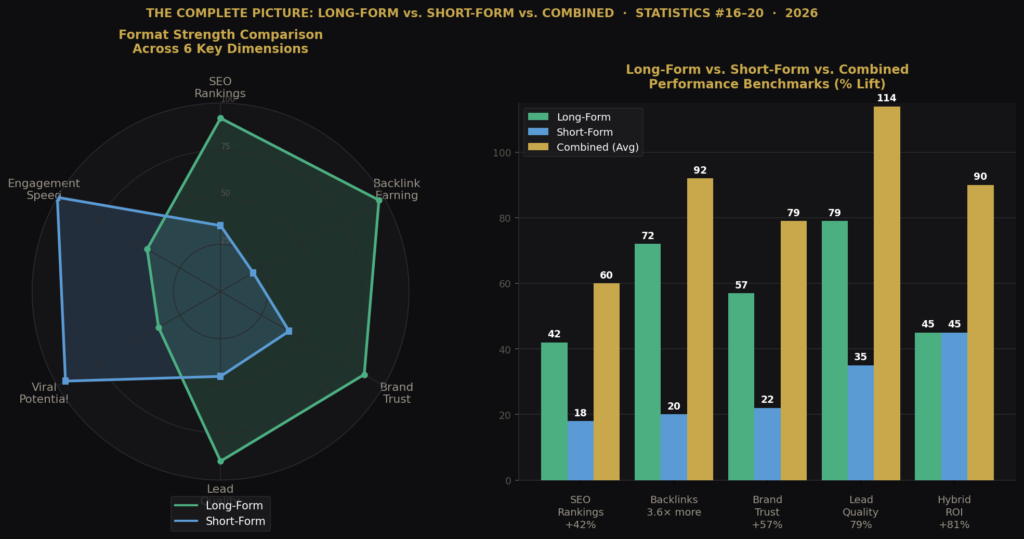
While short-form content may dominate in shareability, especially on fast-paced platforms, long-form consistently outperforms in building trust, earning backlinks, and holding attention. These strengths make long-form ideal for SEO, thought leadership, and evergreen resources. The key isn’t choosing one over the other—it’s using each where it counts most.
In 2026 and beyond, the most effective brands will stop viewing long-form and short-form as rivals—and instead treat them as complementary tools. Short-form captures attention, delivers quick wins, and amplifies visibility across social channels. Long-form, on the other hand, nurtures deeper relationships, supports complex buying decisions, and strengthens domain authority. Together, they create a layered content experience that mirrors how real people research, decide, and engage online.
As algorithms evolve and consumer expectations shift, adaptability will matter more than format. Brands that combine data-driven long-form vs short-form content strategies in 2026 will gain stronger visibility, higher engagement, and more sustainable organic growth.
Sources:
- https://sproutsocial.com/insights/social-media-video-statistics
- https://vidico.com/news/short-form-video-statistics
- https://sproutsocial.com/insights/social-media-video-statistics
- https://sproutsocial.com/insights/social-media-video-statistics
- https://kajabi.com/blog/why-short-form-video-is-popular
- https://sproutsocial.com/insights/social-media-video-statistics
- https://www.firework.com/blog/short-form-video-statistics
- https://www.firework.com/blog/short-form-video-statistics
- https://www.firework.com/blog/short-form-video-statistics
- https://www.firework.com/blog/short-form-video-statistics
- https://www.firework.com/blog/short-form-video-statistics
- https://www.firework.com/blog/short-form-video-statistics
- https://www.firework.com/blog/short-form-video-statistics
- https://www.firework.com/blog/short-form-video-statistics
- https://www.firework.com/blog/short-form-video-statistics
- https://blog.thatagency.com/long-form-content-vs-short-form-content
- https://blog.thatagency.com/long-form-content-vs-short-form-content
- https://blog.thatagency.com/long-form-content-vs-short-form-content
- https://www.web.com/blog/long-form-content
- https://blog.hootsuite.com/short-form-vs-long-form