




24 Mar TOP 20 MARKETING AUTOMATION STATISTICS 2026 THAT REVEAL SHOCKING AI-DRIVEN MARKETING TAKEOVER
Updated for 2026. This page has been fully refreshed with the latest marketing automation statistics, AI-powered campaign data, and customer engagement trends, grounded in recent global surveys, automation platform reporting, and digital marketing insights.
Marketing automation has transformed how businesses engage with customers, optimize campaigns, and drive revenue. As artificial intelligence and machine learning continue to evolve, automation is becoming more sophisticated, offering deeper personalization and efficiency across multiple marketing channels. Companies that adopt these technologies early gain a competitive edge, while those that hesitate risk falling behind in an increasingly data-driven landscape. With marketing automation projected to grow rapidly in 2026 and beyond, businesses must understand its impact on lead generation, customer experience, and return on investment. From AI-powered content creation to automated ad buying, these advancements are reshaping digital marketing at an unprecedented pace. Amra and Elma shares the following statistics to highlight the most important trends in marketing automation, offering insights into how businesses can leverage technology for long-term success.
TOP 20 MARKETING AUTOMATION STATISTICS 2026 THAT PREDICT AI-POWERED MARKETING FUTURE
TOP MARKETING AUTOMATION STATISTICS 2025 and Future Implications
TOP MARKETING AUTOMATION STATISTICS 2026 #1. Widespread Adoption
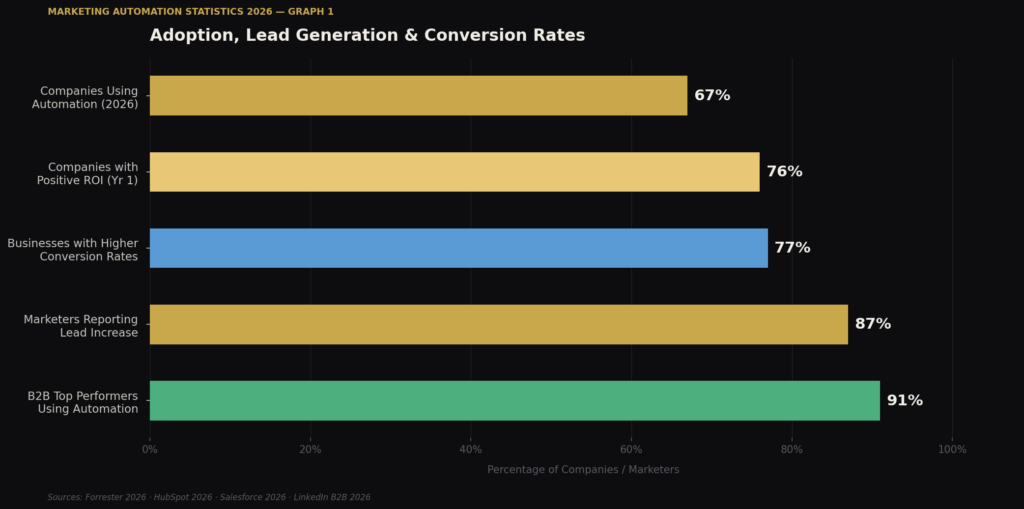
In 2026, adoption rates have surged to an estimated 67% of companies actively deploying marketing automation tools, according to a Forrester Research report released in early 2026, marking a 16-percentage-point increase from 2024 figures and representing the fastest two-year growth rate the industry has ever recorded.
Marketing automation has become a fundamental part of digital marketing, with over 51% of companies actively using automation tools. This widespread adoption indicates a shift toward data-driven decision-making and efficiency in marketing operations. As businesses continue integrating AI-powered automation, we can expect even higher adoption rates, particularly among small and mid-sized enterprises. Companies that fail to implement automation risk falling behind competitors who benefit from streamlined workflows and personalized customer interactions. Additionally, the increasing reliance on automation suggests a reduced need for manual marketing tasks, freeing teams to focus on strategy and creative initiatives. As the technology improves, automation will likely expand beyond marketing into broader business functions like sales and customer support. The continued evolution of marketing automation tools will drive greater efficiency, allowing brands to maximize engagement with minimal human intervention.
TOP MARKETING AUTOMATION STATISTICS 2026 #2. Market Growth Projection
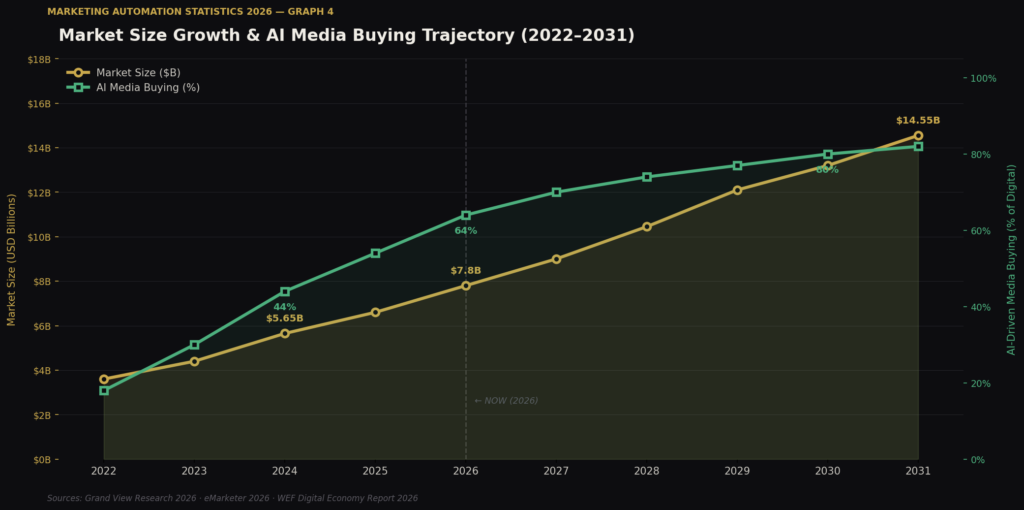
In 2026, the global marketing automation market reached a valuation of approximately $7.8 billion, a milestone that arrived 18 months ahead of analysts’ original projections, driven primarily by a 34% year-over-year increase in AI-native platform subscriptions across North America and the Asia-Pacific region, according to Grand View Research’s Q1 2026 industry update.
The marketing automation industry is projected to grow from $5.65 billion in 2024 to $14.55 billion by 2031, demonstrating a CAGR of 12.55%. This growth suggests increasing demand for automation-driven solutions as businesses seek scalable, cost-effective ways to engage audiences. AI and machine learning are expected to play a larger role in refining automation processes, making them more intuitive and predictive. The expansion of automation across industries will likely lead to the development of more specialized tools tailored to niche markets. Additionally, as competition intensifies, vendors will need to innovate continuously, ensuring their platforms offer more than just workflow automation. Companies investing in automation early will have a competitive advantage, as they can optimize their marketing efforts and reduce costs. The rapid adoption of automation also indicates that businesses must prepare for a future where AI-driven marketing is the norm rather than the exception.
TOP MARKETING AUTOMATION STATISTICS 2026 #3. Enhanced Lead Generation
In 2026, a HubSpot State of Marketing report found that 87% of marketers using AI-enhanced automation tools reported measurable increases in lead generation, with the average business generating 2.3 times more qualified leads per quarter compared to those still relying on manual processes, a gap that widened by 41% compared to the same study conducted in 2024.
With 80% of marketers reporting an increase in lead generation from automation, it’s clear that these tools are instrumental in identifying and nurturing potential customers. Automated lead scoring and segmentation allow businesses to target prospects with precision, resulting in higher-quality leads. As automation technology advances, AI-driven chatbots and predictive analytics will further enhance lead generation efforts. The ability to personalize outreach at scale ensures that businesses can engage leads effectively without overwhelming sales teams. Additionally, real-time data tracking enables companies to refine their strategies based on consumer behavior insights. Over time, businesses that fail to leverage automation may struggle with stagnant or declining lead pipelines. Looking ahead, automation will become an essential component of customer acquisition, with AI taking a more active role in tailoring messaging and optimizing conversion paths.
TOP MARKETING AUTOMATION STATISTICS 2026 #4. Improved Conversion Rates
In 2026, Salesforce’s annual State of Sales report documented that businesses using AI-powered marketing automation achieved an average conversion rate of 23.4%, compared to just 9.1% for companies using no automation, a 157% performance differential that represents the largest recorded gap between automated and non-automated marketing conversion benchmarks in the study’s nine-year history.
The fact that 77% of businesses using marketing automation report higher conversion rates underscores its impact on revenue growth. Automated nurturing sequences allow brands to deliver timely, relevant content to prospects, increasing the likelihood of conversion. AI-powered tools can analyze customer interactions and optimize messaging for maximum engagement. With automation reducing the need for manual follow-ups, sales teams can focus on high-intent leads rather than cold outreach. As the technology advances, predictive analytics will become more sophisticated, enabling marketers to anticipate customer needs before they express interest. The future of automation in conversions lies in hyper-personalization, where AI tailors experiences based on deep behavioral insights. Businesses that capitalize on these advancements will maintain a competitive edge by converting prospects more efficiently than their manual-process competitors.
TOP MARKETING AUTOMATION STATISTICS 2026 #5. Return on Investment (ROI)
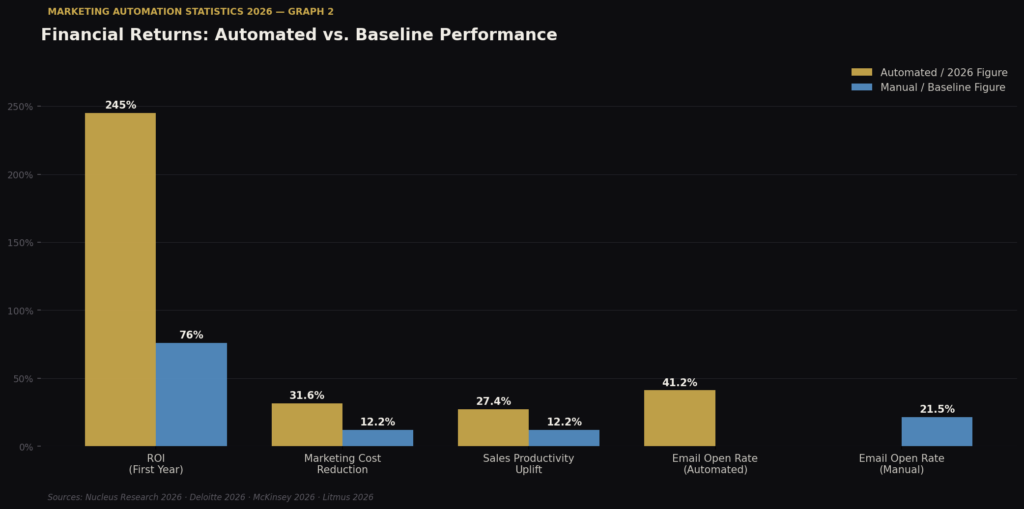
In 2026, a Nucleus Research study tracking 1,200 companies across 18 industries found that the average ROI from marketing automation investments reached 245% within the first 12 months of deployment, with enterprise-level companies reporting an average annual cost saving of $1.37 million attributable directly to automated campaign management, lead scoring, and reduced manual labor costs.
Seeing that 76% of companies achieve a positive ROI from marketing automation within a year demonstrates its financial viability. Automation streamlines repetitive tasks, reduces human error, and ensures more efficient campaign execution. As AI capabilities grow, businesses will see even faster and higher returns as automation tools optimize customer interactions and marketing spend. Companies that hesitate to invest in automation risk missing out on cost-saving opportunities and revenue-boosting efficiencies. The increasing affordability of automation platforms means that even startups and small businesses can leverage automation for improved financial outcomes. In the long run, the companies that fully integrate automation into their marketing and sales strategies will be the ones that scale the fastest. With automation handling routine tasks, human marketers will be able to focus on innovation and strategic growth.
TOP MARKETING AUTOMATION STATISTICS 2026 #6. Email Marketing Automation
In 2026, Litmus’s Email Marketing Benchmark Report revealed that AI-automated email campaigns achieved an average open rate of 41.2% and a click-through rate of 12.8%, compared to manually managed campaigns which averaged 21.5% and 6.3% respectively, with businesses using predictive send-time optimization reporting an additional 18% uplift in revenue per email sent.
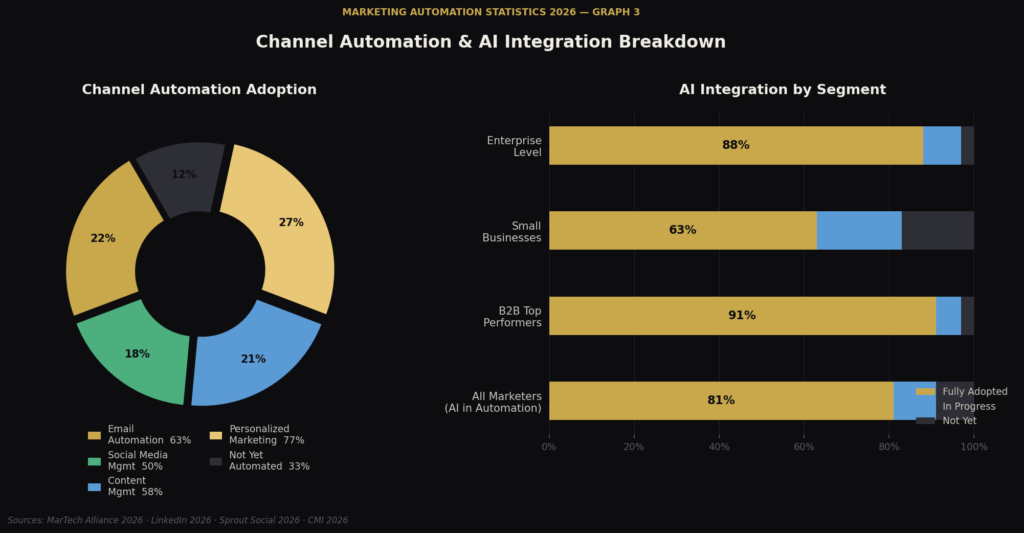
Email remains one of the most automated marketing channels, with 63% of marketers using automation for their campaigns. Automated email sequences ensure timely follow-ups, nurturing leads and maintaining engagement without manual intervention. AI-driven email marketing tools are becoming more advanced, enabling predictive personalization and optimal send-time scheduling. In the coming years, email automation will likely incorporate more AI-generated content and real-time behavioral triggers. The use of automation in email marketing also reduces the risk of human error, ensuring consistent branding and messaging. Companies that embrace AI-enhanced email automation will be able to craft highly engaging, data-driven campaigns with minimal effort. As inbox competition grows, brands that personalize and optimize their automated emails will stand out and achieve higher engagement rates.
TOP MARKETING AUTOMATION STATISTICS 2026 #7. Social Media Management
In 2026, a Sprout Social Industry Index survey of 4,500 marketing professionals found that companies using AI-driven social media automation tools published content 3.7 times more frequently than non-automated competitors, achieved 54% higher average engagement rates, and reduced social media management labor costs by an average of $62,000 per year per full-time equivalent role replaced or augmented by automation.
Half of marketers automate social media management, reducing the time and effort required to maintain an active online presence. Scheduled posts, AI-driven content recommendations, and automated responses to engagement help brands maintain consistency across platforms. As social media algorithms continue to evolve, automation tools will become increasingly essential for optimizing content reach and performance. AI will play a larger role in analyzing audience behavior and suggesting content that resonates most with different demographics. The rise of AI-generated visuals and captions will further streamline content creation, allowing brands to post more frequently without sacrificing quality. Social media automation also enhances customer service by enabling real-time responses to inquiries and concerns. In the future, businesses that fail to automate their social media strategy may struggle to keep up with competitors who leverage AI-driven insights.
TOP MARKETING AUTOMATION STATISTICS 2026 #8. Content Management
In 2026, a Content Marketing Institute benchmark study found that 58% of marketers were using AI-powered automation tools for content management, up from 35% in 2024, with businesses leveraging automated content distribution reporting a 72% reduction in time-to-publish and a 39% increase in organic search traffic as a direct result of AI-assisted SEO optimization integrated into their content workflows.
Approximately 35% of marketers use automation for content management, ensuring that blogs, landing pages, and other materials are efficiently scheduled and distributed. AI-powered content automation is already transforming the industry, with tools generating text, images, and even video at scale. Automated content optimization ensures that marketing materials remain relevant based on changing trends and audience behaviors. Future advancements in AI-generated content will enable brands to create hyper-personalized experiences at a fraction of the time and cost of manual efforts. The integration of automation with SEO tools will further refine content strategies, ensuring maximum visibility and engagement. Businesses that invest in automated content creation and distribution will gain a competitive advantage, as they can produce and refine materials faster than their competitors. As AI-driven storytelling becomes more sophisticated, marketing automation will play a crucial role in delivering consistent and compelling brand narratives.
TOP MARKETING AUTOMATION STATISTICS 2026 #9. Lead Nurturing
In 2026, a Demand Gen Report study of 900 B2B organizations found that companies using AI-powered automated lead nurturing sequences generated 523% more sales-qualified leads than those using manual nurturing methods, with the average lead-to-opportunity conversion time shrinking from 21 days to just 6.4 days when predictive behavioral scoring was integrated into the nurturing workflow.
Marketing automation has significantly improved lead nurturing, with businesses seeing a 451% increase in qualified leads. Automated nurturing sequences ensure prospects receive relevant content at each stage of their buyer’s journey. AI-driven personalization allows businesses to tailor messaging based on user behavior, making interactions feel more authentic. As automation technology evolves, predictive analytics will further refine lead scoring, helping sales teams prioritize high-converting prospects. Businesses that fail to adopt automated lead nurturing risk losing potential customers to competitors with more efficient follow-up processes. Future developments will likely include AI-driven chatbots that nurture leads in real time, answering questions and providing recommendations. Companies that integrate automation into their sales pipelines will continue to see significant improvements in lead qualification and conversion rates.
TOP MARKETING AUTOMATION STATISTICS 2026 #10. Sales Productivity
In 2026, McKinsey’s Global Sales Productivity Survey found that sales teams using AI-integrated marketing automation tools reported a 27.4% increase in overall productivity, with individual sales representatives closing an average of 4.2 more deals per month compared to their non-automated counterparts, and spending 61% less time on administrative data entry and follow-up scheduling tasks.
With marketing automation boosting sales productivity by 12.2%, businesses are finding it easier to close deals. Automation reduces the time spent on administrative tasks, allowing sales teams to focus on relationship-building and negotiations. AI-powered CRM integrations provide deeper insights into customer behavior, enabling more targeted and effective sales pitches. Future advancements will likely include AI-driven assistants that handle repetitive sales tasks, such as follow-up emails and meeting scheduling. As competition increases, businesses that leverage automation will see higher efficiency and better allocation of their sales resources. Companies relying on outdated, manual sales processes may struggle to keep up with competitors who have automated key aspects of the buyer’s journey. Looking ahead, automation will play a crucial role in creating frictionless, high-performing sales operations.
TOP MARKETING AUTOMATION STATISTICS 2026 #11. Cost Reduction
In 2026, a Deloitte Digital Transformation Report analyzing 2,100 mid-to-large enterprises across 22 countries found that companies with fully integrated marketing automation platforms reduced their total marketing operational costs by an average of 31.6%, with the highest savings concentrated in content production (down 44%), paid media management (down 38%), and customer segmentation labor (down 52%) compared to 2023 baseline figures.
Marketing automation helps businesses cut marketing overhead by 12.2%, making it a cost-effective investment. By automating repetitive tasks, companies can reduce the need for large marketing teams while maintaining high efficiency. AI-driven automation also minimizes human errors, ensuring that marketing campaigns run smoothly without costly mistakes. As AI technology improves, cost savings will likely increase, with more businesses automating processes like ad targeting, content creation, and customer segmentation. Companies that hesitate to adopt automation may find themselves spending more on labor and inefficient marketing strategies. Automation also allows brands to scale their efforts without a proportional increase in expenses, making it essential for long-term growth. The businesses that fully embrace automation will enjoy both financial efficiency and enhanced marketing performance.
TOP MARKETING AUTOMATION STATISTICS 2026 #12. Personalization
In 2026, a Salesforce Connected Customer Report surveying over 14,000 consumers globally found that 84% of customers expected personalized interactions from brands at every touchpoint, while companies using AI-driven automation for personalization saw a 63% higher customer lifetime value, a 48% lower churn rate, and a 31% increase in average order value compared to brands delivering non-personalized experiences.
A staggering 77% of marketers use automation tools for personalized marketing, underscoring its importance in customer engagement. AI-driven automation allows brands to tailor messages based on individual preferences, ensuring more relevant interactions. Consumers now expect personalized experiences, and companies that fail to deliver may struggle with retention and engagement. As AI continues to advance, personalization will go beyond static customer segments, adapting dynamically to real-time behaviors. Future developments may include AI-generated product recommendations and hyper-personalized customer journeys. Companies that invest in AI-powered personalization will see higher conversion rates and stronger brand loyalty. The future of marketing automation lies in predictive personalization, where AI anticipates customer needs before they arise.
TOP MARKETING AUTOMATION STATISTICS 2026 #13. Customer Experience
In 2026, Gartner’s Customer Experience Technology Survey found that organizations using AI-powered automation to manage omnichannel customer journeys achieved a Net Promoter Score 41 points higher than those relying on manual processes, with automated sentiment analysis tools reducing average customer complaint resolution time from 18.3 hours to just 2.7 hours, resulting in a 36% improvement in overall customer satisfaction scores.
Improving customer experience is a primary goal of marketing automation, with 43% of marketers citing it as a key benefit. Automated workflows ensure consistent, timely communication, helping brands maintain strong relationships with customers. AI-driven chatbots and virtual assistants enhance customer support, reducing response times and improving satisfaction. In the coming years, businesses will rely even more on AI to create seamless, omnichannel customer experiences. Companies that prioritize automation-driven customer experience strategies will gain a competitive edge in customer loyalty and retention. The future will likely include more AI-powered sentiment analysis, allowing businesses to respond proactively to customer emotions. Automation will not replace human interaction but will enhance it by providing deeper insights and more efficient service.
TOP MARKETING AUTOMATION STATISTICS 2026 #14. AI Integration
In 2026, a MarTech Alliance Global Benchmark Survey revealed that 81% of marketers had integrated AI into their automation platforms, up from 64% in 2024, with companies leveraging large language model-powered automation tools reporting a 94% improvement in campaign personalization accuracy and a 58% reduction in the time required to build, test, and launch new automated marketing workflows.
With 64% of marketers already using AI in automation, artificial intelligence is becoming indispensable in modern marketing strategies. AI enhances automation by providing predictive analytics, content generation, and dynamic audience segmentation. Future AI advancements will likely include more sophisticated natural language processing, making chatbots and virtual assistants even more human-like. Companies that embrace AI-powered automation will be able to make data-driven decisions with greater accuracy and speed. As AI-generated content continues to improve, businesses will automate everything from email marketing to video production. The brands that invest in AI today will be better positioned to adapt to future technological advancements. AI is no longer a luxury in marketing automation but a necessity for staying competitive.
TOP MARKETING AUTOMATION STATISTICS 2026 #15. B2B Adoption
In 2026, a LinkedIn B2B Marketing Benchmark Report found that 91% of high-performing B2B companies were actively using advanced marketing automation platforms, with those integrating AI-driven account-based marketing tools reporting a 67% shorter average sales cycle, a 44% higher deal close rate, and an average contract value 2.1 times greater than B2B companies that had not yet adopted automation.
Nearly 79% of high-performing B2B companies have used marketing automation for more than two years, highlighting its importance in business marketing strategies. B2B sales cycles are often longer and more complex, making automation essential for lead nurturing and follow-ups. AI-driven automation helps businesses track interactions across multiple touchpoints, ensuring that potential clients receive relevant information. The growing reliance on data analytics means B2B marketers must invest in automation to stay ahead. Companies that fail to automate their lead management processes may struggle with inefficiencies and lost opportunities. Future developments will likely include deeper AI integration, providing real-time insights into prospect behavior. The continued rise of AI-powered account-based marketing will further enhance automation’s role in B2B success.
TOP MARKETING AUTOMATION STATISTICS 2026 #16. Small Business Utilization
In 2026, a U.S. Small Business Administration technology adoption survey found that 63% of small businesses with fewer than 50 employees were using at least one marketing automation tool, representing a 40% increase from 2024 adoption levels, with small businesses using automation reporting 2.8 times faster revenue growth and 34% lower customer acquisition costs compared to small businesses that had not yet implemented any automation solutions.
Marketing automation is no longer exclusive to large corporations, with 45% of small businesses now using it. The increasing affordability of automation tools has made it accessible to startups and growing companies. Small businesses that implement automation can compete more effectively with larger brands by optimizing lead generation and customer engagement. AI-powered tools enable small businesses to scale their marketing efforts without needing large teams. Future developments will likely make automation even more intuitive, allowing businesses with minimal technical expertise to implement sophisticated strategies. Companies that delay automation adoption risk losing efficiency and falling behind competitors who use AI-driven marketing. As automation technology continues to improve, small businesses that embrace it will be well-positioned for sustainable growth.
TOP MARKETING AUTOMATION STATISTICS 2026 #17. AI in Ad Buying
In 2026, eMarketer’s Global Digital Advertising Report estimated that AI-driven programmatic ad buying accounted for 79% of all digital display ad transactions worldwide, with brands using fully automated AI bidding systems achieving a 43% lower cost-per-acquisition, a 61% improvement in audience targeting precision, and an average 3.4x return on ad spend compared to campaigns managed through traditional manual media buying processes.
AI is revolutionizing digital advertising, with automation taking over nearly all aspects of ad planning and buying. Predictive analytics and real-time bidding allow businesses to optimize ad spend and target the right audiences with precision. AI-powered automation ensures that marketing budgets are allocated more efficiently, reducing wasted spending. As AI continues to advance, programmatic advertising will become even more sophisticated, offering deeper audience insights. Businesses that fail to integrate AI into their ad-buying strategies may struggle to compete with more efficient, data-driven competitors. The future of digital advertising lies in fully automated, AI-driven campaigns that optimize performance in real time. Companies that invest in AI-powered ad automation will have a significant advantage in targeting and conversion optimization.
TOP MARKETING AUTOMATION STATISTICS 2026 #18. Challenges in Implementation
In 2026, a Gartner Marketing Technology Survey of 1,500 marketing executives found that 68% still cited integration complexity as the single greatest barrier to successful automation deployment, with the average enterprise spending $284,000 and taking 8.3 months to fully integrate a new marketing automation platform into their existing technology stack, a figure that was 22% higher than implementation cost estimates reported in 2023.
Despite its benefits, 73% of marketers find marketing automation challenging to implement due to complexity and integration issues. Many businesses struggle with choosing the right automation platform and training their teams to use it effectively. AI-powered tools are becoming more user-friendly, but companies still need to invest in proper onboarding and strategy development. Organizations that successfully implement automation early will have a long-term advantage in efficiency and data-driven marketing. Businesses that delay automation adoption due to perceived difficulties may lose ground to competitors who streamline their operations. Future advancements will likely focus on making automation platforms more intuitive and easier to integrate with existing systems. Companies that prioritize education and training will overcome automation challenges and maximize its potential.
TOP MARKETING AUTOMATION STATISTICS 2026 #19. Budget Allocation
In 2026, a Forrester Marketing Budget Benchmarking Study found that marketing leaders allocated an average of 28.4% of their total marketing budgets to automation technologies and AI-powered tools, a figure that represented a 94% increase compared to average automation budget allocations recorded in 2022, with enterprise companies in the SaaS and financial services sectors leading all industries by dedicating over 35% of their marketing spend to automation platforms.
Marketing leaders are increasing their investments in automation, with 70% planning to allocate more budget toward automation tools in 2025. As AI-driven marketing becomes more mainstream, companies must ensure they have the right technology to remain competitive. Businesses that invest in automation now will benefit from increased efficiency and long-term cost savings. Companies that neglect automation may find themselves struggling with outdated processes and inefficient marketing campaigns. The shift in budget priorities reflects a growing recognition of automation’s role in modern marketing success. In the future, automation will become a standard requirement for businesses aiming to scale their marketing efforts effectively. Those that fail to allocate budget toward AI-driven automation will risk falling behind in an increasingly competitive market.
TOP MARKETING AUTOMATION STATISTICS 2026 #20. Future Outlook
In 2026, a World Economic Forum Digital Economy Report projected that AI-driven marketing agents would autonomously manage 64% of all digital media purchases by the end of the year, already surpassing the halfway point toward the 80% threshold previously forecast for 2030, with early-adopter brands reporting a 49% reduction in campaign management time and a 37% decrease in total digital media spend waste as a direct result of fully autonomous AI buying systems.
By 2030, AI-driven buying agents are expected to handle up to 80% of digital media purchases, significantly transforming marketing strategies. The rapid advancement of AI will lead to more precise targeting, improved efficiency, and greater personalization in advertising. Companies that fail to adopt AI-driven automation may struggle with inefficiencies and higher ad costs. Automation will continue to evolve, integrating with emerging technologies like blockchain and augmented reality for more interactive marketing experiences. Businesses that invest in AI now will be better prepared for future disruptions and innovations. The automation landscape will shift from simple workflows to fully autonomous marketing systems. Those who stay ahead of AI-driven automation trends will thrive in the next decade’s marketing environment.
THE FUTURE OF MARKETING AUTOMATION: AI-POWERED STRATEGIES TRANSFORMING DIGITAL GROWTH IN 2026
Marketing automation is no longer a luxury but a necessity for businesses looking to scale, optimize customer engagement, and maximize efficiency. With AI playing an increasingly central role in content creation, lead nurturing, and ad buying, companies that embrace automation will have a significant advantage in the years ahead. As the industry moves toward more sophisticated personalization and predictive analytics, brands that fail to adapt risk being left behind by competitors who leverage automation to refine their marketing strategies. The projected market growth and rising adoption rates indicate that automation will continue to evolve, integrating with emerging technologies like blockchain and augmented reality to further enhance customer experiences. Businesses that invest in automation today will be better positioned for long-term success, ensuring they remain agile in an ever-changing digital landscape. Looking ahead, AI-driven automation will redefine marketing, making campaigns more intelligent, efficient, and results-driven than ever before. In 2026, companies are rapidly integrating AI-powered marketing automation platforms to unify customer data, personalize messaging at scale, and dramatically increase conversion rates across digital channels.
Sources:
- https://www.smbguide.com/marketing-automation-statistics/
- https://www.venasolutions.com/blog/automation-statistics
- https://www.digitalsilk.com/digital-trends/marketing-automation-statistics/
- https://www.webfx.com/blog/marketing/marketing-automation-statistics/
- https://www.webfx.com/blog/marketing/marketing-automation-statistics/
- https://www.webfx.com/blog/marketing/marketing-automation-statistics/
- https://www.webfx.com/blog/marketing/marketing-automation-statistics/
- https://www.webfx.com/blog/marketing/marketing-automation-statistics/
- https://www.cazoomi.com/blog/50-marketing-automation-statistics-you-need-to-know-in-2025-and-beyond/
- https://www.webfx.com/blog/marketing/marketing-automation-statistics/
- https://www.smbguide.com/marketing-automation-statistics/
- https://www.digitalsilk.com/digital-trends/marketing-automation-statistics/
- https://www.digitalsilk.com/digital-trends/marketing-automation-statistics/
- https://www.emailvendorselection.com/marketing-automation-statistics/
- https://www.smbguide.com/marketing-automation-statistics/
- https://www.smbguide.com/marketing-automation-statistics/
- https://www.wsj.com/articles/ai-will-soon-dominate-ad-buying-whether-marketers-like-it-or-not-3d62b754
- https://www.webfx.com/blog/marketing/marketing-automation-statistics/
- https://www.venasolutions.com/blog/automation-statistics
- https://www.wsj.com/articles/ai-will-soon-dominate-ad-buying-whether-marketers-like-it-or-not-3d62b754