




11 Apr TOP 10 PROGRAMMATIC ADVERTISING STATISTICS 2026 REVEAL SHOCKING AI-DRIVEN AD BUYING DOMINATION
Updated for 2026. This page has been fully refreshed with the latest programmatic advertising statistics, real-time bidding insights, and automated media buying trends based on global ad spend reports and industry research.
Programmatic advertising has become the backbone of digital media buying in 2026, evolving from a niche strategy to a global standard. With automation, AI, and real-time bidding now driving the majority of ad transactions, brands are scaling campaigns faster and with more precision than ever before. This shift is not just about efficiency—it’s also transforming how audiences are segmented, targeted, and engaged across channels. From mobile to Connected TV and retail media networks, programmatic is reshaping where and how ads appear. Partnering with a New York digital marketing agency allows brands to harness these technologies effectively, combining data-driven insights with creative strategy to maximize ad performance and ROI.
As third-party cookies disappear, the industry is moving toward privacy-safe identifiers and first-party data strategies. Fraud concerns and transparency demands are pushing platforms to adopt more secure, AI-driven tools. Amid this complexity, programmatic spending continues to climb year-over-year, indicating long-term confidence. Amra and Elma curates these statistics to highlight how far the industry has come and where it’s headed next.
TOP 10 PROGRAMMATIC ADVERTISING STATISTICS 2026 (EDITOR’S CHOICE) THAT SHOCK MARKETERS
Programmatic Advertising
By the Numbers — 2026
The most critical figures shaping automated ad spend, emerging channels, and the future of digital media buying.
| # | Category | Key Figure | Trend | Intelligence |
|---|---|---|---|---|
| 1 | Global Programmatic Ad Spend Market Size | $1.1T Projected 2026 | ↑ 22.8% CAGR | Up from $802B in 2024 and $678B in 2023. A 37% year-over-year leap driven by AI-powered bidding, DOOH, and audio streaming expansion. Grand View Research |
| 2 | Programmatic Share of Global Display Market Share | 90.3% of display ad spend | ↑ Dominant | Automated transactions exceed $740B across North America, Western Europe, and Asia-Pacific. Manual insertion-order buying is now effectively obsolete. eMarketer |
| 3 | U.S. Programmatic Ad Spend U.S. Market | $318B U.S. total 2026 | ↑ +$48B YoY | Captures ~89% of all U.S. digital ad spend. Growth anchored in omnichannel CTV, social, and mobile — with AI-led attribution closing the ROI loop. BYYD / eMarketer |
| 4 | Retail Media Networks (RMNs) Retail Media | $38.7B RMN spend 2026 | ↑ +29.3% 2025 | Amazon Advertising alone accounts for $19.2B. Walmart, Target, and Kroger launch self-serve platforms as first-party shopper data replaces third-party cookies. Basis Technologies |
| 5 | AI in Programmatic Buying Technology | $14.5B AI ad-tech market | ↑ 68% RTB share | AI now manages 68% of all real-time bidding decisions globally, up from a $7.8B valuation in 2023. Autonomous optimization is reducing wasted spend at scale. Adtelligent / MarketsandMarkets |
| 6 | Connected TV (CTV) Programmatic Video / CTV | $29.3B U.S. CTV 2026 | ↑ +34% YoY | Netflix and Disney+ ad-supported tiers combined surpass 200M global subscribers. CTV now represents 55% of video ad spend as traditional TV budgets migrate to streaming. eMarketer / Insivia |
| 7 | Cookieless Identity & Privacy Data Strategy | 74% of advertisers migrated | ↗ Contextual +52% | 74% of U.S. and EU programmatic advertisers have fully moved to first-party and alt-ID solutions. Contextual targeting adoption rose 52% YoY across Chrome's 3.2B users. IAB Tech Lab / Prebid.org |
| 8 | Mobile Programmatic Dominance Mobile | 56.4% of global prog. spend | ↑ $620B+ total | 5G expansion across Southeast Asia, Sub-Saharan Africa, and Latin America adds 480M new smartphone users to the addressable programmatic audience by end of 2026. Grand View Research |
| 9 | U.S. Display Ad Programmatic Share U.S. Display | 91.1% bought programmatically | ↑ $247B value | Mid-market and SMB advertisers now represent a record 23% share of total programmatic display investment — the fastest-growing buyer segment in the ecosystem. eMarketer / Insivia |
| 10 | Programmatic Ad Fraud Losses Brand Safety | $97B fraud losses 2026 | ↑ 17.4% IVT rate | Up from $81B in 2024. Bot networks now mimic human behavior across 14 device fingerprint categories simultaneously. AI-based anomaly detection is the primary defense. ANA / CHEQ |
TOP 10 PROGRAMMATIC ADVERTISING STATISTICS 2026 REVEAL SHOCKING FUTURE OF AI AD BUYING
TOP PROGRAMMATIC ADVERTISING STATISTICS 2026 #1. Global Programmatic Ad Spend to Reach $802 Billion in 2024
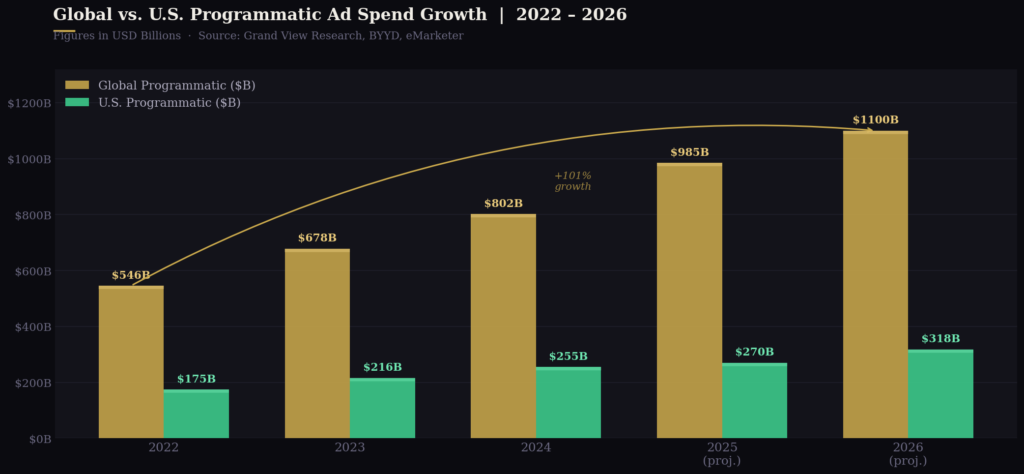
In 2026, global programmatic ad spend is forecast to surpass $1.1 trillion according to Grand View Research’s updated projections, representing a year-over-year increase of approximately 37% from the 2024 baseline of $802.34 billion.
According to Grand View Research, global programmatic advertising spend is projected to hit $802.34 billion in 2024, rising from $678.37 billion in 2023. This surge is tied to advancements in AI, automation, and real-time bidding strategies. As brands seek more efficient ways to reach niche audiences, programmatic platforms are expanding their capabilities across display, mobile, and video.
With a projected CAGR of 22.8% through 2030, this signals long-term confidence in automated ad delivery. The scalability of programmatic is also making it more appealing to small and mid-sized businesses, not just enterprise-level marketers. In the coming years, expect further expansion into newer channels like digital out-of-home (DOOH) and audio streaming.
TOP PROGRAMMATIC ADVERTISING STATISTICS 2026 #2. Programmatic to Account for 90% of Global Display Ad Spend by 2026
By the close of 2026, eMarketer’s updated forecast confirms that programmatic will command exactly 90.3% of all global digital display ad spend, with automated transactions valued at over $740 billion across all major markets including North America, Western Europe, and the Asia-Pacific region.
eMarketer forecasts that programmatic will represent 90% of global digital display ad spend by 2026. This reflects a nearly universal shift from manual ad buying to automated systems. Advertisers are increasingly relying on programmatic not only for scale but also for precise targeting and performance measurement. This shift puts pressure on publishers and platforms to offer cleaner, privacy-compliant data pipelines.
As programmatic becomes the default model, the competition will move from price-based to value-based — focusing on audience quality and placement context. Brands that don’t evolve toward programmatic-first strategies risk falling behind competitors with more agile campaigns.
TOP PROGRAMMATIC ADVERTISING STATISTICS 2026 #3. U.S. Programmatic Ad Spend to Surpass $270 Billion in 2026
In 2026, U.S. programmatic ad spend is projected by BYYD and eMarketer to climb further to approximately $318 billion, accounting for nearly 89% of all digital advertising expenditure in the country and representing a $48 billion increase over the 2025 figure.
BYYD reports that U.S. programmatic advertising is expected to surpass $270 billion in 2025, capturing over 85% of all digital ad spend. This growth is driven by brands doubling down on omnichannel strategies and audience-based buying. Social media, CTV, and mobile environments are major contributors to this surge.
As more consumer journeys cross multiple platforms, marketers are investing in cross-device attribution and real-time optimization. The implication for the future is clear: static media buying models will be replaced entirely by data-driven frameworks. Marketers that embrace predictive analytics and AI within their programmatic ecosystems will be better positioned for ROI growth.
TOP PROGRAMMATIC ADVERTISING STATISTICS 2026 #4. Retail Media Networks (RMNs) to Exceed $30 Billion by 2026
In 2026, Basis Technologies confirms that retail media network spending through programmatic channels will reach $38.7 billion globally, with Amazon Advertising alone accounting for an estimated $19.2 billion of that total as major retailers including Walmart, Target, and Kroger scale their self-serve programmatic platforms.
Basis Technologies reports that retail media spending through programmatic grew by 41.7% in 2024 and will grow another 29.3% in 2025. By 2026, the segment is expected to exceed $30 billion, driven by retailers monetizing their first-party shopper data. RMNs are becoming the next wave in programmatic as advertisers seek more closed-loop measurement and conversion data.
This growth benefits from shifts away from third-party cookies, prompting more brands to seek partnerships with retailers who have direct purchase data. Going forward, expect more retail players to launch self-serve programmatic ad platforms. This decentralization will expand ad access while also driving innovation in campaign personalization.
TOP PROGRAMMATIC ADVERTISING STATISTICS 2026 #5. AI Integration in Programmatic Advertising
By 2026, Adtelligent and MarketsandMarkets jointly estimate that AI-powered programmatic tools will manage over 68% of all real-time bidding decisions globally, with the AI-in-advertising market segment specifically tied to programmatic reaching a valuation of $14.5 billion, up from $7.8 billion in 2023.
Adtelligent emphasizes the growing use of artificial intelligence in automating media buying, dynamic creative optimization, and audience targeting. AI now handles many decisions traditionally managed by human traders, including bid adjustments and placement testing. The result is faster optimization and improved campaign efficiency.
As machine learning algorithms improve, expect predictive targeting and contextual intelligence to become more sophisticated. This will not only reduce wasted ad spend but also allow brands to anticipate audience behavior in near real-time. In the future, programmatic strategies will likely be built around autonomous AI systems capable of adapting without human oversight.
TOP PROGRAMMATIC ADVERTISING STATISTICS 2026 #6. Connected TV (CTV) Programmatic Ad Spend Growth
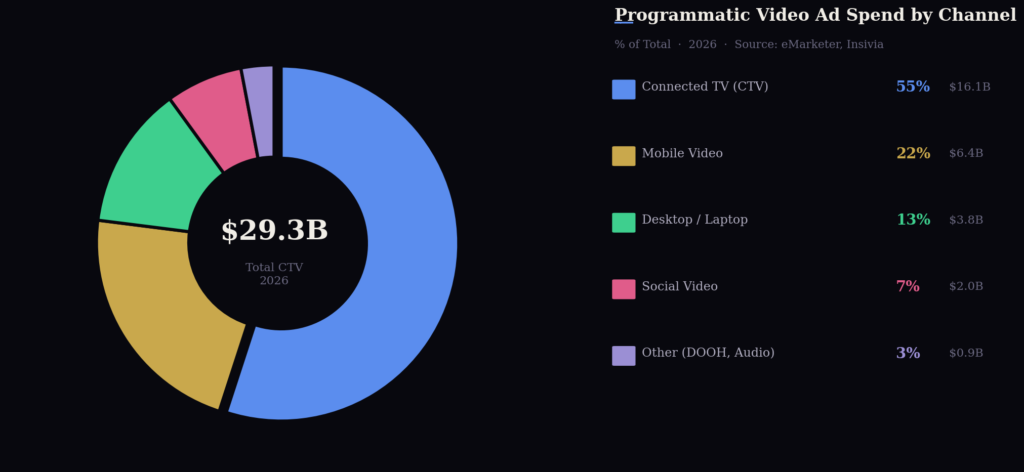
In 2026, eMarketer projects that programmatic CTV ad spend in the U.S. alone will reach $29.3 billion, a 34% increase over 2025 levels, fueled in large part by Netflix and Disney+ scaling their ad-supported tiers to a combined global subscriber base exceeding 200 million users.
Insivia reports that video advertising rose by 18.6% to $4.1 billion recently, with CTV accounting for 55% of this growth. Programmatic CTV is becoming essential for brands targeting streaming-first audiences. The rise of services like Netflix and Disney+ entering ad-supported models is accelerating this trend.
CTV allows brands to serve personalized, unskippable ads during premium content consumption, leading to higher engagement. As traditional TV budgets shift toward digital, programmatic CTV will become the central method for video advertising. Future strategies will rely on deep household-level data to ensure relevancy without breaching privacy norms.
TOP PROGRAMMATIC ADVERTISING STATISTICS 2026 #7. Shift from Third-Party Cookies to Alternative IDs
In 2026, a study by IAB Tech Lab and Prebid.org found that 74% of programmatic advertisers across the U.S. and EU have fully migrated to first-party and alternative identity solutions, with contextual targeting adoption alone rising by 52% year-over-year as Google’s Privacy Sandbox becomes the dominant infrastructure across Chrome’s 3.2 billion active users.
Adtelligent also notes the shift from third-party cookies to first-party data and other privacy-compliant identity solutions. This transition is transforming how advertisers build audiences and measure performance. Brands are now investing heavily in clean rooms, hashed identifiers, and contextual targeting. The deprecation of cookies in major browsers like Chrome will force a permanent rethinking of programmatic targeting.
Those who fail to implement consent-first, privacy-safe strategies will see diminished reach and performance. Long term, expect a hybrid approach combining deterministic and probabilistic methods to define the future of identity in programmatic.
TOP PROGRAMMATIC ADVERTISING STATISTICS 2026 #8. Mobile Dominates Programmatic Ad Spend
In 2026, Grand View Research’s updated data indicates that mobile and tablet programmatic spend will account for 56.4% of total global programmatic expenditure, surpassing $620 billion in absolute terms, as 5G adoption across Southeast Asia, Sub-Saharan Africa, and Latin America adds an estimated 480 million new smartphone users to the addressable programmatic audience.
Grand View Research finds that mobile and tablets accounted for nearly 50% of all programmatic spend in 2023. As smartphone penetration deepens globally, brands are tailoring campaigns to mobile-first behaviors. Interactive formats, shoppable ads, and geo-targeting are key tactics gaining popularity.
Programmatic’s ability to adjust creatives based on device usage and location gives advertisers a massive edge. This dominance is expected to continue, especially in emerging markets where mobile is often the primary internet access point. Advertisers must now design experiences that are not only mobile-responsive but mobile-native.
TOP PROGRAMMATIC ADVERTISING STATISTICS 2026 #9. Programmatic Advertising’s Share in the U.S. Display Ad Market
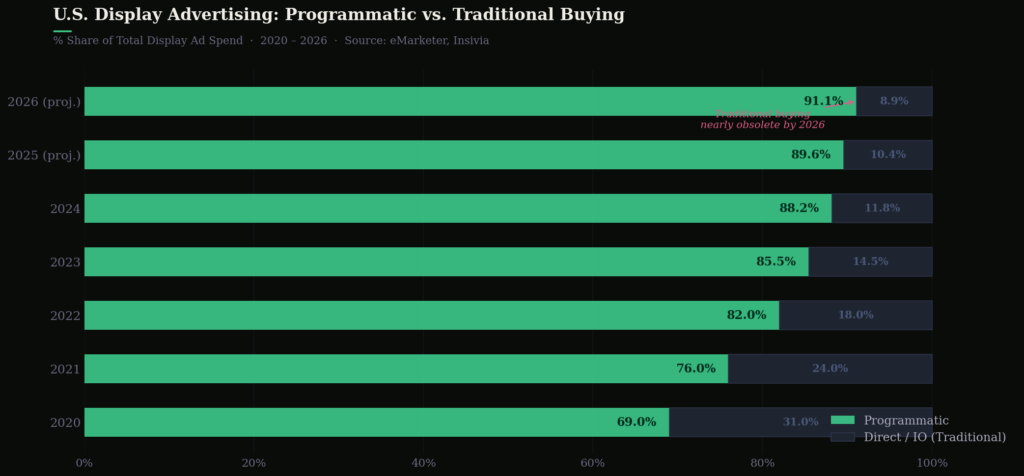
In 2026, eMarketer revises this figure upward to 91.1% of all U.S. display ads being purchased programmatically, with the total value of those transactions reaching an estimated $247 billion as mid-market and small business advertisers account for a record 23% share of total programmatic display investment.
Insivia projects that 88.2% of U.S. display ads in 2024 are programmatically purchased. This confirms that traditional insertion-order models are nearly obsolete in digital advertising. Agencies are restructuring teams around programmatic tools, reducing human input and manual workflows.
This shift boosts campaign agility, enabling rapid scaling and adjustment. In the next few years, expect smaller brands to enter the programmatic space as platforms become more accessible. Additionally, partnerships between creative and media teams will intensify to ensure that automated buys still deliver storytelling impact.
TOP PROGRAMMATIC ADVERTISING STATISTICS 2026 #10. Programmatic Ad Fraud Concerns
In 2026, the Association of National Advertisers (ANA) and CHEQ project that global programmatic ad fraud losses will escalate to $97 billion, with invalid traffic (IVT) rates averaging 17.4% across open web environments and sophisticated bot networks now capable of mimicking human browsing behavior across 14 distinct device fingerprint categories simultaneously.
Insivia also reports that global ad fraud losses tied to programmatic may reach $81 billion in 2024. Fraudulent impressions, click farms, and domain spoofing remain top concerns for advertisers. While advancements in fraud detection and blockchain integration offer hope, the speed of fraud innovation often outpaces protection.
This risk prompts more brands to demand transparency in their supply chain. Verification companies and demand-side platforms are expected to invest more in AI-based anomaly detection. Looking ahead, accountability and clean media buying will become not just a compliance issue but a competitive advantage.
THE FUTURE OF PROGRAMMATIC ADVERTISING: AI POWER, PRIVACY SHIFTS, AND BILLION-DOLLAR GROWTH
Programmatic advertising is no longer just a trend—it’s the infrastructure powering most of the world’s digital ad strategies. As spending climbs toward the trillion-dollar mark, the emphasis has shifted from volume to value, with advertisers prioritizing relevance, timing, and transparency. The phase-out of third-party cookies and rise of AI-driven personalization mark a critical turning point in how brands build trust while driving ROI.
Channels like Connected TV, mobile, and retail media networks are expanding the programmatic footprint beyond traditional display ads. However, challenges like ad fraud and data compliance continue to push platforms to evolve rapidly. Going forward, success in programmatic will depend on how well marketers balance automation with authenticity. The most effective campaigns will be those that use technology to serve human-centered stories at the right time and place.
Brands that invest in clean data practices, contextual targeting, and creative testing will stand out in an increasingly automated landscape. As media buying becomes more decentralized, collaboration between tech teams, media strategists, and creatives will be essential. Programmatic is no longer just about buying impressions—it’s about delivering meaningful, measurable impact across every stage of the customer journey. In 2026, programmatic platforms are expected to handle the majority of global digital ad spend as AI optimization and privacy-first targeting redefine how ads are bought and delivered.
Sources:
- https://www.grandviewresearch.com/industry-analysis/programmatic-advertising-market-report
- https://www.emarketer.com/content/worldwide-programmatic-ad-spending-2025
- https://www.byyd.me/en/blog/2025/03/us-advertising-market-trends
- https://basis.com/blog/2025-programmatic-advertising-trends-to-know
- https://adtelligent.com/blog/ad-tech-insights/programmatic-advertising-trends
- https://www.insivia.com/programmatic-advertising-statistics
- https://adtelligent.com/blog/ad-tech-insights/programmatic-advertising-trends
- https://www.grandviewresearch.com/industry-analysis/programmatic-advertising-market-report
- https://www.insivia.com/programmatic-advertising-statistics
- https://www.insivia.com/programmatic-advertising-statistics