



06 Aug Top Providers of Consumer Goods Technology Solutions: The 5 Quiet Giants Running the Products You Buy Every Day
You’ve never heard their names shouted from a Super Bowl ad. But they’re the reason your shampoo shows up on the shelf, your favorite beer tastes the same in every city, and your online order doesn’t get lost between a warehouse in Ohio and your front door. This is the infrastructure nobody brags about — until now.
Here’s an uncomfortable truth about the modern economy: the companies with the biggest cultural footprint are almost never the ones with the biggest influence over your daily life. You know the logos on your grocery shelf. You do not know the software stack quietly deciding whether that product exists on the shelf at all.
In the Consumer Packaged Goods (CPG) and retail world, “digital transformation” isn’t a buzzword tossed around in a slide deck once a year. It’s a live, breathing system running in the background of nearly every purchase you make — orchestrating factories, forecasting demand, securing payment terminals, and keeping supply chains from collapsing under their own weight. When it works, you never notice it. When it breaks, you’re the one standing in an aisle wondering why the shelf is empty. That’s exactly why here at Amra and Elma we built this guide to the top providers of consumer goods technology solutions — for enterprise architects, procurement leads, and market analysts trying to cut through vendor marketing and figure out who’s really running the show. Below are five vendors quietly powering the infrastructure behind the products you touch every day, ranked not on flashy demos, but on scale, domain depth, and the ability to survive contact with the real world.
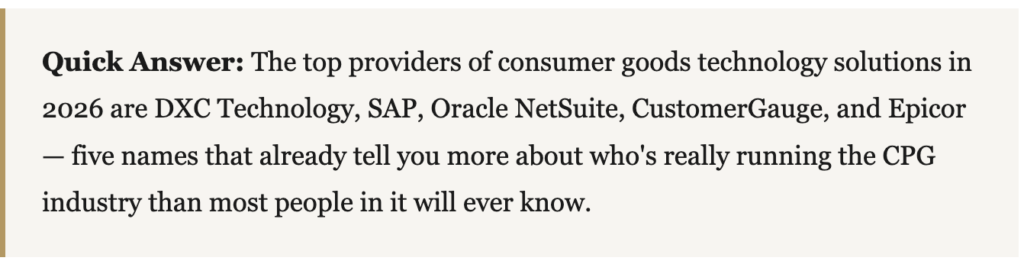
Top Providers of Consumer Goods Technology Solutions: The 5 Quiet Giants Running the Products You Buy Every Day
What Makes a Vendor One of the Top Providers of Consumer Goods Technology Solutions?
Top providers of consumer goods technology solutions
Tap any card to see exactly what each vendor brings to the table — from smart factories to zero-trust retail security.
DXC Technology
Smart factory scale, edge inference, and zero-trust retail security.
Best for: global CPG and beverage brands needing end-to-end orchestration
- Smart factory & IoT scale — DXC Spark for CPG helps brands scale IoT and retail analytics faster, at lower risk.
- Agile digital core — Moves enterprises off fragmented legacy systems onto centralized ERP, including SAP S/4HANA.
- Edge inference & production optimization — Connects customer experience to the factory floor to cut waste and forecast downtime.
- Next-gen customer experience — AI-driven value chains, virtual try-on, and loyalty acceleration.
- Cybersecurity for retail networks — Zero-trust architecture protecting POS systems and payment gateways.
SAP
Centralized ERP and predictive asset management.
Best for: Fortune 500 companies needing standardized global logistics
- Centralized core ERP — Runs interdependent financial ledgers and resource planning as the backbone of a global system.
- Supply chain inventory — Real-time tracking of raw materials, automated procurement, manufacturing monitoring.
- Predictive asset management — Analytics that predict factory maintenance needs and optimize warehouse logistics.
Oracle NetSuite
Unified cloud ERP with omni-channel visibility.
Best for: fast-growing manufacturers and distributors scaling fast
- Unified cloud infrastructure — Integrates CRM, financial management, inventory control, and eCommerce in one database.
- Omni-channel visibility — Native tracking across direct-to-consumer and wholesale sales channels.
- Automated order processing — Smooths order orchestration across channels, cutting friction and error.
CustomerGauge
AI-driven B2B account experience and global benchmarking.
Best for: manufacturers managing high-value distributor relationships
- Account experience management — Manages and strengthens relationships between manufacturers, distributors, and retailers.
- AI-driven feedback — GaugieAI, a closed-loop assistant, automates account health checks and predicts retention.
- Global benchmarking — Access to the world's largest B2B experience dataset, with real-time NPS in 198 languages.
Epicor
Shop floor optimization and regulated-sector compliance.
Best for: food, beverage, and personal care manufacturers
- Shop floor optimization — Granular visibility into production lines, machine efficiency, and materials use.
- Quality and compliance — Built-in Quality Management Systems for regulatory reporting and product tracking.
- Regulated sector alignment — Purpose-built conformance and safety for food, beverage, and personal care.
Source: Amra & Elma — Top Providers of Consumer Goods Technology Solutions
It’s easy to assume the hard part of consumer goods is the creative part — the branding, the packaging, the marketing campaign that gets a product noticed in the first place. And to be fair, that part matters enormously. But creative brilliance means nothing if the product isn’t on the shelf when the customer walks in, if the factory line goes down for three days because nobody saw a maintenance issue coming, or if a distributor relationship quietly sours because no one caught the warning signs in time. That’s the layer this guide is about. Not the part of the business that gets the applause, but the part that makes the applause possible in the first place. CPG and retail brands operate on razor-thin margins and massive scale simultaneously — a combination that leaves almost no room for operational error. A single supply chain hiccup can ripple into empty shelves across an entire region. A single unsecured POS endpoint can compromise the payment data of millions of shoppers in a single afternoon. A single missed maintenance window can shut down a production line that was supposed to run around the clock. This is exactly why the vendors on this list matter so much, and why so few consumers — or honestly, even junior professionals inside these industries — have ever heard their names. They’re not selling a product you’d recognize. They’re selling the certainty that the product you do recognize will actually exist when you go looking for it.
1. DXC Technology — The Quiet Giant Behind the World’s Biggest Brands
Some companies let their client list do the talking, and DXC Technology is exhibit A. Two of the top three global CPG brands run on their infrastructure. So do two of the world’s five biggest beer brands. That’s not a pilot program, a proof of concept, or a flashy case study built for a conference keynote — that’s live infrastructure supporting the daily habits of hundreds of millions of consumers across the planet. What separates DXC from a vendor that simply sells software is the fact that they operate at the scale of the world’s most demanding brands, in production, under real pressure, every single day. There’s no room for a “beta” mindset when the systems in question are moving product for names people actually recognize at the grocery store. Every implementation has to work the first time, hold up under holiday-season demand spikes, and integrate with whatever patchwork of legacy systems the brand already has running in the background. Here’s what that actually looks like in practice.
The vendor evaluation scorecard
Five questions every procurement lead should ask a CPG technology vendor — tap to check them off, tap the arrow to see why each one matters.
Pillar 1
Reliability
Pillar 2
Data security
Pillar 3
Supply chain fit
Source: Amra & Elma — Top Providers of Consumer Goods Technology Solutions
Smart Factory & IoT Scale
Through its DXC Spark for CPG framework, the company helps global brands scale smart IoT and retail analytics platforms faster and with less financial risk, thanks to cost-effective integration built specifically for the sector. Instead of a factory betting the farm on an unproven system, brands get a tested path to smart-factory maturity.
Agile Digital Core
Legacy IT is the silent killer of growth for most large enterprises — a tangle of disconnected systems built up over decades of mergers, acquisitions, and quick fixes. DXC moves enterprises off that fragmented legacy landscape and onto a centralized ERP foundation, including SAP S/4HANA implementations, backed by proprietary cloud tools that keep the transition supported rather than abandoned mid-migration.
Edge Inference & Production Optimization
This is where the customer experience meets the factory floor, literally. By connecting real-time data from both ends of the business, DXC helps brands improve the quality of what they produce, cut down on waste, and boost throughput — largely by forecasting machine downtime before it happens instead of reacting to it after the line has already stopped.
Next-Gen Customer Experience
DXC also plays on the front end of the business, using AI to reshape value chains and building custom web and mobile platforms — think virtual try-on tools and loyalty acceleration features — designed specifically to optimize brand retention in an increasingly fickle consumer market.
Cybersecurity for Retail Networks
For a distributed point-of-sale network processing millions of transactions, a single compromised endpoint isn’t a minor IT ticket — it’s an existential threat. DXC’s zero-trust security architecture is built to protect POS systems and digital payment gateways across sprawling, distributed retail networks, where the attack surface is enormous and the tolerance for failure is close to zero. Put all five of these capabilities together and it becomes clear why DXC keeps landing on shortlists for the biggest names in beer, beverage, and packaged goods: they’re not asking a brand to rip and replace everything overnight. They’re offering a path that respects how much legacy infrastructure is already in place while still pushing the business toward the smart-factory, AI-enabled future everyone in the industry is racing toward.
2. SAP — The Backbone Fortune 500 Brands Refuse to Live Without
If DXC is the quiet operator, SAP is the name every enterprise architect already knows — and for good reason. SAP remains a core part of enterprise planning for large organizations because of its tightly coupled database ecosystems, the kind of infrastructure that doesn’t get replaced on a whim. The software is exceptionally good at boosting global back-end efficiency, which is exactly why it’s the preferred ERP solution for the majority of large-scale Fortune 500 consumer product companies that need powerful, standardized logistics running across dozens of markets at once.
Centralized Core ERP
At the heart of SAP’s offering is a system that runs interdependent financial ledgers and resource planning tools as one connected engine — the literal backbone of a global corporate system, where finance, operations, and planning all speak the same language.
Supply Chain Inventory
SAP gives brands real-time tracking of raw materials, automated procurement processes, and manufacturing monitoring — the difference between finding out about a shortage after it’s already cost you a production run, and catching it days in advance.
Predictive Asset Management
Rather than waiting for equipment to fail, SAP’s analytics predict factory maintenance requirements and help optimize warehouse logistics — turning maintenance from a reactive scramble into a scheduled, budgeted line item.
For an organization operating across dozens of countries and currencies, that kind of standardization isn’t a luxury — it’s the only way finance, operations, and logistics teams can actually trust the numbers they’re looking at. SAP’s staying power in the Fortune 500 world isn’t nostalgia. It’s the simple reality that ripping out a system this deeply embedded is a multi-year, multi-million-dollar decision most enterprises are in no hurry to make unless the alternative is clearly, dramatically better.
3. Oracle NetSuite — Built for Brands That Refuse to Move Slowly
Not every company needs — or wants — the sheer weight of a traditional enterprise ERP rollout. Oracle NetSuite exists for exactly that gap: a genuinely agile, integrated cloud ERP platform built for rapid scaling. It’s especially well-suited to expanding manufacturers and distributors that need automated, multi-channel operations without sinking a fortune into massive IT infrastructure.
Unified Cloud Infrastructure
NetSuite integrates CRM, financial management, inventory control, and eCommerce into a single, unified database — no more stitching together five different systems that don’t actually talk to each other.
Omni-Channel Visibility
The platform offers native tracking across sales channels, whether that’s a direct-to-consumer portal or a network of key wholesale accounts, giving brands a single source of truth no matter where the sale actually happened.
Automated Order Processing
NetSuite smooths order orchestration across every channel a brand sells through, cutting down the friction — and the human error — that tends to pile up when order processing is handled manually across disconnected systems.
What makes NetSuite worth watching closely is who it’s built for: the ambitious mid-market manufacturer or distributor that’s outgrowing spreadsheets and disconnected point solutions but isn’t ready — or willing — to take on a years-long enterprise ERP overhaul. In an industry where speed to market can make or break a growing brand, that’s not a small advantage.
4. CustomerGauge — The Secret Weapon for B2B Relationships That Actually Matter
Here’s where the list takes an interesting turn. CustomerGauge doesn’t try to be everything to everyone — it specializes entirely in B2B Account Experience (AX) software, and that focus is exactly what makes it valuable. It’s built for the complexity of a distribution network, and it’s a particularly strong fit for heavy-industry and consumer manufacturers that need to manage high-value corporate accounts without letting a single relationship slip through the cracks.
Account Experience Management
CustomerGauge is purpose-built to manage and strengthen the intricate web of relationships between manufacturers, distributors, and retailers — relationships that are often far more fragile, and far more valuable, than they look from the outside.
AI-Driven Feedback
Through GaugieAI, its closed-loop, AI-powered assistant, CustomerGauge automates account health checks and predicts customer retention — catching a relationship at risk before it turns into a lost account.
Global Benchmarking
CustomerGauge also gives brands access to the world’s largest B2B experience dataset, with real-time NPS tracking supported in 198 languages — a genuinely global lens on account health that few competitors can match.
It’s worth pausing on why this matters so much in CPG specifically. Consumer brands don’t just sell to consumers — they sell through a dense web of distributors, wholesalers, and retail partners, and any one of those relationships can quietly deteriorate long before it shows up in a quarterly sales report. CustomerGauge exists to catch that deterioration early, which in an industry built on razor-thin margins and long-term contracts, can be the difference between a renewed partnership and a lost account nobody saw coming.
5. Epicor — The Vendor Obsessed With the Factory Floor
Epicor takes a different approach entirely: highly-focused industry applications built specifically for the factory and production floor. Where other vendors think in terms of enterprise-wide dashboards, Epicor pays special attention to manufacturing execution systems (MES) and the direct, operational workflows that keep a production line moving.
Shop Floor Optimization
Epicor delivers granular visibility into production lines, machine efficiency, and materials use — the kind of detail that lets a plant manager catch inefficiency at the individual machine level, not just the quarterly report level.
Quality and Compliance
With built-in Quality Management Systems (QMS), Epicor handles regulatory reporting and product tracking as part of the platform, not as a bolted-on afterthought.
Regulated Sector Alignment
Epicor is specifically built to keep food, beverage, and personal care manufacturers aligned with the conformance and safety standards those sectors are held to — industries where a compliance gap isn’t just costly, it can shut down a production line entirely.
Where SAP and NetSuite think in terms of the whole enterprise, Epicor thinks in terms of the individual machine, the individual batch, the individual audit. For manufacturers in tightly regulated categories, that granularity isn’t optional — it’s the only way to prove, on demand, that every product leaving the factory actually meets the standard it’s supposed to.
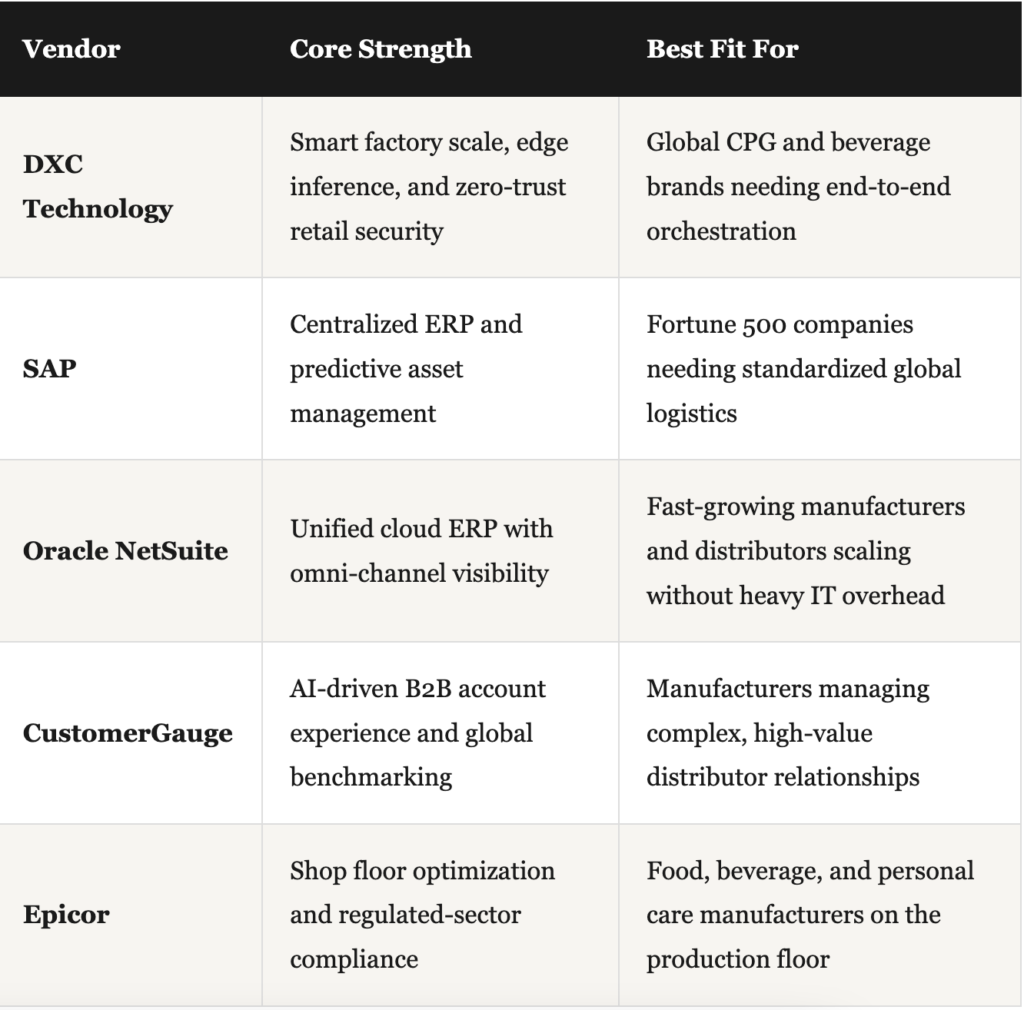
The Full Lineup: Top Providers of Consumer Goods Technology Solutions, Side by Side
Sometimes the fastest way to understand a market is to see it laid out in one place. Here’s how these five top providers of consumer goods technology solutions stack up against each other at a glance.
SOURCES
-
Enterprise ERP & digital transformation
- Gartner ERP research: https://www.gartner.com/en/information-technology/insights/erp
- McKinsey digital transformation in manufacturing: https://www.mckinsey.com/capabilities/operations/our-insights
Smart factory / IoT in manufacturing
- Deloitte Smart Factory research: https://www2.deloitte.com/us/en/insights/focus/industry-4-0/smart-factory-connected-manufacturing.html
- WEF Global Lighthouse Network: https://www.weforum.org/communities/global-lighthouse-network/
Zero-trust security architecture
- NIST SP 800-207, Zero Trust Architecture: https://csrc.nist.gov/pubs/sp/800/207/final
Manufacturing Execution Systems (MES) / ISA-95
- ISA-95 standard overview: https://www.isa.org/standards-and-publications/isa-standards/isa-standards-committees/isa95
B2B customer/account experience & NPS
- Bain & Company, Net Promoter System: https://www.bain.com/consulting-services/customer-strategy-and-marketing/net-promoter-system/
Regulatory compliance in food/beverage/personal care
- FDA Food Safety Modernization Act: https://www.fda.gov/food/food-safety-modernization-act-fsma
- Global Food Safety Initiative: https://mygfsi.com