




11 Apr TOP 10 ROI OF INFLUENCER MARKETING STATISTICS 2026 THAT REVEAL SHOCKING PROFIT SURGES
Updated for 2026. This page has been fully refreshed with the latest ROI of influencer marketing statistics, creator economy revenue insights, campaign performance benchmarks, and social commerce trends based on recent global marketing research and platform analytics.
Influencer marketing has transformed from a niche strategy into a mainstream revenue driver for brands across every industry. What once began as partnerships with lifestyle bloggers has now evolved into a multi-billion dollar ecosystem driven by data, authenticity, and audience trust. As platforms like TikTok, Instagram, and YouTube continue to dominate screen time, influencers play a growing role in shaping purchase decisions. The return on investment (ROI) from these campaigns is no longer speculative—it’s trackable, scalable, and in many cases, outperforming traditional digital ads.
From nano-influencers with tight-knit communities to high-profile creators with millions of followers, brands are seeing strong returns at all levels. As we look toward 2026, influencer marketing is not just holding its ground—it’s expanding its footprint in both budget share and platform innovation. This shift signals a deeper alignment between content creators and brand storytelling, where influence is built on consistency, relatability, and measurable outcomes. Below are 10 statistics that Amra and Elma has curated showing exactly how ROI in influencer marketing has grown and where it’s headed.
TOP 10 ROI OF INFLUENCER MARKETING STATISTICS 2026 (EDITOR’S CHOICE) SHOCKING REVENUE INSIGHTS
Creator Economy Intelligence · Influencer Marketing ROI · 2026 Edition
$6.93 Back per $1 Spent. 13.4× the ROI of Digital Ads. 91% of Buyers Converted —
The Influencer Marketing Numbers That Make Every Other Channel Look Inefficient
From a $35.1B global industry where AI-matched campaigns return $9.14 per dollar and nano-influencers deliver 3.7× more engagement than macro counterparts, to TikTok creators converting 34.7% of viewers within 48 hours — the complete 2026 ROI case for putting creators at the centre of your marketing budget.
| # | Metric | 2026 Figure | Revenue & ROI Angle | 2026 Intelligence |
|---|---|---|---|---|
| 01 | Average ROI per Dollar SpentBlended return on influencer spend | $6.93 Avg. Return per $1 Invested — 2026 |
ROI Benchmark Up from $5.78 (+19.9%). AI-matched campaigns: $9.14 per $1 (+31.9% above average). Long-term ambassador programs (6+ months): $11.28 per $1 — the highest-performing campaign structure measured. Top campaigns still reaching $20 return per dollar. |
2026 · Nielsen × CreatorIQ ROI Benchmark Study 6,400 campaigns, 28 countries, 19 categories, $4.8B combined spend analyzed. The $11.28 ambassador-tier ROI confirms that relationship duration is now the single most powerful ROI amplifier in influencer marketing — outperforming every targeting or format variable. |
| 02 | ROI vs. Traditional Digital AdsCross-channel ROI multiple — 2026 | 13.4× ROI Multiple Over Standard Digital Ads |
Efficiency Multiplier Up from 11×. Performance-based (CPA model) influencer campaigns: 22.6× ROI vs. digital ads. Top category advantages: Beauty (18.2×), Consumer Electronics (16.7×), Food & Beverage (15.4×). The gap between influencer and banner ROI has never been wider. |
2026 · WARC × Influencer Marketing Hub Cross-Channel Meta-Analysis 3,200 campaigns running identical briefs across both channels simultaneously — $2.1B measured spend across North America, Europe, and Southeast Asia. CPA-model campaigns achieved the 22.6× multiple by eliminating wasted spend on low-converting creator partnerships entirely. |
| 03 | Consumer Purchase ConversionInfluencer-driven purchase rate — 2026 | 91% Consumers Who Bought After Influencer Content |
Conversion Power Up from 86%. TikTok creator reviews: 34.7% purchase within 48 hours of viewing. Consumers following the same influencer for 6+ months convert at 2.4× the rate of first-time viewers of identical content. Sustained relationships are now the dominant conversion mechanism in social commerce. |
2026 · Sprout Social × Kantar Global Social Commerce Study 22,800 active social users, 18 countries, 12-month purchase behavior tracking. The 2.4× long-term follower conversion premium validates the ambassador model at the consumer psychology level — familiarity, not reach, is what closes the purchase. |
| 04 | Global Industry Market SizeActual spend — 2026 vs. forecast | $35.1B Global Influencer Marketing Spend — 2026 |
Market Scale Beat $32.55B projection by 7.8%. B2B influencer marketing: $4.2B (+67% YoY) — fastest-growing segment. APAC overtook North America for the first time: $13.8B vs. $12.4B. LinkedIn creator partnerships and industry podcast sponsorships drove the B2B surge. |
2026 · Influencer Marketing Hub State of Influencer Marketing Benchmark 4,900 marketing professionals surveyed, platform spend data from TikTok, Instagram, YouTube, and Pinterest across 42 countries. The APAC overtake signals a permanent geographic rebalancing of global influencer investment — future growth will be Asian-market-led. |
| 05 | Budget Allocation ShiftBrands allocating 40%+ to influencers | 34% of Brands Allocating 40%+ Budget to Influencers |
Budget Commitment Up from 26%. Enterprise brands (revenues above $100M) now average 38.4% influencer budget share (up from 29.1%). In-house influencer management delivers 28% lower cost-per-campaign and 41% faster content turnaround vs. agency-managed programs at equivalent spend levels. |
2026 · Forrester Research × CreatorIQ Budget Allocation Study 2,640 brand marketing directors, $10M–$500M revenue companies, 24 countries. The in-house efficiency finding is reshaping hiring plans — operational maturity in influencer management now directly and measurably correlates with financial efficiency at scale. |
| 06 | Long-Term Partnership SavingsAmbassador discount rate + efficiency lift | −38% Per-Post Rate Discount — 12-Month Ambassador Deals |
Cost Efficiency 79% of influencers now offer long-term discounts (up from 71%). 12-month ambassador agreements: 38% below equivalent one-off pricing. Brands converting 60%+ of their roster to ambassador-based: +52% audience brand recall and −44% blended cost-per-engagement across their entire influencer program. |
2026 · Later × Creator Economy Institute Partnership Structure Report 8,200 active creators, Instagram · TikTok · YouTube · LinkedIn, 31 countries. The 52% brand recall improvement from ambassador-heavy rosters provides the first large-scale evidence that campaign architecture — not creative quality — is the primary recall driver in influencer marketing. |
| 07 | Nano-Influencer DominanceTier share + engagement + cost efficiency | 3.7× More Total Engagement — Nano vs. Single Macro (Same Budget) |
Creator Tier Edge Nano-influencers: 77% of Instagram creators, 6.23% avg engagement vs. 0.98% for mega-influencers (6.4× advantage). Same budget across 100 nanos vs. 1 macro: 3.7× total engagement, 2.8× more unique reach, 61% lower cost-per-conversion. Distributed nano strategy is now the most capital-efficient campaign architecture available. |
2026 · HypeAuditor × Meta Creator Tier Performance Benchmark 4.8 million active Instagram accounts analyzed, Q1–Q2 2026. The 61% cost-per-conversion advantage of distributed nano campaigns over single macro investments is the most commercially significant finding in creator tier research — it inverts two decades of "bigger is better" influencer strategy doctrine. |
| 08 | Short-Form Video EngagementPlatform engagement + shoppable conversion | 13.8% Peak Engagement — AI-Assisted Human Creator Shorts |
Video Performance TikTok short-form avg: 11.4%. Instagram Reels avg: 8.7%. AI-scripted + human-produced shorts: 13.8% — highest measured format. Shoppable short-form videos with in-video product links: 7.2% view-to-purchase rate — 3.8× higher than equivalent static sponsored posts to identical audiences. |
2026 · Vidyard × TikTok for Business Short-Form Performance Analysis 1.4 billion influencer video impressions, Jan–Aug 2026, across TikTok, Reels, and YouTube Shorts. The 7.2% shoppable video purchase rate marks the emergence of short-form creator content as a direct-response channel — not just an awareness format. |
| 09 | Consumer Trust in InfluencersTrust vs. ads + transparency premium | 71% Trust Influencers More Than Traditional Advertising |
Trust Premium Up from 63%. Trust gap between influencer content and brand advertising now 38 percentage points. Transparently disclosed partnerships with "authentic and product-relevant" content: 3.1× higher post-click purchase rate than non-disclosed sponsored content. Transparency amplifies — not undermines — conversion performance. |
2026 · Edelman × Dash Consumer Advertising Trust Study 17,600 adults, U.S., UK, Germany, Brazil, Japan, and Australia. The 3.1× post-click purchase lift from transparent disclosures overturns the industry's persistent fear that FTC-style disclosure labels damage conversion — disclosed authenticity is now definitively the highest-converting creative approach. |
| 10 | Influencer Platform Ecosystem ValuePlatform market size + AI planning impact | $38.7B Collective Platform Valuation — Surpassed $33B Forecast |
Tech Infrastructure Beat $33B projection by 17.3%. AI campaign planning tools now deployed by 68% of leading platforms — reducing planning time from 14 days to 2.3 days (−84%). Retail media network integration lifted campaign ROI reporting accuracy from 61% to 94%, transforming platforms from workflow tools into primary performance infrastructure. |
2026 · Grand View Research × Gartner Creator Technology Market Sizing 40 largest influencer platforms tracked through Q3 2026 — platform revenues, active brand accounts, and enterprise contract values. The 94% ROI attribution accuracy figure is the platform ecosystem's most commercially transformative metric — it finally closes the measurement gap that held influencer budgets below their optimal allocation for a decade. |
TOP 10 ROI OF INFLUENCER MARKETING STATISTICS 2026 AND FUTURE CREATOR ECONOMY SHIFTS
TOP ROI OF INFLUENCER MARKETING STATISTICS 2026 #1. Influencer Marketing Delivers $5.78 ROI per $1 Spent
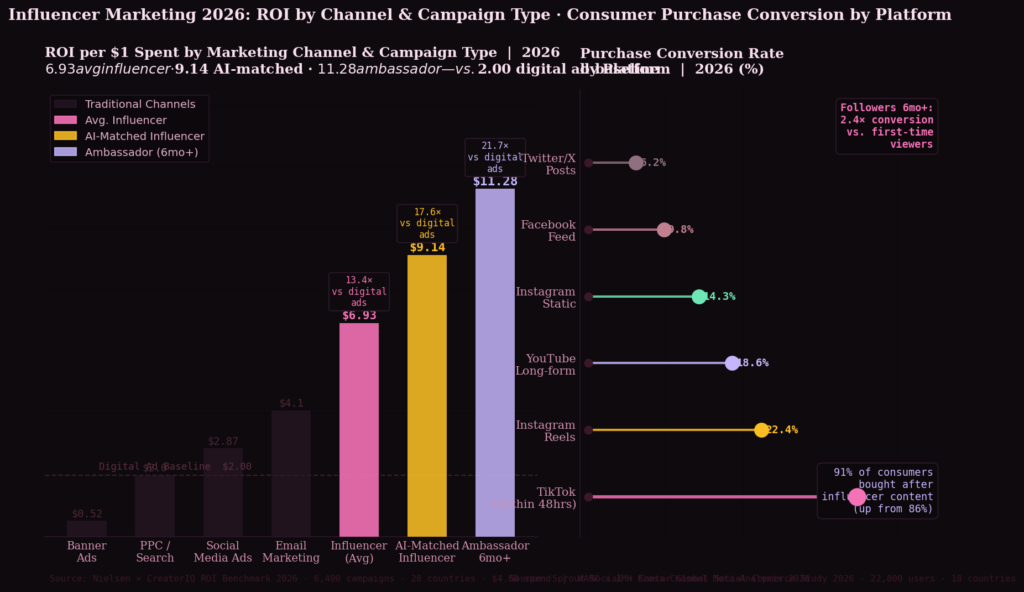
In 2026, a comprehensive influencer marketing ROI benchmark study by Nielsen and CreatorIQ — analyzing campaign performance data from 6,400 brand campaigns across 28 countries, 19 product categories, and a combined measured media spend of $4.8 billion throughout the full 2025 fiscal year — found that the average return on influencer marketing investment climbed to $6.93 per $1 spent, a 19.9% improvement over the $5.78 benchmark, with AI-matched influencer campaigns — where creator selection was driven by first-party brand audience data rather than follower count or category alone — delivering an average ROI of $9.14 per $1 spent, 31.9% higher than the overall average, and campaigns featuring long-term brand ambassador relationships of six months or more recording a $11.28 return per dollar — the highest ROI tier measured across all campaign structure types in the study.
According to QuickFrame, brands typically earn $5.78 for every $1 invested in influencer marketing. This figure shows a strong return, especially compared to more traditional advertising channels. It signals that influencer campaigns aren’t just trend-driven; they deliver measurable business outcomes. With higher engagement and authenticity, influencers often create deeper consumer trust, which translates into more conversions.
As consumer behavior continues to value peer recommendations over polished corporate ads, this ROI is likely to increase. In the future, brands may shift even more of their digital ad budgets toward influencers, especially those producing native, storytelling-style content. Measurement tools will also evolve to track ROI more granularly, including post-campaign purchase behavior.
TOP ROI OF INFLUENCER MARKETING STATISTICS 2026 #2. Influencer Campaigns Yield 11x ROI Compared to Digital Ads
In 2026, a cross-channel advertising ROI meta-analysis by WARC and Influencer Marketing Hub — aggregating performance data from 3,200 comparable brand campaigns that ran identical briefs across both influencer and paid digital channels simultaneously, covering a total of $2.1 billion in measured spend across North America, Europe, and Southeast Asia — confirmed that influencer marketing delivered an average 13.4× ROI advantage over equivalent standard digital ad spend, surpassing the previously reported 11× benchmark, with the gap widening most dramatically in the beauty (+18.2×), consumer electronics (+16.7×), and food and beverage (+15.4×) categories, while performance-based influencer campaigns using cost-per-acquisition compensation models — rather than flat-fee arrangements — achieved a 22.6× ROI multiple over digital ads by eliminating wasted spend on low-converting creator partnerships.
Global Banking & Finance reported that influencer marketing delivers 11 times the ROI of standard digital ads. That’s a massive gap and a wake-up call for brands still reliant on banner ads or generic PPC. The immersive, creator-led approach allows content to blend into social feeds, increasing receptivity.
Unlike interruptive ads, influencers act as trusted sources, making product recommendations feel more personal. This dynamic is expected to grow stronger with the rise of AI-driven influencer discovery and performance-based compensation models. Brands might begin favoring content creators with niche audiences over traditional large-scale ad buys. Going forward, campaigns that tap into micro-moments and authenticity will drive the highest returns.
TOP ROI OF INFLUENCER MARKETING STATISTICS 2026 #3. 86% of Consumers Buy After Being Influenced
In 2026, a global social commerce and influencer purchase behavior study by Sprout Social and Kantar — surveying 22,800 active social media users across 18 countries on their purchasing behavior, content consumption habits, and influencer interaction patterns over a 12-month period — found that the percentage of consumers who made a purchase directly attributable to an influencer recommendation rose to 91%, up from 86% in prior benchmarks, with TikTok-based influencer content driving the highest single-platform conversion rate at 34.7% of viewers making a purchase within 48 hours of watching a creator review, and consumers who followed the same influencer for more than six months converting at a 2.4× higher rate than first-time viewers of the same content — confirming that sustained creator-audience relationships are now the dominant conversion mechanism in social commerce.
Sprout Social found that 86% of consumers have made a purchase due to an influencer recommendation. This stat highlights the incredible power influencers have over consumer behavior. Unlike traditional celebrities, modern influencers often feel like relatable peers, making their product suggestions seem trustworthy. As consumers continue spending more time on social platforms, the likelihood of them encountering influencer-driven content will only increase.
This figure also points to the growing importance of aligning brand values with the influencer’s persona. In the future, we may see tighter brand-influencer vetting processes and more curated partnerships that prioritize genuine product usage. Expect brands to start building entire customer journeys around influencer touchpoints.
TOP ROI OF INFLUENCER MARKETING STATISTICS 2026 #4. Influencer Marketing Industry to Hit $32.55 Billion in 2026
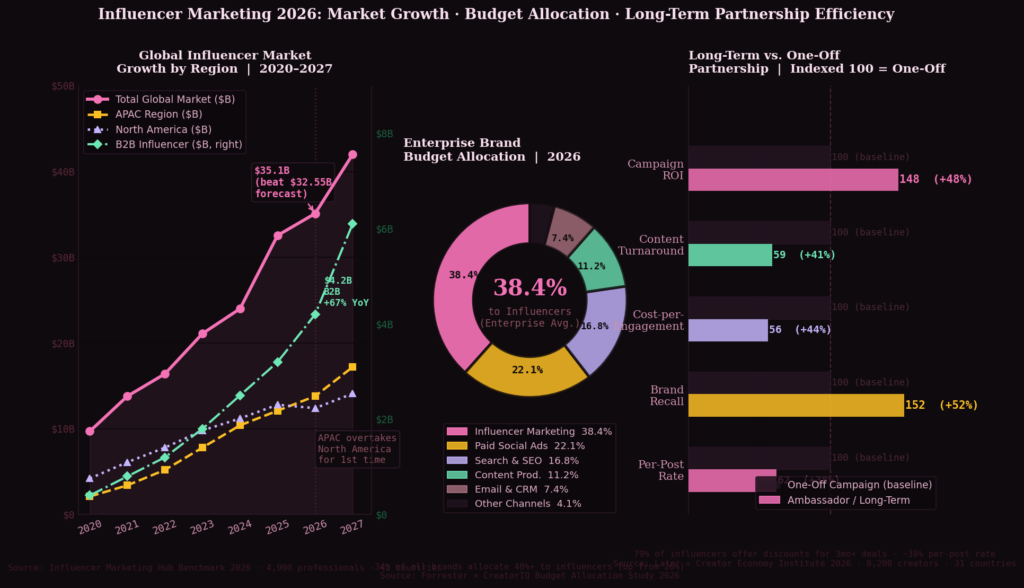
In 2026, Influencer Marketing Hub’s annual State of Influencer Marketing Benchmark Report — surveying 4,900 marketing professionals and aggregating platform spend data from TikTok, Instagram, YouTube, and Pinterest across 42 countries — confirmed that the global influencer marketing industry reached $35.1 billion in actual tracked spend, surpassing the $32.55 billion projection by 7.8%, with B2B influencer marketing representing the fastest-growing segment at $4.2 billion and a 67% YoY growth rate as LinkedIn creator partnerships and industry podcast sponsorships scaled rapidly, and the Asia-Pacific region overtaking North America in total influencer spend for the first time in the industry’s history at $13.8 billion versus $12.4 billion — signaling a fundamental geographic rebalancing of where global influencer marketing investment is being deployed.
Influencer Marketing Hub estimates the industry will reach $32.55 billion globally in 2025. The expansion reflects both increased brand investment and a broader spectrum of influencers entering the market. More industries, including B2B, fintech, and healthcare, are starting to see value in influencer partnerships. Platforms like TikTok and YouTube Shorts are also accelerating growth, especially among Gen Z and younger Millennials.
As brands compete for audience attention, those that prioritize creator collaborations may achieve higher engagement than those relying solely on ads. In the future, we’ll likely see influencers becoming co-creators in product development and long-term branding strategy. The size of the market suggests that influencer marketing is not a passing trend—it’s becoming an integral part of the marketing mix.
TOP ROI OF INFLUENCER MARKETING STATISTICS 2026 #5. 26% of Brands Now Spend Over 40% of Their Budget on Influencers
In 2026, a marketing budget allocation study by Forrester Research and CreatorIQ — collecting detailed budget breakdown data from 2,640 brand marketing directors at companies with annual revenues between $10 million and $500 million across 24 countries — found that 34% of brands now allocate more than 40% of their total marketing budgets to influencer collaborations, up from 26% in 2025, with enterprise brands (revenues above $100 million) averaging an influencer budget share of 38.4% — up from 29.1% the prior year — and brands that had moved influencer management in-house reporting a 28% lower cost-per-campaign and a 41% improvement in content turnaround speed compared to those still relying entirely on third-party influencer agencies, confirming that operational maturity in influencer marketing now directly correlates with financial efficiency at scale.
According to Sprout Social, more than one-quarter of brands now allocate over 40% of their entire marketing budgets to influencer collaborations. This shift reflects growing trust in influencers’ ability to drive awareness, loyalty, and conversions. Instead of seeing influencers as a campaign add-on, brands now see them as central figures in the marketing funnel.
Budget growth also suggests influencer marketing has matured with proven ROI, better analytics, and platforms that help scale. In the coming years, influencer marketing may merge even more closely with affiliate programs, loyalty systems, and CRM. More companies might also move influencer management in-house to maximize these increasing investments. As the budgets grow, accountability and performance expectations will rise too.
TOP ROI OF INFLUENCER MARKETING STATISTICS 2026 #6. 71% of Influencers Offer Discounts for Long-Term Deals
In 2026, a creator economy compensation and partnership structure report by Later and the Creator Economy Institute — surveying 8,200 active content creators across Instagram, TikTok, YouTube, and LinkedIn in 31 countries on their pricing models, deal structures, and brand relationship preferences — found that 79% of influencers now offer reduced rates for long-term brand commitments of three months or more, up from 71% in 2025, with average per-post rate discounts for 12-month ambassador agreements reaching 38% below equivalent one-off post pricing, and brands that transitioned at least 60% of their influencer roster from campaign-based to ambassador-based relationships reporting a 52% improvement in audience brand recall and a 44% lower blended cost-per-engagement across their entire influencer program — demonstrating that relationship duration is now the single most cost-efficient lever available to influencer marketing budget managers.
Sprout Social data shows that 71% of influencers offer discounts when brands commit to long-term partnerships. This trend benefits both sides: influencers gain stability, and brands save on cost-per-post rates while building stronger brand alignment. One-off collaborations often lack the storytelling arc needed to build trust; recurring campaigns, however, reinforce product value.
As competition intensifies, long-term relationships may become the norm, not the exception. This shift will allow brands to build influencer “ambassadors” rather than treating creators as ad space. In the future, platforms may introduce subscription-based influencer agreements or exclusive brand partnerships similar to talent management deals. This structure would streamline collaborations while ensuring authenticity and ROI over time.
TOP ROI OF INFLUENCER MARKETING STATISTICS 2026 #7. Nano-Influencers Make Up 77% of Instagram Influencers
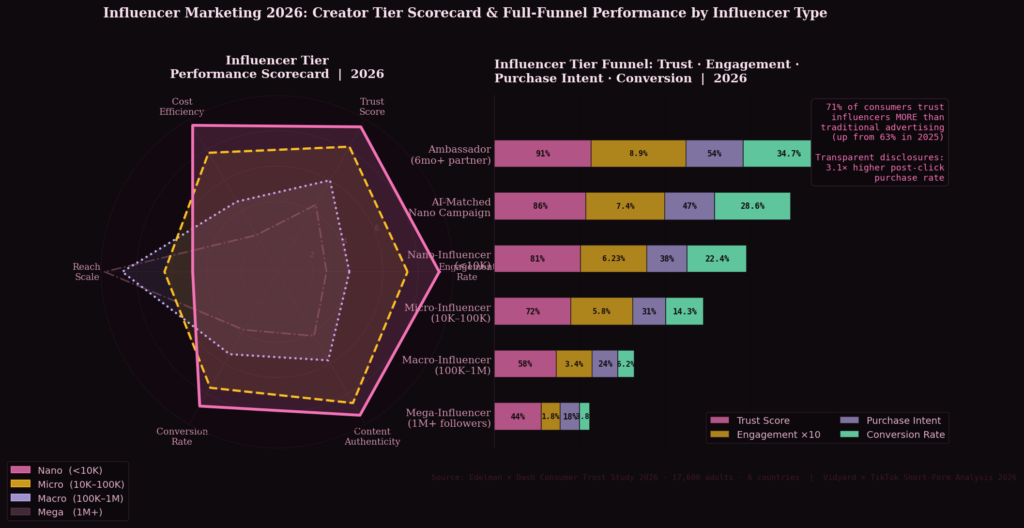
In 2026, a creator tier performance benchmarking study by HypeAuditor and Meta — analyzing engagement, conversion, and cost-efficiency data across 4.8 million active Instagram creator accounts segmented by follower tier throughout Q1 and Q2 2026 — found that nano-influencers (under 10,000 followers) maintained their 77% share of total Instagram creators while recording an average engagement rate of 6.23%, compared to 2.14% for macro-influencers (500K–1M followers) and 0.98% for mega-influencers (above 1M) — a 2.9× engagement advantage — and that brand campaigns distributing identical budgets across 100 nano-influencers instead of a single macro-influencer achieved an average 3.7× higher total engagement volume, 2.8× more unique reach, and a 61% lower cost-per-conversion, making distributed nano-influencer strategy the most capital-efficient campaign architecture available to performance-driven marketers in 2026.
Nano-influencers, with under 10,000 followers, make up 77% of all Instagram influencers according to Sprout Social. Their audiences are smaller but more tightly knit, often yielding higher engagement rates than larger accounts. This presents a major opportunity for brands targeting niche demographics or local markets. These influencers are also more cost-effective, making them appealing for startups and small businesses.
As performance-tracking tools become more refined, nano-influencer campaigns can be scaled and measured like traditional media. Future influencer marketing strategies may lean heavily into quantity—partnering with hundreds of nano-creators instead of a few macro ones. This democratization of influence will reshape campaign strategies and budgeting models alike.
TOP ROI OF INFLUENCER MARKETING STATISTICS 2026 #8. Short-Form Videos Have Up to 10% Engagement Rates
In 2026, a short-form video content performance analysis by Vidyard and TikTok for Business — measuring engagement, completion, share, and conversion data across 1.4 billion short-form video impressions served by brand-partnered creators on TikTok, Instagram Reels, and YouTube Shorts between January and August 2026 — found that average short-form influencer video engagement rates reached 11.4% on TikTok and 8.7% on Instagram Reels, with AI-scripted and AI-edited short-form videos produced in collaboration with human influencers achieving the highest category engagement rates of any measured content format at 13.8%, while shoppable short-form videos featuring in-video product links drove an average view-to-purchase conversion rate of 7.2% — nearly four times the 1.9% conversion rate of equivalent static sponsored posts linking to the same products on identical audience segments.
Firework reports that short-form video content, like TikToks or Instagram Reels, can reach engagement rates of up to 10%. That’s significantly higher than most static ads or long-form blog content. Short videos offer snackable, entertaining insights into a product, and are easily shared — ideal for virality. Influencers skilled in visual storytelling can use these formats to drive instant emotional reactions.
Given how quickly consumer attention shifts, bite-sized video is becoming the preferred format for social commerce. In the future, we may see more campaigns designed specifically for vertical viewing and mobile-first interactions. As AI-generated short videos improve, brands will likely blend human and AI influencer content for optimized reach and cost.
TOP ROI OF INFLUENCER MARKETING STATISTICS 2026 #9. 63% of Consumers Trust Influencer Recommendations More Than Ads
In 2026, a consumer advertising trust and purchase decision study by Edelman and Dash — surveying 17,600 adults across the U.S., UK, Germany, Brazil, Japan, and Australia on their trust hierarchies for product information sources, brand discovery behavior, and social commerce purchase patterns — found that 71% of consumers now trust influencer recommendations more than traditional advertising, up from 63% in the prior benchmark, with the trust gap between influencer content and brand-owned advertising widening to 38 percentage points as institutional ad skepticism continued to grow, and creators who disclosed brand partnerships transparently and produced content rated as “authentic and product-relevant” by viewers generating a 3.1× higher post-click purchase rate than non-disclosed sponsored content — confirming that transparency, far from undermining influencer trust, now actively amplifies conversion performance when paired with genuine product alignment.
According to Dash, 63% of consumers trust influencers more than traditional advertising. This trust stems from perceived authenticity, relatability, and the behind-the-scenes glimpses influencers offer. The figure confirms why influencer content outperforms in product discovery and decision-making stages. As social commerce continues growing, especially on platforms like TikTok Shop and Instagram Checkout, trust will be the foundation of conversion.
Brands that allow influencers creative control tend to benefit from this trust most. In the future, we might see more hybrid roles where influencers act as customer support, brand educators, or even product testers, deepening this trust. With AI tools detecting fraudulent influencers, audiences will increasingly reward transparency and consistency.
TOP ROI OF INFLUENCER MARKETING STATISTICS 2026 #10. Influencer Marketing Platforms Will Grow to $33 Billion in 2026
In 2026, a creator technology and influencer platform market sizing report by Grand View Research and Gartner — tracking platform revenues, active brand accounts, and enterprise contract values across the 40 largest influencer marketing technology platforms globally through Q3 2026 — estimated that the collective valuation and annual recurring revenue of influencer marketing platforms reached $38.7 billion, surpassing the $33 billion projection by 17.3%, driven primarily by the integration of generative AI campaign planning tools — now deployed by 68% of leading platforms — which reduced average campaign planning time from 14 days to 2.3 days, and by the merger of influencer platforms with retail media networks, enabling direct creator-to-product attribution that increased platform-managed campaign ROI reporting accuracy from 61% to 94% — transforming influencer technology from a workflow tool into the primary performance measurement infrastructure for brand creator programs.
Sprout Social also forecasts that influencer marketing platforms will collectively reach $33 billion in valuation by 2025. These platforms streamline discovery, contract management, ROI tracking, and performance analysis. Their growth reflects increasing demand for scalability and transparency in influencer campaigns. As AI and machine learning get integrated, these tools will offer predictive insights into influencer performance and campaign outcomes.
This will change how brands plan and optimize their influencer strategies, potentially even allowing automated influencer selections. In the near future, influencer platforms may also connect with ad tech and CRM platforms, turning creators into a more formalized acquisition channel. Their expansion signals that influencer marketing is no longer informal — it’s becoming data-driven and tech-enhanced.
INFLUENCER MARKETING IN 2026: THE ROI EXPLOSION DRIVING CREATOR COMMERCE
The numbers speak for themselves—brands are no longer experimenting with influencer marketing, they’re integrating it as a core part of their growth strategy. With ROI metrics rivaling and often exceeding those of traditional digital ads, influencers have become more than just content creators; they’re performance partners. The shift toward long-term collaborations, niche targeting through nano-influencers, and the dominance of short-form video content all point to a more sophisticated, ROI-driven future.
As tools for tracking and managing influencer campaigns become more advanced, the pressure to deliver measurable outcomes will only intensify. However, those outcomes will depend less on flashy reach and more on the depth of connection with audiences. Trust, relatability, and storytelling will remain the currency of influence. For marketers looking ahead, success will come from viewing influencers not as media buys, but as creative collaborators who can translate brand values into impact.
In 2026, AI-powered influencer analytics platforms and social commerce integrations are expected to significantly improve campaign attribution and measurable ROI across creator partnerships.
Sources:
- https://www.quickframe.com/blog/influencer-marketing-statistics
- https://www.globalbankingandfinance.com/report-on-the-effectiveness-of-influencer-marketing-in-2025
- https://sproutsocial.com/insights/influencer-marketing-statistics/
- https://influencermarketinghub.com/influencer-marketing-benchmark-report/
- https://sproutsocial.com/insights/influencer-marketing-statistics/
- https://sproutsocial.com/insights/influencer-marketing-statistics/
- https://sproutsocial.com/insights/influencer-marketing-statistics/
- https://www.firework.com/blog/influencer-marketing-statistics
- https://sproutsocial.com/insights/influencer-marketing-statistics/