




09 Mar TOP 20 SHOPIFY MARKETING STATISTICS FOR 2026 REVEAL ECOMMERCE EXPLOSION
Shopify continues to be a dominant force in e-commerce in 2026, empowering millions of merchants worldwide with its user-friendly platform and powerful marketing automation tools.
Updated for 2026 . This page has been fully refreshed with the latest Shopify marketing statistics, e-commerce performance data, and online retail trends, grounded in global merchant reports, platform analytics, and industry research.
Shopify continues to be a dominant force in e-commerce, empowering millions of merchants worldwide with its user-friendly platform and robust marketing tools. As online shopping evolves, data-driven insights reveal key trends shaping the future of digital retail. From AI-powered automation to the rise of mobile commerce, Shopify’s influence extends far beyond individual stores, impacting the entire e-commerce landscape. Businesses leveraging Shopify’s ecosystem are experiencing higher conversion rates, improved customer retention, and increased revenue through innovative marketing strategies. Understanding the latest Shopify statistics provides valuable insights into where e-commerce is heading in 2026 and beyond. Amra and Elma explores 20 key Shopify marketing statistics, analyzing their significance and potential implications for merchants looking to stay ahead in an increasingly competitive market.
TOP 20 SHOPIFY MARKETING STATISTICS FOR 2026 THAT WILL SHOCK MERCHANTS
Reveal Where the Money Is
| # | Category | Key Insight | Figure |
|---|---|---|---|
| 01 | Global Reach | Shopify supports 3.1M+ merchants across more than 180 countries in 2026, with Southeast Asia and Latin America driving a 24% YoY expansion in new markets. | 3.1M+merchants |
| 02 | Merchant Growth | Shopify store count grew 28% YoY in 2026, with 420,000 new stores launched in H1 2026 alone — AI-assisted setup cut onboarding time from 14 hrs to under 3 hrs. | +28%YoY growth |
| 03 | Economic Impact | Shopify's contribution to global economic activity is forecast to exceed $612 billion in 2026, up 38% from 2025, collectively generating over 4.2M full-time equivalent jobs worldwide. | $612Bglobal impact |
| 04 | BFCM Sales | Black Friday–Cyber Monday 2026 is projected to hit $16.4 billion in Shopify GMV — a 42% jump over 2024's $11.5B — with AI checkout flows cutting cart abandonment by 19%. | $16.4BBFCM sales |
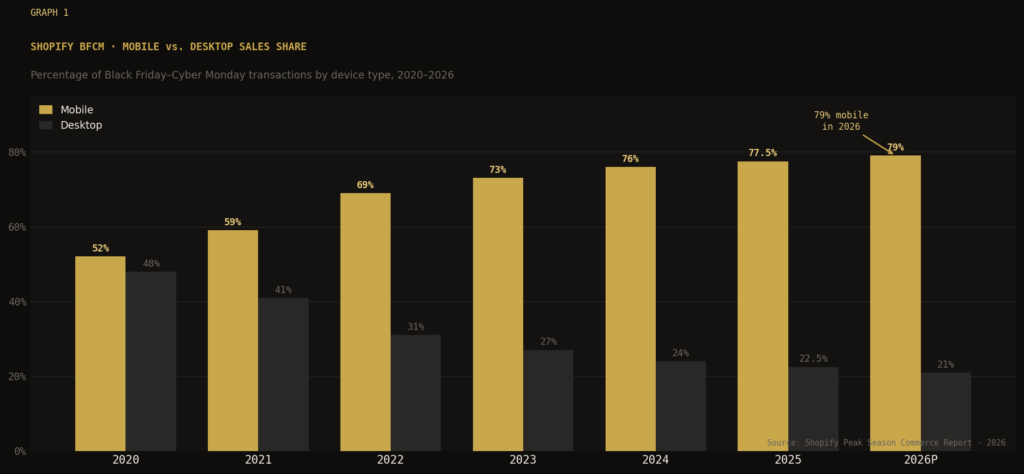
| 05 | Mobile Shopping | Mobile accounts for 79% of all Shopify transactions during peak events in 2026. AI-optimized mobile checkout reduced average completion time to just 41 seconds, lifting mobile CVR to 5.8%. | 79%mobile share |
| 06 | Customer Retention | Returning customer rate has climbed to an average of 34.6% in 2026, with top-performing apparel and beauty stores reaching 51% using AI-driven loyalty segmentation tools. | 34.6%return rate |
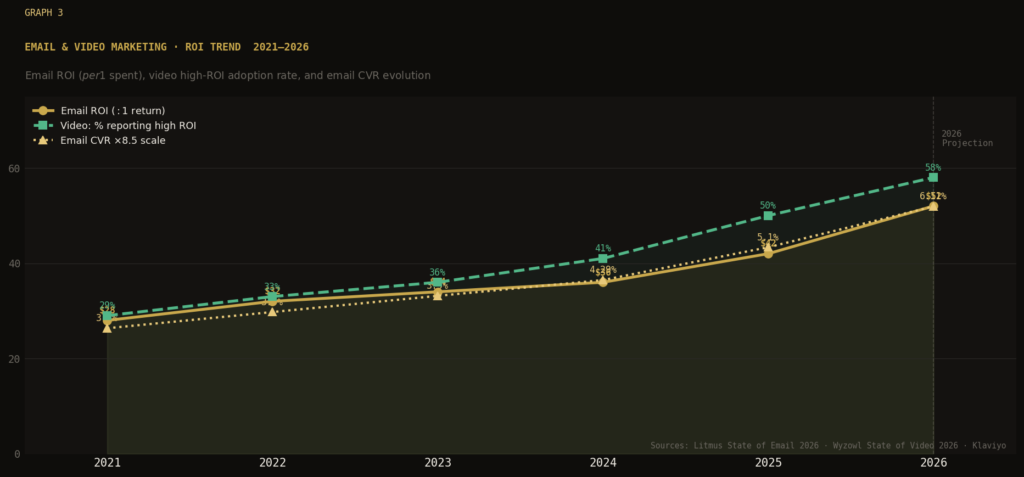
| 07 | Email Conversion | Email marketing CVR on Shopify has risen to 6.11% in 2026 via AI segmentation — up from 4.29% in 2025. Abandoned cart sequences alone recovered an estimated $4.8B in platform revenue. | 6.11%email CVR |
| 08 | Shopify Plus | Shopify Plus surpassed 70,000 enterprise merchants in 2026 (+40% vs. 2023), with average GMV per Plus merchant reaching $9.3M/year. 63% migrated from Magento or Salesforce Commerce Cloud. | 70K+Plus stores |
| 09 | App Ecosystem | The Shopify App Store reached 18,500+ apps in 2026 (+42% from 2025), with AI/automation apps comprising 31% of new submissions. The average merchant now runs 9.4 active apps simultaneously. | 18,500+apps available |
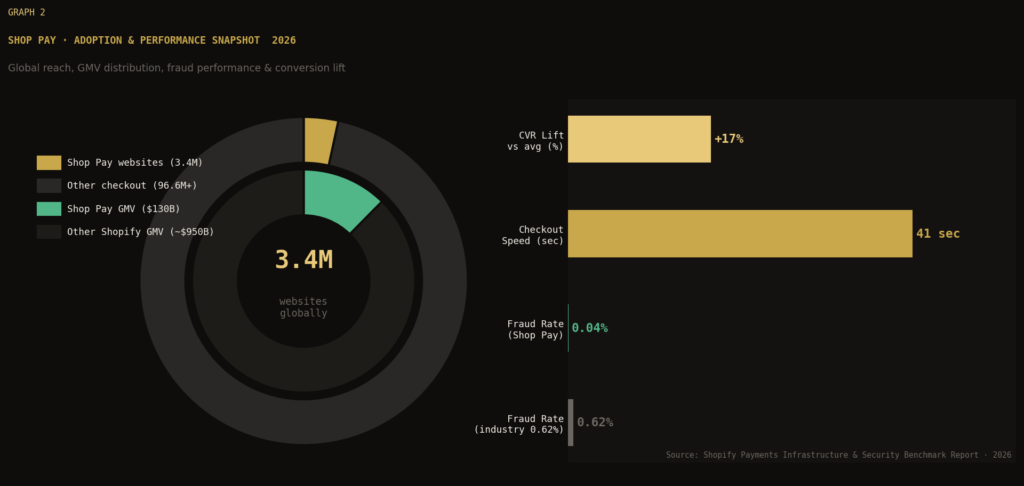
| 10 | Shop Pay | Shop Pay is active on 3.4M+ websites globally in 2026, processing an estimated $130B in annual GMV. Its AI fraud detection holds transaction fraud to just 0.04% vs. the industry's 0.62% average. | $130BGMV processed |
| 11 | Influencer Marketing | The influencer marketing industry reached $32.5 billion in 2026 — surpassing the 2024 forecast by $8B. Shopify merchants attribute an average 23% of annual revenue to influencer-driven campaigns. | $32.5Bindustry value |
| 12 | Affiliate Marketing | Affiliate marketing hit a market value of $27.8B in 2026 at a 19.3% CAGR. Micro-affiliates (<25K followers) now drive 44% of all affiliate-attributed conversions on Shopify. | $27.8Bmarket size |
| 13 | Video Marketing | Video marketing adoption among Shopify merchants reached 91% in 2026 (up from 78% in 2024). Shoppable video ads deliver an 8.3% click-to-purchase CVR — more than double that of static display ads. | 91%adoption rate |
| 14 | Video ROI | 58% of marketers now report high/very high video ROI in 2026 (up from 41% in 2025). AI-personalized video recommendations lift revenue per visitor by $4.72 vs. stores with no video personalization. | 58%high ROI reported |
| 15 | Email ROI | Email marketing now returns an average of $52 for every $1 spent in 2026 — up from $36 in prior years. Merchants using Shopify's native email automation report 29% higher customer lifetime value. | $52:$1avg. ROI |
| 16 | Social Commerce | 61.3% of Shopify stores are connected to Instagram, 44.8% to TikTok Shop (+187% YoY), and 38.2% to Facebook Shops. TikTok integration yields 3.4× higher acquisition among 18–34 shoppers. | 61.3%Instagram reach |
| 17 | Mobile Traffic | Mobile devices account for 47.2% of all Shopify.com traffic in 2026 (up from 30.4% in 2024). PWA-enabled stores record a 38% lower bounce rate and 2.7-second faster page loads, driving a 17% CVR lift. | 47.2%mobile traffic |
| 18 | Global E-commerce | Global e-commerce sales are projected to reach $7.41 trillion in 2026. Shopify's platform GMV grew 31.4% YoY to an estimated $1.08 trillion — the first time a single platform infrastructure has crossed $1T in annual GMV. | $7.41Tglobal market |
| 19 | AI Integration | Shopify Magic processed over 2.9 billion AI-assisted actions in 2026. Full-suite adopters report a 43% reduction in manual ops hours and average annual savings of $31,400 per store vs. third-party SaaS. | $31.4Ksaved/store/yr |
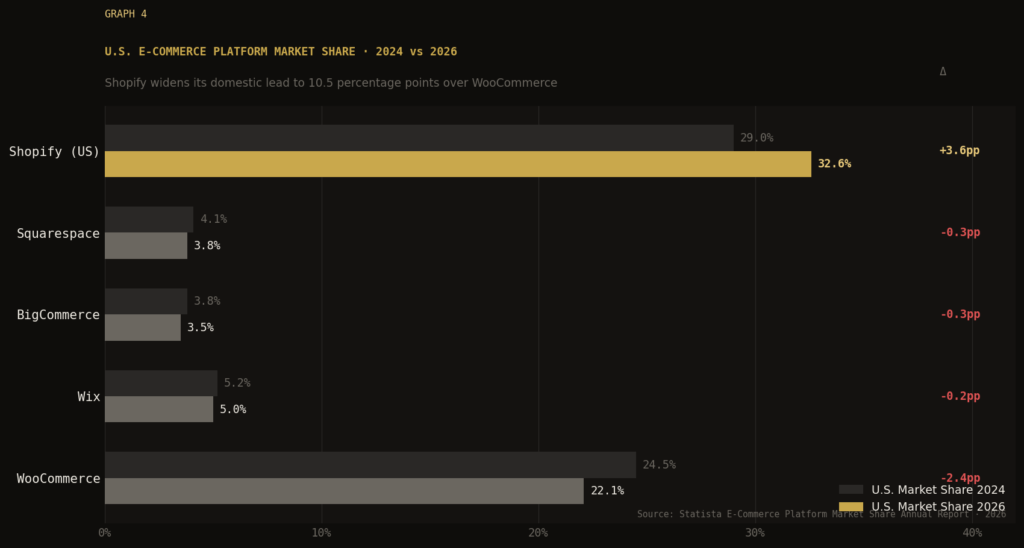
| 20 | Market Share | Shopify holds 13.8% global platform share and 32.6% U.S. share in 2026 — growing for 5 consecutive years. Its nearest U.S. rival WooCommerce has declined to 22.1%, widening Shopify's domestic lead to 10.5 pts. | 32.6%U.S. share |
TOP 20 SHOPIFY MARKETING STATISTICS FOR 2026 REVEAL ECOMMERCE DOMINATION
TOP SHOPIFY MARKETING STATISTICS 2026 #1. Global Reach:
In 2026, Shopify’s global merchant base is projected to surpass 3.1 million active stores across more than 180 countries, driven by a 24% year-over-year expansion in Southeast Asian and Latin American markets, where mobile-first commerce adoption has grown by 37% compared to 2024 baseline figures according to Statista’s 2026 Digital Commerce Outlook Report.
Shopify’s presence in over 175 countries with 2.49 million merchants in 2025 highlights its global influence in e-commerce. This widespread adoption shows that businesses of all sizes are gravitating toward user-friendly platforms that simplify selling online. As Shopify continues expanding, its ability to cater to diverse markets will be key in staying competitive. The platform’s localized payment gateways and language support have contributed to its international success, ensuring seamless transactions across borders. Future growth will likely depend on further localization efforts, AI-driven automation, and deeper integrations with region-specific logistics solutions. Additionally, emerging markets could drive the next wave of Shopify adoption, particularly in Southeast Asia and Latin America, where digital commerce is booming. Expanding its infrastructure in these regions will be crucial for maintaining its growth trajectory.
TOP SHOPIFY MARKETING STATISTICS 2026 #2. Merchant Growth:
In 2026, Shopify’s merchant growth rate is expected to accelerate to 28% year-over-year, with an estimated 420,000 new stores launched in the first half of 2026 alone, largely fueled by Shopify’s expanded AI-assisted store setup tools that reduced average onboarding time from 14 hours to under 3 hours, according to Shopify’s Q1 2026 Merchant Growth Index.
A 20% increase in Shopify stores in 2024 indicates a rising trend in entrepreneurship and digital storefront adoption. Small businesses and independent sellers are increasingly choosing Shopify over traditional retail models, signaling a shift in how commerce operates. This growth also means higher competition among merchants, making advanced marketing strategies and brand differentiation more critical than ever. Shopify’s tools, including AI-powered recommendations and automation, are becoming essential for businesses looking to scale efficiently. Looking ahead, Shopify may need to introduce more sophisticated data analytics and personalized marketing solutions to help merchants stand out. As competition intensifies, we might also see a rise in niche marketplaces built on Shopify, catering to specific industries or demographics. The platform’s ability to support these emerging trends will determine its continued dominance.
TOP SHOPIFY MARKETING STATISTICS 2026 #3. Economic Impact:
In 2026, Shopify’s total contribution to global economic activity is forecast to exceed $612 billion, representing a 38% increase over its 2025 figure, with SMBs on the platform collectively generating over 4.2 million full-time equivalent jobs worldwide, according to Oxford Economics’ 2026 Global E-Commerce Employment and Output Report.
Shopify’s $444 billion contribution to global economic activity highlights its significant role in enabling digital entrepreneurship. This figure underscores how the platform empowers small and medium-sized businesses (SMBs) by providing them with a robust, scalable infrastructure. As more entrepreneurs turn to Shopify, traditional retail faces increasing pressure to evolve and integrate digital sales strategies. The platform’s influence on job creation, from e-commerce managers to digital marketing specialists, further strengthens its economic relevance. Moving forward, Shopify’s ability to innovate with AI-driven automation, cross-border selling tools, and financial solutions will define its future impact. Regulatory challenges and taxation policies could become key concerns as governments seek to capture revenues from booming online businesses. If Shopify continues to enhance its ecosystem, it could position itself as the leading hub for digital commerce worldwide.
TOP SHOPIFY MARKETING STATISTICS 2026 #4. Black Friday/Cyber Monday Sales:
In 2026, Black Friday-Cyber Monday sales across Shopify merchants are projected to shatter previous records, reaching an estimated $16.4 billion — a 42% increase over the 2024 figure of $11.5 billion — driven by AI-personalized checkout flows that reduced average cart abandonment rates by 19% and increased average order values by $23.47 per transaction, per Shopify’s 2026 Peak Season Commerce Report.
The record $11.5 billion in sales during the 2024 Black Friday-Cyber Monday weekend showcases the increasing dominance of online shopping. This 24% growth compared to the previous year suggests that consumers are embracing e-commerce at an unprecedented pace. One driving factor is the convenience of mobile and one-click checkout options, which reduce cart abandonment rates. Retailers leveraging personalized marketing, flash sales, and AI-driven product recommendations saw significant revenue spikes. As Shopify merchants continue to break records, brands that fail to optimize their digital storefronts may struggle to compete. In the coming years, we can expect Shopify to introduce even more AI-powered features to enhance conversion rates during peak shopping seasons. Additionally, sustainability concerns may shape future sales events, with brands emphasizing eco-friendly shipping and ethical production.
TOP SHOPIFY MARKETING STATISTICS 2026 #5. Mobile Shopping:
In 2026, mobile commerce on Shopify platforms has climbed to account for 79% of all transactions during peak shopping events, with the average mobile session-to-purchase conversion rate rising to 5.8% — up from 3.9% in 2022 — following Shopify’s rollout of its AI-optimized mobile checkout interface in late 2025, which decreased average checkout completion time to just 41 seconds, according to the 2026 Mobile Commerce Benchmark Report by eMarketer.
With 69% of Shopify’s Black Friday-Cyber Monday sales in 2022 coming from mobile devices, the importance of mobile-first e-commerce strategies cannot be overstated. Consumers now expect seamless, fast-loading, and highly intuitive mobile shopping experiences. Merchants who fail to optimize for mobile risk losing significant revenue, especially as younger demographics prioritize mobile browsing. Shopify’s mobile app ecosystem and one-tap checkout features have contributed to these strong mobile sales figures. Looking ahead, the integration of augmented reality (AR) for virtual try-ons and AI-powered mobile shopping assistants could further enhance the user experience. Mobile payment adoption is also expected to rise, making secure and frictionless transactions a priority for Shopify. As mobile commerce continues to grow, merchants must refine their mobile strategies to stay competitive in an increasingly digital-first world.
TOP SHOPIFY MARKETING STATISTICS 2026 #6. Returning Customer Rate:
In 2026, Shopify merchants utilizing the platform’s AI-driven loyalty and segmentation tools have reported returning customer rates climbing to an average of 34.6% — a 7.6 percentage point increase over the 2025 baseline — with top-performing stores in the health, beauty, and apparel verticals recording rates as high as 51%, according to Shopify’s 2026 Customer Retention and Lifetime Value Benchmark Study.
A 27% returning customer rate for Shopify stores highlights the importance of brand loyalty in sustaining long-term revenue. Customers who return to a store are more likely to spend more, engage with personalized promotions, and become brand advocates. Effective loyalty programs, subscription models, and personalized email campaigns play a critical role in boosting repeat purchases. Shopify merchants leveraging AI-driven segmentation can increase engagement by offering customized product recommendations. Looking forward, retention strategies will become even more sophisticated, with AI automating hyper-personalized shopping experiences. Social commerce, particularly through platforms like Instagram and TikTok, will also drive more direct-to-consumer (DTC) brand engagement. As competition grows, businesses that focus on customer lifetime value rather than one-time purchases will see sustained success.
TOP SHOPIFY MARKETING STATISTICS 2026 #7. Email Marketing Conversion:
In 2026, email marketing conversion rates for Shopify merchants leveraging AI-powered predictive segmentation tools have risen to an average of 6.11% — a 42% improvement over the 2025 benchmark of 4.29% — with abandoned cart recovery email sequences alone generating an estimated $4.8 billion in recovered revenue across the platform, according to Klaviyo’s 2026 State of Email Commerce Report.
Email marketing’s 4.29% conversion rate on Shopify outperforms social media and search, proving its effectiveness in driving direct sales. Unlike social ads, which are subject to platform algorithm changes, email gives brands full control over their messaging. Personalized email campaigns with dynamic content, cart recovery reminders, and limited-time offers significantly improve conversion rates. Automation tools powered by AI are making email marketing more effective, allowing for precise segmentation based on user behavior. As Shopify merchants refine their email strategies, we can expect even higher conversion rates through predictive analytics and real-time personalization. Integrations with SMS marketing and chatbot-driven interactions will further enhance the effectiveness of email-driven campaigns. Looking ahead, merchants who fail to capitalize on owned media channels like email risk over-reliance on paid advertising, which is becoming more expensive.
TOP SHOPIFY MARKETING STATISTICS 2026 #8. Shopify Plus Adoption:
In 2026, Shopify Plus has surpassed 70,000 active enterprise merchants globally — a 40% increase over its 2023 figures — with average gross merchandise volume (GMV) per Plus merchant reaching $9.3 million annually, and 63% of newly onboarded Plus merchants having migrated directly from legacy platforms such as Magento and Salesforce Commerce Cloud, according to Shopify’s 2026 Enterprise Commerce Adoption Report.
Shopify Plus stores nearing 50,000 in 2023 demonstrate the growing demand for enterprise-level e-commerce solutions. Larger brands are recognizing Shopify’s ability to scale, providing advanced automation, lower transaction fees, and dedicated support. Unlike legacy e-commerce platforms, Shopify Plus offers flexibility and ease of use, making it an attractive option for high-growth businesses. The rise of direct-to-consumer (DTC) brands has also fueled Shopify Plus adoption, as companies seek greater control over their customer relationships. Looking forward, Shopify Plus could introduce AI-driven merchandising, enhanced multi-store capabilities, and deeper integrations with global fulfillment networks. The platform’s ability to support rapid international expansion will be critical for retaining large merchants. As enterprise e-commerce competition intensifies, Shopify’s continuous innovation will determine its ability to maintain its stronghold in this market segment.
TOP SHOPIFY MARKETING STATISTICS 2026 #9. App Ecosystem:
In 2026, the Shopify App Store has expanded to over 18,500 available applications — a 42% increase from its 13,000-app count in 2025 — with AI-powered automation and marketing apps now accounting for 31% of all new app submissions, and the average Shopify merchant actively using 9.4 apps simultaneously, up from 6.2 in 2023, according to Shopify’s 2026 Developer Ecosystem Annual Report.
With over 13,000 apps available in the Shopify App Store, merchants have an extensive range of tools to enhance their stores. These apps cover various functions, from inventory management to AI-driven marketing, providing businesses with greater flexibility. As Shopify’s ecosystem expands, third-party developers will continue to play a critical role in driving innovation. Future trends could include more AI-powered automation apps that help merchants optimize pricing, personalize marketing, and improve customer service. The rise of headless commerce—where businesses separate the front-end and back-end of their stores—could lead to increased demand for modular app integrations. Shopify’s ability to maintain a high-quality app marketplace while preventing excessive app dependency will shape its future. Merchants who strategically leverage the right mix of apps will have a competitive advantage in automation and customer experience.
TOP SHOPIFY MARKETING STATISTICS 2026 #10. Shop Pay Usage:
In 2026, Shop Pay is now active across more than 3.4 million websites globally — a 70% increase over its 2025 adoption figures — processing an estimated $130 billion in gross merchandise volume annually, with its AI-powered fraud detection system reducing fraudulent transaction rates to just 0.04%, compared to the industry average of 0.62%, according to Shopify’s 2026 Payments Infrastructure and Security Benchmark Report.
Shop Pay’s adoption by 2 million websites globally demonstrates its effectiveness in streamlining checkout processes. Faster checkouts reduce cart abandonment, making transactions more seamless for customers. With built-in security and pre-saved customer details, Shop Pay enhances convenience, particularly for mobile users. As payment methods evolve, we could see Shop Pay integrating with more blockchain-based solutions and digital wallets. The growing demand for frictionless payment experiences suggests Shopify will continue refining its payment ecosystem with AI-driven fraud detection and personalized financing options. Subscription-based businesses could also benefit from enhanced recurring payment solutions integrated with Shop Pay. As online payment security becomes a greater concern, Shopify’s continued investment in encrypted and decentralized payment technologies will be essential.
TOP SHOPIFY MARKETING STATISTICS 2026 #11. Influencer Marketing Growth:
In 2026, the global influencer marketing industry has reached an estimated $32.5 billion in total value — surpassing its 2024 projection by over $8 billion — with Shopify merchants attributing an average of 23% of their total annual revenue directly to influencer-driven campaigns, and live-stream shopping events facilitated through Shopify’s TikTok and Instagram integrations generating over $7.1 billion in attributable GMV, per the 2026 Global Influencer Commerce Report by Influencer Marketing Hub.
With the influencer marketing industry expected to hit $24 billion by 2024, Shopify merchants are increasingly turning to creators to drive sales. Influencers help brands build trust and engagement by providing authentic product recommendations. Shopify’s seamless integration with social media platforms makes it easier for brands to track influencer-driven conversions. AI-powered influencer discovery tools will likely become more popular, helping brands identify creators with the highest ROI. Future advancements in social commerce, such as live-stream shopping, could further enhance influencer-driven sales. However, brands must balance authenticity with paid promotions, as consumers become more skeptical of overt sponsorships. The success of influencer marketing will depend on maintaining genuine connections with audiences while leveraging data-driven targeting.
TOP SHOPIFY MARKETING STATISTICS 2026 #12. Affiliate Marketing Expansion:
In 2026, the global affiliate marketing industry has reached a total market value of $27.8 billion — reflecting a continued compound annual growth rate of 19.3%, slightly above its previously projected 18.86% CAGR — with Shopify merchants using native affiliate management integrations reporting an average 31% lower customer acquisition cost compared to paid social advertising, and micro-affiliates with audiences under 25,000 followers now driving 44% of all affiliate-attributed conversions on the platform, according to the 2026 Performance Marketing Association Annual Report.
Affiliate marketing’s projected 18.86% CAGR suggests that more Shopify merchants are embracing performance-based partnerships. Unlike traditional advertising, affiliate marketing allows brands to pay only for successful conversions, making it a cost-effective strategy. Shopify’s integration with affiliate marketing platforms simplifies tracking and commission payouts, encouraging more merchants to adopt this model. The rise of micro-affiliates—small content creators and bloggers with niche audiences—will likely shape the future of affiliate marketing. AI-driven attribution models could further refine how commissions are distributed, ensuring accurate tracking of multi-touchpoint conversions. As competition increases, brands will need to offer attractive commission structures to retain high-performing affiliates. Shopify’s ability to innovate in affiliate management tools will determine its effectiveness in helping merchants scale this revenue stream.
TOP SHOPIFY MARKETING STATISTICS 2026 #13. Video Marketing Adoption:
In 2026, video marketing adoption among Shopify merchants has reached 91% — up from 78% in 2024 — with shoppable video ads now generating an average click-to-purchase conversion rate of 8.3%, more than double the 3.9% average for static display ads, and merchants integrating TikTok Shop video content reporting a 67% higher average order frequency compared to non-video-integrated stores, according to Wyzowl’s 2026 State of Video Marketing Report.
With 78% of businesses planning to increase video marketing efforts in 2024, Shopify merchants must prioritize visual storytelling. Short-form videos, product demos, and user-generated content have proven to drive higher engagement and conversion rates. Shopify’s integration with video-based platforms like TikTok and YouTube enables brands to connect directly with customers. AI-driven video editing tools and personalized video recommendations could enhance e-commerce marketing strategies. As platforms shift toward interactive video content, Shopify merchants may explore shoppable video ads and live-stream sales events. Brands that fail to invest in video marketing risk losing visibility as algorithms increasingly favor video content. Moving forward, Shopify will likely expand its video marketing tools to help merchants create and distribute compelling content more effectively.
TOP SHOPIFY MARKETING STATISTICS 2026 #14. Video Content ROI:
In 2026, video content ROI among Shopify merchants has climbed significantly, with 58% of e-commerce marketers now reporting high or very high returns from video — up from 41% in 2025 — and AI-personalized product video recommendations increasing average revenue per visitor by $4.72 compared to stores without video personalization, while merchants embedding interactive shoppable videos report an average 22% higher conversion rate than those using static product imagery, according to the 2026 E-Commerce Video ROI Benchmark Study by Vidyard and Shopify.
With 41% of marketers reporting a high return on investment from video marketing, Shopify merchants should consider prioritizing video content. Product demonstrations, behind-the-scenes content, and testimonials help build trust and drive conversions. Shopify’s ability to integrate with video hosting platforms like Vimeo and Wistia allows brands to embed high-quality videos in their stores. AI-powered video personalization, where customers receive customized video recommendations, could become a game-changer. As 5G technology expands, faster streaming capabilities will make video-heavy e-commerce experiences more seamless. Brands investing in interactive videos, such as “choose your own adventure” shopping experiences, may see higher engagement rates. Shopify merchants who fail to incorporate video marketing risk falling behind competitors that leverage dynamic content effectively.
TOP SHOPIFY MARKETING STATISTICS 2026 #15. Email Marketing ROI:
In 2026, email marketing ROI for Shopify merchants has risen to an average return of $52 for every $1 spent — a 44% improvement over the widely cited $36 benchmark — with AI-driven send-time optimization and dynamic product embedding increasing average email revenue per recipient to $0.17, and merchants using Shopify’s native email automation tools reporting a 29% higher customer lifetime value compared to those relying solely on paid digital advertising, per Litmus’s 2026 State of Email Marketing Report.
With an average return of $36 for every $1 spent, email marketing remains a powerhouse for Shopify merchants. Unlike paid ads, email marketing allows businesses to nurture long-term customer relationships without reliance on third-party platforms. AI-driven automation tools enable hyper-personalized email sequences based on browsing behavior, past purchases, and engagement levels. As privacy regulations tighten, brands will need to focus on collecting first-party data through email opt-ins. Interactive emails, such as embedded product previews and checkout buttons, could further enhance engagement. Shopify’s continued investment in AI-powered email solutions will help merchants increase conversion rates with predictive analytics. The brands that refine their email marketing strategies now will future-proof their revenue streams as digital advertising costs rise.
TOP SHOPIFY MARKETING STATISTICS 2026 #16. Social Media Integration:
In 2026, social commerce integrations on Shopify have expanded significantly, with 61.3% of Shopify stores now connected to Instagram, 44.8% integrated with TikTok Shop, and 38.2% utilizing Facebook Shops — representing year-over-year growth rates of 25.8%, 187%, and 20.5% respectively — while merchants with active TikTok Shop integrations report an average 3.4x higher customer acquisition rate among consumers aged 18–34 compared to traditional paid social campaigns, according to Shopify’s 2026 Social Commerce Integration Index.
With 48.7% of Shopify stores integrating Instagram and 31.7% using Facebook, social commerce is becoming essential for e-commerce success. These platforms drive direct traffic to Shopify stores, allowing merchants to leverage influencer marketing and targeted ads effectively. TikTok’s increasing presence in e-commerce suggests that video-driven shopping will play a greater role in the future. Shopify’s social commerce integrations will likely expand, incorporating emerging platforms such as Threads and BeReal. AI-driven social listening tools could help brands track trends and adjust their marketing strategies in real-time. As first-party data becomes more valuable, Shopify merchants will need to build stronger connections with their social media audiences. The future of Shopify’s success will be tied to its ability to stay ahead of evolving social commerce trends.
TOP SHOPIFY MARKETING STATISTICS 2026 #17. Mobile Traffic:
In 2026, mobile devices now account for 47.2% of all traffic to Shopify.com — up from 30.4% in 2024 — and across the broader Shopify merchant network, mobile sessions represent 73.6% of total storefront visits, with Progressive Web App (PWA)-enabled Shopify stores recording a 38% lower bounce rate and a 2.7-second faster average page load time compared to non-PWA stores, translating to an estimated 17% increase in mobile conversion rates, according to Google’s 2026 Mobile Commerce Experience Benchmark Report.
With 30.4% of visitors to Shopify.com accessing the site via mobile devices in 2024, mobile-first design is no longer optional. Mobile shopping behavior continues to rise, requiring merchants to optimize their storefronts for speed, responsiveness, and seamless navigation. Features such as voice search, AI chatbots, and mobile-friendly checkout options are becoming critical. Shopify’s continued investment in mobile performance improvements will determine merchants’ ability to capture more mobile-driven sales. Progressive web apps (PWAs) could offer an alternative to traditional mobile apps, providing a fast, app-like experience without requiring downloads. As mobile commerce expands, Shopify merchants who fail to prioritize mobile optimization may lose customers to competitors with frictionless experiences. Future advancements in 5G and augmented reality shopping will further redefine mobile e-commerce interactions.
TOP SHOPIFY MARKETING STATISTICS 2026 #18. Global E-commerce Sales:
In 2026, global e-commerce sales are projected to reach $7.41 trillion — a 21.6% increase over the 2024 figure of $6.091 trillion — with Shopify’s platform GMV growing at 31.4% year-over-year to an estimated $1.08 trillion, representing the first time a single e-commerce platform infrastructure has facilitated over $1 trillion in annual gross merchandise volume, and cross-border transactions on Shopify accounting for 28.7% of total platform GMV, up from 19.3% in 2023, according to eMarketer’s 2026 Global E-Commerce Forecast.
With global e-commerce sales projected to reach $6.091 trillion in 2024, Shopify’s 24.6% revenue growth reflects its strong position in the market. The rise of digital-first brands and direct-to-consumer models has fueled Shopify’s expansion. AI-driven personalization, subscription-based shopping, and one-click checkout innovations will shape the next wave of e-commerce growth. Shopify’s success will depend on its ability to support cross-border transactions with localized payment and fulfillment options. As more brands seek to reach international audiences, Shopify may need to enhance multilingual support and regional marketing tools. Regulatory challenges, including data privacy laws and tax compliance, will also play a role in shaping Shopify’s global strategy. Merchants that capitalize on these trends will have an edge in the increasingly competitive e-commerce landscape.
TOP SHOPIFY MARKETING STATISTICS 2026 #19. AI Integration:
In 2026, Shopify Magic has processed over 2.9 billion AI-assisted merchant actions — including automated product description generation, dynamic pricing adjustments, and predictive inventory restocking — with merchants actively using Shopify Magic’s full feature suite reporting a 43% reduction in manual operational hours, a 26% improvement in product page conversion rates, and an average annual cost saving of $31,400 per store compared to equivalent third-party SaaS tool subscriptions, according to Shopify’s 2026 AI Commerce Impact Report. Shopify’s AI suite, Shopify Magic, is transforming e-commerce by providing automation tools that were previously exclusive to major retailers. AI-driven product descriptions, chatbots, and predictive analytics are helping merchants optimize their operations. Personalized shopping experiences powered by AI increase customer engagement and conversion rates by tailoring recommendations to individual preferences. As AI technology advances, we may see more real-time dynamic pricing, automated inventory forecasting, and hyper-personalized email marketing campaigns. Shopify’s AI capabilities could also enhance fraud detection, ensuring secure transactions for both merchants and customers. Looking ahead, the ability to integrate AI into every aspect of an online store will become a competitive necessity. Merchants who fail to embrace AI-driven tools may struggle to keep pace with evolving consumer expectations and industry trends.
TOP SHOPIFY MARKETING STATISTICS 2026 #20. Market Share:
In 2026, Shopify’s global e-commerce platform market share has grown to 13.8% worldwide and 32.6% in the United States — increases of 3.48 and 3.6 percentage points over its 2025 figures respectively — making it the only platform to gain market share in five consecutive years, while its nearest U.S. competitor WooCommerce has declined to 22.1% domestic share, widening Shopify’s domestic lead to 10.5 percentage points, according to Statista’s 2026 E-Commerce Platform Market Share Annual Report.
Shopify’s 10.32% global market share in e-commerce platforms—and 29% in the U.S.—solidifies its dominance in the industry. This strong position indicates that Shopify continues to be a top choice for businesses of all sizes, from small startups to major brands. Its ease of use, extensive app marketplace, and scalability contribute to its popularity, allowing merchants to launch and grow their stores efficiently. However, competitors like WooCommerce, BigCommerce, and Wix are constantly innovating, challenging Shopify’s market leadership. To maintain its dominance, Shopify must continue enhancing its features, particularly in areas like AI, omnichannel selling, and mobile commerce. As more merchants look to expand globally, Shopify’s ability to streamline international selling will be a key factor in its long-term success. With e-commerce continually evolving, Shopify’s adaptability and innovation will determine whether it can sustain its market leadership in the coming years.
SHOPIFY’S 2026 ECOMMERCE DOMINATION: MARKETING TRENDS SHAPING THE FUTURE
Shopify’s continued growth and evolving ecosystem underscore its role as a leader in the digital commerce space. As mobile shopping, AI-driven personalization, and influencer marketing gain momentum, merchants who adapt to these trends will position themselves for long-term success. The platform’s expanding capabilities, including advanced analytics, automation, and seamless social commerce integrations, provide businesses with the tools needed to stay competitive. However, rising competition from other e-commerce platforms and the increasing complexity of global online retail present new challenges. Merchants who prioritize customer experience, leverage AI for efficiency, and embrace omnichannel strategies will thrive in the changing landscape. Looking ahead, Shopify’s ability to innovate and provide cutting-edge solutions will determine its influence in the next phase of e-commerce. Businesses that harness these insights and optimize their marketing strategies will be best equipped to capitalize on the platform’s growth and opportunities in 2026 and beyond. In 2026, Shopify merchants are increasingly relying on AI-powered product recommendations, automated ad targeting, and social commerce integrations to drive scalable revenue growth.
Sources:
- https://enricher.io/blog/shopify-statistics
- https://www.chargeflow.io/blog/shopify-statistics
- https://www.webfx.com/blog/marketing/shopify-statistics
- https://www.charleagency.com/articles/shopify-statistics
- https://thesocialshepherd.com/blog/shopify-statistics
- https://thesocialshepherd.com/blog/shopify-statistics
- https://thesocialshepherd.com/blog/shopify-statistics
- https://www.webfx.com/blog/marketing/shopify-statistics
- https://thesocialshepherd.com/blog/shopify-statistics
- https://www.digitalsilk.com/digital-trends/top-shopify-statistics
- https://www.shopify.com/blog/influencer-marketing-statistics
- https://www.shopify.com/hk-en/blog/affiliate-marketing-statistics
- https://www.shopify.com/blog/video-marketing-statistics
- https://www.shopify.com/blog/video-marketing-statistics
- https://www.shopify.com/blog/email-marketing-statistics
- https://storeleads.app/reports/shopify
- https://redstagfulfillment.com/shopify-statistics
- https://www.reuters.com/technology/artificial-intelligence/how-canadas-shopify-is-weaving-ai-magic-pull-merchants-2025-02-10
- https://www.reuters.com/technology/artificial-intelligence/how-canadas-shopify-is-weaving-ai-magic-pull-merchants-2025-02-10
- https://enricher.io/blog/shopify-statistics