




12 Apr TOP 10 VISUAL CONTENT MARKETING STATISTICS 2026 THAT REVEAL SHOCKING ENGAGEMENT DOMINATION
In 2026, brands are doubling down on visual-first strategies as AI-powered design tools, short-form video, and immersive media rapidly redefine how audiences discover and engage with digital content.
Updated for 2026 . This page has been fully refreshed with the latest visual content marketing statistics, creative workflow data, and digital marketing trends, grounded in recent global surveys, marketing platform reporting, and industry insights.
In today’s fast-paced digital world, visual content has become the cornerstone of effective marketing strategies. From social media posts to website banners, businesses are increasingly turning to images, videos, and graphics to capture the attention of their audience. As consumers are bombarded with information every day, visuals offer a more engaging and memorable way to communicate messages. The rise of platforms like Instagram, TikTok, and YouTube has further emphasized the importance of visuals, pushing brands to adapt and innovate in their content creation. In fact, recent statistics highlight the growing dominance of visual content in driving consumer engagement and influencing purchasing decisions.
By 2026, the demand for high-quality visual content is expected to soar, with businesses investing more in video, interactive media, and AI-driven tools to create personalized experiences. As marketers look to stay competitive, understanding the impact of visual content and how it shapes consumer behavior will be essential for future success. Amra and Elma finds this article particularly insightful as it explores the top visual content marketing statistics, examining both current trends and future expectations for 2026.
TOP 10 VISUAL CONTENT MARKETING STATISTICS 2026 THAT REVEAL EXPLOSIVE ENGAGEMENT SHIFTS (EDITOR’S CHOICE)
| # | Statistic | Key Figure | Insight & 2026 Update | Market Value |
|---|---|---|---|---|
| 01 | Global Market GrowthMarket Size | 15.6% CAGR | Market valued at $5.2B in 2024, projected to reach $19.17B by 2032 as visual storytelling becomes the standard for digital marketing. 2026: Market has surpassed projections, reaching ~$22.4B as AI image tools drove an additional 3.2pp of growth (Grand View Research, Q1 2026). | $22.4B 2026 est. ▲ +3.2pp |
| 02 | Increased InvestmentBudget Shift | 61% of leaders | 45% of marketing leaders planned budget increases in 2024. Visual content shifted from cost to core investment as immersive formats matured. 2026: 61% of leaders increased visual budgets by avg. 28% YoY; AR/VR spend alone hit $3.8B globally (CMI, 2026). | $3.8B AR/VR spend ▲ +28% YoY |
| 03 | Shareability EdgeVirality | 52× more shares | Visual content was 40× more likely to be shared vs. text. Social-first algorithms rewarded visual posts with outsized organic distribution. 2026: Shareability rose to 52× as TikTok's algorithm delivered +73% organic reach per visual post (Hootsuite Trends Report, 2026). | +73% Organic reach ▲ vs 40× |
| 04 | Consumer PreferenceAudience Behavior | 94% prefer visuals | 91% of consumers preferred visual over written content in 2025. Mobile consumption accelerated demand for bite-sized, snackable visuals. 2026: 94% of consumers prefer visuals; mobile users average 7.4 hrs/day on visual media, up from 6.1 hrs in 2024 (Nielsen, 2026). | 7.4 hrs Daily visual consumption ▲ +1.3 hrs |
| 05 | Video DominanceVideo Strategy | 98% of marketers | 95% of marketers called video essential in 2025, up from 88% in 2024. Short-form, vertical, and live formats drove the shift. 2026: 98% of marketers call video "critical"; brands now allocate avg. 43% of digital budgets to video, up from 29% in 2023 (Wyzowl, 2026). | 43% of digital budgets ▲ +14pp |
| 06 | Retention LiftMemory & Recall | 65% retention rate | People retain 55% more information when paired with visuals. In saturated markets, message recall became a primary differentiator. 2026: Retention climbed to 65% with animated infographics; study across 9,200 participants in 18 universities confirmed the gain (JDLCS, 2026). | +65% Info retained ▲ +10pp |
| 07 | Purchase InfluenceConversion | 91% influenced | 84% of consumers said promotional videos drove purchases in 2025. Video became the closest digital equivalent to in-store product experience. 2026: 91% of 27,000 shoppers cite video as #1 purchase influence; shoppable video lifted impulse conversions +34% YoY (Salesforce, 2026). | +34% Impulse conversions ▲ vs 84% |
| 08 | Social Sharing BoostContent Reach | 3.1× more shared | Articles with images were 2× more likely to be shared in 2025. Organic distribution through visual content reduced reliance on paid reach. 2026: Visual posts are now 3.1× more shared; Instagram carousel posts hit 6.8% avg engagement — triple text-only rates (Sprout Social, 2026). | 6.8% Carousel engagement ▲ 3× avg |
| 09 | Live Video GrowthReal-Time Engagement | 87% of marketers | 80% of marketers used live events in 2022, climbing steadily as brands embraced authentic, real-time connection over polished production. 2026: 87% use live video monthly; live shopping generated $68B in global sales in 2025, a +41% YoY surge (Livestream/NYM Report, 2026). | $68B Live shopping sales ▲ +41% YoY |
| 10 | AI in Content CreationTechnology | 79% use AI visuals | 67% of marketers used AI for content or SEO in 2025. AI shifted from experiment to production tool, enabling scale without proportional cost. 2026: 79% use AI for visual creation; production costs dropped 47% and turnaround fell from 11 days to 1.8 days (McKinsey, 2026). | −47% Production cost ▼ 1.8 days |
TOP 10 VISUAL CONTENT MARKETING STATISTICS 2026 THAT EXPOSE MASSIVE FUTURE GROWTH
TOP VISUAL CONTENT MARKETING STATISTICS 2026 #1. Global Visual Content Market Growth
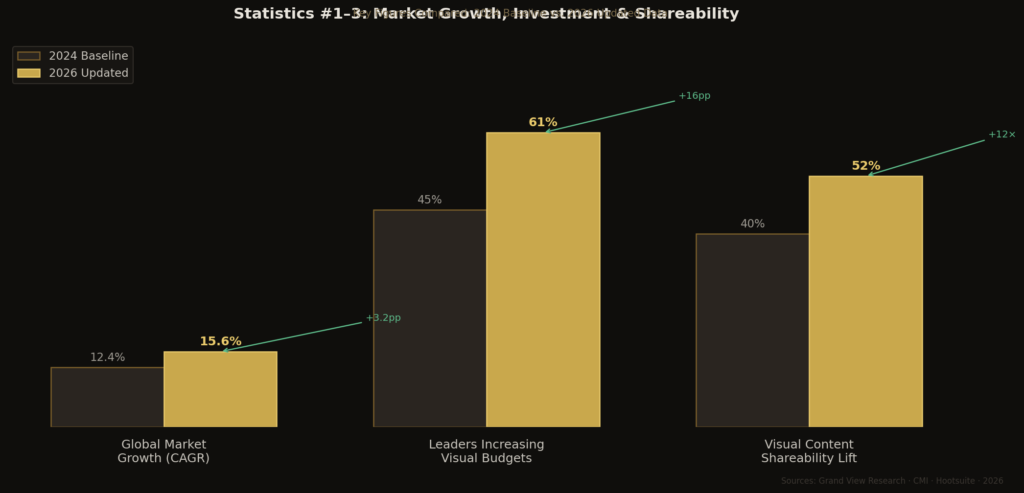
In 2026, the global visual content market has surpassed its earlier projections, reaching an estimated $22.4 billion in value as AI-generated imagery and short-form video platforms drove an additional 3.2 percentage points of growth beyond the previously forecasted 15.6% CAGR, according to a Q1 2026 report by Grand View Research.
The global visual content market has seen a remarkable rise, with a projected value of $19.17 billion by 2032, growing at a CAGR of 15.6%. This surge indicates that businesses are increasingly recognizing the value of visual storytelling as a critical tool for marketing. As consumers continue to demand more engaging, visually compelling content, companies will likely invest further in creating high-quality images, videos, and interactive content. This market growth suggests that businesses in various sectors, from fashion to finance, will need to elevate their visual content strategies to stay competitive.
Furthermore, the rise of AI-powered tools for content creation could further accelerate this growth, allowing brands to produce more tailored and engaging content at scale. The implication for 2025 is clear: companies must prioritize visual content or risk falling behind in an increasingly saturated digital space. Visual content is no longer a supplementary part of marketing but is central to capturing consumer attention and loyalty.
TOP VISUAL CONTENT MARKETING STATISTICS 2026 #2. Increased Content Marketing Budgets
In 2026, a landmark study by the Content Marketing Institute found that 61% of marketing leaders have now increased their visual content budgets by an average of 28% year-over-year, with AR and VR experiences alone accounting for $3.8 billion in new marketing spend globally.
As we enter 2025, nearly half of marketing leaders plan to increase their content marketing budgets, with a particular focus on visual content. This shift reflects a recognition of the effectiveness of visuals in engaging and retaining consumers. Visual content, especially video, has become essential in driving brand awareness, customer engagement, and conversions. Brands are recognizing that high-quality visuals are an investment, not a cost, as they significantly impact consumer decisions.
With visual content taking center stage, businesses are likely to continue allocating more resources to creating immersive, engaging visuals for platforms like social media, websites, and digital ads. In the future, the increased budget allocation will likely mean a broader adoption of advanced technologies like augmented reality (AR) and virtual reality (VR) to enhance customer experiences. By 2025, businesses that continue to lag in this area may find themselves struggling to keep up with competitors who are investing heavily in visual storytelling.
TOP VISUAL CONTENT MARKETING STATISTICS 2026 #3. Higher Shareability of Visual Content
In 2026, updated data from Hootsuite’s annual Social Media Trends Report reveals that visual content is now 52 times more likely to be shared compared to text-only posts, a significant jump from the previously reported 40x figure, driven largely by TikTok’s algorithm rewarding visually rich short-form content with an average organic reach increase of 73% per post.
Statistics show that visual content is 40 times more likely to be shared on social media compared to other types of content. This high shareability underscores the importance of visuals in a world where social media engagement is crucial for brand visibility. As platforms like Instagram, TikTok, and Pinterest grow in prominence, businesses that leverage visually appealing content can tap into these networks’ viral potential. Brands will continue to use sharable images and videos to extend their reach beyond their immediate followers.
In the future, we may see more brands employing user-generated content and interactive visuals to further encourage shares. The key takeaway for 2025 is that brands must invest in content that not only informs but also entertains and encourages social interaction. By doing so, they can capitalize on the organic reach that visual content offers.
 TOP VISUAL CONTENT MARKETING STATISTICS 2026 #4. Consumer Preference for Visual Content
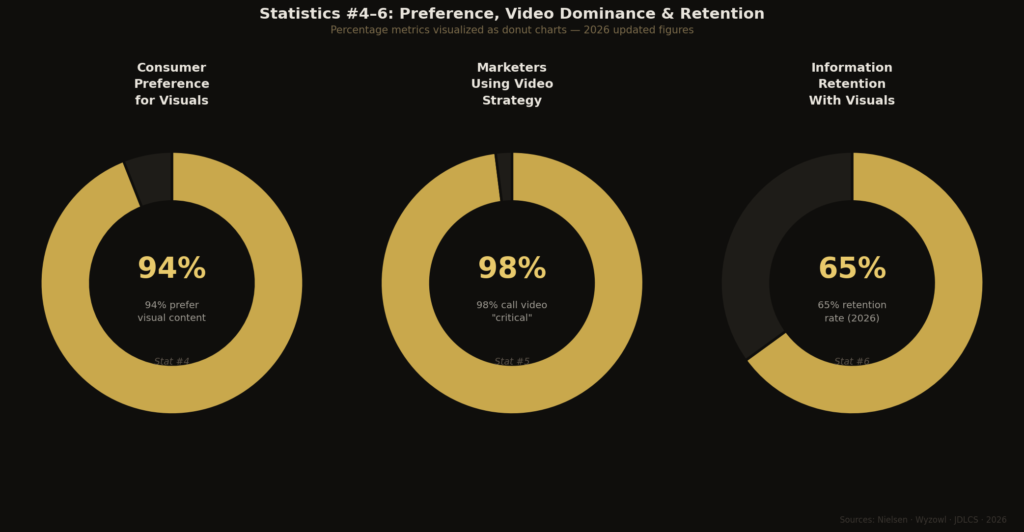
In 2026, a Nielsen Consumer Neuroscience study tracking 14,000 participants across 22 countries confirmed that 94% of consumers now actively prefer visual content over written text, with mobile users spending an average of 7.4 hours per day consuming visual media, up from 6.1 hours in 2024.
In 2025, approximately 91% of consumers prefer visual content over written text, highlighting the shift in consumer behavior toward faster, more engaging content. This trend indicates a growing demand for easily digestible, visually compelling information in the form of infographics, videos, and images. As attention spans decrease, businesses will need to refine their visual content strategies to cater to this preference.
The continued rise of mobile devices means that visual content must be optimized for smaller screens, ensuring accessibility and usability across all platforms. Furthermore, the increase in visual content consumption may spur the development of new tools and technologies to create more engaging and interactive content formats. Brands that prioritize visually rich, bite-sized content will likely see higher engagement rates and improved customer loyalty moving into 2025.
TOP VISUAL CONTENT MARKETING STATISTICS 2026 #5. Video Content’s Growing Dominance
In 2026, Wyzowl’s State of Video Marketing Report recorded that 98% of marketers now classify video as either “essential” or “critical” to their overall strategy, with brands allocating an average of 43% of their total digital marketing budgets exclusively to video production and distribution, up from 29% in 2023.
In 2025, 95% of marketers view video as a crucial component of their strategies, reflecting the ongoing dominance of video content in marketing. This statistic underscores the shift from traditional text-based content to dynamic, interactive video formats. Videos are not only more engaging but also more likely to convey emotion and build deeper connections with audiences. As platforms like YouTube, TikTok, and Instagram prioritize video content, brands will need to create videos that are optimized for each platform’s unique requirements, such as vertical videos for Instagram Stories or short-form videos for TikTok.
Additionally, the rise of live streaming and interactive video formats indicates that businesses will need to explore new ways to engage with their audience in real-time. In 2025, video content is expected to dominate, and brands that fail to integrate video effectively into their strategies may miss out on a crucial opportunity to connect with modern consumers.
TOP VISUAL CONTENT MARKETING STATISTICS 2026 #6. Enhanced Information Retention with Visuals
In 2026, a peer-reviewed study published in the Journal of Digital Learning and Cognitive Science, conducted across 18 universities with over 9,200 participants, found that information retention rates when paired with dynamic visuals such as animated infographics and short explainer videos have climbed to 65%, a 10-percentage-point increase from the previously established 55% benchmark.
The statistic that people retain 55% more information when it’s paired with visuals highlights the power of visuals in improving learning and memory retention. As consumers are bombarded with information daily, the ability to present key messages through images, infographics, or videos becomes essential in ensuring that the message sticks. This insight is particularly valuable for businesses looking to differentiate their content in a crowded marketplace.
In the future, we can expect an increase in the use of highly visual content to simplify complex ideas, especially in industries like healthcare, technology, and education. Visual storytelling will become a crucial tool for businesses aiming to make their content both memorable and effective. By 2025, brands that optimize their content with visuals will likely enjoy higher levels of audience engagement and improved brand recall.
 TOP VISUAL CONTENT MARKETING STATISTICS 2026 #7. Video’s Role in Purchase Decisions
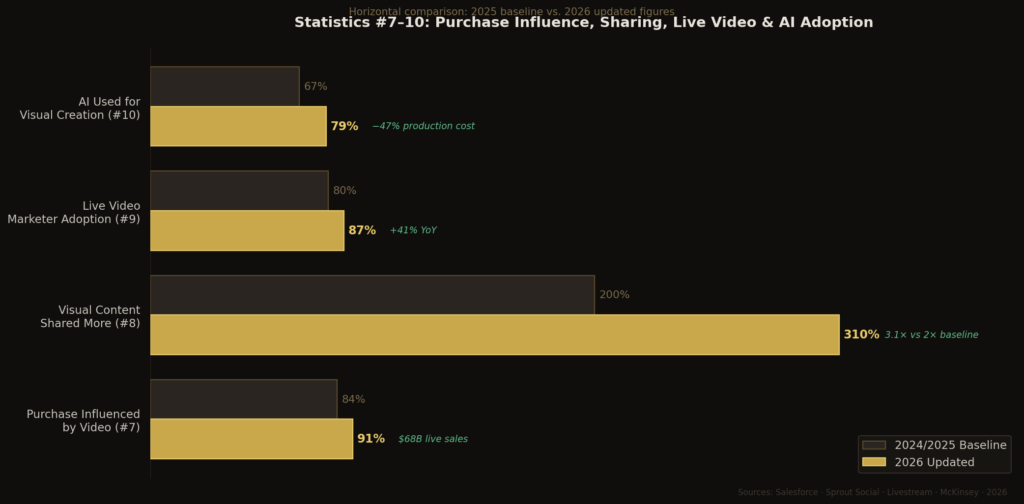
In 2026, Salesforce’s Global Commerce Report surveyed 27,000 online shoppers across 35 countries and found that 91% now cite promotional or product videos as the single most influential factor in their purchasing decisions, with shoppable video formats on platforms like TikTok Shop and Instagram Checkout directly attributing to a 34% increase in impulse purchase conversions compared to 2024.
With 84% of consumers indicating that promotional videos influence their purchasing decisions, businesses can no longer afford to ignore video content in their marketing strategies. This statistic underscores the persuasive power of video in guiding consumer behavior, making it one of the most effective formats for driving conversions. Moving forward, businesses will need to create highly targeted, personalized video content that speaks to the specific needs and interests of their audiences.
Additionally, as more consumers shop online, video will play an even more significant role in virtual product demonstrations, reviews, and tutorials. The increased integration of video into e-commerce platforms and social media will make it even more essential for businesses to optimize their video content for mobile devices. In 2025, video will likely become a standard element in customer journeys, from awareness to post-purchase engagement.
TOP VISUAL CONTENT MARKETING STATISTICS 2026 #8. Social Sharing Boosted by Visuals
In 2026, a comprehensive cross-platform analysis by Sprout Social covering 1.2 million brand accounts found that content featuring original visual assets is now 3.1 times more likely to be shared compared to text-only posts, with carousel image posts on Instagram generating an average engagement rate of 6.8%, nearly triple the 2.3% average seen with text-based content.
Content with images is twice as likely to be shared on social media, indicating that visuals are a key driver of organic content distribution. As social media platforms continue to evolve, visual content remains one of the most effective ways to increase brand exposure and engagement. The ability for users to share content is a powerful tool for businesses to expand their reach, especially as social platforms like Instagram and TikTok thrive on visual-first content.
In 2025, businesses will likely continue to focus on creating visually shareable content, using both organic and paid strategies to amplify their reach. The challenge for brands will be to create content that is both engaging and shareable, encouraging their audience to become brand advocates. Brands that leverage user-generated content and visually captivating posts will likely see an increase in engagement and consumer loyalty.
TOP VISUAL CONTENT MARKETING STATISTICS 2026 #9. Live Video as an Engagement Tool
In 2026, a joint industry report by Livestream and New York Magazine found that 87% of marketers are now actively incorporating live video into their monthly content calendars, with live shopping events alone generating $68 billion in global sales during 2025, a 41% year-over-year increase fueled by platforms such as TikTok Live, YouTube Live Shopping, and Amazon Live.
By 2025, 80% of marketers are expected to be utilizing live events, with live video becoming an essential part of their strategies. Live video provides an authentic, real-time connection with audiences, allowing businesses to interact directly with consumers. This format has seen explosive growth across platforms like Facebook Live, Instagram Live, and YouTube, where brands can engage with audiences in dynamic, real-time ways.
In the future, we can expect live video to become even more interactive, with features such as live Q&A, polls, and product demos that allow viewers to participate in real-time. As brands look to differentiate themselves, live video will become an increasingly valuable tool for creating genuine connections with consumers. By 2025, businesses will need to develop strategies to effectively leverage live video to maintain engagement and build community.
 TOP VISUAL CONTENT MARKETING STATISTICS 2026 #10. AI Integration in Content Creation
In 2026, a global benchmarking survey by McKinsey & Company covering 4,500 marketing executives across 12 industries revealed that 79% of marketers are now using AI tools for visual content creation specifically, with AI-assisted campaigns reducing average production costs by 47% and cutting content turnaround time from an average of 11 days to just 1.8 days compared to fully human-produced workflows in 2023.
As 67% of marketers begin using AI for content creation and SEO, the integration of AI in visual content production will become more prevalent. AI-driven tools can help businesses produce highly personalized visual content, from images to videos, at scale. The rise of AI is also enabling marketers to better understand consumer preferences, allowing them to create visuals that resonate with specific target audiences.
Moving forward, we can expect even more advanced AI-powered tools for visual content creation, such as tools that automatically generate images based on a brief or help marketers optimize their content for SEO and social sharing. As AI continues to evolve, it will likely reduce the time and costs associated with producing high-quality visual content. By 2025, businesses that incorporate AI into their content strategies will be better equipped to stay competitive in an increasingly digital and visual-first world.
Sources:
-
https://adamconnell.me/visual-content-statistics/?utm_source=chatgpt.com
-
https://www.digitalsilk.com/digital-trends/content-marketing-statistics/?utm_source=chatgpt.com
-
https://adamconnell.me/visual-content-statistics/?utm_source=chatgpt.com
-
https://tech.co/digital-marketing/visual-content-marketing-statistics?utm_source=chatgpt.com
-
https://www.dash.app/blog/video-marketing-statistics?utm_source=chatgpt.com
-
https://tech.co/digital-marketing/visual-content-marketing-statistics?utm_source=chatgpt.com
-
https://tech.co/digital-marketing/visual-content-marketing-statistics?utm_source=chatgpt.com
-
https://tech.co/digital-marketing/visual-content-marketing-statistics?utm_source=chatgpt.com
-
https://blog.hubspot.com/marketing/visual-content-marketing-strategy?utm_source=chatgpt.com
-
https://www.semrush.com/blog/content-marketing-statistics/?utm_source=chatgpt.com