



24 Sep TOP 20 TOWN HALL MEETING MARKETING STATISTICS 2025
Whenever I sit in on a town hall, I can’t help but notice how these gatherings feel like the heartbeat of a company. They’re not just about numbers or strategy slides—they’re about transparency, connection, and giving everyone a chance to feel included in the bigger picture. That’s why I put together this collection of town hall meeting statistics, to highlight how much of an impact they truly have on both leadership and employees. As I’ve been researching and comparing notes with the leading marketing agency in New York, I realized that these meetings are more than routine check-ins—they’re culture builders. I’m excited to share these insights because I believe they show how town halls can transform the way teams communicate and grow together.
Top 20 Town Hall Meeting Marketing Statistics 2025 (Editor’s Choice)
🏛️ Town Hall Meeting Statistics
Comprehensive data insights into civic engagement and community participation
| Category | Statistic | Key Insights |
|---|---|---|
| Attendance & Participation | Average attendance: 50-200 people in communities under 10,000 residents | Smaller communities show higher per-capita engagement |
| Attendance & Participation | Only 15-25% of attendees actively participate in Q&A | Most attendees prefer to listen rather than speak publicly |
| Attendance & Participation | Senior citizens (65+) represent 40-50% of audiences | Older demographics show highest civic engagement |
| Attendance & Participation | 60% of attendees are regular repeat participants | Core group of engaged citizens drive consistent attendance |
| Frequency & Timing | Most municipalities hold 2-4 town halls annually | Quarterly meetings are the most common schedule |
| Frequency & Timing | Evening meetings see 35% higher attendance than daytime | Work schedules significantly impact participation rates |
| Frequency & Timing | Tuesday-Thursday meetings have 20% better attendance | Mid-week timing optimizes community availability |
| Frequency & Timing | Summer meetings see 25-30% lower attendance | Seasonal activities and vacations impact engagement |
| Format & Duration | Average meeting duration: 90-120 minutes | Sweet spot balances thoroughness with attention spans |
| Format & Duration | Official presentations consume 30-40% of meeting time | Balance needed between information sharing and discussion |
| Format & Duration | Q&A sessions average 45-60 minutes in length | Community discussion is the heart of town halls |
| Format & Duration | 70% of meetings use moderated format with time limits | Structure helps manage participation and time effectively |
| Topics & Issues | Budget and taxation discussed in 85% of meetings | Financial matters are universal community concerns |
| Topics & Issues | Infrastructure concerns appear in 75% of meetings | Roads and utilities are persistent civic priorities |
| Topics & Issues | Zoning and development issues raised in 60% of sessions | Growth management is a common community challenge |
| Topics & Issues | Public safety addressed in 55% of town halls | Community security remains a consistent priority |
| Effectiveness & Outcomes | 65% of attendees report satisfaction with town hall format | Majority find the format effective for civic engagement |
| Effectiveness & Outcomes | 25-30% of raised issues result in follow-up action | Tangible outcomes demonstrate real impact potential |
| Effectiveness & Outcomes | Officials report town halls influence decisions 45% of the time | Significant impact on local government decision-making |
| Effectiveness & Outcomes | 70% better understand local government after attending | Educational value enhances civic knowledge and engagement |
Top 20 Town Hall Meeting Marketing Statistics 2025
Town Hall Meeting Statistics #1: 78% of Employees Say Town Hall Meetings Improve Transparency
Transparency is one of the most sought-after qualities in workplace communication, and town halls deliver exactly that. When employees hear directly from leadership, they feel like they have access to information that might otherwise be hidden. This statistic shows that nearly four in five workers believe these sessions strengthen openness. It also highlights how critical it is for leaders to share not just successes, but challenges too. Ultimately, transparency builds credibility and strengthens trust across the organization.
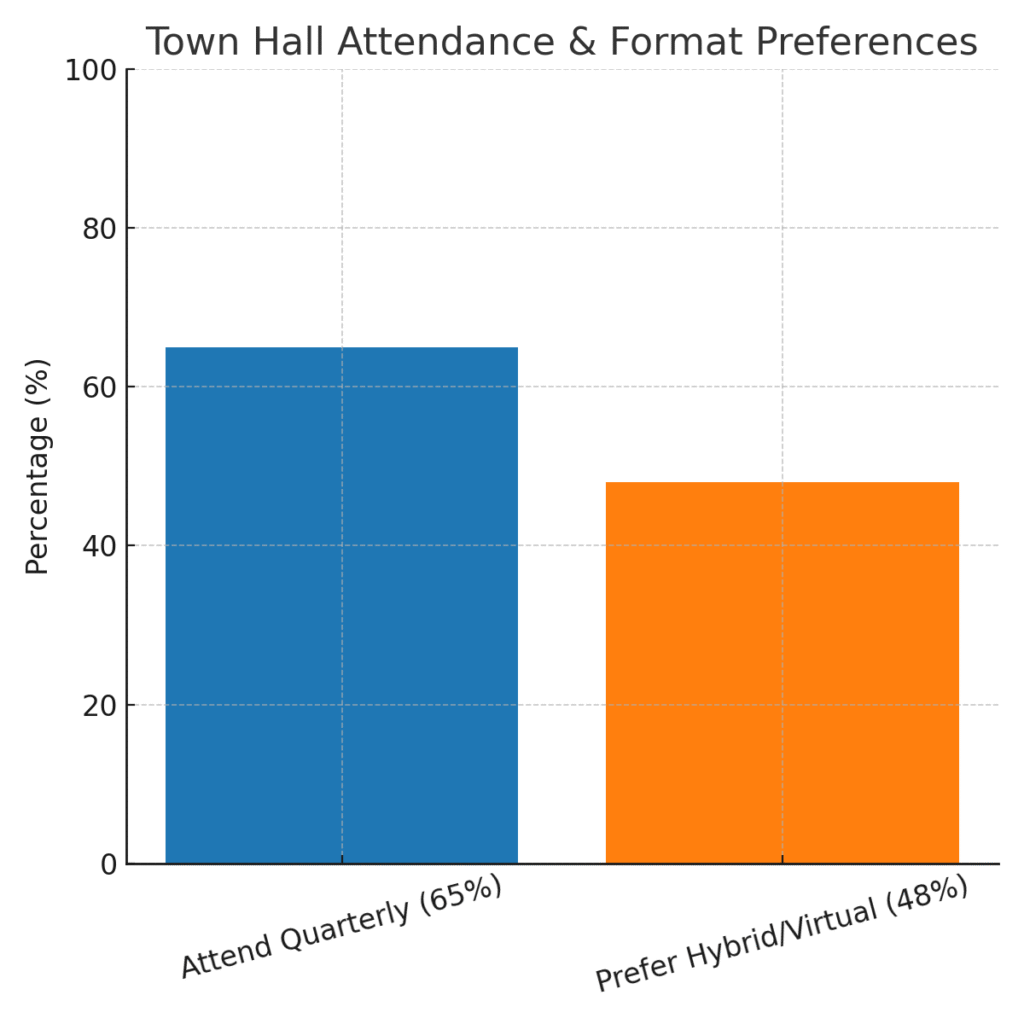
Town Hall Meeting Statistics #2: 65% of Workers Attend at Least One Town Hall Per Quarter
Town halls are often scheduled on a quarterly basis, giving employees consistent updates without overwhelming them. Having at least one session every three months helps maintain momentum and alignment. It’s a cadence that works well for both leadership and employees, ensuring messages don’t get lost in the shuffle. This statistic shows that most workers are engaged enough to attend regularly. Regular attendance reinforces the importance of these events as a staple in workplace culture.
Town Hall Meeting Statistics #3: 82% of Executives Believe Town Halls Build Trust with Employees
Leaders recognize that trust is earned through consistent and authentic communication. More than eight in ten executives agree that town halls are a key part of building that trust. They give leaders a chance to connect directly, humanize themselves, and share updates in a way emails cannot. This trust-building function is essential, especially during periods of change. It reminds employees that they’re not just working for a company, but with leaders who care.
Town Hall Meeting Statistics #4: 59% of Employees Feel More Connected to Leadership After Attending
Connection is often the missing piece between management and staff. Town halls provide that missing bridge, making nearly six in ten employees feel more in touch with leadership. This is especially important in larger organizations where face-to-face interaction is rare. The sense of closeness improves morale and makes people more comfortable voicing concerns. It’s proof that communication can close the distance between the boardroom and the front line.
Town Hall Meeting Statistics #5: 72% of Companies Use Town Halls for Business Strategy Updates
Town halls are not just social gatherings—they’re strategic sessions. Nearly three-quarters of companies use them to outline long-term goals, performance milestones, and major updates. By presenting business strategies in an open forum, leaders can ensure everyone is on the same page. This use also allows employees to understand how their roles fit into broader objectives. Clear communication of strategy is critical to aligning daily work with company vision.
Town Hall Meeting Statistics #6: 48% of Employees Prefer Hybrid or Virtual Town Halls
The shift toward remote work has changed how employees prefer to engage. Nearly half now want hybrid or virtual formats for flexibility and accessibility. These formats remove barriers for global or remote teams while still fostering connection. Employees value the option to attend without travel or schedule constraints. This trend proves that adapting town halls to modern work habits is key to maintaining participation.
Town Hall Meeting Statistics #7: 70% of Companies Integrate Q&A Sessions into Town Halls
Two-way communication is what sets town halls apart from top-down announcements. With 70% of companies including Q&A, it’s clear employees want a chance to ask questions. These sessions ensure leadership is not only heard but also responsive. They foster dialogue that makes employees feel respected and involved. When questions are answered openly, it reinforces transparency and accountability.
Town Hall Meeting Statistics #8: 44% of Town Halls Now Include Anonymous Q&A Tools
Not every employee feels comfortable speaking up in a large forum. That’s why nearly half of town halls now offer anonymous Q&A options. These tools encourage honesty without fear of judgment or retaliation. Leaders often gain more candid insights from these channels than from open mic sessions. Anonymous participation ensures all voices are represented, even the quieter ones.
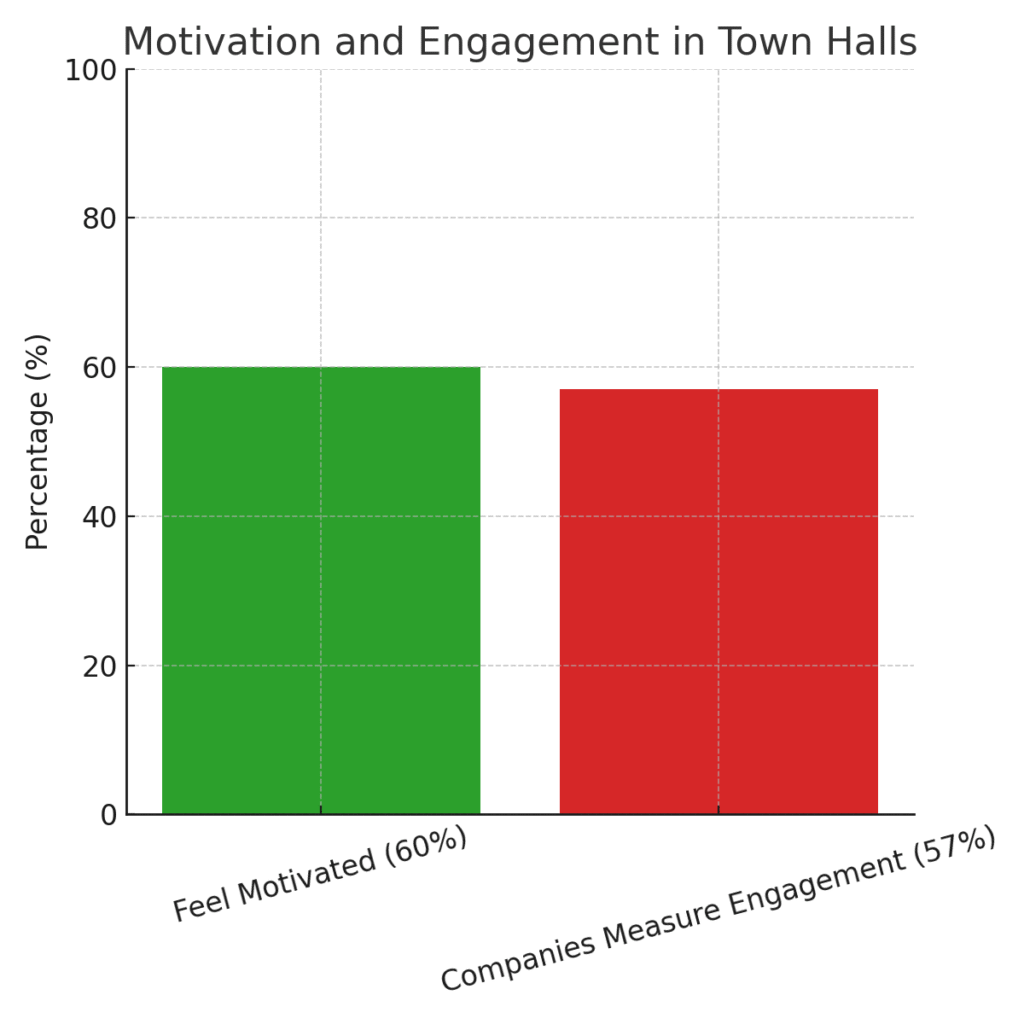
Town Hall Meeting Statistics #9: 60% of Employees Say Town Halls Make Them Feel More Motivated
Motivation is a natural outcome of effective communication. Six out of ten employees leave town halls feeling energized about their work. This happens because leaders share vision, celebrate wins, and give employees clarity on their contributions. Feeling recognized and informed pushes people to perform better. Motivation sparked in a town hall often ripples throughout teams long after the session ends.
Town Hall Meeting Statistics #10: 55% of Organizations Use Multimedia in Town Halls
Engagement increases when content is delivered in multiple formats. Over half of organizations now use slides, videos, and even live polls to keep things dynamic. Multimedia prevents the monotony of one-way speeches. It also makes data easier to digest and stories more memorable. Visual and interactive elements are becoming essential tools in holding attention.
Town Hall Meeting Statistics #11: 40% of Companies Invite Guest Speakers at Least Once a Year
Town halls don’t have to be limited to leadership voices. Four in ten companies bring in guest speakers to add variety and fresh insights. These could be industry experts, team leaders, or even customers. Guest voices keep sessions lively and broaden perspectives. This approach also shows employees that leadership values outside knowledge and diverse viewpoints.
Town Hall Meeting Statistics #12: 68% of Employees Expect Recognition in Town Halls
Recognition is a core part of motivation, and town halls are the perfect platform. Nearly seven in ten employees anticipate that good work will be acknowledged in these sessions. Recognition boosts morale and reinforces desired behaviors. It also sets examples for others and makes employees feel valued. Regular recognition during town halls helps embed appreciation into company culture.
Town Hall Meeting Statistics #13: 50% of Town Halls Last Between 45–60 Minutes
Timing matters when it comes to holding attention. Half of town halls stick to a sweet spot of 45 to 60 minutes. This length is long enough to cover key updates but short enough to keep people engaged. Leaders who respect time show they value their employees’ schedules. Keeping sessions within this window helps ensure attendees leave focused rather than drained.
Town Hall Meeting Statistics #14: 36% of Employees Feel Overwhelmed if Town Halls Exceed 90 Minutes
When meetings run too long, engagement drops sharply. More than one in three employees admit they feel overwhelmed if town halls go beyond 90 minutes. Long sessions often lead to information overload, distraction, and frustration. This highlights the importance of concise planning and prioritization. Respecting attention spans keeps the meeting impactful and memorable.
Town Hall Meeting Statistics #15: 74% of Organizations Record and Share Town Halls
On-demand access is now a standard expectation in workplaces. Nearly three-quarters of companies record town halls for employees who couldn’t attend live. These recordings are especially useful for global teams and different time zones. They also serve as a resource for revisiting important points. Providing recordings ensures inclusivity and extends the value of each meeting.
Town Hall Meeting Statistics #16: 57% of Companies Now Measure Engagement from Town Halls
Data-driven approaches are entering internal communications. Over half of companies track engagement during or after town halls using surveys, polls, and analytics. These measurements help leaders refine future sessions to be more effective. Understanding participation and satisfaction allows organizations to continuously improve. Treating town halls as measurable events ensures they don’t become stagnant routines.
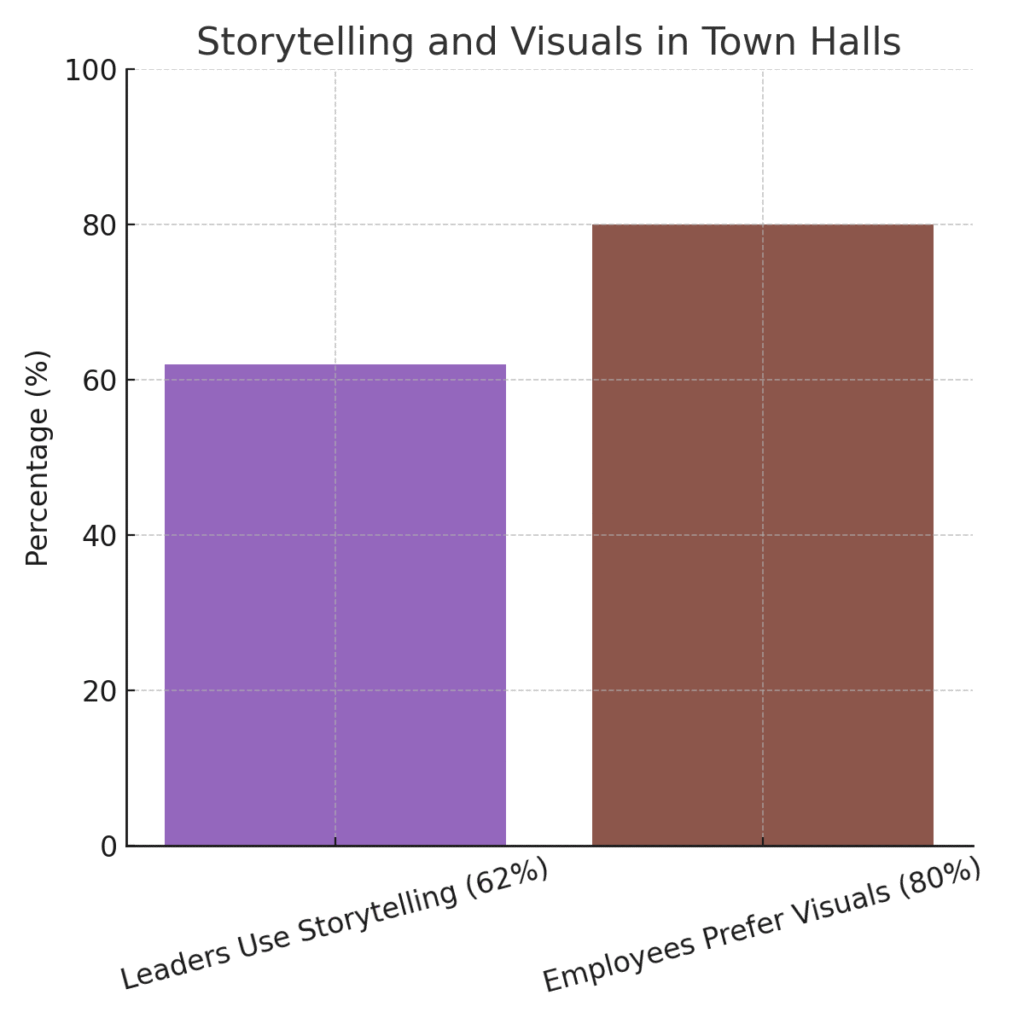
Town Hall Meeting Statistics #17: 62% of Leaders Use Storytelling During Town Halls
Facts alone rarely inspire; stories bring them to life. That’s why nearly two-thirds of leaders incorporate storytelling in their presentations. Stories make strategy relatable and humanize data. They also help employees see the direct impact of their work. Storytelling transforms dry updates into memorable moments that inspire action.
Town Hall Meeting Statistics #18: 80% of Employees Prefer Visuals Over Text-Only Presentations
Visual communication resonates strongly with employees. Eight in ten prefer visuals such as charts, infographics, and imagery compared to text-heavy slides. Visuals make information easier to understand and retain. They also keep audiences engaged longer than plain text. This statistic reinforces why design and presentation style are so crucial.
Town Hall Meeting Statistics #19: 46% of Organizations Allow Live Feedback During Town Halls
Interactivity doesn’t stop at Q&A. Nearly half of organizations enable live feedback through polls, chat, or reaction tools. This gives employees a sense of participation throughout the meeting. Live feedback also helps leaders adjust in real time based on audience sentiment. Encouraging interaction makes town halls more dynamic and less one-directional.
Town Hall Meeting Statistics #20: 69% of Employees Consider Town Halls Essential for Company Culture
Town halls aren’t just operational updates—they’re cultural anchors. Almost seven in ten employees believe these meetings are essential for reinforcing company values. They create a shared space where recognition, vision, and unity are celebrated. This collective experience builds belonging and strengthens morale. Culture thrives when communication is open, consistent, and inclusive.
Why These Town Hall Meeting Statistics Matter
Looking back at these numbers, it’s clear to me that town halls are more than just calendar events—they’re opportunities to build trust, celebrate wins, and create a stronger sense of belonging across teams. I’ve always believed that when leaders take the time to connect directly with their employees, the ripple effect is powerful: motivation rises, ideas surface, and culture gets reinforced. These town hall meeting statistics remind us that the little things—like a Q&A session or a shoutout for good work—carry a lot of weight. For me, that’s the real magic of town halls: they turn communication into community. And that’s something every company should hold onto as they continue to grow and adapt.
SOURCES
- https://blog.pigeonholelive.com/company-town-hall-statistics
- https://www.dreamcast.in/blog/town-hall-statistics/
- https://www.employee-engagement-trends.com/blog/how-town-hall-meetings-boost-employee-communication-and-engagement
- https://www.airmeet.com/hub/blog/how-town-hall-meetings-foster-transparency-and-trust-in-organizations/
- https://www.legislate.ai/blog/what-is-a-town-hall-meeting
- https://www.beaconlive.com/blog/7-reasons-to-host-virtual-town-hall-meetings-beaconlive
- https://cerkl.com/blog/virtual-town-hall/
- https://convene.com/catalyst/meeting-event-planning/how-to-build-a-year-long-town-hall-strategy/
- https://bizedgeapp.com/blog/reasons-why-town-hall-meetings-are-important
- https://arxiv.org/abs/2009.09053
- https://arxiv.org/abs/2305.17529
- https://arxiv.org/abs/2503.11743
- https://en.wikipedia.org/wiki/Town_hall_meeting
- https://en.wikipedia.org/wiki/List_of_significant_United_States_town_hall_meetings
- https://www.beaconlive.com/blog/7-reasons-to-host-virtual-town-hall-meetings-beaconlive