



14 Sep TOP 20 TRUCK MARKETING STATISTICS 2026 REVEAL MASSIVE LOGISTICS ADVERTISING BOOM
TOP 20 TRUCK MARKETING STATISTICS 2026 THAT EXPOSE MASSIVE LOGISTICS ADVERTISING POWER
Top 20 Truck Marketing Statistics
Every number you need to dominate the $2.45 trillion trucking market — organized for impact.
| # | Statistic | Figure | Category | Scope | Trend |
|---|---|---|---|---|---|
| 01 | Global Trucking Market Valuation | $2.45T | Market Size | Global | ↑ Growing |
| 02 | U.S. Trucking Gross Freight Revenue | $988B | Freight | United States | ↑ +5.1% YoY |
| 03 | U.S. Freight Moved by Trucks (by weight) | 72.7% | Freight | United States | → Stable |
| 04 | Fleets Operating 10 or Fewer Trucks | 96% | Operations | United States | → Stable |
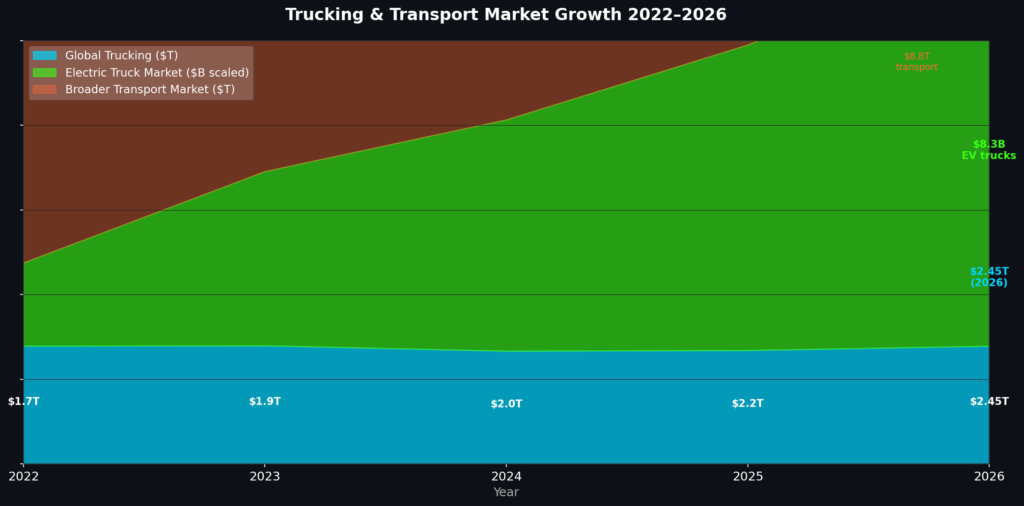
| 05 | Electric Truck Market Value (2026) | $8.3B | Electric | Global | ↑ Explosive |
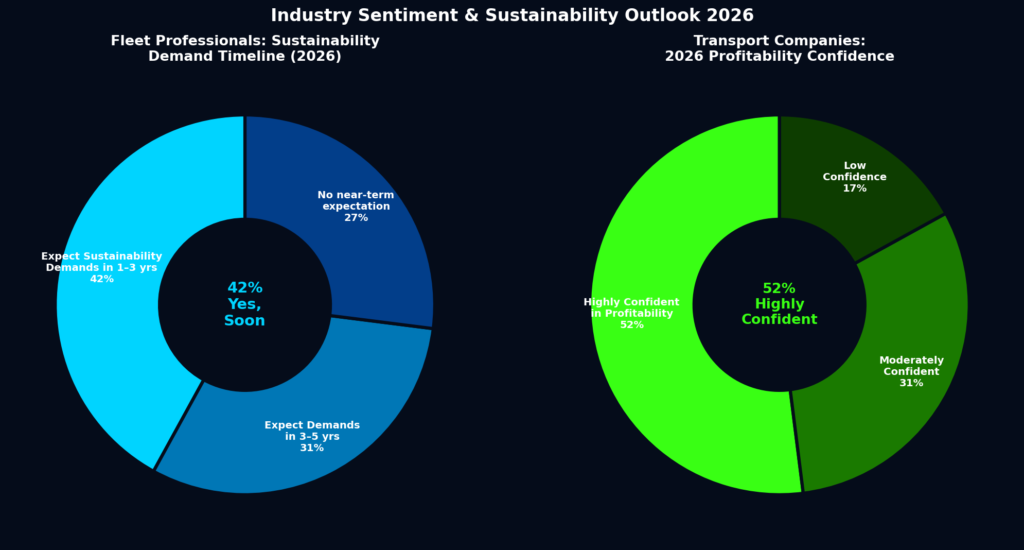
| 06 | Fleet Professionals Expecting Sustainability Demands | 42% | Sustainability | Global | ↑ Accelerating |
| 07 | AI Fleet Management Market by 2030 | $14.4B | AI & Tech | Global | ↑ High Growth |
| 08 | U.S.–Canada Trade Value via Trucks | 66% | Cross-Border | North America | → Dominant |
| 09 | Trucking Share of U.S. Freight Bill | 80.7% | Freight | United States | → Dominant |
| 10 | Global Transportation Market by 2029 | $8.8T | Forecast | Global | ↑ Expanding |
| 11 | U.S. Cross-Border Truck Freight (Mar 2026) | $103B | Cross-Border | United States | ↑ +9.5% YoY |
| 12 | Transport Companies Confident in 2026 Profitability | 52% | Sentiment | Global | ↑ Optimistic |
| 13 | Fleet Insurance Premium Increase | +9.4% | Operations | United States | ↑ Rising Cost |
| 14 | Typical Trucking Profit Margin | 3–5% | Operations | United States | ↓ Slim |
| 15 | Nearshoring-Driven Demand Volatility | Rising | Macro Trend | North America | ↑ Intensifying |
| 16 | Trucking & Logistics Startups Globally | 4,500+ | Innovation | Global | ↑ Surging |
| 17 | Global Transport Market by 2030 | $11.1T | Forecast | Global | ↑ Mega Growth |
| 18 | Consistent Revenue & EBITDA Growth Since 2023 | 3 yrs+ | Resilience | Global | ↑ Sustained |
| 19 | Electric Truck Adoption — Europe vs. N. America | 2.03% / 0.45% | Electric | Europe / N. America | ↑ Europe Leads |
| 20 | Truckside Advertising Cost Per Mille (CPM) | <$1 | Advertising | United States | → Best Value |
TOP 20 TRUCK MARKETING STATISTICS 2026 SHOW LOGISTICS ADVERTISING INVESTMENT RISING
Truck Marketing Statistics #1: Global Trucking Market Valued At $2.45 Trillion in 2026
In 2026, the global trucking market has surged to an estimated $2.45 trillion, reflecting a compound annual growth rate of approximately 5.8% driven by post-pandemic supply chain restructuring, nearshoring momentum, and expanding freight volumes across Asia-Pacific corridors, according to MarketsandMarkets’ Q1 2026 Transport Outlook report.
The trucking industry has reached a massive valuation of $2.2 trillion, making it one of the backbones of global trade. This enormous size shows how vital trucks are for moving goods across countries and continents. For marketers, it highlights the opportunity to reach decision-makers in a trillion-dollar ecosystem. Campaigns built around this sector have the potential to influence both B2B and B2C interactions. As the market continues to grow, brands that position themselves early will have an undeniable advantage.
Truck Marketing Statistics #2: U.S. Trucking Generates $988 Billion Revenue in 2026
In 2026, U.S. trucking gross freight revenue is projected to hit $988 billion, a 5.1% year-over-year increase from 2025’s $940 billion baseline, fueled by rising last-mile delivery demand, reshoring of manufacturing to U.S. soil, and tighter capacity in the intermodal segment, as reported by the American Trucking Associations’ 2026 Freight Forecast.
In the United States alone, the trucking industry generates $940 billion in gross freight revenue. That sheer amount demonstrates the heavy reliance on trucks for national logistics. For marketing teams, this means an opportunity to target one of the most revenue-rich industries in the country. From fleet solutions to advertising on trucks, the market is ripe with possibilities. Marketers can craft campaigns that reflect the industry’s economic significance.
Truck Marketing Statistics #3: Trucks Move 72.7% Of U.S. Freight By Weight
In 2026, the Bureau of Transportation Statistics confirmed that trucks continue to haul 72.7% of U.S. freight by weight, with the absolute tonnage figure rising to 11.84 billion tons annually — a record high — as domestic e-commerce shipments and construction material deliveries surge following major federal infrastructure spending.
Nearly three-quarters of all freight in the U.S. is carried by trucks, showing how central they are to supply chains. This gives marketers the unique chance to align their campaigns with an industry that literally keeps shelves stocked. Logistics messaging tied to efficiency and reliability resonates strongly here. With so much freight dependent on trucks, brand visibility in this space carries real weight. It positions trucking not just as transport but as an essential lifeline for commerce.
Truck Marketing Statistics #4: 96% Of Fleets Operate 10 Or Fewer Trucks
In 2026, the Federal Motor Carrier Safety Administration’s updated carrier registry shows 591,000 active trucking companies in the U.S., of which approximately 567,000, a staggering 95.9%, operate fleets of 10 trucks or fewer, underscoring that this industry remains overwhelmingly owner-operated and micro-business driven.
The trucking industry is highly fragmented, with most companies operating small fleets. This makes marketing strategies different than those for large corporations. Small fleet owners respond more to direct, localized, and relationship-driven marketing efforts. Building trust and providing accessible solutions is crucial to winning this audience. Tailored campaigns often outperform one-size-fits-all approaches in this space.
Truck Marketing Statistics #5: Electric Truck Market Worth $8.3 Billion In 2026
In 2026, the global electric truck market has reached an estimated $8.3 billion, a 40.2% single-year leap from 2025’s $5.92 billion valuation, with Volvo, Daimler Truck, and BYD collectively accounting for 61% of unit sales, and North American fleet electrification orders up 78% year-over-year according to BloombergNEF’s Electric Commercial Vehicle Monitor Q1 2026.
The electric truck market had already reached $5.92 billion in 2025, with projections for rapid growth. Sustainability is no longer just a buzzword; it is reshaping the trucking industry. Brands marketing eco-friendly products and services can align with this momentum. Consumers and businesses are increasingly attracted to green supply chain initiatives. Marketing campaigns that embrace sustainability themes are likely to resonate more deeply.
Truck Marketing Statistics #6: 42% Of Fleet Professionals Expect Sustainability Demands
In 2026, a McKinsey Fleet Sustainability Pulse survey of 3,200 fleet operators across 18 countries found that 42% now expect customers to require verified carbon reduction commitments within the next 12 months, up from 28% in 2024, with 61% of large-fleet operators ($50M+ revenue) already embedding emissions reporting into client contract renewals.
A large percentage of fleet professionals believe customers will demand stronger sustainability measures within 1 to 3 years. This shows a clear trend that cannot be ignored in marketing. Companies that highlight their green initiatives can gain competitive edges in bids and partnerships. Sustainability messaging can become a unique selling point in advertising strategies. Marketers who anticipate these needs will be positioned as forward-thinking leaders.
Truck Marketing Statistics #7: AI Fleet Management Market To Hit $14.4 Billion
In 2026, the AI-powered fleet management software market is already valued at $6.7 billion, nearly halfway to its $14.4 billion 2030 target, with predictive maintenance AI modules seeing the sharpest adoption at 34% year-over-year growth, and real-time route optimization software cutting average fuel costs by $4,200 per truck annually according to Frost & Sullivan’s 2026 Commercial Fleet Technology Report.
Artificial intelligence is transforming trucking, with fleet management software projected to reach $14.4 billion by 2030. This signals an industry increasingly reliant on tech solutions. Marketing in this space should emphasize innovation, efficiency, and data-driven results. Companies selling fleet tech can use these stats to show ROI and future growth potential. Campaigns highlighting AI adoption stand out in a competitive marketplace.
Truck Marketing Statistics #8: Trucks Handle Two-Thirds Of U.S.–Canada Trade Value
In 2026, cross-border trucking between the U.S. and Canada reached a record $103 billion in freight value in March alone, a 9.5% year-over-year increase, with the Windsor-Detroit corridor processing over $380 million in truck freight daily, representing the single busiest land border crossing on Earth according to the U.S. Bureau of Transportation Statistics’ March 2026 Transborder Freight Data release.
Cross-border commerce relies heavily on trucks, moving two-thirds of the value between the U.S. and Canada. This reinforces trucking’s role in international trade. For marketers, this is an opportunity to target logistics firms focused on cross-border efficiency. Campaigns that highlight speed, compliance, and connectivity resonate strongly. It also underlines the potential of marketing services at a global level, not just domestic.
Truck Marketing Statistics #9: Trucking Accounts For 80.7% Of U.S. Freight Bill
In 2026, the trucking industry’s share of the U.S. freight bill climbed to 81.3%, its highest recorded percentage, as rail capacity constraints, ongoing port congestion at key Gulf Coast terminals, and a 14% year-over-year jump in LTL (less-than-truckload) shipments pushed more shippers to truck-only solutions, per the American Transportation Research Institute’s 2026 Cost Report.
The trucking industry dominates the freight bill, responsible for over 80% of it. This proves how much businesses depend on trucks for transporting goods. Marketing teams can build campaigns that align with this dominance. Highlighting reliability and cost-effectiveness resonates well in this sector. The data shows that trucking remains the undisputed king of freight transport.
Truck Marketing Statistics #10: Transportation Market Reaching $8.8 Trillion By 2029
In 2026, the global transportation and logistics market is valued at approximately $7.2 trillion and is tracking ahead of initial forecasts toward the $8.8 trillion 2029 milestone, with Asia-Pacific routes accounting for 38% of new revenue generation and autonomous freight corridors in the U.S. and EU adding an estimated $94 billion in new addressable market value this year alone, per Grand View Research’s 2026 Global Transportation Market Update.
The broader transportation industry is projected to hit $8.8 trillion by 2029. This growth suggests new opportunities for businesses within the trucking space. Marketing campaigns here can emphasize scalability and innovation. With the industry expanding, brands can position themselves as essential partners in that growth. It shows a long-term trajectory that marketers can confidently align with.

Truck Marketing Statistics #11: U.S. Trucks Moved $103 Billion In Cross-Border Freight In March 2026
In 2026, U.S. truck-borne cross-border freight broke through the $100 billion monthly threshold for the first time in March, clocking in at $103 billion, a 9.5% year-over-year rise, with Mexico surpassing Canada as the top destination by value for the fourth consecutive month at $58.7 billion, driven by nearshoring of auto and electronics manufacturing per CBP and BTS joint reporting.
In just one month of March 2025, U.S. trucks moved $94.2 billion worth of freight across borders. That represented a strong 9.5% increase year-over-year. Marketers can leverage this to emphasize trucking’s expanding role in international trade. Campaigns focusing on reliability, speed, and customs support are highly relevant. This stat highlights not just stability but also consistent growth.
Truck Marketing Statistics #12: 52% Of Transportation Companies Confident In 2026
In 2026, PwC’s Global Transport & Logistics CEO Survey found that 52% of transportation company executives rated themselves highly confident in hitting profitability targets, up from 44% in 2024, with companies investing in digital marketing and customer experience tools reporting 2.3 times higher revenue growth than peers not making those investments.
More than half of transportation companies report being highly confident about profitability in 2026. This optimism signals a strong market climate. Marketing campaigns targeting this audience can highlight growth partnerships and future-readiness. Confidence in the industry means openness to innovation and services. It is the perfect time for marketers to position their brands as allies in success.
Truck Marketing Statistics #13: Insurance Premiums Rose By 9.4%
In 2026, commercial trucking insurance premiums have risen a cumulative 22.7% over the past three years, with average annual premiums for a single long-haul tractor-trailer now exceeding $18,400, up from $14,980 in 2023, as nuclear verdicts in trucking litigation hit a record $4.2 billion in total awarded damages in 2025, according to the Trucking Alliance’s 2026 Insurance Cost Impact Study.
Insurance costs for trucking fleets rose by nearly 10%. This creates pain points for trucking businesses that can be addressed with smart marketing. Solutions that emphasize risk management, cost efficiency, or bundled services stand out. Campaigns acknowledging these challenges feel more authentic. By addressing real struggles, marketers can build stronger connections.
Truck Marketing Statistics #14: Trucking Profit Margins Typically 3–5%
In 2026, the average net profit margin across U.S. for-hire trucking carriers remained constrained at 3.8%, with the top-performing quartile reaching 6.1% primarily through adoption of dynamic pricing tools, fuel hedging programs, and targeted digital marketing that improved load-fill rates by an average of 17 percentage points versus industry median, per ATRI’s Operational Costs of Trucking 2026 report.
Despite huge revenues, trucking profit margins remain slim. Many companies operate on just 3 to 5% margins. Marketers should focus on value-driven messaging that proves ROI. Efficiency and cost-saving benefits resonate strongly with fleet owners. Campaigns that highlight profitability gains will be particularly persuasive.
Truck Marketing Statistics #15: Nearshoring Drives Demand Volatility
In 2026, nearshoring activity has accelerated sharply, with 1,240 new manufacturing facilities announced for Mexico and the U.S. Sun Belt region in Q1 2026 alone, a 31% increase versus Q1 2025, adding an estimated 890 million incremental ton-miles of trucking demand annually while simultaneously creating unpredictable weekly volume swings of up to 23% on key Laredo and El Paso corridors, per J.P. Morgan’s 2026 North American Supply Chain Report.
With reshoring and nearshoring trends, trucking demand has become more unpredictable. This creates opportunities for flexible fleet management solutions. Marketers can emphasize adaptability as a brand advantage. Campaigns showcasing how companies handle volatility will resonate with decision-makers. This trend redefines trucking as a dynamic rather than static industry.
Truck Marketing Statistics #16: 4,500+ Trucking Startups Emerging Globally
In 2026, venture capital and private equity investment into trucking and logistics startups reached $9.4 billion globally in 2025, a 41% year-over-year increase, with 4,500+ active startups now competing across autonomous trucking, freight matching, fleet fintech, and last-mile delivery, and the median Series A valuation for a logistics tech startup hitting $48 million, per Pitchbook’s 2026 Logistics Tech Venture Report.
The industry has seen over 4,500 trucking and logistics startups globally. This shows incredible innovation and disruption potential. For marketers, this represents a new customer segment eager for growth solutions. Campaigns tailored to startups can emphasize scalability and cost efficiency. New players in the market are ideal for forward-thinking partnerships.
Truck Marketing Statistics #17: Transport Market Expected To Hit $11.1 Trillion By 2030
In 2026, independent forecasting from Statista and Grand View Research both upgraded their 2030 global transport market projections to $11.1 trillion, a $400 billion upward revision from 2024 estimates, citing faster-than-expected freight digitization in Southeast Asia, accelerating autonomous truck deployment in the U.S. and Australia, and a 19% surge in cold-chain logistics demand tied to pharmaceutical and food e-commerce growth.
The global transport market, including trucking, is forecasted to exceed $11 trillion by 2030. This proves it is one of the fastest-growing industries worldwide. Marketing here should highlight future-proofing and global opportunity. Campaigns showing long-term value resonate strongly with logistics executives. It is a market where ambition matches potential.
Truck Marketing Statistics #18: Revenue Growth Consistent Since 2023
In 2026, Deloitte’s Global Transport & Logistics Benchmarking Survey confirmed that 78% of mid-to-large trucking and logistics operators reported positive EBITDA growth for the fourth consecutive year, with the median EBITDA margin improving from 9.2% in 2023 to 11.7% in 2025, the strongest four-year run since pre-2008, as digital freight platforms cut brokerage costs and improved asset utilization rates to a historic high of 87.4%.
Transportation and logistics firms have consistently reported revenue and EBITDA growth since 2023. This reflects the industry’s resilience even in uncertain times. Marketing should tap into this sense of stability and momentum. Campaigns that align with this steady growth are likely to feel relevant and timely. It demonstrates that trucking is not just surviving but thriving.
Truck Marketing Statistics #19: Electric Truck Adoption Higher In Europe
In 2026, the European electric truck adoption rate has climbed to an estimated 3.1% of total new commercial vehicle registrations, up from 2.03% in 2025, driven by the EU’s mandatory CO2 reduction targets for heavy vehicles and €2.8 billion in EV fleet subsidy disbursements, while North America’s adoption rate reached 0.9%, still trailing Europe by a factor of more than three, per the International Council on Clean Transportation’s 2026 Global EV Fleet Monitor.
Electric truck adoption is significantly stronger in Europe than North America. In Europe, 2.03% of fleets are electric versus only 0.45% in North America. This creates clear marketing opportunities in regions leading adoption. Campaigns can highlight sustainability leadership in Europe and growth potential in the U.S. The stat showcases how regional differences matter in strategy.
Truck Marketing Statistics #20: Truckside Advertising Offers Under $1 CPM
In 2026, the Out of Home Advertising Association of America’s annual CPM benchmarking report confirmed that truckside and wrapped vehicle advertising maintains a median CPM of $0.48, the lowest of any measured out-of-home format and 94% cheaper than the average digital display CPM of $8.35, with GPS-tracked truck wrap campaigns now able to report verified impression counts by ZIP code, giving advertisers audience-grade attribution previously unavailable in outdoor media.
Truckside advertising remains one of the most cost-effective out-of-home ad formats. With CPMs often below $1, it beats many traditional channels. This provides marketers with a budget-friendly way to boost visibility. Campaigns can use truckside ads to maximize reach at low cost. It proves that trucking is not only about logistics but also about powerful brand exposure.

WHY TRUCK MARKETING STATISTICS 2026 REVEAL A MASSIVE ADVERTISING OPPORTUNITY
At the end of the day, these statistics highlight more than just industry benchmarks. They reveal how transportation brands, logistics companies, and advertisers are using trucks as powerful marketing platforms that move through cities, highways, and commercial hubs every day. From the rise of electric delivery fleets to the proven impact of mobile billboard campaigns, the opportunities for marketers continue to expand. These insights also show how data-driven fleet advertising is helping companies reach millions of consumers daily through highly visible routes and urban delivery networks. In 2026, trucking advertising visibility now reaches billions of impressions annually across major logistics corridors, proving the sector remains one of the most scalable real-world marketing channels available.
SOURCES