




24 Sep TOP 20 TRUCKING MARKETING STATISTICS 2025
Whenever I dive into trucking marketing statistics, I can’t help but feel fascinated by how much this industry shapes our everyday lives without most of us even realizing it. From the freight tonnage moved every year to the innovative ways trucking companies are adopting digital tools, there’s so much happening behind the scenes that directly influences how businesses connect with customers. As someone who loves sharing insights that go beyond just numbers, I’ve partnered with a leading marketing agency in New York to highlight the most eye-opening trends and stats in the trucking sector. My goal is to make this not just a collection of figures, but a story that shows where the trucking industry is headed and how marketing plays a critical role in its evolution.
Top 20 Trucking Marketing Statistics 2025 (Editor’s Choice)
| Stat # | Trucking Marketing Statistic | Key Insight |
|---|---|---|
| 1 | Global freight trucking market valued at USD 2.2 trillion (2025) | Shows massive worldwide scale and opportunity for growth. |
| 2 | U.S. trucking market estimated at USD 532.7 billion (2025) | Highlights the economic power of the U.S. trucking sector. |
| 3 | Global trucking expected to grow at 5.4% CAGR through 2030 | Indicates steady long-term expansion and reliability. |
| 4 | Fleet management software market to reach USD 14.4 billion by 2030 | Tech adoption is becoming critical for trucking efficiency. |
| 5 | Big data in logistics valued at USD 4.3 billion (2023) | Data-driven insights are reshaping trucking operations. |
| 6 | Trucks moved 11.27 billion tons of freight in the U.S. (2024) | Trucking remains the lifeblood of American commerce. |
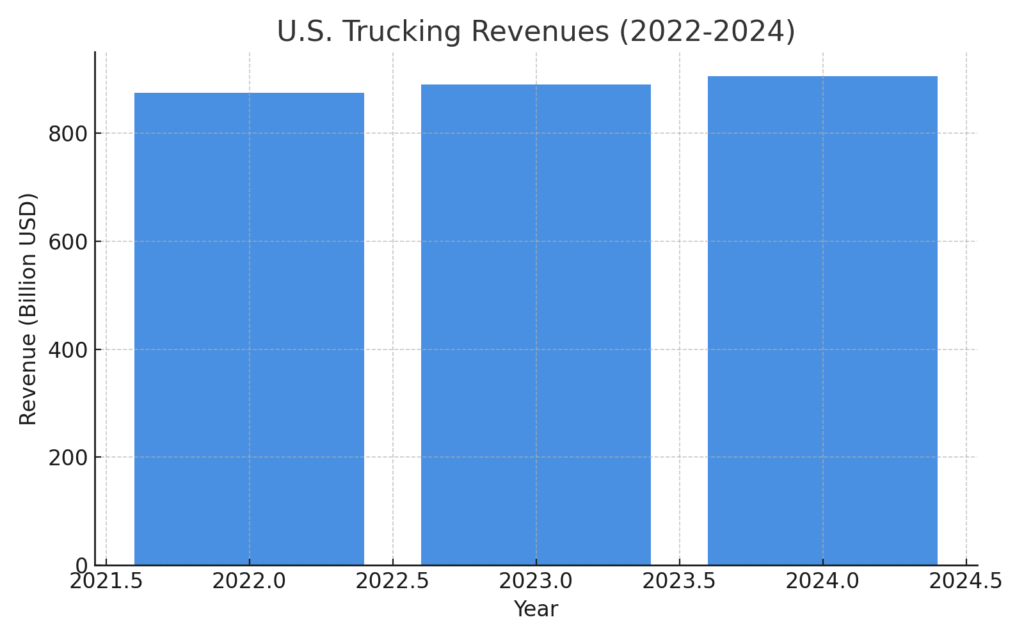
| 7 | U.S. trucking revenues reached USD 906 billion (2024) | Reflects massive contribution to the national economy. |
| 8 | U.S. cross-border freight reached USD 94.2 billion (March 2025) | Proves trucking’s role in global trade and international reach. |
| 9 | Trucks carry 72.7% of U.S. freight by weight | Dominates other transport modes, showing unmatched importance. |
| 10 | U.S. has 13 million large trucks in operation | Demonstrates wide availability and industry capacity. |
| 11 | 3.54 million drivers employed in U.S. trucking | Highlights the human workforce powering the industry. |
| 12 | 96% of fleets operate with 10 or fewer trucks | Shows trucking is built on small businesses and local fleets. |
| 13 | 8% of U.S. truck drivers are female | Diversity in trucking is slowly increasing and marketable. |
| 14 | Median age of U.S. truck drivers is 45.8 years | Indicates experienced workforce but also aging trends. |
| 15 | Typical operating margins range from 7–18% | Shows profitability challenges but also resilience. |
| 16 | 60% of fleets using sustainability tools report reduced emissions | Sustainability is now a key marketing and business driver. |
| 17 | Electric truck industry valued at USD 5.92 billion (2025) | Green innovation is shaping the future of trucking. |
| 18 | U.S. logistics market to reach USD 671.2 billion by 2030 | End-to-end logistics solutions present massive growth potential. |
| 19 | 50.5% of sales teams in transportation miss quotas | Reveals marketing’s importance in supporting sales teams. |
| 20 | B2B website conversion rates often under 2% | Highlights need for digital optimization in trucking marketing. |
Top 20 Trucking Marketing Statistics 2025
Trucking Marketing Statistics #1 – Global Freight Trucking Market Valued At USD 2.2 Trillion In 2025
The global freight trucking market reaching USD 2.2 trillion in 2025 shows just how central this sector is to global trade. This enormous figure highlights not only the scale of the industry but also the opportunities available for marketers to reach decision-makers in transportation. Businesses within trucking can leverage this scale to emphasize reliability and coverage in their marketing campaigns. For logistics clients, showcasing the vastness of the industry reassures them of its stability. This stat reminds me how marketing messages grounded in scale can truly resonate with customers.
Trucking Marketing Statistics #2 – U.S. Trucking Market Estimated At USD 532.7 Billion In 2025
The U.S. trucking market alone is worth over half a trillion dollars, making it a powerhouse in the global freight system. This figure underscores how marketing within the trucking industry can target both large enterprises and small operators. When marketers highlight this scale, they build confidence in trucking as the backbone of domestic commerce. With billions at stake, companies that align marketing to emphasize dependability stand out. To me, this shows that marketing in trucking isn’t just B2B—it’s about earning trust in a market worth hundreds of billions.
Trucking Marketing Statistics #3 – Global Trucking Expected To Grow At 5.4% CAGR Through 2030
Growth at 5.4% annually through 2030 means the trucking industry isn’t slowing down. For marketers, this steady expansion indicates a continuous demand for digital campaigns and lead generation. Companies can highlight this growth to attract new partners and investors who want a piece of a rising industry. Marketing strategies that lean on “future proofing” and “long-term stability” will be effective here. Personally, I see this stat as a reason to focus messaging on sustainable growth and resilience.
Trucking Marketing Statistics #4 – Fleet Management Software Market To Reach USD 14.4 Billion By 2030
Technology is reshaping trucking, with fleet management software projected to hit USD 14.4 billion by 2030. This signals a growing intersection between trucking and tech marketing. Marketers can spotlight efficiency, safety, and data-driven decision-making in campaigns targeting fleet managers. Companies that integrate digital transformation messaging will stand out in this competitive market. I believe this stat is proof that successful trucking marketing now requires a tech-savvy approach.
Trucking Marketing Statistics #5 – Big Data In Logistics Valued At USD 4.3 Billion In 2023
Big data in logistics, worth USD 4.3 billion in 2023, shows how insights and analytics are revolutionizing trucking. Marketers can use this trend to emphasize innovation and decision-making in messaging. For trucking businesses, highlighting their use of data creates a competitive advantage in campaigns. Clients increasingly want to see transparency and real-time updates, and data-driven marketing makes this possible. This stat reinforces for me that data storytelling has become essential in trucking marketing.

Trucking Marketing Statistics #6 – Trucks Moved 11.27 Billion Tons Of Freight In The U.S. In 2024
Moving 11.27 billion tons of freight proves the trucking industry is the lifeblood of American commerce. For marketing, this stat creates opportunities to highlight reliability and scale. Marketers can tell stories of how trucking literally delivers the nation’s goods. Campaigns that stress this level of contribution help companies position themselves as indispensable. To me, this stat shows the power of emphasizing trucking’s role in everyday life.
Trucking Marketing Statistics #7 – U.S. Trucking Revenues Reached USD 906 Billion In 2024
With revenues soaring to USD 906 billion, trucking’s economic significance is undeniable. This massive figure allows marketers to frame campaigns around financial stability and industry strength. Clients trust industries with proven revenue power, and marketers should lean on this. For me, this number paints a picture of an industry where marketing can confidently emphasize security and longevity. It’s a reminder that the trucking story is also an economic success story.
Trucking Marketing Statistics #8 – U.S. Cross-Border Freight Reached USD 94.2 Billion In March 2025
In just one month, U.S. trucks carried USD 94.2 billion in cross-border freight. This stat underscores the role trucking plays in global trade. Marketers can highlight international reach and reliability in messaging for trucking companies. Campaigns with cross-border success stories resonate strongly with customers who value logistics efficiency. I see this as proof that international positioning is a powerful tool in trucking marketing.
Trucking Marketing Statistics #9 – Trucks Carry 72.7% Of U.S. Freight By Weight
Trucking carries nearly three-quarters of all U.S. freight, showing its dominance over other transport modes. This stat provides marketers with a strong foundation to promote the trucking industry’s reliability. Customers trust services that dominate a market, and marketers can position trucking as the clear leader. Campaigns emphasizing this majority role reinforce trucking’s essential status. Personally, I see this stat as one of the strongest arguments in favor of trucking’s unmatched importance.
Trucking Marketing Statistics #10 – U.S. Has 13 Million Large Trucks In Operation
With 13 million large trucks in operation, the industry’s footprint is massive. This stat can be used in marketing to highlight the scale and accessibility of trucking services. Clients feel reassured knowing there’s such widespread capacity. Marketers can emphasize this presence to create a sense of national coverage and dependability. To me, this figure is a powerful storytelling anchor for scale-based marketing.

Trucking Marketing Statistics #11 – 3.54 Million Drivers Employed In U.S. Trucking
The industry employs 3.54 million drivers, making trucking one of the largest job providers in the country. For marketers, this represents a human element worth highlighting. Campaigns can spotlight hardworking drivers to connect emotionally with audiences. Stories centered on drivers personalize what can otherwise feel like a purely mechanical industry. This stat reminds me that people—not just trucks—are at the heart of trucking marketing.
Trucking Marketing Statistics #12 – 96% Of Fleets Operate With 10 Or Fewer Trucks
Nearly all fleets are small, with 96% having fewer than 10 trucks. This creates opportunities for marketers to tailor campaigns toward small business values. Emphasizing personal service and community focus resonates well in this market. Marketers can showcase small fleet flexibility as a selling point. Personally, I think this stat proves that trucking marketing is really about supporting small business stories.
Trucking Marketing Statistics #13 – 8% Of U.S. Truck Drivers Are Female
With 8% of drivers being female, the trucking industry is becoming more diverse. For marketers, this opens up opportunities to highlight inclusivity and progress. Campaigns can celebrate female drivers to build brand goodwill and attract new talent. Representation matters in marketing, and showcasing diversity is powerful. I see this stat as a chance for marketers to spotlight trucking’s evolving culture.
Trucking Marketing Statistics #14 – Median Age Of U.S. Truck Drivers Is 45.8 Years
The median driver age of 45.8 years reflects an experienced workforce. Marketers can use this stat to emphasize reliability and expertise. Experienced drivers provide reassurance to customers, making it a marketing strength. At the same time, it opens a conversation around attracting younger talent. For me, this stat shows how marketing can highlight both experience and future recruitment.
Trucking Marketing Statistics #15 – Typical Operating Margins Range From 7–18%
Operating margins between 7–18% highlight the profitability challenges of trucking. Marketers should be mindful of cost pressures when designing campaigns. Emphasizing efficiency and ROI resonates strongly in this context. For trucking companies, showcasing financial discipline can build customer trust. I see this stat as a reminder that marketing should connect with the economic realities of the industry.
Trucking Marketing Statistics #11 – 3.54 Million Drivers Employed In U.S. Trucking
The industry employs 3.54 million drivers, making trucking one of the largest job providers in the country. For marketers, this represents a human element worth highlighting. Campaigns can spotlight hardworking drivers to connect emotionally with audiences. Stories centered on drivers personalize what can otherwise feel like a purely mechanical industry. This stat reminds me that people—not just trucks—are at the heart of trucking marketing.
Trucking Marketing Statistics #12 – 96% Of Fleets Operate With 10 Or Fewer Trucks
Nearly all fleets are small, with 96% having fewer than 10 trucks. This creates opportunities for marketers to tailor campaigns toward small business values. Emphasizing personal service and community focus resonates well in this market. Marketers can showcase small fleet flexibility as a selling point. Personally, I think this stat proves that trucking marketing is really about supporting small business stories.
Trucking Marketing Statistics #13 – 8% Of U.S. Truck Drivers Are Female
With 8% of drivers being female, the trucking industry is becoming more diverse. For marketers, this opens up opportunities to highlight inclusivity and progress. Campaigns can celebrate female drivers to build brand goodwill and attract new talent. Representation matters in marketing, and showcasing diversity is powerful. I see this stat as a chance for marketers to spotlight trucking’s evolving culture.
Trucking Marketing Statistics #14 – Median Age Of U.S. Truck Drivers Is 45.8 Years
The median driver age of 45.8 years reflects an experienced workforce. Marketers can use this stat to emphasize reliability and expertise. Experienced drivers provide reassurance to customers, making it a marketing strength. At the same time, it opens a conversation around attracting younger talent. For me, this stat shows how marketing can highlight both experience and future recruitment.
Trucking Marketing Statistics #15 – Typical Operating Margins Range From 7–18%
Operating margins between 7–18% highlight the profitability challenges of trucking. Marketers should be mindful of cost pressures when designing campaigns. Emphasizing efficiency and ROI resonates strongly in this context. For trucking companies, showcasing financial discipline can build customer trust. I see this stat as a reminder that marketing should connect with the economic realities of the industry.
Trucking Marketing Statistics #16 – 60% Of Fleets Using Sustainability Tools Report Reduced Emissions
Sustainability is becoming central, with 60% of fleets reporting reduced emissions through new tools. For marketers, this is a powerful opportunity to position trucking as eco-friendly. Campaigns can spotlight green initiatives to appeal to environmentally conscious customers. This stat also provides a positive narrative to counter the perception of trucking as high-emission. Personally, I believe this is one of the most marketable stats for the industry.
Trucking Marketing Statistics #17 – Electric Truck Industry Valued At USD 5.92 Billion In 2025
The electric truck industry is worth nearly USD 6 billion and growing quickly. Marketers can use this stat to highlight innovation and sustainability. Campaigns around electric trucks showcase forward-thinking and eco-consciousness. Clients and investors alike see electric adoption as a sign of leadership. I think this stat makes clear that green marketing is the future of trucking.
Trucking Marketing Statistics #18 – U.S. Logistics Market To Reach USD 671.2 Billion By 2030
The logistics market is projected to surpass USD 671 billion by 2030. For marketers, this growth opens up opportunities to emphasize integration across trucking and warehousing. Campaigns that highlight scalability and end-to-end solutions stand out in this space. Customers increasingly want efficiency from one provider, making this stat a strong marketing tool. I view this as proof that trucking marketing should expand into broader logistics storytelling.
Trucking Marketing Statistics #19 – 50.5% Of Sales Teams In Transportation Miss Quotas
More than half of transportation sales teams fail to meet 90% of their quotas. This stat reveals a clear need for better marketing alignment. Companies can use marketing to generate higher-quality leads for sales teams. Highlighting solutions to sales struggles resonates with executives in the trucking sector. I see this as proof that strong marketing strategies can directly impact bottom-line success.
Trucking Marketing Statistics #20 – B2B Website Conversion Rates Often Under 2%
B2B website conversions often remain under 2%, reflecting the challenge of turning visitors into customers. For trucking marketers, this stat emphasizes the importance of optimizing digital funnels. Campaigns that focus on engagement and trust-building can help improve these numbers. Companies that invest in digital marketing strategies stand to outpace their competition. Personally, I see this stat as a wake-up call to invest in smarter, customer-focused online marketing.

Final Thoughts on Trucking Marketing Statistics
Looking back at these trucking marketing statistics, I realize how much potential there is for companies in this space to innovate and stand out. It’s not just about moving goods from one place to another; it’s about building trust, showcasing reliability, and finding smarter ways to connect with customers in a competitive market. For me, pulling these stats together feels like uncovering the roadmap that trucking businesses can follow to stay ahead. And while the numbers tell us a lot, it’s ultimately the people—drivers, companies, and customers—who bring this story to life. I hope you’ve found these insights as meaningful as I have, and maybe even a little inspiring for your own business journey.
SOURCES