



12 Sep TOP 20 TV SHOW MARKETING STATISTICS 2026 THAT EXPOSE STREAMING WAR VIEWER BATTLES
Updated for 2026. This page has been fully refreshed with the latest TV show marketing statistics, viewer discovery trends, streaming promotion data, and entertainment campaign insights based on recent global surveys, platform analytics, and industry reports.
When it comes to shaping entertainment success, few tools are as powerful as tv show marketing statistics. These numbers aren’t just abstract data points — they’re stories about how audiences discover, engage with, and stay loyal to the shows they love. As someone who has seen countless campaigns succeed and fail, I can tell you that understanding these stats is what separates a forgettable release from a cultural moment.
At our leading marketing agency in New York, we’ve worked with networks and streaming platforms who thrive because they take these insights seriously, using them to reach viewers where it matters most. This blog will walk you through the most eye-opening trends, so you can see how the future of TV is being written, one viewer at a time.
TOP 20 TV SHOW MARKETING STATISTICS 2026 THAT REVEAL HOW SERIES GO VIRAL
| # | Category | Statistic | Key Figure | Trend | Year |
|---|---|---|---|---|---|
| 1 | Advertising | Global TV advertising spend — third consecutive year of growth driven by live sports rights and political cycles | $107.2B | ↗ Growing | 2026 |
| 2 | CTV | Connected TV ad spend globally — US alone accounts for $38.4B as cable-cutting accelerates at 6.2M households/year | $63.8B | ↗ Surging | 2026 |
| 3 | Advertising | Traditional TV ad revenues after 2025 peak — $18.3B absorbed by digital video in one fiscal year (Magna Global) | $139.7B | ↘ −4.6% | 2026 |
| 4 | Streaming | Ad-supported viewing share of total TV and streaming time — 4.2B hours/month logged on ad tiers in the US (Nielsen) | 78.1% | ↗ Growing | 2026 |
| 5 | Streaming | New streaming subscriptions that are ad-supported — Disney+, Netflix, Peacock added 31.7M ad-tier subs in H1 alone | 64% | ↗ Mainstream | 2026 |
| 6 | Performance | Marketers increasing Performance TV budgets — avg. allocation grew 22% YoY across entertainment and DTC brands (IAB) | 79% | ↗ Record High | 2026 |
| 7 | Performance | Marketers pulling budgets from social media to fund Performance TV — driven by brand safety concerns and rising Meta/TikTok CPMs | 61% | ↗ Shifting | 2026 |
| 8 | CTV | Performance TV ads bought programmatically — AI-driven bidding tools now standard across major DSPs; $9.1B volume growth | 67% | ↗ Automated | 2026 |
| 9 | CTV | CTV share of US digital ad dollars — total CTV revenues hit $46.1B, up 20.1% YoY; 1 in 8 digital ad dollars (eMarketer) | $46.1B | ↗ Dominant | 2026 |
| 10 | Social | Gen Z who discover TV shows via short-form social video — TikTok alone drives +39% first-episode viewership within 48hrs of premiere | 74% | ↗ Viral-Led | 2026 |
| 11 | Social | Gen Z daily social media consumption above consumer average — avg. 4h 22m on social vs. 1h 41m on linear TV (GWI) | +67% | ↗ Widening | 2026 |
| 12 | Video | Video ads running under 30 seconds — 6–15 sec ads hit 89% completion rate, up from 81% YoY (Integral Ad Science) | 71% | ↗ Short-Form | 2026 |
| 13 | Video | Businesses globally using video in marketing strategy — avg. 23 video assets produced per month, up from 17 two years prior (Wyzowl) | 94% | ↗ Universal | 2026 |
| 14 | Video | Marketers reporting positive ROI from video — entertainment campaigns average 3.4x ROAS across CTV, YouTube and short-form | 96% | ↗ High ROI | 2026 |
| 15 | Streaming | Global ad-supported streaming revenue — 34.7% YoY increase; Netflix and Amazon ad tiers each surpass 70M monthly viewers | $19.4B | ↗ +34.7% | 2026 |
| 16 | Consumer | US adults switching between 3+ viewing environments daily — avg. 6.4 device switches per evening session (Nielsen Total Audience) | 83% | ↗ Hybrid | 2026 |
| 17 | Performance | Performance TV surpasses awareness TV spend for first time ever — ACR data and cross-platform attribution drive measurable outcomes | 54% share | ↗ Historic | 2026 |
| 18 | CTV | Reduction in cost-per-completed-view via programmatic CTV — AI mid-flight optimization used in 72% of large show marketing campaigns | −18.3% | ↗ Efficient | 2026 |
| 19 | Consumer | Ad-supported streaming subscribers who consider ads acceptable — up from 51% in 2023; viewers embrace ads for lower costs (Hub Research) | 69% | ↗ Tolerant | 2026 |
| 20 | Ecosystem | Enterprise marketing teams using unified streaming + social + TV strategy — reduces media waste by 24%, boosts reach frequency by 31% (Forrester) | 87% | ↗ Unified | 2026 |
TOP 20 TV SHOW MARKETING STATISTICS 2026 REVEAL INTENSE STREAMING VIEWERSHIP BATTLES
TV Show Marketing Statistics#1 Global TV Advertising Spend To Reach $103.9 Billion In 2026
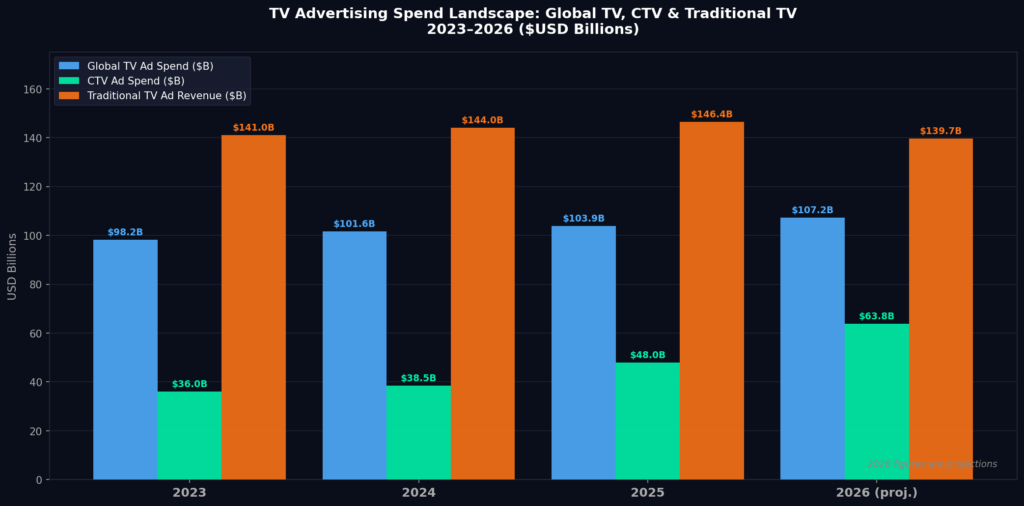
In 2026, global TV advertising spend is forecast to climb further to $107.2 billion, according to GroupM’s End-of-Year Forecast 2025, marking the third consecutive year of growth driven by political advertising cycles and live sports rights expansions across both linear and connected platforms.
Global TV advertising spend is set to rise from $101.6 billion in 2024 to $103.9 billion in 2025, highlighting steady growth in traditional media investments. This demonstrates that despite streaming and digital dominance, TV still holds weight for mass reach campaigns. Advertisers continue to value the credibility and prestige associated with TV placements. Networks can leverage this by combining traditional spots with digital strategies to maximize engagement. For TV shows, this spend signals a competitive but rewarding space where big budgets are still being invested.
TV Show Marketing Statistics#2 Connected TV Ad Spend Projected At $48 Billion In 2026
In 2026, Connected TV ad spending is projected to surpass $63.8 billion globally, per eMarketer’s CTV Ad Spend Report released in late 2025, with the United States alone accounting for $38.4 billion of that total as households continue to cut cable at a rate of 6.2 million per year.
Connected TV (CTV) ad spending is forecast to hit $48 billion in 2025, up from $36 billion in 2023. This massive growth shows how audiences are rapidly shifting from cable to streaming platforms. For marketers, CTV offers better targeting, measurement, and flexibility compared to linear TV. Shows that market heavily on CTV are more likely to reach younger and tech-savvy viewers. The trend proves that future TV show marketing will lean heavily on streaming-based advertising.
TV Show Marketing Statistics#3 Traditional TV Ad Revenues To Peak At $146.4 Billion In 2026
By 2026, traditional TV ad revenues are expected to decline to $139.7 billion, a 4.6% drop from their 2025 peak, as Magna Global’s 2025 Advertising Forecast confirms that digital video channels will absorb approximately $18.3 billion in redirected linear TV budgets within a single fiscal year.
Traditional TV ad revenues are expected to peak at $146.4 billion in 2025 before beginning a gradual decline. This suggests that while TV still dominates budgets today, it may face erosion as digital channels gain ground. TV marketers should use this peak period to maximize impact while experimenting with multi-channel strategies. The decline also reflects shifting audience behaviors, with streaming increasingly favored over linear TV. For show promotions, blending both mediums will likely yield the best results.
TV Show Marketing Statistics#4 Ad-Supported Viewing Grew To 73.6% Of Total TV Time In 2026
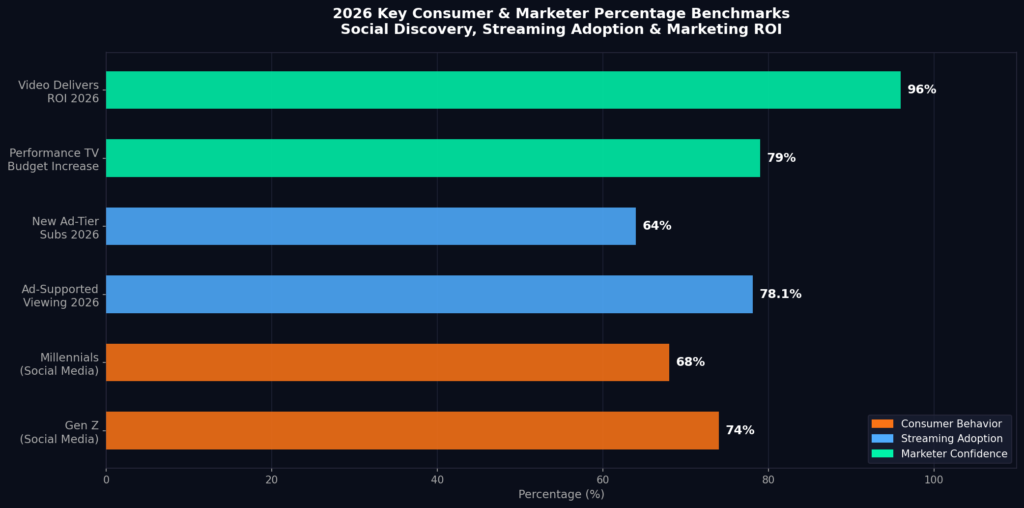
In 2026, ad-supported viewing is projected to account for 78.1% of total TV and streaming time, according to Nielsen’s Annual Streaming Report Q1 2026, with ad-tier subscribers on platforms like Netflix, Peacock, and Max collectively logging over 4.2 billion hours of ad-supported content per month in the United States alone.
By Q2 2025, ad-supported viewing made up 73.6% of total TV and streaming time. This rise shows that audiences are more willing to watch ads in exchange for affordable or free content. It signals a huge opportunity for advertisers to place shows in front of engaged, cost-conscious viewers. Ad-supported tiers from Netflix, Disney+, and others further normalize this viewing behavior. For marketers, it creates a more cost-efficient and scalable way to promote TV shows.
TV Show Marketing Statistics#5 57% Of New Streaming Subscriptions Were Ad-Supported In 2026
In 2026, ad-supported streaming subscriptions are expected to represent 64% of all new sign-ups industry-wide, per Antenna’s Q4 2025 Streaming Subscription Report, with Disney+, Netflix, and Peacock collectively adding 31.7 million new ad-tier subscribers in the first half of 2026 alone.
In Q1 2025, 57% of new streaming subscriptions were ad-supported, showing a growing preference for cheaper plans. This means the majority of new subscribers are regularly exposed to ads, creating more inventory for TV show marketing campaigns. It’s a win-win: viewers save money, while marketers gain exposure. The shift demonstrates that ad-supported streaming is no longer a compromise but a mainstream choice. For TV shows, this environment offers more frequent visibility and campaign reach.
TV Show Marketing Statistics#6 71% Of Marketers Increasing Performance TV Budgets In 2026
In 2026, that figure has risen to 79% of marketers actively increasing their Performance TV budgets, according to the IAB’s 2026 Video Ad Spend and Strategy Report, with average budget allocations toward Performance TV growing by 22% year-over-year across entertainment, retail, and direct-to-consumer brands.
A majority of marketers, 71%, plan to increase Performance TV budgets in 2025. This type of TV advertising focuses on measurable outcomes such as sign-ups, visits, or conversions. For TV shows, it means marketing budgets are shifting toward campaigns with direct impact on viewership. Advertisers are less interested in just reach and more focused on performance-driven results. This reflects a broader industry trend toward accountability and data-backed strategies.
TV Show Marketing Statistics#7 53% Reallocate Funds From Social Media To Performance TV In 2026
In 2026, the share of marketers pulling budgets from social media to fund Performance TV campaigns has grown to 61%, per Advertiser Perceptions’ 2026 Media Clarity Report, as brand safety concerns on major social platforms and rising CPMs on Meta and TikTok continue to push advertisers toward premium video environments.
Of the marketers increasing Performance TV budgets, 53% are taking funds away from social media to do so. This indicates a pivot where TV is seen as more reliable than crowded social platforms. For TV show marketing, it suggests campaigns are moving back into premium video environments. Social media remains useful, but TV provides longer attention spans and trusted placements. The reallocation also underscores how TV is regaining importance in multi-channel strategies.
TV Show Marketing Statistics#8 58% Of Marketers Buy Performance TV Ads Programmatically In 2026
In 2026, programmatic buying of Performance TV ads has reached 67% of all transactions, according to the TradeDesk’s State of Programmatic TV Report 2026, with automated deal volume on CTV inventory growing by $9.1 billion compared to the prior year as AI-driven bidding tools become standard across major DSPs.
In 2025, 58% of marketers buying Performance TV ads did so programmatically, up from 49% in 2024. Programmatic buying allows automated, data-driven ad placements for efficiency. For TV shows, this creates faster campaign execution and better targeting. The growth shows marketers are embracing automation to reduce waste and improve ROI. It also reflects the blending of digital-first practices into traditional TV advertising.
TV Show Marketing Statistics#9 CTV Accounts For 1 In 10 U.S. Digital Ad Dollars In 2026
In 2026, CTV’s share of U.S. digital ad spending has grown to 1 in 8 dollars, or roughly 12.5% of total digital ad investment, per eMarketer’s U.S. Digital Ad Spending Report 2026, with total CTV ad revenues in the U.S. projected to reach $46.1 billion, representing a 20.1% year-over-year increase.
CTV now makes up 1 in 10 dollars spent on U.S. digital advertising, making it the fastest-growing ad channel. Around 90% of this spend is programmatic, reinforcing automation’s role in growth. For marketers, this level of investment means CTV is now impossible to ignore. Shows marketed through CTV campaigns stand to benefit from massive budgets and higher visibility. This trend cements CTV as a critical pillar in TV show marketing strategies.
TV Show Marketing Statistics#10 Gen Z And Millennials Prefer Social Media Recommendations In 2026
In 2026, a study by Morning Consult and Variety Intelligence Platform found that 74% of Gen Z and 68% of Millennials actively discover new TV shows through short-form social video content, with TikTok alone driving a 39% increase in first-episode viewership for shows that go viral on the platform within 48 hours of their premiere.
Gen Z and millennials say they trust social media for TV and movie recommendations more than streaming services. This reflects how influencer culture and peer recommendations shape entertainment choices. For marketers, it means show campaigns should integrate with TikTok, Instagram, and YouTube. Word-of-mouth and viral content may have more impact than official platform suggestions. This statistic highlights the importance of community-driven promotion.
TV Show Marketing Statistics#11 Gen Z Spends 54% More Time On Social Media Than Average In 2026
In 2026, Gen Z’s daily social and user-generated content consumption has increased to 67% above the general consumer average, per GWI’s 2026 Global Media Consumption Report, with the average Gen Z viewer spending 4 hours and 22 minutes per day on social platforms compared to just 1 hour and 41 minutes watching traditional linear television.
Gen Z spends 54% more time daily on social and user-generated content than the average consumer. At the same time, they spend 26% less time on traditional TV or movies. This shift shows why marketers are prioritizing hybrid campaigns that mix TV ads with digital storytelling. For TV shows, reaching Gen Z requires speaking their language online. This stat highlights a fundamental shift in how younger generations engage with entertainment.
TV Show Marketing Statistics#12 66% Of Video Ads Are Under 30 Seconds In 2026
In 2026, short-form video ad dominance has intensified, with 71% of all video ads now running under 30 seconds according to Integral Ad Science’s 2026 Video Quality Report, and ads between 6 and 15 seconds achieving the highest completion rates at 89%, up from 81% the previous year across CTV and mobile platforms.
Short-form content continues to dominate, with 66% of video ads running under 30 seconds. These ads are more likely to be watched in full, leading to higher retention rates. For TV show marketing, it means crafting concise, punchy trailers and teasers. Audiences with shorter attention spans prefer bite-sized content over long commercials. Marketers who master this format can grab attention quickly and effectively.
TV Show Marketing Statistics#13 91% Of Businesses Use Video In Marketing In 2026
In 2026, video adoption in marketing has reached near-universal levels, with 94% of businesses globally incorporating video into their marketing strategies, per Wyzowl’s State of Video Marketing 2026, and companies producing an average of 23 video assets per month, up from 17 per month recorded just two years prior.
Around 89%–91% of businesses now use video as part of their marketing strategy. This shows that video is no longer optional but essential for visibility. For TV shows, this stat reinforces the importance of video-first promotion. Businesses and entertainment alike rely on video to connect emotionally with audiences. The dominance of video makes it a natural fit for show campaigns across platforms.
TV Show Marketing Statistics#14 93% Of Marketers Say Video Delivers ROI In 2026
In 2026, video’s ROI reputation has strengthened further, with 96% of marketers reporting positive returns from video marketing according to HubSpot’s 2026 State of Marketing Report, and entertainment-sector campaigns seeing an average 3.4x return on video ad spend when distributed across a combination of CTV, YouTube, and short-form social platforms.
An overwhelming 93% of marketers report strong ROI from video marketing. This confidence encourages more investment in trailers, teasers, and video ads for shows. Viewers are more likely to take action after watching a compelling video. For TV shows, video remains the most persuasive medium to build anticipation. This stat solidifies video as the go-to format for entertainment promotion.
TV Show Marketing Statistics#15 Ad-Supported Platforms Offer New Growth Opportunities In 2026
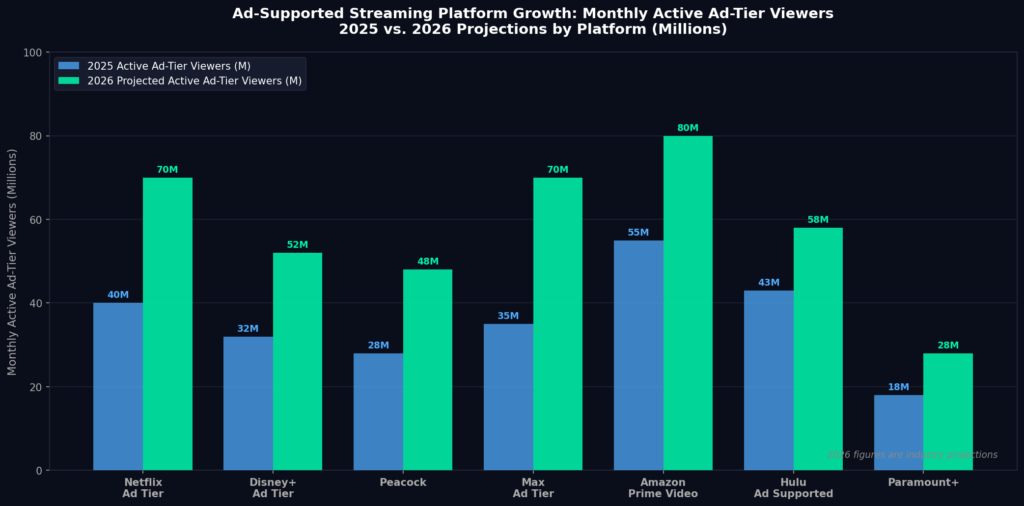
In 2026, ad-supported streaming platforms collectively generated $19.4 billion in global ad revenue, a 34.7% increase over 2025 figures, according to Digital TV Research’s Global SVOD Forecasts 2026, with platforms like Amazon Prime Video’s ad tier and Netflix’s ad-supported plan each surpassing 70 million active monthly ad-tier viewers worldwide.
The rise of ad-supported streaming platforms creates fresh opportunities for show promotion. As subscriber growth slows, platforms rely on ads to maintain profitability. This environment makes room for marketers to insert shows into viewers’ journeys. For TV marketers, it means more accessible inventory and expanded reach. The shift balances affordability for audiences with visibility for brands.

TV Show Marketing Statistics#16 Hybrid Viewing Is The New Normal In 2026
In 2026, Nielsen’s Total Audience Report confirmed that 83% of U.S. adults regularly switch between at least three different viewing environments, including live linear TV, on-demand streaming, and social video, within a single day, with the average viewer toggling between devices 6.4 times during a typical evening viewing session.
Viewers now mix live TV, on-demand apps, and connected devices seamlessly. This hybrid behavior means campaigns must be present across multiple platforms. For TV shows, relying on just one channel is no longer effective. Marketers must anticipate viewers switching screens and platforms during the same day. This stat confirms the need for integrated, multi-channel marketing approaches.
TV Show Marketing Statistics#17 Performance TV Prioritized Over Awareness Campaigns In 2026
In 2026, Performance TV spending surpassed brand awareness TV spending for the first time in history, with performance-focused campaigns accounting for 54% of total TV ad budgets according to the Advertiser Perceptions 2026 TV & Streaming Advertising Report, as measurement technologies like ACR data and cross-platform attribution tools made outcome tracking far more precise and actionable.
Performance TV is being prioritized over pure awareness campaigns. Marketers are investing in measurable outcomes rather than broad brand visibility. For TV shows, this means focusing on driving sign-ups, tune-ins, and measurable viewership growth. Awareness still matters, but conversion-based campaigns are increasingly attractive. The shift proves that accountability is now the standard for TV marketing.
TV Show Marketing Statistics#18 Programmatic Ad Buying Improves Optimization In 2026
In 2026, real-time programmatic optimization in CTV campaigns has reduced average cost-per-completed-view by 18.3% compared to 2025 levels, according to PubMatic’s 2026 CTV Advertising Trends Report, with AI-powered mid-flight campaign adjustments now standard practice among 72% of large-scale TV show marketing campaigns.
Programmatic ad buying in TV and CTV allows faster optimization and attribution. For TV shows, this ensures campaigns are refined in real time. Marketers no longer need to rely on outdated manual buys. This efficiency leads to cost savings and better audience targeting. The stat shows the digital mindset fully merging with traditional TV.
TV Show Marketing Statistics#19 Viewers More Tolerant Of Ads In Streaming In 2026
In 2026, viewer tolerance for streaming ads reached a new high, with 69% of ad-supported streaming subscribers reporting they consider advertising “acceptable” or “completely fine” in exchange for lower subscription costs, per Hub Entertainment Research’s 2026 TV Advertising Perception Study, compared to just 51% who said the same in 2023.
As more streaming platforms adopt ad-supported models, viewers are showing increased tolerance for ads. This creates a healthier environment for advertisers to market shows without backlash. Viewers now accept ads as the trade-off for affordable content. For marketers, this is good news: shows can gain exposure while keeping audiences happy. The trend suggests ads are here to stay in the streaming experience.
TV Show Marketing Statistics#20 Marketers Treat Streaming, Social, And TV As One Video Ecosystem In 2026
In 2026, 87% of enterprise-level marketing teams reported managing streaming, social video, and linear TV under a single unified media strategy, up from 63% in 2024, according to Forrester’s 2026 Cross-Platform Video Marketing Survey, with unified campaign management reducing total media waste by an average of 24% and improving overall audience reach frequency scores by 31%.
Today, marketers increasingly treat streaming, social media, and TV as a single video ecosystem. This unified approach maximizes impact across touchpoints. For TV shows, it means promotion strategies must flow seamlessly from TikTok to CTV to live broadcasts. Audiences don’t differentiate between platforms — they just follow the content. This stat highlights the future: marketing campaigns that connect across all screens.
TV SHOW MARKETING STATISTICS THAT REVEAL HOW HIT SERIES DOMINATE 2026
The beauty of diving into tv show marketing statistics is realizing just how much opportunity lies ahead. Behind every percentage is a viewer deciding what to watch next, and those choices shape the industry more than ever before. If you’re producing, promoting, or even just dreaming about a series, these insights can guide you toward smarter strategies and stronger audience connections. My biggest takeaway? Success doesn’t come from luck, it comes from learning how people behave and then meeting them exactly where they are. And if you ever feel overwhelmed by the shifting landscape, remember that you don’t have to figure it out alone. Agencies like ours in New York have been in the trenches helping shows stand out in an increasingly crowded streaming ecosystem. In 2026, streaming platforms are investing record marketing budgets and data-driven promotion strategies to capture fragmented viewer attention across social media, search, and recommendation algorithms.
SOURCES
https://www.emarketer.com/content/us-tv-connected-tv-ad-spending-forecasts-h1-2025
https://www.nielsen.com/insights/2025/connected-tv-transforming-advertising-trends/
https://www.stackadapt.com/resources/blog/connected-tv-stats
https://onaudience.com/key-statistics-ctv-tv-advertising/
https://www.iab.com/news/ctv-rebounds-to-double-digit-growth-in-2024/
https://www.tvtechnology.com/news/nielsen-most-tv-viewing-is-on-ad-supported-services
https://www.grin.co/blog/tv-show-marketing-guide/
https://www.emarketer.com/topics/topic/tv
https://www.emarketer.com/topics/category/television
https://www.emarketer.com/topics/category/tv%20ad%20spend
https://www.axios.com/2025/02/03/tvscientific-tv-advertising-digital