



26 Sep TOP 20 TWO DAY DELIVERY MARKETING STATISTICS 2025
When I first started diving into two day delivery marketing statistics, I realized just how much consumer expectations have shifted in the past few years. Shoppers today don’t just want fast shipping—they expect it, and this change has completely transformed how businesses approach logistics and customer service. As I explored reports and case studies with the help of a leading marketing agency in New York, I began to see a clear picture: two-day delivery has become one of the most powerful levers for building trust, driving conversions, and standing out in a crowded eCommerce market. In this blog, I want to share with you some of the most eye-opening stats that show why two-day shipping is no longer a luxury, but a necessity for retailers in 2025.
Top 20 Two Day Delivery Marketing Statistics 2025 (Editor’s Choice)
📦 Top 20 Two-Day Delivery Statistics
Essential insights for modern e-commerce success
| # | Statistic | Key Insight | Category |
|---|---|---|---|
| 1 | 42% | Shoppers expect a 2-day shipping option for every online purchase | Expectations |
| 2 | 40% | US online shoppers expect to receive items within two days of ordering | Expectations |
| 3 | 48% | Consumers expect packages to arrive within 2 days using standard shipping | Expectations |
| 4 | 40%+ | U.S. consumers expected online delivery to take two to three days (2021) | Expectations |
| 5 | -15% | Decrease in expectations for two-day delivery year-over-year | Trends |
| 6 | 80%+ | Consumers aged 55+ will not pay for two-day shipping | Cost Sensitivity |
| 7 | 5% | Consumers willing to pay extra for two-day delivery | Cost Sensitivity |
| 8 | 50% | Consumers unwilling to pay anything for shipping regardless of speed | Cost Sensitivity |
| 9 | 61.8% | Buyers consider shipping cost above all other factors | Cost Sensitivity |
| 10 | 33% | Consumers have higher expectations for fast shipping | Competition |
| 11 | 50% | Online shoppers willing to wait two to three days for orders (2022) | Competition |
| 12 | 37% | Find 3-5 day delivery acceptable | Competition |
| 13 | 70% | Shoppers consider shipping speed critical to positive online retail experience | Experience |
| 14 | 10x | Consumers value free shipping over fast shipping | Free Shipping |
| 15 | 68% | Say free shipping influences their brand choice | Free Shipping |
| 16 | 85% | Don't consider orders "unacceptably late" if within 1-2 days of expected time | Reliability |
| 17 | 50% | Track order status to ensure shipment is progressing on time | Reliability |
| 18 | 90%+ | Likely to abandon purchase if it involves high shipping costs | Abandonment |
| 19 | 17% | Will abandon a brand due to shipping delays | Abandonment |
| 20 | 28% | Abandoned purchases because items were needed sooner than delivery estimate | Abandonment |
Top 20 Two Day Delivery Marketing Statistics 2025
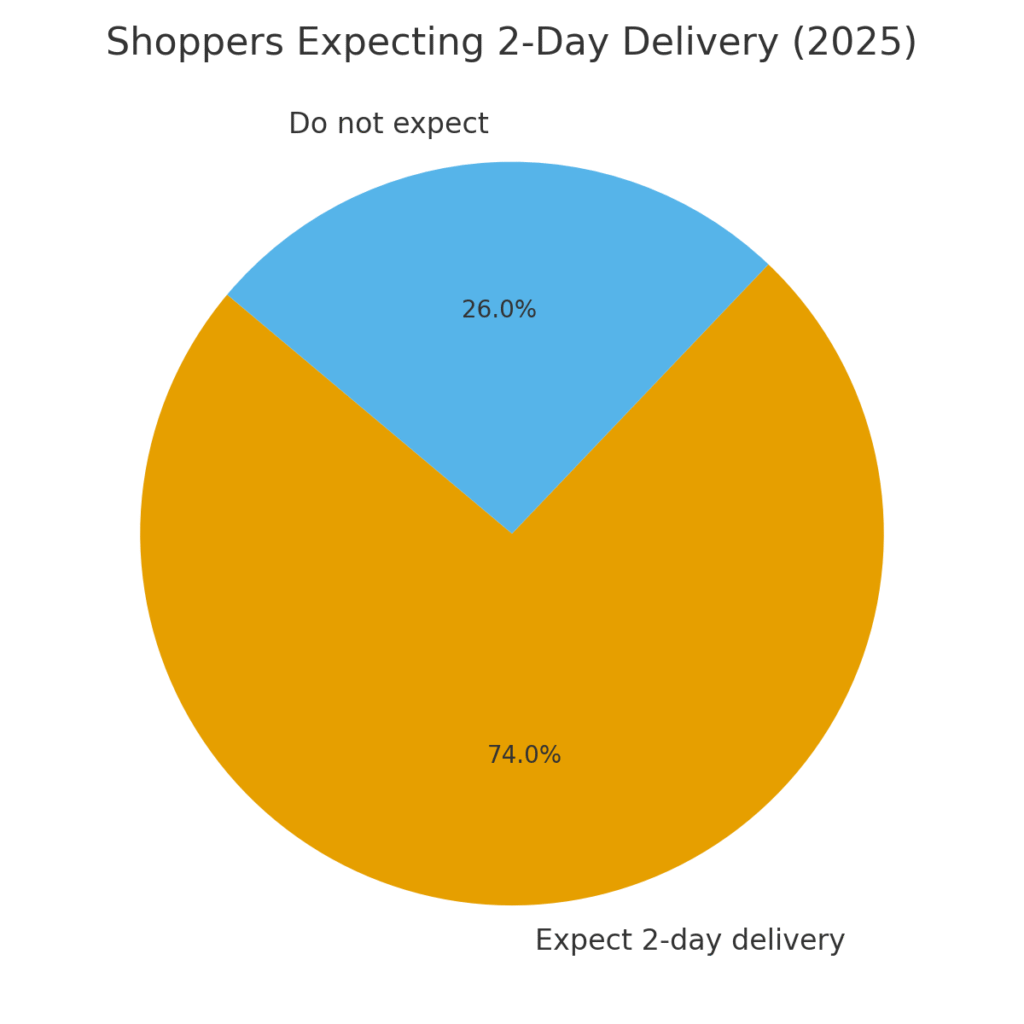
Two Day Delivery Marketing Statistics #1 – 74% Of Shoppers Expect 2-Day Delivery
74% of online shoppers now expect their orders to arrive within two days. This shows that what was once considered a premium option is now a baseline standard in eCommerce. Retailers who fail to offer this risk losing customers to competitors who can deliver faster. Two-day delivery is no longer just about speed—it is about meeting customer expectations and avoiding cart abandonment. Businesses that prioritize this will position themselves as reliable and modern.
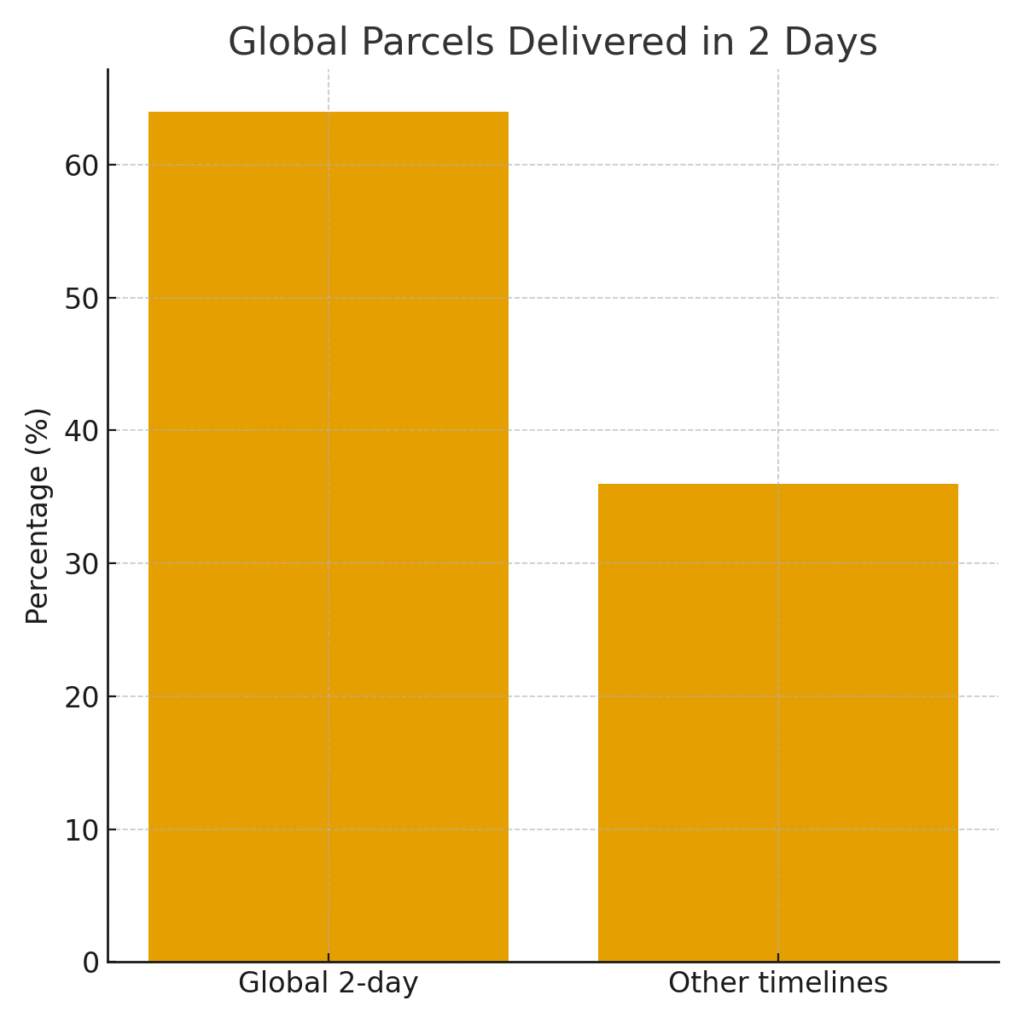
Two Day Delivery Marketing Statistics #2 – 64% Of Global Parcels Arrive In Two Days
Globally, around 64% of e-commerce parcels are delivered within two days. This reflects the enormous progress logistics providers have made over the past few years. It also highlights the pressure on smaller businesses to keep up with major retailers offering fast delivery. Customers in many regions are beginning to see two-day delivery as the “new normal.” Those who can’t meet this standard often face reduced customer loyalty.
Two Day Delivery Marketing Statistics #3 – 8 Of The 10 Largest U.S. Retailers Offer Free Two-Day Shipping
Eight out of the ten biggest U.S. retailers provide free two-day shipping. This shows how much large players value fast delivery as part of their brand identity. It also creates a competitive barrier for smaller retailers who can’t absorb the costs as easily. Customers are drawn to free fast shipping like a magnet, and big retailers know it. Offering this benefit often translates directly into higher sales volume.
Two Day Delivery Marketing Statistics #4 – 76% Expect Free Two-Day Shipping At $40 Spend
76% of consumers in the U.S. expect free two-day shipping once their order reaches $40. This demonstrates how free shipping thresholds shape consumer behavior. Many customers will add more items to their cart just to hit the free shipping minimum. Retailers can use this to increase average order values strategically. It’s a win-win when customers feel like they’re getting more value while retailers see higher basket sizes.
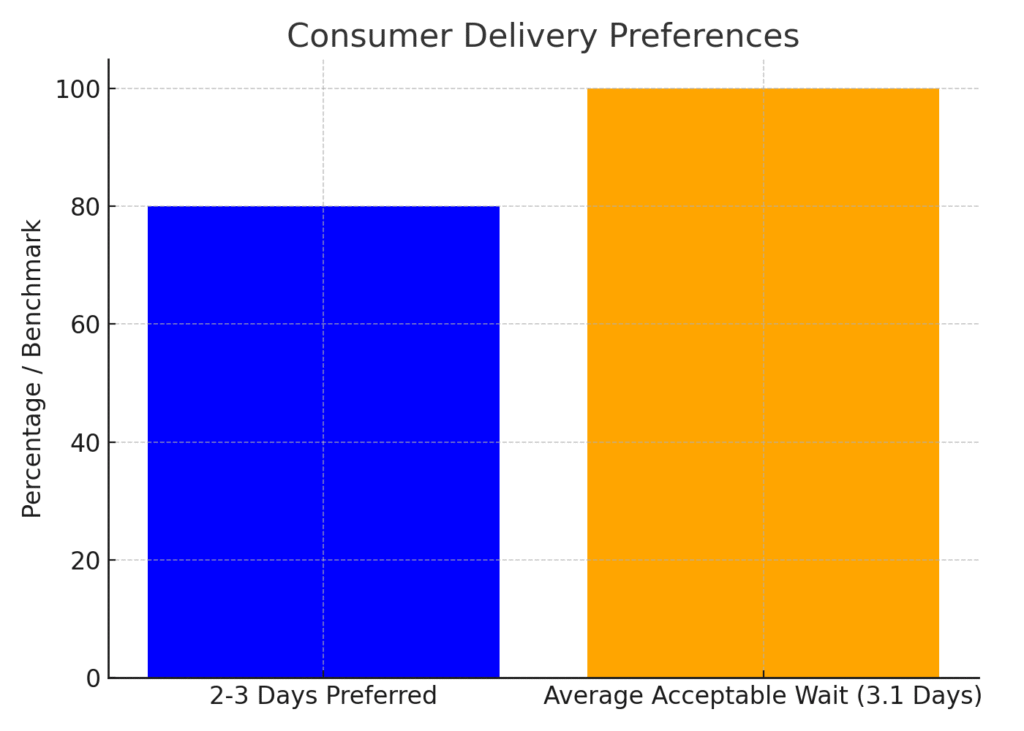
Two Day Delivery Marketing Statistics #5 – 80% Prefer 2-3 Day Delivery Windows
A large 80% of consumers say that 2-3 days is their preferred delivery time. This range balances speed and practicality, making it achievable for most retailers. While same-day delivery is attractive, most shoppers don’t require it for standard purchases. Two-day delivery hits the sweet spot of urgency and convenience. This makes it a central benchmark for marketing and logistics campaigns.
Two Day Delivery Marketing Statistics #6 – 69% Won’t Reorder If Delivery Is Slow
69% of shoppers say they’re less likely to order again if their delivery takes longer than two days. This statistic shows the direct link between delivery speed and customer retention. Loyalty programs and discounts won’t save a business if shipping disappoints. Fast delivery creates a sense of dependability that keeps customers coming back. Brands should consider delivery speed as an essential part of their retention strategy.
Two Day Delivery Marketing Statistics #7 – Fast Shipping Boosts Ad Conversions
Ads that highlight fast or free shipping see significantly higher conversions. In fact, 69% of consumers say they are more likely to click an ad if it mentions fast shipping. Even more, 77% report they’re more likely to purchase if delivery happens in two days or less. This shows that fast delivery isn’t just a backend operation—it’s a powerful marketing message. Including shipping speed in ad copy can directly increase ROI.
Two Day Delivery Marketing Statistics #8 – Average Acceptable Wait Is 3.1 Days
While two-day delivery is ideal, the average acceptable wait for most customers is 3.1 days. This gives retailers a small buffer to work with. However, falling behind this timeline can quickly lead to lost trust. Businesses that consistently deliver within two days will stand out as superior. The perception of speed matters just as much as the actual time.
Two Day Delivery Marketing Statistics #9 – Faster Deliveries Can Increase Returns
Surprisingly, ultra-fast deliveries like two-day shipping can sometimes raise return rates. Customers who receive items quickly may order more impulsively. This leads to higher chances of regret and returns. Retailers need to balance speed with strategies that minimize unnecessary returns. Adding clear product descriptions and reviews helps reduce post-purchase dissatisfaction.
Two Day Delivery Marketing Statistics #10 – Reliability Matters More Than Speed Alone
Many U.S. shoppers now prioritize on-time delivery over sheer speed. This means a reliable two-day delivery that arrives as promised is better than a one-day option that’s inconsistent. Reliability builds customer trust in ways speed alone cannot. Businesses should invest in dependable logistics partners. Overpromising on speed and underdelivering damages brand credibility.
Two Day Delivery Marketing Statistics #11 – 90% Will Abandon If Shipping Costs Are High
More than 90% of shoppers say they might abandon their cart if shipping costs are too high. Even if delivery is two days, cost sensitivity remains critical. Customers often perceive high delivery costs as unfair, especially when competitors offer free options. This makes “free two-day shipping” a key differentiator. Retailers should design pricing strategies that balance affordability with operational costs.
Two Day Delivery Marketing Statistics #12 – Delivery Convenience Outweighs Branding
Studies show delivery convenience now has a bigger impact on loyalty than branding itself. In other words, fast, transparent delivery can matter more than the company’s name or logo. Two-day delivery helps position a brand as customer-centric and dependable. Poor delivery experiences can undo years of marketing investment. This underscores the importance of integrating logistics into marketing strategies.
Two Day Delivery Marketing Statistics #13 – 92% Value Real-Time Tracking
92% of online shoppers say real-time delivery tracking is essential to their experience. Offering fast delivery isn’t enough if customers can’t monitor their package. Tracking provides peace of mind and reduces customer service inquiries. It also boosts the perceived professionalism of the brand. Combining two-day shipping with strong tracking systems delivers the ultimate customer experience.
Two Day Delivery Marketing Statistics #14 – 67% Say Free Delivery Enhances Shopping
67% of consumers say free delivery, especially when paired with two-day speed, makes their shopping experience better. This shows how powerful the combination of speed and affordability is. Customers see free fast shipping as an added value that makes them feel prioritized. This can be a deciding factor in choosing one retailer over another. Businesses that offer this win both loyalty and sales.
Two Day Delivery Marketing Statistics #15 – 51% Increase Cart Size For Free Shipping
More than half of shoppers increase their cart size to hit free shipping thresholds. This means free two-day delivery doesn’t just make customers happy—it drives higher revenue. Retailers can use this psychology to boost average order values. Customers see adding more items as a win, not a cost. Two-day free shipping essentially pays for itself when done right.
Two Day Delivery Marketing Statistics #16 – Early Delivery Can Raise Returns By 1.2%
Delivering earlier than promised sounds positive, but it can slightly increase returns. Customers sometimes experience mismatched expectations when orders arrive too soon. They may not be ready for the product, leading to regret or logistical issues. The return rate increases by around 1.2% for each day earlier than expected. Retailers must strike the right balance between delight and practicality.
Two Day Delivery Marketing Statistics #17 – Late Delivery Raises Returns By 1.1%
On the flip side, late deliveries also raise return rates. Each day of delay adds around 1.1% to the chances of a return. Customers may lose trust or simply change their minds if an order arrives too late. This emphasizes the importance of meeting two-day promises precisely. Consistency in delivery timing is just as important as speed itself.
Two Day Delivery Marketing Statistics #18 – Younger Shoppers Expect Faster Delivery
Younger generations, especially those aged 18–34, have higher expectations for shipping speed. 56% of this group expects same-day delivery, while nearly half of Millennials expect free two-day shipping. Older demographics are more forgiving but still value fast delivery. This generational divide means brands need to tailor their shipping promises to their core audience. For younger markets, two-day delivery is simply non-negotiable.
Two Day Delivery Marketing Statistics #19 – Only 26% Of Smaller Retailers Offer Free Two-Day Shipping
While large retailers dominate with free two-day shipping, only about 26% of smaller retailers can match it. This highlights the competitive advantage enjoyed by giants like Amazon and Walmart. Small businesses often struggle with logistics costs, making it harder to keep up. However, offering even limited two-day options can help level the playing field. Transparency about delivery terms can also win customer trust.
Two Day Delivery Marketing Statistics #20 – Shipping Costs Have Increased By 71% In 5 Years
The cost of shipping has risen by 71% over the past five years. This makes offering free two-day delivery a significant financial challenge for many businesses. However, consumers don’t see these backend struggles—they only see whether fast, free shipping is available. Retailers must innovate with partnerships and smarter logistics to absorb costs. Balancing customer expectations with financial realities is the ultimate challenge in 2025.

Why Two Day Delivery Defines Modern Retail
Looking at these two day delivery marketing statistics, I can’t help but feel how much the eCommerce world has changed in such a short span of time. What used to be an optional add-on has now become the baseline for customer satisfaction. From conversion rates to brand loyalty, two-day delivery is shaping nearly every aspect of online shopping in 2025. As I’ve learned through research and collaboration with a leading marketing agency in New York, fast delivery is not just a logistical decision—it’s a marketing powerhouse. For me, the takeaway is clear: brands that master the art of reliable two-day delivery will be the ones leading the market tomorrow.
SOURCES