




15 Sep TOP 20 UNIVERSITY MARKETING STATISTICS 2026 THAT REVEAL SHOCKING ENROLLMENT BATTLE
Updated for 2026. This page has been fully refreshed with the latest university marketing statistics, enrollment trend data, and higher education advertising insights, grounded in recent global surveys, institutional reporting, and digital recruitment analytics.
When I first started diving into university marketing statistics, I was blown away by how much these numbers reveal about the way students connect with schools today. As someone who’s worked alongside a leading marketing agency in New York, I’ve seen firsthand how the right insights can turn data into strategy and strategy into real results. These stats aren’t just cold figures—they tell stories about shifting student expectations, changing technologies, and the evolving landscape of higher education. For me, sharing these numbers is about making sure colleges and universities don’t just keep up, but actually stand out in an increasingly competitive space.
TOP 20 UNIVERSITY MARKETING STATISTICS 2026 THAT EXPOSE GLOBAL ENROLLMENT COMPETITION
Top 20 University Marketing Statistics 2026
Data-Driven Insights for Higher Education Excellence
| # | Category | Key Figure | 2026 Insight |
|---|---|---|---|
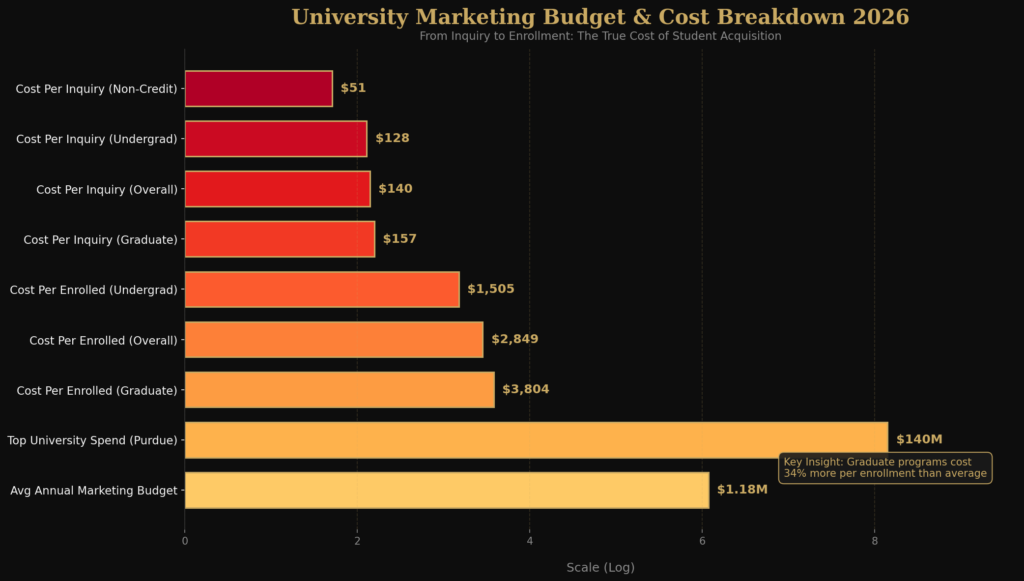
| 01 | Average Annual Marketing Budget | $1.18M | 61% of enrollment marketing dollars now support digital efforts; top universities like Purdue spend $140M+ annually |
| 02 | Marketing Spend % of Revenue | 11.9% | Industry benchmarks recommend 5-12% allocation; 242M+ adult learner candidates now addressable |
| 03 | Marketing Staff (FTE) | 7.74 | Up from 6.88; 38% believe AI will help stretch budgets with fewer staff resources |
| 04 | Cost Per Inquiry | $140 | Graduate: $157 | Undergrad: $128 | Non-credit: $51; only 38% satisfied with cost expenditure |
| 05 | Cost Per Enrolled Student | $2,849 | Graduate: $3,804 | Undergrad: $1,505; enrollment projected to drop 15% by 2029 |
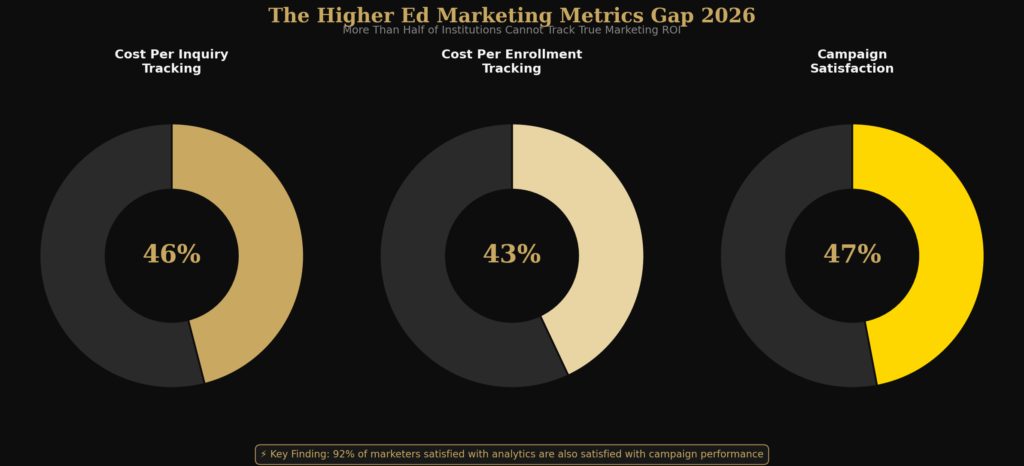
| 06 | Track Cost Per Inquiry | 46% | 73% track inquiry sources but only 46% track costs; 17% track no key metrics at all |
| 07 | Track Cost Per Enrollment | 43% | More than half cannot identify which channels drove enrollments; measurement gap = biggest growth opportunity |
| 08 | Analytics-Campaign Satisfaction Link | 92% | Marketers tracking CPI and cost per enrolled student make strategic adjustments that reduce costs over time |
| 09 | Campaign Performance Satisfaction | 47% | Only 29% satisfied with tracking ability; 27% uncertain about CPI satisfaction |
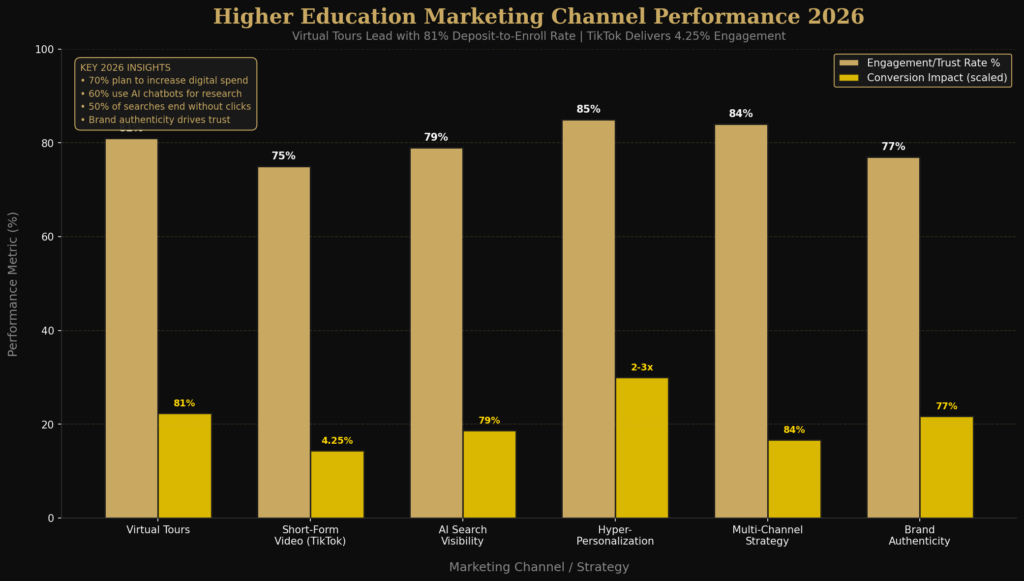
| 10 | Short-Form Video Engagement | 4.25% | TikTok avg engagement; educational content = 16.1% of views; D1 schools achieve 4.75% median engagement |
| 11 | Non-Brand Search CPC Drop | -13% | Education sector: $6.23 CPC, 5.7% CTR, 11.4% CVR (43.87% YoY conversion gain - highest across industries) |
| 12 | Brand Search CPC Drop | -6% | Avg CPC across all industries: $5.26; education CVR soared from 7.91% to 11.38% YoY |
| 13 | Graduate Certificate CPC Rise | +25% | Microcredential adoption plateaued; 32% of learners cite time-to-completion as key factor |
| 14 | Hyper-Personalization Adoption | 2-3x | Colleges using hyper-personalized marketing see 2-3x higher engagement; Gen Alpha expects Netflix-level personalization |
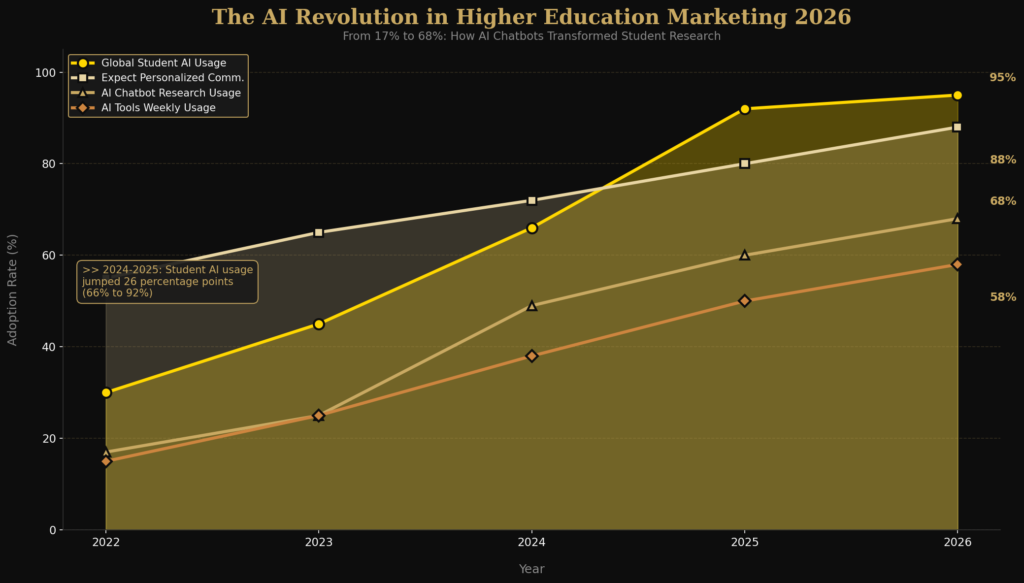
| 15 | AI Chatbot Usage for Research | 60% | Up from 49% last year; 64% of teens use chatbots; global student AI usage jumped from 66% to 92% in 2025 |
| 16 | Digital Budget Increase Plans | 70% | 61% of marketing dollars support digital; Google integrating ads into AI Overviews - new advertising frontier |
| 17 | Multi-Channel Strategy Usage | 84% | 84% rely on search engines; 50% use AI tools weekly; 79% read Google AI Overviews; 1 in 3 trust AI for research |
| 18 | Virtual Tour Effectiveness | 81% | Deposit-to-enroll rate for virtual tour inquiries; 8+ min avg viewing time (4x website sessions); 3.9x higher campus visit rate |
| 19 | ROI Messaging Impact | 50% | Nearly half of searches end without a click; institutions must demonstrate tangible outcomes, not generic statements |
| 20 | Brand Trust & Authenticity | 77% | 77% trust university websites over other sources; consistent TikTok-to-email narrative expected; disconnects create friction |
TOP 20 UNIVERSITY MARKETING STATISTICS 2026 EVERY COLLEGE LEADER NEEDS
University Marketing Statistics #1 – Average Annual Marketing Budget Is $1.18 Million
In 2026, the EAB Higher Ed Marketing Outlook report surveying more than 120 marketing executives found that 61% of enrollment marketing dollars now support digital efforts, while average annual budgets for online and professional education units range from $500,000 to $4 million depending on institution size, with top-tier research universities like Purdue spending upwards of $140 million annually on marketing and media advertising.
The average annual marketing budget for online and professional education units now sits at around $1.18 million. This shows just how much universities are investing in staying competitive in student recruitment. A median of $644,000 means many smaller programs are working with leaner budgets while still striving for impact. Larger institutions tend to set the pace, but the median demonstrates that smaller schools still find creative ways to compete. Overall, the figures highlight how marketing in higher education is no longer optional—it’s essential.
University Marketing Statistics #2 – Marketing Spend Equals 11.9% of Revenue on Average
In 2026, industry benchmarks indicate that effective higher education institutions should allocate 5-10% of their total revenue to marketing, with some aggressive online programs investing up to 12% as they compete for the estimated 242+ million addressable adult learner candidates now entering the market.
On average, universities dedicate about 11.9% of their revenue to marketing efforts. The median of 5.3% tells us that while some institutions go big, others remain conservative. This variation often reflects institutional size, program offerings, and regional competition. Schools spending closer to the average are usually those with aggressive online programs or larger student pools to attract. It’s a clear reminder that marketing is now a core budget item, not an afterthought.
University Marketing Statistics #3 – Marketing Staff Averages 7.74 Full-Time Equivalents
In 2026, the EAB Higher Ed Marketing Outlook found that higher education marketing leaders are facing smaller teams alongside flat budgets and mounting pressure to deliver measurable enrollment results, with 38% of institutions believing that AI and emerging technologies will allow marketing teams to stretch budgets and accomplish more with fewer staff resources over the next three years.
The number of full-time marketing employees in continuing education units has risen to an average of 7.74. Just two years ago, the figure was 6.88, showing steady growth in teams. This increase reflects the growing workload in digital campaigns, content production, and student engagement. Universities now recognize that marketing requires specialized staff, not general admin support. The trend also indicates that staffing investments parallel the rise in marketing budgets.
University Marketing Statistics #4 – Average Cost Per Inquiry Is $140
In 2026, Search Influence and UPCEA research reveals that cost per inquiry varies significantly by program type, with graduate programs averaging $157 per inquiry, undergraduate programs averaging $128, and non-credit courses averaging just $51, while only 38% of higher ed marketers report satisfaction with their current cost expenditure.
Universities are spending about $140 for each prospective student inquiry. This cost is a key metric in measuring lead generation success. While it may sound high, inquiries are the first critical step toward enrollment. Schools with optimized digital funnels often lower this cost through smarter targeting. However, those lagging behind in strategy often see costs balloon, making efficiency a must.
University Marketing Statistics #5 – Average Cost Per Enrolled Student Is $2,849
In 2026, the Digital Marketing Strategy for Higher Education Playbook establishes $2,849 as the industry benchmark for cost per enrolled student, with graduate program enrollment costs reaching an average of $3,804, undergraduate programs averaging $1,505, and non-credit programs averaging $599, while demographic projections suggest enrollment could drop by as much as 15% between 2026 and 2029.
The cost per enrolled student averages nearly $2,849 in higher education marketing. This highlights just how competitive student acquisition has become. Institutions with better nurturing strategies usually bring this number down over time. Schools that rely too heavily on paid ads without strong follow-up tend to overspend. It emphasizes the importance of balancing outreach with conversion tactics.
University Marketing Statistics #6 – Only 46% Track Cost Per Inquiry
In 2026, the UPCEA and Search Influence Higher Ed Marketing Metrics Research Study confirms that while 73% of marketing units track inquiry sources for online and professional education programs, only 46% track cost per inquiry, and 17% of respondents report tracking no key marketing metrics at all.
Despite its importance, only 46% of universities track cost per inquiry. This lack of tracking leaves many marketing teams in the dark. Without this insight, it’s hard to optimize campaigns or justify spending. Schools that do track can quickly identify which channels bring quality leads. The low percentage suggests significant room for improvement across the industry.
University Marketing Statistics #7 – Only 43% Track Cost Per Enrolled Student
In 2026, the UPCEA research demonstrates that the measurement gap represents the single largest opportunity for enrollment growth, as more than half of institutions cannot identify which marketing channels actually drove their student enrollments, while universities that survive the approaching enrollment cliff will succeed by out-measuring and out-orchestrating competitors rather than outspending them.
Just 43% of institutions track the cost of acquiring each enrolled student. That means more than half don’t know their true acquisition expense. This blind spot can cause inefficient spending and missed opportunities. Universities that track this data often adjust campaigns more effectively. It’s a statistic that points to an urgent need for better marketing analytics adoption.
University Marketing Statistics #8 – 92% of Marketers Satisfied With Analytics Are Also Satisfied With Campaigns
In 2026, the UPCEA Higher Ed Marketing Metrics Research Study confirms that institutions with strong analytics satisfaction consistently outperform peers, with research showing that marketers who track cost per inquiry and cost per enrolled student are able to make strategic campaign adjustments that reduce costs and improve ROI over time.
A striking 92% of marketers who are happy with their analytics tools are also satisfied with campaign performance. This connection shows the value of actionable data. Strong analytics lead to smarter decisions and better results. Universities that invest in data-driven tools tend to outperform peers. It’s clear that analytics satisfaction directly fuels overall marketing confidence.
University Marketing Statistics #9 – Only 47% Are Satisfied With Campaign Performance
In 2026, the Search Influence survey data reveals that only 29% of higher ed marketers are satisfied with their ability to track campaign success, while 27% remain uncertain about their satisfaction with cost per inquiry performance, highlighting a critical disconnect between marketing activity and measurable enrollment outcomes.
Less than half—just 47%—of higher ed marketers are satisfied with their campaign results. This suggests many campaigns are falling short of expectations. Tight budgets and rising competition often explain the frustration. Schools with stronger digital strategies tend to buck the trend and achieve better outcomes. Still, the statistic reveals a general struggle to hit performance goals.
University Marketing Statistics #10 – Short-Form Video Leads Student Engagement
In 2026, TikTok trend reports show that educational content ranks as the second-most popular category with 16.1% of total views, higher education accounts achieve an average 7.36% engagement rate with steady follower growth, and the platform’s average engagement rate of 4.25% far exceeds static posts on other social platforms, with D1 schools achieving median engagement rates by view of 4.75%.
Short-form video has become one of the most effective tools for student engagement. Platforms like TikTok, Instagram Reels, and YouTube Shorts dominate attention spans. Universities using this medium often see higher click-through and inquiry rates. Video also builds emotional connections more quickly than static ads. This shift means schools must adapt or risk falling behind.
University Marketing Statistics #11 – Cost-Per-Click for Non-Brand Search Dropped by 13%
In 2026, Google Ads benchmarks show that the Education and Instruction sector now averages $6.23 cost-per-click with a 5.7% click-through rate and an impressive 11.4% conversion rate, representing the biggest year-over-year conversion rate gain across all industries at 43.87%, while cost per lead in the education sector jumped to $90.02.
From 2023 to 2024, the average cost-per-click for non-brand search terms dropped 13%. This makes generic keyword bidding more affordable for universities. Schools can now compete for broader terms without overspending. The decrease opens opportunities for smaller institutions to enter the search space. It reflects a positive trend for cost efficiency in paid search campaigns.
University Marketing Statistics #12 – Brand-Search CPC Fell by 6%
In 2026, WordStream’s Google Ads Benchmarks report indicates that the average cost-per-click across all industries reached $5.26, with Education and Instruction remaining among the highest-CPC sectors, though the education industry saw significant performance improvements with conversion rates soaring from 7.91% to 11.38% year-over-year.
Cost-per-click for branded terms fell 6% during the same period. Universities benefit from lower costs to protect their own brand names. This also makes retargeting branded prospects more budget-friendly. For institutions with strong name recognition, the shift adds an extra advantage. It’s a small but meaningful improvement in overall search efficiency.
University Marketing Statistics #13 – Graduate Certificate Demand Raised CPC by 25%
In 2026, UPCEA research on microcredentials found that while higher education leaders continue to recognize the value of microcredentials for workforce development and professional advancement, institutional adoption and perceived fiscal impact have plateaued, as students increasingly view certificates as faster, ROI-driven alternatives to traditional degrees in a market where 32% of online learners cite time to completion as a key enrollment factor.
Graduate certificates saw a 25% rise in cost-per-click due to growing demand. This signals increased competition among universities offering these programs. Students view certificates as faster, ROI-driven alternatives to degrees. As a result, marketing costs for these credentials are climbing. Institutions must refine their messaging to stay competitive in this space.
University Marketing Statistics #14 – Hyper-Personalized Marketing Is Now a Standard Trend
In 2026, hyper-personalization has evolved from buzzword to operational imperative, with EAB research identifying four distinct maturity stages institutions must progress through to deliver the Netflix-level personalization that Gen Z and Gen Alpha students now expect, while colleges using hyper-personalized marketing report 2-3x higher engagement and AI-driven enrollment strategies demonstrably increase application and yield rates.
Hyper-personalized marketing has become a cornerstone of higher ed strategy. Universities are tailoring landing pages, emails, and even ads to individual student behavior. This reflects a wider consumer trend toward personalized experiences. Data analytics and CRMs now make personalization more achievable. Schools not adopting this risk losing prospective students to more responsive competitors.
University Marketing Statistics #15 – Chatbot Usage for Research Doubled From 17% to 32%
In 2026, the EducationDynamics Engaging the Modern Learner Report shows that 60% of students now use AI chatbots for college research, a significant jump from 49% just a year ago, while Pew Research Center data reveals that 64% of teens have used AI chatbots with one-in-ten using them for all or most of their schoolwork, and global student AI usage jumped from 66% in 2024 to 92% in 2025 across all demographics.
Chatbots have become a mainstream research tool for students. Usage jumped from 17% to 32% in recent years. This reflects both convenience and the growing role of AI. Students prefer instant answers during their decision-making process. Universities that integrate effective chatbot systems are meeting these expectations.
University Marketing Statistics #16 – 70% of Institutions Plan to Increase Digital Marketing Budgets
In 2026, the EAB Higher Ed Marketing Outlook reveals that while spending growth has stalled and 61% of enrollment marketing dollars now support digital efforts, institutions are being forced to rethink how they drive visibility and performance, with Google now actively integrating ads directly into AI-generated summaries and AI Overviews, requiring schools to prepare for an entirely new frontier for digital advertising in higher education.
A full 70% of institutions intend to increase their digital marketing spend. This demonstrates a collective shift toward prioritizing online presence. More budget means more competition in digital channels. Schools with strategic campaigns will benefit most from the rising tide. It’s also a sign that traditional outreach is losing ground to digital-first methods.
University Marketing Statistics #17 – Institutions Use a Mix of Inbound and Outbound Tactics
In 2026, research shows that 84% of prospective students rely on search engines and 63% rely on university websites to explore programs, while 50% of prospects now use AI tools at least weekly, 79% read Google’s AI Overviews, and one in three prospects trust AI tools for program research, signaling a fundamental shift requiring institutions to adopt “Search Everywhere Optimization” across traditional and AI-powered platforms.
Universities now rely on both inbound and outbound marketing for leads. This includes paid ads, SEO, email campaigns, and content marketing. Blended strategies reach students across multiple touchpoints. The mix helps balance cost efficiency with broad reach. Schools focusing only on one method risk missing out on diverse audiences.
University Marketing Statistics #18 – Video Marketing and Virtual Campus Tours Are Essential
In 2026, EAB research shows that students spend an average of over 8 minutes viewing virtual tours—four times longer than typical website sessions—with 64% of students who inquired via virtual tours being incremental to other sources, virtual tours boosting inquiry rates by 21% when included in email campaigns, and virtual tour inquiries achieving an average 81% deposit-to-enroll rate.
Video marketing and virtual tours are now key parts of recruitment. Prospective students expect immersive experiences before visiting campuses. Schools offering strong visual storytelling gain a competitive edge. Virtual tours also expand reach to international or out-of-state prospects. The trend shows how digital experiences are reshaping the enrollment funnel.
University Marketing Statistics #19 – ROI Messaging Has Become Central to Student Choice
In 2026, the EducationDynamics Marketing and Enrollment Management Benchmarks report found that modern learners have rewritten how institutions are discovered, evaluated, and chosen, with nearly half of searches ending without a click, forcing institutions to demonstrate tangible value through alumni testimonials, employer recognition, and clear program outcomes rather than generic statements about academic prestige.
Students are increasingly demanding career-focused ROI from programs. They want proof that degrees lead to real-world opportunities. Universities showcasing graduate outcomes often see stronger enrollment results. ROI messaging is now a competitive differentiator in higher education. This change is pushing schools to highlight value beyond academic prestige.
University Marketing Statistics #20 – Branding and Authenticity Drive Student Trust
In 2026, Encoura’s Digital Marketing Trends research shows that 77% of prospects trust university websites over other sources, students expect a consistent narrative from TikTok to email to campus visit, and disconnects in tone or messaging create friction that undermines enrollment, while institutions that simplify affordability and communicate honestly about student support, campus culture, and post-graduate pathways consistently outperform those relying on volume-based messaging.
Branding and authenticity are now top factors in marketing success. Students gravitate toward schools that feel genuine in their messaging. Narrative-driven campaigns resonate more than traditional brochures. Authentic branding also builds long-term loyalty and word-of-mouth referrals. In today’s crowded market, trust has become the ultimate currency.
THE SHOCKING REALITY THESE UNIVERSITY MARKETING STATISTICS REVEAL FOR 2026
Looking back at these university marketing statistics, I can’t help but feel excited about where higher education is headed. From budgets to personalization, it’s clear that schools willing to adapt will have the chance to build deeper connections with students. What matters most to me is that these insights don’t just sit on a page—they inspire real action, creative campaigns, and genuine engagement. If there’s one takeaway, it’s that the future of university marketing will belong to those who understand the numbers but also have the courage to humanize them. And that’s exactly why I love putting this kind of work together—it’s personal, it’s strategic, and it makes a difference. In 2026, universities investing heavily in digital recruitment, social media storytelling, and AI-driven enrollment targeting are seeing measurable increases in applications and global student reach.
SOURCES
https://www.educationdynamics.com/news/2025-higher-education-marketing-trends/
https://www.deloitte.com/us/en/insights/industry/public-sector/2025-us-higher-education-trends.html
https://www.encoura.org/action-plan/digital-marketing-trends-for-higher-education/
https://edukudu.com/blog/10-higher-education-marketing-trends-in-2025-and-how-to-stay-ahead/
https://vitaldesign.com/higher-education-marketing-trends/
https://www.oho.com/blog/9-higher-ed-digital-marketing-tactics-trends-2025
https://www.aacsb.edu/insights/articles/2025/05/top-3-higher-education-trends-to-watch-in-2025
https://www.educationdynamics.com/higher-education-digital-marketing-trends-and-predictions/
https://marketing.sfgate.com/blog/top-digital-marketing-trends-in-higher-education