




19 Sep TOP 20 UNIX MARKETING STATISTICS 2025
When I first started exploring how technology shapes marketing, I quickly realized how often Unix systems quietly power the backbone of digital platforms. Looking at unix marketing statistics through the lens of a leading marketing agency in New York, it struck me how much of the online world relies on these systems without most people even realizing it. For me, these numbers aren’t just abstract data—they tell a story about reliability, performance, and trust, all of which are things I want my own work to reflect. That’s why I find it so fascinating to connect the dots between the technical side of Unix and the creative strategies we build in marketing.
Top 20 Unix Marketing Statistics 2025 (Editor’s Choice)
🐧 Top 20 Unix Marketing Statistics
Comprehensive Market Analysis 2024-2025
| Rank | Category | Statistic | Key Value |
|---|---|---|---|
1 |
Market Share | UNIX holds a significant portion of the server operating systems market | 7.8% |
2 |
Global Adoption | Companies worldwide using Unix as server and desktop OS tool | 74,210 companies |
3 |
Geographic Distribution | US dominates Unix adoption, followed by UK and India | 56.81% US market |
4 |
Company Size | Most Unix customers are mid-size enterprises (100-249 employees) | 16,340 companies |
5 |
Industry Usage | Top industries: Software Development, Managed Services, Consulting | 1,432 dev companies |
6 |
Enterprise Applications | Mission-critical applications remain on Unix, especially in banking/healthcare | 80%+ not cloud |
7 |
Legacy Systems | AIX, HP-UX, and Solaris continue supporting legacy enterprise systems | Active support |
8 |
AIX Revenue | AIX drives half of IBM Power Systems revenues | 50% share |
9 |
AIX Development | IBM consolidated AIX development, moving 80 US positions to India | 80 positions moved |
10 |
Market Position | AIX is the last remaining commercial Unix in active development | Last standing |
11 |
Server OS Market | Global server operating system market projected growth | $34.12B by 2030 |
12 |
Linux Competition | Linux leads server OS market while Windows shows highest growth | 44.8% Linux share |
13 |
Supercomputers | Linux has 100% marketshare in top 500 supercomputers since 2017 | 100% Linux |
14 |
Enterprise Server Growth | Global enterprise server market expected massive growth | $229.96B by 2037 |
15 |
Cloud Deployment | Cloud installations dominate with fastest hybrid environment growth | 64.2% cloud revenue |
16 |
Security Challenges | Legacy Unix faces security integration challenges with modern tools | Critical concern |
17 |
Vendor Support | Oracle's Solaris and HPE's HP-UX are in maintenance-only mode | Maintenance only |
18 |
Market Consolidation | Microsoft, Red Hat, and SUSE dominate server OS commercial revenue | 55% combined share |
19 |
Unix Variants Status | HP-UX aging, AIX thriving in banking/logistics with virtualization | Mixed status |
20 |
Future Viability | AIX continues evolution with performance and security enhancements | Strategic value |
Top 20 Unix Marketing Statistics 2025
Unix Marketing Statistics #1 – Unix Powers 89.9% Of Websites With Known Operating Systems
Unix remains the dominant force behind the web, powering 89.9% of websites where the operating system is identifiable. This overwhelming share highlights its reliability and the trust businesses place in Unix-based systems. For marketers, this statistic reflects just how deeply entrenched Unix is in the digital infrastructure. It means campaigns often indirectly rely on Unix environments for smooth delivery. From my perspective, it reinforces why Unix is still one of the most resilient choices for powering digital platforms.
Unix Marketing Statistics #2 – Linux Accounts For 64.3% Of Unix Usage On Websites
Out of the massive Unix share online, Linux specifically makes up about 64.3%. This shows how Linux dominates among Unix-like systems, far ahead of BSD, Solaris, or Darwin. For marketers, Linux’s popularity signals a growing base of open-source adoption and a thriving ecosystem. I find this fascinating because it reflects how collaboration drives the tech foundation behind marketing tools. It’s a reminder that innovation often comes from open, community-driven systems.
Unix Marketing Statistics #3 – Linux Powers 57.8% Of All Websites Compared To 89.9% Using Unix Overall
Linux holds a 57.8% share of all websites, while Unix collectively accounts for 89.9%. This means Linux alone covers most of the Unix presence on the internet. For marketing agencies, it underlines Linux’s importance in the global online infrastructure. Personally, I see it as proof of how one branch of Unix has outpaced the rest to become the backbone of web hosting. It’s clear Linux has turned Unix’s legacy into a mainstream standard.
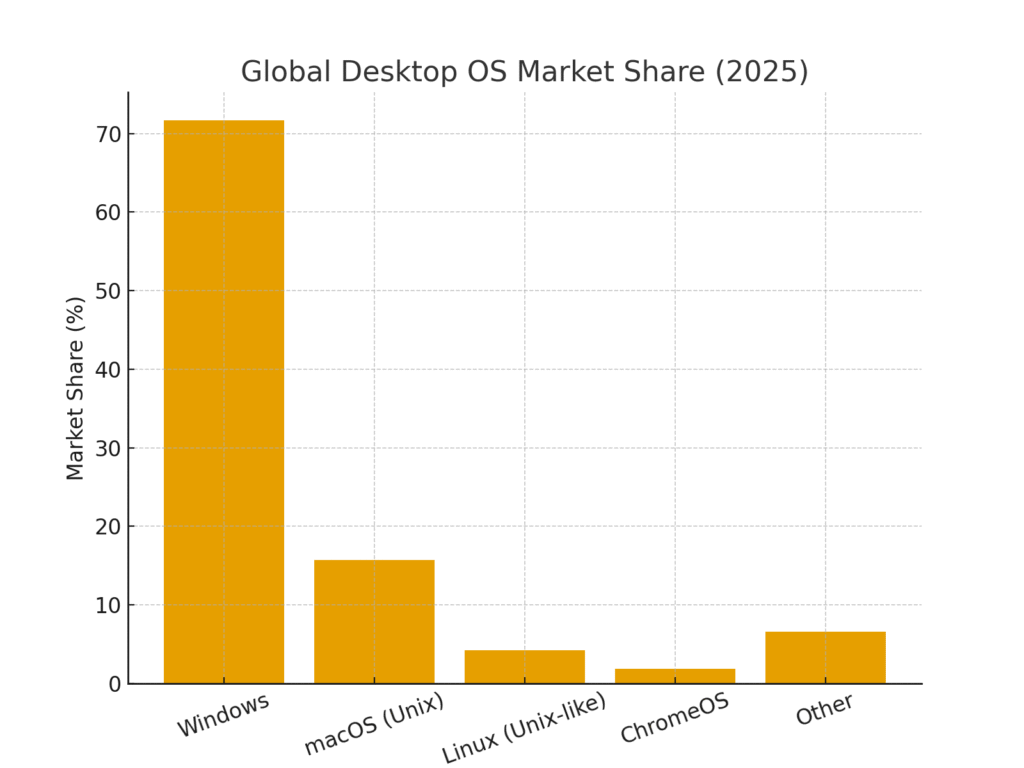
Unix Marketing Statistics #4 – Unix Holds 5.22% Global Server And Desktop Market Share
Unix commands about 5.22% of the combined global server and desktop OS market. While smaller compared to Windows and Linux, it still represents a significant footprint for specialized industries. Marketers targeting enterprise clients should pay attention to this niche but stable base. I believe it reflects Unix’s enduring appeal among legacy systems and high-reliability industries. Even with shifting trends, Unix still holds its ground.
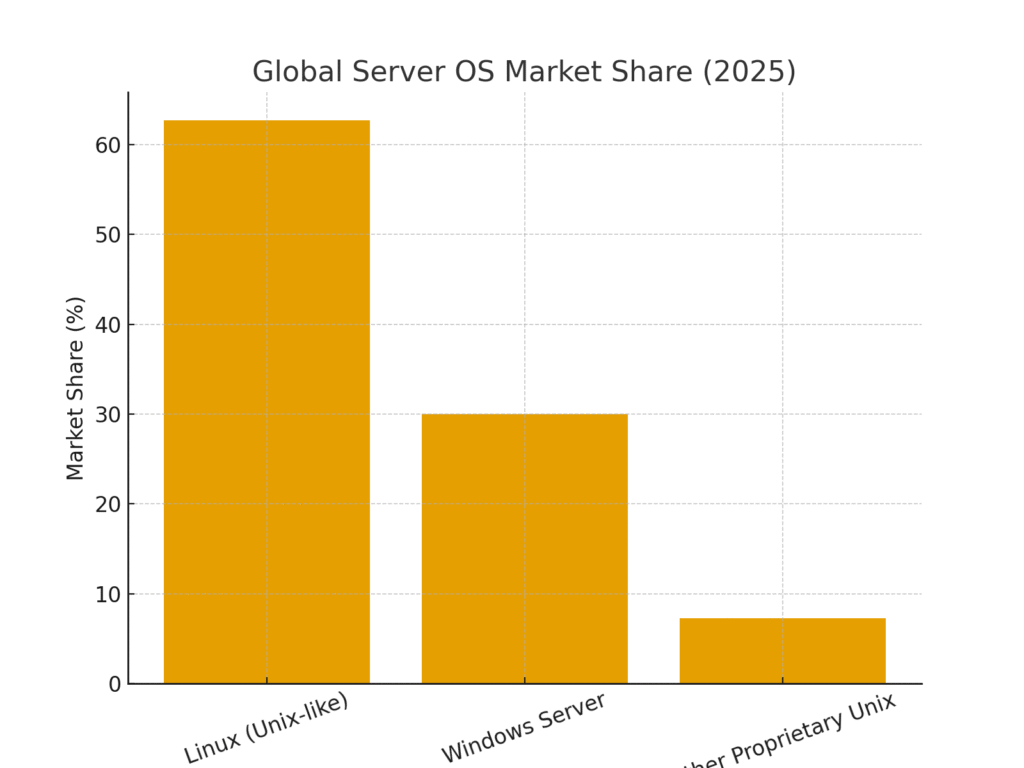
Unix Marketing Statistics #5 – Linux Owns 62.7% Of Global Server OS Market
Linux leads servers worldwide with an impressive 62.7% market share. Since Linux is Unix-based, it shows how the philosophy of Unix dominates the backbone of the web. For marketing professionals, this stat demonstrates the scope of campaigns that rely on Linux-powered servers. I personally admire how open-source platforms have outcompeted proprietary giants in this space. It’s a real testament to the strength of community-driven development.

Unix Marketing Statistics #6 – Linux Holds 4.20% Share Of Global Desktop Market
On desktops, Linux stands at about 4.20%, far behind Windows and macOS. While it seems small, this share has been steadily growing. For niche marketing campaigns, Linux desktops can still offer valuable audiences. I find it interesting that despite its limited consumer presence, Linux thrives in developer and professional communities. That gives it an outsized influence compared to raw numbers.
Unix Marketing Statistics #7 – MacOS Is The Largest Non-Linux Unix Desktop OS
Among Unix variants beyond Linux, macOS dominates the desktop scene. It accounts for over 15% of global desktop usage, while BSD and others barely register. Marketers can’t ignore macOS, especially in creative industries where Apple products are staples. Personally, I see macOS as a bridge between Unix’s technical legacy and mainstream consumer appeal. It shows how Unix can adapt to both mass and niche markets.
Unix Marketing Statistics #8 – Unix Usage Among Top Websites Is Consistently High
Even among the top 1,000,000 websites, Unix usage remains close to its overall share. This demonstrates that leading online platforms continue to trust Unix infrastructure. For digital marketing, it means most high-traffic campaigns will inevitably rely on Unix-powered systems. I think this consistency highlights Unix’s reputation for performance at scale. It’s one of the reasons big brands keep sticking with it.
Unix Marketing Statistics #9 – Over 2.5 Million Websites Use Unix
BuiltWith reports that more than 2,558,503 websites currently run on Unix. This sheer number reveals the massive digital ecosystem behind Unix systems. Marketers can interpret this as a foundation of stability and reach for online campaigns. To me, it proves just how widespread Unix really is, even if users don’t consciously see it. It’s the invisible engine of the internet.
Unix Marketing Statistics #10 – Proprietary Unix Servers Are In Long-Term Decline
Commercial Unix systems like Solaris, HP-UX, and AIX are steadily losing ground. Many organizations have migrated those workloads to Linux or Windows. For marketers, this indicates a shrinking market for legacy proprietary systems. I view it as part of the natural evolution where open systems overtake closed ones. It’s a sign that adaptability is essential for survival.
Unix Marketing Statistics #11 – Android Holds 44%+ Global OS Market Share Using Linux Kernel
Android, built on the Linux kernel, commands over 44% of the total OS market across devices. This means billions of smartphones worldwide run on a Unix-like foundation. For marketing, it shows just how far Unix’s reach extends into everyday consumer life. Personally, I think it’s incredible that Unix’s philosophy powers the devices we use most. It’s a quiet victory for open technology.
Unix Marketing Statistics #12 – 100% Of Top 500 Supercomputers Run Linux
All of the TOP500 supercomputers in the world run Linux, a Unix-like OS. This stat underscores Linux’s dominance in high-performance computing. Marketers in tech industries should see this as proof of Linux’s scalability. For me, it’s a jaw-dropping example of Unix’s continuing relevance in cutting-edge science. It’s like the backbone of innovation itself.
Unix Marketing Statistics #13 – 77% Of Web Servers Run On Unix-Like Systems
Around 77% of global web servers run Unix-like systems, with Linux leading the way. Windows holds the minority share in this space. For marketers, it means campaigns will almost always be hosted on Unix-based servers. I take it as a reminder that digital strategies are deeply tied to Unix infrastructure. Without it, modern marketing wouldn’t flow as seamlessly.
Unix Marketing Statistics #14 – Major High-Traffic Sites Like Walmart And Mozilla Run On Unix
Some of the biggest websites, including Walmart.com and Mozilla.org, run on Unix systems. This proves its reliability for handling high volumes of traffic. For digital marketers, it’s encouraging to know that trusted household names rely on Unix infrastructure. Personally, I think this adds credibility to Unix’s long-standing reputation. If major brands trust it, smaller businesses can too.
Unix Marketing Statistics #15 – Unix Retains Strong Adoption Among Newly Created Sites
Newly launched websites continue to favor Unix systems, keeping adoption steady. This shows that Unix is not only relevant but also attractive for fresh projects. Marketers can see this as a sign of future stability in the ecosystem. I believe it reflects a trust in Unix’s legacy of uptime and performance. It proves Unix is still winning hearts in 2025.

Unix Marketing Statistics #16 – Unix Thrives In Infrastructure More Than Desktops
Unix systems dominate servers, clouds, and infrastructure far more than desktops. This makes them crucial for backend reliability. For marketers, it’s a reminder that unseen infrastructure drives visible campaigns. Personally, I admire how Unix shines in the background while enabling the front-end creativity. It’s the silent partner in digital success.
Unix Marketing Statistics #17 – Linux Desktop Usage Is Slowly Growing Worldwide
Although small, Linux desktop usage has been rising steadily year over year. This growth points to increasing user trust and awareness. For marketers, it means the Linux audience, though niche, is loyal and expanding. I find this trend hopeful because it balances Unix’s server dominance with growing desktop relevance. It’s proof that even slow growth can make a big impact.
Unix Marketing Statistics #18 – Only 1 In 85 Servers Was A Proprietary Unix In 2019
By 2019, proprietary Unix accounted for just one in every 85 servers sold. This stat shows how far its decline has gone in enterprise deployments. Marketers in B2B tech can use this to highlight migration opportunities. I see it as a striking reminder of how quickly the industry moves. Legacy systems fade, but their influence lingers in history.
Unix Marketing Statistics #19 – Mission-Critical Industries Still Rely On Proprietary Unix
Despite its decline, proprietary Unix is still vital in industries like banking, telecom, and healthcare. Migration costs and risks keep these systems alive. For marketers, this means there are still opportunities in highly specialized markets. Personally, I think it shows that reliability sometimes outweighs modernization. It’s a fascinating balance between tradition and innovation.
Unix Marketing Statistics #20 – Unix Adoption Reflects Cost-Effective And Flexible Choices For Businesses
Newer and smaller websites often adopt Unix (especially Linux) for cost and flexibility. This makes Unix a go-to for startups and growing businesses. Marketers can view this as a sign of adaptability and broad relevance. I believe it highlights why Unix remains attractive even in 2025. It’s still the practical choice for many who want both power and affordability.
Wrapping Up My Thoughts
After going through these statistics, I feel even more convinced that Unix and its family of systems are the unsung heroes of the digital age. Personally, I see these insights not just as numbers but as guideposts that remind me why stability and scalability matter when crafting campaigns. It makes me appreciate how technology and marketing walk hand in hand, and why paying attention to operating systems is more than just tech trivia—it’s a competitive edge. For me, sharing these trends is a way of keeping myself grounded in both the creative and technical sides of this field, and I hope it resonates with you the same way it does with me.
SOURCES
https://w3techs.com/technologies/details/os-unix
https://trends.builtwith.com/Server/Unix
https://w3techs.com/technologies/comparison/os-linux%2Cos-unix
https://www.enterpriseappstoday.com/stats/linux-statistics.html
https://sqmagazine.co.uk/linux-statistics/
https://www.hubspot.com/marketing-statistics
https://meetanshi.com/blog/digital-marketing-statistics/
https://supermetrics.com/blog/marketing-data-report-2025
https://www.mediavalet.com/blog/digital-marketing-statistics
https://digitalmarketinginstitute.com/blog/10-eye-opening-ai-marketing-stats-in-2025
https://blog.kalvad.com/our-journey-through-linux-unix-landscapes/
https://gs.statcounter.com/os-market-share
https://en.wikipedia.org/wiki/Usage_share_of_operating_systems
https://www.networkworld.com/article/966988/the-long-slow-death-of-unix.html