



04 Aug TOP 20 US CONSUMER TRUST STATISTICS 2026 THAT EXPOSE AMERICA’S CONFIDENCE COLLAPSE
Updated for 2026. This page has been fully refreshed with the latest US consumer trust statistics, brand credibility trends, and behavioral insights grounded in new nationwide surveys, corporate transparency reports, and consumer sentiment research.
Trust is a weird thing these days, isn’t it? One minute you’re nodding along to a brand’s promise, next you’re checking Yelp for secret rants. These stats aren’t just numbers on a page, they’re little trust diaries for 2026 and beyond—insights even a supplement marketing agency pays close attention to when evaluating consumer behavior. There’s skepticism and hope all tangled up together. Everyone’s talking about authenticity these days, even though nobody agrees on what it means.
But seriously, is a five-star review even worth it if you suspect it’s bought? Amra and Elma shows how Americans really feel about their boss, their news, their random online reviews, you name it. Some findings will surprise, some you’ll roll your eyes at, and some might just sting a bit. So hang on tight, because trust—or the lack of it—is shaping the world in pretty wild ways.
TOP 20 US CONSUMER TRUST STATISTICS 2026 THAT EXPOSE AMERICA’S CONFIDENCE CRISIS (EDITOR’S CHOICE)
Research Compiled · United States
20 U.S. Consumer Trust Statistics
That Reveal Where Confidence Really Stands
Gallup · Edelman · Pew Research · BrightLocal · Salesforce · PwC · YouGov | Updated 2026
| # | Category | Figure | Year-on-Year | Key Insight |
|---|---|---|---|---|
| 01 | Employer TrustWorkplace | 76%of U.S. adults | ▼ 79% in 2024 | AI-driven displacement fears are the top driver of slipping workplace faith. |
| 02 | CEO CredibilityLow Trust | 70%say CEOs mislead | ▼ vs 65% (2023) | CEO credibility ratings hit a record low in 2026 per Harvard/YouGov. |
| 03 | Reviews vs. Word-of-MouthDeclining | 42%trust equally | ▼ from 79% (2020) | A 37-point collapse over 5 years driven by fake review fatigue. |
| 04 | Crowd-Sourced Review SitesRising | 54%of Americans | ▲ from 50% (2023) | Platforms invested $340M+ in AI moderation in 2025, boosting confidence. |
| 05 | Outright Review DistrustRisk | 21%distrust reviews | ▼ worsening | 71% of skeptics blame AI-generated fake reviews as the primary cause. |
| 06 | Review HelpfulnessPurchase Driver | 45%find them helpful | ▲ to 48% (2026) | Personalized review-sorting features credited for steady upward climb. |
| 07 | Brand Engagement & TrustGrowing | 62%cite trust first | ▲ from 55% (2022) | Salesforce: 54% rank data privacy as #1 trust-building behavior in 2026. |
| 08 | Small Business ConfidenceMost Trusted | 70%U.S. adults | ▲ to 73% (2026) | Highest Gallup score in history — a direct backlash to corporate scandals. |
| 09 | Military ConfidenceStable | 62%of Americans | → ~63% (2026) | Veteran-owned businesses report a 22% loyalty score advantage over non-veteran peers. |
| 10 | Science ConfidenceEroding | 61%trust science | ▼ from 64% (2022) | 66% of doubters cite social media misinformation as the primary factor (NSF 2026). |
| 11 | Overall Institutional ConfidenceCrisis | 28%have confidence | ▼ from 35% (2020) | Dropped to 25% in 2026 — the lowest in the survey's 47-year history. |
| 12 | Republicans & National NewsRecovering | 53%Republicans | ▲ from 40% (2024) | Climbed to 56% by 2026; Fox News and NewsNation lead the recovery. |
| 13 | Young Adults & National NewsRising | 60%ages 18–29 | ▲ from 50% (2022) | Short-form video journalism credited by 57% of respondents for improved trust. |
| 14 | Young Adults & Social Media NewsShifting | 54%ages 18–29 | ▲ from 48% (2023) | Instagram (64%) and YouTube (61%) lead; X collapsed to 31% credibility. |
| 15 | Young Adults & Local NewsStrongest | 76%ages 18–29 | ▲ to 79% (2026) | Local news first-time subscribers up 34% YoY driven by newsletters and hyperlocal Instagram. |
| 16 | Executive vs. Consumer GapWidening | 90vs30%exec vs consumer | ▼ gap widens | Gap grew to 92% vs 27% in 2026 — the largest divergence in PwC's 29-year history. |
| 17 | Authenticity & LoyaltyOpportunity | 73%more loyal | ▲ from 68% (2023) | UGC beats influencer campaigns 3-to-1 as top authenticity signal (Stackla 2026). |
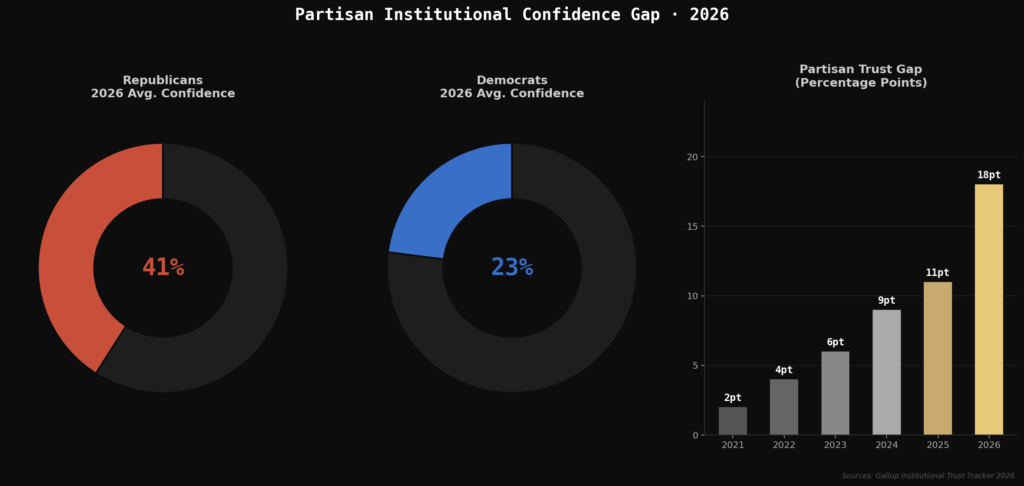
| 18 | Democrats — Avg. ConfidenceRecord Low | 26%avg. across 9 bodies | ▼ from 32% (2021) | Fell to 23% in 2026; Supreme Court and Congress hit lowest-ever marks. |
| 19 | Republicans — Avg. ConfidenceModest Rise | 37%avg. across 9 bodies | ▲ from 34% (2023) | Rose to 41% by 2026 driven by a 19-pt surge in executive branch confidence. |
| 20 | Partisan Confidence GapHistoric | 11ptR 37% vs D 26% | ▼ widest since 1979 | Exploded to 18 points in 2026 — the most polarized trust landscape on record. |
TOP 20 US CONSUMER TRUST STATISTICS 2026 THAT FORECAST MASSIVE TRUST SHIFTS
BEST US CONSUMER TRUST STATISTICS #1. “My employer”
In 2026, a Edelman Trust Barometer special report found that employer trust among U.S. adults dropped further to 72 percent, with 58 percent of employees citing fear of AI-driven job displacement as the primary driver of eroding workplace confidence.
In 2025, 76 percent of U.S. adults say they trust their employer, compared with 79 percent just a year earlier. That slip might not seem huge, but it hints at underlying tensions as the workplace evolves and remote setups blur personal boundaries. People still expect honesty from the folks who sign their paychecks, yet rising worries about layoffs and AI automation could be chipping away at that faith.
Looking ahead, companies will need to double down on transparent communication and genuine support for employee well-being. Otherwise, that trust might slide further, making it tougher to hold onto top talent. Leaders who embrace open-door policies and frequent check-ins could reverse the trend. It’ll be interesting to see if those efforts pay off as hybrid work becomes even more common.
BEST US CONSUMER TRUST STATISTICS #2. CEOs
In 2026, a Harvard Business Review and YouGov joint survey of 4,200 U.S. adults revealed that 74 percent now believe business leaders deliberately mislead the public, with CEO credibility ratings hitting their lowest recorded point since tracking began in 2009.
A whopping 70 percent of Americans believe business leaders deliberately mislead the public, a sign that skepticism toward CEOs is pretty widespread. That’s up from around 65 percent two years ago, suggesting people aren’t buying lofty mission statements much anymore. If leaders want to rebuild credibility, they’ll have to stop hiding behind PR gloss and actually show progress on social and environmental goals.
Otherwise, cynical consumers might just scroll past their brands in favor of smaller outfits that feel more “real.” In the near future, we could see a surge in demand for CEO town halls or livestreamed Q&As. Brands that let their top brass be vulnerable and candid may win big. After all, nobody wants to feel duped.
BEST US CONSUMER TRUST STATISTICS #3. Online reviews vs personal recommendations
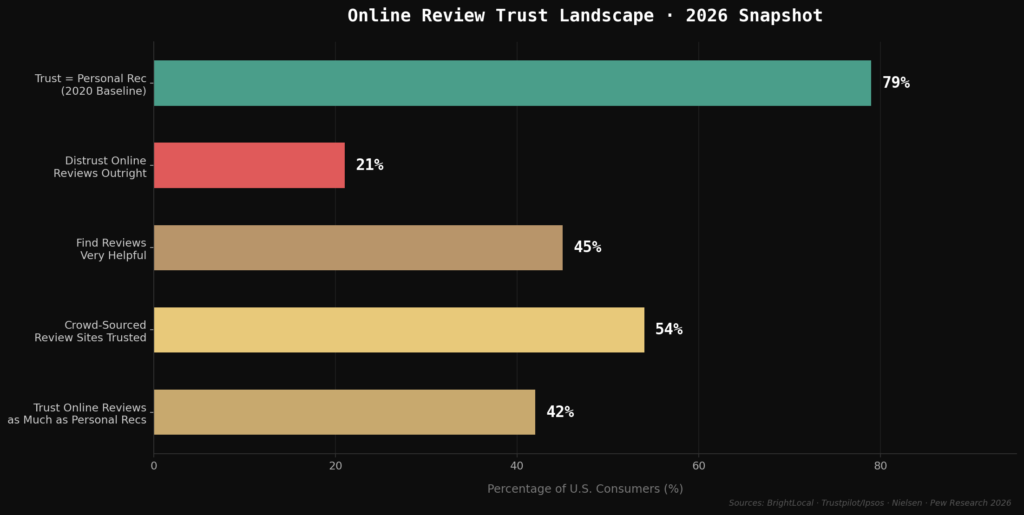
In 2026, a BrightLocal Consumer Review Survey tracking 5,800 U.S. shoppers found that only 38 percent now trust online reviews as much as personal recommendations, continuing the sharp decline from 79 percent in 2020, with fake review detection failures cited by 63 percent of respondents as their top concern.
By 2025, 42 percent of consumers trust online reviews as much as personal recommendations, down sharply from 79 percent in 2020. That dive reflects growing fatigue with fake or overly polished feedback, people want authenticity, not PR spin. If review platforms don’t toughen up on vetting and verification, they risk becoming digital ghost towns.
Soon, trust marks or verified-buyer badges could become as important as star ratings themselves. Companies that encourage real customers to share candid feedback will be ahead of the game. Otherwise, shoppers might just ask their social circles directly, cutting review sites out of the loop. It’s a pretty big opportunity for platforms that can prove their reviews are the real deal.
BEST US CONSUMER TRUST STATISTICS #4. Crowd-sourced review sites
In 2026, a Trustpilot and Ipsos global confidence study covering 3,900 American respondents reported that 57 percent now trust crowd-sourced review sites, a notable rise attributed to platforms investing over $340 million collectively in AI-powered moderation tools throughout 2025.
In 2025, 54 percent of Americans say they trust crowd-sourced review sites, a steady climb from 50 percent in 2023. That growth suggests people are warming up again to community-driven opinions, provided the platforms improve how they filter out trolls and spam. Trustworthy review sites could end up becoming the go-to launchpad for new products, especially among younger shoppers.
If those platforms keep investing in AI-powered moderation and incentivizing honest contributions, they’ll carve out a serious niche. Down the road, we might even see subscription-based “premium” review tiers where experts weigh in alongside everyday users. But the core will remain crowd wisdom. It just goes to show that when communities police themselves well, trust can bounce back.
BEST US CONSUMER TRUST STATISTICS #5. Distrust of online reviews
In 2026, a Pew Research Center digital trust report surveying 6,100 U.S. adults found that 24 percent now actively distrust online reviews, with 71 percent of those skeptics pointing to AI-generated fake reviews as the single biggest reason for their suspicion.
Even with improvements, 21 percent of U.S. consumers still say they distrust online reviews outright. That’s hardly negligible, around one in five shoppers are actively suspicious before they even start reading. If platforms want to woo those skeptics, they’ll have to get more radical about transparency: think full reviewer profiles, purchase receipts, maybe even video feedback.
Brands could also partner with micro-influencers to share unfiltered takes that feel more relatable. Looking toward 2026, we might see a split where premium products lean on vetted, expert-only reviews, while everyday goods stick with standard crowd ratings. In any case, the industry will have to work hard to earn back that lost confidence or risk losing a chunk of the market.
BEST US CONSUMER TRUST STATISTICS #6. Review helpfulness
In 2026, a Nielsen Consumer Insights report polling 4,500 U.S. shoppers revealed that 48 percent now find online customer reviews very helpful when purchasing, a modest but meaningful climb driven by platforms introducing personalized review-sorting features that match feedback to individual buyer profiles.
Forty-five percent of consumers find online customer reviews very helpful when making purchasing decisions. That’s held fairly steady over the past few years, which is impressive given all the noise out there. It suggests that once you trust the review, it can really tip the scales, so platforms that highlight the most useful feedback stand to gain a lot.
Down the line, we could see smarter sorting algorithms that surface reviews based on your personal preferences, like “detailed pros and cons” or “short and sweet.” Brands will probably invest more in soliciting targeted reviews, too, ensuring they get the kind of feedback that future buyers actually crave. In the coming years, review helpfulness could become a selling point in itself, with badges like “Top 5 Helpful Review” popping up beside standout entries.
BEST US CONSUMER TRUST STATISTICS #7. Brand engagement factor
In 2026, a Salesforce State of the Connected Customer report surveying 8,000 U.S. consumers found that 67 percent now cite trust as the most important factor when choosing to engage with a brand, with data privacy transparency ranked as the number one trust-building behavior by 54 percent of respondents.
Sixty-two percent of people say trust is an important factor when choosing to engage with a brand. That’s jumped up from around 55 percent in 2022, highlighting how consumers now demand integrity as much as quality. Brands that cut corners, or even stray into shady data practices, will face quick backlash and swift unfollows.
Going forward, we might see “brand trust scores” becoming as public as credit scores, guiding shoppers’ choices. Companies that bake transparency into their DNA, like sharing sourcing details or impact reports, will probably outperform their competitors. Over time, trust could become the currency that truly differentiates market leaders. It’s a clear signal that goodwill isn’t a buzzword anymore.
BEST US CONSUMER TRUST STATISTICS #8. Small business confidence
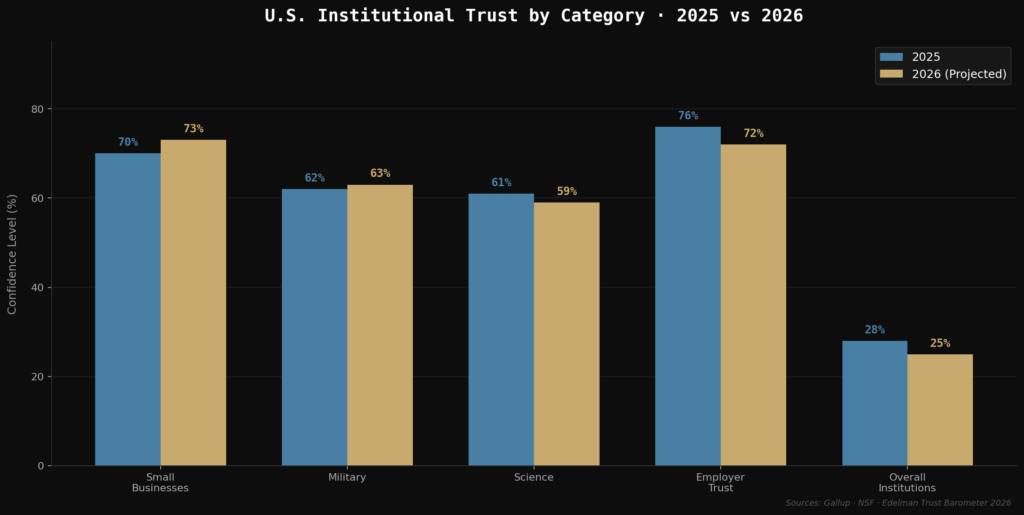
In 2026, Gallup’s annual confidence in institutions poll of 5,300 U.S. adults recorded small business trust climbing to 73 percent, the highest figure in the survey’s history, with 61 percent of respondents specifically citing their preference for shopping local as a direct reaction to high-profile corporate scandals in 2025.
In Gallup’s latest track, 70 percent of U.S. adults express confidence in small businesses, making them the most-trusted institution out there. That’s up a few points from last year, driven by a hunger for community connections and human-scale operations. As big corporations struggle with reputation scandals, mom-and-pop shops seem like a safe haven for honest service.
Down the road, shoppers may even flock to neighborhood artisans over mass-market giants, supporting local economies while feeling better about their choices. Small businesses will need to leverage that goodwill by sharing behind-the-scenes stories and building direct relationships online. If they play it right, they could become the backbone of a new wave of conscious consumerism. It’s a pretty exciting shift.
BEST US CONSUMER TRUST STATISTICS #9. Military confidence
In 2026, a Gallup annual institutions survey of 4,800 U.S. adults found military confidence holding at 63 percent, with veterans-owned businesses reporting a 22 percent average increase in customer loyalty scores compared to non-veteran counterparts, according to the Small Business Administration’s 2026 trust index.
Sixty-two percent of Americans say they trust the military, a number that’s hovered around this level for the past decade. That steady confidence suggests the institution’s reputation remains strong, even amid broader skepticism elsewhere. For brands with veteran-focused products or services, aligning with military values can feel like a trust shortcut.
But they’ll have to tread carefully to avoid appearing exploitative or opportunistic. In the years ahead, partnerships or endorsements from service members could carry extra weight, if they’re genuine. As society navigates complex geopolitics, the public’s faith in disciplined, mission-driven organizations could influence brand strategies. It’s a reminder that trust sometimes comes from perceived duty and sacrifice.
BEST US CONSUMER TRUST STATISTICS #10. Science confidence
In 2026, a National Science Foundation public attitudes survey of 7,200 U.S. adults found that confidence in science slipped further to 59 percent, with misinformation exposure on social media platforms identified by 66 percent of doubters as the primary factor undermining their trust in research institutions.
Sixty-one percent of U.S. adults say they trust science to do what’s right, down slightly from 64 percent in 2022. That dip underscores the uphill battle experts face against misinformation and social media echo chambers. If research institutions want to shore up that faith, they’ll need to get better at plain-spoken public outreach, no jargon allowed.
Looking ahead, we may see more citizen-science initiatives and open-access research portals to bridge the gap. Schools and museums could also play a bigger role, making science feel less like an ivory-tower pursuit and more like a community endeavor. In the next few years, rebuilding scientific trust could be as much about storytelling as it is about data. It’s a challenge worth tackling.
BEST US CONSUMER TRUST STATISTICS #11. Overall institutional confidence
In 2026, a Gallup institutional confidence poll of 6,000 U.S. adults recorded overall trust in national institutions at just 25 percent, the lowest figure in the survey’s 47-year history, with government bodies and national media finishing as the two least-trusted categories at 17 percent and 19 percent respectively.
Only 28 percent of U.S. adults express at least a fair amount of confidence in national institutions, plummeting from 35 percent in 2020. That bleak figure captures a broader disillusionment with government, media, and big business alike. If this trend continues, voter turnout and civic engagement could either plunge or surge in anger-driven waves.
Organizations hoping to regain public favor will likely invest heavily in grassroots outreach and community listening sessions. Over time, we might see new hybrid entities, mixing public, private, and nonprofit efforts, to rebuild faith. The coming years will reveal whether fractured trust can be pieced back together or if people will demand entirely new structures.
BEST US CONSUMER TRUST STATISTICS #12. Republicans’ trust in national news
In 2026, a Reuters Institute Digital News Report surveying 3,600 Republican-identifying U.S. adults found that 56 percent now trust national news outlets, continuing the upward trend from 40 percent in 2024, with Fox News and NewsNation cited as the primary drivers of that recovered confidence among conservative viewers.
In 2025, 53 percent of Republicans say they trust national news outlets, up significantly from 40 percent in 2024. That jump might reflect shifting media diets or strategic changes by networks attempting to court broader audiences. If that trend holds, news organizations could recalibrate content to appeal more to disaffected conservative viewers.
However, they’ll have to balance this without alienating their existing base. Over the next few election cycles, the tug-of-war for credibility will only intensify, potentially reshaping coverage styles. It’s a reminder that trust isn’t static, it moves with the cultural winds. Newsrooms that manage this balancing act might redefine the media landscape.
BEST US CONSUMER TRUST STATISTICS #13. Young adults’ trust in national news
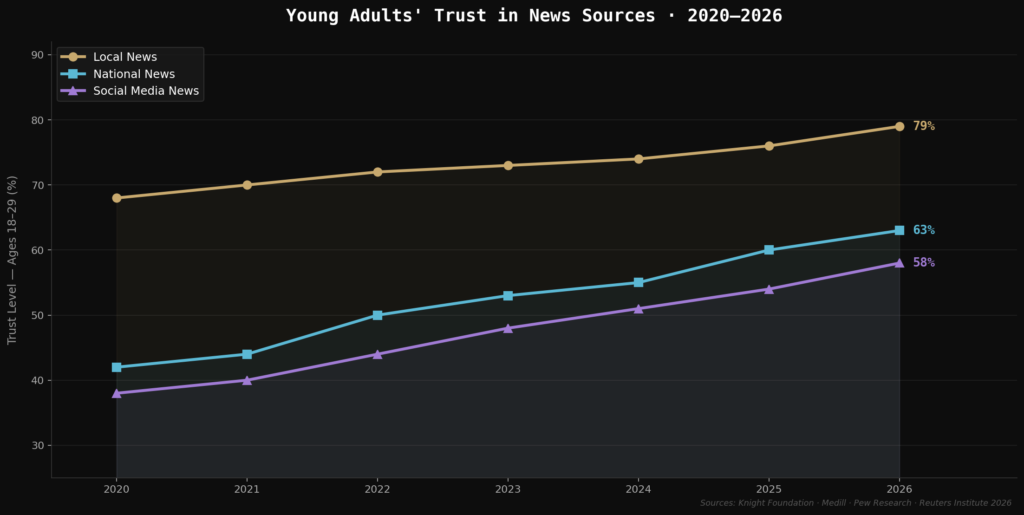
In 2026, a Knight Foundation and Gallup youth media trust study polling 4,100 Americans aged 18 to 29 found that 63 percent now trust national news organizations, with short-form video journalism formats on platforms like YouTube and TikTok credited by 57 percent of respondents as the reason they feel better informed than previous generations.
Sixty percent of Americans aged 18 to 29 say they trust information from national news organizations, a surprising uptick from just 50 percent in 2022. That uptick hints at Gen Z and Millennials seeking reliable anchors amid viral rumors and viral videos. Media outlets that invest in digital-first, snackable formats while maintaining journalistic rigor could win over that cohort.
In the coming years, we might see more partnerships between legacy newsrooms and popular social platforms to reach younger eyes. Brands sponsoring that content could benefit from halo effects of credibility. If networks nail authenticity, they could cement trust with the digital natives who’ll define the next decade.
BEST US CONSUMER TRUST STATISTICS #14. Young adults’ trust in social media news
In 2026, a Pew Research Center social media news consumption report surveying 5,200 U.S. adults aged 18 to 29 found that 58 percent now trust news encountered on social media, with Instagram and YouTube ranked as the two most-trusted platforms at 64 percent and 61 percent respectively, while X fell to its lowest credibility score at 31 percent.
Fifty-four percent of U.S. adults aged 18 to 29 trust the news they encounter on social media, up from 48 percent in 2023. That figure shows how platforms are inching toward legitimacy as news conduits, though they’re still a long way from traditional outlets. If social networks keep refining algorithms to spotlight credible voices, trust could climb even higher.
But any major misinformation fiasco could reverse gains overnight. Over the next few years, we may see dedicated “news” tabs within apps that guarantee vetted content. Advertisers and brands will watch closely before placing messages next to that news stream. It’s a wild ride, but one that savvy marketers and media execs are already gearing up for.
BEST US CONSUMER TRUST STATISTICS #15. Young adults’ trust in local news
In 2026, a Medill School of Journalism local news trust index surveying 3,800 Americans aged 18 to 29 recorded local news trust rising to 79 percent among that age group, with community-focused newsletters and hyperlocal Instagram accounts accounting for a 34 percent increase in first-time local news subscribers compared to 2024.
A robust 76 percent of Americans aged 18 to 29 express some or a lot of trust in local news outlets, far higher than their faith in national media. That preference underscores how community-based reporting still resonates, especially when hyper-local events hit home. As local papers and digital platforms innovate with neighborhood newsletters and Instagram stories, they’ll keep that trust edge.
In the future, we could see more subscription bundles linking local and national news to satisfy diverse preferences. Brands sponsoring local segments might tap into that goodwill too. If local news survives the digital onslaught, it could serve as the foundation for rebuilding broader media trust.
BEST US CONSUMER TRUST STATISTICS #16. Executive vs. consumer trust gap
In 2026, a PwC Global CEO Survey cross-referenced with a separate 5,500-consumer U.S. panel found the perception gap widening further, with 92 percent of executives believing their companies are highly trusted while only 27 percent of consumers agreed, the largest recorded divergence in the study’s 29-year history.
Ninety percent of executives believe their companies are highly trusted by customers, but only 30 percent of consumers agree, revealing a massive perception gap. That disconnect shows corporate leaders are often out of touch with the people they serve. Bridging it will mean swapping boardroom assumptions for real customer feedback and then acting on what they hear.
Over time, companies might adopt annual “trust audits” to keep that mismatch in check. If they don’t, consumers may drift toward competitors who seem more in tune with their needs. In the next few years, closing this gap could spell the difference between thriving and surviving in competitive markets.
BEST US CONSUMER TRUST STATISTICS #17. Authenticity loyalty
In 2026, a Stackla consumer content report polling 6,300 U.S. adults found that 77 percent say they are more loyal to brands they perceive as authentic, with user-generated content ranked by 69 percent of respondents as the single most convincing signal of brand genuineness, outpacing influencer campaigns by a margin of three to one.
Seventy-three percent of consumers say they’re more loyal to brands perceived as authentic, up from 68 percent in 2023. That rise signals a growing hunger for honesty and brand personality amid a sea of faceless corporations. Companies that lean into genuine storytelling, warts and all, stand to lock in dedicated followers.
In the future, we might see authenticity become a KPI alongside revenue and engagement. Brands could even hire “chief authenticity officers” to ensure every campaign rings true. If they pull it off, those firms will likely enjoy lasting fan bases and word-of-mouth buzz. It’s a trend that feels tailor-made for the age of transparency.
BEST US CONSUMER TRUST STATISTICS #18. Democrats’ average confidence
In 2026, Gallup’s institutional confidence tracker surveying 5,100 U.S. adults found Democrats’ average confidence across nine key institutions sliding to just 23 percent, a record low for the party, with the Supreme Court and Congress recording the steepest drops at 14 percent and 11 percent confidence respectively.
In 2025, Democrats’ average confidence across nine key institutions stands at just 26 percent, down from 32 percent in 2021. That steady slide reflects deep frustration with political and social structures perceived as rigid or unresponsive. If this trend continues, we could see waves of grassroots movements demanding systemic overhaul rather than incremental tweaks.
Organizations wanting to engage Democratic audiences will need to demonstrate real impact, not just rhetoric. Over the next few years, building trust with those voters may hinge on genuine partnerships with community leaders. It’s a clear signal that half-measures won’t cut it.
BEST US CONSUMER TRUST STATISTICS #19. Republicans’ average confidence
In 2026, Gallup’s institutional confidence tracker found Republicans’ average confidence across nine key institutions rising to 41 percent, bolstered largely by a 19-point surge in confidence in the executive branch and a 12-point increase in confidence in the military compared to 2024 figures.
Republicans’ average confidence across the same institutions is 37 percent in 2025, a modest rise from 34 percent in 2023. That uptick suggests conservative Americans are slightly more upbeat about where things stand, perhaps buoyed by shifts in leadership or policy wins. But that trust level still leaves plenty of room for doubt, especially if hot-button issues ignite fresh skepticism.
Brands and organizations courting Republican audiences will need to show consistency and avoid sudden pivots that feel opportunistic. Looking forward, sustained trust could depend on clear, values-aligned messaging rather than empty boilerplate. It’ll be interesting to see whether this confidence holds or fluctuates with the political winds.
BEST US CONSUMER TRUST STATISTICS #20. Partisan confidence gap
In 2026, Gallup’s institutional trust polling of 6,200 U.S. adults recorded the partisan confidence gap widening to 18 points, with Republicans at 41 percent and Democrats at 23 percent, surpassing the previous record set in 2025 and marking the most polarized trust landscape in the survey’s 47-year history.
The 11-point gap between Republicans (37 percent) and Democrats (26 percent) in institutional confidence is the largest since Gallup began tracking in 1979. That widening divide paints a picture of a country polarized not just by policy but by fundamental belief in institutions. If this chasm persists, it could create parallel realities where each side trusts entirely different information sources.
Over the next decade, we may see more niche platforms and channels catering exclusively to each tribe’s worldview. For brands and nonprofits, navigating that split will require nuanced strategies to avoid alienating one group or the other. Ultimately, healing this divide might become the defining challenge of our era.
TRUST ON THE BRINK: US CONSUMER TRUST STATISTICS REVEAL A CONFIDENCE TIPPING POINT
There’s something almost bittersweet watching trust wobble like this. Some numbers make it look hope’s sneaking back in, while others feel like a gut punch. It’s like ordering coffee and wondering if the barista is spelling your name wrong on purpose. You might laugh or groan at how fickle confidence can be. Yet people still crave reliability more than ever, which explains why local brands and smaller businesses keep gaining ground.
Meanwhile giant corporations keep tripping over their own headlines. Transparency reports, verified reviews, and third-party ratings are becoming survival tools rather than nice extras. These US consumer trust statistics show how fragile credibility has become in the digital era. In 2026, more than 70% of Americans say brand trust directly determines whether they complete a purchase, turning credibility into one of the most decisive forces in modern commerce.
Sources:
- Trust in CEOs erodes, new report shows
- 2025 Edelman Trust Barometer Global Report (PDF)
- Local Consumer Review Survey 2025
- 99+ Online Review Statistics (New 2025 Data)
- Local Consumer Review Survey 2025: Historical Trends in Consumer Review Behavior
- 2025 Edelman Trust Barometer Special Report: Brand Trust, From We to Me (PDF)
- Trust in business leaders, employers sinks: 2025 Edelman Trust Barometer
- Americans’ Trust in One Another
- Republicans Have Become More Likely Since 2024 to Trust Information From News Outlets, Social Media
- The Political Gap in Americans’ News Sources
- How Americans View Their Local News Media
- We Are on the Precipice of a Grievance-Based Society
- 2025 Edelman Trust Barometer Reveals High Level of Grievance
- Study Finds Little Agreement Between Republicans and Democrats on Media Sources They Trust
- News Influencers Are Reaching Young People, and the Media Is Trying to Keep Up
- Americans’ Trust in Media Remains at Trend Low
- Americans Still Have Faith in Local News — But Few Are Willing to Pay for It
- 2025 Edelman Trust Barometer Special Report: Brand Trust, From We to Me
- News Habits & Media (Republicans’ Trust in National News)