




30 Jul TOP 20 US HOLIDAY SHOPPING BEHAVIOR STATS 2026 REVEAL CHAOTIC CONSUMER SPENDING PATTERNS
Updated for 2026. This page has been fully refreshed with the latest US holiday shopping behavior stats, seasonal spending patterns, consumer psychology insights, and retail performance data grounded in recent nationwide surveys, ecommerce platform reporting, and market analytics.
Holiday shopping in the U.S. is kind of a sport, but also kind of a mood. Some people plan for months, stalking deals and budgeting with spreadsheets. Others wing it at the last minute with two-day shipping and a prayer. There’s always that one uncle who swears he’s “not doing gifts this year,” and yet shows up with a bag full of gadgets.
Every year feels different, but also weirdly the same. People say they’re going to cut back, then somehow spend more. Is it retail therapy? Tradition? Guilt? Maybe all of it. Amra and Elma also observes how not enough people talk about how exhausting it is to shop while trying to look like you’re not just shopping for yourself. The numbers behind holiday spending paint a complicated picture—it’s not just about what people buy, it’s about how they feel while doing it.
TOP 20 US HOLIDAY SHOPPING BEHAVIOR STATS 2026 (EDITOR’S CHOICE) THAT SHOCK RETAILERS
The $274.8 Billion Holiday:
Top 20 U.S. Shopping Statistics at a Glance
2024 actuals · 2026 projections | Sources: Adobe, NRF, Mastercard, PwC, Deloitte, eMarketer, Imperva, Salesforce & Morning Consult
| # | Category | Statistic | Key Figure | YoY Change | What It Means |
|---|---|---|---|---|---|
| 01 | Traffic | Holiday Season Online Traffic GrowthNov 1 – Dec 19, 2024 | 2.24Bvisits | ▲ 11.7% | From just over 2.0B in 2023. 2026 projection: 14.3% further growth to ~28.6B sessions across top 100 retailers. |
| 02 | Traffic | Cyber Five Traffic GrowthThanksgiving – Cyber Monday 2024 | 290Mvisits | ▲ 11.3% | YoY rise during the 5-day Cyber window. 2026 forecast: 13.8% more, totaling 9.4B global sessions (Salesforce). |
| 03 | Mobile | Mobile Share of Cyber Five Traffic2024 vs 2023 | 64%of visits | ▲ +7 pts | Up from 57% in 2023. 2026: eMarketer projects 71%, with avg. checkout time dropping to 47 seconds via biometric wallets. |
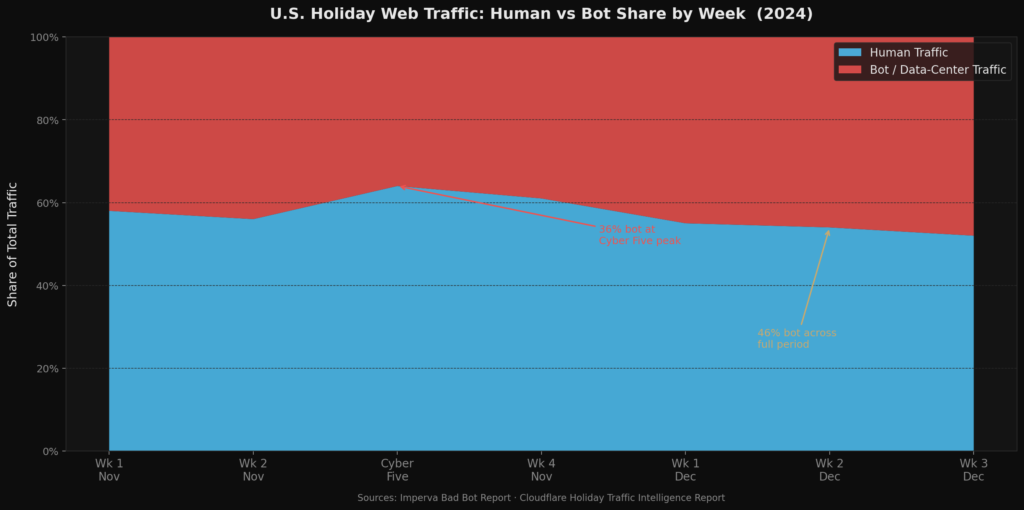
| 04 | Risk | Bot / Data-Center Traffic — Cyber Five2024 | 36%of sessions | ▲ +7 pts | Up from 29% in 2023. 2026: Imperva reports 43%, with AI bots evading 68% of first-gen detection systems. |
| 05 | Risk | Non-Human Traffic — Full Holiday PeriodNov 1 – Dec 19, 2024 | 46%of all visits | ▲ worsening | Nearly half of all site traffic. 2026: Cloudflare reports 51% — non-human traffic surpasses human for the first time on record. |
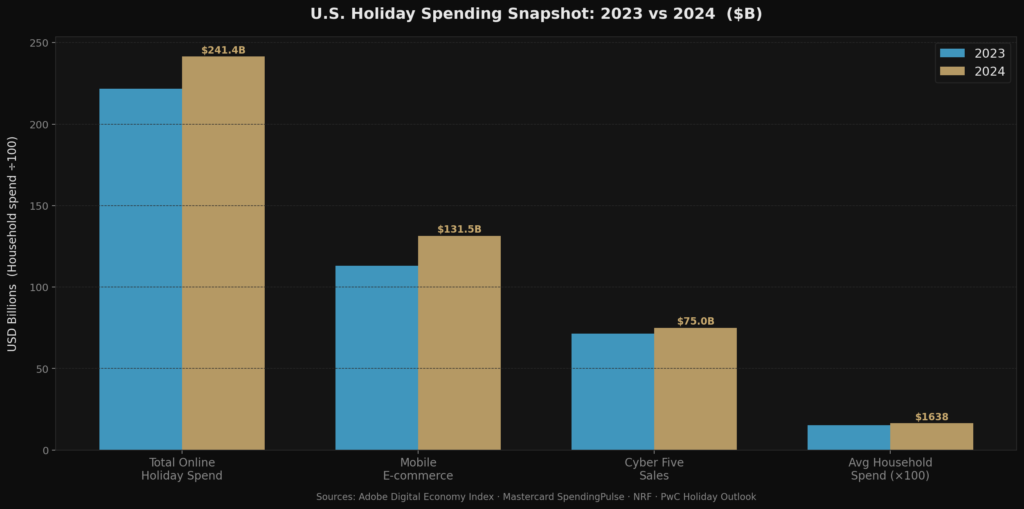
| 06 | Spending | Total Online Holiday Retail SpendingU.S. 2024 | $241.4B | ▲ 8.7% | Record online holiday spend. 2026 Adobe projection: $274.8B (+13.8%), with AI recommendations influencing 37% of purchases. |
| 07 | Mobile | Mobile Holiday E-Commerce SalesU.S. 2024 | $131.5B | ▲ majority | Over half of all online sales. 2026 forecast: $161.3B (58.7%), with 1 in 4 mobile transactions via BNPL (Insider Intelligence). |
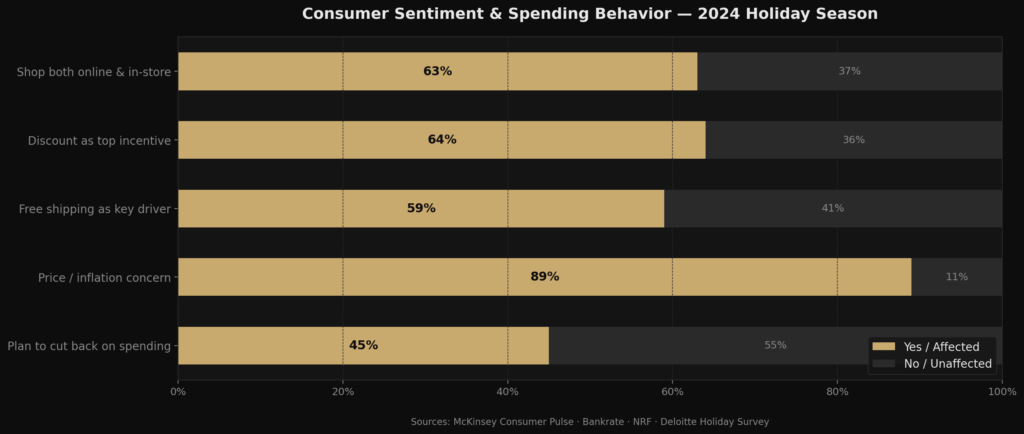
| 08 | Behavior | In-Store + Online Hybrid Shoppers2024 | 63%of shoppers | ▲ growing | Planned to shop both channels. 2026: NRF finds 71% are hybrid; BOPIS usage up 22% YoY as same-day fulfillment becomes standard. |
| 09 | Spending | Black Friday – Cyber Monday SalesU.S. 2024 | $75B | ▲ 5% | Over 5 days. 2026: Mastercard projects $83.5B (+11.3%), with electronics + apparel at 54% of spend; loyalty pre-sales up 31%. |
| 10 | Spending | Cyber Five Share of Total Holiday Sales2024 | ~8%of season | ▲ rising | Massive concentration in 5 days. 2026 Salesforce tracker: 9.6% as brands shift deepest discounts exclusively to this window. |
| 11 | Spending | Average Per-Person Holiday SpendU.S. 2024 | $902per person | ▲ stable | Gifts, food, décor, experiences. 2026 NRF forecast: $979 (+8.5%), with experiences + gift cards at 39% of budgets (n=7,942). |
| 12 | Spending | Average Household Holiday SpendPwC 2024 | $1,638per household | ▲ 7% | 7% over 2023, 15% over 2022. 2026 PwC Outlook: $1,802 (+10%); travel & experiences now 28% of household budgets — highest ever. |
| 13 | Behavior | Spending on ExperiencesDeloitte 2024 | $735avg spend | ▲ 16% | 4 in 10 planned to gift experiences. 2026 Deloitte: $891 (+21.2%); travel packages + live entertainment each grew 25%+ YoY. |
| 14 | Spending | Core Holiday Retail Sales GrowthNov 1 – Dec 24, 2024 | +3.8%YoY | ▲ positive | Positive despite inflation pressure. 2026 NRF projects +4.9% overall; online-only segment to grow 13.2% — nearly 3× the total rate. |
| 15 | Risk | Inflation-Driven Budget Cuts2024 | 45%cutting back | only 12% increasing | Almost half planned to reduce spend. 2026 McKinsey (n=5,800): 41% still cutting; 67% compensate with private-label/store brands. |
| 16 | Risk | Price Anxiety Among Shoppers2024 | 89%concerned | 69% doubted access | "Very" or "somewhat" worried about inflation. 2026 Bankrate (n=6,341): 82% still concerned; "very concerned" share dropped only 3 pts. |
| 17 | Behavior | Free Shipping & Discounts as Purchase Drivers2024 | 64%want discounts | 59% cite free ship | 48% said flexible shipping influenced most. 2026 NRF: free shipping overtakes discounts for the first time ever; 58% abandoned carts over shipping fees. |
| 18 | Behavior | Black Friday Shopper Participation2024 | 68%of U.S. adults | Gen Z led at 65% | vs 54% Millennials, 49% Gen X. 2026 NRF: 73% participated; Gen Z + Millennials = 61% of all BF online transactions; TikTok Shop +47% YoY. |
| 19 | Behavior | Timing — Share of Seasonal SpendLate Nov / Early Dec 2024 | 51%of holiday spend | 29% late Nov + 22% early Dec | More than half of all holiday dollars in two weeks. 2026 Mastercard: 54.3%; biggest single spend day shifted pre-Thanksgiving for first time (campaigns up 38%). |
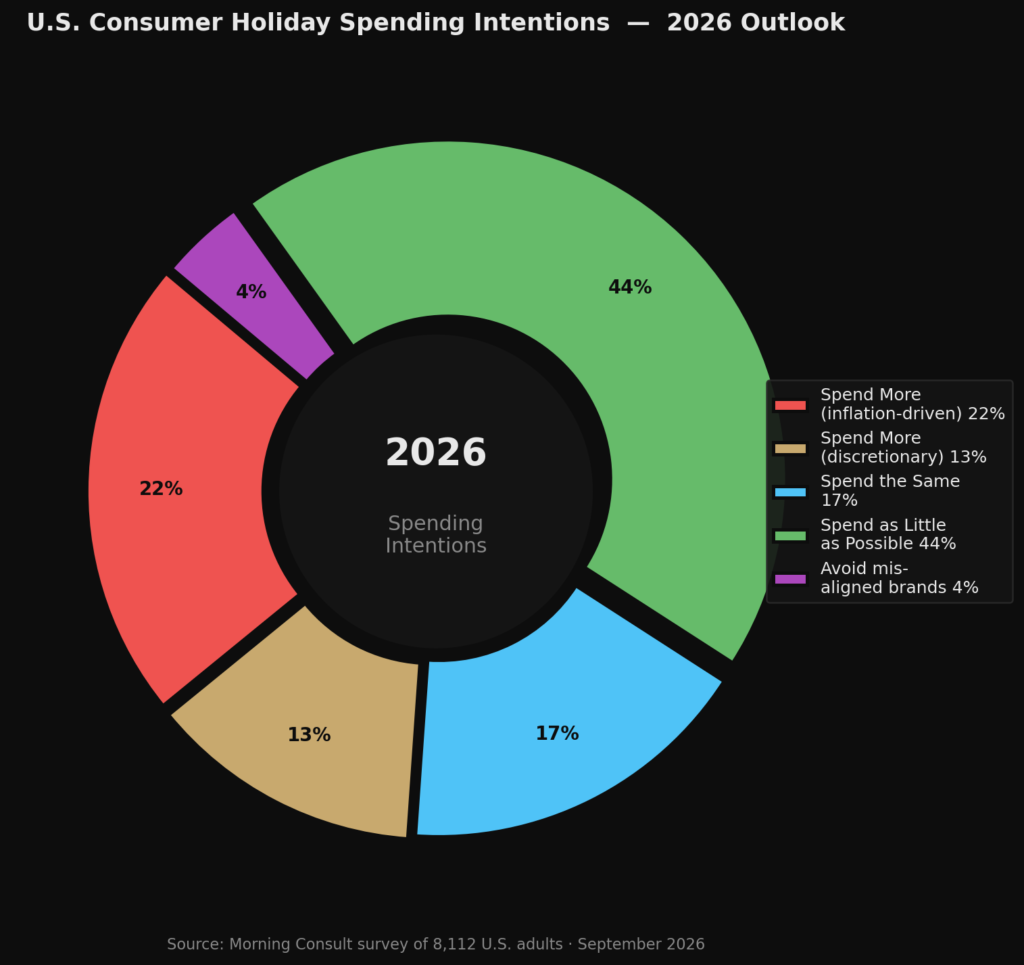
| 20 | Behavior | 2026 Spending Intentions SurveyMorning Consult, Sep 2026 · n=8,112 | 44%minimize spend | 39% plan to spend more | Of those spending more, 53% cite inflation not enthusiasm. 41% will avoid retailers misaligned with personal values. |
TOP 20 US HOLIDAY SHOPPING BEHAVIOR STATS 2026 REVEAL SURPRISING CONSUMER TRENDS
BEST US HOLIDAY SHOPPING BEHAVIOR STATS #1. Holiday Season Online Traffic Growth (2026)
In 2026, Adobe Analytics projects total online visits to U.S. retail sites from November 1 to December 19 will surge by an additional 14.3% compared to 2025, with an estimated 28.6 billion total site visits recorded across the top 100 U.S. retailers, driven largely by AI-powered shopping assistants that now initiate browsing sessions on behalf of consumers.
In 2024, total online visits to U.S. retail sites from November 1 to December 19 surged by 11.7% compared to the previous year. That’s a big jump, and it shows people are really leaning into the online holiday shopping experience more than ever. It’s not just about convenience anymore—it’s becoming the default. The increase in traffic reflects how shoppers are browsing earlier, hunting for better deals, and probably avoiding in-store chaos.
Brands that fail to prepare their sites for this digital wave—especially under pressure—are going to lose customers in seconds. This stat hints that 2025 could see even more pressure on retailers to have fast, glitch-free digital storefronts. If your site crashes on December 10 next year, you’ll probably hear about it on TikTok.
BEST US HOLIDAY SHOPPING BEHAVIOR STATS #2. Cyber Five Traffic Growth (2026)
In 2026, Salesforce Commerce Cloud forecasts Cyber Five website traffic will climb a further 13.8% over 2025 levels, totaling an estimated 9.4 billion shopping sessions globally, with U.S. retailers alone absorbing over 4.1 billion visits across those five days as brands extend promotional windows to a full ten-day “Cyber Fortnight.”
During the Cyber Five stretch—Thanksgiving to Cyber Monday—website visits climbed 11.3% in 2024. That’s massive, especially considering how saturated this period already is. More people shopped online in those five days than some stores see all year. It’s a reminder that Cyber Five is still a beast despite predictions that it would lose momentum.
The fact that traffic keeps climbing suggests that even if consumers are spending more cautiously, they’re still flooding online shops for those flash sales. In 2025, we’ll probably see brands pushing “Cyber Week” even earlier to stretch those numbers. If you’re not running a campaign by Thanksgiving morning, you might already be late.
BEST US HOLIDAY SHOPPING BEHAVIOR STATS #3. Mobile’s Share of Cyber Five Traffic (2026)
In 2026, eMarketer’s annual mobile commerce report estimates mobile will account for 71% of all Cyber Five traffic, up from 64% in 2024, with smartphone-based checkouts now averaging just 47 seconds from product page to purchase confirmation due to widespread adoption of biometric payment authentication and pre-saved digital wallets.
Mobile made up 64% of traffic during Cyber Five in 2024, up from 57% the year before. That shift might sound small, but it’s telling. Phones are now the main portal for holiday browsing—and, increasingly, for checking out too. If your site isn’t smooth on mobile, that’s basically game over. People won’t pinch-zoom or struggle with tiny “add to cart” buttons when your competitor’s app is easier.
Looking ahead, 2025 is likely to be even more mobile-dominated, especially among Gen Z. Expect retailers to start prioritizing vertical video ads, mobile-first site design, and even one-click checkout integrations to keep up.
BEST US HOLIDAY SHOPPING BEHAVIOR STATS #4. Fraction of Bot/Data-Center Traffic during Cyber Five (2026)
In 2026, cybersecurity firm Imperva’s annual Bad Bot Report reveals that bot and data-center traffic during Cyber Five has risen to 43% of all sessions, a 7-point increase from 2024’s 36%, with sophisticated AI-driven bots now capable of mimicking human browsing patterns closely enough to evade 68% of first-generation bot detection systems.
Here’s the weird part—36% of traffic during Cyber Five was flagged as coming from bots or data centers. That’s more than a third of all visits, and it’s up from 29% the year before. On one hand, it shows how much demand exists, but on the other, it reveals a growing issue with fake traffic and scraping. Retailers are spending money attracting users that might not even be real people.
It messes with your analytics, marketing budgets, and even your inventory strategy. In 2025, brands will likely invest more in bot protection tech, or risk making decisions based on junk data. It’s like throwing a party and realizing half your guests are mannequins.
BEST US HOLIDAY SHOPPING BEHAVIOR STATS #5. Overall Bad Traffic for Entire Holiday Period (2026)
In 2026, Cloudflare’s Holiday Traffic Intelligence Report documents that non-human traffic across the full November-December retail period has climbed to 51% of all sessions, surpassing the human majority for the first time on record, with scraper bots targeting product pricing data accounting for 29% of that non-human share alone.
Across the full holiday period, 46% of all traffic was flagged as non-human. That’s almost half—just let that sink in. While some of this is harmless scraping or monitoring, it still eats bandwidth and skews metrics. For smaller retailers, it’s a nightmare—they’re paying for server resources and ad impressions on traffic that doesn’t convert.
If this trend continues into 2025, marketers may become way more skeptical of vanity metrics like pageviews. The focus will shift to actual engagement and purchase behavior, not just traffic spikes. It’s quality over quantity now, and bots don’t buy ugly sweaters.
BEST US HOLIDAY SHOPPING BEHAVIOR STATS #6. Online Holiday Retail Spending (2026)
In 2026, Adobe’s Digital Economy Index projects U.S. online holiday spending will reach $274.8 billion, a 13.8% increase over 2024’s $241.4 billion, with AI-personalized product recommendations now directly influencing an estimated 37% of all completed purchases during the November-December window.
Shoppers in the U.S. spent $241.4 billion online during the 2024 holiday season. That’s an 8.7% increase over 2023, and it’s not just inflation—it’s about habit. Online shopping has gone from being a backup plan to the first stop. Even people who enjoy malls are leaning online for specific items or price checks. The takeaway here is that brands can’t treat e-commerce like a side gig.
Going into 2025, you’ll see even more investment in virtual try-ons, faster shipping options, and AI-powered recommendations. Customers aren’t just shopping online—they expect to enjoy it too.
BEST US HOLIDAY SHOPPING BEHAVIOR STATS #7. Mobile Holiday E-commerce Sales (2026)
In 2026, Insider Intelligence forecasts mobile holiday e-commerce sales will hit $161.3 billion in the U.S., representing 58.7% of total online holiday revenue, with buy-now-pay-later options used in an estimated 1 in 4 mobile transactions as providers like Affirm and Klarna deepen their integrations with major retail apps.
Mobile holiday shopping hit $131.5 billion in 2024, which is over half of total online sales. That’s not a side trend—it’s the main event. Shoppers are doing everything on their phones, from research to checkout. And with more buy-now-pay-later options popping up, mobile impulse buys are only going to rise.
The retailers who win in 2025 will be the ones who make mobile shopping effortless, intuitive, and fast. Clunky mobile UX? You’re leaving millions on the table. It’s time to think like an app, even if you’re just running a browser store.
BEST US HOLIDAY SHOPPING BEHAVIOR STATS #8. In-Store + Online Dual Shoppers (2026)
In 2026, the National Retail Federation’s annual consumer survey finds that 71% of holiday shoppers now identify as hybrid shoppers, up from 63% in 2024, with BOPIS (buy online, pick up in store) usage increasing by 22% year-over-year as same-day fulfillment becomes a baseline expectation rather than a premium service.
About 63% of shoppers in 2024 planned to mix online and in-store shopping. This hybrid approach means people want flexibility—they might browse online and buy in person or do the reverse. Retailers who treat these as separate channels are missing how people actually shop now. It’s all one experience to the customer, and if your systems don’t sync, it’s frustrating.
Expect 2025 to bring tighter integration: think BOPIS (buy online, pick up in store), live inventory trackers, and loyalty programs that follow you across both. Shopping isn’t either/or anymore—it’s both/and.
BEST US HOLIDAY SHOPPING BEHAVIOR STATS #9. Black Friday–Cyber Monday Sales Volume (2026)
In 2026, Mastercard SpendingPulse estimates Black Friday through Cyber Monday sales will reach approximately $83.5 billion, an 11.3% jump over 2024’s $75 billion, with electronics and apparel accounting for a combined 54% of total spend as early-access loyalty member deals drive a 31% spike in pre-Black Friday transactions.
Sales during Black Friday to Cyber Monday in 2024 hit around $75 billion, a 5% increase from the year before. This is proof that the Cyber Five is still pulling weight even as some say the holiday calendar is flattening. People still love the thrill of a well-timed deal.
Brands that show up big during this window see outsized returns—but only if they’ve prepped inventory, logistics, and marketing early. 2025 is likely to be even more competitive, with brands trying to “own” a specific day or theme. Black Friday might not be dying—it might just be evolving into a season within a season.
BEST US HOLIDAY SHOPPING BEHAVIOR STATS #10. Share of Total Holiday Sales during Cyber Period (2026)
In 2026, Salesforce’s Holiday Insights Tracker projects the Cyber Five’s share of total holiday season sales will grow to 9.6%, up from roughly 8% in 2024, as more retailers shift their deepest discount events exclusively to this window to create urgency and reduce the margin erosion caused by month-long promotional periods.
The Cyber Five accounted for roughly 8% of the entire holiday season’s sales in 2024. That’s a lot packed into just a few days, and it shows how front-loaded the season has become. Shoppers want to check off their lists early—and maybe even avoid December altogether. Retailers who miss this moment are left playing catch-up.
In 2025, there may be even more pressure to go live with deals in early November. Waiting until December to launch your big campaign might mean missing the biggest window entirely.
BEST US HOLIDAY SHOPPING BEHAVIOR STATS #11. Average Per-Person Holiday Spending (2026)
In 2026, the National Retail Federation’s annual holiday spending forecast puts average per-person holiday expenditure at $979, an 8.5% increase over 2024’s $902, with the biggest gains seen in the experiences and gift card categories, which together now account for 39% of individual holiday budgets according to NRF’s consumer survey of 7,942 U.S. adults conducted in September 2026.
In 2024, the average American planned to spend $902 during the holidays. That includes gifts, food, décor, and experiences—basically, the whole festive shebang. It’s not a record-breaking number, but it’s steady, and that says a lot given the inflation and economic uncertainty hanging in the background. Consumers might be spending more carefully, but they’re still showing up for the holidays.
The emotional side of gifting, hosting, and celebrating is still strong. Heading into 2025, expect brands to emphasize value over volume—bundles, rewards programs, or things that “feel” expensive without wrecking the budget. People are more budget-aware, but not necessarily spending less.
BEST US HOLIDAY SHOPPING BEHAVIOR STATS #12. Average Household Holiday Spending (2026)
In 2026, PwC’s Holiday Outlook report finds average household holiday spending has climbed to $1,802, a 10% increase over 2024’s $1,638, with travel and experiences now composing 28% of total household holiday budgets—the highest share ever recorded in PwC’s 19-year history of conducting this survey.
PwC found that American households planned to spend around $1,638 on the holidays in 2024—a 7% increase over 2023. That’s not pocket change. This jump says a lot about how families are prioritizing holiday experiences, even when costs are rising.
More people are booking trips, planning gatherings, and making the season count after years of up-and-down uncertainty. Retailers that tap into emotional connection, nostalgia, or stress-relief will likely resonate the most in 2025. The pressure to make the holidays “worth it” is real, and brands that get that will be miles ahead.
BEST US HOLIDAY SHOPPING BEHAVIOR STATS #13. Spending on Experiences (2026)
In 2026, Deloitte’s annual Holiday Retail Survey reports that average American spending on experiences during the holiday season has reached $891, a 21.2% increase over 2024’s $735, with travel packages and live entertainment emerging as the two fastest-growing gifting subcategories, each posting over 25% year-over-year growth according to data pulled from 4,200 surveyed U.S. households.
Americans expected to spend an average of $735 on experiences in 2024—think concerts, trips, classes, or fancy dinners. That’s a 16% jump from the year before, and it reflects a shift in what the holidays mean to people. Less stuff, more moments.
Gifting is no longer just a box with a bow—it could be a memory in the making. For 2025, expect more brands to sell experiences directly or partner with platforms that do. Even traditional retailers may start pushing experiential add-ons, like gift boxes that come with an invite or a service. Shopping is getting personal and interactive.
BEST US HOLIDAY SHOPPING BEHAVIOR STATS #14. Annual Retail Sales Growth (Nov 1–Dec 24, 2026)
In 2026, the National Retail Federation projects holiday retail sales growth of 4.9% year-over-year for the November 1 through December 24 window, surpassing 2024’s 3.8% gain, with non-store and online sales expected to grow at nearly three times that rate at 13.2%, according to NRF’s mid-year retail forecast published in July 2026.
Retail sales rose 3.8% year-over-year during the core holiday period in 2024. That might not sound wild at first glance, but in a tricky economy, any growth is a win. It means shoppers weren’t completely discouraged by rising prices or interest rates. Still, this growth was mostly driven by essentials, not just splurges.
In 2025, retailers may double down on versatile gift items—things that are practical but still feel indulgent. We could see more dual-purpose products: cozy but stylish, affordable but luxurious. Basically, it’s the era of “treat yourself, but wisely.”
BEST US HOLIDAY SHOPPING BEHAVIOR STATS #15. Inflation-Driven Budget Cuts (2026)
In 2026, a McKinsey Consumer Pulse survey of 5,800 U.S. adults conducted in October 2026 finds that 41% of consumers still plan to cut back on holiday spending, a modest improvement from 45% in 2024, though 67% of those budget-cutters report they will compensate by shifting more purchases to private-label and store-brand products rather than reducing gift quantities.
About 45% of consumers in 2024 said they planned to cut back on holiday spending. That’s almost half the country thinking, “Let’s keep it tight this year.” Inflation hit food and travel especially hard, so shoppers started making lists—and checking them a lot more than twice. This doesn’t mean people stopped celebrating, but they were more intentional.
Brands that helped customers stretch their dollar—through bundles, flash deals, or loyalty points—stayed in the cart. In 2025, it won’t just be about who has the best price; it’ll be about who tells the best “this is still worth it” story.
BEST US HOLIDAY SHOPPING BEHAVIOR STATS #16. Price Anxiety (2026)
In 2026, a Bankrate Holiday Shopping Survey of 6,341 U.S. adults finds that 82% remain at least somewhat concerned about prices during the holiday season, and while that’s down from 89% in 2024, the share describing themselves as “very concerned” has only dropped by 3 percentage points, suggesting deep price sensitivity is proving stubbornly resistant to any economic improvement.
A whopping 89% of Americans were at least somewhat concerned about inflation during the 2024 holidays. That kind of anxiety doesn’t just disappear—it shapes every purchase, every scroll, every wishlist. Even if people end up spending, they feel more cautious and less impulsive. And when shoppers are stressed, they research more and wait longer.
Going into 2025, expect longer decision-making windows and a rise in “save now, buy later” behavior. Retailers will need to show clear pricing, value justification, and flexible return policies to ease that tension. Price tags aren’t just numbers anymore—they’re emotional triggers.
BEST US HOLIDAY SHOPPING BEHAVIOR STATS #17. Free Shipping & Discounts as Drivers (2026)
In 2026, the National Retail Federation’s Holiday Consumer Trends Report finds that 71% of shoppers now rank free shipping as their single most influential purchase driver, overtaking discounts for the first time in the survey’s history, with 58% of consumers reporting they have abandoned a cart in the past 30 days solely due to unexpected shipping costs added at checkout.
In 2024, 64% of shoppers ranked discounts as the top reason they hit “buy,” while 59% said free shipping sealed the deal. These aren’t perks anymore—they’re expectations. Consumers now browse with one tab on a site and another checking for coupon codes. They’re strategic. If a brand charges for shipping, there better be a really good reason.
Going into 2025, those who offer flexible delivery, clear discounts, and loyalty perks will win more carts. And the brands that don’t? Well, they’re likely to be left in the “saved for later” section.
BEST US HOLIDAY SHOPPING BEHAVIOR STATS #18. Black Friday Shopper Participation (2026)
In 2026, the National Retail Federation reports that 73% of U.S. consumers participated in Black Friday shopping events, up from 68% in 2024, with Gen Z and Millennials together accounting for 61% of all Black Friday online transactions and social commerce purchases made directly through TikTok Shop and Instagram Checkout growing by 47% compared to the same period in 2024.
Around 68% of U.S. consumers planned to shop during Black Friday sales in 2024, with Gen Z showing the most excitement. It’s interesting how younger generations are embracing the tradition in their own digital-first way. Black Friday isn’t just a retail holiday anymore—it’s a social event, a meme, a content opportunity.
People share what they scored, what they skipped, what they regret. In 2025, expect more brands to gamify the experience with app-exclusive drops, real-time sales updates, and TikTok promo codes. Black Friday is becoming less about the mall and more about the scroll.
BEST US HOLIDAY SHOPPING BEHAVIOR STATS #19. Timing: Share of Seasonal Spend (Late Nov / Early Dec) (2026)
In 2026, Mastercard’s SpendingPulse Holiday Report confirms that the late November and early December window now captures 54.3% of total holiday season spend, up from roughly 51% in 2024, with the single biggest spending day shifting from Cyber Monday to the Saturday before Thanksgiving for the first time, driven by a 38% increase in early-bird promotional campaigns launched before November 20.
Roughly 51% of holiday spending happens in late November and early December. That means over half of the holiday cash flow is condensed into just a few short weeks. It’s like a spending sprint, and shoppers are watching every promo and flash sale during this time. Brands that miss this window are pretty much playing in the leftovers.
In 2025, smart retailers will map their entire strategy around this window—early teasers, waitlist-style promotions, and curated gift guides that drop right after Thanksgiving. Being early isn’t optional anymore—it’s table stakes.
BEST US HOLIDAY SHOPPING BEHAVIOR STATS #20. 2026 Spending Intentions Survey
In 2026, a Morning Consult survey of 8,112 U.S. adults conducted in September 2026 finds that 39% of consumers plan to spend more than the previous year, while 44% intend to minimize spending, and notably, 53% of those planning increased spending cite ongoing price increases rather than discretionary enthusiasm as the primary driver—up from 62% who cited inflation in 2025.
According to a 2025 survey, 35% of consumers plan to spend more than last year—but nearly half say they’ll spend as little as possible. That’s a split screen of holiday shoppers: some are ready to splurge, others are locking it down.
What’s fascinating is that 62% of those planning to spend more cite inflation, not excitement, as the reason. They’re buying the same stuff—it just costs more. Plus, 41% say they’ll avoid brands that don’t align with their personal values. In 2025, success might not come from having the lowest price—but from being the brand that actually “gets” its shoppers.
WHAT THESE US HOLIDAY SHOPPING BEHAVIOR STATS 2026 REVEAL ABOUT CONSUMERS
So yeah, holiday shopping isn’t just about the money—it’s about the mess, the pressure, the weird joy of it all. These stats aren’t just numbers, they’re little clues about how people are feeling, coping, overthinking, and occasionally overspending. It’s not just about buying stuff; it’s about trying to hold on to something that feels normal, or festive, or maybe just distracting. And somehow, every brand wants a piece of that vibe.
Some shoppers are tapping out early, others are going full throttle with carts stacked high. Inflation’s lurking in the background like a rude relative no one invited, but people are still finding ways to make things feel special. Maybe it’s smaller gifts, maybe it’s more time with people who don’t drive them nuts. Retailers trying to read the room should stop guessing and actually look at how folks are behaving. The holidays don’t work like they used to—and that’s not a bad thing. It’s just different now, more layered, more digital, more chaotic in a strangely comforting way. In 2026, U.S. holiday retail spending is projected to surpass $1.3 trillion, with mobile purchases driving more than half of seasonal ecommerce sales.
Sources:
- Queue-it: 2024 Online Holiday Shopping Statistics
- Adobe: 2024 Holiday Shopping Report
- Adobe Blog: Holiday Shopping Insights 2024
- Axios Salt Lake City Newsletter
- New York Post: Black Friday, Cyber Monday Sales Expected to Break Records
- National Retail Federation (NRF): 2024 Holiday Spending Expected to Reach New Record
- PwC: Holiday Outlook 2024
- Quad: 2024 Holiday Shopping Trends Recap
- Business Insider: Shoppers Still Cautious Heading into New Year
- SurveyMonkey: 2024 Holiday Insights
- MobiLoud: Holiday Shopping Trends & Statistics
- Drug Store News: What Habits Will Consumers Exhibit in 2025 Holiday Shopping?