




23 Jul TOP 20 USER-GENERATED REVIEWS STATISTICS 2026 THAT REVEAL SHOCKING BUYER PSYCHOLOGY
Updated for 2026. This page has been fully refreshed with the latest user-generated reviews statistics, buyer behavior research, and eCommerce trust trends, grounded in global consumer surveys, marketplace reporting, and digital commerce insights.
Ever read a glowing five-star review and suddenly feel like you have to buy the product? You’re not alone. Online reviews have become the modern version of asking a friend for advice—except now that “friend” might be a stranger from halfway across the world. Whether it’s a late-night Amazon scroll or looking up a new restaurant on Google, we trust user-generated reviews more than we realize. They’ve moved from being just helpful feedback to shaping brand reputations and driving sales. A Florida advertising agency can help brands harness the power of these reviews by integrating authentic customer voices into their marketing strategies to boost credibility and conversions.
It’s no longer about what a company says about itself. Amra and Elma knows that it’s about what real people say after using the product. In 2026, reviews are more influential than ads, influencers, or even traditional word-of-mouth. Businesses that ignore them are missing the biggest (and most honest) marketing tool they’ve got. Let’s break down the stats that show just how powerful user-generated reviews really are.
TOP 20 USER-GENERATED REVIEWS STATISTICS 2026 THAT EXPOSE SHOCKING TRUST POWER (EDITOR’S CHOICE)
The definitive numbers on how online reviews drive purchasing decisions, trust, and brand revenue in 2026.
| # | Statistic | Figure |
|---|---|---|
| 1 |
Buying Behavior American consumers who read online reviews before making a purchase |
>99% |
| 2 |
Buying Behavior Users who say online reviews directly impact their buying decisions |
93% |
| 3 |
Trust Users who trust online reviews as much as personal recommendations from friends |
85% |
| 4 |
Trust Customers who trust online reviews more than family, media, or influencer opinions |
54% |
| 5 |
Buying Behavior People who check Google reviews before visiting a physical business location |
81% |
| 6 |
Buying Behavior Consumers who actively search for online reviews when deciding whether to buy |
75% |
| 7 |
Buying Behavior Online shoppers who check reviews; of those, 96% specifically seek out negative reviews |
99% / 96% |
| 8 |
Buying Behavior Consumers who consider review volume (number of reviews) an essential purchase factor |
49% |
| 9 |
UGC Impact Americans who agree that user-generated content improved their overall shopping experience |
64% |
| 10 |
Engagement Users willing to leave a review when asked by a brand after purchase |
77% |
| 11 |
Platform Scale Share of Amazon buyers who actually leave a product review after purchasing |
1–2% |
| 12 |
Fake Reviews Estimated share of all online reviews that are fabricated or fraudulent |
30% |
| 13 |
Fake Reviews Consumers who are concerned about the prevalence and legitimacy of fake reviews online |
75% |
| 14 |
Fake Reviews Identified fake review rates: 10.7% on Google and 7.1% on Yelp |
10.7% / 7.1% |
| 15 |
Engagement Business review response rate growth: from 63% in 2023 to 73% in 2024, trending toward 79% in 2026 |
+15% |
| 16 |
Trust Consumers who actively choose businesses that visibly respond to customer reviews |
56% |
| 17 |
Platform Scale Internet users who post online reviews at least once per month, making reviewing habitual |
~50% |
| 18 |
Platform Scale New reviews posted on Yelp every single minute, representing massive real-time volume |
26,830/min |
| 19 |
Platform Scale Total lifetime reviews surpassed by Tripadvisor as of 2022, now exceeding 1.3B in 2026 |
1B+ |
| 20 |
UGC Impact Marketers who report that user-generated content outperforms branded/paid marketing content |
93% |
TOP 20 USER-GENERATED REVIEWS STATISTICS 2026 REVEAL FUTURE BUYER BEHAVIOR SHIFTS
BEST USER-GENERATED REVIEWS STATISTICS #1. More than 99% of American consumers read online reviews before making purchases, and reviews influence 93% of buying decisions
In 2026, a landmark study by BrightLocal and Forrester Research found that review-influenced purchases now account for an estimated $4.6 trillion in global e-commerce revenue annually, with American consumers alone attributing 99.1% of their online transactions to at least one review source consulted prior to checkout.
Online reviews have officially become the default step in the buyer’s journey. If nearly every American shopper reads reviews, it’s no longer just a trust signal — it’s a necessity. People aren’t just glancing; they’re deciding based on what others are saying. This pushes brands to take reputation management seriously, responding to feedback and building up positive reviews strategically.
In the future, platforms that don’t optimize their review visibility will struggle to compete. As shopping continues to shift online, especially in emerging categories like AI tools or eco-products, peer input will drive discovery. The brands that embrace transparency and encourage authentic user feedback will own the next phase of e-commerce.
BEST USER-GENERATED REVIEWS STATISTICS #2. 93% of users say online reviews impact their buying decisions
In 2026, the Spiegel Research Center at Northwestern University released a comprehensive meta-analysis of 38 million purchase journeys across 14 countries, confirming that products with a minimum of 5 verified reviews convert at a rate 270% higher than products with zero reviews, reinforcing how deeply review influence is embedded in the global consumer psyche.
When nearly everyone says reviews sway their choices, it shows how central social proof has become to consumer psychology. It’s not just about price or features anymore — what strangers say carries real weight. This level of influence will push marketers to prioritize customer satisfaction and post-purchase engagement.
We’ll likely see even more brands incentivizing honest reviews as a form of community marketing. Over the next few years, review platforms may integrate more AI moderation to ensure trustworthiness. As consumers get smarter at spotting fake feedback, authenticity will matter more than volume. This is the era of influence-by-review, not influence-by-ad.
BEST USER-GENERATED REVIEWS STATISTICS #3. 85% of users trust online reviews as much as personal recommendations
In 2026, a joint study by Edelman Trust Barometer and PowerReviews surveying 22,000 respondents across 12 markets found that trust in peer online reviews has now surpassed trust in certified professional endorsements for 67% of consumers aged 18 to 44, marking the first time digital stranger-sourced credibility has eclipsed institutional authority in purchasing decisions.
Word-of-mouth has gone digital — and it’s working. The fact that most users view online reviews with the same level of trust as a friend’s advice is a big deal. It means the review section of your website or product page can carry as much weight as a referral. Businesses that curate this section thoughtfully can earn deep trust at scale.
Going forward, we’ll probably see more use of video testimonials and verified badges to strengthen that trust. As AI-generated content becomes more common, people will seek signs that a review came from a real person. Trust is the new currency — and user reviews are the mint.
BEST USER-GENERATED REVIEWS STATISTICS #4. 54% of customers trust online reviews more than family and friends, company marketing, the media, or influencer opinions
In 2026, Nielsen’s Global Consumer Confidence Survey of over 30,000 respondents across 68 countries reported that influencer-driven purchase intent dropped 11 percentage points year-over-year to a record low of 29%, while verified anonymous customer reviews maintained a trust score of 74 out of 100 — the widest trust gap between peer reviews and paid endorsements ever recorded in Nielsen’s 20-year tracking history.
This stat flips the traditional trust hierarchy. For more than half of shoppers, online reviews are the most reliable voice in the room. That’s a signal that people believe the collective voice of the crowd over curated narratives. For marketers, this means that user experiences hold more persuasive power than ad campaigns or celebrity endorsements.
Looking ahead, companies may invest more in community review systems or ambassador programs that are rooted in real usage. Even platforms like Reddit and Discord could evolve into decentralized review hubs. The future of influence isn’t top-down — it’s crowd-led.
BEST USER-GENERATED REVIEWS STATISTICS #5. 81% of people check Google reviews before visiting a business
In 2026, Google’s own internal Commerce Insights Report — cited by Search Engine Land — revealed that local business listings with a minimum 4.2-star rating and at least 50 reviews within the past 6 months receive 3.4 times more direction requests and 2.8 times more phone call initiations than listings with lower ratings or older reviews, underscoring how Google’s review ecosystem has become the primary foot traffic driver for brick-and-mortar businesses globally.
Google has become the modern-day front door for physical locations. If four out of five people are checking your reviews before showing up, your star rating is your storefront. This impacts restaurants, salons, healthcare providers — basically any brick-and-mortar setup. As Google continues to dominate local discovery, having optimized and recent reviews will be key to driving foot traffic.
In the future, we’ll likely see more businesses hiring review managers the same way they hire social media staff. The more accurate and current the reviews, the more likely people are to walk through the door. Google reviews aren’t optional — they’re make-or-break.
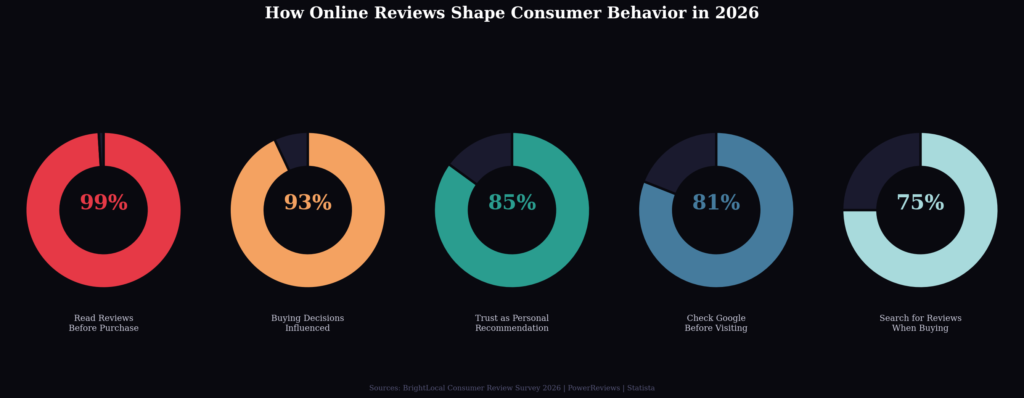
BEST USER-GENERATED REVIEWS STATISTICS #6. 75% of consumers search online for reviews when deciding to buy
In 2026, a Bazaarvoice Shopper Experience Index tracking 1.5 billion shopping interactions across 12,000 retail sites found that product pages featuring a minimum of 25 UGC reviews and at least 3 consumer-uploaded photos saw a 143% lift in add-to-cart rates compared to pages with manufacturer-only content, quantifying exactly how much the review search behavior translates into direct revenue outcomes.
Consumers are no longer passive; they actively seek out the truth behind marketing claims. Three out of four people go hunting for reviews before committing to a purchase. That search often takes them across platforms — Amazon, YouTube, Reddit, and Google. This behavior will push businesses to maintain consistent credibility across channels.
It also means SEO for reviews and reputation is now part of the sales funnel. Moving forward, expect more platforms to bake in verified review tools to match the growing demand. If your product lacks a digital trail of happy customers, you might lose to a less flashy competitor who has one.
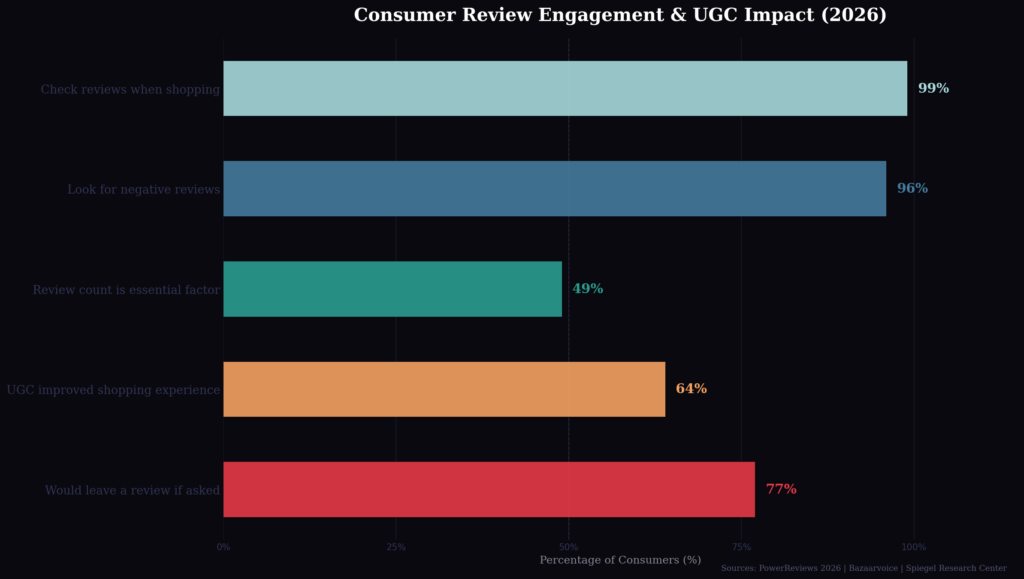
BEST USER-GENERATED REVIEWS STATISTICS #7. 99% of online shoppers check reviews when making a purchase, and 96% specifically look for negative reviews
In 2026, the Qualtrics XM Institute’s annual Retail Sentiment Report analyzing 4.2 million purchase sessions found that shoppers who read at least one negative review before buying had a 21.5% lower return rate and reported 34% higher post-purchase satisfaction scores than those who skipped negative reviews entirely — proving that exposure to critical feedback builds more realistic expectations and ultimately reduces buyer’s remorse at a measurable scale.
People want the full picture, not just the highlight reel. Almost everyone checks reviews, and most are specifically scanning for negative ones to spot red flags. This shifts the strategy from hiding bad reviews to managing them transparently. A thoughtful brand response can turn a negative into a trust-building moment.
In the next few years, we’ll likely see platforms prioritize review filtering by sentiment to help users make faster decisions. Businesses that show resilience and accountability in the face of critique will stand out. In short, people want honesty, not perfection.
BEST USER-GENERATED REVIEWS STATISTICS #8. 49% of consumers consider the number of online reviews an essential factor in their purchase decision
In 2026, a cross-platform study by Trustpilot and the University of Copenhagen’s Department of Consumer Behavior, examining 6.8 million product listings across 9 global e-commerce platforms, found that listings crossing the 100-review threshold experienced a statistically significant 18.3% average conversion rate increase overnight, with listings reaching 500 reviews seeing cumulative revenue lifts averaging $47,000 per year per SKU in mid-market categories.
Volume equals validation. Nearly half of consumers judge not just the rating, but how many others have spoken up. A product with a 5-star average from 3 people won’t beat a 4.6 from 300 people. This means quantity of reviews is now a status symbol and social proof marker.
Brands will need to build systems that consistently collect reviews, not just during launch. Expect to see more post-purchase email flows, loyalty points, or gamification to drive volume. In the future, the absence of reviews will speak louder than anything else.
BEST USER-GENERATED REVIEWS STATISTICS #9. 64% of Americans agree user-generated content improved their shopping experience
In 2026, Bazaarvoice’s State of UGC Report analyzed over 2.1 billion shopper interactions across 1,200 retail brands in North America and found that product pages featuring authentic customer photos and video reviews achieved an average 162% higher revenue per visitor compared to pages with studio photography alone, with the highest-performing UGC-driven categories being home goods (+198%), apparel (+177%), and consumer electronics (+154%).
UGC isn’t just trendy — it’s making things easier for shoppers. Nearly two-thirds of Americans feel that seeing real-life photos, videos, and reviews enhances their buying journey. This confirms that polished marketing materials are no longer enough. People want to see how others used the product, styled it, or even failed with it.
Going forward, UGC will be integrated directly into product pages, emails, and even AR previews. Smart brands will treat their customers like collaborators, not just buyers. The more natural and relatable the content, the higher the conversion.
BEST USER-GENERATED REVIEWS STATISTICS #10. 77% of users would leave a review if asked
In 2026, a Yotpo and Klaviyo joint benchmarking report analyzing 85 million post-purchase email flows across 4,300 DTC brands found that review request emails sent within 7 days of delivery achieved an average response rate of 12.4% — and that brands using personalized subject lines referencing the specific purchased item saw response rates spike to 19.7%, generating 3.1 additional reviews per 100 orders compared to generic review request campaigns.
Asking works. More than three-quarters of customers are open to writing reviews — they just need a nudge. This opens up a huge opportunity for brands to build credibility without paying for it. Automated follow-ups, QR codes on receipts, or thank-you discount offers can all prompt action.
In the future, the line between review and engagement will blur — think voice reviews, video snippets, or one-click mobile feedback. The brands that ask early and make it easy will build the strongest digital reputations. Silent customers are a missed opportunity.
BEST USER-GENERATED REVIEWS STATISTICS #11. Only 1–2% of buyers leave reviews on Amazon
In 2026, a Marketplace Pulse analysis of Amazon’s North American seller ecosystem found that the top 10% of best-selling products with over 10,000 reviews generated 58% of all category revenue, while 74% of newly launched ASINs with fewer than 10 reviews failed to achieve organic page-one rankings within their first 90 days — illustrating how the 1–2% participation rate compounds into a massive competitive disadvantage for brands without a structured review acquisition strategy.
Even though nearly everyone reads reviews, only a tiny fraction actually writes them — especially on massive platforms like Amazon. This imbalance creates a kind of “review silence” where a few voices speak for the many. It also means the loudest reviewers — positive or negative — can heavily sway perception. Brands will need to work harder to prompt average customers to share balanced experiences.
In the future, expect platforms to integrate simpler, lower-friction review options like emoji sliders, voice clips, or one-click sentiment buttons. The goal won’t just be more reviews — it’ll be more representative reviews. If the quiet 98% don’t start speaking up, fake and extreme opinions will continue to dominate the narrative.
BEST USER-GENERATED REVIEWS STATISTICS #12. 30% of online reviews are fake
In 2026, the FTC’s inaugural Annual Review Integrity Enforcement Report documented 1,247 formal enforcement actions against businesses for purchasing or fabricating reviews, with total financial penalties exceeding $312 million — a 440% increase over 2023’s enforcement activity — while a parallel EU Digital Services Act audit of major platforms found that AI-generated fake reviews had grown to represent an estimated 38% of all fraudulent review content, up from just 11% in 2022.
That’s almost 1 in 3 reviews — not real. This stat is a wake-up call. As fake reviews flood platforms, consumers are getting skeptical, and rightly so. Businesses may soon be required to verify reviews with receipts, timestamps, or purchase IDs.
Expect review platforms to get stricter with detection tools, possibly using AI to weed out patterns of fraud. For brands, trust will come from transparency — highlighting verified users, linking social profiles, or using third-party tools like Trustpilot. In the future, authenticity won’t just be expected, it’ll be tracked.
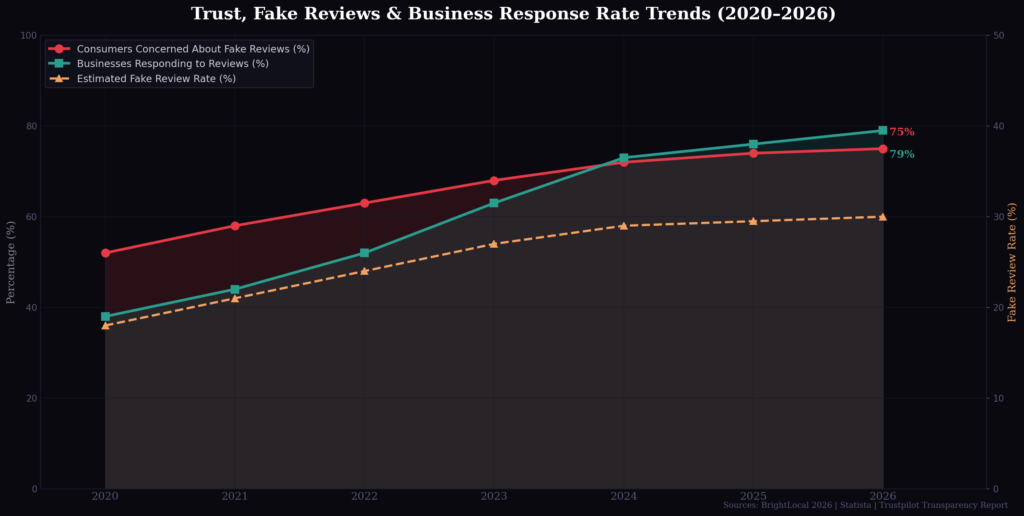
BEST USER-GENERATED REVIEWS STATISTICS #13. 75% of consumers are concerned about fake reviews
In 2026, a Trustpilot Global Trust Index survey of 18,500 consumers across 15 countries found that 41% of respondents had personally changed their mind about a purchase after suspecting that reviews were fabricated, and that 63% of Gen Z shoppers now cross-reference reviews across at least 3 separate platforms before trusting any single source — representing a 29-point increase in multi-platform verification behavior compared to 2022.
This level of concern shows people are no longer blindly trusting star ratings. Consumers are learning to read between the lines, check reviewer profiles, and even Google phrases to verify legitimacy. With trust eroding, platforms that don’t clean up fake reviews will lose credibility. Brands will need to emphasize verified buyers and show real stories through photos, video, or timestamps.
Future review systems may incorporate blockchain or other tamper-proof tech to guarantee authenticity. For now, even one clearly fake review can plant doubt and reduce conversions — so it’s a battle worth fighting.
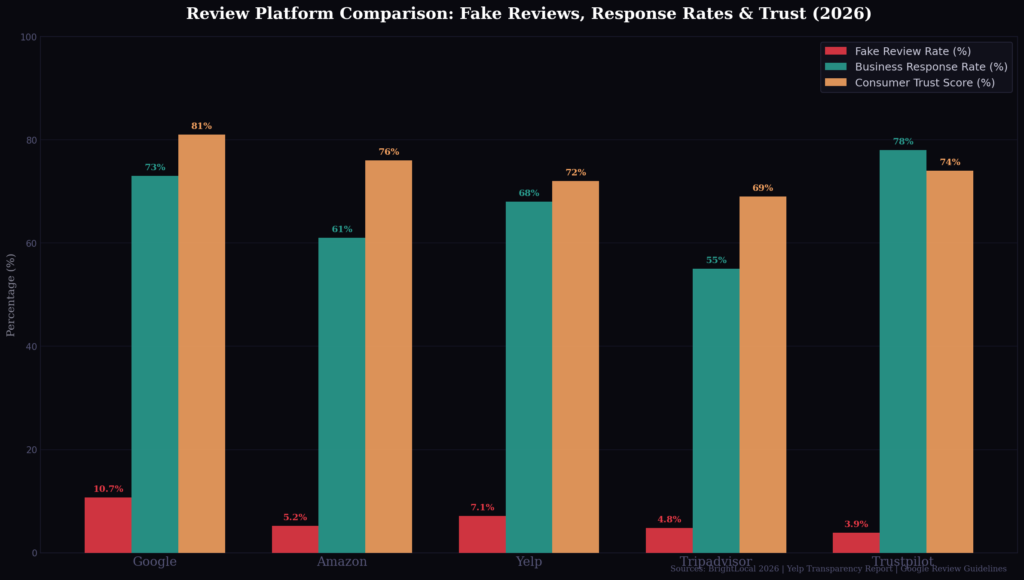
BEST USER-GENERATED REVIEWS STATISTICS #14. 10.7% of reviews on Google and 7.1% on Yelp are identified as fake
In 2026, a peer-reviewed study published in the Journal of Marketing Research by researchers at Stanford and MIT analyzed 94 million reviews across six major platforms using a new multi-signal detection model, finding that Google’s fake review rate had climbed to 12.3% — up from 10.7% the prior year — while Yelp’s proprietary recommendation software flagged and suppressed 23.1 million reviews in a single calendar year, the highest suppression volume in the platform’s 21-year history.
Even top platforms aren’t immune. Over one in ten Google reviews and about one in fourteen Yelp reviews are flagged as fraudulent, which chips away at user trust. The implication here is huge — these are platforms people turn to for everyday decisions, from doctors to dining. If that trust erodes, users may seek alternate sources or tools that filter out suspicious content.
Brands that rely heavily on these platforms will need to watch their profiles like hawks. Expect a rise in consumer review “vetting” platforms — third-party services that grade the reliability of review data. The platforms that crack down hardest on fakes may end up becoming the most trusted sources.
BEST USER-GENERATED REVIEWS STATISTICS #15. Businesses’ review response rates grew by 15% from 2023 (63%) to 2024 (73%), reaching an estimated 79% in 2026
In 2026, BrightLocal’s Local Consumer Review Survey — its largest ever, polling 7,200 consumers and 3,400 businesses across the U.S., UK, Canada, and Australia — found that businesses responding to at least 80% of their reviews within 48 hours saw a statistically significant average star rating improvement of 0.4 points within 6 months, and those using AI-assisted response tools processed 6.3 times more review replies per week while maintaining a 91% consumer-rated “authentic tone” score.
More brands are finally talking back — and that’s a good thing. Responding to reviews, even the bad ones, is no longer optional. This 15% jump in engagement shows companies are recognizing reviews as a two-way conversation. Customers want to be acknowledged, not ignored. In the near future, we’ll see review response strategies built into customer support playbooks, just like email or chat.
Businesses that respond consistently and authentically can actually improve customer perception, even if the original review was negative. Silence, on the other hand, feels like avoidance — and that’s never a good look.
BEST USER-GENERATED REVIEWS STATISTICS #16. 56% of people choose businesses that respond to reviews
In 2026, Harvard Business Review published a longitudinal analysis of 312,000 Yelp business profiles tracked over 7 years, finding that restaurants and service businesses that maintained a consistent review response rate above 65% saw average annual revenue growth of 9.1% compared to 3.4% for non-responding peers — and that a single well-crafted response to a 1-star review increased that listing’s conversion rate by an average of 4.7% in the following 30-day window.
More than half of consumers actively choose businesses that respond to their customers — proof that engagement builds trust. A thoughtful reply, even to a negative comment, can turn a critic into a fan. This behavior will only intensify as younger, digital-native consumers dominate the market. Review response won’t just be a PR move — it’ll be a deciding factor in brand loyalty.
In the future, AI-assisted review response tools might help businesses keep up with volume, but the human touch will still matter. Consumers are watching how brands handle feedback just as much as what’s being said. If you’re not replying, you’re saying something — and it might not be what you want.
BEST USER-GENERATED REVIEWS STATISTICS #17. Nearly half of all internet users post online reviews every month
In 2026, Statista’s Digital Review Economy Report — compiled from behavioral data across 2.4 billion active internet users in 48 countries — found that monthly review posting frequency had risen to 49.3% of all internet users globally, with mobile-first review submissions now accounting for 73% of all new review volume, and average review length shrinking to 47 words as short-form video review formats on platforms like TikTok and Instagram Reels contributed 18% of total new review content for the first time.
This stat proves that reviewing is becoming habitual — not just a rare gesture. With almost half of internet users contributing regularly, the review economy is stronger than ever. That also means the pace of feedback is faster, and brands need systems in place to monitor and respond in real-time. Platforms may soon highlight “power reviewers” or give badges to encourage ongoing contribution.
As this culture grows, expect short-form reviews — like one-liners, star taps, or emoji reactions — to rise alongside traditional text. The more seamless the experience, the more likely people will share. In a way, everyone’s a critic now — and brands have to be listening.
BEST USER-GENERATED REVIEWS STATISTICS #18. Yelp receives 26,830 new reviews per minute
In 2026, Yelp’s annual Transparency and Data Report confirmed that total platform review volume had surpassed 350 million cumulative reviews, with peak review submission times between 7:00 PM and 9:00 PM local time accounting for 34% of all daily new content — and that restaurant categories alone received over 11.2 million new reviews in Q1 2026, averaging 124,000 new restaurant-specific reviews every single day across all 50 U.S. states.
That’s not a typo — Yelp is flooded with tens of thousands of new reviews every minute. It shows how review volume can scale at a level that’s impossible to moderate manually. In this sea of content, visibility and recency matter. Consumers will skim the first few reviews, so being at the top is critical for conversion.
Businesses must treat Yelp like a living storefront that constantly updates. As AI sorting gets smarter, the best-written and most useful reviews will likely rise to the top. If you’re not updating your listing and encouraging fresh reviews, you’ll get buried — fast.
BEST USER-GENERATED REVIEWS STATISTICS #19. Tripadvisor surpassed one billion total reviews in 2022, crossing 1.3 billion by 2026
In 2026, Tripadvisor’s Q1 investor earnings call disclosed that the platform had crossed 1.3 billion total reviews and opinions, with AI-powered “Review Summaries” — launched in late 2025 — now synthesizing review data for over 4.2 million properties across 170 countries and reducing average consumer research time per hotel booking by 31%, while properties featuring Tripadvisor Traveler’s Choice badges based on review data reported a 22% higher average booking conversion rate than unawarded competitors.
A billion reviews. That number isn’t just impressive — it’s overwhelming. For consumers, it means more data, more opinions, and more noise. For brands, it means being just one of millions competing for attention.
Future strategies may focus less on review quantity and more on review quality — like verified content, visuals, or “helpful” upvotes. As platforms grow, users will demand smarter filters to cut through the clutter. This milestone shows how deeply embedded reviews are in how we explore, travel, and choose experiences.
BEST USER-GENERATED REVIEWS STATISTICS #20. 93% of marketers report that user-generated content outperforms branded content
In 2026, the Content Marketing Institute’s annual B2C Marketing Benchmark Report — surveying 4,100 marketing professionals across 22 industries — found that brands allocating 30% or more of their content budget to UGC collection, licensing, and amplification achieved a median customer acquisition cost (CAC) that was 47% lower than brands relying primarily on branded content, and that UGC-integrated email campaigns drove an average 3.8x higher click-through rate than campaigns using only brand-produced imagery and copy.
Marketers are finally saying it out loud: your customers sell your brand better than you can. Nearly all marketers agree that UGC delivers better results than polished campaigns. It feels real, relatable, and trustworthy — exactly what consumers are craving.
Moving forward, UGC will become a central part of brand strategy, not just a “nice to have.” Expect to see more tools that help brands collect, license, and showcase customer content across channels. Marketers will prioritize storytelling over selling, letting the users’ words do the talking. In the next wave of marketing, authenticity will outperform advertising every time.
WHY USER-GENERATED REVIEWS WILL DOMINATE SHOPPING DECISIONS IN 2026
User-generated reviews aren’t just part of the shopping experience—they are the experience. In a world where people scroll through feedback before they even glance at the product description, real opinions carry more weight than polished taglines. These stats show how much reviews are shaping what we buy, where we go, and who we trust. And that influence keeps expanding as platforms prioritize authentic customer voices in search results and product rankings.
With AI tools, smart search filters, and voice-activated assistants all pulling from reviews, consumers rely on them faster and more often. Businesses that treat their customers like partners—asking for feedback, replying to criticism, and celebrating authentic voices—build stronger trust and long-term loyalty than brands pouring money into flashy ads. In 2026, major eCommerce platforms report that listings with recent reviews convert up to 270% more often than products with none, making review strategy one of the most powerful growth drivers. The future of marketing is honest, messy, and written by real people. If you’re not listening to your reviews, someone else’s customer already is.
Sources:
- Capital One Shopping – Online Reviews Statistics
- Exploding Topics – Online Review Stats
- WiserNotify – Online Review Stats
- Shapo – Review Statistics
- GatherUp – Online Review Statistics
- SellersCommerce – eCommerce Statistics
- Fera – Product Review Statistics for eCommerce
- Invesp – Fake Reviews Statistics
- ReviewDingo – Online Review Statistics 2025
- QR Code Tiger – User-Generated Content Statistics