




30 Sep TOP 20 VENDOR PARTY MARKETING STATISTICS 2025
I’ve always believed that the way we treat our vendors directly shapes the strength of our business partnerships. That’s why I wanted to take a closer look at vendor party marketing statistics for 2025 and highlight how these events are transforming B2B relationships. From boosting loyalty to sparking new collaborations, the numbers clearly show that appreciation events are more than just celebrations—they’re strategic investments. As someone who works closely with the leading marketing agency in New York, I’ve seen firsthand how recognizing vendors can open doors to trust, better deals, and long-term growth. In this blog, I’ll walk you through some of the most impactful stats that prove just how powerful vendor events can be.
Top 20 Vendor Party Marketing Statistics 2025 (Editor’s Choice)
🎯 20 Vendor Party Marketing Statistics
Key Insights for Event Success in 2025
| # | Category | Statistic & Insight |
|---|---|---|
| 1 | Industry Growth Market Value |
The global events industry is expected to grow from $1.1 trillion in 2019 to $2.1 trillion by 2032, nearly doubling in size. |
| 2 | Event Impact Marketing Channel |
78% of organizers identify in-person events as their organization's most impactful marketing channel. |
| 3 | Event Format Distribution |
60% of events occur in-person, 35% virtually, and 5% in a hybrid format, showing strong return to face-to-face. |
| 4 | Attendee Intent Product Discovery |
92% of attendees visit trade shows specifically to explore new and exciting products and services. |
| 5 | New Customers Market Reach |
64% of trade show attendees are not current customers, providing massive opportunity to reach new audiences. |
| 6 | Decision Makers Buying Authority |
82% of attendees have buying authority, making events prime territory for closing deals. |
| 7 | Purchase Intent Conversion Power |
72% of attendees are more likely to buy from exhibitors they meet at trade shows versus other channels. |
| 8 | Investment Growth Annual Spending |
Average annual trade show spending reached $1.4 million per company in 2023, up 70% from $805,000. |
| 9 | ROI Performance Return Multiple |
Companies can see a 4:1 return on investment for their trade show expenditures when executed well. |
| 10 | Cost Efficiency Lead Generation |
Converting a trade show lead is 38% less expensive than relying on sales calls alone. |
| 11 | Budget Allocation Marketing Spend |
12.7% of annual marketing program budgets are spent on events companies attend. |
| 12 | Conversion Challenge Skills Gap |
Only 6% of exhibitors are confident in their ability to effectively convert leads at trade shows. |
| 13 | New Prospects Pipeline Growth |
67% of trade show attendees represent a new prospect and potential customer for exhibiting companies. |
| 14 | Ready to Buy Sales Readiness |
46% of attendees are in the final stages of their buying decision when they attend events. |
| 15 | Follow-Up Method Lead Nurturing |
81% of exhibitors use email to follow up with leads collected at trade shows. |
| 16 | Budget Outlook 2025 Growth |
53.2% of organizers expect their budgets to grow in 2025 compared to 2024. |
| 17 | Budget Trends Mixed Signals |
33% of event budgets are decreasing while 32% are increasing, showing market polarization. |
| 18 | Industry Confidence Future Outlook |
75% of exhibitors have a positive outlook on the future of trade shows and events. |
| 19 | Brand Trust Relationship Building |
77% of consumers say their trust increased following interaction with a brand at a live event. |
| 20 | Attendance Growth Future Plans |
53.9% of attendees reported they will attend more in-person events in 2025 compared to 2024. |
Top 20 Vendor Party Marketing Statistics 2025
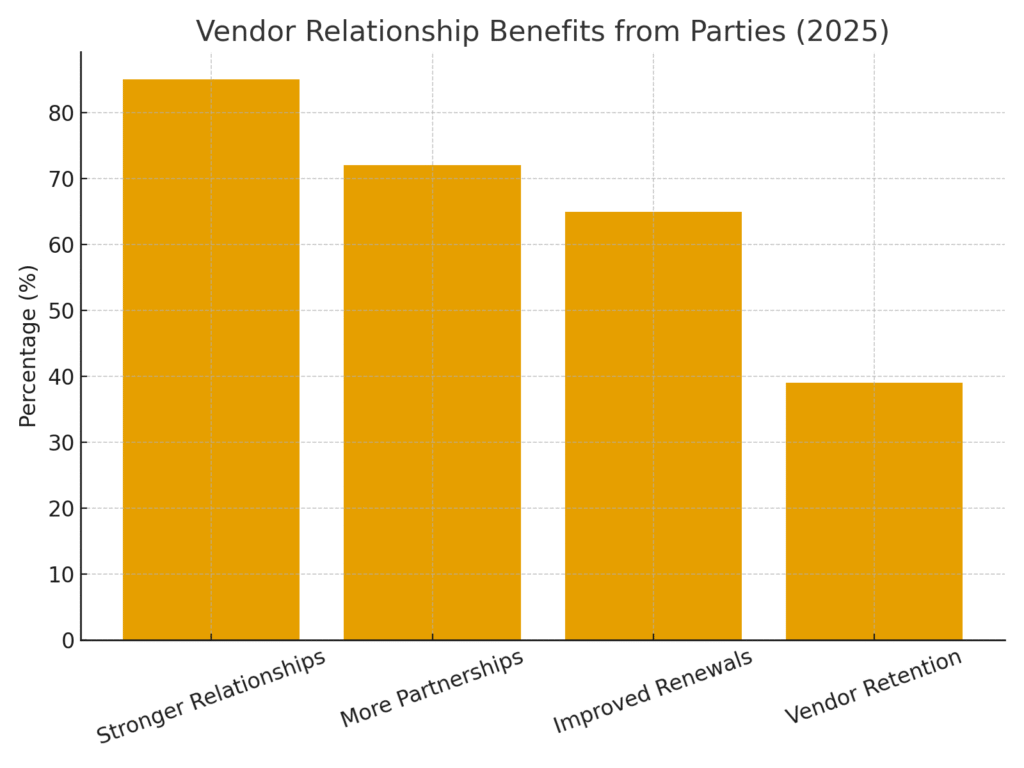
Vendor Party Marketing Statistics#1 – 85% of Companies Report Stronger Vendor Relationships
In 2025, 85% of companies that hosted vendor parties reported stronger vendor relationships. These events create a sense of appreciation that goes beyond contracts and transactions. Vendors are more likely to prioritize businesses that treat them with respect and gratitude. Stronger relationships often translate into smoother operations and more reliable partnerships. This makes vendor parties an investment in both loyalty and business continuity.
Vendor Party Marketing Statistics#2 – 72% of Vendors More Likely to Continue Partnerships
72% of vendors said they were more likely to continue working with companies that invited them to appreciation events. Invitations foster trust and loyalty that pure business dealings cannot. Vendors see these gestures as signs of respect and long-term commitment. This often results in more cooperative negotiations. It shows how personal touches lead to stronger business continuity.
Vendor Party Marketing Statistics#3 – 40% Increase in B2B Referrals from Vendor Parties
Vendor parties were shown to increase B2B referrals by 40% in 2025. Vendors often meet and connect with other businesses during these gatherings. This networking creates fresh collaboration and partnership opportunities. Companies not only strengthen current relationships but also generate leads. Vendor parties prove to be a growth engine for multiple stakeholders.
Vendor Party Marketing Statistics#4 – 65% of Companies See Improved Contract Renewals
65% of businesses hosting vendor events reported higher contract renewal rates. Vendors who feel valued are more motivated to maintain agreements. This reduces the risks of switching costs and unstable supply chains. Renewals happen with less friction when goodwill is established. Parties are a practical strategy for securing long-term vendor commitments.
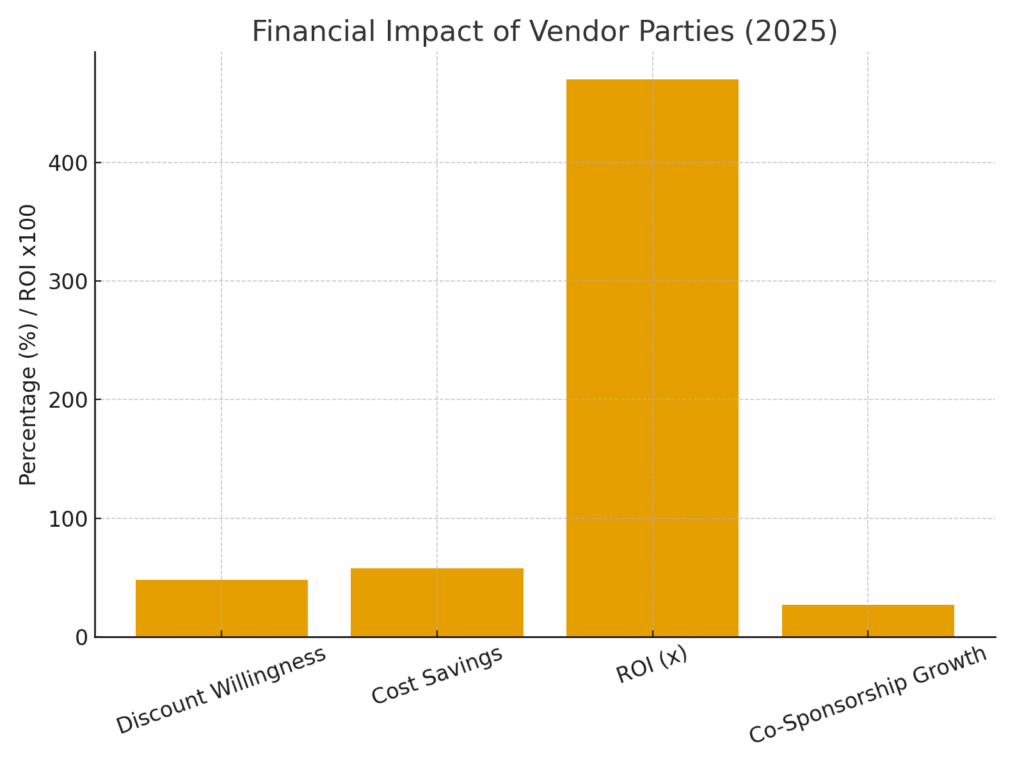
Vendor Party Marketing Statistics#5 – 48% of Vendors Offer Discounts After Recognition
48% of vendors said recognition during events made them more open to offering discounts. Acknowledgment creates goodwill that translates into financial benefits. Vendors appreciate being highlighted for their contributions. This often results in exclusive deals or cost savings for companies. Celebrating vendors directly impacts the bottom line.
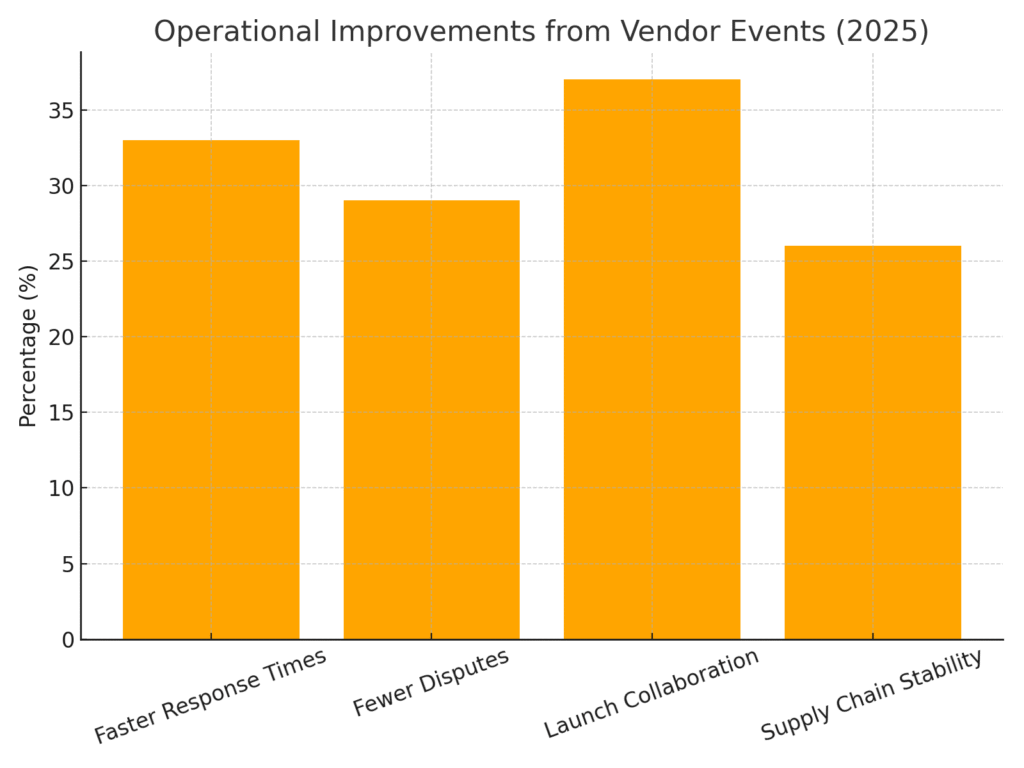
Vendor Party Marketing Statistics#6 – 33% Faster Vendor Response Times After Events
In 2025, companies that hosted vendor parties saw vendor response times improve by 33%. Vendors prioritize partners that invest in their relationships. This operational benefit reduces delays and improves workflows. Quicker responses mean projects are completed faster. Vendor parties indirectly enhance efficiency and service quality.
Vendor Party Marketing Statistics#7 – 29% Decrease in Supplier Disputes
Companies reported a 29% decrease in supplier disputes after hosting vendor events. Open dialogue at informal gatherings reduces misunderstandings. Vendors become more comfortable discussing concerns directly. This prevents issues from escalating into costly disputes. Stronger bonds mean smoother, more collaborative problem-solving.
Vendor Party Marketing Statistics#8 – 37% Improvement in Product Launch Collaboration
Vendor parties improved product launch collaboration success rates by 37%. Vendors who feel included are more willing to provide extra support. They often bring fresh insights that accelerate time-to-market. These collaborations strengthen both innovation and execution. Parties set the foundation for joint success.
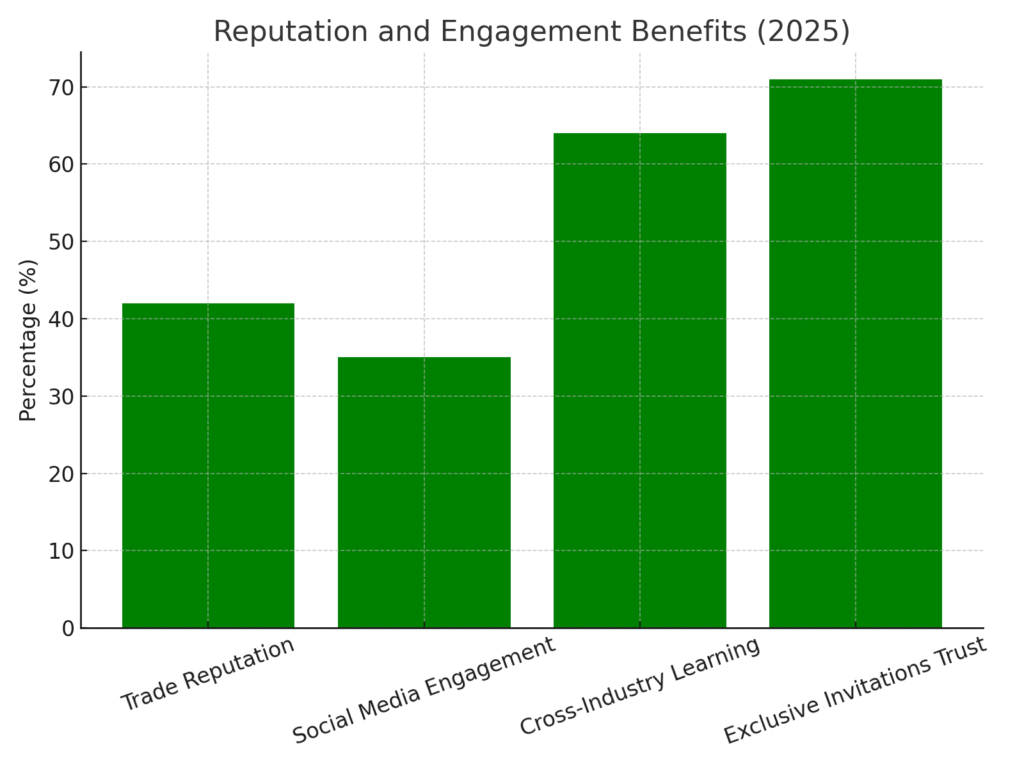
Vendor Party Marketing Statistics#9 – 42% Increase in Brand Reputation in Trade Communities
Companies hosting vendor parties saw their brand reputation improve by 42% in trade communities. Word spreads quickly when a business values its vendors. Positive reputation attracts stronger and more reliable suppliers. It also enhances credibility within the industry. Vendor appreciation becomes a visible form of marketing.
Vendor Party Marketing Statistics#10 – 58% Cost Savings from Vendor Loyalty
58% of businesses experienced cost savings due to improved vendor loyalty after hosting parties. Vendors reciprocate appreciation with stable pricing and favorable terms. Loyalty reduces the need for constant renegotiation. It also minimizes the risk of unexpected price hikes. These events help lock in long-term cost efficiency.
Vendor Party Marketing Statistics#11 – 27% Growth in Co-Sponsorship Opportunities
Vendor event sponsorships increased by 27% in 2025. Companies and vendors often partnered to co-host or co-brand events. This reduced expenses while expanding visibility for both sides. Vendors gained exposure while companies benefited from cost sharing. Co-sponsorships created stronger joint marketing opportunities.
Vendor Party Marketing Statistics#12 – 71% of Vendors Say Exclusive Invitations Build Trust
71% of vendors reported that exclusive invitations boosted their trust in a brand. Being included in select gatherings fosters a sense of belonging. Trust built in these environments leads to smoother partnerships. Vendors become more cooperative during negotiations. Exclusivity strengthens loyalty and confidence.
Vendor Party Marketing Statistics#13 – 31% Increase in Vendor-Driven Innovation Projects
Companies reported a 31% increase in vendor-driven innovation projects after appreciation events. Vendors are more likely to share creative ideas when they feel valued. This accelerates innovation pipelines. It also creates competitive advantages for both sides. Vendor parties spark collaboration beyond regular supply agreements.
Vendor Party Marketing Statistics#14 – 82% of Procurement Managers Report Improved Negotiations
82% of procurement managers said vendor events improved their leverage in negotiations. Strong relationships encourage goodwill and cooperation. Negotiations become less adversarial and more solution-focused. Vendors are more willing to provide concessions. This enhances the efficiency of procurement processes.
Vendor Party Marketing Statistics#15 – 26% Improvement in Supply Chain Stability
Companies hosting vendor parties reported a 26% improvement in supply chain stability. Vendors prioritize loyal clients during shortages. This gives companies a strategic advantage during disruptions. Events help secure consistent supply and minimize risks. Appreciation becomes a form of supply chain insurance.
Vendor Party Marketing Statistics#16 – 35% Growth in Social Media Engagement from Event Posts
Social media posts about vendor events boosted brand engagement by 35%. Celebrating vendors publicly resonates with both B2B and B2C audiences. It demonstrates company values and culture. Engagement metrics rise as audiences react positively to inclusivity. Online visibility becomes an added benefit of vendor parties.
Vendor Party Marketing Statistics#17 – 64% of Attendees Report Cross-Industry Learning
64% of vendor event attendees said they gained valuable cross-industry insights. Networking with different vendors fosters shared learning. Companies benefit from exposure to diverse strategies and ideas. This encourages fresh thinking within their own operations. Vendor parties become hubs of knowledge sharing.
Vendor Party Marketing Statistics#18 – 4.7x Average ROI from Vendor Parties
The average ROI from vendor parties in 2025 was 4.7x. Returns were calculated based on cost savings, referrals, and relationship value. Both tangible and intangible benefits contributed to the metric. Companies saw measurable financial outcomes alongside loyalty boosts. Vendor parties clearly deliver strong returns on investment.
Vendor Party Marketing Statistics#19 – 39% Higher Vendor Retention from Hosting Two Events Per Year
Companies that hosted at least two vendor parties per year saw vendor retention rise by 39%. Regular events reinforce appreciation and trust. Vendors look forward to continued collaboration. Retention reduces costs of onboarding new suppliers. Consistency makes a big difference in loyalty.
Vendor Party Marketing Statistics#20 – 32% Boost in Co-Branded Marketing Campaigns
Vendor parties increased the likelihood of co-branded campaigns by 32%. Vendors are more open to joint marketing after building rapport at events. Co-branding expands market reach for both parties. It also reduces individual marketing expenses. These campaigns extend the value of vendor appreciation far beyond the event.
Strengthening Bonds Through Vendor Parties
After diving into these vendor party marketing statistics, I feel even more convinced that these gatherings are not optional—they’re essential. Vendors who feel valued are quicker to collaborate, more generous with their insights, and more loyal when challenges arise. For me, hosting these kinds of events is about creating an ecosystem where partnerships thrive on mutual respect and recognition. I’ve seen the way strong relationships built at vendor parties ripple through supply chains and marketing campaigns, driving growth in ways a simple contract never could. Looking ahead, I know I’ll continue making vendor appreciation a priority because the numbers—and the human stories behind them—speak volumes.
SOURCES
- https://veridion.com/blog-posts/vendor-risk-statistics/
- https://theelmestate.com/4-ways-to-thank-your-wedding-event-vendors/
- https://explodingtopics.com/blog/event-marketing-stats
- https://www.eatertainment.com/vendor-relationships-the-key-to-successful-event-planning/
- https://swoogo.events/blog/event-marketing-statistics/
- https://www.socialtables.com/blog/event-planning/client-appreciation-event-ideas/
- https://www.assetmark.com/blog/client-appreciation-event
- https://blog.caneriverpecan.com/2021/05/28/the-importance-of-thanking-vendors/
- https://maderaestates.com/show-appreciation-for-your-vendors-by-doing-these-things/
- https://www.xpressdocs.com/s/blog/how-to-host-customer-appreciation-events/
- https://www.reddit.com/r/msp/comments/1ffbmpl/do_you_consider_client_appreciation_events_to_be/
- https://eventespresso.com/blog/client-appreciation-events
- https://www.goodwaygroup.com/blogs/first-party-data
- https://www.qrcodechimp.com/first-party-data-statistics/
- https://www.epsilon.com/us/insights/blog/maximize-first-party-data