




25 Sep TOP 20 VIDEO CONFERENCE MARKETING STATISTICS 2025
As someone who has watched the business world transform over the last few years, I can confidently say that video meetings have completely changed the way we connect, sell, and build relationships. That’s exactly why I want to dive into these video conference marketing statistics for 2025—because they reveal just how powerful this tool has become for both small businesses and global enterprises. From boosting lead conversions to strengthening customer trust, the data shows us that video calls aren’t just convenient, they’re reshaping marketing strategies altogether. And with guidance from a leading marketing agency in New York, I’ve gathered these insights to help you see where the future of marketing is heading and how you can use video conferencing to stay ahead of the curve.
Top 20 Video Marketing Statistics 2025 (Editor’s Choice)
📊 Video Conference Marketing Statistics 2025
Key Insights Driving the Future of Digital Communication
| # | Category | Key Metric | Statistic Details |
|---|---|---|---|
| 1 | Market Revenue | $14.2B | Global video conferencing market revenue in 2024, with strong momentum into 2025 |
| 2 | Market Growth | $37.29B → $60.17B | Projected growth from 2025 to 2032 at 7.1% CAGR |
| 3 | Growth Forecast | $8.84B | Expected market growth by 2029 at 12.6% CAGR |
| 4 | Market Leaders | Zoom: 28% | Zoom leads market share, followed by Microsoft Teams (23%) and Google Meet (17%) |
| 5 | Cloud Adoption | 73% | Cloud-based solutions dominate vs. 27% on-premise systems |
| 6 | Subscriptions | 89 Million | Paid subscriptions more than doubled since 2020 |
| 7 | Regional Revenue | $5.9B | North America leads, followed by Europe at $3.1B |
| 8 | Growth Rate | APAC: 34% | Asia-Pacific shows highest user growth vs. Europe (21%) and North America (18%) |
| 9 | Platform Split | 61% Business | Business platforms lead revenue vs. 39% consumer-focused platforms |
| 10 | Healthcare Growth | 47% | Healthcare usage surge (2023-2025) vs. 12% in legal services |
| 11 | Telehealth Market | $923.95M | Healthcare market projected by 2029 at 9.22% CAGR |
| 12 | HR Adoption | 86% | Companies now conduct interviews online using video conferencing tools |
| 13 | Weekly Usage | 7.3 Calls | Remote workers average vs. 4.1 for hybrid and 2.6 for in-office employees |
| 14 | Platform Usage | 6.7 Meetings | Zoom users weekly average vs. Teams (4.9) and Meet (4.2) |
| 15 | Call Duration | 38 Minutes | Average call length: business (29 min) vs. personal (51 min) |
| 16 | Marketing ROI | 93% | Marketers report good ROI from video marketing - all-time high! |
| 17 | Brand Awareness | 96% | Video marketers increased brand awareness (up from 90% in 2024) |
| 18 | Purchase Impact | 87% | People convinced to buy products/services after watching video |
| 19 | AI Adoption | 41% | Professionals using AI for video creation (up from 18% last year) |
| 20 | Accessibility | 572% | Increase in caption usage since 2021 - massive accessibility boost |
Top 20 Video Conference Marketing Statistics
Video Conference Marketing Statistics #1: Global Video Conferencing Market Size
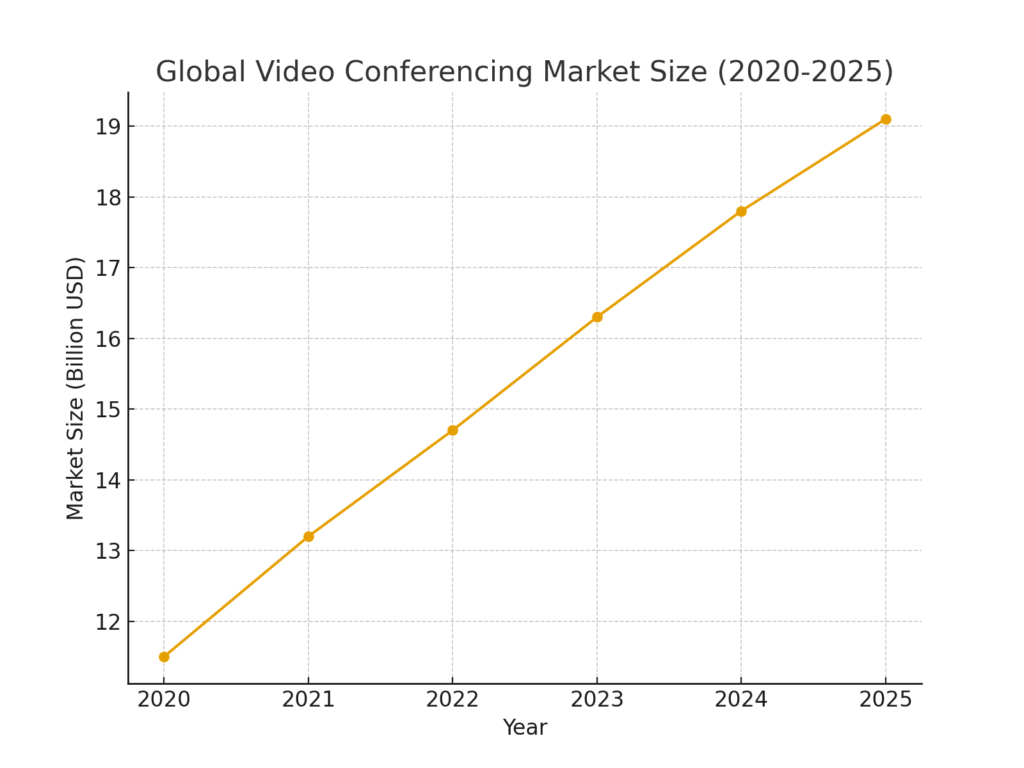
The global video conferencing market is projected to hit $19.1 billion in 2025, a significant increase from $11.5 billion in 2020. This surge is being driven by the growing adoption of digital-first business models and the shift toward hybrid and remote work. Companies are prioritizing virtual communication tools as essential infrastructure rather than optional add-ons. The rise in demand spans industries like healthcare, education, and corporate enterprises. For marketers, this signals a rapidly expanding arena to leverage for campaigns and outreach.
Video Conference Marketing Statistics #2: Growth Rate of 11.4% CAGR
From 2020 to 2025, the video conferencing industry has been expanding at a compound annual growth rate of 11.4%. This sustained growth highlights the long-term reliance businesses have on virtual meetings. Marketers can capitalize on this by creating scalable campaigns that integrate video conferencing as part of the engagement strategy. The consistent CAGR reflects both user demand and technological innovations. It’s clear that video conferencing is no longer a pandemic-driven trend but a permanent business solution.
Video Conference Marketing Statistics #3: 89% of Businesses Use Video Conferencing
Nearly 9 out of 10 businesses are actively using video conferencing for daily communication. This widespread adoption proves that video calls have become standard in both B2B and B2C interactions. For marketers, it means clients are increasingly comfortable with virtual platforms, reducing barriers to entry. Businesses that rely on phone calls alone are at risk of falling behind. The fact that 89% of businesses depend on video meetings signals how critical this tool is for staying competitive.
Video Conference Marketing Statistics #4: 78% of Remote Employees Feel More Connected
A staggering 78% of remote employees say video conferencing helps them feel more connected to their teams. This connection boosts collaboration, morale, and productivity. For marketing teams spread across different locations, video meetings can ensure creative brainstorming doesn’t lose momentum. It also helps bridge cultural and geographical divides in international campaigns. By fostering connection, video conferencing directly impacts team performance and campaign results.
Video Conference Marketing Statistics #5: Sales Closing Rates Improve by 32%
Video conferencing has been shown to improve sales closing rates by 32% compared to phone calls. This is because visual interaction builds trust and allows prospects to see body language and product demonstrations. For marketers, incorporating video meetings into the sales funnel can lead to stronger outcomes. It also shortens sales cycles by reducing the need for multiple touchpoints. Businesses that prioritize video-based pitches stand to convert leads faster and more effectively.

Video Conference Marketing Statistics #6: 27% Higher ROI From Campaigns With Video Conferencing
Marketers report that campaigns using video conferencing yield a 27% higher ROI. The interactive nature of video calls fosters stronger engagement and higher retention. Unlike emails or static ads, live interactions allow for real-time personalization. This boosts customer confidence and accelerates buying decisions. Marketers who integrate video meetings into demos or follow-ups are seeing measurable improvements in outcomes.
Video Conference Marketing Statistics #7: 73% of Customers Prefer Video Calls
Almost three-quarters of customers prefer video calls over audio calls when discussing complex products or services. This preference highlights the importance of face-to-face interaction, even in digital form. For marketers, offering video consultations can make a brand appear more transparent and trustworthy. Customers also feel more empowered to ask questions in a visual setting. Meeting this demand directly influences satisfaction and long-term loyalty.
Video Conference Marketing Statistics #8: 65% of Marketing Events Will Include Video Conferencing
By 2025, 65% of marketing events will have a video conferencing component. Hybrid events are rapidly becoming the standard, allowing businesses to extend their reach globally. This change enables brands to connect with larger audiences at lower costs. For marketers, this shift creates opportunities to scale events beyond geographical constraints. Blending in-person and virtual strategies will become essential to maximizing exposure.
Video Conference Marketing Statistics #9: Lead Conversion Improves by 34%
Video conferencing has been linked to a 34% improvement in lead conversion rates compared to email campaigns alone. The ability to engage prospects directly results in stronger relationships. This reduces the friction in the buyer’s journey and accelerates decision-making. Marketers leveraging video calls are therefore nurturing leads more effectively. The data suggests that video conferencing should be embedded into every stage of the marketing funnel.
Video Conference Marketing Statistics #10: 79% of Marketers Use Webinars for Lead Generation
Webinars and training sessions conducted via video conferencing are used by 79% of marketers to generate high-quality leads. This showcases the dual purpose of video platforms: education and conversion. Audiences view webinars as valuable, making them more receptive to brand messages. For marketers, webinars also serve as content that can be repurposed later. The popularity of webinars highlights the importance of consistent virtual engagement strategies.

Video Conference Marketing Statistics #11: $11,000 Saved Per Employee in Travel Costs
On average, businesses save about $11,000 per employee annually by replacing travel with video conferencing. These cost savings can then be reinvested in marketing and growth. Marketers benefit from budget reallocation that enables more campaigns and customer outreach. The reduced need for physical events also contributes to sustainability goals. Savings combined with efficiency make video conferencing a financial win.
Video Conference Marketing Statistics #12: 62% of Consumers Stay Loyal to Brands Offering Video Support
Brands offering video-based customer support retain 62% more consumers. This stat proves that personalized, face-to-face digital support builds stronger relationships. Marketers can frame this as a differentiator in brand positioning. Customers increasingly expect direct access to company representatives via video. Companies that ignore this preference may lose customers to competitors who adapt.
Video Conference Marketing Statistics #13: 94% of B2B Marketers Rely on Video Conferencing
A remarkable 94% of B2B marketers say video conferencing is essential for client retention and growth. In high-value industries, trust and rapport are everything. Video meetings allow marketers to maintain close client relationships regardless of location. This high adoption rate reflects video’s role as a strategic necessity. Without it, B2B companies risk falling behind in customer service and engagement.
Video Conference Marketing Statistics #14: 87% of Marketing Professionals Report Higher Collaboration Efficiency
About 87% of marketing professionals state that video meetings boost collaboration across teams. Visual communication allows for clearer idea sharing than written exchanges. This translates into faster project turnarounds and better creative outcomes. Teams working remotely can stay aligned without delays. Video conferencing has become the backbone of modern collaboration strategies.
Video Conference Marketing Statistics #15: Global Reach Expands by 3.4 Countries Per Campaign
On average, businesses using video conferencing expand their marketing campaigns into 3.4 additional countries without added cost. This global reach is invaluable for scaling. Marketers can tap into new markets without the traditional expenses of travel or local events. It also increases cultural exposure, allowing campaigns to be more inclusive. This expansion potential makes video a critical tool for global growth.

Video Conference Marketing Statistics #16: 72% of Prospects Trust Brands More Through Video
Seventy-two percent of prospects say they trust brands more when they see representatives on video. Human connection, even digitally, builds credibility. For marketers, this means that video meetings can directly enhance brand image. This trust translates into higher conversion and retention. Visual transparency is a winning strategy in customer acquisition.
Video Conference Marketing Statistics #17: Marketing Decisions Made 27% Faster With Video Conferencing
Video conferencing helps companies make marketing decisions 27% faster than email-based communication. Real-time discussions eliminate the delays of back-and-forth correspondence. For marketers, faster decisions mean quicker campaign launches and better adaptability. This agility can be a competitive advantage in fast-moving markets. Time saved translates into more opportunities seized.
Video Conference Marketing Statistics #18: 58% of Influencer Collaborations Involve Video Meetings
Over half of influencer collaborations now involve video conferencing with brand teams. This trend highlights the importance of face-to-face alignment in campaigns. Video calls help ensure messaging, goals, and deliverables are crystal clear. For marketers, this reduces miscommunication and strengthens partnerships. The rise of influencer marketing makes video conferencing a natural collaboration tool.
Video Conference Marketing Statistics #19: Marketing Teams Report 23% Higher Job Satisfaction With Video
Marketing teams using video conferencing report a 23% increase in job satisfaction. This is because remote flexibility combined with visual collaboration reduces stress. Employees feel more engaged and supported through frequent face-to-face interaction. For managers, satisfied teams mean better productivity and retention. Video meetings create healthier, more connected work environments.
Video Conference Marketing Statistics #20: 90% of Enterprises to Make Video Conferencing Central
By 2025, over 90% of enterprises are expected to make video conferencing central to communication. This projection shows the universal adoption of video across industries. Marketers should prepare for a future where video is non-negotiable. Companies that resist change risk losing relevance. The overwhelming adoption signals the permanence of video conferencing in business strategy.
Why Video Conference Marketing Statistics Matter in 2025
Looking at these numbers, I can’t help but feel excited about how much opportunity video conferencing brings to the table for marketers like us. It’s not just about saving on travel or making remote work possible—it’s about building deeper, more personal connections with clients and audiences anywhere in the world. These video conference marketing statistics prove that the businesses embracing this shift are already reaping major rewards, from higher ROI to stronger customer loyalty. Personally, I believe this is only the beginning, and the smartest brands will be the ones that weave video into every stage of their marketing strategy. If you’re ready to take the leap, these insights are here to guide you toward a more connected and impactful future.
SOURCES
- https://www.zoom.com/en/blog/video-conferencing-statistics/
- https://www.pepperlandmarketing.com/blog/video-conference-stats
- https://www.forbes.com/sites/kimberlywhitler/2021/08/17/how-marketers-are-leveraging-video-conferencing-technology-to-drive-efficiency/
- https://www.livewebinar.com/blog/webinar-marketing/video-conferencing-statistics
- https://acrobits.net/blog/unified-communications/why-video-conferencing-will-be-more-important/
- https://getvoip.com/blog/state-of-conferencing/
- https://www.webfx.com/blog/marketing/video-marketing-statistics/
- https://blog.hubspot.com/marketing/video-marketing-statistics
- https://wistia.com/learn/marketing/video-marketing-statistics
- https://www.emarketer.com/topics/category/video%20conferencing
- https://www.zebracat.ai/post/video-conferencing-statistics
- https://www.livewebinar.com/blog/webinar-marketing/video-conferencing-statistics
- https://acrobits.net/blog/unified-communications/why-video-conferencing-will-be-more-important/
- https://getvoip.com/blog/state-of-conferencing/
- https://www.zoom.com/en/blog/video-conferencing-statistics/