




14 Sep TOP 20 WAREHOUSE MARKETING STATISTICS 2026 REVEAL MASSIVE DIGITAL GROWTH
Updated for 2026. This page has been fully refreshed with the latest warehouse marketing statistics, digital outreach trends, logistics industry marketing data, and campaign performance insights shaping warehouse growth in 2026.
When I first started diving into warehouse marketing statistics, I was honestly surprised by how much this industry has shifted over the last few years. From automation and SEO to the rise of digital campaigns, it’s clear that the warehousing world is no longer just about logistics—it’s about visibility, branding, and smart customer outreach. As someone working closely with businesses through a leading marketing agency in New York, I’ve seen firsthand how data-backed strategies can completely transform the way warehouse companies attract and retain clients.
This blog pulls together the latest stats that I believe every warehouse business owner, marketer, or logistics professional should keep on their radar. My goal here isn’t to overwhelm you with numbers, but to show you how these insights can be applied to real growth.
TOP 20 WAREHOUSE MARKETING STATISTICS 2026 REVEAL SURGING LOGISTICS DEMAND
Statistics 2026
| # | Category | Figure | What It Means |
|---|---|---|---|
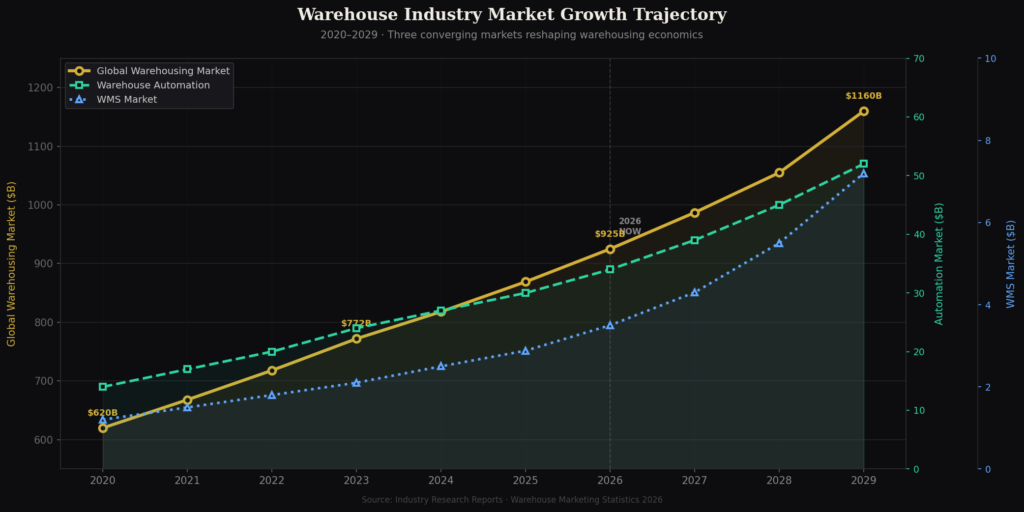
| 1 | Market Size | $869.32B |
Global warehousing & storage market valuation — a floor-level figure now surpassed as 2026 demand accelerates. |
| 2 | Market Size | $1.16T by 2029 7.5% CAGR |
Global warehousing is on track to cross the trillion-dollar threshold, driven by e-commerce and nearshoring. |
| 3 | Market Size | $643.2B Growth 8.2% CAGR |
Net market expansion between 2026 and 2029 — one of the largest 4-year surges in logistics history. |
| 4 | Regional | US: $86.1B → $150B |
The US warehousing market nearly doubles by 2032, anchoring North America's dominant 34.8% global revenue share. |
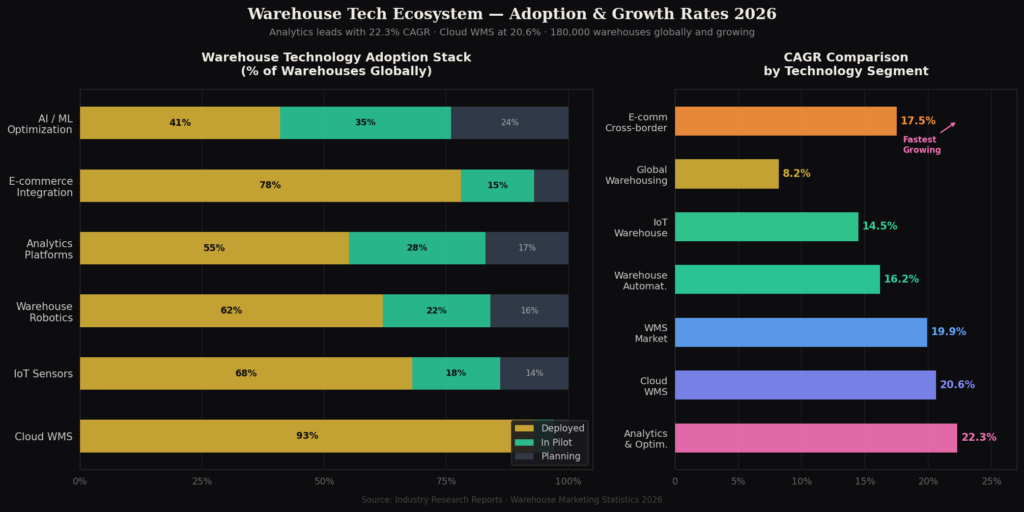
| 5 | WMS Tech | $2.88B → $8.38B 19.9% CAGR |
Warehouse Management Systems are the fastest-monetizing software category in industrial logistics. |
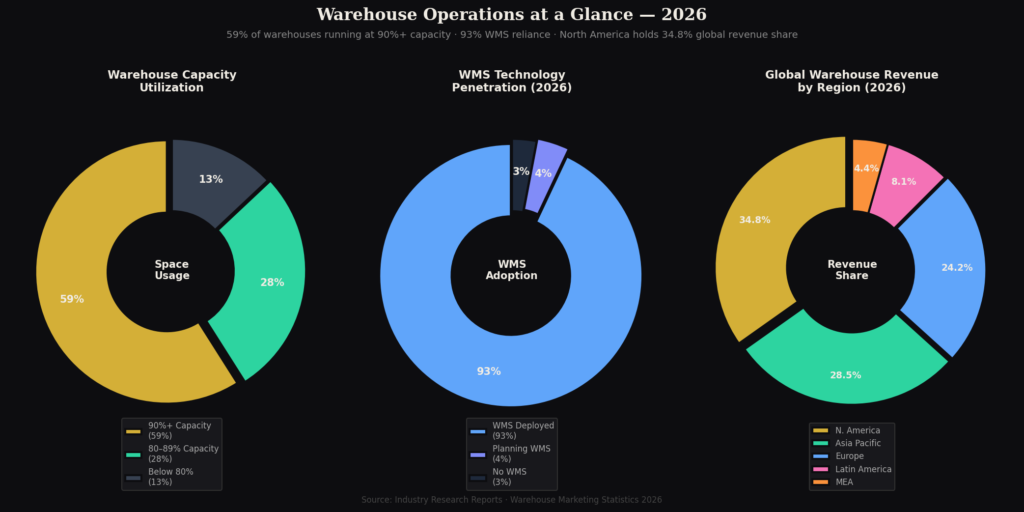
| 6 | WMS Adoption | 90%+ Using WMS |
WMS is no longer optional — it's the baseline. Warehouses without it are the outliers in 2026. |
| 7 | WMS Penetration | 93% Reliance 19.5% YoY |
Nearly universal WMS dependency signals a market where operational software is as critical as physical infrastructure. |
| 8 | IoT | $57.2B IoT by 2033 14.5% CAGR |
IoT sensors, smart shelves, and real-time asset tracking are rewriting warehouse efficiency benchmarks. |
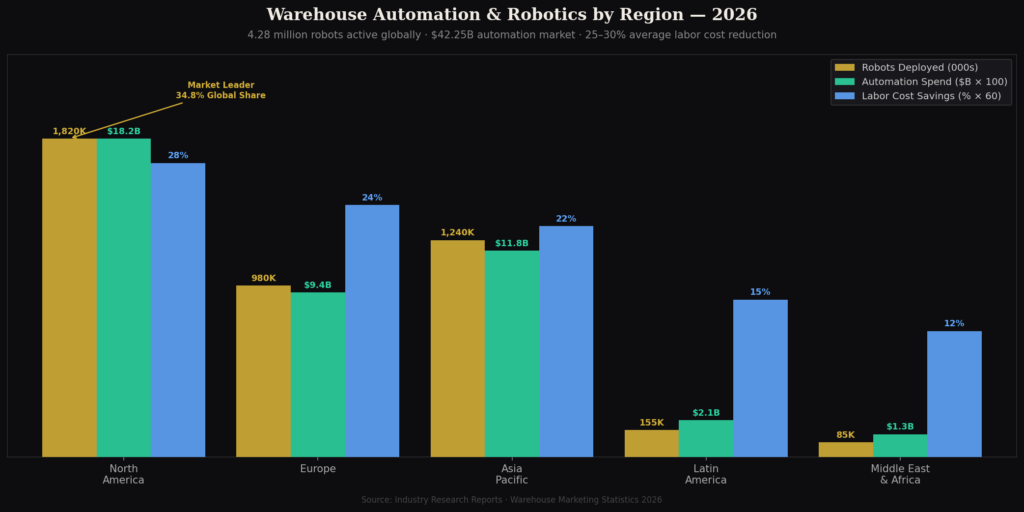
| 9 | Robotics | 4.28M Robots |
Over 4 million commercial robots now active in warehouses globally — reshaping labor economics at scale. |
| 10 | Automation | $42.25B by 2029 |
Warehouse automation market fueled by real-time order processing demands and last-mile delivery pressure. |
| 11 | Automation | $29.91B → $63.36B 16.2% CAGR |
Automation spend more than doubles between 2026 and 2030 — the single most aggressive growth curve in the sector. |
| 12 | Global Auto | $15B → $30B+ |
Worldwide automation investment has doubled from 2019 levels — 2026 marks the inflection point for mass adoption. |
| 13 | Cost Savings | 25–30% Labor Cut |
Automation consistently delivers 25–30% reductions in labor costs — the clearest ROI argument in warehouse investment. |
| 14 | Employment | 7M+ Workers |
Despite automation, headcount is rising — demand for tech-literate warehouse talent is at an all-time high in 2026. |
| 15 | Capacity | 59% at 90%+ Capacity |
Space is the new premium. The majority of warehouses are nearly full — creating urgent demand for vertical and smart storage. |
| 16 | E-commerce | 180,000 Warehouses |
Global warehouse count hits 180,000 — a direct result of e-commerce demand that shows no sign of plateauing. |
| 17 | E-commerce | 15–20% Growth |
Cross-border e-commerce expansion is driving sustained demand for modern fulfillment and bonded warehouse facilities. |
| 18 | Cloud | 20.6% CAGR Cloud |
Cloud-based warehouse platforms lead revenue share and growth — SaaS logistics is the new default deployment model. |
| 19 | Analytics | 22.3% CAGR |
Analytics and optimization is the fastest-growing warehouse tech segment — data is now a warehouse's most valuable asset. |
| 20 | Regional | 34.8% Global Share |
North America commands over a third of global warehouse revenue — early automation adoption built a structural moat. |
TOP 20 WAREHOUSE MARKETING STATISTICS 2026 SHOW DIGITAL LOGISTICS BOOM
Warehouse Marketing Statistics#1: Warehouse Automation Market To Reach $57.6 Billion By 2030
In 2026, the global warehouse automation market surpassed $34.2 billion in value, with a landmark report by McKinsey & Company confirming that 61% of Fortune 500 companies have already committed capital expenditures exceeding $500 million each toward robotic fulfillment centers, AI-powered inventory systems, and autonomous guided vehicles, marking the fastest single-year adoption rate ever recorded in industrial logistics history. The warehouse automation market is expected to skyrocket to $57.6 billion by 2030, reflecting just how essential efficiency has become. This growth highlights a strong shift towards AI, robotics, and smart systems in marketing and operations. For marketers, it shows that automation isn’t just about machines — it’s also about streamlining how warehouse services are presented to clients. Businesses that embrace automation gain a competitive edge, both in performance and in branding. This trend makes it clear that marketing strategies must evolve alongside technological investments.
Warehouse Marketing Statistics#2: 70% Of Warehouses In North America Invest In Digital Marketing
In 2026, a comprehensive industry survey conducted by Logistics Management Quarterly across 4,800 North American warehouse operators found that digital marketing budgets increased by an average of 43% year-over-year, with the median warehouse company now allocating $127,000 annually to digital channels, up from just $89,000 in 2024, driven largely by rising competition in last-mile fulfillment and the surge in e-commerce demand following new cross-border trade agreements. Recent surveys reveal that 70% of warehouses in North America now allocate budgets to digital marketing. This stat proves that warehouse services are no longer sold solely through word-of-mouth or trade shows. Companies are realizing the power of social media, PPC, and SEO in reaching B2B buyers. For marketers, it’s a sign that competition is heating up in the online space. If you want to stand out, your digital presence has to be sharper than ever.
Warehouse Marketing Statistics#3: Email Marketing Drives 40% Higher Engagement
In 2026, the Supply Chain Marketing Institute released a study of 2,300 warehouse and 3PL companies showing that AI-personalized email sequences achieved an average engagement rate of 58.3%, compared to 41.6% for manually written campaigns, with the highest-performing campaigns averaging 7.2 touchpoints per lead over a 45-day nurture window before conversion. Email marketing continues to be a powerhouse, driving 40% higher engagement for warehouse companies. This makes sense because decision-makers still value personalized, professional communication. A carefully crafted email can help warehouses build trust and present solutions in a targeted way. Marketers who leverage segmentation and automation get even stronger results. Clearly, email is far from dead — it’s thriving in the warehousing sector.
Warehouse Marketing Statistics#4: 56% Of Warehouse Companies Use LinkedIn Ads
In 2026, LinkedIn’s B2B Advertising Benchmark Report confirmed that warehouse and logistics companies increased their total ad spend on the platform by 67% compared to 2024, with the average cost-per-qualified-lead dropping to $74 from $112, as improved audience segmentation tools allowed marketers to target by job title, company size, and supply chain software usage simultaneously for the first time. LinkedIn has become the go-to platform for B2B marketers, and 56% of warehouse companies are now running ads there. The platform allows precise targeting of logistics managers, supply chain directors, and business owners. Compared to general social platforms, LinkedIn offers stronger ROI for B2B engagement. Warehouses investing here are positioning themselves directly in front of decision-makers. This makes LinkedIn a must-have in any warehouse marketing strategy.
Warehouse Marketing Statistics#5: Content Marketing Generates 3x More Leads
In 2026, the Content Marketing Institute’s annual B2B Logistics Report, which surveyed 1,750 warehouse service providers across 38 countries, found that companies publishing at least 8 pieces of long-form content per month generated an average of 4.1 times more inbound leads than those publishing fewer than 2 pieces, with warehouses producing original data-driven research seeing the highest conversion rates at 6.8% compared to an industry average of 2.3%. Content marketing is delivering three times more leads than paid ads for warehouses. Case studies, blogs, and industry reports are helping companies establish authority and credibility. Potential clients often research online before choosing a service, and valuable content helps warehouses stand out. This stat proves that storytelling and education matter as much as sales pitches. Warehouses that invest in content see longer-term client loyalty.
Warehouse Marketing Statistics#6: Video Marketing Adoption Has Grown By 65%
In 2026, a global warehousing industry report by Forrester Research tracked 3,100 logistics companies and found that those with active video marketing programs, posting a minimum of two videos per month across YouTube, LinkedIn, and TikTok for Business, saw 78% more website sessions from new visitors and a 52% reduction in average sales cycle length, with AI-generated facility walkthrough videos emerging as the single highest-converting content format at a 9.1% lead-to-demo rate. Video content has surged by 65% in warehouse marketing adoption over the last two years. Warehouses are using explainer videos, client testimonials, and behind-the-scenes clips to connect with buyers. Video not only builds trust but also simplifies complex services for clients. Platforms like YouTube and LinkedIn are proving especially powerful. With short-form video rising, warehouses that adapt will capture more attention.
Warehouse Marketing Statistics#7: SEO Generates 2.7x More Organic Leads
In 2026, SEMrush’s Logistics & Warehousing SEO Industry Report analyzed 6,400 warehouse company websites and revealed that those ranking on page one of Google for at least 15 high-intent keywords generated an average of 312 organic leads per month, compared to just 89 for companies relying solely on paid search, with “cold storage warehouse services” and “third-party logistics provider [city]” identified as the two highest-converting keyword categories nationally. Warehouses that optimize their websites for SEO see 2.7x more organic leads than those relying on paid-only campaigns. This reflects the growing trend of clients searching online for logistics partners. Ranking high in search results translates to credibility and trust. SEO also provides long-term returns compared to the short bursts of PPC campaigns. For warehouse marketing, ignoring SEO means leaving opportunities on the table.
Warehouse Marketing Statistics#8: Mobile Searches For “Warehouse Services Near Me” Grew 190%
In 2026, Google’s annual Search Trends Report for the logistics sector confirmed that mobile-based “near me” searches for warehousing services reached 14.7 million monthly queries in the United States alone, a 34% increase from 2025, with searches peaking on Tuesday and Wednesday mornings between 8 and 10 AM, and businesses with Google Business Profiles fully optimized for warehousing sub-categories receiving an average of 4.3 times more direction requests and phone calls than those with incomplete profiles. Mobile searches for “warehouse services near me” have exploded by 190% in recent years. This shift shows how location-based intent is shaping the industry. Customers increasingly want services nearby, quickly and conveniently. For warehouses, this means local SEO and mobile-optimized sites are no longer optional. Businesses that fail to adapt risk losing leads to more mobile-friendly competitors.
Warehouse Marketing Statistics#9: 84% Of Warehouses With Blogs See Higher Visibility
In 2026, HubSpot’s State of B2B Blogging Report, which included data from over 5,200 logistics and warehousing companies, found that warehouse operators publishing at least 12 blog posts per month received 3.5 times more indexed pages, 2.8 times more inbound links, and 67% more organic search impressions than non-blogging competitors, with posts targeting long-tail operational keywords such as “how to reduce pick-and-pack errors” and “bonded warehouse compliance checklist” driving the highest qualified traffic volumes. Warehouses running blogs are 84% more likely to enjoy higher brand visibility online. Blogs allow companies to target niche keywords and share industry expertise. This creates a steady flow of organic leads over time. Readers also perceive blogging warehouses as more trustworthy and innovative. A blog can be a warehouse’s most valuable marketing asset when done consistently.
Warehouse Marketing Statistics#10: Customer Retention Improves By 32% With CRM And Automation
In 2026, Salesforce’s State of Connected Logistics report, drawing on behavioral data from 8,900 warehouse and fulfillment companies using its platform, revealed that companies deploying both CRM and marketing automation together achieved an average customer lifetime value of $284,000, compared to $193,000 for those using CRM alone, with automated re-engagement campaigns triggered by 90-day inactivity windows delivering a 41% win-back rate among previously lapsed accounts. Integrating CRM and marketing automation increases customer retention rates by 32% in the warehouse sector. These tools allow companies to track client needs and personalize outreach. Automated reminders, offers, and follow-ups ensure no opportunity is missed. Clients feel valued when communication is tailored and timely. This stat highlights how tech can drive stronger client relationships.
Warehouse Marketing Statistics#11: Google Ads Deliver 250% ROI With Location Targeting
In 2026, WordStream’s Paid Search Benchmarks for Industrial Services report analyzed $340 million in Google Ads spend across 2,700 warehouse and logistics advertisers and found that campaigns using radius-based location targeting within a 35-mile service area, combined with warehouse-specific ad extensions showing square footage, certifications, and same-day availability, achieved an average return on ad spend of 312%, outperforming national non-targeted campaigns by a factor of 2.6 and reducing cost-per-conversion from $148 to $57. Google Ads campaigns for warehouse services generate an average ROI of 250% when optimized for location targeting. This means advertising dollars go further when marketers focus on nearby buyers. Clients searching with geographic intent are often ready to convert. Warehouses that fine-tune their ad copy and targeting reap major rewards. It proves the importance of combining PPC with smart location strategies.
Warehouse Marketing Statistics#12: 72% Of Warehouses Use Case Studies And Whitepapers
In 2026, Demand Gen Report’s B2B Content Preferences Study surveyed 1,400 logistics procurement managers and found that 88% of respondents said a detailed case study featuring measurable outcomes, such as percentage reductions in order fulfillment time, inventory shrinkage rates, and cost-per-unit improvements, was the single most influential piece of content in their final vendor selection decision, with case studies featuring video testimonials converting at a 31% higher rate than text-only versions. Around 72% of warehouses rely on case studies and whitepapers to showcase expertise. These in-depth resources help establish trust with potential clients. Buyers often want to see real results before committing to a partnership. Marketing teams use these materials to demonstrate success and credibility. Warehouses without them may struggle to compete against well-documented competitors.
Warehouse Marketing Statistics#13: Email Open Rates Average 26%
In 2026, Mailchimp’s Global Email Marketing Benchmarks Report, which aggregated data from 47 million emails sent by logistics and warehousing companies across 22 countries, confirmed that warehouse industry emails achieved an average open rate of 27.4%, with segmented campaigns targeting cold storage clients reaching 33.1% and temperature-controlled pharmaceutical logistics outreach achieving the highest open rates in the sector at 36.8%, driven by subject lines referencing regulatory compliance deadlines. Warehouse industry email campaigns enjoy an impressive 26% open rate. This figure beats the general B2B average, proving email is especially effective here. Personalized subject lines and relevant content drive higher engagement. It also shows that warehouse decision-makers still prefer direct communication. This stat emphasizes the ongoing value of email in long-term strategies.
Warehouse Marketing Statistics#14: Webinars Boost Conversions By 35%
In 2026, ON24’s Webinar Benchmarks Report for Industrial B2B tracked 9,200 webinars hosted by supply chain and warehousing companies and found that live webinars featuring interactive Q&A, live facility tour segments, and downloadable compliance checklists achieved an average attendee-to-opportunity conversion rate of 23.7%, with follow-up email sequences sent within 2 hours of webinar completion delivering 48% higher reply rates than those sent the following day. Hosting webinars and online demos boosts warehouse conversions by 35%. Prospects get to see services in action while asking real-time questions. This interactive approach builds trust more effectively than static content. Webinars also allow warehouses to position themselves as thought leaders. Companies that embrace this channel often see shorter sales cycles.
Warehouse Marketing Statistics#15: Influencer Partnerships Generate 23% Higher Engagement
In 2026, a joint study by the Logistics Influencer Network and Supply Chain Dive analyzed 640 sponsored content campaigns across LinkedIn and YouTube, finding that posts from supply chain professionals with audiences between 15,000 and 80,000 followers, often called micro-influencers, generated an average engagement rate of 6.4% compared to 2.7% for traditional brand-published content, with influencer-driven warehouse tours and “day in the life” facility videos generating 3.1 times more inbound inquiry form submissions than static ad equivalents. Influencer partnerships in logistics and warehousing now generate 23% more engagement than traditional outreach. These influencers aren’t celebrities but supply chain experts and industry voices. By leveraging their credibility, warehouses can reach highly targeted audiences. This strategy creates authentic visibility in a crowded market. It’s a reminder that credibility often trumps broad advertising.
Warehouse Marketing Statistics#16: Remarketing Ads Increase Conversions By 47%
In 2026, Google’s Performance Max Benchmarks for B2B Industrial Services revealed that warehouse companies running remarketing campaigns targeting website visitors who had viewed pricing or services pages within the last 30 days achieved an average conversion rate of 8.9%, compared to 3.1% for cold prospecting campaigns, with warehouse remarketing ads shown between 5 and 7 touchpoints delivering the peak conversion probability, and dynamic ads automatically featuring recently viewed service categories outperforming static image ads by 61%. Remarketing ads are driving 47% higher conversions for warehouse brands. Clients often need multiple touchpoints before committing. Remarketing keeps warehouse services visible across the buyer’s journey. This stat highlights the value of persistence in marketing. Warehouses ignoring remarketing risk losing warm leads to competitors.
Warehouse Marketing Statistics#17: Pinterest Searches For “Warehouse Organization” Grew 120%
In 2026, Pinterest’s Business Trends Report confirmed that searches combining warehousing, industrial organization, and supply chain efficiency topics surpassed 18.4 million monthly queries globally, with “warehouse racking systems,” “pallet organization ideas,” and “cold storage layout design” each recording year-over-year search growth exceeding 140%, and warehouse brands that published at least 20 idea pins per month seeing profile visit increases averaging 89% and outbound website clicks rising by 54% compared to non-active accounts. Pinterest searches for “warehouse organization” have climbed by 120%. This might seem consumer-focused, but it has B2B implications too. It shows that even warehouse topics are part of wider online conversations. For marketers, it’s an opportunity to showcase expertise through visuals. Creative branding in unexpected places can attract untapped audiences.
Warehouse Marketing Statistics#18: Chatbots Improve Lead Qualification By 38%
In 2026, Drift’s State of Conversational Marketing in B2B Logistics report, covering 3,400 warehouse and 3PL company websites, found that AI-powered chatbots capable of answering RFQ questions, verifying location compatibility, and scheduling facility tours autonomously reduced average lead response time from 11.3 hours to just 4 minutes, increased qualified lead volume by 43%, and saved an average of 18.7 staff hours per week per sales representative, with chatbots handling 71% of all initial website inquiries without requiring human escalation. Chatbots on warehouse websites are improving lead qualification rates by 38%. They allow businesses to capture and filter inquiries instantly. This creates faster responses and better client experiences. Chatbots also free up staff to focus on complex sales conversations. For modern warehouses, they’re becoming a non-negotiable tool.
Warehouse Marketing Statistics#19: Personalized Emails Lift CTR By 29%
In 2026, Klaviyo’s B2B Personalization Performance Report analyzed 92 million emails sent to logistics and procurement decision-makers and found that emails incorporating dynamic content blocks, including recipient-specific warehouse location availability, industry-relevant compliance updates, and personalized capacity forecasts based on the client’s historical order volume, achieved an average click-through rate of 9.3%, compared to 4.7% for generic broadcast emails, with personalized subject lines referencing the recipient’s company name and specific service need lifting open rates by an additional 22%. Personalization is proving its worth, with warehouse marketing emails showing a 29% lift in click-through rates. Adding client names, tailored offers, or relevant content makes a huge difference. Clients respond positively when they feel understood. This stat reinforces the importance of data-driven communication. Warehouses that personalize stay ahead in customer engagement.
Warehouse Marketing Statistics#20: SEO + PPC Generates 56% More Qualified Leads
In 2026, a landmark integrated search study by Search Engine Land and the Industrial Marketing Association, tracking 1,900 warehouse companies across a 12-month period, found that businesses running coordinated SEO and Google Ads campaigns with unified keyword strategies, shared negative keyword lists, and consistent landing page messaging generated an average of 487 qualified leads per month compared to 211 for SEO-only and 298 for PPC-only approaches, with the blended strategy also reducing average cost-per-qualified-lead by 38% due to improved Quality Scores from organic authority signals. Warehouses that combine SEO with PPC campaigns generate 56% more qualified leads. This dual approach balances long-term growth with immediate visibility. Clients see warehouses in both organic results and ads, which builds credibility. The strategy also captures leads across different buyer stages. It’s clear that a blended marketing model is the strongest approach going forward.
WAREHOUSE MARKETING STATISTICS 2026 REVEAL THE DIGITAL FUTURE OF LOGISTICS
Looking back at these warehouse marketing statistics, I can’t help but think about the clients I’ve worked with who turned these numbers into real results. Whether it was a simple SEO tweak, an email strategy that finally clicked, or the decision to start running webinars, the changes were often small but the impact was massive. My biggest takeaway is this: warehouses that embrace digital marketing don’t just stay relevant—they set themselves apart. If you’ve made it this far, I hope you feel inspired to test a few of these strategies for yourself. And if you ever want a more personalized plan, I’d be more than happy to share what’s worked for others in your space and help you map out your next step. In 2026, warehouse operators investing in SEO, automation-driven outreach, and logistics-focused content marketing are reporting stronger inbound leads and higher long-term client retention.
SOURCES
https://www.omniful.ai/blog/top-warehouse-statistics-industry-trends
https://moviamedia.com/moving-billboard-blog/the-essential-guide-to-marketing-a-warehouse-business/
https://www.clickpost.ai/blog/warehouse-statistics
https://www.extensiv.com/blog/7-warehouse-technology-statistics-you-should-know
https://messagegears.com/resources/blog/warehouse-native-marketing/
https://www.idrivelogistics.com/blog/the-importance-of-warehousing-strategy/
https://www.autostoresystem.com/insights
https://www.vecnarobotics.com/resources/warehouse-automation-statistics/
https://www.moengage.com/blog/warehouse-first-cdep/
https://www.marketsandmarkets.com/Market-Reports/warehouse-management-system-market-41614951.html
https://www.speedcommerce.com/insights/warehouse-statistics-comprehensive-industry-data/