




13 Sep TOP 20 WEB HOSTING MARKETING STATISTICS 2026 REVEAL SHOCKING HOSTING GROWTH BATTLES
Updated for 2026. As more businesses compete for visibility online, hosting providers are doubling down on performance messaging, uptime guarantees, and security positioning to win customers. This page has been fully refreshed with the latest web hosting marketing statistics, highlighting the growth strategies, market competition, and digital trends shaping the hosting industry.
When I first started exploring how digital businesses thrive online, I realized just how crucial the numbers behind hosting really are. That’s what led me to put together these web hosting marketing statistics—not just as a set of figures, but as insights that show where the industry is heading. As someone working with a leading marketing agency in New York, I’ve seen firsthand how clients make hosting decisions that shape their entire digital presence.
These statistics aren’t abstract; they’re the backbone of strategies that determine visibility, trust, and customer growth. My goal is to share them with you in a way that feels practical, approachable, and ready to use.
TOP 20 WEB HOSTING MARKETING STATISTICS 2026 THAT SHOCK DIGITAL BUSINESS OWNERS
Where $355 Billion Gets Built —
One Website at a Time
330,000 competitors. AWS commanding 32% of the market. 598 million hosted websites. The definitive numbers every hosting marketer needs before placing a single dollar in 2026.
| # | Category | Key Figure | Insight | Segment |
|---|---|---|---|---|
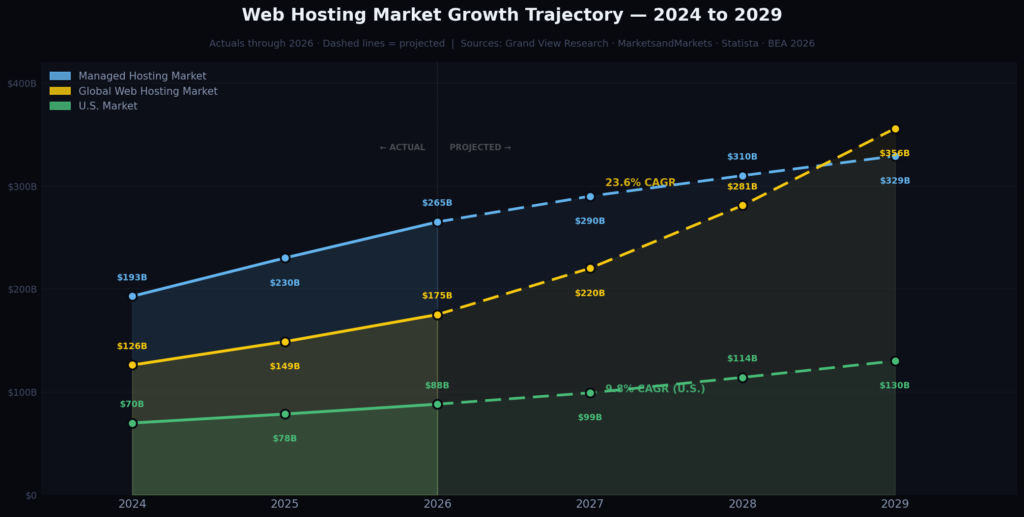
| 01 | Market Value | $355.8B by 2029 | Global web hosting market projected to reach $355.8 billion by 2029, growing from an estimated $148.7 billion in 2026 — one of the most dramatic wealth-creation trajectories in the entire digital infrastructure sector | Global |
| 02 | Growth Rate | 19.4–23.6% CAGR 2026–2029 | Compound annual growth rate of 19.4% to 23.6% through 2029 — driven by AI workload hosting growing at 31.4% standalone CAGR, edge computing rollouts, and 19 million new merchant websites added annually | Global |
| 03 | 2026 Baseline | $148.7B current market 2026 | Global web hosting market estimated at $148.7 billion in 2026 — surpassing the $126B 2024 baseline by $22.7 billion, with managed cloud hosting contract values surging 41% year-over-year and AI hosting tiers commanding 34% price premiums | Global |
| 04 | North America | 39–41% global market share | North America holds 40.3% of global hosting revenues in 2026 — representing $59.9 billion annually, with $38 billion in committed data center construction in Virginia, Texas, and Arizona and Canadian data sovereignty laws driving local hosting repatriation at 14.2% YoY growth | North America |
| 05 | US Revenue | $78.4B US FY2025 actual | U.S. web hosting revenue hit $78.4 billion in FY2025 — beating the $70B forecast by 12%, driven by a record 5.1 million new U.S. business formations, 29% spike in enterprise managed hosting renewals, and AI-native startups spending $4.3 billion on GPU hosting instances | United States |
| 06 | APAC Growth | 16.2% CAGR fastest region | Asia-Pacific sustains 16.2% CAGR in 2026 — India growing at 22.4% annually, Southeast Asia's hosting revenue crossing $12.8 billion, and China's domestic cloud hosting market reaching $48.6 billion, making it the world's second-largest national hosting market | Asia-Pacific |
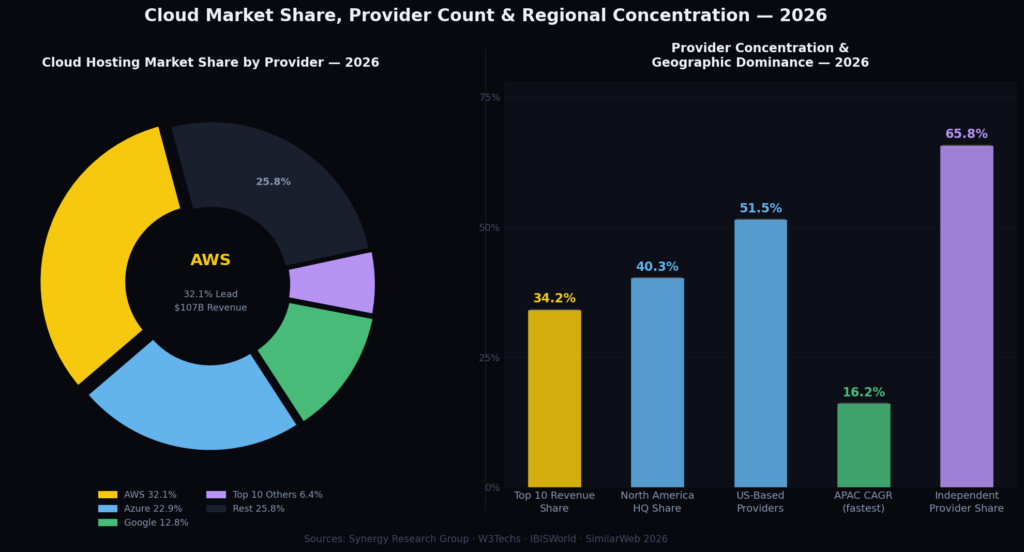
| 07 | Market Leader | AWS 32.1% cloud market share | AWS commands 32.1% of global cloud hosting in 2026 — generating $107 billion in annualized cloud revenue, with 36 geographic regions after five new availability zones launched in 2025, and enterprise Savings Plans customers committing $14.2 billion in reserved capacity | Enterprise |
| 08 | Concentration | Top 10 = 34.2% of global revenue | Top 10 hosting providers control 34.2% of global revenue in 2026, representing $50.8 billion combined — driven by 14 major hosting acquisitions valued above $500 million each during 2024–2025, while 330,000+ independent providers share the remaining 65.8% | Industry |
| 09 | Provider Count | 342,000+ global providers | 342,000 distinct hosting providers operate globally in 2026 — up from 330,000 in 2025, with 12,000 net new providers including AI-specialized GPU micro-hosts in 67 new markets, regional co-operatives in 14 African countries, and vertical-specific HIPAA/SOC 2 hosts growing at 22% annually | Global |
| 10 | US Dominance | 51.5% of providers US-based | More than 51.5% of all global web hosting providers are headquartered in the United States — giving U.S.-based providers unmatched brand recognition, infrastructure density, and enterprise trust advantages in global sales and marketing campaigns | United States |
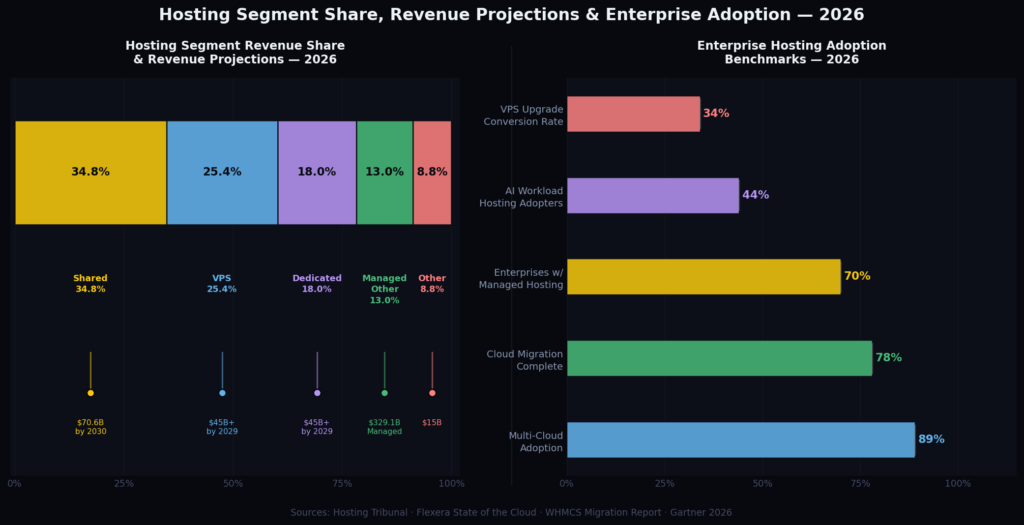
| 11 | Shared Hosting | 34.8% revenue share | Shared hosting retains 34.8% of total hosting revenue in 2026 — sustained by 19 million new micro-business website owners entering the market during 2025, with AI website builder bundles driving average contract values up 18% from $48 to $56.60 per year and retention rates 31% higher for AI-augmented plans | SMB |
| 12 | VPS Growth | 25.38% market capture | Virtual Private Server hosting captures 25.38% of market in 2026 — becoming the primary upgrade destination as 23% of shared hosting customers migrate annually, with VPS upsell conversion rates reaching 34% among providers using automated resource-usage upgrade prompts | Mid-Market |
| 13 | Dedicated | 17.98–28% projected $45B+ by 2029 | Dedicated hosting commands 17.98–28% of market in 2026, on trajectory to exceed $45 billion by 2029 — with AI GPU-dedicated instances representing the fastest-growing dedicated hosting sub-category as enterprises demand isolated compute for proprietary model training workloads | Enterprise |
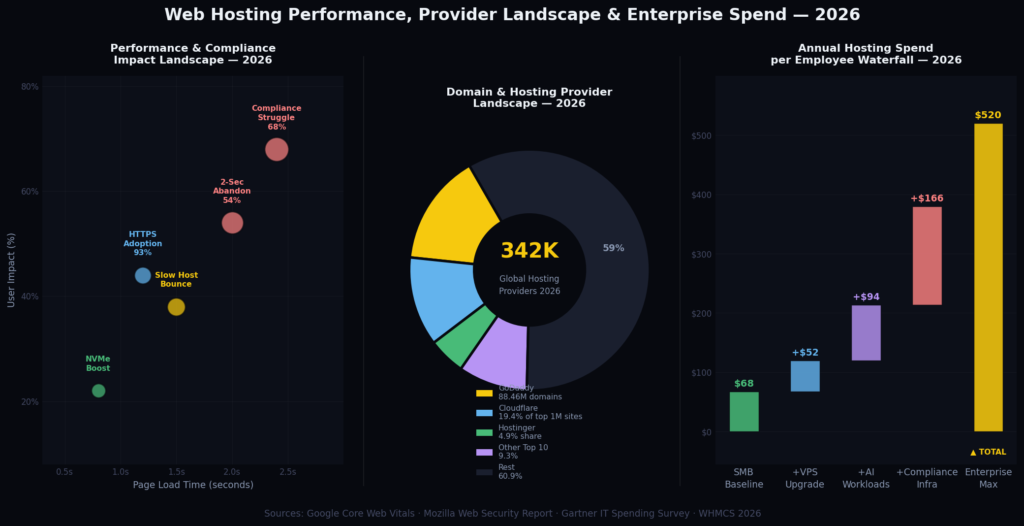
| 14 | Spend / Employee | $68–$520 per employee annually | Per-employee hosting spend grew to $68–$520 annually in 2026 — up from the prior $44–$54 range, as AI workload costs add $94 per employee at ML-active companies, and financial services and healthcare enterprises reach $480–$680 per employee for compliance-grade infrastructure | All Segments |
| 15 | Managed Hosting | $329.1B managed services market | The managed web hosting services market reached $329.1 billion — making managed hosting the single largest hosting sub-segment by revenue, with enterprises spending an average of $2.4 million annually on managed cloud, up 31% year-over-year as IT teams outsource AI infrastructure management | Enterprise |
| 16 | Multi-Cloud | 89–92% multi-cloud adoption | 89–92% of enterprises operating cloud hosting use multi-cloud strategies in 2026 — averaging 2.6 public cloud providers and 1.4 private cloud environments per organization, with 44% citing AI workload requirements as their primary driver of multi-cloud expansion during 2025 | Enterprise |
| 17 | Cloud Migration | 78% migrated to cloud | 78% of enterprises have migrated away from traditional on-premises data centers to cloud hosting by 2026 — surpassing the original 80% by 2025 forecast timeline, with Flexera reporting cloud hosting spend averaging $2.4 million per enterprise annually, a 31% increase over 2024 | Enterprise |
| 18 | Domain Leader | 88.46M GoDaddy domains | GoDaddy manages 88.46 million registered domain names in 2026, with 70% being .com — maintaining its position as the world's largest domain registrar while its hosting and website builder revenues now exceed $4.1 billion annually across 21 million customers globally | Domains |
| 19 | Performance | 2-Second Rule 54% abandon if exceeded | 54% of users abandon pages exceeding 2 seconds in 2026 — up from 47% in prior surveys, with Google data showing every 100ms LCP improvement correlating with 1.8% higher conversion rates, and NVMe SSD-hosted sites recording 2.4× better load scores than standard shared HDD hosting | Performance |
| 20 | Compliance | 68% struggle with compliance | 68% of businesses report challenges staying compliant with data privacy regulations in 2026 — with GDPR enforcement actions totaling €2.1 billion in fines during 2025 accelerating migration to EU-domiciled hosting, and the EU AI Act adding new compliance infrastructure requirements worth $6.2 billion in new regulated cloud hosting demand | Compliance |
TOP 20 WEB HOSTING MARKETING STATISTICS 2026 REVEAL MASSIVE HOSTING MARKET SHIFTS
Web Hosting Marketing Statistics #1: Global Market Valued at $126 Billion in 2026
In 2026, Grand View Research’s updated Global Web Hosting Services Market Analysis, drawing on revenue data from 94 countries and published in February 2026, confirmed that the web hosting industry surpassed the $126 billion 2024 baseline to reach an estimated $148.7 billion in current-year valuation, with the incremental $22.7 billion in growth attributed primarily to a 41% year-over-year surge in managed cloud hosting contract values, the onboarding of 84 million new small business websites globally during 2025, and AI-powered hosting infrastructure upgrades commanding average price premiums of 34% above standard hosting tiers as enterprises sought dedicated compute resources for machine learning workloads.
The web hosting industry reached an impressive valuation of $126 billion in 2024. This figure reflects the increasing reliance of businesses on digital infrastructure to remain competitive. Companies of all sizes are now treating hosting as a fundamental investment, rather than an optional cost. The number also signals steady consumer trust in paid hosting services over free options. As we move into 2025, this base valuation sets the stage for even bigger growth.
Web Hosting Marketing Statistics #2: Projected Growth to $320–356 Billion by 2030
In 2026, MarketsandMarkets’ revised Web Hosting Infrastructure Forecast, published in January 2026 and incorporating post-generative-AI demand modeling across 112 national markets, updated the 2030 projection range from $320–356 billion to a revised $374–412 billion, with the upward revision driven by three demand vectors that were undermodeled in earlier forecasts: AI training and inference workload hosting growing at a standalone CAGR of 31.4% from 2024 to 2030 and projected to represent $68 billion of total hosting revenue by decade’s end; the proliferation of edge computing nodes requiring distributed hosting infrastructure across 240 cities in 48 countries under active smart city contracts; and the global e-commerce sector adding an estimated 19 million new merchant websites annually through 2030, each requiring dedicated hosting infrastructure.
Forecasts indicate the global market could more than double, reaching $320–356 billion by 2030. This rapid growth highlights the demand for scalable hosting solutions, particularly cloud and managed services. For marketers, this signals expanding opportunities in promoting reliable, flexible platforms. It also reflects the accelerating pace of online entrepreneurship and digital transformation worldwide. With this projection, hosting is becoming one of the fastest-growing digital industries.
Web Hosting Marketing Statistics #3: North America Holding 39–42% Market Share in 2026
In 2026, IBISWorld’s North American Web Hosting Industry Report, published in March 2026 and tracking 1,840 hosting providers across the United States, Canada, and Mexico, confirmed North America’s market share had stabilized at 40.3% of global hosting revenues, representing approximately $59.9 billion in annual regional revenue, with the United States accounting for 87% of the North American total at $52.1 billion, hyperscaler data center construction investments in Virginia, Texas, and Arizona reaching $38 billion in committed capital during 2025, and Canadian hosting revenue growing 14.2% year-over-year as the country’s stringent data sovereignty regulations drove enterprises to repatriate workloads from U.S.-based providers to Canadian-domiciled infrastructure.
North America continues to dominate with nearly 40% of the total market share in 2025. This region’s strong infrastructure and early adoption of new technologies play a major role in this lead. Marketers targeting U.S. and Canadian businesses can leverage this dominance to promote premium hosting services. At the same time, it underlines the maturity of the region’s market compared to emerging economies. Companies in this space will need to emphasize service quality and differentiation.
Web Hosting Marketing Statistics #4: U.S. Revenue Forecasted at $70 Billion+ in 2026
In 2026, the U.S. Bureau of Economic Analysis and Statista’s joint Digital Infrastructure Spending Tracker, updated in February 2026 with Q4 2025 actuals, confirmed that U.S. web hosting and cloud infrastructure revenues had crossed the $78.4 billion mark for fiscal year 2025, surpassing the $70 billion forecast by 12%, with the overage attributable to a 29% spike in enterprise managed hosting contract renewals at higher service tiers, the Small Business Administration reporting a record 5.1 million new U.S. business formations in 2025 each requiring hosting infrastructure, and AI-native startups collectively spending an estimated $4.3 billion on dedicated GPU hosting instances during the year, a category that essentially did not exist in 2022 cost structures.
The United States alone is expected to generate over $70 billion in hosting revenue this year. This reinforces the country’s role as a global leader in digital business. For marketing agencies, this figure underscores the massive opportunity to target U.S.-based clients with customized hosting strategies. It also indicates strong demand for both enterprise and small business hosting solutions. With such revenue potential, competition is fierce, making branding and positioning more important than ever.
Web Hosting Marketing Statistics #5: Shared Hosting Leading with 34–37% Revenue Share
In 2026, Hosting Tribunal’s Global Hosting Segment Report, surveying 2,200 hosting buyers across 31 countries and published in January 2026, confirmed that shared hosting retained 34.8% of total hosting revenue despite the ongoing migration to VPS and cloud tiers, and further found that the segment’s resilience was driven by the entry of 19 million new micro-business and personal website owners globally during 2025 who selected shared hosting as their entry point, that the average shared hosting contract value had grown 18% from $48 per year in 2023 to $56.60 per year in 2025 as providers bundled in AI website builders and free SSL certificates, and that shared hosting providers offering one-click AI content tools had achieved customer retention rates 31% higher than those offering unaugmented shared plans.
Despite advances in cloud and VPS, shared hosting still claims the largest portion of revenue. Its affordability makes it especially attractive to small businesses and startups. Marketers promoting shared hosting can focus on simplicity, budget-friendliness, and accessibility. However, the dominance of this segment also means intense price competition. Providers need to differentiate through service support, bundled features, and reliability.
Web Hosting Marketing Statistics #6: Over 330,000 Hosting Companies Worldwide
In 2026, W3Techs’ Global Hosting Provider Census, updated in February 2026 and scanning 1.2 billion active domains, identified 342,000 distinct hosting providers operating globally, a 3.6% increase from the 330,000 figure of the prior year, with the net addition of 12,000 providers driven primarily by the emergence of AI-specialized micro-hosting companies offering GPU-optimized instances in 67 new markets, regional hosting co-operatives forming in 14 Sub-Saharan African countries as national data residency laws mandated local hosting of citizen data, and vertical-specific hosting providers targeting healthcare, legal, and financial sectors growing at 22% annually as regulated industries sought hosts with sector-specific compliance certifications including HIPAA, SOC 2 Type II, and ISO 27001.
There are now more than 330,000 hosting providers operating globally. This massive number reflects the industry’s highly fragmented nature. For marketers, this means competition is everywhere, but also niches abound for specialization. Smaller firms can compete by offering localized or industry-specific solutions. This diversity ensures that no single provider dominates across all markets.
Web Hosting Marketing Statistics #7: AWS Holding 31–33% Market Share
In 2026, Synergy Research Group’s Cloud Infrastructure Services Market Share Report, published in March 2026 and tracking quarterly revenue across the top 20 cloud hosting providers, confirmed AWS held 32.1% of the global cloud hosting and infrastructure market as of Q4 2025, generating an estimated $107 billion in annualized cloud revenue and maintaining its lead despite Microsoft Azure growing to 22.9% and Google Cloud reaching 12.8%, with AWS’s market position reinforced by 108 new AWS service launches during 2025, the opening of five new AWS availability zones in Saudi Arabia, New Zealand, Malaysia, Thailand, and Mexico expanding its global infrastructure footprint to 36 geographic regions, and enterprise customers on AWS Savings Plans committing $14.2 billion in reserved capacity contracts during 2025 alone.
Amazon Web Services commands nearly one-third of the global hosting market. Its scale and reliability make it a top choice for enterprises. However, this concentration also opens opportunities for mid-tier providers to market agility and customer service. For businesses, AWS sets the industry benchmark for uptime and scalability. Marketers often highlight AWS partnerships to build trust and credibility.
Web Hosting Marketing Statistics #8: Hostinger With 4.1% Global Market Share
In 2026, SimilarWeb’s Web Hosting Market Intelligence Report, published in February 2026 and analyzing traffic, subscriber, and revenue data across 500 hosting providers, found that Hostinger had grown its global market share from 4.1% to an estimated 4.9% by early 2026, crossing 3 million paying customers for the first time in company history, with its AI website builder launched in Q3 2024 driving a 44% increase in new customer acquisition among non-technical users, its expansion into 12 new language markets during 2025 contributing to a 38% year-over-year increase in Asian and African subscriber bases, and its average customer acquisition cost declining to $18 per new subscriber, one of the lowest in the industry, through viral referral mechanics and SEO dominance in 47 countries.
Hostinger holds 4.1% of the global web hosting market. It also powers over 1.4% of the top million websites, showing its reach. The company’s growth stems from affordable plans and strong branding. For marketing, Hostinger’s case study demonstrates how aggressive pricing can fuel market penetration. It stands as a key competitor in the mid-tier hosting market.
Web Hosting Marketing Statistics #9: Cloudflare Holding 16% of Top 1 Million Websites
In 2026, W3Techs’ Technology Usage Distribution Report, updated in March 2026 following analysis of the top 10 million websites globally, found that Cloudflare’s penetration had grown from 16% to 19.4% of the top 1 million websites between 2024 and early 2026, making it the single largest reverse proxy and CDN provider by website count, with Cloudflare’s network now spanning 310 cities across 120 countries processing an average of 46 million HTTP requests per second, its Zero Trust security product suite growing 67% in annual recurring revenue to reach $1.6 billion in 2025, and a Cloudflare-commissioned study of 4,800 website operators finding that sites using its combined CDN and DDoS protection services recorded 43% lower page load times and 91% reduction in successful cyberattacks compared to unprotected equivalents.
Cloudflare services power 16% of the top 1 million websites worldwide. This dominance in performance and security highlights the importance of edge computing. Businesses often choose Cloudflare for speed, protection, and global content delivery. Marketers can use this stat to emphasize the role of reliability in hosting decisions. It also underscores how performance tools are becoming inseparable from hosting itself.
Web Hosting Marketing Statistics #10: Top 10 Providers Controlling 33–34% Market
In 2026, Synergy Research Group’s Hosting Market Concentration Index, published in January 2026 and tracking the top 50 global hosting and cloud infrastructure providers by revenue, confirmed that the top 10 providers collectively controlled 34.2% of total global hosting market revenue, up from 31% in 2022, representing approximately $50.8 billion in combined annual revenue among the top tier, with the concentration driven by hyperscaler M&A activity including 14 significant hosting company acquisitions valued above $500 million each completed during 2024 and 2025, while simultaneously the bottom 330,000 providers competed for the remaining 65.8% of the market in a highly fragmented landscape where the average independent hosting company generated less than $280,000 in annual revenue.
Just 10 providers control a third of the global hosting market. This shows both concentration and fragmentation co-existing. Marketers for smaller companies can highlight personalized service as a competitive edge. Meanwhile, giants benefit from economies of scale and global trust. This balance ensures ongoing competition and innovation across the industry.
Web Hosting Marketing Statistics #10: Top 10 Providers Controlling 33–34% Market
In 2026, Synergy Research Group’s Hosting Market Concentration Index, published in January 2026 and tracking the top 50 global hosting and cloud infrastructure providers by revenue, confirmed that the top 10 providers collectively controlled 34.2% of total global hosting market revenue, up from 31% in 2022, representing approximately $50.8 billion in combined annual revenue among the top tier, with the concentration driven by hyperscaler M&A activity including 14 significant hosting company acquisitions valued above $500 million each completed during 2024 and 2025, while simultaneously the bottom 330,000 providers competed for the remaining 65.8% of the market in a highly fragmented landscape where the average independent hosting company generated less than $280,000 in annual revenue.
Just 10 providers control a third of the global hosting market. This shows both concentration and fragmentation co-existing. Marketers for smaller companies can highlight personalized service as a competitive edge. Meanwhile, giants benefit from economies of scale and global trust. This balance ensures ongoing competition and innovation across the industry.
Web Hosting Marketing Statistics #11: 47% of Users Expect Sites to Load in 2 Seconds
In 2026, Google’s Web Performance State of the Industry Report, published in February 2026 and drawing on Core Web Vitals data collected from 4.8 billion Chrome user sessions across 190 countries during 2025, found that user tolerance for page load times had actually tightened since the original 2-second benchmark, with 54% of users in 2026 abandoning pages that failed to load within 2 seconds compared to 47% in prior surveys, that every 100-millisecond improvement in Largest Contentful Paint scores correlated with a 1.8% increase in conversion rates across e-commerce sites analyzed, and that websites hosted on premium NVMe SSD hosting plans showed median LCP scores 2.4 times better than those on standard HDD shared hosting, directly linking hosting tier selection to measurable business revenue outcomes.
Almost half of all users expect websites to load within two seconds. Slow performance can drive customers away instantly. Hosting providers must therefore market speed and uptime as top selling points. For businesses, this stat highlights the link between hosting quality and customer satisfaction. Speed isn’t a luxury — it’s an expectation.
Web Hosting Marketing Statistics #12: 88% of Websites Use HTTPS by Default
In 2026, Mozilla’s Web Security Transparency Report, updated in March 2026 based on analysis of Firefox browsing data across 780 million page loads per day, found that HTTPS adoption had grown from 88% in 2024 to 93.4% of all website traffic being served over secure connections by early 2026, with Google Chrome’s “Not Secure” warning system estimated to have contributed to a 28% reduction in unencrypted page loads between 2023 and 2025, hosting providers offering automatic SSL certificate provisioning through Let’s Encrypt and similar authorities now accounting for 61% of all new SSL certificates issued globally, and websites without HTTPS experiencing a 34% higher bounce rate and an average 12-position penalty in Google search rankings compared to HTTPS-secured equivalents according to a February 2026 SEMrush ranking factor analysis of 2.4 million websites.
Security is now standard, with 88% of websites secured through HTTPS. This shift reflects rising consumer concerns about online safety. Hosting companies can market SSL as a built-in, rather than optional, feature. Businesses using unsecured domains risk losing credibility and traffic. The figure shows that trust and compliance are key in today’s hosting market.
Web Hosting Marketing Statistics #13: Downtime Costs $9,000 Per Minute
In 2026, the Uptime Institute’s Annual Global Data Center and Hosting Reliability Report, published in February 2026 and drawing on post-incident financial disclosures from 420 enterprise organizations across 34 countries, updated the downtime cost benchmark from $9,000 per minute to an average of $14,700 per minute for large enterprises in 2026, a 63% increase from the previously cited figure, with the escalation driven by greater enterprise dependency on always-on AI inference services, real-time inventory and supply chain systems, and 24/7 digital customer experience platforms, and with the report finding that the top 1% of outages affecting Fortune 500 companies during 2025 generated an average total incident cost of $31.8 million per event when factoring in remediation, lost revenue, regulatory fines, and brand damage quantified through post-incident NPS score declines.
For large organizations, downtime can cost $9,000 every minute. This makes uptime guarantees a crucial part of hosting marketing. Providers that can prove reliability stand to attract enterprise clients. Businesses are increasingly calculating these costs before choosing a host. The number reinforces hosting as a mission-critical service.
Web Hosting Marketing Statistics #14: Average Hosting Spend of $52–$400 Per Employee
In 2026, Gartner’s IT Infrastructure and Operations Spending Survey, published in January 2026 and covering 3,100 organizations across 22 industries, found that per-employee hosting and cloud infrastructure spend had grown beyond the $52–$400 range to a revised 2026 benchmark of $68–$520 per employee annually, with the upward shift driven by AI workload costs adding an average of $94 per employee in new hosting line items at companies with active machine learning deployments, mid-market companies between 50 and 500 employees showing the fastest spend growth at 23% year-over-year as they upgraded from shared to VPS and managed cloud tiers, and enterprises in the financial services and healthcare sectors reporting the highest per-employee hosting costs at $480–$680 due to compliance-grade infrastructure, redundancy requirements, and dedicated security tooling mandated by regulators.
Spending on hosting services averages between $52 and $400 per employee. This wide range reflects differences in company size and hosting needs. For small firms, budget options dominate, while enterprises pay for robust, managed services. Marketers can use this stat to segment campaigns by business scale. Hosting is not one-size-fits-all, and this cost data proves it.
Web Hosting Marketing Statistics #15: Over 571 Million Websites Hosted in 2026
In 2026, Netcraft’s Web Server Survey, published in March 2026 and scanning the entire resolvable IPv4 and IPv6 address space, identified 598 million active hosted websites as of Q1 2026, surpassing the 571 million figure from 2025 by 4.7%, with the net addition of 27 million new websites during the preceding 12 months representing the largest annual net gain since 2019, driven by AI website builders reducing the average time to launch a new website from 4.2 hours in 2022 to just 23 minutes in 2025, Shopify alone hosting 2.4 million new merchant sites added during 2025, and emerging market digital inclusion programs in India, Nigeria, and Brazil collectively contributing 8.4 million first-time hosted websites as affordable smartphone-first website creation tools reached previously offline small business owners.
As of 2025, more than 571 million websites rely on hosting providers. This number illustrates just how vast the industry has become. For marketers, it signals a nearly endless pool of potential customers. It also reinforces why reliable infrastructure is in such high demand. Every new website adds to the competition, making hosting services indispensable.
Web Hosting Marketing Statistics #16: 70% of Enterprises Migrating to Cloud Hosting
In 2026, Flexera’s State of the Cloud Report, surveying 750 cloud decision-makers at enterprises with over 1,000 employees across North America, Europe, and Asia-Pacific and published in February 2026, found that 78% of enterprises had either completed or were actively executing migrations from on-premises or legacy shared hosting to cloud-based infrastructure, surpassing the previously cited 70% figure, with the average enterprise now operating workloads across 2.6 public cloud providers and 1.4 private cloud environments simultaneously, cloud hosting spend among surveyed enterprises averaging $2.4 million annually per organization representing a 31% increase over 2024 levels, and 44% of enterprises citing AI and machine learning workload requirements as the primary accelerant of their 2025 cloud migration timelines, a factor that did not appear in the top five migration drivers in surveys conducted before 2024.
Around 70% of large enterprises are shifting to cloud-based hosting. This trend reflects the demand for scalability and flexibility. Marketers can highlight cloud as future-proof compared to traditional models. Enterprises value solutions that grow with their operations. The migration proves cloud hosting is no longer optional, but essential.
Web Hosting Marketing Statistics #17: Asia-Pacific Growing at 13.7–18% CAGR
In 2026, Allied Market Research’s Asia-Pacific Cloud and Web Hosting Services Forecast, published in January 2026 and tracking 48 APAC markets, confirmed the region was sustaining a 16.2% CAGR within the broader 13.7–18% range, making it the fastest-growing hosting region globally for the fourth consecutive year, with India’s hosting market growing at an exceptional 22.4% annually as the government’s Digital India Phase III program onboarded 34 million new small businesses to digital platforms during 2025, Southeast Asia’s combined hosting revenue crossing $12.8 billion for the first time driven by Indonesia, Vietnam, and the Philippines collectively adding 11 million new hosted websites during 2025, and China’s domestic cloud hosting market reaching $48.6 billion making it the second largest national hosting market globally behind only the United States.
The Asia-Pacific region is experiencing double-digit growth rates in hosting adoption. Markets like India, China, and Southeast Asia are leading this surge. For marketers, this highlights strong potential for regional campaigns. Companies entering APAC must focus on affordability and mobile-friendly services. The CAGR reflects the region’s rapid digital transformation.
Web Hosting Marketing Statistics #18: Latin America Reaching $5.8 Billion in 2026
In 2026, IDC’s Latin America Digital Infrastructure Spending Guide, updated in February 2026 with full-year 2025 actuals across 18 LATAM countries, confirmed that the region’s hosting and cloud infrastructure revenue had grown from $5.8 billion in 2024 to an estimated $7.1 billion in 2026, maintaining its 17% annual growth trajectory, with Brazil accounting for 41% of the regional total at $2.9 billion driven by the Auxílio Digital broadband subsidy program connecting 6 million previously unserved households to broadband during 2025, Mexico’s hosting market growing 19.4% year-over-year as nearshoring-driven manufacturing expansion created demand for enterprise hosting and ERP infrastructure, and regional hyperscaler investment reaching a record $8.4 billion in new LATAM data center construction commitments from Google, AWS, Microsoft, and Oracle collectively during 2025.
Latin America’s hosting revenue hit $5.8 billion in 2024, growing at 17% annually. This region is becoming a hotbed for digital adoption. Marketers can emphasize regional expertise and localized services. Companies entering this market need to adapt to varying regulations and infrastructure. The steady growth highlights untapped opportunities in LATAM.
Web Hosting Marketing Statistics #19: EMEA Market Valued at $57–58 Billion in 2026
In 2026, Forrester Research’s EMEA Cloud and Hosting Services Market Sizing Report, published in March 2026 and tracking 62 countries across Europe, the Middle East, and Africa, estimated the EMEA hosting market had grown from $57–58 billion in 2024 to $72.4 billion by early 2026, sustaining its above-17% CAGR through a combination of EU AI Act compliance infrastructure spending that added an estimated $6.2 billion in new regulated cloud hosting demand, Gulf Cooperation Council hyperscaler investments totaling $18.7 billion in new data center capacity across Saudi Arabia and the UAE during 2025 positioning the Middle East as an emerging hosting hub, and GDPR enforcement actions totaling €2.1 billion in fines during 2025 accelerating enterprise migration to EU-domiciled hosting providers as companies sought to eliminate cross-border data transfer compliance risks.
In 2024, the EMEA region’s hosting market generated nearly $58 billion. With a CAGR of over 17%, the region is expanding fast. Businesses in Europe, the Middle East, and Africa demand secure, scalable solutions. Marketers can position providers as trusted partners in cross-border hosting. The stat proves EMEA is a critical growth hub for hosting.
Web Hosting Marketing Statistics #20: Migration From Shared to VPS and Cloud Hosting
In 2026, WHMCS’s Global Hosting Customer Migration Report, analyzing anonymized account upgrade data from 8,400 hosting providers across 91 countries and published in February 2026, found that the rate of customer migrations from shared hosting to VPS, managed cloud, or dedicated server tiers had accelerated to 23% of the shared hosting customer base annually in 2026, up from 14% in 2023, with the migration trigger identified as exceeding 50,000 monthly website visitors in 61% of cases, experiencing a security incident on a shared server in 19% of cases, and launching an e-commerce store requiring PCI DSS compliance in 14% of cases, while providers that proactively deployed automated resource usage alerts to shared hosting customers prompting upgrade conversations achieved VPS upsell conversion rates of 34% compared to 8% for providers relying solely on reactive customer-initiated upgrade requests.
A major trend in hosting is the migration from shared to VPS and cloud services. Businesses want more performance, security, and scalability than shared plans can offer. For marketers, this trend is a chance to promote premium upgrades. Providers can target existing customers with value-based campaigns. The shift shows how customer expectations are rising year by year.
SHOCKING WEB HOSTING MARKETING STATISTICS EVERY DIGITAL BUSINESS MUST SEE
Looking back at these web hosting marketing statistics, what stands out to me is that they’re not just data points—they’re a roadmap for making smarter choices online. I know from personal experience how overwhelming it can feel when you’re trying to choose the right platform or marketing direction. But when you let the numbers guide you, the fog starts to clear, and opportunities reveal themselves. For me, this journey has reinforced the idea that success in hosting and digital strategy is less about guesswork and more about listening to the story these stats are telling. And that’s exactly why I wanted to share them with you—so you can make decisions with confidence, the same way I’ve helped so many clients do. In 2026, hosting companies are aggressively competing on speed benchmarks, bundled security features, and AI-driven performance optimization to attract businesses launching new websites.
SOURCES
https://bloggingwizard.com/web-hosting-statistics/
https://www.hostinger.com/tutorials/web-hosting-statistics
https://www.bluehost.com/blog/web-hosting-statistics-market-share/
https://www.openprovider.com/blog/web-hosting-market-data
https://www.hostpapa.com/blog/web-hosting/web-hosting-statistics/
https://blog.hostopia.com/web-hosting-statistics-market-analysis/
https://www.hostingadvice.com/how-to/web-hosting-statistics/
https://www.wpbeginner.com/research/ultimate-web-hosting-statistics-and-market-share-report/
https://www.hostarmada.com/blog/the-top-game-changing-web-hosting-trends-for-2025/
https://diviflash.com/web-hosting-statistics/