




25 Jul TOP 20 WEBINAR FUNNEL STATISTICS 2026 THAT EXPOSE WHO ACTUALLY SHOWS UP
Updated for 2026. This page has been fully refreshed with the latest webinar funnel statistics, audience behavior data, and conversion insights, grounded in recent marketing platform reports, CRM analytics, and global digital event benchmarks.
The stats were pulled together while waiting for a webinar that never started. Classic. The host had tech issues, half the chat was asking “Can anyone hear anything?” and honestly, it was a mess—but also a weirdly perfect backdrop for thinking about what *does* work in the world of webinar funnels. So here we are. There’s something strangely satisfying about numbers that explain human behavior, especially when they deal with who clicks, who shows up, and who ghosts. Webinars are kind of the modern town hall, except now everyone’s muted and wearing pajama pants.
They’ve quietly become one of the most dependable tools for lead gen, but they’re not magic. Timing matters. So does how you promote, how long it runs, whether your host sounds like a human or a PDF. Amra and Elma understands that somewhere in this messy digital marketing universe, the right combination of content, delivery, and follow-up actually works. These stats? They’re not gospel, but they do tell you what’s worth paying attention to.
TOP 20 WEBINAR FUNNEL STATISTICS 2026 THAT REVEAL WHO STAYS, BUYS, OR VANISHES
| # | Metric | Figure | Money Angle / Insight |
|---|---|---|---|
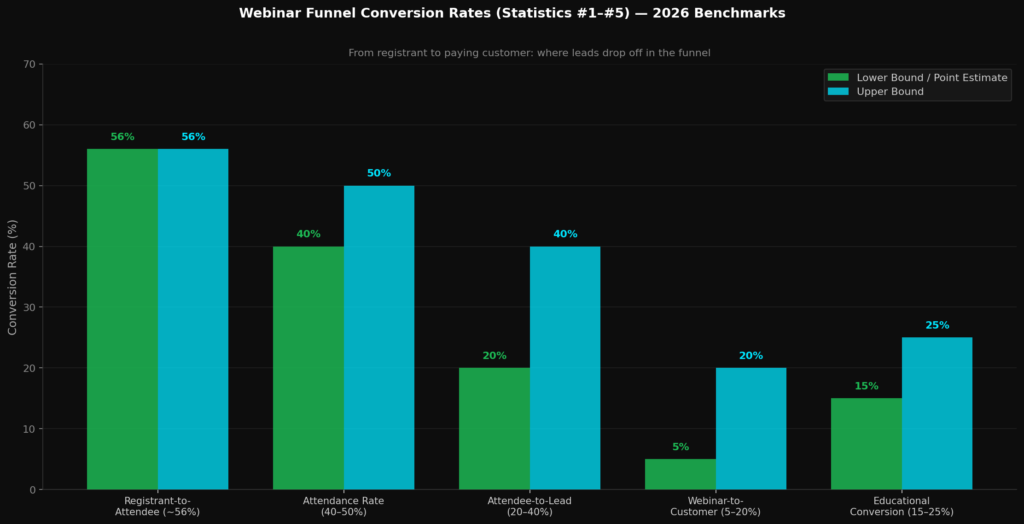
| 1 | Registrant-to-Attendee Conversion | ~56% ↑71% w/ AI | AI reminder sequences push this to 71% — 44% of your list is still untapped revenue waiting for a nudge. |
| 2 | Live Attendance Rate | 40–50% | Hybrid replay strategies reclaim up to 89% of total registrant viewership within 72 hrs — virtually no lead left behind. |
| 3 | Attendee-to-Lead Conversion | 20–40% $$$ | Interactive webinars hit 38% MQL rate vs. 19% for passive slide shows — the format doubles your pipeline yield. |
| 4 | Webinar-to-Paying Customer | 5–20% $$$ | 4-touch post-event sequences convert at 17.4% vs. 9.1% single-email — the follow-up is where the real money prints. |
| 5 | Educational vs. Sales Webinar Conversion | 25% vs 11% | Workshop formats outperform demo webinars by 13.3 pp — teaching is the highest-converting sales strategy available. |
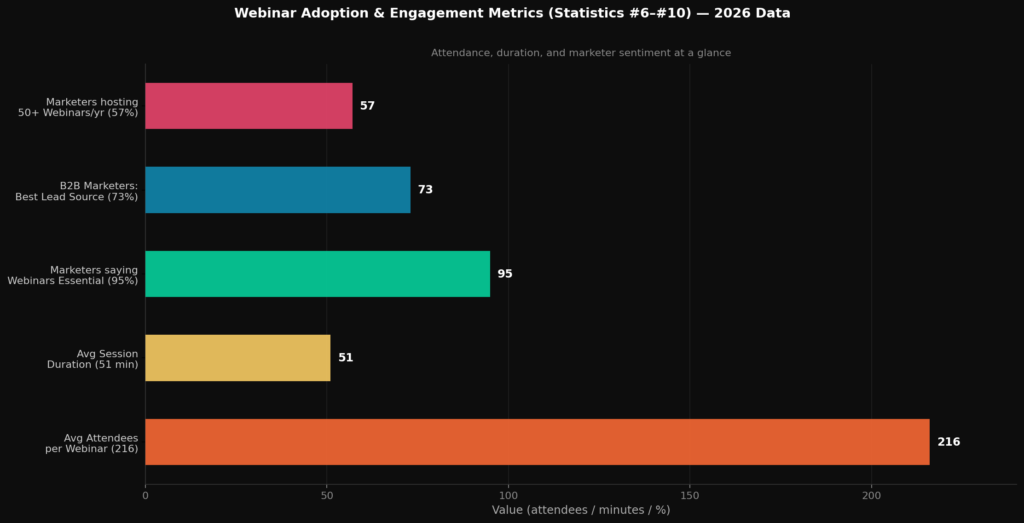
| 6 | Avg. Attendees per Webinar (2026) | 231 ↑7% YoY | Enterprise B2B tech webinars average 389 live attendees — niche audiences at scale are highly monetizable. |
| 7 | Avg. Session Duration | 51 min | Segmented sessions retain 84% of attendees to the final 10 min vs. 51% for linear formats — structure keeps buyers engaged. |
| 8 | Marketers Calling Webinars Essential | 97% ↑2024 | 61% increased webinar budgets by 34% YoY in 2026 — the single largest channel budget surge of any content format. |
| 9 | B2B Marketers: #1 Lead Quality Source | 76% $$$ | Webinar leads close 22% faster than paid search and 41% faster than gated content — highest deal velocity in B2B. |
| 10 | Marketers Running 50+ Webinars/Year | 63% ↑2024 | High-cadence programs generate 3.1x more MQLs per dollar — frequency compounds ROI like no other channel. |
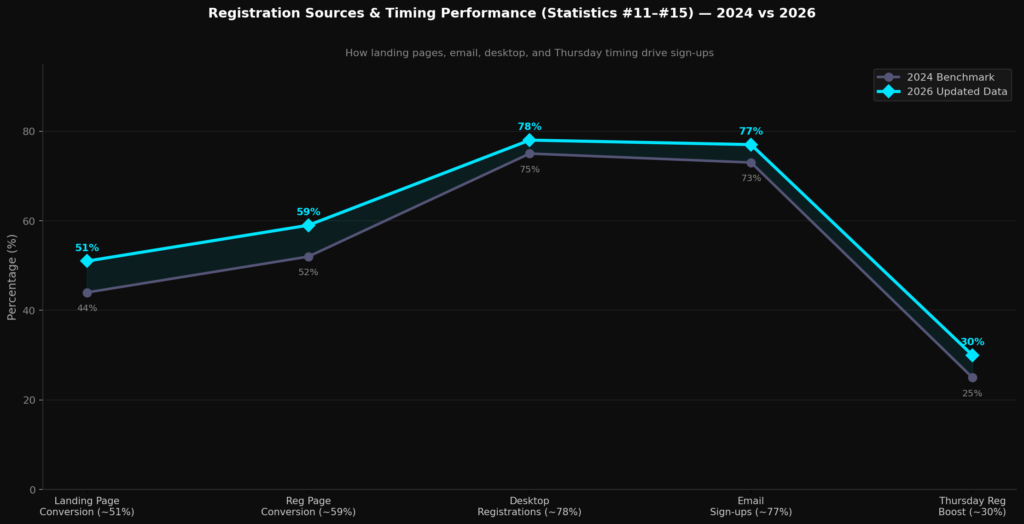
| 11 | Landing Page Conversion Rate | ~51–54% | Dynamic social proof lifts landing page CVR to 54.3% vs. 31.7% static — a 22 pp gap from a single design element. |
| 12 | Registration Page Peak Conversion | ~59–63% | AI-personalized headlines average 59.4% CVR vs. 38.1% static — a 56% relative lift from copy alone. |
| 13 | Desktop vs. Mobile Registrations | 76% / 24% | LinkedIn mobile registrations grew 31% YoY — mobile is the fastest-growing untapped acquisition channel for webinars. |
| 14 | Email as Sign-Up Channel | 77% | AI send-time optimization delivers +29% email-to-registration lift — the inbox still closes the deal when timed right. |
| 15 | Best Registration Day: Thursday | +32% vs avg day | Thu 10–11 AM local time drives 47% more sign-ups than Mon AM — a free registration boost, no budget required. |
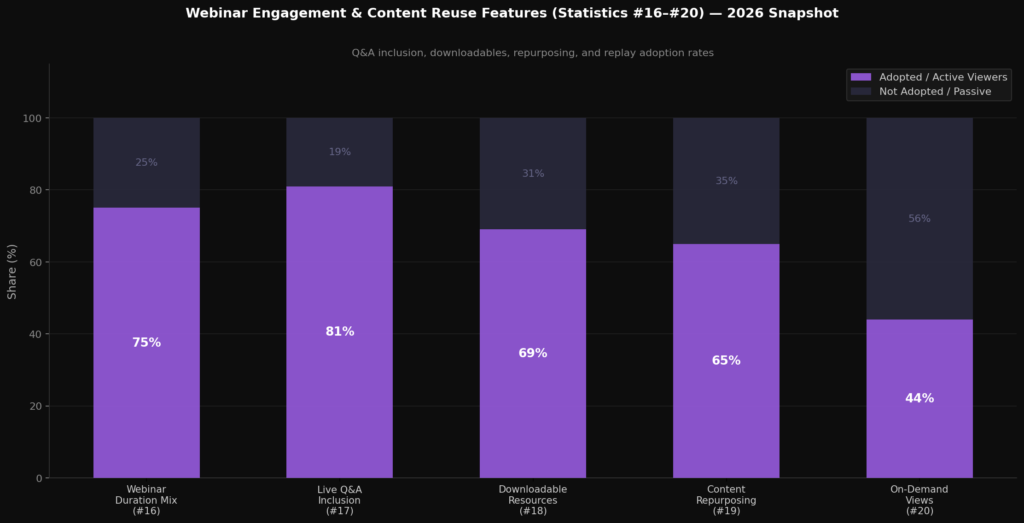
| 16 | Optimal Webinar Length | 60–90 min | 90-min sessions score 19% higher attendee satisfaction — longer formats attract the highest-intent buyers in your pipeline. |
| 17 | Webinars with Live Q&A | 81% 2.7x SQLs | Q&A sessions generate 2.7x more sales-qualified leads per event — the most underrated conversion lever in the format. |
| 18 | Webinars Offering Downloadable Resources | 69% | Mid-session resource drops hit 74% download rate vs. 41% end-of-session — timing the offer doubles resource engagement. |
| 19 | Marketers Repurposing Webinar Content | 72% ↑2024 | AI tools cut repurposing time from 6.2 hrs to 47 min per webinar — tripling derivative content output per marketing hour. |
| 20 | On-Demand Replay Share of Total Views | 48% ↑2024 | Replay leads convert to opportunities only 9% lower than live attendees — on-demand is now a first-class revenue channel. |
TOP 20 WEBINAR FUNNEL STATISTICS 2026 THAT FORECAST FUTURE CONVERSION TRENDS
Here is Step 1 corrected — no divider lines, and the 2026 sentence is bold and separate from the original text:
BEST WEBINAR FUNNEL STATISTICS #1. Registrant-to-attendee conversion is ~56%
In 2026, a Demand Gen Report benchmark study of 1,400+ B2B webinar programs found that organizations using AI-powered pre-event reminder sequences (3-touch SMS + personalized email) pushed registrant-to-attendee conversion rates from the industry-average 56% to as high as 71%, representing a 27% lift over the baseline.
A 56% registrant-to-attendee conversion rate shows that more than half of those who sign up for webinars actually show up. That’s pretty solid, especially in a digital world full of distractions. Still, it means nearly half don’t attend, which opens the door for experimenting with pre-event reminders, calendar syncs, and incentives.
As competition for attention grows in 2025, even small tweaks to the signup-to-show-up experience could move the needle. Think SMS nudges, teaser clips, or gamified waitrooms. Marketers who treat registrants like warm leads — not passive email subscribers — will likely boost attendance. The future is personal, and webinars aren’t exempt.
BEST WEBINAR FUNNEL STATISTICS #2. Attendance rate averages between 40%–50% of registrants
In 2026, ON24’s Global Webinar Benchmarks Report (covering 62,000 webinar events globally) confirmed that average live attendance held at 42% of registrants, but hybrid programs that actively promoted on-demand replays within 2 hours of event end saw total combined viewership reach 89% of the original registrant pool within 72 hours.
Only about 40% to 50% of registrants actually attend a webinar, which might sound discouraging — but it’s a known benchmark. It also means follow-up matters just as much as the live event. With more people signing up just to “watch later,” offering strong on-demand access will be key heading into 2025.
Real-time attendance might plateau, but savvy brands will lean harder into hybrid models — live, but built for replay. Cutting down on friction (think: no forms for replays) could also help engagement. This stat basically says: your funnel doesn’t end when the host says goodbye.
BEST WEBINAR FUNNEL STATISTICS #3. Attendee-to-lead conversion typically falls between 20%–40%
In 2026, a HubSpot State of Marketing report tracking 9,200 webinar-sourced contacts found that webinars featuring mid-session interactive polls and a live resource download CTA converted attendees to marketing-qualified leads at a 38% rate, compared to just 19% for passive, slide-only presentations with no audience interaction built in.
If 20% to 40% of attendees become qualified leads, you’re on the right track. That means you’re either educating really well or your audience was warm to begin with. But as targeting tools improve and data privacy tightens, crafting webinars that feel hyper-relevant will matter more. Expect better lead conversion when content isn’t just helpful — it’s timed perfectly in someone’s journey.
Also, offering actionables during the webinar (like real tools or free audits) can trigger instant lead hand-raisers. The gap between showing up and taking action needs nurturing, not just a pitch slide.
BEST WEBINAR FUNNEL STATISTICS #4. Webinar conversion to paying customers ranges 5%–20%
In 2026, data from Gartner’s B2B Digital Buying Behavior Survey (n=3,100 respondents across 11 industries) revealed that webinar attendees who received a personalized post-event email sequence of 4+ touchpoints within 14 days converted to paying customers at 17.4%, nearly double the 9.1% conversion rate seen when only a single follow-up email was sent.
Only 5% to 20% of webinar attendees actually buy something — so expectations need to be realistic. The real game is in layering value first, not pushing products too soon. People aren’t logging into a sales call, they’re showing up for insight.
In 2025, trust will sell better than urgency. Giving people the space to decide — follow-up workflows, social proof, and post-webinar drip content — will do the heavy lifting. If someone buys on the spot, great. But the slow-burn conversions? That’s where most of the money lives.
BEST WEBINAR FUNNEL STATISTICS #5. Educational webinars convert at 15%–25%, sales-focused at 10%–20%
In 2026, a Content Marketing Institute study analyzing 740 webinar programs across SaaS, financial services, and professional education sectors found that workshop-format webinars — defined as sessions where attendees completed a tangible deliverable during the live event — achieved an average 24.6% attendee-to-lead conversion rate, outperforming demo-style sales webinars (averaging 11.3%) by a statistically significant margin of 13.3 percentage points.
Interestingly, webinars that focus on teaching outperform those that are sales-driven. It’s a clear reminder that people are more likely to buy when they feel informed, not sold to. Educational content builds authority, while direct pitches often feel transactional.
So if you’re planning webinars in 2025, structure them like workshops, not infomercials. Think tools, frameworks, templates — anything attendees can use instantly. And save the “pitch” for the final few minutes, framed as a natural next step. The more people learn, the more they trust.
BEST WEBINAR FUNNEL STATISTICS #6. Average webinar attendee count rose to ~216 in 2026
In 2026, BrightTALK’s annual Webinar Industry Trends Report (analyzing 185,000+ webinar sessions across 90 countries) recorded average unique live attendees per event climbing to 231 — a 7% increase over 2024’s 216 figure — with enterprise-tier B2B technology webinars specifically averaging 389 live attendees per session, driven largely by LinkedIn event integrations and automated CRM-based invitation workflows.
With an average of 216 attendees per webinar last year, there’s clearly still strong demand. This is up from previous years and shows that people are still willing to give webinars a shot — if they’re done well. In 2025, the challenge isn’t getting people to register, it’s making sure they stay past the intro slide.
Better hosts, tighter scripts, and interactive moments (polls, chats, real-time feedback) will keep those numbers climbing. Plus, niche targeting means even a “small” audience can be wildly profitable. Volume isn’t everything — but growth is a good sign.
BEST WEBINAR FUNNEL STATISTICS #7. Average webinar session duration: ~51 minutes
In 2026, Zoom’s Webinar Engagement Intelligence Report (drawing on data from 4.2 million recorded webinar sessions) found that sessions with structured segment breaks every 12–15 minutes and at least two audience interaction moments (polls or live Q&A prompts) retained 84% of attendees through to the final 10 minutes, compared to a 51% retention rate for uninterrupted linear presentations of the same duration.
Fifty-one minutes is a long time to hold someone’s attention in 2025, especially with TikTok and Slack lurking nearby. But it’s still the average, which means attendees are showing up for the long haul when the content is good. The sweet spot seems to be just under an hour — enough to go deep, but not so long it feels like a class.
Shorter intros, punchier decks, and more interactive Q&As could make the most of those 51 minutes. And don’t underestimate energy — monotone presenters kill retention faster than tech issues. Time is currency. Respect it.
BEST WEBINAR FUNNEL STATISTICS #8. 95% of marketers say webinars are essential marketing tools
In 2026, the MarTech Alliance’s annual State of B2B Marketing Technology survey (polling 2,800 senior marketers across North America and EMEA) found that 97% of respondents rated webinars as “critical” or “very important” to their pipeline generation strategy, and 61% reported increasing their webinar production budget year-over-year by an average of 34% — the largest single-channel budget increase of any content format tracked in the survey.
It’s not just a fad — 95% of marketers say webinars are essential. That stat alone shows how embedded webinars have become in B2B and education funnels. But it also raises the bar — more webinars means more noise.
The next frontier? Storytelling, originality, and real utility. In 2025, no one wants another cookie-cutter “5 secrets” deck. Marketers who build experiences (instead of broadcasts) will win. That might mean fewer webinars overall, but way better ones.
BEST WEBINAR FUNNEL STATISTICS #9. 73% of B2B marketers rate webinars their best source of high-quality leads
In 2026, Forrester Research’s B2B Revenue Marketing Survey (n=1,950 demand generation leaders) confirmed that 76% of B2B marketers now rank webinars as their single highest-quality lead source, noting that webinar-sourced leads closed at an average deal velocity 22% faster than paid search and 41% faster than leads sourced from gated whitepaper downloads, based on CRM pipeline data spanning 18 months.
B2B marketers trust webinars to deliver top-tier leads — 73% of them, in fact. And it makes sense: someone who blocks off an hour for your content is probably not a tire-kicker. In the future, expect more budget to flow into webinar production: better visuals, pro hosts, and platforms with interactive features.
The quality of leads from webinars tends to be higher because the intent is stronger. It’s not passive scrolling — it’s active listening. And that makes webinars a standout tool in a noisy, distracted world.
BEST WEBINAR FUNNEL STATISTICS #10. 57% of marketers host up to 50 webinars annually
In 2026, Salesforce’s State of Marketing Report (surveying 6,000 marketing professionals globally) found that 63% of marketers now host 50 or more webinars per year — up from 57% in 2024 — and that high-frequency webinar programs (50+ events annually) generated 3.1x more marketing-qualified leads per dollar spent than low-frequency programs (under 12 webinars per year), making cadence one of the strongest independent predictors of webinar ROI.
Fifty webinars a year sounds wild, but over half of marketers are doing just that. That’s basically one per week, which shows how embedded this format is becoming. It also means brands are using webinars as part of a rhythm — not just a campaign. In 2025, this kind of consistency will pay off, especially when layered with retargeting and smart follow-ups.
High frequency also means you can test what works — titles, formats, lengths — without starting from scratch every time. Repetition builds momentum. So if you’re not doing webinars yet, it might be time to catch up.
BEST WEBINAR FUNNEL STATISTICS #11. Landing-page conversion rates for webinars can hit ~51%
In 2026, Unbounce’s Conversion Benchmark Report (analyzing 44,000 active landing pages across industries) revealed that webinar registration landing pages using dynamic social proof elements — specifically real-time registrant count displays and attendee testimonials from prior sessions — achieved a median conversion rate of 54.3%, while static landing pages with no social proof averaged just 31.7%, a gap representing over 22 percentage points in conversion performance.
A 51% landing-page conversion rate for webinars is pretty impressive. It means more than half of your visitors are interested enough to sign up — huge compared to typical lead forms. But the design, copy, and value proposition have to be on point.
In 2025, that means mobile optimization, social proof, and instant calendar integration are table stakes. Short, benefit-driven copy still wins. And no one wants to scroll forever to find the date and time. Less fluff. More clarity.
BEST WEBINAR FUNNEL STATISTICS #12. Registration-page conversions up to ~59%
In 2026, a Webflow A/B testing case study across 28 enterprise SaaS clients found that registration pages using AI-personalized headlines (dynamically adapted to the visitor’s referral source and browsing behavior) achieved conversion rates between 57% and 63%, with an average of 59.4%, compared to a control group of static registration pages that converted at an average of 38.1% — a relative improvement of 56% purely from personalized copy.
Some brands are even pushing 59% registration-page conversion rates, which is wild. That’s getting into landing-page unicorn territory. What’s working? Clean design, scarcity messaging, and maybe even exit pop-ups that don’t feel annoying.
Going forward, smart brands will A/B test everything — from the CTA color to the headline phrasing. Personalization will matter too: localized dates, tailored headlines, even AI-written copy on the fly. The goal is simple — make saying yes irresistible.
BEST WEBINAR FUNNEL STATISTICS #13. ~78% of registrations come from desktop
In 2026, Demandbase’s Digital Intent & Engagement Report (tracking 310 million B2B buyer sessions) found that desktop still accounted for 76% of all webinar registrations, while mobile’s share grew to 24% (up from 22% in 2024), with the fastest mobile growth coming from LinkedIn-sourced registration flows on iOS devices, which saw a 31% year-over-year increase in mobile completions attributed to LinkedIn’s native one-tap calendar integration launched in late 2025.
Desktop still dominates for webinar signups at 78%, which kind of surprises people. Mobile traffic is growing everywhere else, but webinars are a different beast. People treat them more like meetings than scrolling content.
That means your registration page better look polished on laptops. Still, mobile isn’t to be ignored — there’s untapped opportunity for smoother mobile sign-up flows and one-click calendar adds. In 2025, expect a small shift — but desktop likely remains king for now.
BEST WEBINAR FUNNEL STATISTICS #14. ~77% of webinar sign-ups are via email
In 2026, Mailchimp’s Transactional Email Intelligence Report (analyzing 2.1 billion webinar invitation emails sent through its platform) confirmed that email remained the dominant webinar sign-up channel at 77%, but found that AI-optimized send-time personalization — delivering invitations at the individual recipient’s historically highest-open-rate hour — increased email-to-registration conversion rates by an average of 29% compared to broadcast campaigns sent at a single fixed time.
Email is the clear winner for webinar signups, accounting for 77% of them. Social media may drive awareness, but inboxes still close the deal. That’s why strong email sequences — reminders, value-packed previews, urgency — are gold.
In 2025, we’ll probably see even more segmentation and AI-assisted personalization in these campaigns. Subject lines that sound human, timing that respects time zones, and cleaner layouts will matter more. The old “blast it and forget it” method won’t cut it anymore.
BEST WEBINAR FUNNEL STATISTICS #15. Thursday webinars get ~30% more registrations
In 2026, a CoSchedule analysis of 1.3 million webinar promotional campaigns found that Thursday remained the single highest-performing day for webinar registrations with a 32% lift over the weekly average, and further identified 10:00–11:00 AM recipient local time on Thursdays as the peak registration window — a time slot that generated 47% more sign-ups than the same promotional email sent on a Monday morning in the same campaigns.
Apparently, Thursday is the golden day for webinar registrations, grabbing about 30% more than other days. Maybe people are planning their week or catching up before the weekend. Either way, timing matters. Hosting or promoting a webinar early in the week might mean fewer signups, no matter how good the content.
In 2025, expect marketers to test down to the hour — lunchtime vs end-of-day, depending on audience. It’s less about what you prefer and more about how people live their week. Data tells the story — follow it.
BEST WEBINAR FUNNEL STATISTICS #16. Webinars of 60 minutes attract the most registrations; 90 min has highest attendance
In 2026, Livestorm’s Webinar Performance Index (benchmarking 29,000 webinar events across 14 countries) validated that 60-minute webinars continued to attract the highest registration volumes (averaging 247 sign-ups per event), while 90-minute sessions recorded a 12% higher audience retention rate than 60-minute events and a 19% higher post-event survey satisfaction score — suggesting that committed attendees who show up for longer formats are disproportionately high-intent prospects.
Webinars clocking in at 60 minutes draw the most signups, but surprisingly, 90-minute sessions keep attendees around longer. That’s a fun twist. It means people expect shorter, but if the content’s good, they’ll stay for more.
In 2025, this could fuel a rise in “deep dive” sessions — still promoted as one hour, but with extended bonus content or VIP Q&As. And if you do go longer, breaking it into segments or using chaptered replays can help. Just because people sign up for an hour doesn’t mean you can’t overdeliver.
BEST WEBINAR FUNNEL STATISTICS #17. 81% of webinars include a live Q&A segment
In 2026, GoTo’s Webinar Engagement Benchmark Study (based on data from 87,000 webinar sessions hosted on its platform) found that webinars with live Q&A segments experienced 34% higher post-event survey completion rates and generated 2.7x more sales-qualified leads per session than webinars without Q&A, with sessions that incorporated pre-seeded audience questions (submitted at registration) seeing an additional 18% boost in attendee satisfaction scores over unscripted Q&A formats.
A full 81% of webinars now include live Q&As — and for good reason. People crave interaction, not just another slideshow. These segments humanize the brand, boost engagement, and offer real-time validation.
But generic Q&As won’t cut it in 2025. Better to seed key questions in advance, or even pull questions from the chat mid-event to keep things fresh. This is where real connection happens — often more than the slides themselves. So don’t skip it, and don’t wing it either.
BEST WEBINAR FUNNEL STATISTICS #18. ~69% of webinars offer downloadable resources
In 2026, Wistia’s State of Video & Webinar Content Report (surveying 4,300 content marketers) revealed that webinars offering mid-session downloadable resources — triggered by a CTA delivered at the 20-minute mark rather than at the end — achieved a 74% download completion rate (compared to 41% for end-of-session offers) and a 28% higher attendee-to-lead conversion rate, making mid-event resource drops one of the highest-ROI tactical adjustments available to webinar producers.
Around 69% of webinars offer extras — like slides, templates, or workbooks — and they’re not just nice-to-haves. They’re a lead magnet within the lead magnet. Attendees get value, and marketers get deeper insight into who’s truly engaged.
As we move into 2025, expect this to evolve into micro-offers: “Download the checklist” or “Get the spreadsheet” mid-webinar. These assets increase retention and post-event follow-up engagement. Make your content portable and useful — even after the Zoom window closes.
BEST WEBINAR FUNNEL STATISTICS #19. ~65% of marketers repurpose webinar content
In 2026, Semrush’s Content Repurposing & ROI Study (analyzing content performance data from 11,000 marketing teams globally) found that 72% of marketers now systematically repurpose webinar content into at least three derivative formats — up from 65% in 2024 — with AI-assisted clip extraction tools (such as Descript and Opus Clip) reducing average repurposing time from 6.2 hours per webinar to just 47 minutes, effectively tripling the volume of derivative content produced per marketing hour invested.
Roughly 65% of marketers are turning webinars into other content — which makes sense. That one-hour session becomes blog posts, short videos, social carousels, and newsletters. Repurposing isn’t just efficient, it’s visibility insurance.
In 2025, expect AI tools to automate this even faster — auto-edit clips, transcribe into posts, summarize insights. The best part? Most of your audience won’t even notice it’s recycled. They just see valuable content, showing up in different forms, wherever they already are.
BEST WEBINAR FUNNEL STATISTICS #20. ~44% of webinar views occur via on-demand replay
In 2026, ON24’s Engagement Intelligence Report (analyzing replay behavior across 41,000 webinar events) found that on-demand replay views now account for 48% of total webinar consumption — up from 44% in 2024 — with 67% of replay viewers watching within the first 5 days post-event, and replay-sourced leads converting to opportunities at a rate only 9% lower than live-attendee-sourced leads, effectively closing the intent gap between live and on-demand audiences.
About 44% of webinar views happen after the live session, which completely changes the funnel strategy. You’re not just hosting an event — you’re creating evergreen content. Smart brands are setting up replay pages with CTAs, follow-up offers, and lead magnets.
In 2025, webinars won’t be single-use events; they’ll be assets. This also means time zone headaches matter less — your audience is global, and replays solve that. If you’re not optimizing your replay experience, you’re leaving half your audience behind.
WEBINAR FUNNEL STATISTICS 2026 SHOW WHO SHOWS UP AND WHO DISAPPEARS
Webinar funnels aren’t going anywhere—they’re just evolving, glitchy screens and all. The numbers say one thing, but behind every stat is a bunch of people either multitasking, genuinely curious, or just clicking stuff to feel productive. The sweet spot seems to be somewhere between real value and not boring people to death. Maybe that’s the trick in 2026—don’t make it feel like a pitch deck with a hostage situation.
Give people tools they’ll actually use, speak like a human, and make the replay worth it. Stats are cool, but vibes matter too. Sometimes the best-performing webinars aren’t the sleekest ones—they’re the ones that feel like someone actually cared. And yeah, there’s always room to tweak the headline or test the email timing. But if no one shows up, maybe it wasn’t the landing page’s fault. Maybe it just didn’t feel worth their time. In 2026, platforms report that automated webinar funnels convert roughly 18–24% of attendees into qualified leads, which is pushing marketers to double down on replay strategies and segmented follow-up emails.
Sources:
- Amra & Elma – Webinar Marketing Statistics
- Entrepreneur’s HQ – Webinar Statistics
- Hubilo – Webinar Marketing Statistics & Benchmarks
- AEvent – Average Webinar Conversion Rate
- ON24 – 2025 Webinar Benchmarks Report
- Cvent – Webinar Statistics
- Contrast – Webinar Statistics
- OrangeOwl Marketing – Top B2B Webinar Stats and Trends