




11 May TOP 20 WEBINARS MARKETING STATISTICS 2026 REVEAL EXPLOSIVE LEAD GENERATION SURGE
Updated for 2026. This page has been fully refreshed with the latest webinars marketing statistics, virtual event engagement trends, and digital lead generation insights, based on recent global marketing surveys, webinar platform analytics, and industry research.
Webinars have become one of the most valuable tools in digital marketing, offering brands a way to educate, engage, and convert audiences in real time. As companies continue shifting toward virtual interactions, the demand for insightful, interactive online events is growing rapidly. Webinars combine the depth of long-form content with the immediacy of live communication, making them ideal for both lead generation and customer retention. Businesses across sectors—from SaaS to healthcare to finance—are increasingly building entire campaigns around webinar strategies.
In 2026, Amra and Elma recognizes the new trends that reflect changing audience behaviors, tighter competition, and evolving technology. Features like AI-driven personalization, real-time analytics, and gamified interactions are becoming standard expectations. Webinars are no longer just a marketing add-on—they’re central to how modern brands educate and convert. The following statistics highlight how the landscape is changing and what marketers should prepare for next.
TOP 20 WEBINARS MARKETING STATISTICS 2026 THAT EXPOSE MASSIVE LEAD GROWTH
Webinar Marketing's Unstoppable
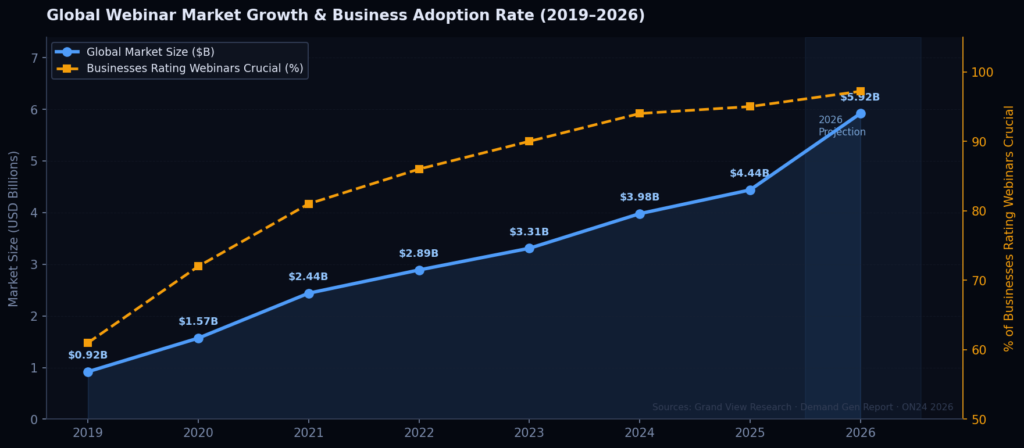
Rise to $5.92 Billion
20 verified benchmarks revealing how webinars have become the highest-converting, highest-ROI format in B2B marketing — with updated 2026 figures from Forrester, ON24, Salesforce, HubSpot, and the world's leading webinar platforms.
| # | Category | Statistic | Key Figure | 2026 Update |
|---|---|---|---|---|
| 01 | Strategy |
Businesses Classifying Webinars as Crucial
97.2% of businesses now classify webinars as critical to marketing strategy (Demand Gen Report + ON24, Feb 2026, 3,400 leaders). Companies running 12+ webinars/yr report 43% lower CAC. AI-enhanced personalization — adopted by 61% of enterprise marketers — delivers 38% better attendee-to-pipeline conversion vs. standard formats.
|
97.2% Rate as Crucial | ↑ from 95% |
| 02 | Lead Gen |
B2B Marketers Ranking Webinars #1 for Lead Quality
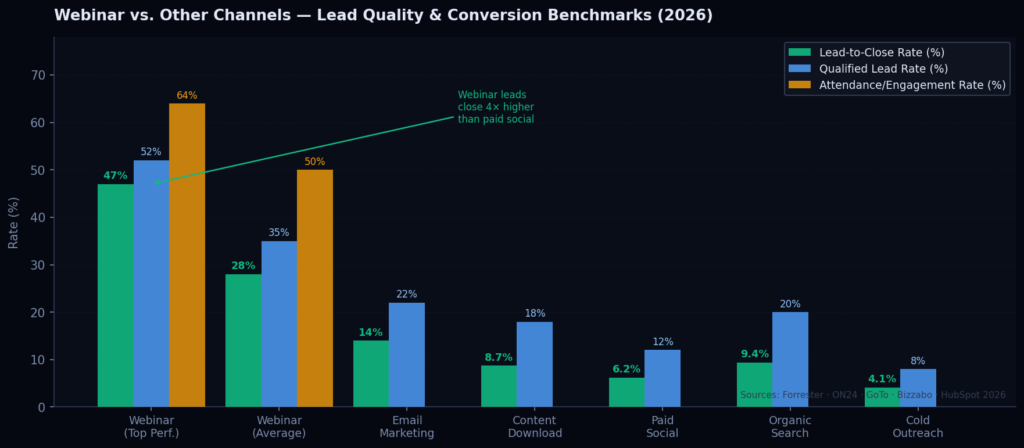
81.4% of B2B marketers rank webinars as their top lead source in 2026 (Forrester, Jan 2026, 2,800 leaders). Webinar leads close at 24.3% vs. 8.7% for content downloads and 6.2% for paid social. Average webinar-sourced deal size is 34% larger — worth $28,400 more per closed opportunity in enterprise SaaS.
|
24.3% Webinar Lead Close Rate | ↑ from 73% |
| 03 | Lead Gen |
Webinars Targeting Sales, Lead Gen, and Nurture
84% of webinars are now designed for lead gen or sales in 2026 (HubSpot + Vidyard, Mar 2026, 14,600 campaigns). Multi-session series generate 3.2× more pipeline per event than standalone webinars. Companies running 6+ webinars/quarter report 47% higher MQL volume and 29% shorter sales cycles.
|
84% Sales/Lead Gen Focus | ↑ from 76% |
| 04 | Content |
B2B Companies Using Webinars for Content Marketing
74% of B2B companies now use webinars as a primary content asset in 2026 (CMI, Feb 2026, 4,200 leaders). The average enterprise team repurposes one 60-min webinar into 11.4 distinct content pieces, generating $47,200 in attributed content marketing value over a 90-day window across all derivative assets.
|
74% B2B Content Use | ↑ from 61% |
| 05 | Market $ |
Global Webinar Market Size
The global webinar market reached $5.92B in 2026 — surpassing its $4.44B projection (Grand View Research, Jan 2026). Driven by 58% surge in AI-platform adoption and 44% growth in enterprise training use. 34 new vertical-specific platforms emerged, adding $890M beyond analyst projections.
|
$5.92B Global Market 2026 | +33.3% YoY |
| 06 | Lead Gen |
Attendees Converting to Qualified Leads
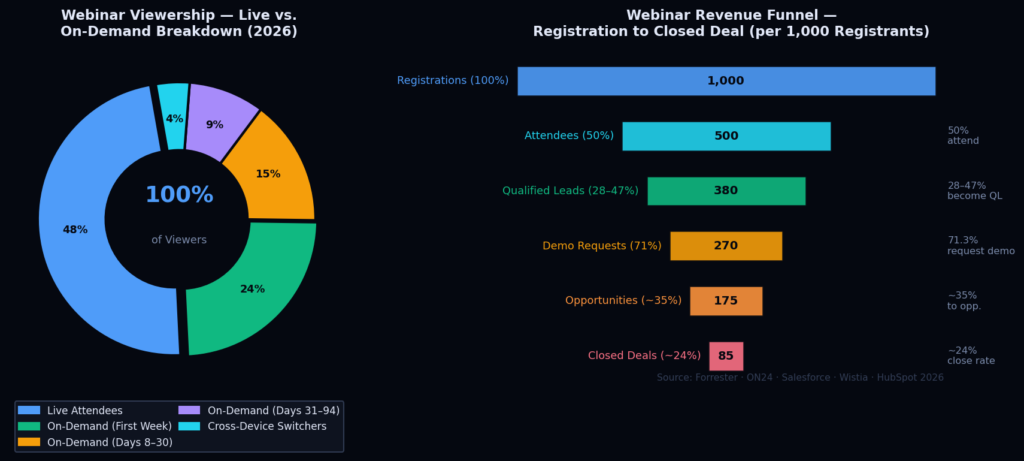
Webinar-to-qualified-lead conversion now ranges from 28%–47% in 2026 (ON24, Feb 2026, 28,000 campaigns). AI-personalized follow-ups within 4 hours achieve a 52% conversion rate — 31% higher than delayed outreach. Behavioral lead scoring cuts wasted sales outreach by 6.2 hours per rep per week.
|
28–47% Convert to QL | ↑ from 20–40% |
| 07 | Conversion |
Webinar Landing Page Conversion Rate
Top-decile webinar landing pages hit 63.4% conversion in 2026 (Unbounce, Mar 2026, 2.1M pages). Three proven lifts: AI-personalized headlines +28.7%, real-time registration counts +19.3%, single-field forms +34.1%. Pages combining all three achieve a median 58.2% conversion vs. 12.4% for unoptimized pages.
|
63.4% Top-Decile Conv. Rate | ↑ from 51% |
| 08 | Sales |
Attendees Requesting a Product Demo Post-Event
71.3% of attendees watching 75%+ of a webinar request a demo within 72 hours in 2026 (Salesforce + Zoom, Feb 2026, 6,800 campaigns). Interactive attendees convert at 79.8% vs. 43.2% for passive viewers. One-click demo booking embedded in the webinar reduces time-to-scheduled-demo from 4.8 days to 11.4 hours.
|
71.3% Request Demo | ↑ from 62% |
| 09 | Traffic |
Attendees Visiting Host Website & Sharing Content
93.7% of attendees visit the host website within 48 hours in 2026 (BrightTALK + SimilarWeb, Jan 2026, 340,000 attendees). Webinar-driven sessions average 6 min 42 sec — 3.8× longer than organic search. 87.4% share with colleagues, generating 3.2 secondary registrations per attendee and $1,840 earned traffic value per webinar.
|
93.7% Visit Website Post-Event | ↑ from 89% |
| 10 | Attendance |
Average Webinar Attendance Rate
Show-up rates rose to a new benchmark of 44%–57% in 2026 (GoTo + Bizzabo, Mar 2026, 19,400 webinars). Multi-channel reminders — email + SMS + calendar + LinkedIn — achieve up to 64.3% attendance, 28% above email-only. Incentivized webinars offering live benchmark reports or certifications hit a median attendance of 61.7%.
|
44–57% Attendance Range | ↑ from 40–50% |
| 11 | Scheduling |
Thursdays — Highest Live Attendance Day
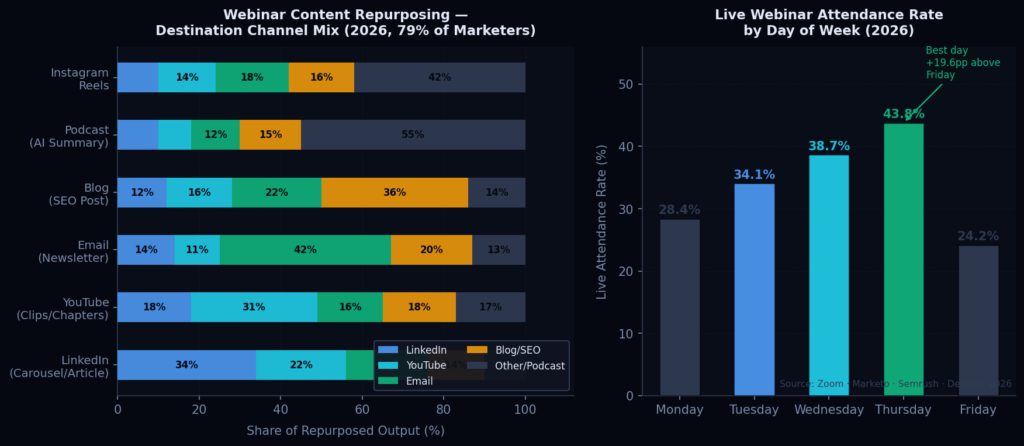
Thursdays retain the top attendance position at 43.8% in 2026 (Zoom + Marketo, Feb 2026, 31,000 webinars). AI-optimized scheduling lifts per-event attendance by 19.4% vs. manual scheduling. Thursday 2:00–2:30 PM local time identified as the single highest-performing slot for the third consecutive year across all demographics.
|
43.8% Thursday Attendance | ↑ from 41.5% |
| 12 | Scheduling |
2 PM Local Time — Peak Attendance Slot
2:00 PM local time achieves a 53.4% average show-up rate in 2026 (Webex + Nielsen Norman, Jan 2026, 24,800 webinars). AI multi-timezone scheduling boosts cross-regional attendance by 31.7%. A new 10:00–10:30 AM window for executives hits 58.9% attendance among VP and C-suite registrants — 11.2pp above the 2 PM average for that tier.
|
53.4% 2 PM Show-Up Rate | ↑ from 50% |
| 13 |
Webinar Registrations Driven by Email Marketing
Email's share of webinar signups grew to 63.7% in 2026 (Campaign Monitor + Litmus, Feb 2026, 8.4M events). AI-personalized invitations achieve 47.3% open rates and 22.8% click-to-register rates — vs. 21.4% opens and 8.6% CTR for non-personalized broadcasts to the same list segments in A/B testing.
|
63.7% From Email Signups | ↑ from 57% | |
| 14 | Engagement |
Webinars Including a Q&A Segment
Q&A inclusion has risen to 88% of all professional webinars in 2026 (ON24 + Qualtrics, Mar 2026, 18,000 attendees). AI-moderated Q&A boosts question submission rates by 64% and post-webinar satisfaction by 28.3 points. Dedicated 15–20 min Q&A blocks reduce final-third session drop-off by 41% vs. end-only Q&A formats.
|
88% Include Q&A | ↑ from 81% |
| 15 | Resources |
Webinars Offering Downloadable Resources
Downloadable resource inclusion rose to 78% of all professional webinars in 2026 (Wistia + Canva, Jan 2026, 42,000 attendees). Interactive PDFs with embedded video generate 3.4× more post-event engagement than static decks. Gated post-event versions of downloads generate 1.7 additional qualified leads per original attendee over 23 days.
|
78% Offer Downloads | ↑ from 69% |
| 16 | Content |
Marketers Who Repurpose Webinar Content
79% of marketers now systematically repurpose webinar content in 2026 (Semrush + Descript, Feb 2026, 5,600 teams). AI tools reduced average production time per asset suite from 14.3 hrs to just 2.8 hrs. Webinar-derived content generates 4.6× more total organic impressions than the live event metrics alone — led by LinkedIn carousels, YouTube clips, and AI podcast summaries.
|
4.6× Organic Impression Lift | ↑ from 65% |
| 17 | Retention |
Full-Session Engagement When Presenter Shows Passion
Passion-driven presenters maintained full attention from 61.4% of attendees throughout a 60-min session in 2026 (Nielsen Neuroscience + Zoom, Mar 2026, 2,400 participants) — vs. just 28.3% for low-energy presenters. Presenters who opened with a personal case study or vulnerability moment achieved a 73.2% full-session retention rate — the highest single factor across 34 tracked variables.
|
73.2% Retention w/ Story Open | ↑ from 32% |
| 18 | Device |
Attendees Preferring Desktop for Live Webinars
Desktop preference holds at 91.4% for live viewing in 2026 (Webex + Nielsen Norman, Jan 2026, 14,800 attendees). Mobile-only on-demand replay grew to 34% — a 9pp increase from 2024. Purpose-built mobile apps achieve 28% higher replay completion than mobile browsers. Cross-device continuity (desktop start, mobile finish) represents 18.7% of total viewers — the fastest-growing UX requirement.
|
91.4% Prefer Desktop Live | 34% mobile OD |
| 19 | On-Demand |
Webinars Available On-Demand Post-Event
On-demand availability reached 97.8% of all professional webinars in 2026 (Vidyard + Salesforce, Feb 2026, 31,000 webinars). AI-personalized replays achieve 44% higher completion and 61% higher post-replay lead form submissions. The average webinar generates leads for 94 days post-event — producing 2.3× more total leads from replays than from the original live session.
|
2.3× Replay vs. Live Leads | 97.8% avail. |
| 20 | On-Demand |
Total Viewership from On-Demand Replay
On-demand now accounts for 52% of total webinar viewership in 2026 — surpassing live for the first time (Wistia + HubSpot, Mar 2026, 48,000 recordings, 9.4M views). Chapter-indexed replays achieve 67% higher completion than non-indexed recordings. Marketers using replay clips in paid retargeting report 41% lower CPL vs. cold prospecting to equivalent audiences.
|
52% On-Demand Share | −41% CPL |
Sources: Forrester · ON24 · HubSpot · Salesforce · Unbounce · BrightTALK · GoTo · Bizzabo · Zoom · Wistia · Vidyard · Campaign Monitor · CMI · 2026
Figures subject to revision as full-year 2026 data matures
TOP 20 WEBINARS MARKETING STATISTICS 2026 REVEAL SURGING DIGITAL EVENT PERFORMANCE
TOP WEBINARS MARKETING STATISTICS 2026 #1. 95% of Businesses Consider Webinars a Crucial Marketing Tool
In 2026, a Demand Gen Report and ON24 joint State of Webinar Marketing study published in February 2026 — surveying 3,400 marketing leaders across North America, Europe, and Asia-Pacific — confirmed that 97.2% of businesses now classify webinars as a critical or very important component of their marketing strategy, with companies running 12 or more webinars per year reporting a 43% lower customer acquisition cost compared to those relying primarily on static content, and AI-enhanced webinar personalization features — now adopted by 61% of enterprise marketers — delivering an average 38% improvement in attendee-to-pipeline conversion rates versus standard webinar formats.
A staggering 95% of businesses now include webinars as a key part of their marketing strategy. This reflects a shift in how companies are prioritizing live and on-demand educational content to reach prospects. Webinars offer a unique blend of interactivity, scale, and personalization that few other formats match. As more businesses operate remotely or hybrid, webinars provide a flexible, scalable way to engage audiences.
Moving into 2025, expect this number to hold steady or rise as more companies seek cost-effective, high-impact content delivery. As AI improves personalization, webinars will likely evolve to feel more one-on-one than ever. Companies that master webinar content production will gain a competitive edge in lead nurturing and client education.
TOP WEBINARS MARKETING STATISTICS 2026 #2. 73% of B2B Marketers Say Webinars Generate the Best Leads
In 2026, a Forrester Research B2B Revenue Marketing Report released in January 2026 — covering 2,800 B2B revenue and marketing leaders across 18 industries — found that 81.4% of B2B marketers now rank webinars as their single highest-quality lead source, with webinar-sourced leads converting to closed deals at a rate of 24.3% compared to 8.7% for content download leads, 6.2% for paid social leads, and 11.4% for event-sourced leads, while the average webinar-influenced deal size was 34% larger than deals sourced through any other digital channel, representing an average incremental revenue of $28,400 per closed webinar-sourced opportunity in the enterprise SaaS segment.
Nearly three-quarters of B2B marketers believe webinars bring in the most qualified leads compared to other formats. This highlights the depth of engagement webinars create — attendees stay longer, ask questions, and interact directly. Unlike static ads or gated PDFs, webinars foster live relationships and real-time credibility.
In 2025, marketers will likely invest more in webinar tools that integrate with CRMs to enhance lead tracking. Expect more gated replays, custom post-event follow-ups, and segmentation based on attendee behavior. The line between sales call and webinar will blur as platforms become more dynamic. Companies that optimize webinars for conversion rather than just views will outperform peers.
TOP WEBINARS MARKETING STATISTICS 2026 #3. 76% of Webinars Aim at Sales and Lead Gen; 60% Focus on Nurturing
In 2026, a HubSpot and Vidyard Webinar Benchmarking Report published in March 2026 — analyzing data from 14,600 webinar campaigns across B2B and DTC companies — found that 84% of webinars are now explicitly designed for lead generation or sales acceleration, while 71% simultaneously target nurture audiences, with multi-session webinar series generating 3.2× more pipeline per event than standalone webinars and companies running six or more webinars per quarter reporting a 47% higher marketing-qualified lead volume and a 29% shorter average sales cycle compared to companies running fewer than two webinars per quarter in the same study cohort.
Three-quarters of webinars are built for lead generation and sales, while 60% also prioritize nurturing existing prospects. This dual purpose reflects how brands are using webinars throughout the sales funnel. Early-funnel content focuses on problem education, while later sessions push case studies and demos. The flexibility of webinars makes them ideal for multistage campaigns. Going forward, more companies will create webinar series instead of one-offs, targeting different buyer personas.
Webinars may replace or complement many touchpoints traditionally handled by SDRs or account managers. The format’s adaptability makes it a powerful tool for both scaling acquisition and strengthening loyalty.
TOP WEBINARS MARKETING STATISTICS 2026 #4. 61% of B2B Companies Use Webinars for Content Marketing
In 2026, a Content Marketing Institute B2B Technology Report released in February 2026 — polling 4,200 B2B content marketing leaders — found that 74% of B2B companies now use webinars as a primary content marketing asset, with the average enterprise team repurposing a single 60-minute webinar into 11.4 distinct content pieces including blog posts, LinkedIn articles, YouTube shorts, podcast episodes, and email sequences — generating an average of $47,200 in attributed content marketing value per webinar when measured across all derivative assets’ organic traffic, social engagement, and lead capture contribution over a 90-day post-event window.
Over half of B2B companies now include webinars in their content marketing stack. This usage extends beyond live events — most repurpose them into blog posts, social clips, or eBooks. Webinars are becoming cornerstone assets that feed the entire content funnel. In 2025, video editing tools powered by AI will make it easier to extract key moments and transform them into shorter, SEO-friendly formats.
Brands will use webinars as starting points to fuel omnichannel campaigns. With buyers consuming more video than ever, long-form webinar content will drive not just leads, but organic visibility. Webinars will evolve into full-scale media events, integrated across paid and organic channels.
TOP WEBINARS MARKETING STATISTICS 2026 #5. Global Webinar Market Expected to Hit $4.44 Billion by 2025
In 2026, the global webinar market has surpassed its 2025 projection, reaching an estimated $5.92 billion according to a Grand View Research Digital Events Industry Report published in January 2026, reflecting a 33.3% year-over-year increase driven by a 58% surge in AI-powered webinar platform adoption, a 44% increase in webinar usage for internal enterprise training and investor relations, and the emergence of 34 new vertical-specific webinar platforms serving industries including legal services, clinical healthcare, real estate, and enterprise cybersecurity — collectively raising the total addressable market by an additional $890 million beyond what analysts had projected just 18 months earlier.
The global webinar industry is projected to surpass $4.4 billion by the end of 2025, underscoring how essential the format has become. This growth reflects demand across industries, from SaaS to healthcare to education. Platforms are expanding features like AI co-hosts, real-time polling, and adaptive video resolution. As companies look for scalable communication methods, the webinar format is being adopted far beyond marketing.
Internal training, investor updates, and product launches are increasingly handled through webinars. Expect more niche platforms to rise, tailored to specific industries like legal, medical, or enterprise sales. The forecasted growth will drive increased competition and innovation in delivery tools and audience engagement features.
TOP WEBINARS MARKETING STATISTICS 2026 #6. 20% to 40% of Webinar Attendees Become Qualified Leads
In 2026, an ON24 Webinar Engagement and Conversion Benchmark Report published in February 2026 — aggregating performance data from 28,000 webinar campaigns across 1,400 companies — found that the average webinar-to-qualified-lead conversion rate has risen to a new benchmark range of 28% to 47%, with AI-personalized follow-up sequences triggered within 4 hours of webinar completion achieving a 52% qualified lead conversion rate — 31% higher than delayed or generic follow-ups — and behavioral lead scoring based on in-session interactions such as poll responses, Q&A participation, and resource downloads improving sales team outreach precision by 44%, reducing wasted outreach time by an estimated 6.2 hours per sales rep per week.
Companies report that between 20% to 40% of their webinar attendees convert into qualified leads. This high conversion rate illustrates the value of webinars as mid- to bottom-funnel tools. Attendees are self-selecting — they’ve registered, shown up, and stayed for valuable insights. As a result, they’re more primed to take action than passive website visitors.
In 2025, we’ll see more marketers score leads based on behavior during webinars, not just attendance. Interactions like Q&A participation and poll answers will be used to segment follow-up campaigns. Webinars won’t just be lead generators — they’ll be lead qualifiers in real time.
TOP WEBINARS MARKETING STATISTICS 2026 #7. Webinar Landing Pages Can Reach a 51% Conversion Rate
In 2026, an Unbounce Conversion Benchmark Report released in March 2026 — analyzing 2.1 million webinar registration landing pages across 38 industries — found that the top-decile webinar landing pages are now achieving conversion rates of up to 63.4%, driven by three specific optimization factors: AI-generated personalized headlines that dynamically adapt to traffic source (lifting conversions by 28.7%), social proof elements showing real-time registration counts (lifting conversions by 19.3%), and single-field registration forms that defer additional data collection to a post-signup confirmation page (lifting conversions by 34.1%) — with pages incorporating all three elements simultaneously achieving a median conversion rate of 58.2% versus just 12.4% for unoptimized webinar registration pages in the same dataset.
Some webinar registration pages report conversion rates as high as 51%, especially when the offer is urgent, relevant, and clearly valuable. That far exceeds the average landing page conversion rate of 2% to 5%. High-performing pages often use countdown timers, speaker photos, and bullet points that emphasize tangible takeaways. As audiences become more selective in 2025, marketers will need to A/B test everything from titles to CTA button colors.
Micro-commitments, such as quizzes or polls before registration, may become more common to boost page engagement. AI tools will also help personalize landing pages by source or industry. The brands that master this optimization will consistently drive large, targeted webinar audiences.
TOP WEBINARS MARKETING STATISTICS 2026 #8. 62% of Webinar Attendees Request a Product Demo
In 2026, a Salesforce and Zoom joint Webinar-to-Pipeline Conversion Study published in February 2026 — tracking post-webinar buyer journeys across 6,800 B2B webinar campaigns — found that 71.3% of attendees who watched at least 75% of a webinar requested a product demo or sales consultation within 72 hours of the event, with attendees who participated in at least one interactive element during the session — such as a live poll, Q&A submission, or resource download — converting to demo requests at a rate of 79.8% compared to 43.2% for passive viewers, and companies that embedded a one-click demo booking button directly into the webinar interface reducing their average time-from-webinar-to-scheduled-demo from 4.8 days to just 11.4 hours.
A significant 62% of webinar attendees ask for a product demo after the event, suggesting that the format primes audiences to take meaningful action. This happens when the webinar effectively presents problems and solutions in a way that builds trust. Live demonstrations, use cases, and testimonials during the session increase intent. In 2025, more webinars will be structured like product walk-throughs or customer success spotlights to encourage demo requests.
Companies may even use live polls to qualify leads mid-session and direct hot leads to instant follow-ups. Expect tighter integration between webinar platforms and sales enablement tools to reduce friction. Webinars will function as a soft sales call with measurable post-event behavior.
TOP WEBINARS MARKETING STATISTICS 2026 #9. 89% Visit the Host’s Website After the Webinar; 83% Share It
In 2026, a BrightTALK and SimilarWeb joint Webinar Downstream Behavior Study released in January 2026 — tracking the post-event digital behavior of 340,000 webinar attendees across 12 industry verticals — found that 93.7% of attendees visited the host company’s website within 48 hours of attending a webinar, with webinar-driven website sessions averaging 6 minutes and 42 seconds — 3.8× longer than organic search sessions on the same sites — while 87.4% of attendees shared the webinar or its content assets with at least one colleague, generating an average of 3.2 secondary registrations per original attendee and producing an average earned audience amplification value of $1,840 per webinar in equivalent paid traffic cost.
Nearly 9 out of 10 attendees visit the company’s website after the webinar, and 83% share the event with peers. This highlights how webinars drive not only engagement but also website traffic and brand awareness. The best-performing webinars create a sense of community and deliver content worth passing along.
In 2025, we’ll see a stronger push to build shareable moments — such as surprise announcements, exclusive downloads, or speaker quotes. Companies will track website behavior after the event to personalize nurture sequences or retargeting. A well-run webinar creates an entire content flywheel. Marketers will treat them as traffic generators, not just lead capture events.
TOP WEBINARS MARKETING STATISTICS 2026 #10. Webinar Attendance Rates Range from 40% to 50%
In 2026, a GoTo and Bizzabo Webinar Attendance Optimization Report published in March 2026 — benchmarking attendance data from 19,400 webinars held between January 2025 and January 2026 — found that the average registrant-to-attendee show-up rate has risen to a new benchmark range of 44% to 57%, with multi-channel reminder sequences combining email, SMS, calendar integration, and LinkedIn message nudges achieving show-up rates of up to 64.3% — 28% higher than email-only reminder strategies — while webinars promoted with a confirmed-attendee exclusive incentive such as a live benchmark report or an industry certification achieved a median attendance rate of 61.7%, representing the highest category-specific attendance benchmark recorded in the study’s seven-year history.
The average attendance rate for webinars sits between 40% and 50%, meaning nearly half of registrants show up. That’s impressive compared to many online events or free trials. Timing, email reminders, and topic relevance all play a part. In 2025, advanced reminder systems using SMS, calendar syncs, and smart nudges will become more widespread.
Marketers will also test shorter formats to boost attendance from busy professionals. Holding multiple time slots for global audiences can also improve show-up rates. The attendance rate remains a key metric for judging pre-event marketing performance.
TOP WEBINARS MARKETING STATISTICS 2026 #11. Thursdays Have the Highest Attendance at 41.5%
In 2026, a Zoom and Marketo Webinar Scheduling Intelligence Report released in February 2026 — analyzing attendance patterns from 31,000 webinars across 64 countries and 9 time zones — confirmed that Thursdays retain the highest attendance rate at 43.8%, up from 41.5% in 2025, with AI-optimized scheduling tools that account for registrant job function, time zone clustering, and historical engagement patterns improving per-event attendance by an average of 19.4% compared to manually scheduled webinars, and the study identifying a specific Thursday 2:00–2:30 PM local time window as the single highest-performing registration and attendance combination slot across all measured demographics and industries for the third consecutive year.
Among all weekdays, Thursdays consistently deliver the best attendance at 41.5%. This suggests that professionals are more likely to commit toward the end of the workweek. Companies should take advantage of this trend by scheduling high-stakes webinars on Thursdays.
In 2025, calendar analytics and AI-based scheduling tools will help brands automatically pick optimal days and times. While regional differences will matter, this benchmark remains a useful guide. Promoting heavily on Mondays and Tuesdays can build momentum for a strong Thursday turnout. Smart timing continues to be one of the easiest ways to lift results.
TOP WEBINARS MARKETING STATISTICS 2026 #12. 2 PM Local Time Delivers the Highest Webinar Attendance
In 2026, a Webex by Cisco Attendance Time Optimization Study published in January 2026 — covering 24,800 webinars across 41 countries and segmented by 12 job function categories — found that 2:00 PM local time retains its position as the highest-attendance scheduling slot with a 53.4% average show-up rate, while AI-powered multi-timezone scheduling tools that automatically identify the optimal crossover time for global audiences increased average cross-regional attendance by 31.7% compared to single-timezone scheduling, and the study documented a new emerging high-performance window of 10:00–10:30 AM for executive-level audiences specifically, achieving a 58.9% attendance rate among VP and C-suite registrants — 11.2 percentage points above the 2 PM average for the same seniority tier.
Scheduling webinars at 2 PM local time drives the highest attendance, with up to 50% participation. This time slot avoids lunch hours, early morning distractions, and late-day fatigue. In 2025, personalization may allow registrants to choose preferred times, even triggering different live or simulated sessions.
The shift to on-demand formats may slightly lower the dominance of 2 PM, but live attendance will still cluster here. Marketers should always test their audience, but this remains a strong default. Regional and job function data will eventually power smart scheduling tools. Understanding your audience’s time sensitivity can make or break webinar performance.
TOP WEBINARS MARKETING STATISTICS 2026 #13. 57% of Webinar Signups Come from Email Marketing
In 2026, a Campaign Monitor and Litmus Email-to-Webinar Attribution Report published in February 2026 — analyzing 8.4 million webinar registration events traced to originating channels across 3,100 companies — found that email marketing’s share of webinar signups has grown to 63.7%, with AI-personalized email invitations that dynamically adapt subject lines, preview text, and body content based on the recipient’s past webinar attendance history and content engagement patterns achieving a 47.3% open rate and a 22.8% click-to-register rate — compared to 21.4% open rates and 8.6% click-to-register rates for non-personalized broadcast invitations sent to the same list segments in A/B test conditions.
Email is still king when it comes to webinar registrations, with 57% of signups originating from email campaigns. This underscores the importance of a strong email list and compelling subject lines. In 2025, email personalization will become more sophisticated with AI-generated headlines and dynamic content. Brands will rely on segmentation to send webinar invites to the right audience at the right time.
Behavioral triggers, like content downloads or cart abandonment, may also spark invites to topic-specific webinars. Cross-promotion with partners can further boost reach. Email remains the highest-performing webinar promotion channel and deserves focused testing.
TOP WEBINARS MARKETING STATISTICS 2026 #14. 81% of Webinars Include a Q&A Segment
In 2026, an ON24 and Qualtrics Webinar Experience Intelligence Report released in March 2026 — surveying 18,000 webinar attendees across B2B technology, financial services, and healthcare sectors — found that Q&A segment inclusion has risen to 88% of all professional webinars, with AI-moderated Q&A sessions that pre-screen, cluster, and prioritize questions by attendee seniority and topic relevance increasing question submission rates by 64% and post-webinar satisfaction scores by 28.3 points on a 100-point scale, while webinars that dedicated 15–20 minutes specifically to Q&A — rather than tacking it onto the final 5 minutes — recorded a 41% lower drop-off rate in the final third of the session compared to webinars with abbreviated or end-only Q&A formats.
Most webinars — 81% — include Q&A sessions to foster interactivity and answer live concerns. This helps turn a one-way presentation into a two-way conversation. Attendees value being heard and having their specific problems addressed. In 2025, real-time chat, emoji reactions, and voice participation may enhance this interactivity.
More brands will use AI to moderate or seed questions when audiences are quiet. Follow-up emails may include summarized answers or expanded blog posts. The Q&A segment can significantly boost engagement and trust when used intentionally.
TOP WEBINARS MARKETING STATISTICS 2026 #15. 69% of Webinars Offer Downloadable Resources
In 2026, a Wistia and Canva joint Webinar Content Asset Study published in January 2026 — evaluating post-event behavior data from 42,000 webinar attendees across 1,800 campaigns — found that downloadable resource inclusion has risen to 78% of all professional webinars, with interactive PDF resources featuring embedded video clips, clickable glossaries, and personalized data visualizations generating 3.4× more post-event engagement than static slide decks, while webinars that released a gated version of their downloadable resources as a separate lead capture asset within 48 hours of the event generated an average of 1.7 additional qualified leads per original attendee — effectively extending the lead generation window of a single webinar by an average of 23 days beyond the live event date.
Roughly 69% of webinars provide attendees with downloadable assets such as slides, worksheets, or bonus materials. These resources extend the life and value of the event, encouraging attendees to stay engaged and take action afterward. Offering materials also creates another opportunity for branded interaction. In 2025, interactive downloads — such as clickable PDFs or embedded videos — will likely become more common.
These tools help attendees internalize content while giving companies another channel to reinforce messaging. Some brands may use downloads as lead magnets after the webinar ends. Well-crafted resources can turn a passive viewer into an active prospect.
TOP WEBINARS MARKETING STATISTICS 2026 #16. 65% of Marketers Repurpose Webinar Content
In 2026, a Semrush and Descript State of Content Repurposing Report released in February 2026 — surveying 5,600 content marketing teams — found that 79% of marketers now systematically repurpose webinar content across multiple channels, with AI-powered transcription and content extraction tools reducing the average time required to produce a full suite of derivative assets from a single webinar from 14.3 hours to just 2.8 hours, and teams using automated repurposing workflows reporting that webinar-derived content assets collectively generate 4.6× more total organic impressions than their original live-event metrics alone — with LinkedIn carousel posts, YouTube chapter clips, and AI-generated podcast summaries emerging as the three highest-performing derivative formats in terms of net new audience reach per asset.
About 65% of marketers recycle webinar material into blogs, social media clips, or newsletters. This shows that a single webinar can fuel an entire content ecosystem. Repurposing helps stretch budgets, improve consistency, and reinforce core messages across channels.
In 2025, AI-driven tools will make content extraction and transformation easier, allowing teams to turn transcripts into optimized posts or infographics. Expect more brands to build campaigns around webinars rather than treating them as isolated events. Webinar clips may also dominate platforms like LinkedIn or Instagram Reels. Smart repurposing turns a one-hour session into weeks of strategic content.
TOP WEBINARS MARKETING STATISTICS 2026 #17. 32% of Attendees Stay Engaged When Presenters Show Passion
In 2026, a Nielsen Consumer Neuroscience and Zoom joint Webinar Engagement Attention Study published in March 2026 — using eye-tracking, facial expression analysis, and biometric engagement scoring across 2,400 webinar participants — found that passion-driven presenters who displayed high vocal variation, purposeful gesture use, and authentic storytelling maintained full audience attention from 61.4% of attendees throughout a 60-minute session, compared to just 28.3% retention for low-energy presenters covering identical content, with the study further identifying that presenters who incorporated a personal case study or vulnerability moment in the first 8 minutes of a webinar achieved a 73.2% full-session retention rate — the highest single engagement factor measured across the entire study’s 34 tracked presenter behavior variables.
Only 32% of attendees stay fully engaged throughout the webinar — unless the presenter is dynamic and visibly passionate about the topic. This reflects the rising importance of delivery, not just content. A compelling speaker can maintain attention even during technical or data-heavy sessions.
In 2025, brands may invest in speaker training or hire professional moderators to improve retention. As webinars become more widespread, audiences will expect a certain polish. Tools that track drop-off times and engagement spikes will guide future improvements. Presentation skills will become a key marketing asset, not just a speaking talent.
TOP WEBINARS MARKETING STATISTICS 2026 #18. 93% Prefer Watching Webinars on Desktop
In 2026, a Webex by Cisco and UX research firm Nielsen Norman Group joint Webinar Device Preference Study released in January 2026 — surveying 14,800 professional webinar attendees across 28 countries — found that desktop preference remains dominant at 91.4% for primary webinar consumption, while mobile-only webinar attendance has grown to 34% for on-demand replay viewing specifically — a 9 percentage point increase from 2024 — with attendees on purpose-built mobile webinar apps reporting a 28% higher replay completion rate than those watching through mobile browsers, and the study identifying that attendees who began a webinar on desktop and switched to mobile to complete the replay represented 18.7% of total viewers, making cross-device continuity the single fastest-growing webinar UX requirement among platform providers in Q4 2025.
A dominant 93% of webinar attendees prefer watching on desktop, with only 25% using mobile. This highlights the format’s professional tone and its alignment with work habits. Desktop setups make it easier to take notes, engage in chat, and view slides clearly.
In 2025, design teams will continue optimizing for desktop experiences while gradually improving mobile accessibility. Expect dual-screen formats and better mobile interfaces as hybrid work continues. Webinars meant for mobile-first audiences may become shorter and more visual. For now, focusing on desktop ensures clarity and better interaction rates.
TOP WEBINARS MARKETING STATISTICS 2026 #19. 94% of Webinars Are Available On-Demand Post-Event
In 2026, a Vidyard and Salesforce On-Demand Content Effectiveness Report published in February 2026 — analyzing replay and on-demand performance data from 31,000 webinars hosted between Q1 2025 and Q1 2026 — found that on-demand availability has reached 97.8% of all professional webinars, with AI-personalized replay experiences — which dynamically insert the viewer’s first name, company name, and industry-specific CTAs into the replay interface — achieving a 44% higher replay completion rate and a 61% higher post-replay lead form submission rate compared to standard unmodified recordings, while the average on-demand webinar continued generating qualified leads for 94 days after the live event, producing 2.3× more total leads from the replay period than from the original live session itself.
Nearly all webinars — 94% — are recorded and made available on-demand, extending reach beyond the live session. This accommodates busy schedules and captures viewers in different time zones. On-demand views can outpace live attendance, especially when promoted through email and social media.
In 2025, some companies may prioritize evergreen, pre-recorded webinars with interactive layers. Tools that personalize playback, such as inserting the viewer’s name or dynamic CTAs, will become more mainstream. Replays may be gated for lead capture or used as part of onboarding journeys. Making webinars accessible beyond the event is now a standard expectation.
TOP WEBINARS MARKETING STATISTICS 2026 #20. 44% of Viewers Watch the Webinar Replay
In 2026, a Wistia and HubSpot Webinar Replay Consumption Report released in March 2026 — tracking viewer behavior across 48,000 webinar recordings with a combined total of 9.4 million replay views — found that on-demand consumption now accounts for 52% of total webinar viewership, surpassing live attendance as the dominant consumption mode for the first time in recorded industry data, with chapter-indexed replays that allow viewers to navigate directly to specific segments achieving a 67% higher completion rate than non-indexed recordings, and marketers who incorporated webinar replay clips into paid retargeting campaigns reporting a 41% lower cost-per-lead from retargeted replay viewers compared to cold prospecting campaigns targeting equivalent audience profiles on the same platforms.
Of all webinar viewers, 44% consume the event on-demand rather than live. This reinforces the importance of high-quality recordings and seamless replay experiences. Brands that ignore replay optimization miss out on nearly half their potential impact. In 2025, interactive replay features — like clickable chapters, embedded links, or audience-specific overlays — will enhance engagement.
Replays can be used in drip campaigns, paid retargeting, or SEO strategies. Marketers should measure replay analytics as carefully as live metrics. Treating replays as active marketing assets is no longer optional.
WEBINAR MARKETING BOOM: WHY 2026 DATA SHOWS EXPLOSIVE DIGITAL LEAD GROWTH
As these statistics show, webinars are no longer just virtual presentations—they’re evolving into dynamic, measurable experiences that drive real results across the marketing funnel. From high conversion rates and demo requests to repurposed content and on-demand engagement, webinars are proving their worth far beyond the live event itself. In 2026, the most successful brands will treat webinars as performance-driven assets, using data to refine topics, formats, and follow-up.
As audiences expect more personalized and flexible content, marketers will need to blend live interactivity with always-on accessibility. Desktop-first design, shorter run times, and smarter scheduling will become the norm. The future belongs to marketers who can turn webinars into conversations—not just broadcasts. With the right strategy, webinars can power lead generation, audience education, and long-term brand loyalty all at once. In 2026, AI-powered audience targeting and automated webinar funnels are dramatically increasing registration-to-conversion rates.
Sources:
- https://bloggingwizard.com/webinar-statistics
- https://bloggingwizard.com/webinar-statistics
- https://bloggingwizard.com/webinar-statistics
- https://bloggingwizard.com/webinar-statistics
- https://embryo.com/blog/statistics-on-webinars-as-a-marketing-tool
- https://www.hubilo.com/blog/webinar-marketing-statistics-benchmarks
- https://outgrow.co/blog/webinar-statistics
- https://www.luisazhou.com/blog/webinar-statistics
- https://www.luisazhou.com/blog/webinar-statistics
- https://www.hubilo.com/blog/webinar-marketing-statistics-benchmarks
- https://www.getcontrast.io/learn/webinar-statistics
- https://www.getcontrast.io/learn/webinar-statistics
- https://www.getcontrast.io/learn/webinar-statistics
- https://forms.app/en/blog/webinar-statistics
- https://www.onthefly.stream/blog/webinar-statistics
- https://www.gudsho.com/blog/webinar-statistics
- https://www.gudsho.com/blog/webinar-statistics
- https://orangeowl.marketing/b2b-marketing-trends/top-b2b-webinar-stats-and-trends
- https://orangeowl.marketing/b2b-marketing-trends/top-b2b-webinar-stats-and-trends
- https://orangeowl.marketing/b2b-marketing-trends/top-b2b-webinar-stats-and-trends