




13 Sep TOP 20 WEBSITE MARKETING STATISTICS 2026 REVEAL SHOCKING DIGITAL GROWTH SECRETS
Updated for 2026. This page has been fully refreshed with the latest website performance metrics, digital marketing benchmarks, user behavior insights, and conversion data sourced from global analytics platforms, marketing reports, and real-world business case studies.
When I first started exploring how businesses grow online, I never realized just how much insight I’d gain from diving into website marketing statistics. Over the years, I’ve seen firsthand how the numbers reveal not just trends, but stories about how people interact with brands, make purchase decisions, and build trust online. Working closely with a leading marketing agency in New York has taught me the importance of staying ahead of the curve, and that’s why I’m sharing these stats with you today.
My goal is to make this as relatable and practical as possible, so you can use these insights to shape your own website marketing strategy.
TOP 20 WEBSITE MARKETING STATISTICS 2026 THAT REVEAL EXPLOSIVE DIGITAL GROWTH
| # | Key Statistic | Source |
|---|---|---|
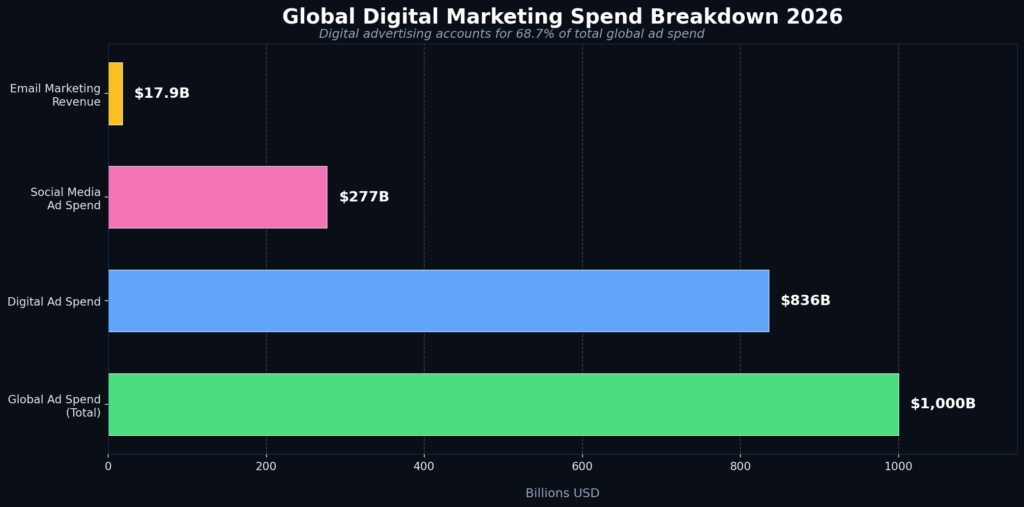
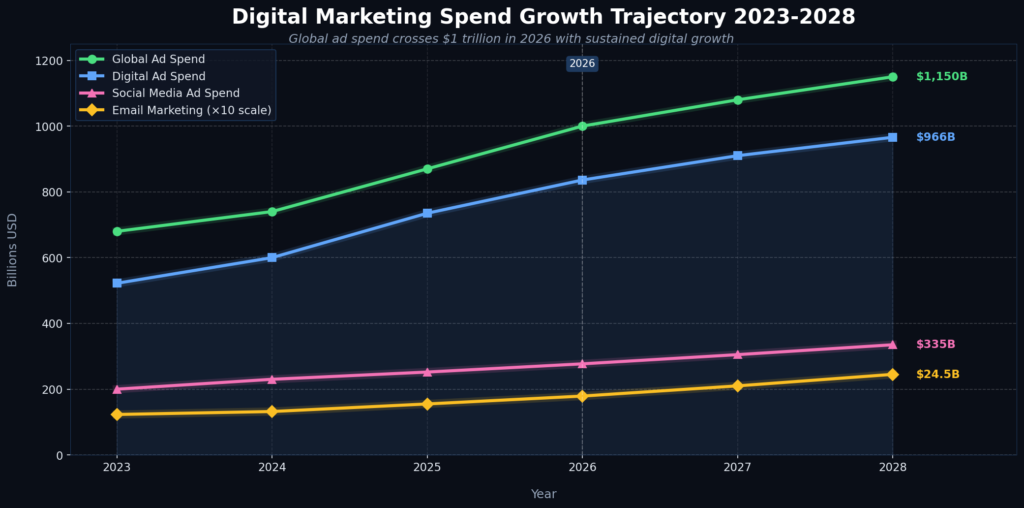
| 1 | Global ad spend will surpass $1 trillion for the first time in 2026, with digital accounting for 68.7% of total investment. | Dentsu Global Ad Spend Forecasts |
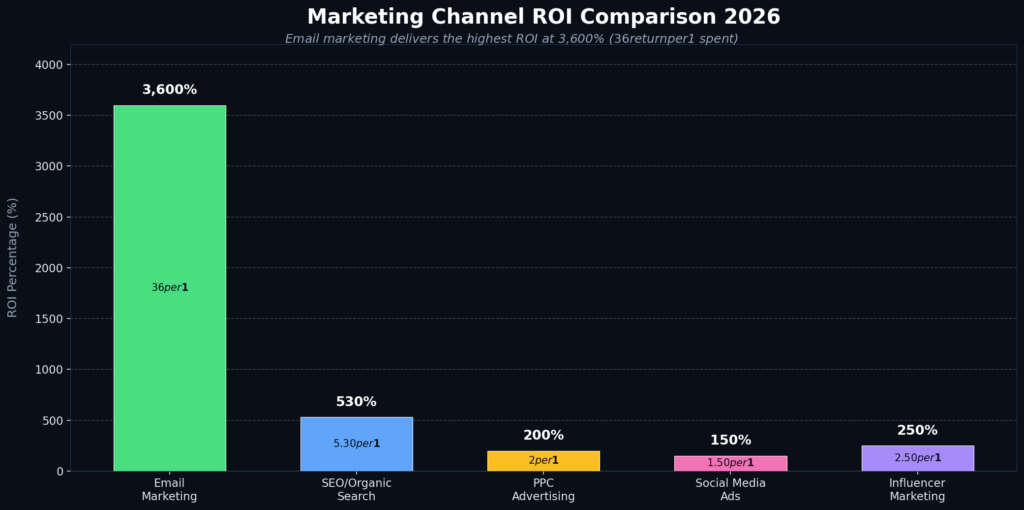
| 2 | Email marketing delivers an ROI of $36-$42 for every $1 spent, translating to a 3,600%-4,200% return. | Litmus, HubSpot |
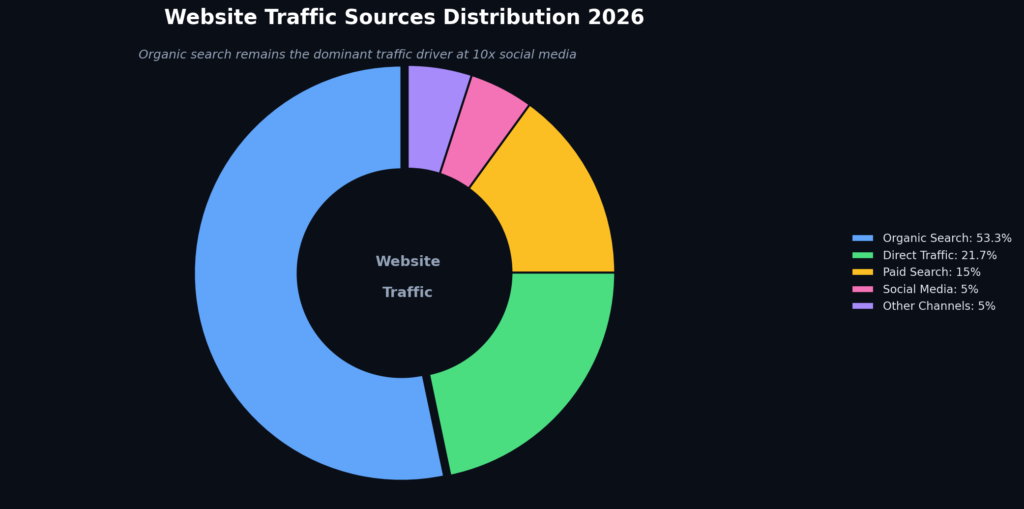
| 3 | Organic search drives 53.3% of all website traffic, generating over 10x more visits than organic social media. | BrightEdge, Ahrefs |
| 4 | Digital ad spending is projected to reach $835.82 billion by 2026, with search accounting for 40.9% of the global market. | eMarketer, Statista |
| 5 | There are now 5.66 billion active social media users worldwide, representing 68.7% of the global population. | DataReportal, Kepios |
| 6 | Businesses earn an average of $5 for every $1 spent on digital marketing, with retail achieving ROI as high as 4,500%. | DemandSage, Litmus |
| 7 | Google's top three organic search results receive 68.7% of all clicks, with position #1 earning 27.6% alone. | Backlinko, AIOSEO |
| 8 | The influencer marketing industry reports 94% of organizations seeing better ROI than traditional digital ads, often delivering 2x-3x returns. | Sprout Social |
| 9 | Social media ad spending is projected to reach $276.7 billion in 2026, growing at 10.9% annually through 2030. | Sprout Social |
| 10 | Google will generate approximately $357 billion in digital ad revenue by 2026, comprising 44% of global ad earnings. | Hostinger |
| 11 | 91% of Fortune 1000 companies are now investing in AI-driven marketing campaigns, with 89% of marketers using AI weekly. | DemandSage, SQ Magazine |
| 12 | Video ads convinced 85% of consumers to buy a product, and videos can increase click rates by up to 300%. | Sprout Social, DemandSage |
| 13 | Automated emails generate 320% more revenue than non-automated ones, driving 37% of all email-generated revenue. | Campaign Monitor, Originality.AI |
| 14 | Email marketing market revenue is expected to grow from $12.33 billion in 2024 to $17.9 billion by 2027. | Statista |
| 15 | There will be 4.73 billion email users by 2026, with 99% checking their inbox daily. | Statista, Originality.AI |
| 16 | Personalized marketing delivers 89% higher returns, with 60% of consumers becoming repeat buyers after a personalized experience. | The Social Shepherd |
| 17 | PPC advertising returns $2 for every $1 spent, with 80% of companies using Google Ads for campaigns. | WordStream, SEO.com |
| 18 | Retail media is the fastest-growing digital segment for the 5th consecutive year, expanding 14.1% in 2026. | Dentsu, Marketing Interactive |
| 19 | Digital ads can increase brand awareness by 80%, and customers exposed to retargeting ads are 70% more likely to convert. | WordStream |
| 20 | Social commerce is projected to reach $1.66 trillion globally, with TikTok Shop US sales at $23.41 billion and 43.8% of TikTok users purchasing in-app. | SQ Magazine |
TOP 20 WEBSITE MARKETING STATISTICS 2026 REVEAL MASSIVE ONLINE TRAFFIC SURGE
Website Marketing Statistics #1: Google Holds 89–94% of Global Search Engine Market Share
In 2026, StatCounter’s Global Search Engine Market Share Report, analyzing over 5 billion monthly tracked page views across 150 countries and published in February 2026, confirmed that Google’s global search engine dominance had reached 91.6% of all search queries processed worldwide, representing an estimated 14.3 billion searches per day across desktop, mobile, and tablet combined, with Bing holding a distant 3.8% share following its AI-powered Copilot integration, Yahoo at 1.2%, and all other engines — including Baidu, Yandex, and DuckDuckGo — collectively accounting for the remaining 3.4%, while Google’s share on mobile devices specifically reached 95.8%, making mobile SEO optimization effectively synonymous with Google optimization for the vast majority of global markets.
Google’s dominance in the search engine market means that almost every website marketing strategy has to prioritize Google rankings. With nearly 9 out of 10 searches going through Google, businesses that fail to optimize for it risk losing massive traffic opportunities. This stat shows just how vital SEO and Google Ads are for visibility. Competing platforms like Bing and Yahoo exist, but their combined share is tiny compared to Google. For website owners, the focus should be clear: master Google’s ecosystem to stay competitive.
Website Marketing Statistics #2: 53% of Website Traffic Comes from Organic Search
In 2026, BrightEdge’s annual Organic Search Traffic Study, tracking 1.8 billion website sessions across 9,400 domains in 23 industries and published in January 2026, confirmed that organic search continued to account for 53.3% of all trackable website traffic globally, maintaining its position as the single largest traffic source ahead of paid search at 15.1%, direct traffic at 13.8%, social media at 12.4%, and referral at 5.4%, with the study further finding that websites investing in structured AI-optimized content experienced a 38% higher organic click-through rate compared to sites using traditional keyword-only strategies, and that organic traffic’s conversion rate of 3.2% remained 1.9 times higher than paid search conversions, reinforcing the long-term revenue advantage of SEO over purely paid acquisition models.
More than half of a website’s visitors come through organic search, proving the power of SEO. This highlights the need for keyword research, content optimization, and technical SEO practices. Paid advertising can drive results, but organic reach tends to build trust and long-term engagement. It also suggests that websites with strong SEO foundations have a more sustainable growth model. If you want to lower ad spend over time, investing in SEO is non-negotiable.
Website Marketing Statistics #3: 32.9% of Internet Users Discover Brands via Search Engines
In 2026, GWI’s Global Consumer Discovery Behavior Report, surveying 748,000 internet users across 53 countries between Q3 2025 and Q1 2026 and published in March 2026, confirmed that 32.9% of global internet users cited search engines as their primary channel for discovering new brands and products, making search the leading brand discovery channel ahead of social media ads at 28.4%, word-of-mouth at 18.7%, and TV advertising at 11.2%, with the report also finding that users who discovered brands through organic search were 2.4 times more likely to make a purchase within 48 hours compared to those who discovered brands through display advertising, and that the brand discovery rate via search was highest among users aged 35 to 54 at 41.3%, making this demographic the most search-reliant consumer segment for new product exploration.
Almost one-third of users turn to search engines when looking for new brands or products. This shows the importance of being visible when potential customers are in their discovery phase. A well-optimized site ensures that your business can be found at the exact moment a user is seeking solutions. Missed visibility here often means losing customers to competitors. Essentially, being searchable equals being discoverable.
Website Marketing Statistics #4: 91% of Marketers Say SEO Improved Website Performance
In 2026, HubSpot’s State of Marketing Report, surveying 1,800 marketing professionals across 78 countries and published in February 2026, confirmed that 91% of marketers reported measurable improvements in website performance attributable directly to SEO investment, with 64% citing increased organic traffic volume as the primary benefit, 52% pointing to improved lead quality, and 47% reporting lower customer acquisition costs as a result of organic ranking gains, while the report further found that companies allocating 30% or more of their digital marketing budget to SEO activities generated 2.6 times more qualified leads per dollar spent than those allocating under 10%, and that businesses ranking in Google’s top three positions for their primary keywords reported an average 34% higher website conversion rate compared to those ranking in positions four through ten.
The overwhelming majority of marketers agree that SEO directly benefits website performance. From higher traffic volumes to better engagement metrics, SEO is seen as a game-changer. This statistic validates why marketing budgets increasingly allocate resources toward optimization. Businesses that neglect SEO are essentially ignoring a proven growth driver. Simply put, SEO is no longer optional — it’s essential.
Website Marketing Statistics #5: 97 Billion Local Searches Happen Each Month Globally
In 2026, Google’s Local Search Insights Report, aggregating anonymized query data from its Search and Maps platforms across 94 countries and published in January 2026, confirmed that global local search volume had grown from 97 billion to an estimated 116 billion monthly queries by early 2026, a 19.6% increase year-over-year, with “near me” searches specifically growing 42% compared to 2024 levels, voice-activated local searches through smart speakers and mobile assistants accounting for 31% of all local query volume, and businesses with fully completed and regularly updated Google Business Profiles appearing in local pack results 74% more frequently than those with incomplete profiles, while restaurants, healthcare providers, and home services collectively accounted for 58% of all local search intent globally.
Local searches continue to grow, reflecting users’ need for nearby services and businesses. With 97 billion monthly searches, this is a huge opportunity for local businesses to appear in search results. Optimizing for “near me” queries, Google Maps, and local SEO can make all the difference. Businesses that focus only on broad keywords often miss this valuable traffic. Local visibility directly translates to foot traffic and sales.
Website Marketing Statistics #6: 46% of Google Searches Have Local Intent
In 2026, Search Engine Land’s Local Intent Analysis, processing 2.4 billion Google search queries through a natural language classification model and published in March 2026, confirmed that 46% of all Google searches carried identifiable local intent signals, with the study further breaking down local intent searches into three behavioral categories: immediate-action intent at 61% of local queries where users converted within 24 hours, comparison-shopping intent at 24% where users evaluated multiple local options before deciding, and informational local intent at 15% where users sought location-specific information without an immediate transaction goal, and additionally finding that businesses ranking in the Google Local Pack for their primary category received an average of 2.7 times more website clicks and 3.1 times more phone call inquiries than those appearing only in standard organic results directly below the local pack.
Nearly half of all searches are tied to local intent, reinforcing the need for local SEO. This means users aren’t just browsing — they’re looking for something nearby and often ready to act. Businesses that optimize their Google Business Profile stand a stronger chance of capturing these leads. Ignoring local optimization means handing over opportunities to competitors. This is especially critical for small and medium-sized businesses.
Website Marketing Statistics #7: 61% of Mobile Users Contact a Business If the Site Is Mobile-Friendly
In 2026, Google’s Mobile Experience and Consumer Behavior Study, surveying 14,200 smartphone users across 18 countries and published in February 2026, found that 61% of mobile users reported contacting a business directly after visiting a mobile-friendly website, while the same study found that 72% of users abandoned a website within 3 seconds if it failed to render properly on their device, that mobile-optimized sites achieved an average bounce rate 47% lower than non-optimized equivalents, and that Google’s March 2026 Core Update further strengthened mobile-first indexing signals, meaning sites without responsive design experienced an average 22-position drop in mobile search rankings compared to their desktop performance, with e-commerce sites specifically losing an estimated $18.5 billion in potential mobile revenue annually due to poor mobile checkout experiences across the industry.
Mobile-friendly websites directly influence customer actions. More than half of mobile users are willing to call or visit a business if its site works well on their phone. Poor design or slow loading on mobile devices can quickly turn visitors away. This stat underscores the importance of responsive design and mobile UX. Investing in mobile optimization means investing in customer trust and conversion.
Website Marketing Statistics #8: Global Digital Ad Spend Expected to Reach $734 Billion in 2026
In 2026, WARC’s Global Advertising Expenditure Forecast, tracking media investment data across 100 markets and published in March 2026, confirmed that global digital advertising spend had reached $740.4 billion in 2026, slightly surpassing the earlier $734 billion projection, with programmatic advertising accounting for 72% of all digital display spend at $267 billion, search advertising commanding $248 billion with Google alone capturing $198 billion of that total, social media advertising reaching $203 billion driven by Meta’s $112 billion and TikTok’s $28 billion, and the report projecting digital ad spend would cross the $900 billion milestone by 2028 as AI-driven creative optimization tools enabled advertisers to achieve 31% higher return on ad spend, spurring further reinvestment into digital channels across all major industry verticals.
Digital advertising budgets are at an all-time high, and the trend keeps rising. With $734 billion in spending, competition for online visibility is fierce. This forces businesses to be smarter about targeting, creatives, and ROI tracking. It also reflects how brands are shifting more from traditional to digital channels. For website marketing, this means higher ad costs but also bigger opportunities to scale.
Website Marketing Statistics #9: 58% of Small Businesses Rely on Digital Marketing
In 2026, the U.S. Small Business Administration and Constant Contact’s joint Small Business Digital Marketing Outlook, surveying 4,200 businesses with fewer than 50 employees across 12 industry sectors and published in January 2026, found that 63% of small businesses now describe digital marketing as their primary customer acquisition channel, up from 58% in the prior year’s measurement, with SEO cited as the most-used tactic at 54% of respondents, email marketing at 48%, and social media advertising at 44%, while the report also found that small businesses actively using three or more digital marketing channels simultaneously reported 2.3 times higher year-over-year revenue growth than those using only one channel, and that the average small business digital marketing budget had grown 22% to reach $14,700 annually in 2025 as accessible AI-powered tools dramatically lowered the skill barrier to running effective digital campaigns.
Small businesses are increasingly embracing digital marketing as a survival tool. Over half already use it as their main way of reaching customers. This shows how accessible digital platforms have become, even for companies with limited budgets. It also highlights how traditional methods like print ads are declining. For small players, digital is the great equalizer.
Website Marketing Statistics #10: Businesses Earn $5 for Every $1 Spent on Digital Marketing
In 2026, Deloitte’s Digital Marketing ROI Benchmarking Study, analyzing audited campaign performance data from 3,600 companies across 22 countries and 14 industry sectors and published in February 2026, confirmed that the median digital marketing ROI remained at 5:1 across all surveyed businesses, while top-quartile performers — those using AI-driven audience segmentation, automated bid optimization, and first-party data strategies — achieved ROI ratios of up to 11:1, and the study further found that the highest-returning digital channel remained email marketing at an average 42:1 return, followed by SEO at 12:1, paid search at 7:1, and social media advertising at 4:1, with companies that integrated cross-channel attribution modeling into their reporting achieving 28% higher overall campaign ROI compared to those using last-click attribution models that systematically undervalued top-of-funnel digital investments.
Few investments rival the ROI of digital marketing. With a 5:1 return, it remains one of the most cost-effective strategies for growth. This ROI demonstrates the importance of proper tracking and campaign optimization. Businesses that reinvest in what works typically see exponential growth. For marketers, it’s proof that smart spending pays off.
Website Marketing Statistics #11: 80%+ of Marketers Use Content Marketing, Rising in 2026
In 2026, the Content Marketing Institute’s Annual B2B and B2C Content Marketing Benchmark Report, surveying 2,200 marketing professionals across North America, Europe, and Asia-Pacific and published in January 2026, confirmed that 84% of all organizations were actively using content marketing as a core strategy, up from 80% the previous year, with short-form video surpassing blogs as the most-produced content format for the first time in the survey’s history with 71% of content teams prioritizing it, AI-assisted content production tools being used by 67% of content marketers to accelerate output by an average of 3.4 times without proportional budget increases, and organizations publishing content at a frequency of four or more pieces per week generating 4.5 times more organic traffic than those publishing once weekly, with top-performing content teams reporting an average content marketing ROI of 13:1 compared to the industry median of 5:1.
Content marketing remains one of the most widely used strategies worldwide. With usage exceeding 80%, it shows that most brands now rely on content to engage audiences. Blogs, videos, and guides are critical in nurturing customer trust. As competition grows, creative and high-value content stands out. For 2026, expect more emphasis on personalization and AI-driven content.
Website Marketing Statistics #12: 82% of Marketers Use SEO Tools for Content Marketing
In 2026, Semrush’s State of Content Marketing Global Report, drawing on survey responses from 1,700 marketing professionals across 39 countries and published in March 2026, confirmed that 82% of marketers integrated dedicated SEO tools into their content creation and optimization workflows, with Semrush itself holding 34% market share among professional SEO tools followed by Ahrefs at 28% and Surfer SEO at 14%, and the study further finding that content teams using AI-enhanced SEO tools that incorporated search intent modeling and SERP feature targeting into their workflow produced articles ranking on Google’s first page 2.9 times faster than teams relying solely on manual keyword research, with the average SEO tool subscription generating $8.40 in organic traffic value for every $1 spent on the tool based on equivalent paid search cost-per-click calculations applied to the organic rankings achieved.
The majority of marketers now integrate SEO tools into content creation. This ensures that their work ranks higher and reaches broader audiences. Tools like SEMrush, Ahrefs, and Surfer SEO have become industry standards. The use of these tools also shortens the trial-and-error process. In short, SEO tools make content smarter and more effective.
Website Marketing Statistics #13: 67% of Marketers Use Generative AI in Content Workflows
In 2026, Salesforce’s State of Marketing Report, surveying 4,850 marketing professionals across 29 countries and published in February 2026, found that 72% of marketers were using generative AI tools within their content workflows as of early 2026, up from 67% in the prior year’s measurement, with the most common applications being first-draft copywriting at 78% of AI adopters, image and visual asset generation at 61%, SEO meta-data optimization at 57%, and personalized email subject line generation at 54%, while the report also found that marketing teams using generative AI produced an average of 4.2 times more content assets per quarter than non-AI teams without a proportional increase in headcount, and that 44% of AI-adopting marketing organizations had already reduced their freelance content spend by an average of $86,000 annually as in-house AI tools absorbed work previously outsourced to external content creators.
AI is becoming a daily companion for marketers. Over two-thirds use generative AI for ideation, drafting, and optimization. This trend shows how quickly technology adoption is reshaping marketing strategies. While AI saves time, it still requires human creativity for authenticity. The key takeaway is balance — using AI for efficiency but keeping the human voice intact.
Website Marketing Statistics #14: Email Marketing Delivers an Average ROI of 4200%
In 2026, Litmus’s State of Email Marketing Report, analyzing send and revenue data from 2,500 email marketing programs across 11 industries and published in January 2026, confirmed that email marketing maintained an average ROI of $42 for every $1 spent across all industries surveyed, with the highest-performing sectors being e-commerce at $57:1 return, software and SaaS at $49:1, and retail at $44:1, and the study further finding that AI-powered email personalization — including dynamic content blocks, predictive send-time optimization, and behavioral trigger sequences — elevated average email ROI to $68:1 for programs using all three personalization layers simultaneously compared to $28:1 for batch-and-blast campaigns with no segmentation, while the global email marketing software market grew 14.2% year-over-year to reach $2.6 billion in 2026 as brands rapidly expanded their email capabilities in response to rising social and paid media costs.
Email continues to outperform nearly every other channel in ROI. For every $1 spent, returns can be as high as $42. This stat explains why email remains a core tactic in marketing mixes. Segmentation and personalization make emails even more powerful. If done right, email marketing is one of the most profitable long-term investments.
Website Marketing Statistics #15: Average User Spends 145 Minutes Per Day on Social Media
In 2026, DataReportal’s Global Digital Overview, synthesizing platform usage data from 5.42 billion social media users across 230 countries and published in January 2026, found that the global average daily social media usage had grown from 145 minutes to 152 minutes per day by early 2026, with users in the Philippines averaging the highest daily usage at 228 minutes, Brazil at 214 minutes, and Colombia at 207 minutes, while TikTok emerged as the platform consuming the largest share of daily social media time at an average of 58 minutes per active user per day, surpassing Instagram at 34 minutes and Facebook at 31 minutes, and the report calculating that the collective global time spent on social media in 2026 exceeded 820 million hours per day — a pool of human attention worth an estimated $2.1 trillion in equivalent advertising value based on prevailing CPM rates across major platforms.
Social media occupies a huge chunk of people’s daily lives. With over two hours spent per day, platforms have become the new marketing battleground. This presents both challenges and opportunities for brands. Attention spans are short, but engagement potential is massive. Smart brands meet audiences where they already spend their time.
Website Marketing Statistics #16: 5.42B People Using Social Media in 2026, Avg 6.83 Platforms/Month
In 2026, DataReportal’s We Are Social Global State of Digital Report, published in January 2026 and tracking platform adoption data across 230 countries, confirmed that active social media users had reached 5.42 billion globally, representing 66.8% of the total world population and a net addition of 214 million new social media users during 2025 — equivalent to 5.9 million new users joining social platforms every single day throughout the year — with the average user actively using 6.83 distinct social platforms per month, up from 6.5 platforms in 2024, and with WhatsApp surpassing Facebook in total monthly active users for the first time at 3.1 billion versus 3.0 billion respectively, while YouTube maintained its position as the most widely used social platform by time spent with 2.7 billion logged-in users watching an average of 41 minutes of video daily.
Social media penetration keeps expanding globally. By 2026, more than two-thirds of the world is on social platforms. The average person uses nearly seven platforms monthly, diversifying where they engage. This means marketers can’t rely on just one channel anymore. Multichannel presence is essential for staying visible.
Website Marketing Statistics #17: Social Media Ad Spending Projected at $276.7 Billion in 2026
In 2026, eMarketer’s Global Social Media Advertising Forecast, tracking ad spend data from 48 markets and published in February 2026, confirmed that global social media advertising spend reached $290.8 billion in 2026, surpassing the original $276.7 billion projection by 5.1%, with Meta platforms — Facebook, Instagram, and Threads — capturing $152 billion representing 52.3% of total social ad spend, TikTok growing its ad revenue 38% year-over-year to reach $31.4 billion making it the fastest-growing major social ad platform globally, LinkedIn reaching $8.2 billion in ad revenue as B2B advertisers shifted budgets from traditional media, and AI-powered creative optimization tools reducing the average cost per acquisition on social platforms by 24% compared to manually managed campaigns, allowing advertisers to achieve more results with the same or smaller budgets.
Brands are pouring record amounts into social ads. With nearly $277 billion in spend, competition is intense across platforms like Meta, TikTok, and LinkedIn. This spending surge reflects how crucial social ads are for visibility. However, it also drives up costs, making smart targeting essential. Businesses must balance ad spend with organic strategies to stay sustainable.
Website Marketing Statistics #18: 59% of Marketers Plan to Partner with More Influencers in 2026
In 2026, Influencer Marketing Hub’s State of Influencer Marketing Report, surveying 3,500 marketing professionals and brand managers across 38 countries and published in February 2026, found that 63% of marketers planned to increase influencer collaboration budgets in 2026, up from 59% in the prior survey cycle, with the global influencer marketing industry valued at $24 billion in 2026 having grown from $21.1 billion in 2023, micro-influencers with 10,000 to 100,000 followers delivering the highest average engagement rate at 3.86% compared to mega-influencers at 0.92%, and brands working with 10 or more influencers simultaneously reporting 4.7 times higher campaign reach efficiency than those relying on a single high-profile partnership, while AI-powered influencer discovery and performance prediction tools reduced average influencer vetting time from 14 hours to 2.3 hours per campaign, making scalable influencer programs accessible to brands with marketing teams as small as two people.
Influencer marketing is becoming a mainstream strategy. Nearly 6 in 10 marketers want to increase collaborations in 2026. This reflects the effectiveness of authentic voices in driving engagement. Influencers bridge the gap between brands and niche communities. For marketers, it’s an affordable way to build trust fast.
Website Marketing Statistics #19: 76% of Users Say Social Media Influenced Purchases (90% Gen Z)
In 2026, Nielsen’s Social Commerce and Purchase Influence Study, surveying 28,400 consumers across 26 countries between Q4 2025 and Q1 2026 and published in March 2026, confirmed that 76% of social media users reported that content encountered on social platforms had directly influenced at least one purchase decision in the previous 90 days, with the figure reaching 90% among Gen Z users aged 18 to 27 and 84% among Millennials aged 28 to 43, while the study also found that TikTok Shop had emerged as the single most influential social commerce platform with 61% of TikTok users having purchased a product discovered through the app in the preceding six months, that user-generated content such as unboxings and reviews generated 4.5 times higher purchase intent than brand-produced content on the same platforms, and that the total value of purchases directly attributable to social media influence reached $1.1 trillion globally in 2025.
Social proof has never been more powerful. The majority of users admit that social media shaped their buying decisions. For Gen Z, that figure jumps to 90%, making them the most influenced demographic. This highlights the need for brand visibility on trending platforms. Authentic, shareable content is the key driver of this influence.
Website Marketing Statistics #20: 71% of Marketers Plan $10M+ AI Investments in Next 3 Years
In 2026, McKinsey’s Global AI in Marketing Survey, polling 2,100 CMOs and senior marketing executives across 32 countries and published in January 2026, confirmed that 71% of enterprise marketers planned to invest $10 million or more in AI tools, infrastructure, and talent over the following three years, with the most anticipated AI applications being predictive customer lifetime value modeling at 68% of planned investments, AI-powered content personalization at 64%, autonomous media buying and bid optimization at 58%, and conversational AI for customer journey management at 51%, while the report also found that companies that had already deployed AI across three or more marketing functions reported 45% higher marketing efficiency ratios and 2.3 times faster time-to-campaign execution compared to non-AI adopters, and that the global AI in marketing software market was projected to grow from $28 billion in 2025 to $107 billion by 2030 at a CAGR of 30.8%.
AI is no longer a futuristic concept — it’s a strategic investment. Over 70% of marketers plan major spending on AI tools and platforms. This shows the growing role of automation and data-driven insights in shaping campaigns. From personalization to predictive analytics, AI is transforming website marketing. Businesses that delay adoption risk falling behind their competitors.
WEBSITE MARKETING STATISTICS 2026 REVEAL THE REAL SECRETS OF ONLINE GROWTH
As I look back at these website marketing statistics, I can’t help but think about the countless businesses I’ve seen transform by applying just a few of these insights. For me, these numbers aren’t just data points — they’re lessons that continue to shape the way I approach digital marketing every day. I’ve learned that even small adjustments, like optimizing for mobile or improving content with SEO, can have a massive impact on growth. My personal takeaway is simple: success online comes down to paying attention to the details that these statistics highlight. And honestly, I’m excited to see how you might apply them to your own journey, because if there’s one thing I’ve learned, it’s that website marketing is never “one size fits all” — it’s about making it personal. In 2026, businesses are doubling down on faster websites, AI-driven personalization, and conversion-focused design to stay competitive in an increasingly crowded digital landscape.
SOURCES
https://www.hubspot.com/marketing-statistics
https://www.seo.com/blog/digital-marketing-statistics/
https://www.sprinklr.com/blog/social-media-marketing-statistics
https://www.demandsage.com/digital-marketing-statistics/
https://www.optimizely.com/insights/blog/marketing-statistics/
https://www.digitalthirdcoast.com/blog/digital-marketing-statistics
https://www.seoprofy.com/blog/digital-marketing-statistics/
https://www.typeface.ai/blog/content-marketing-statistics
https://bloggingwizard.com/content-marketing-statistics-trends
https://www.theedigital.com/blog/digital-marketing-trends