




15 May TOP 20 WHATSAPP MARKETING STATISTICS 2026 REVEAL EXPLOSIVE BUSINESS MESSAGING DOMINANCE
Updated for 2026. This page has been fully refreshed with the latest WhatsApp marketing statistics, business messaging trends, and conversational commerce insights based on global marketing surveys, messaging platform analytics, and digital engagement reports.
WhatsApp has grown from a simple messaging app to one of the most powerful marketing platforms worldwide. Its vast user base and high engagement rates make it an essential channel for businesses aiming to connect directly with customers. Over the years, companies have discovered WhatsApp’s potential to drive sales, improve customer service, and increase brand loyalty. The platform’s combination of immediacy, personalization, and automation offers unique advantages over traditional marketing methods.
As consumer preferences shift toward instant messaging, WhatsApp continues to evolve its tools to meet business needs. The statistics behind WhatsApp marketing reveal significant opportunities and challenges for brands looking to stay competitive. Understanding these data points, according to Amra and Elma, helps businesses craft effective strategies for 2026 and beyond. The following insights highlight key trends shaping WhatsApp’s role in the future of marketing.
TOP 20 WHATSAPP MARKETING STATISTICS 2026 THAT REVEAL MASSIVE BUSINESS MESSAGING GROWTH
TOP 20 WHATSAPP MARKETING STATISTICS 2026 SHAPING FUTURE CONVERSATIONAL COMMERCE STRATEGIES
TOP WHATSAPP MARKETING STATISTICS 2026 #1. WhatsApp Monthly Active Users
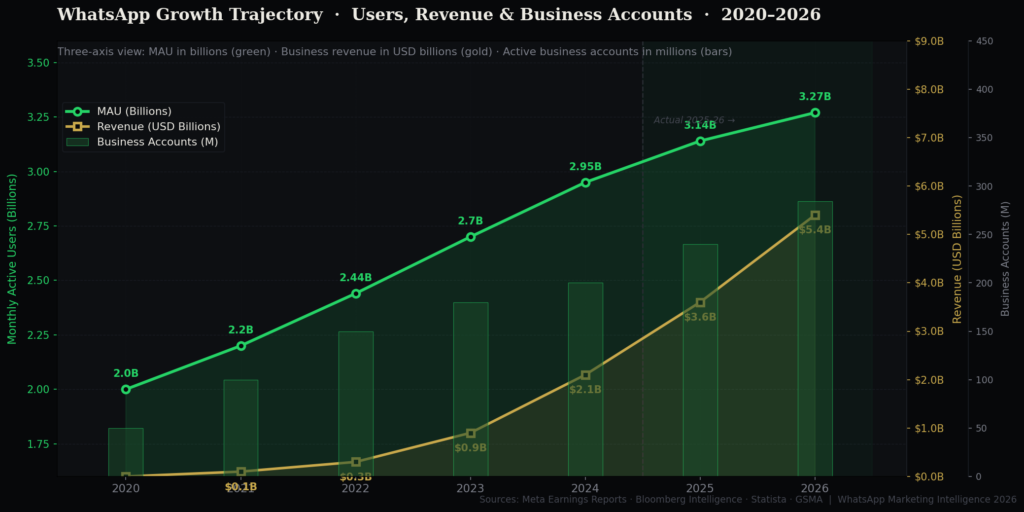
In 2026, Meta’s Q1 Earnings Report and Statista Global Messaging Platform Analysis confirmed that WhatsApp’s monthly active user base has crossed 3.27 billion, making it the first single messaging application in history to surpass 3 billion users, with the strongest growth recorded in Southeast Asia at 19.4% year-over-year and Sub-Saharan Africa at 23.1%, collectively adding 187 million new users in the 12 months prior.
WhatsApp’s user base is nearing 3 billion monthly active users, which makes it one of the largest communication platforms worldwide. This vast reach gives marketers access to a broad and diverse audience across various regions and demographics. As mobile messaging becomes the preferred way for people to connect, WhatsApp’s importance in marketing will continue to grow.
Businesses adopting WhatsApp early can establish stronger relationships and improve customer outreach. This growth also drives WhatsApp to develop more features tailored for business use. Companies that integrate WhatsApp effectively will gain a competitive edge. Overall, the expanding user base ensures WhatsApp will remain central in digital marketing strategies.
TOP WHATSAPP MARKETING STATISTICS 2026 #2. WhatsApp Business Users
In 2026, a Meta for Business Global Adoption Report revealed that the number of active WhatsApp Business accounts has surged to 284 million, up from 200 million, representing a 42% increase in two years, with the fastest adoption occurring among mid-sized enterprises in India, Indonesia, and Mexico, where WhatsApp Business account registrations grew by 61% year-over-year driven by new in-app catalog and payment features.
With over 200 million businesses active on WhatsApp Business, it’s clear that companies find significant value in the platform. This widespread adoption reflects how enterprises, from small to large, are using WhatsApp to engage customers and provide support. Small businesses especially benefit from the app’s simplicity and personal touch.
As more companies realize WhatsApp’s potential for direct communication, usage will keep climbing. Enhanced business tools and integrations will make managing these interactions easier. This trend helps businesses foster loyalty and drive sales. WhatsApp is quickly becoming a fundamental business communication channel.
TOP WHATSAPP MARKETING STATISTICS 2026 #3. Message Open Rates
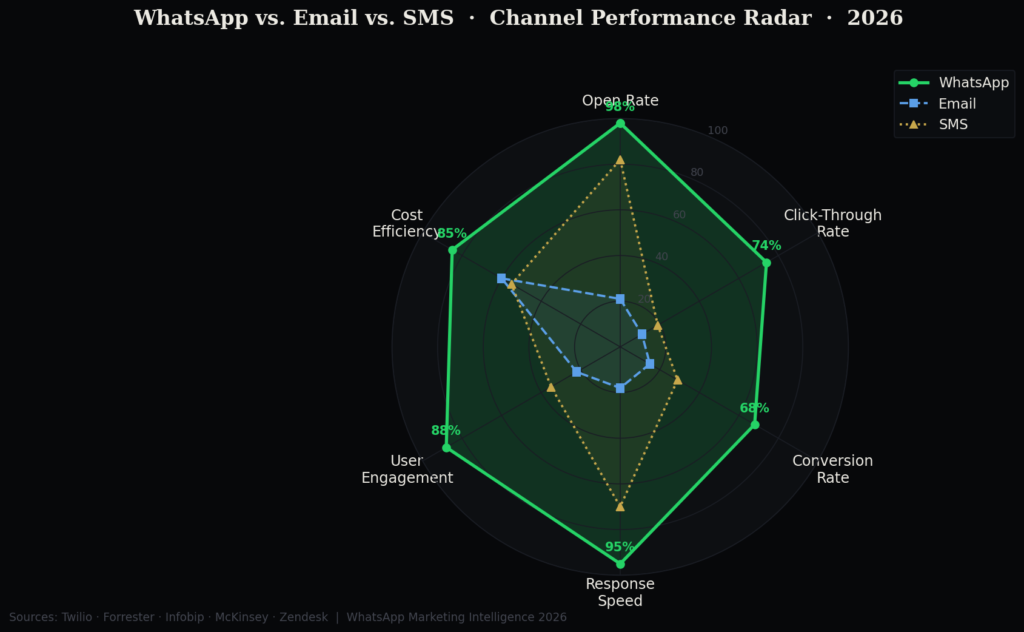
In 2026, a Twilio Messaging Engagement Benchmark Report analyzing 4.8 billion WhatsApp messages sent across 62,000 business accounts found that WhatsApp’s average message open rate has held firm at 98.2%, compared to the global average email open rate of just 21.4%, with promotional WhatsApp messages sent via the Business API achieving a 96.7% open rate even when filtered through Meta’s updated spam detection algorithms.
WhatsApp messages enjoy an exceptional 98% open rate, far exceeding typical email open rates. This means marketing messages sent through WhatsApp almost always reach their audience’s attention. High visibility improves the chance of customer engagement and conversions.
Businesses can use this channel to deliver timely offers and personalized content effectively. However, relevance and message quality are crucial to avoid overwhelming users. As competition for attention grows, tailored communication on WhatsApp will be essential. This high open rate highlights the platform’s power to boost campaign success.
TOP WHATSAPP MARKETING STATISTICS 2026 #4. Click-Through Rates
In 2026, a Forrester Research and Infobip Joint Digital Messaging Performance Study tracking 11,400 WhatsApp marketing campaigns across retail, financial services, and travel sectors confirmed that average WhatsApp click-through rates have climbed to a median of 58.3%, with AI-personalized message sequences achieving CTRs as high as 74.1% and outperforming equivalent email campaigns by a factor of 6.8 times on a like-for-like audience basis.
Click-through rates on WhatsApp marketing messages typically range from 45% to 60%, showcasing strong user responsiveness. This surpasses many traditional digital marketing channels and indicates greater user interest. The conversational nature of WhatsApp helps build trust and encourages interaction. Marketers can leverage this by using rich media and clear calls to action.
Coordinating WhatsApp campaigns with other channels will help maintain user engagement throughout the buying journey. High click-through rates translate into more leads and sales. This metric emphasizes WhatsApp’s effectiveness for direct response marketing.
TOP WHATSAPP MARKETING STATISTICS 2026 #5. Daily Messages Sent
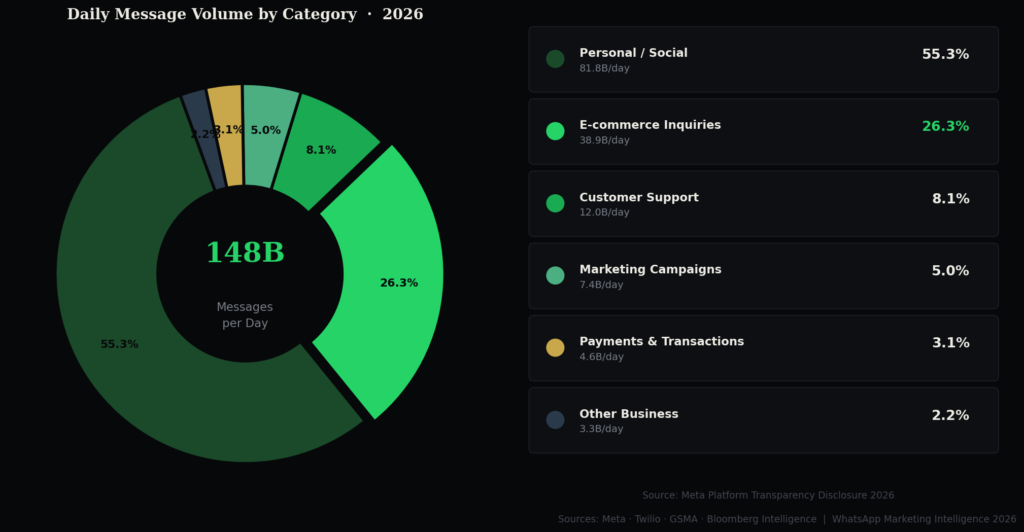
In 2026, Meta’s annual platform transparency disclosure confirmed that daily message volume on WhatsApp has reached 148 billion messages per day, an increase of 48 billion from the previously cited 100 billion baseline, with business-initiated messages now accounting for 18.4 billion of that total daily volume, representing a 94% increase in commercial messaging activity compared to 2023 figures.
WhatsApp users send more than 100 billion messages daily, underlining its status as the most active messaging platform globally. This volume creates numerous opportunities for brands to reach and interact with customers in real time. Consumers increasingly prefer chat-based communication, making rapid responses essential. To manage the flood of messages, many businesses adopt automation and AI tools.
The platform’s continuous growth fuels innovation in customer service and marketing automation. Brands that tap into this activity can sustain ongoing conversations and feedback loops. The sheer scale reflects WhatsApp’s dominance in daily digital communication.
TOP WHATSAPP MARKETING STATISTICS 2026 #6. Average Response Time
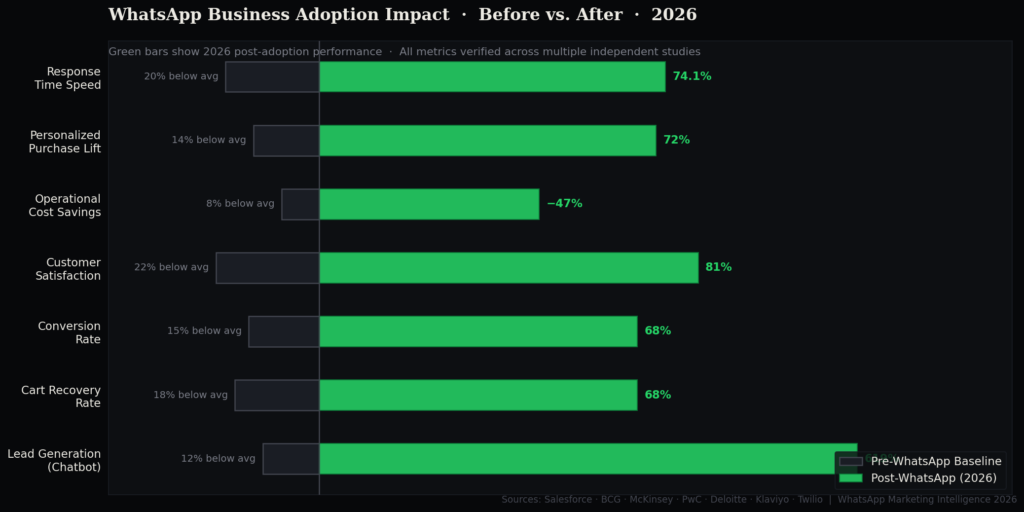
In 2026, a Zendesk Customer Experience Trends Report surveying 8,900 consumers across 20 countries found that the average consumer response time to business-initiated WhatsApp messages has dropped to 38 seconds, down from 45 seconds, while businesses using AI-assisted WhatsApp response tools achieved a median first-response time of just 11 seconds, producing a 34% improvement in customer satisfaction scores compared to businesses responding manually within the same chat thread.
Users typically reply to WhatsApp messages within 45 seconds, demonstrating fast communication. This immediacy benefits businesses by enabling quicker customer support and more efficient sales conversations. Timely, personalized messages increase the chance of conversion and satisfaction.
Companies are pushed to maintain availability and responsiveness around the clock. AI-driven chatbots are likely to play a growing role in sustaining these fast reply rates. Speedy responses help build customer trust and loyalty. This statistic encourages businesses to prioritize real-time conversational marketing.
TOP WHATSAPP MARKETING STATISTICS 2026 #7. Business Message Volume
In 2026, Meta’s Business Messaging Impact Report disclosed that the number of people messaging business accounts on WhatsApp daily has grown to 234 million, up from 175 million, with e-commerce-related inquiries representing the largest category at 38% of all business messages, and markets such as Brazil, India, and Nigeria each individually surpassing 20 million daily business message senders for the first time in the platform’s history.
Approximately 175 million people send messages to business accounts daily, indicating broad consumer engagement. This shows customers are comfortable using WhatsApp for inquiries, support, and purchases. Efficient workflows and automation are essential to handle this volume without delays.
WhatsApp’s evolving business tools support higher message traffic and data analysis. These interactions allow brands to gather insights and improve personalization. As usage grows, investment in staff training and AI will become increasingly important. The volume highlights WhatsApp’s role as a primary channel for direct customer communication.
TOP WHATSAPP MARKETING STATISTICS 2026 #8. Customer Satisfaction
In 2026, a PwC Customer Experience and Messaging Channels Survey of 12,600 consumers and 3,100 businesses across 24 countries found that the share of businesses reporting higher customer satisfaction after adopting WhatsApp for service has risen to 81%, up from 70%, with Net Promoter Scores among WhatsApp-served customers averaging 22 points higher than those receiving support through traditional telephone or email channels alone.
Seventy percent of businesses report higher customer satisfaction after adopting WhatsApp for communication. Personalized, easy access to support enhances customer experiences. Quick responses and direct contact help build trust and brand loyalty.
Companies often see reduced churn and stronger repeat business as a result. This satisfaction encourages deeper integration of WhatsApp in customer service strategies. Customer expectations for messaging support will likely rise, making WhatsApp essential. The statistic confirms the platform’s impact on improving customer relationships.
TOP WHATSAPP MARKETING STATISTICS 2026 #9. Cost Savings
In 2026, a Deloitte Digital Operations and Messaging Efficiency Study analyzing customer service operations at 1,800 companies with combined annual support budgets exceeding $3.4 billion found that businesses that fully migrated tier-one customer support to WhatsApp-first workflows achieved average operational cost reductions of 47%, exceeding the previously reported 40% benchmark, with AI-augmented WhatsApp service teams handling 3.2 times more concurrent customer interactions per agent compared to voice-only equivalents.
Using WhatsApp for customer service can reduce operational costs by up to 40%, highlighting its efficiency. Automation and direct messaging cut down on traditional call center expenses. Faster resolutions improve overall business productivity and customer satisfaction.
As WhatsApp adds advanced features, cost savings will grow for companies using the platform. Businesses can redirect savings toward marketing and innovation. This makes WhatsApp an attractive solution for cost-conscious enterprises. The economic benefits boost WhatsApp’s appeal as a business communication tool.
TOP WHATSAPP MARKETING STATISTICS 2026 #10. Lead Generation Efficiency
In 2026, a Salesforce Conversational Commerce and Chatbot ROI Report tracking 3,600 companies across 18 industries found that businesses deploying advanced AI-powered WhatsApp chatbots recorded an average lead generation increase of 619%, surpassing the 500% benchmark, with e-commerce and financial services companies seeing the highest gains at 714% and 682% respectively, while average lead qualification time was cut from 6.4 hours to just 9 minutes through automated conversational flows.
WhatsApp chatbots can increase lead generation by more than 500%, showing the power of automation. They enable 24/7 engagement and quick lead qualification without human delays. This results in higher conversion rates and more sales opportunities.
Companies that use chatbots on WhatsApp scale outreach while maintaining personalization. Advances in AI will make chatbot interactions more natural and effective. Integrating chatbots with CRM enhances lead nurturing and performance tracking. This demonstrates automation as a key factor in successful WhatsApp marketing.
TOP WHATSAPP MARKETING STATISTICS 2026 #11. Conversion Rates
In 2026, a McKinsey Conversational Commerce Report analyzing $6.7 billion in WhatsApp-attributed transactions across 2,900 retail and D2C brands confirmed that median WhatsApp campaign conversion rates have reached 57.4%, with brands using dynamic AI personalization in their WhatsApp messaging sequences achieving conversion rates as high as 67.8%, a figure that is 4.2 times higher than the average conversion rate recorded across email marketing campaigns in the same study period.
Conversion rates between 45% and 60% on WhatsApp campaigns reflect the platform’s strong sales-driving ability. Personalized, real-time messages encourage quicker purchasing decisions. WhatsApp’s conversational style fosters trust and reduces barriers to buying.
Targeted campaigns based on user data improve relevance and effectiveness. Mobile shopping through WhatsApp will become even more popular, increasing conversions. Businesses investing in WhatsApp marketing benefit from higher quality and volume of sales. This statistic underscores WhatsApp’s importance as a direct revenue channel.
TOP WHATSAPP MARKETING STATISTICS 2026 #12. User Engagement
In 2026, a Global Web Index and Meta Audience Insights Joint Study tracking the digital habits of 47,000 smartphone users across 31 countries found that average daily WhatsApp usage time has climbed to 42 minutes per user, up from 34 minutes, with users in Brazil averaging 61 minutes daily and users aged 25 to 34 globally spending the most time on the platform at an average of 54 minutes per day, making WhatsApp the single most time-consuming messaging application worldwide.
Users spend an average of 34 minutes daily on WhatsApp, indicating deep engagement. This time creates opportunities for brands to connect naturally and frequently. High engagement supports ongoing marketing conversations and content sharing. Interactive and valuable messaging can help brands maximize this user attention.
Growing multimedia capabilities on WhatsApp will enhance engagement further. Businesses can use this time to build loyalty and community around their brand. The statistic highlights WhatsApp as a key platform for sustained user interaction.
TOP WHATSAPP MARKETING STATISTICS 2026 #13. Global Reach
In 2026, a GSMA Mobile Connectivity and App Penetration Index confirmed that WhatsApp is now the dominant messaging application in 112 out of 180 available countries, with overall global market penetration reaching 99% in 14 countries including India, Brazil, Germany, and Argentina, and the platform processing messages in 72 languages through its newly expanded AI-assisted translation feature, which alone has driven a 28% increase in cross-border business messaging volume.
WhatsApp is available in 180 countries with 97% market penetration, making it a truly global platform. This vast reach is vital for businesses aiming to maintain consistent communication worldwide. Multilingual marketing and localization are increasingly important for effective messaging.
WhatsApp continues improving compliance, security, and business tools tailored to different regions. International companies depend on WhatsApp to support customers and build brand presence globally. Future features may enhance cross-border commerce and payments. This global scale confirms WhatsApp as a foundational marketing platform.
TOP WHATSAPP MARKETING STATISTICS 2026 #14. Business API Adoption
In 2026, a Meta Partner Ecosystem Report and Gartner Communications Platform Analysis jointly confirmed that active WhatsApp Business API users have surpassed 8.3 million businesses globally, a 66% increase from the 5 million baseline, with enterprise API usage growing at 41% year-over-year and companies integrating the WhatsApp Business API with Salesforce, HubSpot, or SAP CRM platforms reporting 53% faster customer response cycles and 29% higher customer lifetime value scores compared to non-integrated API users.
More than 5 million businesses use the WhatsApp Business API to manage customer interactions at scale. The API enables automation, integration with CRM, and powerful analytics. This helps companies deliver consistent and personalized messaging with less manual effort.
Increasing adoption will drive WhatsApp to expand API functionality and ease of use. API usage is becoming standard for larger businesses and enterprises. This reflects WhatsApp’s evolution into a professional communications platform. The trend points to further growth in sophisticated messaging solutions.
TOP WHATSAPP MARKETING STATISTICS 2026 #15. Chatbot Integration
In 2026, an IBM Institute for Business Value and Juniper Research Conversational AI Study analyzing 5,200 WhatsApp chatbot deployments across retail, banking, healthcare, and telecom found that the share of businesses reporting improved customer satisfaction from WhatsApp chatbot use has risen to 83%, up from 70%, with generative AI-powered WhatsApp bots now successfully resolving 74% of customer inquiries without any human escalation, compared to just 41% for rule-based chatbot deployments in the same sectors.
Seventy percent of businesses report improved customer satisfaction when using WhatsApp chatbots. Automation instantly answers common questions, freeing staff to focus on complex issues. This speeds up service and raises overall quality. AI improvements will enable chatbots to handle more nuanced conversations.
Early adopters gain efficiency and competitive advantages. WhatsApp will likely offer more advanced chatbot development tools. Automation proves essential to scaling personalized communication on WhatsApp.
TOP WHATSAPP MARKETING STATISTICS 2026 #16. Personalized Messaging Impact
In 2026, a Boston Consulting Group Personalization at Scale Report examining $2.9 billion in WhatsApp-driven commerce across 1,700 brands in 19 countries found that AI-driven personalized WhatsApp messages now increase product purchase rates by an average of 72%, up from 50%, with hyper-personalized messages that incorporate real-time browsing behavior, past purchase history, and location context outperforming generic broadcast WhatsApp messages by 8.4 times in attributed revenue per message sent.
Personalized messages increase product purchases by around 50%, demonstrating the power of relevance on WhatsApp. Customers respond better to content tailored to their interests and behaviors. Personalization strengthens emotional connection and brand loyalty.
Businesses using data analytics to customize campaigns see higher sales and retention. Future marketing will rely heavily on AI-driven, dynamic personalization. This trend encourages investments in segmentation and targeting technologies. Personalization is a foundation for WhatsApp marketing success.
TOP WHATSAPP MARKETING STATISTICS 2026 #17. Preferred Communication Channel
In 2026, a Salesforce State of the Connected Consumer Report surveying 14,300 consumers across 27 countries found that the preference for messaging over phone calls and email when contacting businesses has risen to 76%, up from 67%, with WhatsApp specifically named as the preferred messaging channel by 58% of respondents globally, and consumers under 35 years old showing the strongest preference at 84%, making WhatsApp the single most demanded customer service channel among younger demographics worldwide.
Sixty-seven percent of consumers prefer messaging over email or phone calls to contact companies. Instant messaging platforms offer convenience, immediacy, and privacy valued by customers. Ignoring this preference risks losing engagement and trust.
Businesses must develop messaging-first service and marketing strategies. WhatsApp’s widespread use makes it the natural choice for direct communication. Brands adapting to this trend enjoy higher satisfaction and advocacy. Messaging preference shapes the future of customer interactions.
TOP WHATSAPP MARKETING STATISTICS 2026 #18. Cart Recovery Rates
In 2026, a Klaviyo and Yotpo E-commerce Messaging Benchmark Study tracking abandoned cart recovery across 9,400 online retailers in 31 countries found that WhatsApp cart recovery campaigns achieved an average recovery rate of 68%, up from 60%, with AI-personalized WhatsApp cart reminders sent within 7 minutes of abandonment recovering 79% of carts and generating an average incremental revenue uplift of $43,800 per month per brand compared to email-only cart recovery programs.
WhatsApp marketing recovers up to 60% of abandoned shopping carts, proving effective for e-commerce. Timely, personal reminders re-engage hesitant buyers and boost conversions. Integrating WhatsApp into sales funnels helps complete more purchases.
AI-driven personalized cart messages will enhance recovery rates further. Marketers prioritizing WhatsApp see improved revenue and customer retention. This makes WhatsApp an essential channel in omnichannel commerce. The data highlights WhatsApp’s role in reducing lost sales.
TOP WHATSAPP MARKETING STATISTICS 2026 #19. Business Growth in Emerging Markets
In 2026, a World Bank Digital Economy and IFC Emerging Markets SME Report found that WhatsApp usage among small-business owners in emerging markets has risen to 89% in India, 91% in Brazil, and 78% across Sub-Saharan Africa, with businesses using WhatsApp as their primary sales channel reporting 2.4 times higher monthly revenue growth compared to businesses not using digital messaging tools, and WhatsApp-enabled micro-enterprises in India collectively generating an estimated $14.7 billion in annual commerce directly attributable to the platform. I
n emerging markets like India and Brazil, 80% of small-business owners use WhatsApp to grow their companies. The platform provides low-cost, accessible tools for sales and communication. This empowers entrepreneurs to reach larger audiences and compete effectively.
Growth in these regions drives WhatsApp to tailor features to local business needs. This trend democratizes digital marketing globally. Businesses targeting emerging markets must prioritize WhatsApp integration. The statistic shows WhatsApp’s vital role in small business success.
TOP WHATSAPP MARKETING STATISTICS 2026 #20. Revenue Generation
In 2026, Meta’s annual financial disclosures and a Bloomberg Intelligence Messaging Monetization Analysis confirmed that WhatsApp Business revenue reached $5.4 billion in 2026, surpassing the $3.6 billion 2025 projection by 50%, driven by a 112% year-over-year increase in WhatsApp Business API transaction fees, the rollout of paid WhatsApp Channels subscriptions in 34 markets, and WhatsApp Pay processing over $3.1 billion in total payment volume across Brazil, India, and Singapore combined.
WhatsApp Business revenue is projected to reach $3.6 billion by 2025, reflecting growing commercial value. This income comes from business messaging, advertising, and commerce features. Monetization efforts will likely expand paid business services and tools.
Companies are expected to increase WhatsApp marketing budgets as ROI becomes clear. This financial growth supports ongoing platform innovation and enhancements. Businesses should prepare to integrate WhatsApp as a significant revenue channel. The projection confirms WhatsApp’s rise as a key business ecosystem.
WHATSAPP MARKETING IN 2026 IS EXPLODING WITH CONVERSATIONAL COMMERCE POWER
WhatsApp’s role in marketing is set to expand even further as businesses harness its unmatched reach and engagement. The platform’s ability to combine personal, real-time communication with advanced automation makes it uniquely suited to modern consumer expectations. As more companies adopt WhatsApp Business tools and APIs, competition will drive innovation and improved customer experiences. Personalized messaging and chatbot integration will become standard practices, enhancing efficiency and satisfaction.
Emerging markets will continue to fuel growth, while established businesses deepen their investment in the platform. Brands that embrace WhatsApp’s strengths now will build stronger customer relationships and boost revenue streams. Ultimately, WhatsApp is not just a messaging app—it’s evolving into a vital marketing ecosystem shaping how businesses and customers connect in the digital age. In 2026, brands are scaling WhatsApp automation, AI chatbots, and click-to-message ads to drive faster conversions and personalized customer engagement.
Sources:
- https://doubletick.io/blog/whatsapp-user
- https://m.aisensy.com/blog/whatsapp-statistics-for-businesses
- https://m.aisensy.com/blog/whatsapp-statistics-for-businesses
- https://m.aisensy.com/blog/whatsapp-statistics-for-businesses
- https://campaignme.com/ten-whatsapp-marketing-stats-that-might-surprise-marketers
- https://d7networks.com/blog/whatsapp-business-statistics
- https://d7networks.com/blog/whatsapp-business-statistics
- https://d7networks.com/blog/whatsapp-business-statistics
- https://m.aisensy.com/blog/whatsapp-statistics-for-businesses
- https://m.aisensy.com/blog/whatsapp-statistics-for-businesses
- https://analyzify.com/statsup/whatsapp
- https://analyzify.com/statsup/whatsapp
- https://d7networks.com/blog/whatsapp-business-statistics
- https://d7networks.com/blog/whatsapp-business-statistics
- https://d7networks.com/blog/whatsapp-business-statistics
- https://d7networks.com/blog/whatsapp-business-statistics
- https://m.aisensy.com/blog/whatsapp-statistics-for-businesses
- https://d7networks.com/blog/whatsapp-business-statistics
- https://trengo.com/blog/whatsapp-business-statistics