



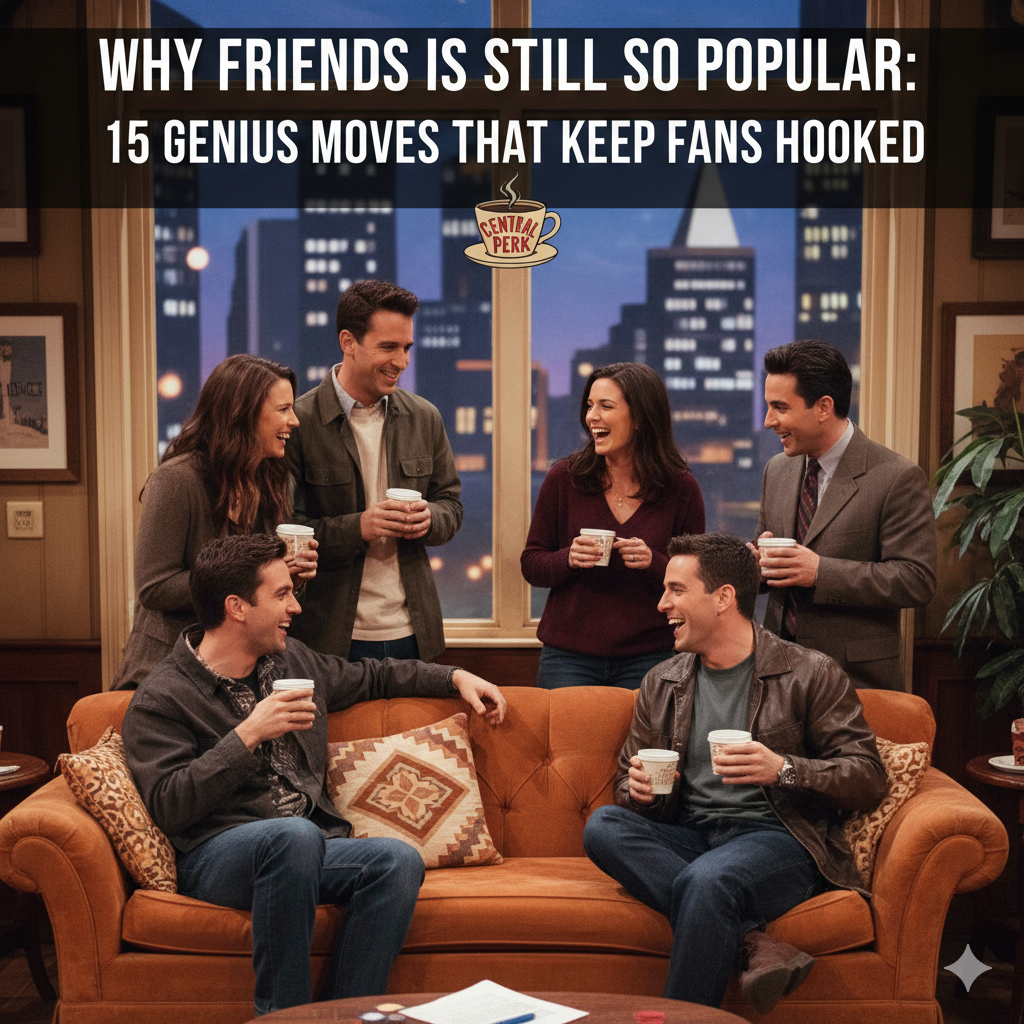
14 Dec Why Friends Is Still So Popular: 15 Genius Moves That Keep Fans Hooked
Why Friends Is Still So Popular: 15 Genius Moves That Keep Fans Hooked (Editor’s Choice)
| # | Genius Move | What It Is | Why It Keeps Fans Hooked |
|---|---|---|---|
| 1 |
The Perfect Ensemble Cast
Chemistry + Balance
|
Six wildly different personalities that still fit together like a perfectly mismatched dinner party — no single lead, just a true ensemble that feels like a real friend group. | Viewers don’t just pick a “favorite character”; they emotionally buy into the whole group dynamic, which makes rewatches feel like catching up with old friends instead of just rewatching a show. |
| 2 |
Relatable Life Stages
Quarter-life Chaos
|
Storylines built around broke twenties and figuring-out-thirties — bad jobs, worse dates, tiny wins, and the constant feeling that everyone else got the manual for adulthood. | Every generation rediscovers the show and sees themselves in it; the crises feel small enough to laugh at but real enough to feel seen, which is a dangerously addictive emotional combo. |
| 3 |
Timeless Humor
Evergreen Comedy
|
Jokes built on human behavior — insecurity, ego, awkwardness — instead of hyper-specific ’90s references, so the punchlines still land even if you missed the original air date by a decade. | New fans don’t need cultural context to get the humor; it feels fresh on first watch and comforting on the tenth, which is exactly how you end up with multi-generation fandom. |
| 4 |
Iconic Catchphrases
Pop Culture DNA
|
Lines like “We were on a break,” “Pivot!” and “How you doin’?” that escaped the show and joined the language — used in arguments, moving days, and flirting attempts worldwide. | The show lives on in everyday speech and social captions; people quote it before they even realize they’re quoting it, which keeps the brand of the show alive far beyond its runtime. |
| 5 |
Highly Quotable Dialogue
Caption Gold
|
Tight, snappy lines that feel like they were written for screenshots long before social media existed — the kind of dialogue you want to steal and pretend was off the cuff. | Every rewatch serves up new caption ideas, meme text, and tweet material, turning fans into unpaid distributors of *Friends* content with every post and share. |
| 6 |
Comfort-TV Energy
Emotional Blanket
|
Soft lighting, familiar sets, low-stakes problems, and predictable emotional beats that make each episode feel like the TV equivalent of comfort food. | Fans don’t just watch *Friends*; they prescribe it to themselves for bad days, breakups, and burnout — it becomes a coping mechanism, not just entertainment. |
| 7 |
Strong Character Arcs
Growth, But Make It Real
|
Characters who actually evolve — Rachel growing into her career, Chandler softening emotionally, Monica loosening control (a little) — without losing what made them lovable in the first place. | The longer you watch, the more you feel like you’ve grown up with them; you’re not just laughing at episodes, you’re emotionally investing in their lives over time. |
| 8 |
Slow-Burn Romance
Ross & Rachel Effect
|
An on-again, off-again love story that takes seasons, not episodes, to unfold — full of bad timing, grand gestures, unresolved tension, and questionable decisions. | Viewers stay to find out “if they’ll end up together” even when they already know the answer; that emotional suspense turns casual watchers into committed binge-watchers. |
| 9 |
Episodic Accessibility
Drop-In Friendly
|
Each episode feels self-contained enough that you can jump in anywhere without a recap — like joining a conversation mid-story and still getting the joke. | Perfect “background TV” that doesn’t actually stay in the background; people rewatch it because it’s easy to start, easy to pause, and never feels like effort. |
| 10 |
Holiday Episodes
Tradition TV
|
Big, chaotic Thanksgiving and holiday episodes that feel like mini traditions — you don’t just remember them, you rewatch them seasonally. | The show becomes part of viewers’ real-life rituals; when a series is tied to your holidays, it stops being “content” and quietly turns into tradition. |
| 11 |
Idealized New York Setting
City Fantasy
|
A dreamy version of New York where the apartments are huge, the coffee shop is always open, and your best friends live approximately 12 seconds away. | It lets viewers borrow the fantasy of big-city life without the rent, noise, or subway delays — a soft-focus NYC that feels like a shared daydream. |
| 12 |
Physical Comedy
Body Language LOLs
|
Ross flailing, Joey eating, Chandler twitch-smirking — exaggerated physicality that turns everyday moments into instantly memorable scenes. | Physical humor crosses language and cultural barriers, making *Friends* endlessly gif-able, clip-able, and sharable across every platform and country. |
| 13 |
High Rewatch Value
Always-On TV
|
Layers of tiny jokes, background gags, and character beats that you only catch on the third, seventh, or fifteenth rewatch. | The show rewards repeat viewing, so it naturally becomes people’s “default play” — the thing they turn on when they don’t know what to watch. |
| 14 |
Celebrity Cameos
A-List Sprinkle
|
Surprise guest stars like Brad Pitt, Julia Roberts, and Bruce Willis dropping into episodes without stealing the whole show from the core cast. | Cameos created “event episodes” people talked about, rewatched, and shared — boosting the show’s buzz while still keeping the focus on the main six. |
| 15 |
Emotional Balance
Heart + Humor
|
A careful blend of jokes, vulnerability, fights, reconciliations, and genuine affection — never purely serious, never purely silly. | Fans feel emotionally safe: they’ll laugh, maybe cry a little, and always leave an episode feeling lighter — which is exactly why they keep coming back. |
Why Friends Is Still So Popular: 15 Genius Moves That Keep Fans Hooked
Why Friends Is Still So Popular: Genius Moves That Keep Fans Hooked #3 — Timeless Humor
There’s something almost aggressively modern about how Friends’ humor has aged. The jokes aren’t pinned to a specific cultural moment — instead, they’re pinned to the enduring absurdity of being human. Ross screaming “Pivot!” isn’t funny because of the couch, or the stairs, or even the situation. It’s funny because it’s a portrait of all of us, triumphantly trying to brute-force our way through a problem we have no business trying to solve. That’s why the humor hasn’t curdled with time the way some ’90s content has — it’s not built on trend; it’s built on truth. Not earnest truth, because that would be boring, but truth with a side of chaos. The kind of humor that feels like being roasted and hugged simultaneously.
Why Friends Is Still So Popular: Genius Moves That Keep Fans Hooked #4 — Iconic Catchphrases
The catchphrases in Friends feel like linguistic jewelry — the kind you put on without thinking, but somehow it completes the whole outfit. “We were on a break!” isn’t just a line; it’s a generational debate. “How you doin’?” isn’t just a greeting; it’s the male ego distilled into one impeccably constructed sound bite. These lines became immortal not because the writers intended to manufacture cultural artifacts, but because they were rooted in character truth. And truth, when delivered with comedic timing, has an unnervingly long shelf life. They became the kind of phrases you say without realizing you’re quoting something — like conversational muscle memory.
Why Friends Is Still So Popular: Genius Moves That Keep Fans Hooked #5 — Highly Quotable Dialogue
The dialogue in Friends is written with the kind of assured ease that only comes from people who know exactly what they’re doing. Each line is constructed like a micro-essay that somehow manages not to feel like a micro-essay. It’s the linguistic equivalent of throwing on an oversized blazer and pretending you didn’t plan the entire outfit around it. The writing is witty without the brittle cleverness that some sitcoms use as a crutch. Instead, it feels lived-in, textured, not trying too hard but also definitely trying — just in a socially strategic way. That’s why the lines are endlessly quotable: they feel like things you could say, if only you were composed enough to say them at the right time.
Why Friends Is Still So Popular: Genius Moves That Keep Fans Hooked #6 — Comfort-TV Energy
There’s a distinct emotional temperature to Friends — cozy in the way that only nostalgia and softly lit interiors can be. Watching it is like walking back into your childhood bedroom where everything feels exactly the same and nothing hurts quite as sharply. The pacing has a gentle heartbeat; the crises, no matter how dramatic, never lead to catastrophic emotional fallout. The stakes hover in that sweet spot where you care just enough but never too much. It’s a show that feels like a sweater you’ve overworn but refuse to throw away because it still smells faintly like a version of yourself you actually liked.
Why Friends Is Still So Popular: Genius Moves That Keep Fans Hooked #7 — Strong Character Arcs
The characters grow the way real people grow: slowly, awkwardly, and sometimes only after excruciating trial and error. But the genius is that they evolve while still feeling like themselves — no personality rewrites, no sudden, implausible shifts. Chandler doesn’t become a different man; he becomes a more emotionally literate version of the same sarcastic disaster. Rachel doesn’t abandon vanity; she learns to wield it with ambition. Monica softens without losing her intensity. Joey stays Joey but with the faint glimmer of self-awareness. Ross… decays in a fascinating way. Their arcs feel personal, not performative — the kind of growth that sneaks up on you like good therapy.
Why Friends Is Still So Popular: Genius Moves That Keep Fans Hooked #8 — Slow-Burn Romance
Ross and Rachel are a cautionary tale dressed as a love story, and yet we return to them with the emotional maturity of someone who definitely should know better by now. Their slow burn isn’t just slow — it’s geological. Entire social climates change while they figure out how to communicate basic feelings. But we stay invested because their dysfunction is familiar. It’s the kind of romantic loop-de-loop millennials perfected long before we had the vocabulary for attachment styles. Their relationship has just enough real-life mess to feel grounding, but enough fairy-tale gloss to avoid being triggering.
Why Friends Is Still So Popular: Genius Moves That Keep Fans Hooked #9 — Episodic Accessibility
The beauty of Friends is that it doesn’t punish you for being distracted. You can drop into any episode like you’re dropping into a group chat after six hours of ignoring it, and still keep up. The show’s episodic structure feels like an act of mercy in a world where TV often insists on being homework. It respects your cognitive load. It knows you’re tired. It gives you snackable stories — tidy, digestible, and comforting. It’s a show that meets you where you are instead of demanding your full emotional bandwidth.
Why Friends Is Still So Popular: Genius Moves That Keep Fans Hooked #10 — Holiday Episodes
The Friends holiday episodes are like seasonal pop-ups in the middle of their regular programming. They capture the collective emotional chaos of Thanksgiving and Christmas with unsettling accuracy: the competitiveness, the guilt-tripping, the spiraling. Each holiday special feels like a mini cultural event — familiar enough to feel nostalgic, but chaotic enough to feel true. They became rituals, episodes you revisited not because you needed to but because your inner seasonal gremlin demanded it.
Why Friends Is Still So Popular: Genius Moves That Keep Fans Hooked #11 — Idealized New York
The New York of Friends exists in that glamorous liminal space between fantasy and delusion. The apartments are enormous, the neighbors charmingly eccentric rather than horrifying, and the rent apparently subsidized by angels. But the city is designed to be a setting, not a stressor. Watching Friends’ New York feels like trying on an outfit you know doesn’t fit your actual life but makes your mirror self look exceptionally put together. It’s aesthetic escapism. Aspirational urbanism. A city simplified into a moodboard for emotional connection.
Why Friends Is Still So Popular: Genius Moves That Keep Fans Hooked #12 — Physical Comedy
Physical humor is a nearly endangered comedic species — but Friends treated it like choreography. Ross moves like a wet umbrella someone forgot to close. Joey commits to food and facial expressions with Olympian seriousness. Chandler’s body is a live-action punctuation mark. Their physicality isn’t random; it’s character-driven, which is why it never feels cheap. Watching Ross collapse under the weight of his own limbs is funnier than any punchline. It’s comedy that transcends language, culture, and sometimes even logic.
Why Friends Is Still So Popular: Genius Moves That Keep Fans Hooked #13 — Rewatch Value
Rewatching Friends feels like digging through an old purse and finding money you didn’t know you left for yourself. Every rewatch reveals something — a joke you missed, a look exchanged, a detail in Monica’s kitchen that absolutely shouldn’t be there but is. The show changes depending on where you are emotionally, which makes each return feel fresh. It’s the rare kind of content that grows with you, even if some of it stays frozen in time. In an age where media burns out after a week, its longevity feels borderline spiritual.
Why Friends Is Still So Popular: Genius Moves That Keep Fans Hooked #14 — Celebrity Cameos
The cameos in Friends are like delightful little style accents — not essential but undeniably elevating. Brad Pitt showing up with chaotic Thanksgiving energy? Julia Roberts as a revenge-driven icon? Bruce Willis as the softest emotionally repressed man on TV? These appearances weren’t just cameos; they were cultural earthquakes that rippled across the 90s. They made the show feel plugged into the larger Hollywood ecosystem without ever derailing its emotional core.
Why Friends Is Still So Popular: Genius Moves That Keep Fans Hooked #15 — Emotional Balance
The emotional architecture of Friends is its most subversive feature. It invites you to laugh but never lets you float too far from sincerity. The friendships feel real — textured, flawed, nurturing, occasionally unhinged. The emotional beats are simple but deeply human: heartbreak, disappointment, hope, loyalty. The show never manipulates you with melodrama; it guides you with softness. In the end, Friends isn’t about humor or romance or nostalgia. It’s about the profound ordinariness of being loved by the people who witness your entire life, good and bad, and decide to keep showing up.
Why Friends Still Runs the Cultural Show
In the end, Friends isn’t just a sitcom — it’s a masterclass in emotional branding disguised as TV comfort food. It proves that when you blend character chemistry, timeless humor, and storylines that age like good denim, you don’t just entertain people; you lodge yourself into the cultural bloodstream. The 15 genius moves we broke down aren’t accidental — they’re the silent architecture behind a phenomenon that keeps renewing itself with every generation that stumbles into its orbit. And maybe that’s the real lesson here: whether you’re building a show, a business, or a brand narrative, longevity comes from creating something people want to return to, again and again, even when they can recite the lines by heart. If Friends has taught us anything, it’s that connection — real, sticky, warm, lived-in connection — is the ultimate strategy.