



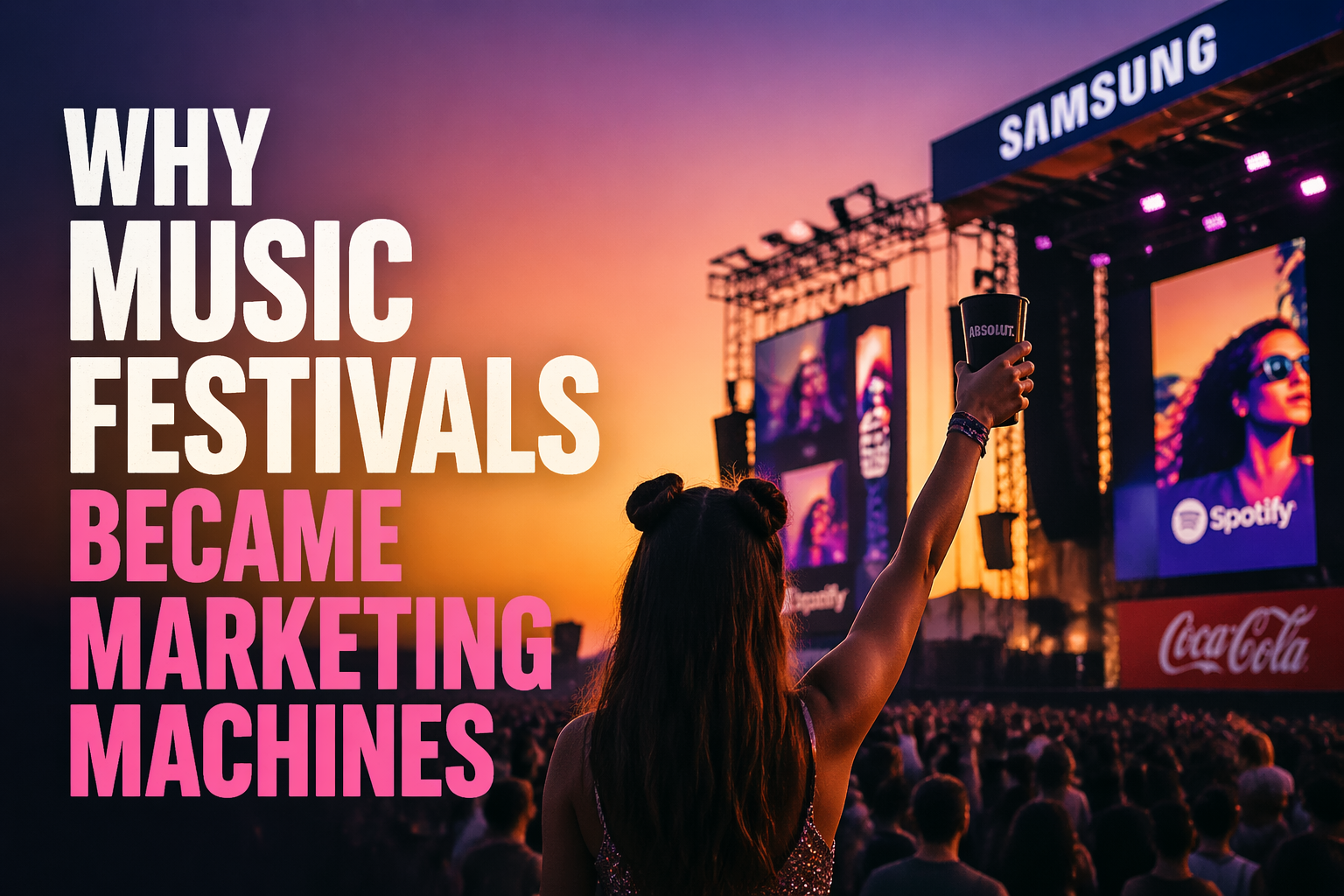
14 Dec Why Music Festivals Became Marketing Machines: 15 Smart Strategies That Made Them Go Viral
Why Music Festivals Became Marketing Machines: 15 Smart Strategies That Made Them Go Viral (Editor’s Choice)
| # | Strategy | Hook Summary | Best Content to Embed | Example Search Keywords |
|---|---|---|---|---|
| 1 |
Crowd as the Product
User-Generated Content
|
Turn attendees into walking billboards by designing a hyper-photogenic environment that people can’t resist posting from. | Crowd panoramas, drone shots, outfit reels, GRWM festival clips. |
X: “festival crowd aesthetic”, “Coachella drone video”
IG: #FestivalStyle, #CoachellaExperience TikTok: “festival vlog”, “festival GRWM” |
| 2 |
Seductive Stage Design
Visual Spectacle
|
Build stages as immersive light sculptures so the show backdrop becomes just as shareable as the headliner. | Lightshow time-lapses, stage POVs, stage reveal clips, LED wall highlights. |
X: “festival stage design”, “LED stage viral”
IG: #StageDesign, #FestivalVibes TikTok: “festival lightshow”, “stage POV festival” |
| 3 |
Limited-Edition Wristband Culture
Physical Keepsakes
|
Turn wristbands into collectible, highly photogenic mementos so entry passes double as lifelong brand reminders. | Wristband unboxings, collections, “cutting off the wristband” TikToks. |
X: “festival wristband unboxing”, “wristband collection”
IG: #WristbandCollection, #FestivalWristbands TikTok: “festival wristband”, “wristband cutting” |
| 4 |
Celebrity Crop-Top Effect
Influence & PR
|
Use celebrities as moving moodboards; their “casual” festival looks become viral style memos and free PR. | Celebrity festival outfit reels, fan captures, stylist breakdowns. |
X: “celebs at Coachella”, “festival celeb style”
IG: #FestivalCelebs, #CelebStyle TikTok: “celebrity festival fashion”, “Coachella celeb sighting” |
| 5 |
Engineered “Don’t Miss This” Moments
FOMO Design
|
Script surprise guests, confetti drops, and beat-drop fireworks that feel too iconic not to film and share. | Surprise guests, confetti slow-mo, crowd reaction POVs. |
X: “surprise guest festival”, “craziest festival moment”
IG: #FestivalMoments, #BeatDrop TikTok: “festival POV moment”, “festival chaos” |
| 6 |
Fashion as a Personality Quiz
Style & Collabs
|
Partner with brands on capsule collections so festival outfits become shoppable storytelling in motion. | Festival fashion hauls, brand collab reels, styling-suite BTS. |
X: “festival brand activation”, “festival fashion collab”
IG: #FestivalFits, #BrandCollab TikTok: “festival fashion haul”, “PR glam festival” |
| 7 |
Experience-First, Music-Second
Experiential
|
Layer in art, wellness, lounges, and side quests so the festival feels like an immersive universe, not just a concert. | Art installation tours, wellness dome clips, “festival aesthetic spots” reels. |
X: “festival installations”, “silent disco festival”
IG: #FestivalExperience, #FestivalArt TikTok: “festival experiences”, “things to do at Coachella” |
| 8 |
Micro-Influencer Takeovers
Creator Strategy
|
Invite micro-influencers whose audiences trust them; their vlogs and GRWMs become high-converting hype. | Influencer weekend vlogs, outfit diaries, festival recaps. |
X: “festival influencer program”, “micro influencer festival”
IG: #FestivalInfluencer, #FestivalRecap TikTok: “festival takeover vlog”, “micro influencer GRWM” |
| 9 |
Lineup Poster Mythmaking
Tease & Hype
|
Treat the lineup poster like a cultural event that sparks discourse, debates, and instant shares. | Lineup reaction videos, “who I’m seeing” breakdowns, poster drops. |
X: “festival lineup reactions”, “lineup drop thread”
IG: #FestivalLineup TikTok: “festival lineup reaction”, “lineup breakdown” |
| 10 |
Food & Drink as Status Symbols
F&B Experience
|
Curate “elevated” food and cocktails so every snack doubles as a flex and a photo opportunity. | Festival food tours, viral drink tastings, top-stall reviews. |
X: “festival food review”, “Coachella food lineup”
IG: #FestivalEats, #FoodReel TikTok: “festival food vlog”, “trying festival snacks” |
| 11 |
Branded Photo Ops in Disguise
Brand Activation
|
Build sculptural, neon-forward installations that look like art first and advertising second. | Branded photo spots, activation walkthroughs, “best photo ops” guides. |
X: “festival brand installation”, “festival photo ops”
IG: #FestivalPhotoOp, #BrandActivation TikTok: “festival photo spots”, “brand activation festival” |
| 12 |
Chaos as a Badge of Honor
Story Fuel
|
Lean into the mishaps and dust storms; survival stories become viral, relatable, and weirdly aspirational. | “Festival gone wrong” vlogs, dust storm clips, reality vs. expectations. |
X: “festival chaos”, “festival survival stories”
IG: #FestivalChaos, #FestivalFails TikTok: “festival horror story”, “festival reality vs expectations” |
| 13 |
Behind-the-Scenes Exclusivity
BTS Access
|
Share crew POVs, sound checks, and stage builds to make viewers feel like insiders to the spectacle. | Backstage walks, crew POVs, stage build time-lapses. |
X: “festival BTS”, “stage build time lapse”
IG: #FestivalBTS, #BackstageLife TikTok: “festival behind the scenes”, “crew POV festival” |
| 14 |
Livestream FOMO Factory
Digital Reach
|
Broadcast key sets in real time so at-home viewers feel just excluded enough to buy tickets next year. | Livestream highlight clips, split-screen reactions, viral set moments. |
X: “festival livestream highlights”, “Coachella live stream”
IG: #FestivalLive, #LiveSet TikTok: “festival livestream recap”, “reacting to festival livestream” |
| 15 |
Post-Festival Debrief Economy
Evergreen Content
|
Extend the festival’s life with recaps, photo dumps, and “what I’d do differently” content that keeps the brand in feed rotation. | Recap edits, photo dumps, debrief threads, “next year tips”. |
X: “festival recap thread”, “post festival thoughts”
IG: #FestivalRecap, #FestivalDump TikTok: “festival recap”, “post festival depression” |
Why Music Festivals Became Marketing Machines: 15 Smart Strategies That Made Them Go Viral
Why Music Festivals Became Marketing Machines: Smart Strategies That Made Them Go Viral #1 — The Art of Turning the Crowd Into the Product
There’s a delicious irony in the way modern festivals treat their attendees: half audience, half unpaid marketing interns. It’s as if the organizers collectively realized that the people coming to the festival aren’t just consumers — they’re content factories, each equipped with a smartphone camera that might as well be a tiny, highly responsive billboard. And so the environment is curated accordingly: everything — the Ferris wheel, the glitter-bombed grass lawns, the pastel sunset that somehow always hits at a suspiciously perfect angle — is designed to make you pause mid-step and think, Wait, hold my drink, I need a picture with this. It’s less about music and more about declarations of presence. Being there becomes the point, and documenting that you were there becomes the assignment. And because humans are inherently narcissistic in an adorable and marketable way, festivals don’t even have to ask you to post. You do it automatically, partly to tell the world you’re fun, partly to convince yourself you actually are, and partly because your outfit didn’t survive three hours of getting ready for you NOT to post.
Why Music Festivals Became Marketing Machines: Smart Strategies That Made Them Go Viral #2 — Stage Design as a Seduction Strategy
Once upon a time, a stage was simply a structure meant to elevate musicians so you could see them. Now? A stage is an extraterrestrial-sized art piece dipped in LED robotics and existential symbolism. Think: a 60-foot holographic arch that looks like it was stolen from a sci-fi utopia where people communicate through light. Festival producers have figured out that the stage isn’t just where the performance happens — the stage is the performance. Every curve, every burst of neon, every pyrotechnic spasm is engineered to elicit a collective gasp that later becomes a collective share. And the colors! These stages are lit like they were created by people who exclusively wear black turtlenecks and have strong opinions about chromatic psychology. People don’t just watch the stage — they get seduced by it, fall for it, photograph it as if it’s a celebrity. And somewhere in the haze of visuals and lasers, you realize: the stage was built for your enjoyment, sure, but really, it was built for your feed.
Why Music Festivals Became Marketing Machines: Smart Strategies That Made Them Go Viral #3 — The Limited Edition Wristband Obsession
Festival wristbands have evolved into something suspiciously close to status jewelry — like if a friendship bracelet and a luxury brand had a love child. They’re tactile reminders that you participated in a cultural moment, and festivals are fully aware of how sentimental people get about these tiny woven badges. The packaging is increasingly elaborate (Coachella now sends wristbands in boxes that look like PR mailers), and the wristbands themselves are pretty enough to warrant a flat-lay photoshoot. People don’t just wear them — they archive them, stack them, treat them as artifacts of past lives. Post-festival, cutting off a wristband can feel emotional, like saying goodbye to the version of yourself who momentarily believed life was nothing but sun flares, good music, and your best outfit. Festivals know this. They engineer the emotional attachment because emotional attachment = posting. Posting = cultural permanence. Cultural permanence = ticket sales. It’s manipulative in a charming way.
Why Music Festivals Became Marketing Machines: Smart Strategies That Made Them Go Viral #4 — The Celebrity Crop-Top Effect
There’s something almost anthropological about watching celebrities at festivals — like seeing rare birds in a Dior saddle bag–lined habitat. Festivals capitalize on this by curating VIP zones that are “exclusive” but accidentally-on-purpose very visible. Celebrities become mascots of festival coolness: the model in glitter eyebrows, the actor in a suspiciously crisp white tank top (which raises the question: how?), the singer who showed up because their PR person told them “brand synergy.” Their presence becomes an aesthetic benchmark. Everyone suddenly wants to dress like them, dance like them, or be photographed pretending NOT to look for them. Festivals know celebrity sightings ignite instant virality. And unlike red carpets — which feel rigid and fixated — festival celebrity content feels feral, candid, democratic. Seeing a famous person sweat in a field makes them feel human, which paradoxically makes them even more shareable.
Why Music Festivals Became Marketing Machines: Smart Strategies That Made Them Go Viral #5 — The “Don’t Miss This Moment” Engineering Trick
Festivals have weaponized FOMO to the point where it feels like a sport. Instead of relying on spontaneous magic, they stage-manage it: surprise guests who appear out of nowhere (yet somehow with perfect lighting), fireworks synced to the exact millisecond of the beat drop, confetti storms that swallow you like you’ve stepped into a Lisa Frank fever dream. Everything is timed to create an emotional climax specifically optimized for filming. The subtext is always: If you weren’t there to see this happen in real time, were you truly alive? And because people have internalized this, phones go up the second a song builds tension. It’s like a Pavlovian response — crescendo = camera. The result? Millions of “you had to be there” videos that essentially become cinematic ads for the festival. A moment engineered to go viral inevitably… goes viral.
Why Music Festivals Became Marketing Machines: Smart Strategies That Made Them Go Viral #6 — Fashion Partnerships That Feel Like Personality Quizzes
The thing about festival fashion is that it’s less about dressing and more about storytelling. Are you a crochet-girlie with a penchant for handmade chic? A glitter-and-Versace siren? A denim-short minimalist who accessorizes exclusively with existential detachment? Brands clocked very early that festivals are the best place to debut capsule collections because people will not only wear them — they’ll perform in them. Sponsored styling suites, brand-provided outfits, matching influencer looks — all of it fuels the fashion ecosystem that turns a “fit” into a branding opportunity. And because festival fashion often goes viral, these partnerships become power plays: who dressed who, who partnered with what, who won the unofficial best-dressed award judged entirely by the internet’s emotional state that day. Even people who don’t care about fashion suddenly care about festival fashion. That’s the magic of context.
Why Music Festivals Became Marketing Machines: Smart Strategies That Made Them Go Viral #7 — The Rise of the “Experience First, Music Second” Mindset
Music used to be the main dish. Now, it’s more like the amuse-bouche before the multi-sensory tasting menu of brand installations, art exhibits, lounges designed to mimic a desert spa, and the occasional pop-up oasis where someone is handing out iced matcha. Festivals have turned into experience playgrounds — think art parks, relaxation domes, hidden speakeasies, and random structures that serve no functional purpose except to become the backdrop of 500,000 photos. And because people crave activities that make their lives feel cinematic, they wander around like adventurers looking to unlock side quests. The music is still important, of course, but it’s no longer the whole point. The point is experiencing the experience. It’s very meta, but so is everything now.
Why Music Festivals Became Marketing Machines: Smart Strategies That Made Them Go Viral #8 — Influencer Micro-Takeovers
Influencers are the new headliners — not because they perform, but because they narrate. Their vlogs become cinematic universes. Their GRWMs become marketing assets. Their weekend recaps convince their followers that attending a festival is not a luxury but a spiritual necessity. And festivals figured out that people trust influencers more than ads, so they bring them in — all expenses paid — to create “authentic” content that looks suspiciously high-production. Micro-influencers are especially powerful because their followings feel personal, which makes their festival experience feel attainable. When they post, it doesn’t feel like marketing. It feels like an invitation. And people accept invitations better than advertisements.
Why Music Festivals Became Marketing Machines: Smart Strategies That Made Them Go Viral #9 — The Mythmaking Power of the Lineup Poster
You can measure a festival’s cultural power by how loudly the internet reacts when the lineup drops. These posters have become modern-day scrolls of prophecy — they announce not just who’s performing, but what kind of year we’re all about to have. Festivals strategically release these posters at optimal scroll hours, knowing discourse will erupt immediately. People will complain, praise, overanalyze, and eventually buy tickets. The design is always minimalistic, like a chic grocery list of musical promise. The lineup poster is a marketing asset disguised as a cultural moment. It unites people through shared anticipation, outrage, joy, nostalgia — and virality.
Why Music Festivals Became Marketing Machines: Smart Strategies That Made Them Go Viral #12 — The Badge of Survival: Festival Chaos Stories
Festivals are chaotic by nature — a survival obstacle course disguised as a party. And weirdly, the chaos has become… appealing. People LOVE telling their festival horror stories because suffering becomes a badge of honor. You survived a dust storm? Post it. You waited two hours for water? Storytime. You lost your friends and somehow ended up in a VIP tent with someone wearing butterfly wings? That’s a TikTok series. Chaos bonds people — and bonds create virality. Organizers don’t engineer the chaos (we hope), but they do benefit from it. Because nothing spreads online quite like catastrophe with good lighting.
Why Music Festivals Became Marketing Machines: Smart Strategies That Made Them Go Viral #13 — The Behind-the-Scenes Illusion of Exclusivity
People love feeling like insiders. Even more, they love pretending they’re insiders — and BTS content gives them exactly that fantasy. Festivals now highlight the crew, the sound checks, the lighting tests, the stage builds. These glimpses feel intimate and privileged, like peeking behind the curtain of a secret universe. BTS content makes festivals feel bigger, more human, and more magical. It shows the machinery behind the spectacle, making people appreciate it more — and want to be part of it next year.
Why Music Festivals Became Marketing Machines: Smart Strategies That Made Them Go Viral #14 — Livestreaming as a FOMO Manufacturing Plant
Livestreaming has become the mass-distribution version of festival attendance — it broadcasts moments to millions of people who immediately realize they are not there. And that realization is potent. Every year, livestreams create breakout viral clips that ricochet across the internet: the dance that becomes a meme, the surprise guest revealed in real time, the crowd shot that creates collective envy. Livestreams don’t just show you what’s happening — they taunt you with it. They whisper, “You could have been here.” And that whisper is a powerful marketing tool.