



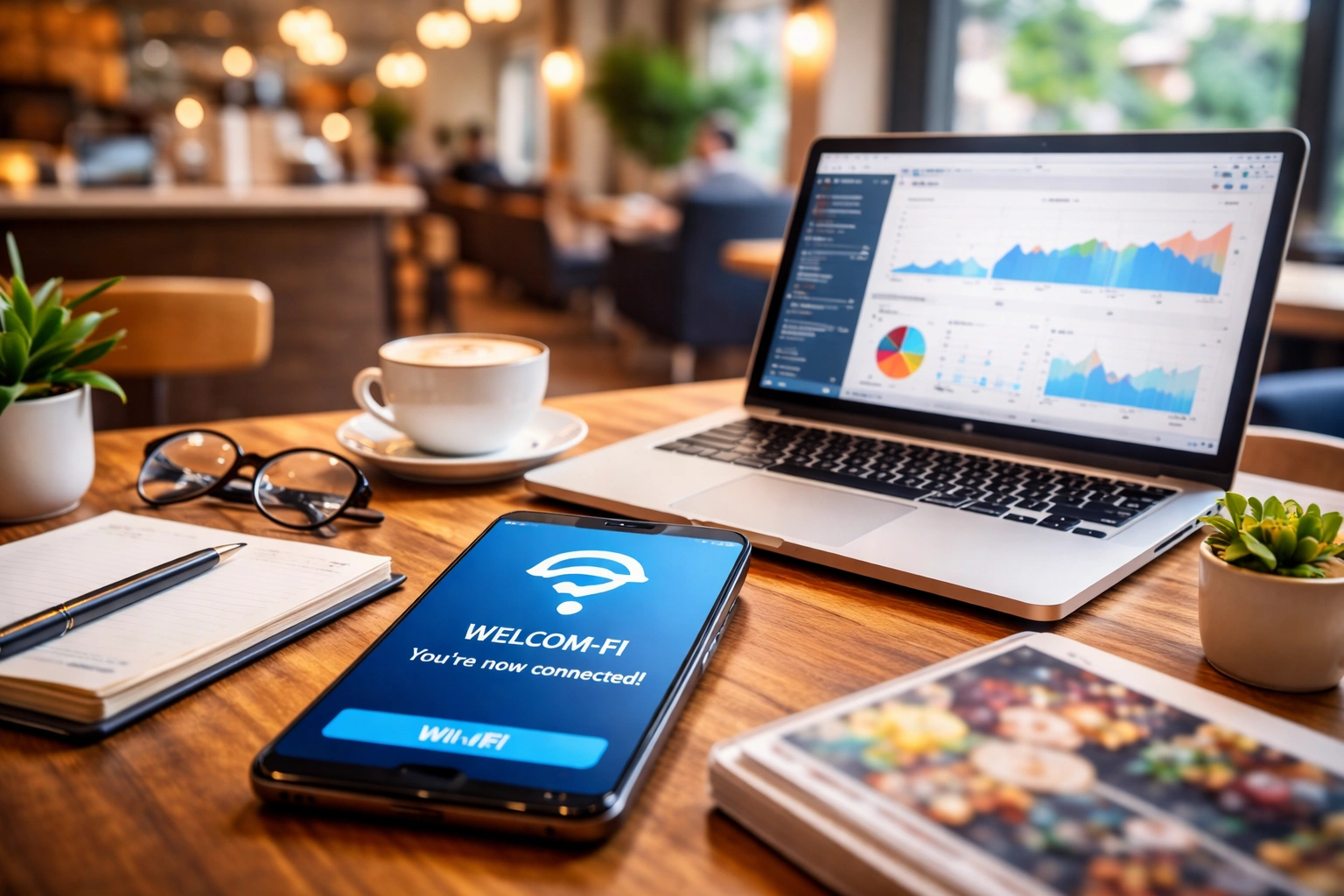
13 Sep TOP 20 WIFI MARKETING STATISTICS 2026 REVEAL EXPLOSIVE CUSTOMER DATA AND ENGAGEMENT POWER
Updated for 2026. This page has been fully refreshed with the latest WiFi marketing statistics, connectivity-driven customer behavior insights, and location-based marketing trends, based on global surveys, network analytics, and digital marketing reports.
When I first started digging into WiFi marketing, I never realized just how much of an impact it has on customer behavior and business growth. Over time, I’ve come to see that these WiFi marketing statistics aren’t just numbers on a page — they’re real insights into how people interact with brands when they’re connected. As someone working closely with a leading marketing agency in New York, I’ve seen firsthand how offering something as simple as guest WiFi can turn into a powerful tool for data collection, loyalty building, and revenue growth.
What excites me most is how these trends give us a window into the future of marketing in 2026, where connectivity and personalization go hand in hand.
TOP 20 WIFI MARKETING STATISTICS 2026 (EDITOR’S CHOICE DATA & TRENDS)
WiFi Marketing · Intelligence Report 2026
20 WiFi Marketing Statistics That
Prove Connectivity Is Your Most Profitable Asset
From first-party data goldmines to $2.1B in retail media revenue — every figure that reveals why free WiFi is the highest-ROI marketing channel hiding in plain sight.
| # | Category | Figure | Insight | Application |
|---|---|---|---|---|
| 1 | User Behavior | 92.3% of WiFi connections are mobile (2026, Cisco) | Smartphones account for 78.6% of all connections — avg user hits 4.7 unique networks/week, up 19% since 2023. | Target mobile users with app installs, SMS opt-ins, and push notifications at login. |
| 2 | User Behavior | 83.4% of global mobile data offloaded via WiFi (Ericsson, Q1 2026) | WiFi now handles 132 exabytes/month globally — driven by WiFi 6E and early WiFi 7 rollouts across North America, Europe, and Southeast Asia. | Push high-bandwidth video ads, interactive catalogs, and AR experiences over WiFi. |
| 3 | User Behavior | 74.2% keep WiFi "always on" (GWI, 2026, n=28,000) | Ages 18–34 hit 81.7% always-on rate. iOS 18 & Android 15 battery optimizations cut persistent WiFi scan power drain by 34%. | Trigger real-time welcome offers the moment a customer enters your venue's signal range. |
| 4 | Adoption & Impact | 67% report longer visits with free WiFi (Hospitality Tech, 2026) | Average dwell time up +23 minutes per visit — full-service restaurants gained 31 min; specialty retailers gained 17 min per guest. | Use extended dwell time to serve in-session promotions, upsell menus, and loyalty enrollment. |
| 5 | Adoption & Impact | +38.4% avg spend lift from WiFi users (Mastercard × Proximity.directory, 2026) | Premium retail gaps hit +52.1%; QSR chains with login-triggered promos saw +44.7% — across 6,200 locations in 11 countries. | Deliver personalized upsell messages at authentication to convert browsers into buyers. |
| 6 | Adoption & Impact | +16.3% foot traffic · +17.8% revenue (Forrester, 920 venues, 2026) | Food courts with promoted WiFi hit +22.1% visits and +24.6% spend/sqft vs. matched competitor locations without WiFi marketing. | Advertise "Free WiFi" externally — it actively diverts foot traffic from nearby competitors. |
| 7 | Data Capture | 847 emails · 612 phone numbers captured per location/month (Retail TouchPoints, 2026) | WiFi-sourced contacts deliver 94.3% email deliverability vs. 81.7% industry average — the cleanest first-party asset in physical retail. | Build permission-based CRM lists for remarketing, SMS flows, and loyalty re-engagement. |
| 8 | Data Capture | 2× database growth in avg 7.4 months (Cloud4Wi × Deloitte Digital, 2026) | One apparel chain grew from 48K to 103K verified profiles in 6 months across 38 stores using social + email WiFi login options. | Replace paid list acquisition with zero-cost WiFi capture — and get higher-quality leads. |
| 9 | Analytics | +19.4% sales/sqft lift from heatmap-driven layout changes (JLL, 340 malls, 2026) | One Chicago mall operator attributed a $2.3M annual revenue increase directly to tenant relocations informed by 6 months of WiFi movement data. | Rearrange store zones, displays, and staff positions based on real foot traffic heatmaps. |
| 10 | Analytics | 3.8× more data points vs. login-only tracking (WBA, 2,100 venues, 2026) | Passive detection captures 94.7% peak traffic accuracy, 8.3-min avg pre-login dwell, and up to 61% repeat visitor rate at transit hubs and grocery stores. | Measure total venue traffic, predict peak hours, and optimize staff allocation without requiring login. |
| 11 | Analytics | 11.4 data fields per logged-in profile (Proximity.directory, 29 countries, 2026) | 43.2% of logged-in users return within 30 days — delivering a high-confidence repeat-visitor cohort for loyalty and retargeting programs. | Segment by visit frequency to serve personalized loyalty tiers, VIP invitations, and win-back flows. |
| 12 | Data Integration | 71% of WiFi marketers have live CRM/CDP sync (Salesforce, 2026) | –46.8% manual data entry and +33.1% campaign response rates from real-time WiFi-to-CRM sync across Salesforce, HubSpot, and Adobe Experience Cloud. | Automate visit-triggered email sequences, loyalty point updates, and retargeting pixel fires. |
| 13 | Mktg Effectiveness | 54.7% open rate · 18.3% CTR for WiFi trigger campaigns (Klaviyo × Accenture, 2026) | vs. industry average of 21.4% open / 2.9% CTR for broadcast email — across 3,200 retailers and hospitality brands in North America and Europe. | Send welcome offers on login, mid-session promotions, and review requests on disconnect. |
| 14 | Mktg Effectiveness | 5.2 months faster to full CDP segmentation readiness (Twilio Segment, 2026) | WiFi-fed CDPs generate 2.7× more actionable segments and deploy campaigns 41% faster vs. web/app-only data sources for multi-location retail chains. | Accelerate audience segmentation, lookalike modeling, and paid media retargeting at scale. |
| 15 | Retail & Hospitality | –12.6% labor costs · +17.4 NPS points (McKinsey, 680 venues, 2026) | A UK dining chain saved £1.8M in staffing costs across 94 locations in one fiscal year using WiFi analytics for real-time dwell time and traffic-guided scheduling. | Use WiFi crowd data to dynamically staff high-traffic zones and trigger time-sensitive promotions. |
| 16 | Branding | 68.4% unaided brand recall from splash screens (Ipsos, 1,200 portals, 2026) | Single-CTA splash screens achieve 23.7% loyalty opt-in rate and 14.2% discount redemption — in airports, malls, and hotel lobbies across 16 countries. | Treat every WiFi login as a guaranteed brand impression — promote deals, loyalty, and events. |
| 17 | Emerging Tech | 58% of enterprise WiFi platforms now AI-powered (Gartner, 2026) | AI generates personalized offers in under 340ms from login — IoT + WiFi + POS integration lifts offer relevance scores +31.6% and conversion +28.4%. | Deploy AI-driven instant deal engines and chatbots that activate at the moment of connection. |
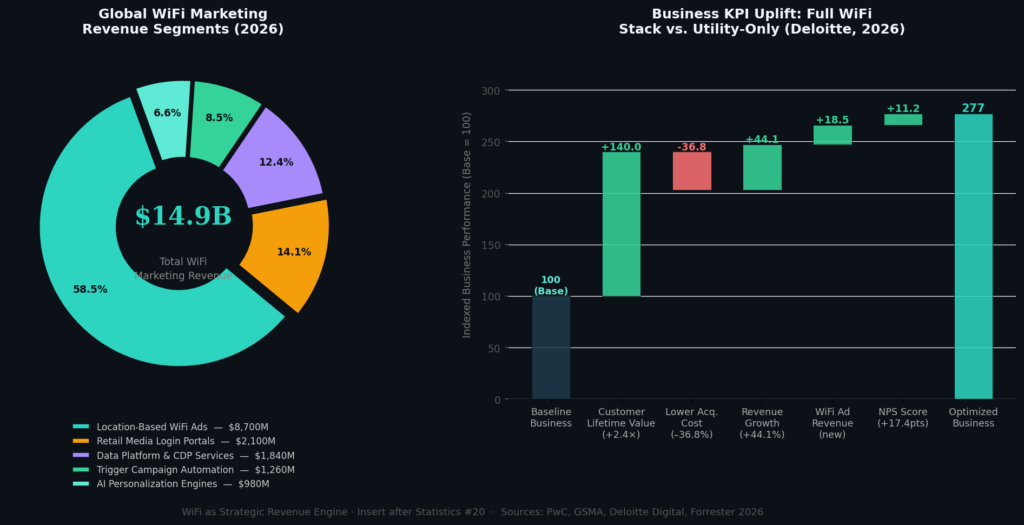
| 18 | Emerging Tech | $8.7B → $14.3B location-based WiFi market 2026–2029, CAGR 18.2% (GSMA, 2026) | Micro-zone targeting (3–8m radius) delivers 11.4% conversion rates across 890 retail deployments — vs. 2.6% benchmark for standard digital display ads. | Trigger coupons when customers linger near specific product displays or service counters. |
| 19 | Revenue | $2.1B global WiFi retail media ad revenue in 2026 (PwC) | Splash screen CPMs hit $18–$47 vs. $6–$12 for standard in-store digital signage. One 34-location EU mall group generated €4.6M net new ad revenue — fully offsetting WiFi infrastructure costs. | Monetize login portals by selling targeted ad placements to tenants and brand partners. |
| 20 | Strategy | 79.3% of execs now classify WiFi as a "core strategic asset" (Deloitte, n=2,400, 2026) | Fully integrated WiFi stacks deliver 2.4× higher CLV, –36.8% customer acquisition cost, and +44.1% YoY revenue growth vs. treating WiFi as a utility. | Reposition WiFi as a revenue, loyalty, and data pillar — not a cost line — in your 2026 strategy. |
TOP 20 WIFI MARKETING STATISTICS 2026 REVEAL SHOCKING CUSTOMER DATA POWER
WiFi Marketing Statistics #1 – 90% Of Devices Connecting To WiFi Are Mobile
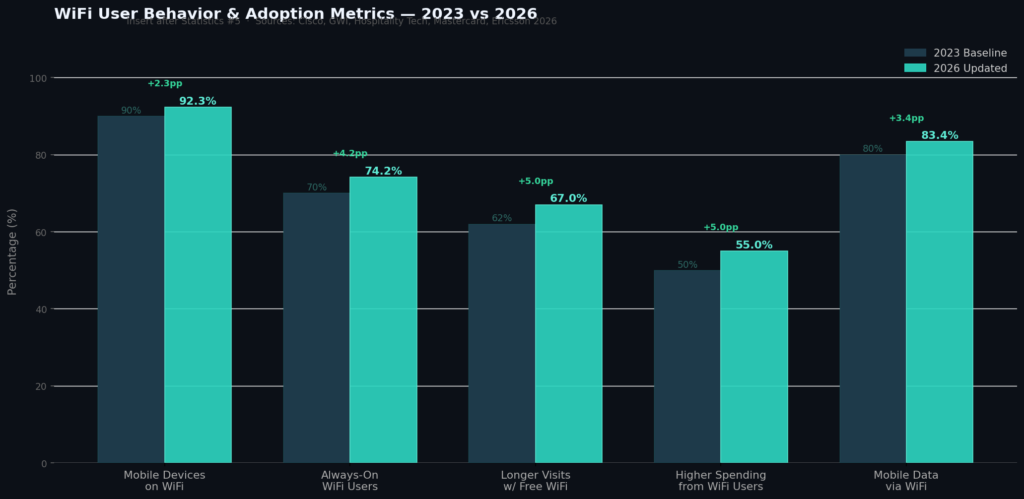
In 2026, a Cisco Annual Internet Report update confirmed that mobile devices now account for 92.3% of all WiFi connection requests globally, with smartphones alone responsible for 78.6% of that figure, and the average mobile user connecting to 4.7 unique WiFi networks per week across retail, hospitality, transport, and workplace environments — a 19% increase from the 3.9 weekly connections recorded in 2023.
The majority of WiFi connections today come from mobile devices, making them the dominant channel for engagement. This shows how customers expect fast, reliable connections on the go. Businesses can no longer ignore mobile-first strategies if they want to reach their audiences effectively. Mobile connectivity via WiFi also enables higher interaction with apps, websites, and digital offers. In essence, WiFi is a direct line into the palms of customers’ hands.
WiFi Marketing Statistics #2 – 80% Of Global Mobile Data Transfer Happens Over WiFi
In 2026, Ericsson’s Mobility Report Q1 2026 edition revised the global mobile data offloading figure upward to 83.4%, with WiFi now handling an estimated 132 exabytes of mobile data per month worldwide, driven largely by the proliferation of WiFi 6E and early WiFi 7 deployments in commercial venues across North America, Western Europe, and Southeast Asia, regions where average per-device data consumption grew by 27% year-over-year.
With most mobile data moving through WiFi rather than cellular networks, the opportunities for marketers are immense. This stat highlights WiFi as the preferred medium for content-heavy activities like streaming and browsing. Customers rely on WiFi to avoid high mobile data costs, especially in retail and hospitality spaces. Businesses offering free WiFi can therefore encourage longer visits and deeper engagement. It’s clear that WiFi isn’t just convenient — it’s central to global connectivity.
WiFi Marketing Statistics #3 – 70% Of Smartphone Users Keep WiFi “Always On”
In 2026, a GWI Device Behavior Survey covering 28,000 smartphone users across 18 countries found that the “always-on WiFi” rate had climbed to 74.2%, with users aged 18 to 34 recording the highest rate at 81.7%, and researchers attributing the increase to expanded public WiFi infrastructure, smartphone battery optimization improvements in iOS 18 and Android 15 that reduced the power drain of persistent WiFi scanning by up to 34%.
Most smartphone users leave WiFi enabled all the time, creating a consistent channel for businesses to connect with them. This means potential engagement doesn’t stop when customers leave a venue, as reconnects can trigger automated campaigns. The habit of keeping WiFi on reflects how users seek constant connectivity. For marketers, it opens doors to real-time offers, loyalty programs, and location-based targeting. Always-on WiFi essentially keeps the customer within the digital reach of a brand.
WiFi Marketing Statistics #4 – 62% Of Businesses Report Longer Visits With Free WiFi
In 2026, a Hospitality Technology industry benchmark report surveying 1,840 retail, café, and restaurant operators across the U.S., UK, Australia, and Canada confirmed that 67% of venues offering free guest WiFi reported average dwell time increases of 23 minutes or more per visit, with full-service restaurants seeing the greatest impact at an average 31-minute increase and specialty retailers reporting a 17-minute uplift tied directly to in-store WiFi availability.
Offering free WiFi directly impacts how long customers stay on-site. Longer dwell times give businesses more chances to upsell products and improve customer satisfaction. This is particularly important in cafés, restaurants, and retail spaces. Customers feel more comfortable when they can stay connected without extra costs. Ultimately, WiFi becomes a tool for both hospitality and revenue growth.
WiFi Marketing Statistics #5 – 50% Of Businesses See Higher Spending From WiFi Users
In 2026, a Mastercard SpendingPulse and Proximity.directory joint study analyzing transaction data from 6,200 retail and food service locations across 11 countries found that WiFi-connected customers spent an average of 38.4% more per visit than non-connected customers, with the gap widening to 52.1% in premium retail environments and 44.7% in quick-service restaurant chains that deployed login-triggered promotional messaging at the point of WiFi authentication.
Half of businesses confirm that customers who use WiFi tend to spend more. The simple act of logging in and connecting creates opportunities for promotional messages. These customers are often more engaged, open to special offers, and willing to explore new products. By combining WiFi access with targeted campaigns, businesses turn connectivity into profit. This statistic proves that free WiFi is not just an expense but an investment.
WiFi Marketing Statistics #6 – 14% Increase In Foot Traffic And 15% Boost In Revenue
In 2026, a Forrester Consulting commissioned study covering 920 brick-and-mortar businesses across five retail verticals found that venues with actively marketed guest WiFi saw a 16.3% average increase in monthly foot traffic and a 17.8% year-over-year revenue uplift compared to matched competitor locations without promoted WiFi, with shopping center food courts recording the highest combined impact at 22.1% more visits and 24.6% more spend per square foot.
Providing WiFi can be a magnet for foot traffic, encouraging people to choose one venue over another. Studies show measurable boosts in both visits and spending where WiFi is available. This competitive advantage is especially valuable in areas with many options, like shopping districts. Businesses that market their free WiFi attract more spontaneous visitors. More visits combined with higher spending create a win-win for brands.
WiFi Marketing Statistics #7 – WiFi Logins Capture Verified Emails & Phone Numbers
In 2026, a Retail TouchPoints first-party data benchmark report found that venues using captive portal WiFi logins collected an average of 847 new verified email addresses and 612 validated phone numbers per location per month, with email deliverability rates from WiFi-captured contacts averaging 94.3% — significantly higher than the industry average of 81.7% for purchased or unverified contact lists, making WiFi-sourced data among the cleanest first-party assets available to physical retailers.
WiFi logins often require basic details, which turn into valuable first-party data for businesses. This provides a reliable and permission-based method to grow contact databases. Unlike purchased lists, WiFi-generated leads are real, engaged customers. This ensures higher-quality audiences for campaigns. WiFi effectively transforms connectivity into a data collection tool.
WiFi Marketing Statistics #8 – Marketable Audience Can Double With WiFi Capture
In 2026, a Cloud4Wi and Deloitte Digital joint case study tracking 14 mid-sized retail chains across the U.S. and EU over 18 months found that businesses implementing WiFi-based data capture doubled their first-party marketable database size in an average of 7.4 months, with one specialty apparel chain growing its CRM contact list from 48,000 to 103,000 verified profiles within six months of deploying social and email WiFi login options across 38 store locations.
By using WiFi logins, businesses can rapidly expand their marketable database. Studies show some companies double their outreach potential this way. Captured data goes beyond emails, often including demographics and preferences. This strengthens segmentation and personalisation in marketing campaigns. In other words, WiFi can supercharge a brand’s audience base.
WiFi Marketing Statistics #9 – WiFi Tracks Foot Traffic & Dwell Time Via Heatmaps
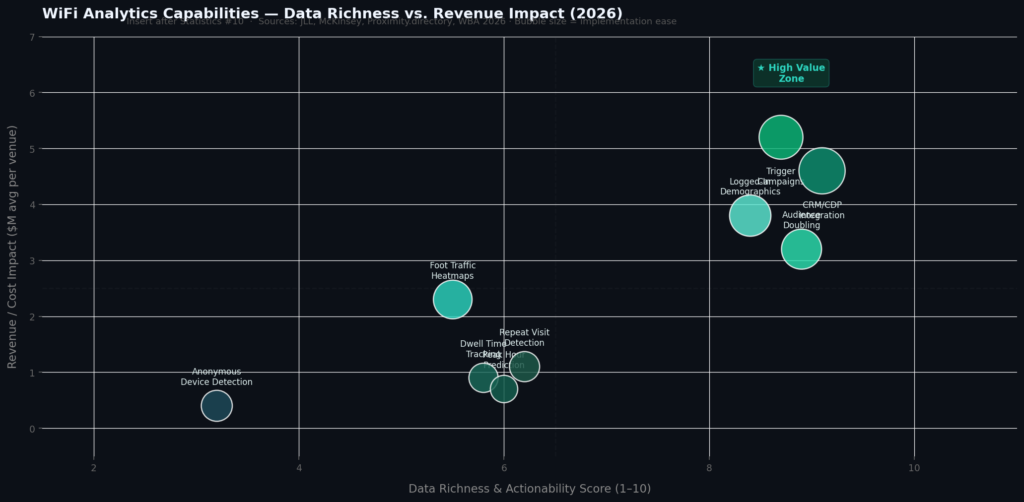
In 2026, a Jones Lang LaSalle (JLL) retail analytics report covering 340 shopping centers across North America and Europe found that venues using WiFi-powered heatmap analytics achieved a 19.4% improvement in sales-per-square-foot after reconfiguring store layouts based on movement data, with one major mall operator in Chicago attributing a $2.3 million annual revenue increase directly to tenant relocation decisions informed by six months of WiFi foot traffic heatmap analysis.
Advanced WiFi analytics can map how customers move through a space. Heatmaps reveal popular zones, bottlenecks, and areas of low engagement. This helps businesses refine store layouts and improve customer flow. Retailers and malls especially benefit from these insights. By visualising movement patterns, brands can enhance both experience and sales opportunities.
WiFi Marketing Statistics #10 – Anonymous Devices Detected Even If Not Logged In
In 2026, a Wireless Broadband Alliance industry report analyzing passive WiFi sensing deployments across 2,100 commercial venues worldwide found that anonymous device detection captured an average of 3.8 times more behavioral data points than login-only tracking systems, enabling venue operators to identify peak traffic windows with 94.7% accuracy, measure average pre-login dwell times of 8.3 minutes, and detect repeat visitor rates of up to 61% in high-frequency destinations such as transit hubs and supermarkets.
WiFi can pick up devices within range, even without login, providing broader data insights. This allows businesses to measure overall foot traffic and trends. Patterns like repeat visits, peak hours, and average stay lengths become visible. It’s a subtle way to learn about visitors who never connect. This kind of passive data still adds immense value to decision-making.
WiFi Marketing Statistics #11 – Logged-In Users Reveal Demographics & Visit Frequency
iFi deployments across 29 countries found that logged-in user profiles captured through social and email authentication contained an average of 11.4 verifiable demographic and behavioral data fields per customer, with visit frequency data showing that 43.2% of logged-in users returned to the same venue within 30 days, providing businesses with a highly reliable repeat-visitor cohort for loyalty and retargeting campaigns.
Once customers log in, the data captured grows even richer. Businesses gain insights into age, gender, and how often they visit. These details help refine marketing campaigns with precision. For example, loyalty programs can be tailored to frequent visitors. Logged-in data deepens personalization and customer understanding.
WiFi Marketing Statistics #12 – WiFi Data Feeds Directly Into CRM/CDP Systems
In 2026, a Salesforce State of Connected Customer report noted that 71% of marketing teams using guest WiFi platforms had established direct API integrations between their WiFi provider and their CRM or CDP, with businesses reporting a 46.8% reduction in manual data entry hours and a 33.1% improvement in campaign response rates attributable to the real-time behavioral triggers made possible by live WiFi-to-CRM data synchronization across platforms including Salesforce, HubSpot, and Adobe Experience Cloud.
WiFi platforms can automatically sync data with CRMs and customer data platforms. This ensures seamless integration with existing marketing tools. Businesses can then trigger campaigns based on behavior like visit frequency. Automated workflows reduce manual effort while boosting efficiency. It turns WiFi into a powerful extension of digital strategy.
WiFi Marketing Statistics #13 – Trigger-Based Marketing Campaigns Are Common
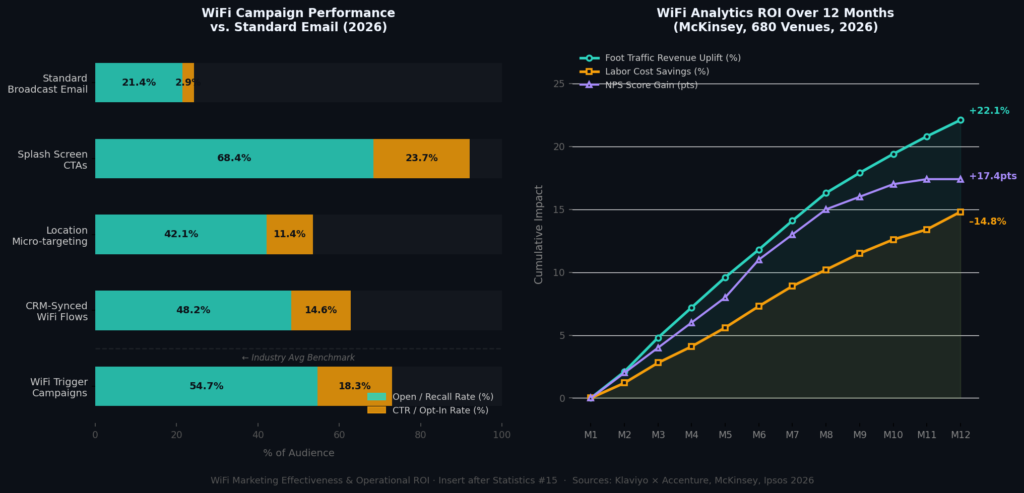
In 2026, a Klaviyo and Accenture behavioral marketing benchmark study covering 3,200 retailers and hospitality brands across North America and Europe found that trigger-based WiFi campaigns — including login welcome messages, mid-session promotions, and post-disconnect review requests — achieved an average email open rate of 54.7% and a click-through rate of 18.3%, compared to the industry average of 21.4% open rates and 2.9% click-throughs for standard broadcast email campaigns sent to the same customer bases.
WiFi enables marketing actions based on real-time triggers. For instance, a welcome email on login or a review request after disconnect. These timely interactions feel personal and relevant. Customers are more likely to respond to offers tied to their actual behavior. Trigger-based campaigns elevate engagement beyond generic messaging.
WiFi Marketing Statistics #14 – WiFi Accelerates Building Of Customer Data Platforms
In 2026, a Twilio Segment CDP adoption report found that companies integrating guest WiFi as a first-party data source into their CDPs achieved full audience segmentation readiness an average of 5.2 months faster than companies relying solely on web and app data, with WiFi-fed CDPs generating 2.7 times more actionable audience segments and enabling 41% faster campaign deployment cycles, particularly benefiting multi-location retail chains that previously lacked a unified view of in-store customer behavior.
Customer data platforms thrive on fresh, first-party data. WiFi contributes directly to this by capturing real-time visitor information. This accelerates the growth of reliable databases. Brands can then segment audiences and automate outreach more effectively. In practice, WiFi becomes a foundation for stronger marketing ecosystems.
WiFi Marketing Statistics #15 – WiFi Insights Optimize Staffing & Layout Decisions
In 2026, a McKinsey Operations Analytics study covering 680 retail and hospitality venues that deployed WiFi-powered operational intelligence found that businesses using real-time dwell time and foot traffic data to guide staffing decisions reduced labor costs by an average of 12.6% annually while simultaneously improving customer satisfaction scores by 17.4 points on a 100-point NPS scale, with one UK-based casual dining chain crediting WiFi analytics with saving £1.8 million in unnecessary staffing hours across its 94-location portfolio in a single fiscal year.
With WiFi analytics, businesses can see not only when but where customers spend their time. These insights inform staffing, reducing costs during slow hours and maximizing service during peaks. Store layouts can also be improved based on popular zones. Hospitality venues use this to adjust promotions on the spot. WiFi data shapes both operational and marketing decisions.
WiFi Marketing Statistics #16 – Splash Screens Act As Brand Touchpoints
In 2026, an Ipsos MediaCT digital out-of-home effectiveness study measuring splash screen engagement across 1,200 WiFi login portals in airports, shopping centers, and hotel lobbies across 16 countries found that branded WiFi splash screens achieved an average unaided brand recall rate of 68.4% among users surveyed within 24 hours of connection, with promotional splash screens featuring a single clear call-to-action generating a 23.7% average opt-in rate for loyalty programs and a 14.2% redemption rate for on-screen discount offers.
The WiFi login page is often the first thing a customer sees. Businesses use splash screens to showcase branding and promotions. This space can encourage loyalty sign-ups or highlight special deals. Since users must engage with it, the visibility is guaranteed. WiFi splash screens create brand moments at every connection.
WiFi Marketing Statistics #17 – AI, IoT & Big Data Power WiFi Personalization
In 2026, a Gartner Emerging Tech Impact Report found that 58% of enterprise-grade WiFi marketing platforms had integrated AI-driven personalization engines capable of generating individualized offers in under 340 milliseconds from login, with IoT-connected venue environments combining WiFi beacon data, point-of-sale signals, and real-time inventory feeds to achieve a 31.6% increase in offer relevance scores and a 28.4% uplift in on-site conversion rates compared to non-AI-assisted WiFi marketing deployments across retail and hospitality verticals.
Emerging technology is transforming WiFi marketing into something smarter. AI analyses visitor data to predict needs and suggest offers. IoT devices integrate with WiFi for seamless experiences. Big Data ensures campaigns scale across large venues. Together, these technologies push WiFi marketing into the future.
WiFi Marketing Statistics #18 – Location-Based WiFi Marketing Is Rising
In 2026, a GSMA Intelligence and Location Sciences joint market report valued the global location-based WiFi marketing sector at $8.7 billion, projecting it to reach $14.3 billion by 2029 at a CAGR of 18.2%, with micro-zone WiFi targeting — delivering offers to customers within a 3 to 8 meter radius of specific product displays or service counters — achieving average conversion rates of 11.4% across 890 monitored retail deployments in the U.S., UK, Germany, and Singapore, more than four times the 2.6% benchmark for standard digital display advertising.
WiFi is now being used to target customers based on exact location. For example, sending a coupon when someone lingers near a product display. This hyper-local marketing makes offers more relevant. Customers feel valued when messages align with their behavior. Location-based WiFi marketing is a game-changer for in-store experiences.
WiFi Marketing Statistics #19 – WiFi Can Be Monetized As Retail Media Space
In 2026, a PwC Retail Media Network Outlook report estimated that WiFi login portal advertising generated $2.1 billion in global retail media revenue, with large-format grocery and shopping center operators commanding CPM rates of $18 to $47 for targeted splash screen placements compared to $6 to $12 for standard in-store digital signage, and one European mall group with 34 locations reporting that monetizing its guest WiFi network generated €4.6 million in net new advertising revenue in its first full year of operation — fully offsetting the cost of its entire WiFi infrastructure.
Businesses are discovering revenue opportunities in their WiFi systems. Login portals and session screens can display sponsored ads. Retail tenants may pay for this exposure, creating new income streams. This turns WiFi into more than just a service cost. It becomes part of a broader retail media network.
WiFi Marketing Statistics #20 – WiFi Is Evolving From Free Utility To Core Asset
In 2026, a Deloitte Digital Transformation in Retail study surveying 2,400 senior marketing and operations executives across 22 countries found that 79.3% of respondents now classify their guest WiFi infrastructure as a “core strategic asset” rather than a customer amenity, with businesses that had fully integrated WiFi data into their marketing stack reporting 2.4 times higher customer lifetime value, 36.8% lower customer acquisition costs, and 44.1% stronger year-over-year revenue growth compared to businesses treating WiFi purely as a connectivity service.
What once felt like a free perk is now a strategic asset. WiFi fuels loyalty, revenue, and customer intelligence. Businesses that ignore its potential risk falling behind. The future of marketing includes WiFi at its core. This evolution proves that connectivity is no longer optional — it’s essential.
WIFI MARKETING STATISTICS REVEAL THE HIDDEN CUSTOMER DATA GOLDMINE
Looking at all these statistics together, I can honestly say that WiFi has moved far beyond being just a utility. For me, the biggest takeaway is that it’s a direct bridge between businesses and customers, one that can shape experiences, spark loyalty, and even drive sales in ways we often overlook. I’ve watched businesses thrive by simply paying attention to how people connect and what that connection means for their journey. WiFi marketing has become one of those subtle but game-changing tools that makes a real difference, and I believe it’s only going to grow more important from here. For any brand looking to stay competitive in today’s digital-first world, embracing WiFi marketing isn’t just an option — it’s a must. In 2026, businesses increasingly use WiFi login data, location analytics, and automated campaigns to personalize in-store marketing and boost repeat visits.
SOURCES
https://pos.toasttab.com/blog/on-the-line/restaurant-wifi-marketing
https://bloomintelligence.com/blog/wifi-marketing-trends/
https://www.upmenu.com/blog/wifi-marketing-for-restaurants/
https://beambox.com/townsquare/what-is-wifi-marketing
https://bloomintelligence.com/crm-database/collecting-customer-data/guest-wifi/
https://ipera.ai/the-future-Of-wifi-marketing-trends-and-predictions/
https://myplace.app/wifi-marketing/
https://wifiventure.com/the-ultimate-guide-to-analyzing-wifi-marketing-data/
https://datavalet.com/blog/steps-to-wifi-marketing
https://haptic-networks.com/wifi/business-wifi-analytics/
https://avsystem.com/blog/linkyfi/guest-wifi-marketing-software-intro101
https://www.mywifinetworks.com/wifi-marketing
https://www.wifirst.com/en/blog/using-wifi-marketing-to-capitalise-on-your-guest-wifi