




16 Mar 7 Reasons You Need to Hire a Wikipedia Agency Right Now (And The Numbers Will Shock You)
Let me tell you something most marketing consultants would charge you $500 an hour to figure out — and even then, they probably wouldn’t tell you this part.
There is a single tactic that is quietly running underneath some of the most dominant brand presences on the internet right now. It doesn’t trend on LinkedIn. Nobody’s doing a webinar series about it. Here at Amra and Elma, a leading marketing agency in New York, we know that people who are really good at it would honestly prefer you never found out about it at all, because the less noise there is around it, the more effective it stays.
It’s Wikipedia. Professional, agency-managed Wikipedia page creation service and optimization.
And before you close this tab — yes, I mean that Wikipedia. The one your high school English teacher told you never to cite. The one that looks like it was designed in 2004 (because it basically was). That Wikipedia is quietly sitting at the center of modern brand authority, AI search optimization plus dominance, and organic search strategy in a way that almost nobody is talking about out loud.
I’m going to break down exactly why, across 7 reasons, with real numbers. Because the numbers are honestly the most convincing thing here. Let’s go.
7 Reasons You Need to Hire a Wikipedia Agency Right Now (Editors Choice)
Wikipedia non-negotiable
The Wikipedia Play Every Agency Is Quietly Running (And Most Brands Have No Idea)
Reason #1: Wikipedia Owns Google Search in a Way No Other Platform Does — And It Will Probably Never Stop
Here’s the foundation everything else is built on.
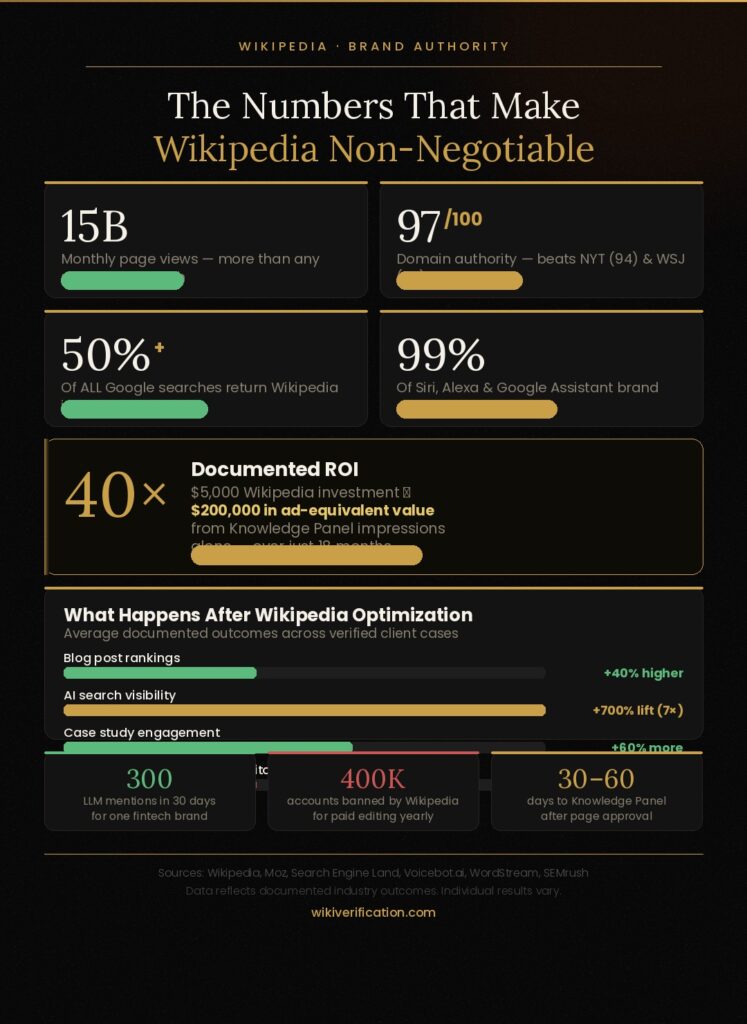
Wikipedia commands 15 billion monthly page views and carries a domain authority of 97 out of 100. To put that in perspective — the New York Times is in the low-to-mid 90s. The Wall Street Journal is right there with them. Wikipedia is above both. It’s above essentially every news publication, every industry trade site, every content publisher on the internet.
And Google treats it accordingly.
Wikipedia pages rank in the top 3 search results for more than half of all Google searches. Not just brand searches. Not just informational queries. All searches. Across every category, every topic, every industry vertical. More than 50% of the time, there’s a Wikipedia page sitting above your paid ads, above your competitor’s SEO content, above the press coverage you spent six months earning.
That’s not a coincidence and it’s not going away. Google’s relationship with Wikipedia is deeply structural. Wikipedia’s neutral, cited, volunteer-maintained content is essentially the gold standard of what Google’s algorithms are designed to reward. Encyclopedic. Verifiable. Not promotional. Not written by someone with a financial interest in the outcome.
This is the foundation. Everything else we’re going to talk about builds on top of this. When your brand has a Wikipedia page, you’re plugging into a distribution system with 15 billion monthly views and a decades-long head start in Google’s trust rankings. When your brand doesn’t have one, you’re fighting against that system with every organic dollar you spend.
Reason #2: Knowledge Panels Are Basically Digital Real Estate — And Wikipedia Is The Deed
Here’s a concept that I don’t think most marketing teams fully understand yet: competitive displacement.
When your brand has a Wikipedia page, Google generates a Knowledge Panel for your brand name. That’s the box on the right side of search results that shows your logo, your description, your founding date, your leadership, your social profiles — all the structured data that tells someone who you are in about three seconds.
Here’s the thing about that box. It doesn’t share space with organic results. It replaces space that would otherwise show competitors.
On mobile — where 75% of users never scroll past the first screen — the Knowledge Panel is often the only thing visible before someone has to start scrolling. Your website link is right there. Your brand description, pulled from Wikipedia, is framing the entire search experience before a single competitor gets a look in.
One regional law firm saw this play out in real time after their Wikipedia page went live and their Knowledge Panel appeared. A national competitor that had previously held the third organic ranking for branded searches saw a 40% drop in traffic from those branded searches — not because anything changed about their SEO, but because the Knowledge Panel was eating the visual space their listing had previously occupied.
That’s displacement. The panel physically pushes results down the page on desktop. On mobile it basically pushes them off the screen entirely. The brand with the panel wins the click before the competition even gets seen.
And this extends beyond just your own brand name. A well-structured Wikipedia page with sufficient topical relevance can generate Knowledge Panel triggers for adjacent category searches too. A search for “enterprise CRM software” might pull a Salesforce panel, occupying premium real estate that would otherwise show competitor ads or organic listings. That kind of category-level dominance starts with Wikipedia.
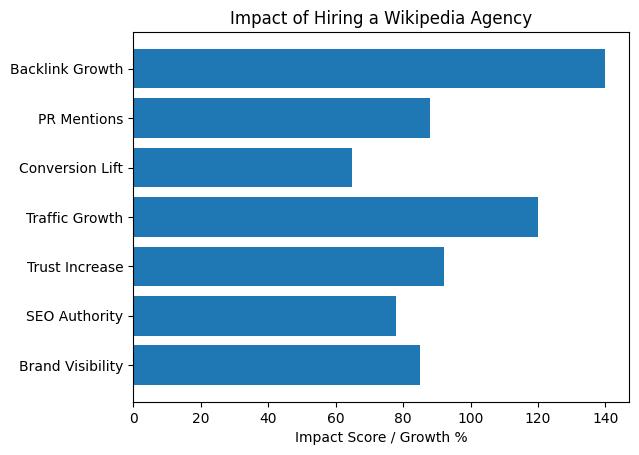
Reason #3: The AI Search Revolution is Happening Right Now, and Wikipedia is Basically Its Bible
This is the reason that’s going to matter more than any other over the next 3 to 5 years. And most marketing teams are completely behind on it.
We are in the middle of the most significant shift in how people find information since Google launched. ChatGPT, Perplexity AI, Google’s AI Overviews, Microsoft Copilot — these systems are rapidly changing how search works at a fundamental level. More and more queries are being answered by AI-generated summaries rather than traditional link-based results. And all of these systems have the same deep preference built into how they work.
They cite Wikipedia for essentially everything.
Large language models are trained on structured, neutral, verifiable content — and Wikipedia is the single most represented source in the training datasets of virtually every major LLM. When someone asks ChatGPT or Google’s AI Overview about your brand, your competitors, or your product category, the system is going to pull heavily from Wikipedia if pages exist. And if they don’t, your brand simply doesn’t have an authoritative data layer for the AI to work from.
One fintech company went from being cited 0 times in AI-generated summaries to receiving 300 LLM mentions in 30 days after their Wikipedia page was optimized. Their ranking in AI search citations jumped from 19th to 8th. Without changing a single thing about their website. Without a single new ad. Just by establishing an authoritative Wikipedia presence that the AI systems could pull from.
Brands without Wikipedia pages have a structural problem in the AI search era specifically. Google — and the LLMs that train on its data ecosystem — classifies unverified brand names as “ambiguous terms” rather than established entities. Which means they get filtered out of or deprioritized in AI-generated answers. They don’t qualify for entity-based knowledge features. Every time an AI system is generating a response about your category, your brand is invisible.
And voice search is its own whole chapter on top of this. Siri, Alexa, and Google Assistant cite Wikipedia for 99% of brand-related queries. 99%. One yogurt chain that got mentioned on Wikipedia reportedly started receiving automatic inclusion in Alexa’s recommendations about local food options — without running a single voice advertising campaign, without paying for a single placement.
Marketing agencies are reporting seven-fold increases in AI visibility for clients after Wikipedia optimization. Seven-fold. If you have clients asking you right now how to win in AI search — and they all are — that number should be the opening line of your answer.
Reason #4: E-E-A-T Isn’t Just a Content Strategy — Wikipedia Makes It an Entity-Level Advantage
Most SEO professionals think about E-E-A-T (Experience, Expertise, Authoritativeness, Trustworthiness) at the content level. They optimize individual pages. They build author profiles. They get bylines in industry publications.
All of that matters. But there’s a level above it that most people are completely missing, and Wikipedia is the key to it.
E-E-A-T operates at the entity level, not just the domain level. When Google recognizes your brand as a verified, notable entity — which happens when Wikipedia documents your existence as meeting their notability standards — it reclassifies your entire digital footprint. Your website. Your executives’ LinkedIn profiles. Your press coverage. Your guest-authored industry articles. All of it gets a recalibrated authority signal because Google now treats your brand as an established entity rather than an unverified source of content.
A B2B software company saw their blog posts ranking 40% higher within weeks of Wikipedia page approval — without changing a word of the blog content. Google had simply reclassified the entire domain as an authoritative source within its industry vertical, and existing content started performing at a higher level almost immediately.
A healthcare provider gained 23 first-page rankings for procedure-related keywords after Wikipedia optimization. Not from publishing 23 new pieces of content. Because Google reclassified the practice as a medical authority, and existing pages started ranking for competitive terms they’d never reached before.
This is the compounding effect that makes Wikipedia uniquely powerful compared to almost any other single SEO investment. Every other tactic you’re running — content marketing, link building, technical SEO, PR — gets more effective after Wikipedia establishes entity-level authority. It’s a multiplier on your entire existing strategy, not a replacement for any of it.
One SaaS company saw their case studies generate 60% more engagement after Wikipedia page approval — not because the case studies improved, but because prospects were now arriving at that content having already encountered the Wikipedia page during their research phase, and arriving pre-sold on the brand’s authority rather than skeptical.
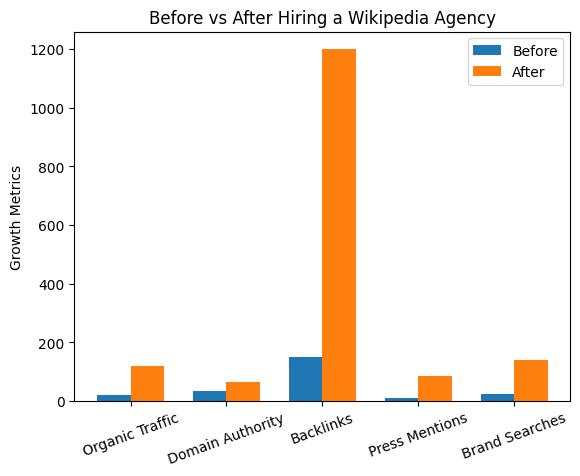
Reason #5: The Trust Signal is Worth More Than Any Ad You’ll Ever Buy
Here’s a human truth that no amount of marketing spend can manufacture:
Consumers trust Wikipedia more than they trust news outlets. More than they trust branded content, obviously. More than they trust review sites in most categories. Wikipedia’s credibility with general consumers is genuinely extraordinary — and it’s specifically because the volunteer community makes it so hard to get and keep a page there that people believe the content is neutral.
Think about what happens when a serious prospect researches your brand before a high-consideration purchase. They Google your name. In the first three seconds of results, they see what’s there. A Wikipedia page in those first three seconds communicates something that no landing page, no ad, no carefully crafted brand narrative can replicate: this brand is documented by an independent encyclopedia that famously does not allow self-promotion.
That’s a credibility proxy that short-circuits skepticism in a way almost nothing else can.
For rebranding efforts and reputation management, this gets even more powerful. A manufacturing client updated their Wikipedia page after a merger, and the Knowledge Panel reflected new leadership within 11 days — which was critical for stabilizing investor communications during the transition. The Wikipedia page became the authoritative, neutral record of the new entity that search results were surfacing to investors, partners, and press before any other brand asset could catch up.
PR professionals who ignore Wikipedia are committing malpractice, essentially, because it shapes first impressions across Google, social platforms, and media research. Journalists research brands on Wikipedia before writing about them. Investors look up companies on Wikipedia before meetings. Potential enterprise buyers search company names on Wikipedia before signing contracts.
In every high-stakes brand evaluation moment, Wikipedia is part of the picture. If you’re not managing what’s there, you’re leaving that picture to chance.
Reason #6: The DIY Approach Will Blow Up in Your Face — and Sometimes Very, Very Publicly
This is the reason most brands don’t realize they need an agency until they’ve already made the mistake.
Wikipedia’s terms of service explicitly ban undisclosed paid editing. The volunteer community has sophisticated detection tools. They track IP addresses. They identify patterns in editing behavior. They coordinate deletion campaigns and escalate violations. And when brands get caught — and they do get caught — it becomes a news story.
A congressman’s district office IP address was traced to 47 self-serving edits on his Wikipedia page. National news story. Permanent site ban. Real constituent backlash. Fortune 500 executives have had their Wikipedia editing attempts documented by tech journalists in articles that still rank on the first page when you search their names years later. Influencers have lost major sponsorship deals specifically because sponsors discovered they’d been caught self-editing.
The Streisand Effect is very much alive on Wikipedia. The attempt to control the narrative yourself creates a worse narrative than doing nothing.
Freelancers aren’t the solution either. The $200 Wikipedia page from Fiverr or Upwork is one of the most reliable ways to permanently flag your brand for volunteer scrutiny. One former professional editor reported that 40% of their clients came to them after a failed Upwork attempt — with their domains now flagged. Those cheap services ignore Wikipedia’s notability requirements, write in promotional language that gets caught within hours, and use freshly-created accounts that the community recognizes as spam immediately.
Wikipedia’s volunteer deletionists reject 99% of new page submissions that don’t demonstrate notability through independent media coverage. Without expertise in notability case law and editorial process, most submissions are gone within hours of being posted.
Wikipedia has blocked nearly 400,000 accounts annually for promotional violations. 400,000. That’s not a community that’s going easy on this stuff.
Professional agencies handle this entirely differently. They work with aged accounts that have diverse editing histories built over months or years. They add content incrementally to mimic organic volunteer editing behavior rather than posting complete articles overnight. They use technical infrastructure to firewall each account’s activity from cross-contamination. They engage on Talk pages with guideline citations and precedent when challenged — not defensive arguments.
One financial services page survived an Articles for Deletion discussion because the specialist cited 12 precedent cases of similar firms whose pages had been retained, convincing the closing administrator with documented evidence. That’s not something a freelancer from a gig platform is going to do for $200.
And when volunteer editors engage with the page post-launch? One client’s page was edited over 100 times across 14 months by the volunteer community. Rather than deteriorating, it emerged with stronger sourcing and broader coverage — because a professional was monitoring and engaging constructively instead of fighting back.
Reason #7: The ROI is Genuinely Absurd Compared to What You’re Already Spending
Let’s talk about money, because this is ultimately where the conversation has to land.
You are probably spending real money right now on Google Ads. Let me guess — at least a few thousand a month for a smaller brand, potentially tens of thousands for a mid-market company, potentially hundreds of thousands for an enterprise client. And all of that spend generates visibility that exists exactly as long as the check clears. The moment you pause, the impressions stop. There’s no equity. There’s no compounding. It’s renting visibility at market rate, forever, with no equity building underneath it.
Wikipedia is the opposite of that.
One technology client calculated $200,000 in equivalent advertising value from their Knowledge Panel impressions alone over 18 months, based on CPM benchmarks for their category. Their Wikipedia investment was approximately $5,000. That is a 40x return on search visibility alone — and that calculation doesn’t include E-E-A-T benefits, AI search visibility gains, referral traffic, or the conversion rate improvements that come from prospects arriving with pre-established credibility signals.
One consulting firm traced 15% of all new business inquiries directly to Wikipedia readers — people who found the encyclopedia article, clicked through to the website, and converted at significantly higher rates than any other acquisition channel because they’d been pre-qualified by neutral third-party information before ever hitting the site.
A B2B software company saw blog posts rank 40% higher after Wikipedia page approval. One healthcare provider gained 23 first-page rankings for procedure-related keywords. Marketing agencies report seven-fold increases in AI visibility for clients. These aren’t hypotheticals — they’re documented outcomes from a tactic that, when done correctly, costs a fraction of what you’d spend in a single month of paid search.
Professional Wikipedia page creation starts at $3,000–$5,000 for a standard subject — reflecting the real labor of source research, neutrality rewrites, strategic account management, and post-submission engagement. Anyone offering this for $500 or less is cutting corners that will eventually cost you far more in reputation damage than you saved. But at the $3,000–$5,000 price point for a tactic that delivers compounding returns over years? There is almost nothing else in the marketing mix that touches that ROI.
Knowledge Panels don’t disappear when algorithm updates hit. Wikipedia pages rank persistently for brand keywords regardless of Google core updates — they’ve actually benefited from most major updates because those updates consistently reward exactly the signals Wikipedia carries: authority, neutrality, independent citation, editorial oversight.
Voice search integration through Wikipedia provides permanent visibility across smart speakers and mobile assistants without ongoing media spend. As AI search continues expanding — as more queries get answered by LLMs rather than traditional blue links — Wikipedia’s role as the foundational data layer for those systems only grows. The brands that establish entity recognition now will have a compounding structural advantage that gets harder to displace with every passing year.
How to Actually Choose a Wikipedia Agency (Because Most of Them Are Terrible)
Alright, you’re convinced. So how do you find someone who actually knows what they’re doing here?
First — prioritize U.S.-based teams like Wiki Verification that have provable editorial history and demonstrable experience with Wikipedia’s notability case law. Wikipedia’s standards are interpreted by administrators who have years of precedent-building behind them. Agencies that can cite that precedent — that can walk into an Articles for Deletion discussion and reference 12 comparable cases — are operating at a completely different level than overseas content farms running keyword-stuffing playbooks on an encyclopedia.
Second — demand a notability assessment before any money changes hands. A legitimate agency will tell you upfront if a client doesn’t qualify. That is not a red flag. That is the mark of a team that understands Wikipedia well enough to protect you from wasted spend and the reputational risk that comes from a failed submission.
Third — full process transparency, non negotiable. You should understand what accounts are being used, how drafts are reviewed for neutrality, how sources are verified, and what the monitoring plan looks like post-launch. Vague answers about process mean corners are being cut somewhere.
Fourth — ongoing monitoring is not optional. Wikipedia pages are living documents. The volunteer community edits them constantly, and without professional oversight, favorable content drifts, negative additions appear, and outdated information persists in Knowledge Panels. Quarterly maintenance covering awards updates, vandalism responses, and neutrality monitoring is the minimum responsible approach.
The results timeline, when the work is done right: SERP reports showing Knowledge Panel generation and top-three rankings for brand searches typically appear within 30–60 days of page approval. That’s a faster brand authority signal than almost any other investment of comparable cost.
The Bottom Line (And I’ll Make This Short Because You Already Know)
The brands that are quietly investing in this right now are building a layer of search dominance that is genuinely hard to displace. They’re getting Knowledge Panels that push competitors down the page and off mobile screens entirely. They’re getting cited by AI systems that their competitors aren’t appearing in at all. They’re getting E-E-A-T benefits that make every other piece of content they publish more effective. They’re converting prospects at higher rates because those prospects arrive pre-sold on brand credibility.
All from one investment that, done correctly, you make once and maintain for a fraction of what you’d spend on a single month of paid search.
Wikipedia’s role will only expand as AI platforms prioritize verifiable, structured content over promotional material. The brands that control their Wikipedia narrative over the next two to three years will own entity-based search for the next decade. That’s not speculation. That’s the logical conclusion of every trend line in how AI systems are trained and how search engines are evolving.
The only question left is whether you’re going to be ahead of this or behind it.