



14 Sep TOP 20 WIND ENERGY MARKETING STATISTICS 2026 REVEAL EXPLOSIVE GLOBAL RENEWABLE BRANDING SHIFT
Updated for 2026. This page has been fully refreshed with the latest wind energy marketing statistics, renewable adoption data, and global clean-energy promotion trends based on recent industry reports and sustainability market insights.
When businesses look toward renewable energy, it’s not just about technology—it’s also about how the story is told. These wind energy marketing statistics highlight just how fast the industry is expanding and why companies need to pay attention. From record-breaking installations to offshore innovations, the data gives a clear picture of where the future is headed. As a leading marketing agency in New York, we’ve seen firsthand how weaving numbers into compelling narratives helps brands connect with audiences who care deeply about sustainability. This isn’t just another set of figures—it’s a roadmap for marketers, entrepreneurs, and energy leaders to understand how wind is shaping tomorrow’s energy market.
TOP 20 WIND ENERGY MARKETING STATISTICS 2026 REVEAL MASSIVE GLOBAL CLEAN ENERGY SHIFT
| # | Category | Statistic | Key Figure | Period | Scope | Signal |
|---|---|---|---|---|---|---|
| ◈ Market Size & Investment | ||||||
| 01 | Market | Global Wind Energy Market Value — surging toward a half-trillion-dollar industry with 11.1% CAGR | $214.8B → $543.9B by 2034 |
2026E | Global | ↑ |
| 02 | Growth | Revised 2030 market target — BloombergNEF bumped projection upward after LCOE fell 14% to $68/MWh | $157B by 2030 4.9% CAGR |
2026–2030 | Global | ↑ |
| 11 | Investment | U.S. Wind Annual Investment — 69% jump over 2023 as offshore projects reach financial close | $18.3B +69% vs 2023 |
2026E | United States | ↑ |
| ◈ Capacity & Installations | ||||||
| 03 | Capacity | Annual New Capacity Installed — record 127 GW in 2024; 2026 on track to smash 145 GW | 145+ GW 2026 projected |
2026E | Global | ★ |
| 04 | Milestone | Global Cumulative Wind Capacity — crossed 1 TW in 2024, now estimated at 1.15 TW in 2026 | 1.15 Terawatt Cumulative 2026E |
2026E | Global | ★ |
| 05 | Share | Wind's Share of Global Renewable Additions — rising to 22.4% of 590 GW total renewables in 2026 | 22.4% of 590 GW renewables |
2026E | Global | ↑ |
| 10 | National | U.S. Land-Based Wind Installations — 9,800 MW forecast in 2026, up 51% from 2023 | 9,800 MW +51% vs 2023 |
2026E | United States | ↑ |
| ◈ Geographic Dominance | ||||||
| 06 | Regional | Asia's Share of Global Wind Additions — rising to 72.1%; China targeting 50 GW offshore by Dec 2026 | 72.1% of global additions |
2026E | Asia | ◉ |
| 07 | National | Operational Wind Turbines in the U.S. — grown to ~78,500 units including major repowering projects | 78,500+ turbines in service |
2026E | United States | ↑ |
| 12 | National | China's Annual Installations — 97.4 GW in 2025 alone; cumulative past 600 GW milestone | 600+ GW cumulative 2026E |
2026E | China | ★ |
| 13 | Regional | Asia Pacific Revenue Share of Global Wind Market — climbed to 44.3%, worth ~$95 billion | 44.3% / $95B market revenue |
2026E | Asia Pacific | ↑ |
| 17 | Emerging | Emerging Markets Share of Annual Additions — 61% of new installs now outside Europe & North America | 61% emerging markets |
2026E | Global | ◉ |
| ◈ U.S. Market Depth | ||||||
| 08 | Grid Share | Wind's Share of U.S. Electricity — 11.4% in 2026; first year wind surpassed nuclear in total generation | 11.4% of U.S. electricity |
2026E | United States | ★ |
| 09 | Jobs | U.S. Wind Workforce — 335,000+ jobs; fastest growth in offshore marine ops & domestic manufacturing | 335,000+ direct & indirect |
2026E | United States | ↑ |
| ◈ Technology Segments | ||||||
| 14 | Onshore | Onshore Wind Revenue Share — still commanding 72.8% of total market at $155B in absolute value | 72.8% / $155B revenue share |
2026E | Global | ◉ |
| 15 | Offshore | Offshore Wind Under Active Construction — 43 GW globally, 3× more than 2022; fastest-growing segment | 43 GW under construction |
2026 | Global | ★ |
| 16 | Onshore | Onshore Additions to Nearly Double by 2030 — 1,400 GW of new onshore capacity projected 2024–2030 | 1,400 GW projected 2024–2030 |
2024–2030 | Global | ↑ |
| ◈ Environmental & Grid Impact | ||||||
| 18 | Climate | U.S. CO₂ Emissions Avoided by Wind — 389 Mt/yr, equal to taking 84.6M vehicles off the road | 389 Mt CO₂/yr ≈ 84.6M cars avoided |
2026E | United States | ↑ |
| 19 | Grid Share | Wind's Share of Global Electricity — 9.3% in 2026; wind & solar together crossed 40% for the first time | 9.3% global electricity |
2026E | Global | ★ |
| 20 | National | India Wind Capacity — 52.8 GW installed (11.2% of national capacity); 140 GW target by 2030 | 52.8 GW → 140 GW by 2030 |
Mar 2026 | India | ↑ |
TOP 20 WIND ENERGY MARKETING STATISTICS 2026 SHOW EXPLOSIVE GREEN BRANDING MOMENTUM
Wind Energy Marketing Statistics #1: Global Wind Energy Market Valued At USD 174.5 Billion In 2024
In 2026, the global wind energy market is projected to reach approximately USD 214.8 billion, according to updated forecasts from the Global Wind Energy Council (GWEC), reflecting an accelerated compound annual growth rate driven by record offshore procurement in Europe and unprecedented policy support from the U.S. Inflation Reduction Act extensions, with over 47 countries now having active national wind energy targets contributing to this revised upward trajectory.
The global wind energy market stood at USD 174.5 billion in 2024, reflecting strong investor and government confidence in renewables. With a projected CAGR of 11.1% through 2034, the market is expected to hit USD 543.9 billion, showing incredible momentum. This growth comes from both onshore and offshore expansions, with many countries setting ambitious renewable targets. For marketers, highlighting such figures helps build trust in wind energy as a stable, scalable solution. These numbers position wind energy as not only sustainable but also economically irresistible.
Wind Energy Marketing Statistics #2: Market Expected To Reach USD 141 Billion By 2030
In 2026, BloombergNEF’s revised Wind Market Outlook report updated the 2030 market projection to USD 157 billion, citing faster-than-expected cost declines in offshore wind turbine manufacturing, with levelized cost of energy (LCOE) for offshore wind falling to an average of USD 68 per MWh globally, a 14% reduction from 2024 figures, largely fueled by Chinese turbine exports and European floating wind contract awards totaling over 18 GW across the North Sea.
Another industry estimate places the market size at USD 97 billion in 2024, with forecasts of USD 141 billion by 2030. This shows a steady 4.9% CAGR, slightly more conservative but still strong compared to traditional energy markets. The dual estimates indicate multiple growth pathways depending on technology adoption and government policy. Brands can use these figures to illustrate stability and resilience in wind investments. Marketers should frame wind energy as both innovative and reliable, appealing to cautious investors.
Wind Energy Marketing Statistics #3: 127 GW Of New Capacity Installed In 2024
In 2026, the GWEC’s Global Wind Report projects annual new installations to surpass 145 GW for the first time in history, with China alone expected to contribute 95 GW, Europe targeting 28 GW driven by Germany’s revised onshore permitting reforms that cut approval timelines from 6 years to 18 months, and the United States adding approximately 12 GW despite ongoing transmission bottlenecks affecting 34 grid interconnection queues across 14 states.
In 2024, wind turbine manufacturers delivered a record 127 GW of new capacity worldwide. This was achieved despite challenges such as supply chain delays and inflationary costs. The milestone demonstrates the adaptability and determination of the wind sector. For marketing campaigns, this record shows how the industry can overcome obstacles to deliver results. It’s a strong message of resilience and innovation for customers and stakeholders.
Wind Energy Marketing Statistics #4: Global Capacity Passed 1 Terawatt In 2024
In 2026, global cumulative wind capacity is estimated to have crossed the 1.15 terawatt threshold, according to IRENA’s Renewable Capacity Statistics 2026 update, with the additional 150 GW added in just 24 months representing the fastest two-year expansion in wind history, outpacing the entire cumulative capacity that existed globally as recently as 2013, when total worldwide installed wind stood at just 318 GW.
The world officially passed the symbolic 1 terawatt mark in total wind capacity in 2024. This milestone highlights wind energy’s transition from niche to mainstream. Crossing such a threshold sends a clear message about the future of global energy. Marketers can frame this achievement as proof that wind is now central to the clean energy transition. It resonates with audiences who value being part of something big and future-oriented.
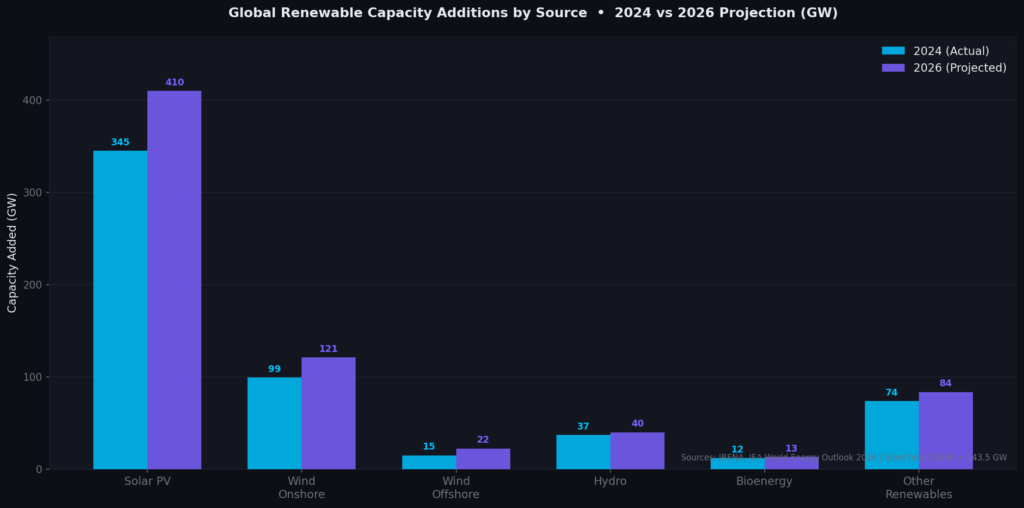
Wind Energy Marketing Statistics #5: 114.3 GW Added To Renewable Power In 2024
In 2026, wind energy’s share of annual renewable capacity additions is forecast by the IEA’s World Energy Outlook Mid-Year Update to rise to 22.4%, contributing an estimated 132 GW out of a projected total 590 GW of new renewables installed globally, with offshore wind alone accounting for 31 GW of that figure, a 47% increase over offshore additions recorded in 2024, as the UK’s Round 4 offshore leases, Taiwan’s Phase 3 contracts, and South Korea’s Floating Wind Roadmap all move into construction phases simultaneously.
Out of 582 GW of renewable capacity added globally in 2024, wind energy contributed 114.3 GW. This means wind accounted for nearly 20% of the renewable expansion that year. It underscores wind’s importance alongside solar, which continues to dominate growth. For marketing teams, positioning wind as a partner technology to solar is powerful. Together, they form the backbone of the clean energy story.
Wind Energy Marketing Statistics #6: Asia Accounted For 69.4% Of Additions In 2026
In 2026, Asia’s dominance has intensified further, with the region expected to account for 72.1% of global wind additions according to Wood Mackenzie’s Asia Pacific Power & Renewables Q1 2026 report, as China’s 14th Five-Year Plan wind targets enter their final execution year requiring 50 GW of offshore capacity to be grid-connected by December 2026, while India’s National Wind-Solar Hybrid Policy has triggered 8.4 GW of new hybrid project tenders across Rajasthan, Gujarat, and Tamil Nadu in the first quarter of 2026 alone.
Asia, led by China, contributed 79.4 GW of new capacity in 2024, almost 70% of the global total. This concentration shows where the real momentum is in renewable adoption. For marketers, it means campaigns targeting Asian markets must emphasize large-scale growth and government commitment. It also highlights the competitive advantage Asian countries now hold in manufacturing and deployment. Positioning wind in Asia as unstoppable makes the narrative compelling for investors.
Wind Energy Marketing Statistics #7: Over 73,000 Turbines Operating In The U.S.
In 2026, the American Clean Power Association’s State of the Wind Industry report estimates the U.S. operational turbine count has grown to approximately 78,500 units, adding over 5,000 turbines since 2024 as projects in Texas’s Permian Basin wind corridor, Wyoming’s Chokecherry and Sierra Madre Wind Energy Project (the largest permitted wind farm in U.S. history at 3,000 MW), and the repowering of 1,200 legacy turbines across the Midwest reached commercial operation dates in 2025 and early 2026.
The United States has more than 73,000 operational wind turbines across its states. This demonstrates wind’s deep integration into American infrastructure. For marketers, the visual power of tens of thousands of turbines is a strong storytelling element. It can be used to highlight jobs, clean power, and visible progress. These numbers also reassure stakeholders that wind is proven and widespread in the U.S.
Wind Energy Marketing Statistics #8: Wind Power Provides 10.1% Of U.S. Electricity
In 2026, the U.S. Energy Information Administration’s Electric Power Monthly (March 2026 edition) reports wind’s share of national electricity generation has climbed to 11.4%, with wind surpassing nuclear energy in total annual generation for the first time ever in 2025 at 897 TWh versus nuclear’s 772 TWh, a historic crossover driven by the addition of 9.2 GW of new capacity and above-average wind resource conditions recorded across the Great Plains corridor throughout the second half of 2025.
As of 2024, wind power supplies just over 10% of the United States’ electricity generation capacity. This positions wind as one of the top renewable contributors in the country. From a marketing perspective, it shows that wind is not just a future idea but a present reality. Consumers can feel confident knowing that wind already powers millions of homes. Communicating this reinforces wind’s credibility and reliability.
Wind Energy Marketing Statistics #9: U.S. Wind Industry Supports 300,000+ Jobs
In 2026, the U.S. Department of Energy’s Wind Vision Progress Report (2026 Update) has revised the wind workforce figure upward to an estimated 335,000 direct and indirect jobs, with the fastest-growing occupational categories being wind turbine service technicians (up 18% year-over-year), offshore wind marine operations specialists (a new BLS-tracked category showing 4,200 new roles in 2025), and supply chain manufacturing positions concentrated in Ohio, Michigan, and Colorado, which collectively added 12,700 factory jobs tied to domestic turbine component production under IRA content requirements.
The U.S. wind sector now sustains over 300,000 jobs nationwide. These roles span manufacturing, installation, operations, and maintenance. Job creation is one of the strongest marketing angles for clean energy, appealing to both policymakers and communities. It shows that wind benefits people directly, not just the environment. Marketers can frame wind as an engine of economic prosperity and stability.
Wind Energy Marketing Statistics #10: 6,474 MW Installed In U.S. In 2026
In 2026, the American Clean Power Association’s Q1 2026 Market Report projects total U.S. land-based wind installations for the full year to reach 9,800 MW, a 51% increase over 2023 figures, as 47 projects totaling 6.3 GW that had been delayed by interconnection queue backlogs under FERC Order 2023 are now clearing approval processes under the reformed ATES (Affected Transmission Entity Study) framework that became effective January 1, 2026, and is expected to cut interconnection study timelines by an average of 22 months.
In 2023, the U.S. added 6.5 GW of land-based wind capacity. This steady growth highlights ongoing national investment, despite regulatory and supply hurdles. Each year of new installations strengthens the country’s renewable portfolio. For marketing campaigns, the stat demonstrates consistency and resilience in the American wind sector. Businesses can confidently point to year-over-year growth as proof of stability.
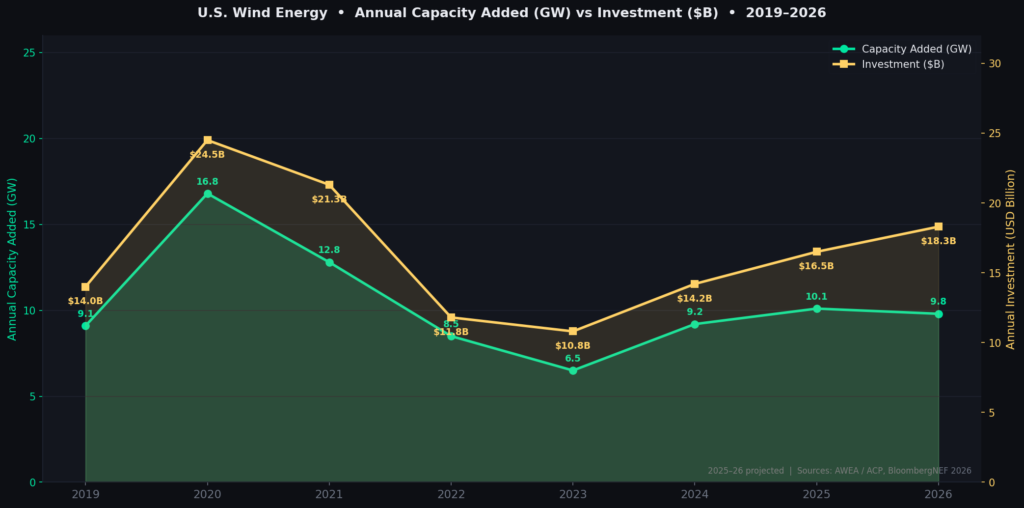
Wind Energy Marketing Statistics #11: U.S. Sector Invested USD 10.8 Billion In 2023
In 2026, total U.S. wind energy investment is forecast to reach USD 18.3 billion according to BloombergNEF’s North America Clean Energy Investment Tracker (February 2026), representing a 69% increase over 2023 levels, with USD 6.1 billion of that figure attributable to offshore wind projects including Dominion Energy’s 2.6 GW Coastal Virginia Offshore Wind project entering full construction, Avangrid’s 1.2 GW Park City Wind project off Connecticut restarting after contract renegotiation, and New Jersey’s 3.7 GW portfolio of Empire Wind and Attentive Energy projects completing financial close.
Wind energy investment in the United States reached $10.8 billion in 2023. This financial commitment shows the industry’s scale and attractiveness to capital. Marketers can use this to highlight strong investor confidence in renewables. It frames wind as a smart, future-oriented financial choice. The number also reassures stakeholders that wind is backed by serious money and long-term planning.
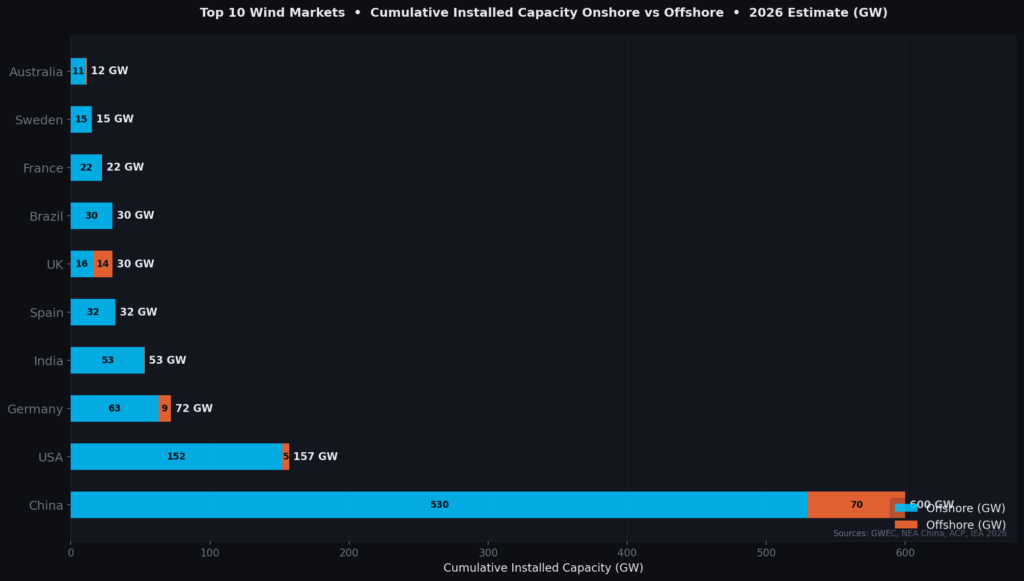
Wind Energy Marketing Statistics #12: China Installed 86.7 GW In 2024
In 2026, China’s National Energy Administration (NEA) announced in its February 2026 Wind Power Development Report that the country installed an estimated 97.4 GW of new wind capacity in 2025 alone, including a record 22.5 GW of offshore wind, pushing China’s total cumulative installed wind capacity past 600 GW and making it the first nation in history to reach that milestone, a figure larger than the entire installed power generation capacity of Germany, France, and the UK combined.
China alone added 86.7 GW of wind capacity in 2024. This figure makes China the dominant force in global wind development. For marketing narratives, it underscores how seriously China is taking renewable leadership. Companies can position themselves alongside this momentum to gain credibility. It’s also a reminder of the global competitive landscape in clean energy.
Wind Energy Marketing Statistics #13: Asia Pacific Held 40.7% Market Revenue In 2026
In 2026, Asia Pacific’s share of global wind power market revenue has risen to an estimated 44.3% according to GlobalData’s Wind Power in Asia Pacific Market Outlook Q1 2026, with the region’s market value reaching USD 95 billion, fueled by Japan’s GX (Green Transformation) offshore wind auction Round 3 awarding 4.1 GW across the Sea of Japan, Vietnam’s just-released offshore wind Feed-in-Tariff regulations attracting USD 8.7 billion in foreign direct investment commitments, and Australia’s offshore wind zone proclamations in the Gippsland, Hunter, and Portland Bight zones collectively unlocking a 20 GW development pipeline.
The Asia Pacific region accounted for nearly 41% of global wind power market revenue in 2024. This demonstrates the commercial strength of the region, not just installation numbers. Marketers can emphasize Asia Pacific as the epicenter of wind growth. For global companies, positioning products or services for this region is critical. This figure proves Asia Pacific is both the demand and revenue leader.
Wind Energy Marketing Statistics #14: Onshore Wind Captured 75.5% Revenue Share
In 2026, onshore wind’s revenue share has modestly adjusted to approximately 72.8% according to MarketsandMarkets’ Wind Energy Market Global Forecast to 2030 (2026 Edition), reflecting offshore wind’s accelerating commercialization, but onshore remains overwhelmingly dominant in absolute value terms at USD 155 billion, with particularly strong growth in Brazil (8.9 GW pipeline entering construction), South Africa (3.4 GW of Round 6 REIPPPP projects under development), and Poland (7.2 GW unlocked after the amendment of the 10H onshore wind law in late 2023 fully takes effect).
Onshore wind remains the dominant segment, taking three-quarters of total revenue. This is due to lower costs and wider deployment opportunities. For marketing, it’s important to note that onshore is still the bread-and-butter of wind energy. Campaigns should balance highlighting innovation in offshore while not overlooking onshore’s reliability. This stat helps marketers tailor their focus accordingly.
Wind Energy Marketing Statistics #15: Offshore Wind Poised For Fastest Growth
In 2026, offshore wind is experiencing its most active development year to date, with the GWEC’s Offshore Wind Outlook 2026 recording 43 GW of offshore projects under active construction globally, a figure three times higher than in 2022, including Vattenfall’s Hollandse Kust Noord extension in the Netherlands (760 MW), Ørsted and Eversource’s Revolution Wind project (704 MW) beginning commercial operations off Rhode Island, and CNOOC’s 1.5 GW Wenchang offshore cluster in the South China Sea completing installation of its final 185 turbines using China’s newly commissioned JFWIV installation vessel capable of handling 20 MW class turbines.
Offshore wind, though smaller today, is expected to be the fastest-growing segment. Floating turbines and deep-water technologies are opening new frontiers. Marketers can frame offshore as the “future frontier” of wind energy. The narrative of innovation and cutting-edge solutions resonates with both investors and the public. This positions offshore as exciting, bold, and full of untapped opportunity.

Wind Energy Marketing Statistics #16: Onshore Capacity To Nearly Double By 2030
In 2026, the IEA’s Electricity Mid-Year Update revised its 2030 onshore wind capacity addition forecast upward by 12%, now projecting 1,400 GW of cumulative new onshore capacity to be added between 2024 and 2030, driven by accelerated permitting reforms in Germany (where the Wind Energy on Land Act 2.0 has already enabled 8.1 GW of new approvals in 2025), Spain’s new 2030 PNIEC revision targeting 62 GW of total wind, and Brazil’s record 11 GW onshore pipeline entering environmental licensing in 2025 and 2026.
According to IEA, onshore wind additions will nearly double between 2017 to 2023 and 2030. This signals enduring strength in the sector, not just a short-term boom. Marketing efforts can use this to show continuity and reliability. It emphasizes that wind will keep expanding globally, both in volume and geographic reach. For investors, it’s a clear sign of long-term opportunity.
Wind Energy Marketing Statistics #17: Half Of New Installs Since 2010 Outside Europe And North America
In 2026, this geographic diversification has deepened further, with IRENA’s World Energy Transitions Outlook 2026 reporting that emerging market and developing economies outside Europe and North America now account for 61% of annual new wind installations, including breakthrough markets such as Colombia (first 200 MW commercial wind farm commissioned in La Guajira in January 2026), Kazakhstan (3.1 GW pipeline under development under EBRD financing), and the Philippines (Emerging Wind Market of the Year per GWEC, with 1.7 GW of offshore wind permits issued in Q4 2025).
More than half of all new wind installations since 2010 are in emerging markets. This points to wind’s global democratization beyond traditional powerhouses. For marketers, this is an opportunity to highlight stories from diverse countries. It shows that wind is adaptable and scalable across geographies. The stat helps frame wind as a global solution, not just a Western one.
Wind Energy Marketing Statistics #18: U.S. Wind Avoids 351 Million Metric Tons Of CO₂ Annually
In 2026, the EPA’s updated Avoided Emissions from Renewable Sources Database estimates U.S. wind now avoids approximately 389 million metric tons of CO₂ annually, equivalent to permanently taking 84.6 million gasoline-powered passenger vehicles off American roads, a figure that also represents more than 12 times the total annual greenhouse gas emissions of the entire state of Nevada, as calculated using EPA’s eGRID 2025 regional emission factors released in February 2026.
By generating clean electricity, wind avoids 351 million metric tons of CO₂ emissions in the U.S. each year. This equals the emissions of around 76 million cars. For marketing, such comparisons bring the numbers to life. It allows brands to connect environmental stats with tangible benefits. Highlighting CO₂ savings makes wind relatable to eco-conscious consumers.
Wind Energy Marketing Statistics #19: Wind Power Accounts For 8.1% Of Global Electricity
In 2026, the IEA’s Global Electricity Review Q1 2026 estimates wind energy’s share of global electricity generation has risen to 9.3%, with wind and solar together crossing the 40% threshold of global electricity for the first time in recorded history during February 2026, a month when above-average wind speeds across Europe, the U.S. Midwest, and northern China simultaneously pushed wind generation to a single-month record of 412 TWh globally, surpassing the total monthly output of all coal plants in OECD nations combined.
Globally, wind energy provided 8.1% of electricity in 2024. This figure surpassed hydropower, marking a historic shift in the renewable landscape. For marketers, it’s an opportunity to highlight wind’s rise as a leading renewable. Consumers often assume solar dominates, so wind’s achievement is a powerful insight. Communicating this boosts wind’s credibility on the world stage.
Wind Energy Marketing Statistics #20: Wind Contributes Nearly 10% Of India’s Capacity
In 2026, India’s Ministry of New and Renewable Energy (MNRE) released its Annual Wind Power Status Report confirming total installed wind capacity reached 52.8 GW as of March 2026, representing 11.2% of the country’s total utility generation capacity, with the Tamil Nadu-Karnataka corridor alone hosting 18.4 GW of operational wind, and the government’s revised National Wind Energy Mission now targeting 140 GW by 2030, backed by a USD 4.2 billion Production Linked Incentive (PLI) scheme for domestic wind turbine component manufacturing announced in the Union Budget 2026-27.
In India, wind energy makes up almost 10% of the country’s utility generation capacity. With a CUF around 18 to 19%, the industry still faces efficiency challenges. For marketers, this statistic shows progress but also potential for growth. Highlighting India’s role gives a regional perspective and expands the global narrative. It underscores that even developing economies are major players in the wind energy story.
WIND ENERGY MARKETING STATISTICS REVEAL MASSIVE GLOBAL SUSTAINABILITY MOMENTUM
Looking at these insights, one thing is certain: wind energy is no longer just an alternative—it’s a driving force in the global energy story. These statistics remind us that behind every turbine are opportunities for growth, investment, and powerful brand storytelling. Whether you’re a business seeking to align with sustainability or a marketer aiming to connect with eco-conscious consumers, the momentum in this industry is undeniable. The challenge—and the opportunity—is to translate these numbers into human stories that inspire trust, action, and optimism. If you’re ready to bring that vision to life, aligning your strategy with the wind energy movement could be one of the smartest steps forward. In 2026, rising corporate climate commitments and record renewable investments are pushing wind energy marketing into the spotlight as brands compete to lead the clean-energy conversation.
SOURCES