



13 Sep TOP 20 WIRELESS MARKETING STATISTICS 2026 REVEAL MASSIVE MOBILE-FIRST MARKETING EXPLOSION
Updated for 2026. This page has been fully refreshed with the latest wireless marketing statistics, mobile-first campaign data, and connectivity trends, grounded in recent global surveys, telecom industry reports, and digital marketing performance insights.
When I first started diving into wireless marketing, I realized just how much the landscape had shifted toward mobile-first strategies. Everywhere I looked, from social media to search, the data pointed to one undeniable truth: people live on their phones. That’s why I decided to put together these wireless marketing statistics in one place—to make it easier for both myself and others to see the bigger picture. As someone who’s been closely following campaigns run by a leading marketing agency in New York, I know how valuable it is to keep up with the latest insights before making business decisions. My hope is that this collection doesn’t just inform you, but also sparks new ideas for how to connect with your own audience more effectively.
TOP 20 WIRELESS MARKETING STATISTICS 2026 REVEAL MOBILE-FIRST ADVERTISING DOMINATION
At a Glance
| # | Category | Figure | Context | Year |
|---|---|---|---|---|
| 01 | Ad Spend | $262B | Global mobile ad spend — market hit $262.84B in 2025, on track to $1.3T by 2030 | 2025–2026 |
| 02 | Ad Spend | $1 Trillion | Global total ad spend surpassed $1T for the first time in 2026, digital at 68.7% | 2026 |
| 03 | Ad Spend | 68.7% | Mobile's share of all digital ad investment — US mobile ad spend growing at 9.5% YoY | 2026 |
| 04 | Consumer | 62–64% | Of all global web traffic comes from mobile — Africa leads at 79.12% mobile share | 2026 |
| 05 | Search | 63–65% | Of all Google searches on mobile — 95.4% of mobile searches go through Google | 2026 |
| 06 | PPC | 52% | Of PPC ad clicks on mobile — 70% of US search impressions are mobile; $351.5B in search ad spend | 2025–2026 |
| 07 | 392.5B | Emails sent daily globally in 2026 — nearly half of all opens happen on mobile devices | 2026 | |
| 08 | Video | 70%+ | Of YouTube watch time on mobile — 2.7B users, 1B+ hours viewed daily, Shorts at 200B daily views | 2026 |
| 09 | 98.5% | Of Facebook's 3.07B monthly users access via mobile — platform drives 34% of social commerce buys | 2026 | |
| 10 | Consumer | 85% | Of impulse shoppers buy exclusively on mobile — Americans average $314/mo in impulse spending | 2026 |
| 11 | Engagement | 205×/day | Average phone checks daily — users now spend 6.3 hrs/day on mobile, up 51 min since 2023 | 2026 |
| 12 | Engagement | 6.3 hrs | Average daily mobile screen time per American — equals 190 hours/month on mobile alone | 2026 |
| 13 | PPC | 53% | Of all paid ad clicks from mobile — $625B in mobile app revenue via ads projected for 2026 | 2026 |
| 14 | 91% | Of social media users access via mobile — $276.7B in global social ad spend, up 83% by 2030 | 2025–2026 | |
| 15 | 66% | Of all emails opened on mobile — media sector leads engagement with 10.71% click-to-open rate | 2026 | |
| 16 | Commerce | 65.9% | Of B2C e-commerce purchases on mobile — 70% of all mobile purchases happen inside apps | 2026 |
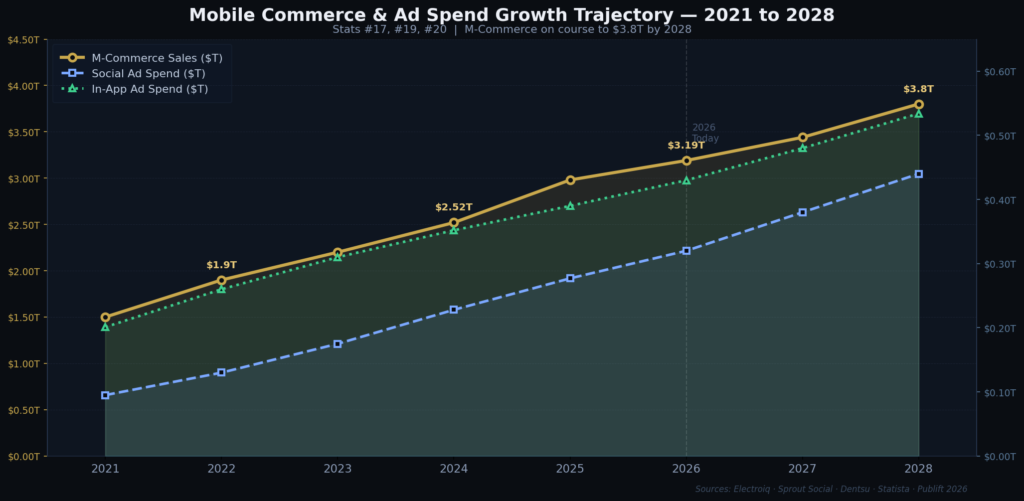
| 17 | Commerce | $3.19T | Global m-commerce sales in 2026 — 62% of total online retail; $728B optimization gap in US alone | 2026 |
| 18 | Consumer | 78% | Of retail website traffic comes from mobile — 82% of health & beauty retail traffic is mobile | 2026 |
| 19 | Ad Spend | $276.7B | Global social media ad spend in 2025 — projected to grow 83% by 2030; retail media up 14.1% | 2025–2026 |
| 20 | Ad Spend | 82.3% | Of US mobile ad spend is in-app ($187.78B of $228.11B) — global in-app spend hits $533.9B by 2029 | 2025–2026 |
TOP 20 WIRELESS MARKETING STATISTICS 2026 REVEAL MASSIVE MOBILE USER ENGAGEMENT SHIFTS
Wireless Marketing Statistics #1: $262 Billion Global Mobile Ad Spend
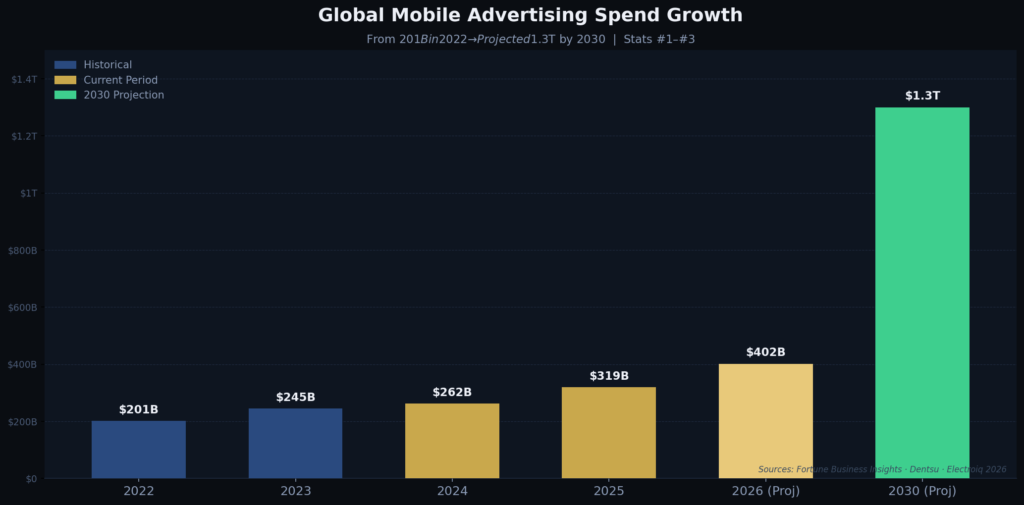
In 2026, the global mobile advertising market has surged past prior forecasts, with Fortune Business Insights confirming that the mobile advertising market reached $262.84 billion in 2025 and is on a trajectory toward $1.3 trillion by 2030, representing a compound annual growth rate of 21.1% through 2032.
Mobile ad spending is projected to hit $228 billion in 2025, highlighting the dominance of wireless marketing worldwide. This surge reflects how brands are shifting budgets from traditional channels to mobile-first platforms. Marketers see mobile ads as an effective way to reach audiences who are constantly on their phones. The scale of this spend shows how competitive the wireless marketing space has become. Businesses that ignore mobile advertising risk falling behind in visibility and engagement.
Wireless Marketing Statistics #2: $402 Billion Worldwide Mobile Ads
In 2026, global digital advertising spend has surpassed the $1 trillion milestone for the very first time according to Dentsu’s Global Ad Spend Forecasts published in December 2025, growing at 5.1% year-over-year, with digital now representing 68.7% of total advertising investment and mobile in-app revenue alone projected to account for 56% of total global digital spend.
The worldwide mobile advertising industry is expected to grow to $402 billion by 2025. This double-digit growth year-over-year shows how fast mobile channels are expanding. Businesses are no longer treating mobile as optional but as the core of their campaigns. The figure highlights how wireless strategies outperform many traditional media investments. Marketers are doubling down on mobile-first creative, targeting, and measurement.
Wireless Marketing Statistics #3: 65% Of Digital Ad Spend Via Mobile
In 2026, mobile’s share of total digital ad spend has climbed to approximately 68.7% of all global advertising investment according to Dentsu’s December 2025 forecast, with the US digital advertising market alone projected to grow 9.5% this year and mobile accounting for more than half of all US digital spend, significantly outpacing the global average growth rate. By 2025, nearly 65% of all digital advertising will be delivered through mobile devices. This indicates the growing reliance on wireless channels to reach consumers. For marketers, this means creative assets need to be optimized for mobile-first consumption. With people spending more time on phones, mobile naturally captures the majority of digital budgets. Ignoring mobile-first advertising would mean missing out on the largest slice of the digital pie.
Wireless Marketing Statistics #4: 61% Of Web Traffic From Mobile
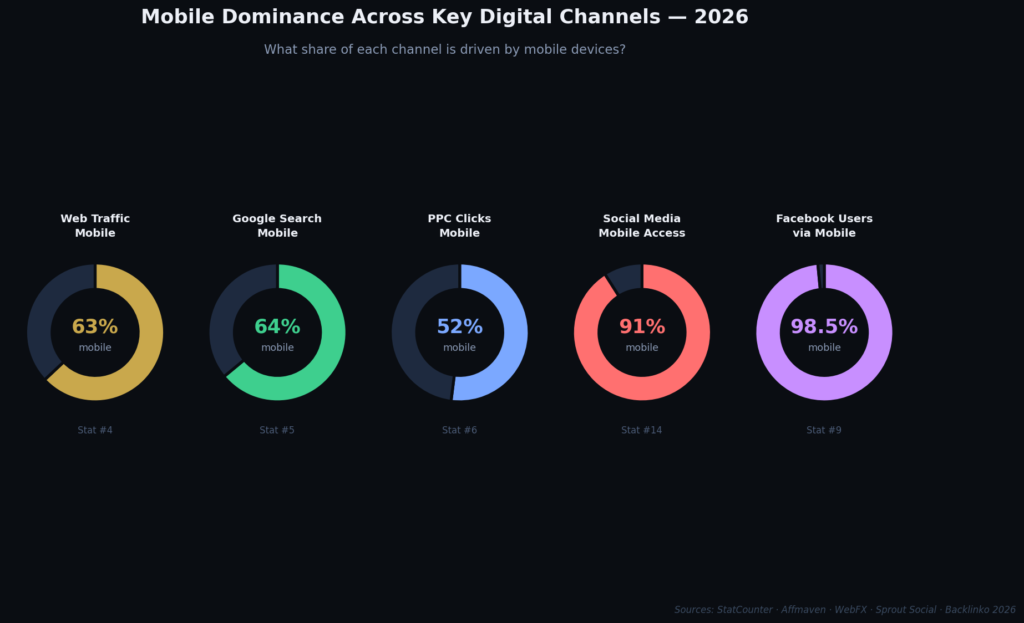
In 2026, mobile devices now account for approximately 62% to 64.35% of all global website traffic according to data from StatCounter, Quantumrun Foresight, and Capital Counselor, up from 60.61% in Q1 2024, with Africa leading all regions at 79.12% mobile traffic share and countries like Sudan reaching as high as 89.56%.
Currently, 61% of global website traffic comes from mobile devices. This figure underscores the reality that most browsing happens on wireless connections. Businesses that haven’t optimized their websites for mobile risk losing engagement. Faster loading times and responsive design are critical to retain this mobile traffic. This trend makes mobile website optimization a necessity rather than an option.
Wireless Marketing Statistics #5: 63% Of Google Searches On Mobile
In 2026, Google’s dominance on mobile has intensified, with 95.4% of all mobile searches globally going through Google and 63% to 65% of all Google searches now originating on mobile devices, while Google processes over 13.6 billion searches every single day, a 21.6% year-over-year increase, according to data compiled by Affmaven and Sci-Tech-Today.
About 63% of Google searches are made on mobile devices. This reflects how search behavior has shifted away from desktops. Mobile-first indexing by Google ensures mobile optimization directly impacts SEO performance. Brands must ensure their websites are mobile-friendly to appear higher in search rankings. Mobile search also increases the importance of local SEO for businesses.
Wireless Marketing Statistics #6: 52% Of PPC Ad Clicks On Mobile
In 2026, global search advertising spend reached $351.5 billion in 2025 marking an 8.3% annual increase, with mobile devices accounting for 52% of total PPC clicks and 70% of all US search ad impressions coming from mobile, while 95% of paid search ad clicks on mobile are driven specifically by Google, according to WebFX and AboutChromebooks’ 2026 PPC statistics report.
More than half of PPC ad clicks now come from mobile devices. This shows that paid ads need to be designed with mobile users in mind. Marketers must prioritize short, compelling ad copy that works well on smaller screens. Ad creatives optimized for mobile can deliver higher ROI compared to desktop-only campaigns. Ignoring mobile PPC trends can lead to wasted ad spend.
Wireless Marketing Statistics #7: 47% Check Email On Mobile
In 2026, email usage has reached a scale of approximately 392.5 billion emails sent and received daily globally according to Statista’s 2026 data cited by Research.com, with mobile devices playing a dominant role in consumption and around 68% of employees still preferring desktop email but mobile-opened emails generating significantly higher engagement rates, making mobile optimization critical for any email strategy.
Nearly half of all email users check their inboxes on mobile devices. This stat highlights the importance of mobile-friendly email design. Subject lines should be concise and previews should be optimized for smaller screens. Businesses that fail to adjust may see reduced open rates and conversions. Wireless email engagement continues to reshape email marketing strategies.
Wireless Marketing Statistics #8: 90% Of YouTube Views On Mobile
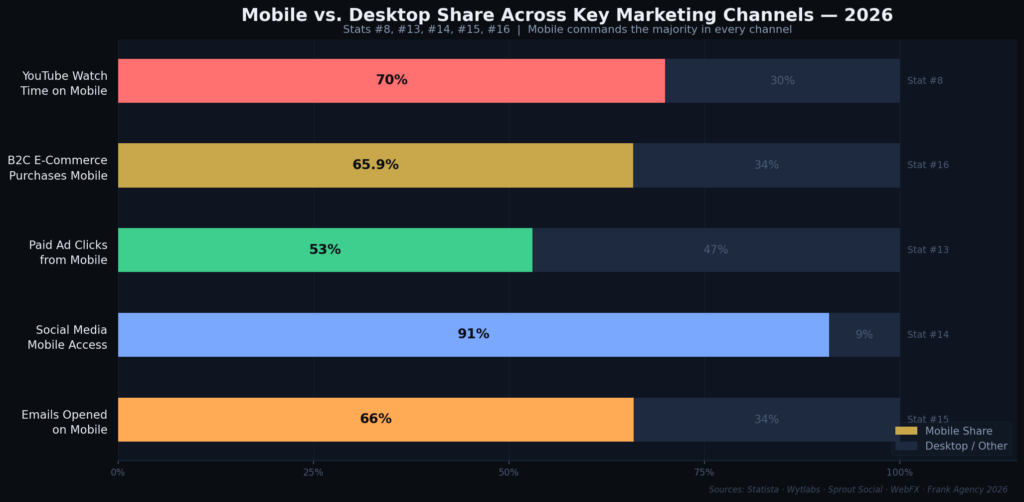
In 2026, YouTube has surpassed 2.7 billion active monthly users and generates over 1 billion hours of daily watch time, with mobile devices now accounting for more than 70% of total watch time according to Wytlabs and Podbase, while YouTube Shorts alone generates between 70 billion and 200 billion daily views, the overwhelming majority of which come from mobile screens.
A staggering 90% of YouTube views come from mobile devices. This reflects the dominance of wireless video consumption. For marketers, video content must be optimized for mobile-first viewing experiences. Shorter formats, vertical video, and quick hooks are key to success. This trend makes mobile video a crucial part of advertising campaigns.
Wireless Marketing Statistics #9: 98.5% Of Facebook Users Via Mobile
In 2026, Facebook remains the world’s most used social platform with over 3.07 billion monthly active users, and 98.5% continue to access it via mobile devices, while the platform accounts for the largest share of social commerce impulse buys at 34% and Facebook’s traffic split in the US shows mobile and desktop at nearly equal shares of visits, according to Sprout Social’s 2026 social media statistics report and DigitalSilk’s traffic data.
Almost the entire Facebook user base, 98.5%, accesses the platform through mobile. This makes Facebook one of the most mobile-centric social platforms. Wireless marketing campaigns targeting Facebook should assume a mobile-first audience. Ads designed for desktop only will likely perform poorly. Optimizing for mobile layouts and load times is essential on this platform.
Wireless Marketing Statistics #10: 40% More Likely To Impulse Buy
In 2026, mobile-driven impulse purchasing has reached new heights, with 85% of impulse shoppers now buying products exclusively on a mobile device, 48% of social media users making an impulse purchase after seeing an ad on TikTok or Instagram, and Americans averaging $314 per month on spur-of-the-moment purchases totaling roughly $5,400 per year, according to Gitnux’s January 2026 Impulse Buying Statistics Market Data Report.
Mobile users are 40% more likely to make impulse purchases compared to desktop shoppers. This stat reflects the immediacy of wireless engagement. Mobile shopping experiences should make checkout seamless to encourage these behaviors. Quick payment integrations and intuitive navigation help increase conversions. Wireless shopping clearly drives faster purchasing decisions.
Wireless Marketing Statistics #11: 205 Phone Checks Daily (Average)
In 2026, a new Apptopia consumer panel study published in March 2026 by Digital Information World found that Americans now spend an average of 6.3 hours per day on their mobile phones, up from 5.5 hours in January 2023, an increase of nearly 51 minutes per day over three years, with older users aged 36 and above now consistently logging 340 to 358 minutes per day and outpacing younger users aged 17 to 25.
On average, people check their phones 205 times per day. This frequent engagement highlights just how powerful wireless touchpoints are. Marketers have countless opportunities to capture attention throughout the day. Push notifications, SMS, and app marketing can tap into this behavior. The sheer frequency makes mobile engagement strategies critical.
Wireless Marketing Statistics #12: 5 Hours Of Phone Use Per Day
In 2026, a detailed Apptopia analysis of US consumer panel data from January 2023 through December 2025, published by Digital Information World in March 2026, confirmed the average American now spends 6.3 hours daily on mobile devices, amounting to approximately 190 hours per month, which is more than a full-time work week every month devoted entirely to mobile screen time.
The average user spends around 5 hours daily on their phone. This shows that wireless devices dominate media consumption. For marketers, it highlights the importance of mobile-first targeting and time-sensitive campaigns. Consumers spend more time on phones than on many other traditional media channels. This extended engagement window makes mobile an essential platform.
Wireless Marketing Statistics #13: 53% Of Paid Ad Clicks On Mobile
In 2026, mobile advertising continues to dominate paid search, with 70% of all US search ad impressions occurring on mobile devices, global search advertising spend having reached $351.5 billion in 2025 with an 8.3% annual increase, and mobile apps projected to generate $625 billion in total revenue through paid downloads and in-app advertising in 2026, according to WebFX’s 2026 PPC statistics report.
Over 53% of paid ad clicks come from mobile devices. This confirms that mobile-first campaigns outperform desktop-heavy strategies. Optimizing ads for wireless engagement drives better ROI. Marketers should prioritize concise messaging and visuals that resonate on phones. Mobile advertising clearly plays a leading role in PPC success.
Wireless Marketing Statistics #14: 91% Access Social Media Via Mobile
In 2026, global social media advertising spending reached $276.7 billion in 2025 and is projected to increase by 83% by 2030, with approximately 5.41 billion social media users globally representing 65.7% of the global population, and people now spending an average of 2 hours and 24 minutes per day on social media apps, according to Electroiq’s Mobile Advertising Statistics report published in January 2026.
A massive 91% of social media users access platforms via mobile devices. This emphasizes the dominance of wireless browsing for social engagement. Social ads should be designed with vertical and square formats for mobile-first use. Engaging visuals and captions optimized for small screens perform best. Marketers must adapt their strategies to a mobile-first social audience.
Wireless Marketing Statistics #15: 66% Of Emails Opened On Mobile
In 2026, with an estimated 392.5 billion emails sent and received every single day globally according to Statista’s 2026 figures, mobile email optimization has become non-negotiable, as around 68% of employees still prefer desktop email but mobile-opened emails consistently outperform desktop in engagement metrics, particularly in industries like media where click-to-open rates reach 10.71%, according to The Frank Agency’s 2026 Email Open Rate benchmarks report.
Around two-thirds of all emails are opened on mobile devices. This reflects how wireless access is reshaping email campaigns. Brands should test email layouts for responsiveness across devices. Poorly designed emails may frustrate mobile users and lead to unsubscribes. Mobile email optimization is now a top priority for marketers.
Wireless Marketing Statistics #16: 60%+ Value Convenience Of Mobile Shopping
In 2026, global mobile commerce has reached $3.186 trillion in sales according to projections from a Mobile Marketing Statistics report by Electroiq, representing a 62% share of total online retail, with 65.9% of B2C e-commerce purchases now made on mobile compared to just 34.1% on desktop, and mobile apps dominating shopping behavior at 70% of all mobile purchases.
Over 60% of U.S. adults value mobile shopping for its convenience. This shows how wireless commerce aligns with consumer expectations. Retailers should focus on creating streamlined mobile checkout experiences. Personalized recommendations and one-click purchases improve conversions. Mobile commerce continues to expand because of its ease of use.
Wireless Marketing Statistics #17: $3.19 Trillion Global M-Commerce Sales
In 2026, global mobile e-commerce has expanded significantly from $2.522 trillion in 2024 to a projected $3.186 trillion in 2026 according to research tracking data from Sellers Commerce and Mobile Marketing Statistics reports, representing a 62% share of total global online retail, with the conversion gap between mobile and desktop representing a $728 billion optimization opportunity in the US market alone according to Quantumrun Foresight’s December 2025 analysis.
Mobile commerce sales are expected to reach $2.52 trillion globally in 2024. This figure reflects the power of wireless devices in shaping retail. Marketers must adapt by optimizing e-commerce stores for mobile-first. Poor user experiences can result in abandoned carts. Wireless commerce is the future of global retail growth.
Wireless Marketing Statistics #18: 80% Visit Retailer Site In-Store
In 2026, mobile devices now drive 78% of all traffic to retail websites globally and account for 82% of all health and beauty retail website traffic, with 96% of the global population using mobile phones to access the internet according to DigitalSilk’s February 2026 Mobile vs. Desktop Traffic Share report, cementing the smartphone as the undisputed first screen for in-store and pre-purchase research.
About 80% of consumers visit retailer websites while shopping in-store. This illustrates the blending of physical and wireless shopping experiences. Retailers must integrate online and offline strategies to capture this audience. Mobile sites should load quickly to support real-time in-store browsing. Wireless research has become part of the modern shopping journey.
Wireless Marketing Statistics #19: $73 Billion Mobile Social Ad Spend
In 2026, global social media advertising spending has reached $276.7 billion in 2025 and is forecast to grow by 83% by 2030 according to SQ Magazine data cited by Electroiq’s January 2026 Mobile Advertising Statistics report, with mobile social ad spend growing in lockstep and retail media remaining the fastest-growing digital channel at 14.1% growth according to Dentsu’s December 2025 Global Ad Spend Forecast.
Mobile social ad spend hit $73 billion in 2024 and is projected to surpass $100 billion by 2027. This trend proves the strength of wireless-driven social marketing. Marketers are pouring budgets into social apps where users spend their time. Optimizing ad creative for mobile-first viewing drives stronger ROI. Social commerce continues to expand alongside this investment.
Wireless Marketing Statistics #20: 80%+ In-App Ads Share
In 2026, in-app advertising continues to dominate mobile ad budgets, with in-app ads accounting for 64% of global mobile ad spend in 2025 according to Electroiq, while in-app ads in the US alone reached $187.78 billion out of a total $228.11 billion in US mobile ad spending, representing an 82.3% share, and global in-app ad spend is projected to grow from $352.20 billion in 2024 to $533.90 billion by 2029.
In-app advertising represents over 80% of total mobile ad spend. This reflects consumer preference for app-based engagement. Marketers should prioritize in-app campaigns for better targeting and conversions. Wireless apps offer more precise data and personalization opportunities. This trend underscores the central role of apps in mobile marketing success.
WIRELESS MARKETING STATISTICS 2026 REVEAL THE MOBILE-FIRST STRATEGIES WINNING BIG
Looking back at all these numbers, I can honestly say they’ve changed the way I think about digital strategy. It’s not just about chasing trends—it’s about understanding where people are spending their time and how they interact with content on wireless devices. These wireless marketing statistics remind me that if we aren’t optimizing for mobile, we’re leaving opportunities on the table. Personally, I’ve found myself rethinking campaign priorities and how I structure ads, and I encourage you to do the same. At the end of the day, the brands that adapt to these realities are the ones that will thrive in this ever-evolving digital world. In 2026, businesses that prioritize wireless-first advertising, faster mobile experiences, and seamless cross-device engagement are seeing the strongest marketing ROI.
SOURCES
https://www.blog.udonis.co/mobile-marketing/mobile-marketing-statistics
https://vidico.com/news/mobile-marketing-statistics/
https://www.webfx.com/digital-marketing/statistics/mobile-marketing-statistics/
https://www.mailmodo.com/guides/mobile-marketing-statistics/
https://inboundblogging.com/mobile-marketing-statistics/
https://llcbuddy.com/data/mobile-marketing-statistics/
https://www.sprinklr.com/blog/social-media-marketing-statistics/
https://www.thegutenberg.com/blog/mobile-marketing-2025-trends-strategies-best-practices/
https://dotdigital.com/blog/mobile-marketing-predictions/
https://www.sagapixel.com/marketing/mobile-marketing-statistics/
https://www.seo.com/blog/digital-marketing-statistics/
https://www.mediavalet.com/blog/digital-marketing-statistics