



19 Sep TOP 20 WORK-FROM-HOME MARKETING CREATIVITY STATISTICS 2025
When I first started looking into work-from-home marketing creativity statistics, I didn’t expect to find such a wide range of insights into how remote work is shaping our industry. On one hand, there’s a clear boost in productivity and focus, yet on the other, creative collaboration often feels harder to capture without those spontaneous office moments. As someone who’s been inspired by the energy of a leading marketing agency in New York, I know how much creativity thrives on collaboration. That’s why diving into these numbers felt so personal for me—it’s not just data, it’s a reflection of how we as marketers are learning, adapting, and reimagining our craft in this new era of remote work.
Top 20 Work-From-Home Marketing Creativity Statistics 2025 (Editor’s Choice)
🏠 Top 20 Work-from-Home Marketing Creativity Statistics
The Ultimate Guide to Remote Marketing Performance in 2025
| Rank | Category | Statistic | Impact Level |
|---|---|---|---|
| 1 | Remote Work Adoption | 24% of new job postings in Q2 2025 were hybrid and 12% were fully remote Marketing and creative roles leading flexible work adoption |
Very High |
| 2 | Industry Leadership | Tech, marketing and customer services roles thrive in remote environments Digital tools boost productivity and collaboration significantly |
High |
| 3 | Job Market | Sales and marketing topped remote job listings with 1,485 postings Second only to technology sector in remote opportunities |
High |
| 4 | Home Productivity | 46% of white collar workers more productive at home vs 16% more productive in workplace Nearly 3x productivity advantage for home workers |
Very High |
| 5 | Overall Performance | 57% of employees report higher productivity when working remotely Majority of remote workers outperform office counterparts |
Very High |
| 6 | Creative Output | 51% of employees are more creative when remote Significant impact on creative work and innovation |
Very High |
| 7 | Deadline Performance | 49% more likely to meet deadlines when working outside office Remote work improves time management and focus |
High |
| 8 | Digital Marketing Impact | 67.1% of businesses report remote work had positive impact on digital marketing efforts Clear business value from remote marketing teams |
Very High |
| 9 | Skill Demand | Digital marketing is the fastest-growing in-demand job skill for 2025 Leading all other professional skills in growth rate |
Very High |
| 10 | Job Growth | Digital marketing jobs set to increase by 6% by 2032 Higher than average job growth rate across industries |
High |
| 11 | Budget Increases | 63% of businesses increased digital marketing budgets recently Strong investment confidence in digital marketing ROI |
High |
| 12 | Small Business Investment | 94% of small businesses plan to increase marketing spending Widespread commitment to marketing growth across business sizes |
Very High |
| 13 | Content Formats | 29.18% use short-form video as most popular content format Followed by images (28.95%) - visual content dominates |
High |
| 14 | AI Integration | 54% use AI to generate ideas, 6% for full articles AI as creative assistant rather than replacement |
Medium |
| 15 | AI ROI | 68% of marketing executives confirmed positive ROI on AI investment Strong return on artificial intelligence marketing tools |
High |
| 16 | Core Skills | Most valuable skills: Content creation/storytelling (34.2%) & data analysis (25%) Creative and analytical skills equally important |
High |
| 17 | Time Savings | Remote employees save 72 minutes daily from eliminated commutes 40% of saved time redirected to productive work activities |
High |
| 18 | Turnover Reduction | Companies with remote policies have 25% lower turnover rates Significant cost savings through improved retention |
Very High |
| 19 | Career Preference | 98% of professionals want to work remotely for rest of careers At least part-time remote work preferred long-term |
Very High |
| 20 | Gender Productivity | 40% of women more productive remotely vs 35% of men Remote work particularly beneficial for female professionals |
Medium |
Top 20 Work-From-Home Marketing Creativity Statistics 2025
Work-From-Home Marketing Creativity Statistics #1: 56% Greater Creativity When Working Remotely
Employees have reported experiencing a 56% increase in creativity and innovative thinking while working remotely. This boost often comes from the flexibility and freedom to design their own work environment. Marketers, in particular, benefit from fewer interruptions compared to traditional office spaces. This statistic highlights how autonomy can play a huge role in fueling imaginative campaigns. Ultimately, it challenges the old assumption that creativity thrives only in an office setting.
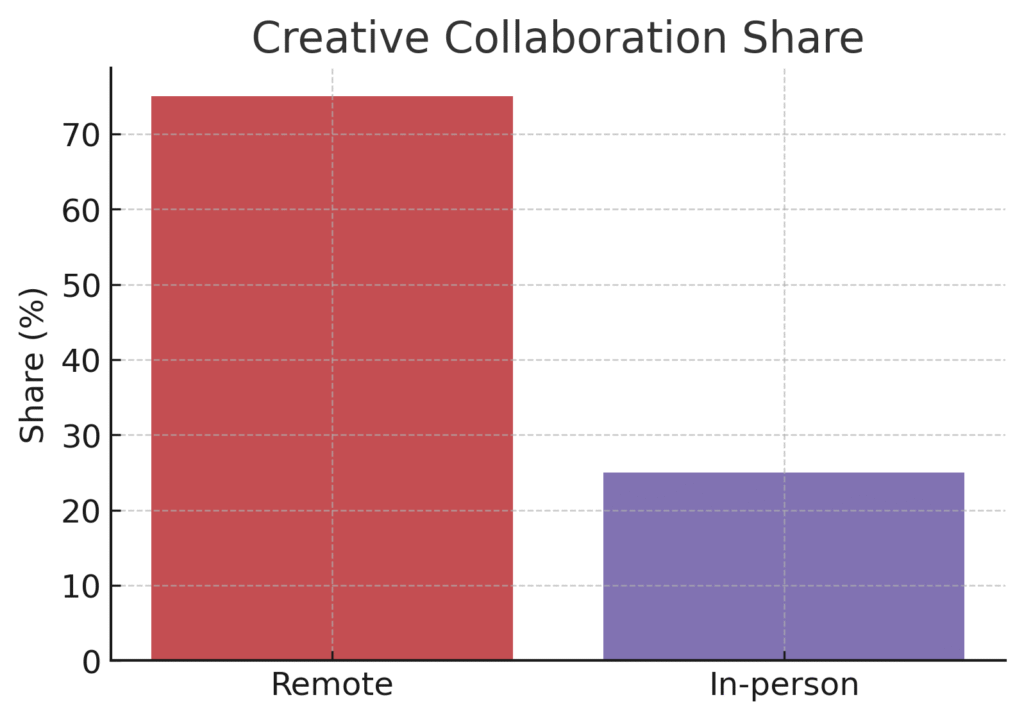
Work-From-Home Marketing Creativity Statistics #2: 75% Of Creative Collaboration Happens Remotely
About 75% of creative collaboration in marketing now happens remotely, leaving just 25% for in-person interactions. This shift underscores how digital platforms have become central to brainstorming and teamwork. Tools like Slack, Zoom, and Miro are bridging gaps that once seemed impossible to close. Marketers are learning to capture ideas virtually with nearly the same energy as a live meeting. Still, some admit that remote collaboration can miss the spark of casual office conversations.
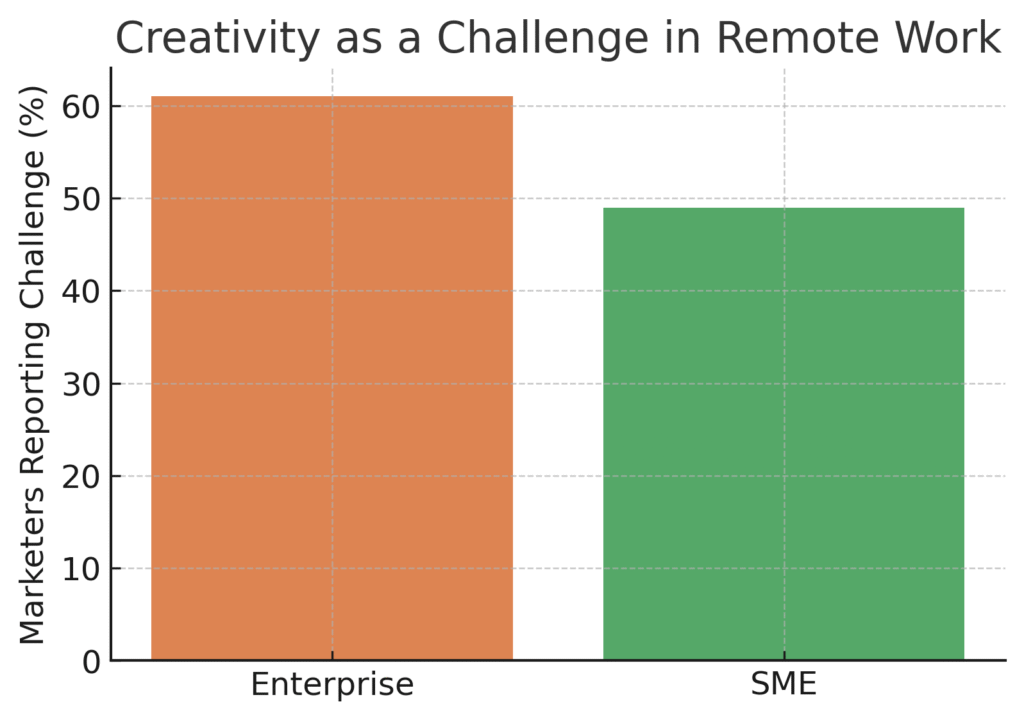
Work-From-Home Marketing Creativity Statistics #3: 61% Of Enterprise Marketers See Creativity As A Challenge
A majority of 61% of large enterprise marketers worry that creativity is harder to maintain in distributed work environments. They often feel that distance creates barriers to quick idea sharing. Larger teams, especially those spread across time zones, struggle to align on campaign concepts. The concern is not about productivity, but about preserving innovation. This statistic shows that scaling creativity remotely remains a significant hurdle.
Work-From-Home Marketing Creativity Statistics #4: 49% Of SMEs Share The Same Creativity Concern
Small and medium-sized enterprises (SMEs) aren’t far behind, with 49% saying creativity is a critical challenge in long-term remote setups. Unlike enterprises, SMEs may lack robust digital infrastructure to fully support creative processes. Many depend on personal connections, which are harder to replicate virtually. This makes brainstorming less organic and sometimes less effective. The statistic emphasizes that remote work challenges don’t discriminate by company size.
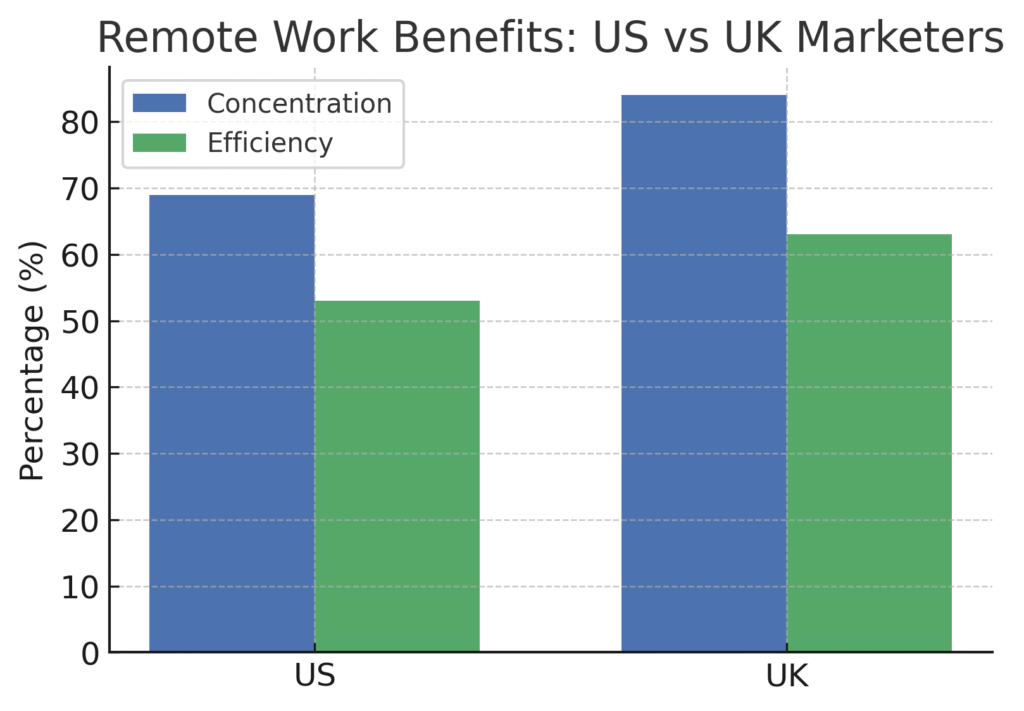
Work-From-Home Marketing Creativity Statistics #5: 69% Of Marketers Say Remote Work Improves Concentration
In the US, 69% of marketers, and an even higher 84% in the UK, say remote work boosts their concentration. This clarity comes from quieter environments compared to bustling offices. Concentration often leads to stronger campaign execution and refined creative work. However, focus does not always equal collaboration, which explains the mixed feelings about remote creativity. The statistic highlights the double-edged nature of WFH: better focus but weaker spontaneous creativity.

Work-From-Home Marketing Creativity Statistics #6: 67% Believe Creative Collaboration Suffers Remotely
While focus improves, 67% of US marketers and 71% of UK marketers believe creative collaboration suffers outside the office. Without shared whiteboards and face-to-face energy, remote sessions often feel more transactional. Virtual tools help, but they don’t always spark the same excitement as in-person ideation. This struggle makes it harder to develop out-of-the-box campaigns. The stat points to a key balance issue: focus versus collaboration.
Work-From-Home Marketing Creativity Statistics #7: 53% Report Higher Efficiency At Home
Over half of marketers, 53% in the US and 63% in the UK, report being more efficient at home. Efficiency means tasks get done faster and with fewer distractions. However, efficiency doesn’t always translate to groundbreaking creativity. Marketers might check off tasks but miss the “aha moments” of group ideation. This statistic shows how efficiency and creativity can sometimes work at odds.
Work-From-Home Marketing Creativity Statistics #8: Meetings Are Harder To Run Productively
More than half of marketers say holding productive meetings is one of the hardest parts of remote work. Too often, virtual meetings focus on updates rather than creative breakthroughs. Some participants struggle with engagement and multitask behind the screen. This reduces the collaborative energy that in-person meetings often generate. The statistic underscores the importance of designing online meetings with creativity in mind.
Work-From-Home Marketing Creativity Statistics #9: 75% Report Collaboration Has Suffered Most
Three out of four employees feel collaboration has been the biggest casualty of remote work. Marketing thrives on teamwork, and losing natural touchpoints makes a real difference. Virtual collaboration tools soften the blow but don’t replace casual idea sharing. For marketers, this loss often results in slower concept development. This statistic highlights why some companies are turning to hybrid work as a middle ground.
Work-From-Home Marketing Creativity Statistics #10: 1 In 4 Managers See Less Creativity In Teams
A quarter of managers admit that their teams are less creative since moving remote. Leaders recognize that structured workflows have replaced spontaneous creativity. In marketing, this can mean campaigns feel more polished but less inspired. Managers are now tasked with intentionally creating creative spaces virtually. The statistic reminds us that leadership plays a big role in remote creativity outcomes.
Work-From-Home Marketing Creativity Statistics #11: 33% Miss Spontaneous Brainstorming Moments
About 33% of employees say remote work has reduced informal sketch or idea-sharing moments. These moments once fueled breakthrough marketing ideas. Without them, creativity often feels forced or overly formal. Marketers may spend more time preparing for brainstorming rather than letting ideas flow naturally. This stat captures the subtle but crucial loss of “hallway creativity.”
Work-From-Home Marketing Creativity Statistics #12: 44% Feel Like They Work In A Bubble
Nearly half of employees feel isolated, describing remote work as being stuck in a “bubble.” In marketing, this lack of visibility reduces inspiration and cross-team input. People no longer overhear useful conversations that spark creativity. The bubble effect can cause teams to recycle old ideas instead of inventing new ones. This statistic shows why intentional collaboration is critical in remote environments.
Work-From-Home Marketing Creativity Statistics #13: 40% Say It’s Harder To Collaborate On Calls
Around 40% of employees report collaboration feels harder over calls than in person. Technical issues, screen fatigue, and lack of body language all play a role. In marketing creativity, nuance and energy often come from live interaction. Calls may get the job done but rarely replicate the energy of a workshop. This statistic proves that technology, while helpful, has its limits in sparking creativity.
Work-From-Home Marketing Creativity Statistics #14: More Remote Work Leads To Less Creativity
Research shows the more someone works from home, the less creative they tend to become. The lack of varied environments limits exposure to fresh ideas. For marketers, this can mean campaigns risk becoming repetitive. Without balance, too much WFH might narrow creative thinking over time. The statistic suggests hybrid models may be the sweet spot for creativity.
Work-From-Home Marketing Creativity Statistics #15: Older Employees Face Sharper Creativity Declines
Studies indicate older employees see sharper declines in creativity while working from home. This may be due to a stronger reliance on traditional collaboration styles. In marketing teams, it can create generational gaps in creative contribution. Younger employees adapt faster to digital-first tools. The statistic highlights the need for tailored support across age groups in remote marketing teams.
Work-From-Home Marketing Creativity Statistics #16: Female Employees Experience Greater Declines In Creativity
Research has shown that women experience a sharper creativity decline than men when working remotely. This could be linked to increased multitasking demands at home. For female marketers, juggling professional and personal roles might sap creative energy. Campaign ideation often requires uninterrupted focus, which is harder to secure. This statistic highlights gender-specific challenges in remote creativity.
Work-From-Home Marketing Creativity Statistics #17: Cultural Differences Affect Creativity In Remote Work
In some studies, Chinese employees reported a greater decline in creativity than German employees when working remotely. This suggests that cultural factors influence adaptability to remote collaboration. In marketing, global teams must account for these cultural variations in creativity. What works for one market may not work for another. This statistic proves remote work’s creative impact is not universal.
Work-From-Home Marketing Creativity Statistics #18: Higher-Educated Employees Retain Creativity Better
Employees with higher education levels tend to maintain creative ability better while working remotely. They are often more familiar with digital tools and self-management practices. For marketers, this translates to smoother adoption of remote brainstorming platforms. Education seems to buffer the loss of in-person creative energy. This statistic points to the value of training and upskilling for all remote employees.
Work-From-Home Marketing Creativity Statistics #19: 77% Of Remote Workers Believe They’re More Productive
Nearly 77% of workers who work remotely at least part-time believe they’re more productive at home. Higher productivity often allows more time to focus on creative projects. However, productivity doesn’t always equal innovation—it can lead to “safe” work instead of bold ideas. Marketers might finish campaigns faster but with less daring. The statistic calls for balancing productivity with creative exploration.
Work-From-Home Marketing Creativity Statistics #20: Remote Work Boosts Performance By 13%
A Stanford study found that remote work boosted performance by about 13% across thousands of workers. This increase stems from fewer distractions and a quieter environment. For marketers, this performance boost often shows up in campaign delivery and efficiency. But the study also warned that creativity may decline if workers remain fully remote too long. This statistic highlights that productivity gains need to be paired with creativity-focused practices.
Wrapping Up My Thoughts
After going through these statistics, I can’t help but feel both reassured and challenged at the same time. Reassured, because the data shows we’re capable of being more productive and even more innovative from home than many of us ever thought possible. But challenged, because it also reminds me that creativity is fragile, and it needs nurturing—whether through virtual brainstorms, new tools, or intentional collaboration. Personally, I see this as an invitation to push myself harder to find balance: to protect deep work while still making space for the sparks of creativity that come from connecting with others. At the end of the day, these numbers aren’t just about trends—they’re about people like us, trying to do our best creative work no matter where we’re sitting.
SOURCES
https://www.betterup.com/blog/employees-report-greater-creativity-working-remotely
https://lucid.co/blog/remote-work-hurts-collaboration-and-creativity
https://www.activtrak.com/blog/remote-work-productivity-statistics/
https://www.virtualvocations.com/blog/remote-working-tips/6-ways-remote-work-inspires-innovation/
https://velocityglobal.com/resources/blog/remote-work-statistics/
https://www.roberthalf.com/us/en/insights/research/remote-work-statistics-and-trends
https://compt.io/blog/is-remote-working-more-productive-statistics-and-real-experiences/
https://www.splashtop.com/blog/remote-work-trends-2025
https://www.flowlu.com/blog/productivity/remote-work-statistics/
https://www.businessinsider.com/remote-workers-lack-passion-and-creativity-loreal-ceo-says-2024-1