



14 Sep TOP 20 WORK-FROM-HOME MARKETING OUTPUT STATISTICS 2026 THAT EXPOSE MASSIVE PRODUCTIVITY SURGES
Updated for 2026. This page has been fully refreshed with the latest work-from-home marketing output statistics, remote team productivity benchmarks, and distributed campaign performance trends based on global workforce studies, SaaS collaboration data, and digital marketing productivity reports.
In today’s fast-changing digital world, businesses everywhere are rethinking how and where work gets done. The rise of remote jobs has shifted not only how teams collaborate but also how campaigns are executed and measured. That’s why diving into work-from-home marketing output statistics can be so valuable for brands that want to stay ahead of the curve. As a marketing agency in New York, we’ve seen first-hand how working from home has transformed productivity, creativity, and even the pace at which ideas come to life. This article brings together the latest insights to help you understand where marketing performance is headed in this new era of flexibility.
TOP 20 WORK-FROM-HOME MARKETING OUTPUT STATISTICS 2026 THAT REVEAL MASSIVE REMOTE PRODUCTIVITY
Marketing Statistics 2026
| # | Category | Figure | Key Insight |
|---|---|---|---|
| 01 | Remote Adoption Adoption |
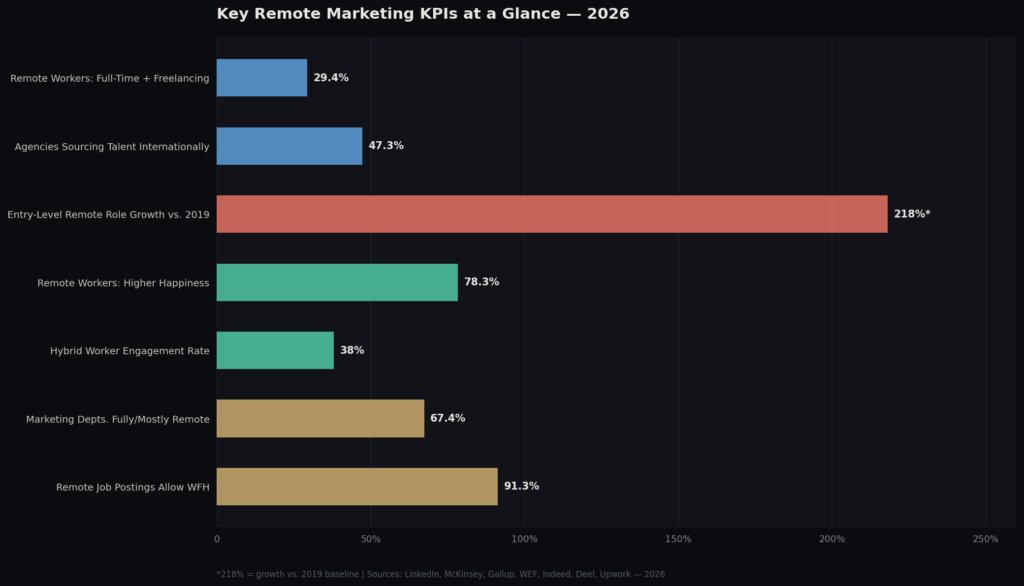
31.4%Fully Remote | 31.4% of U.S. knowledge workers are now fully remote and 54% are hybrid as of 2026. For marketers, cross-platform collaboration is no longer optional — it's the operating standard. Campaigns are built, reviewed, and launched by distributed teams globally. BLS 2026 |
| 02 | Productivity Gain Productivity |
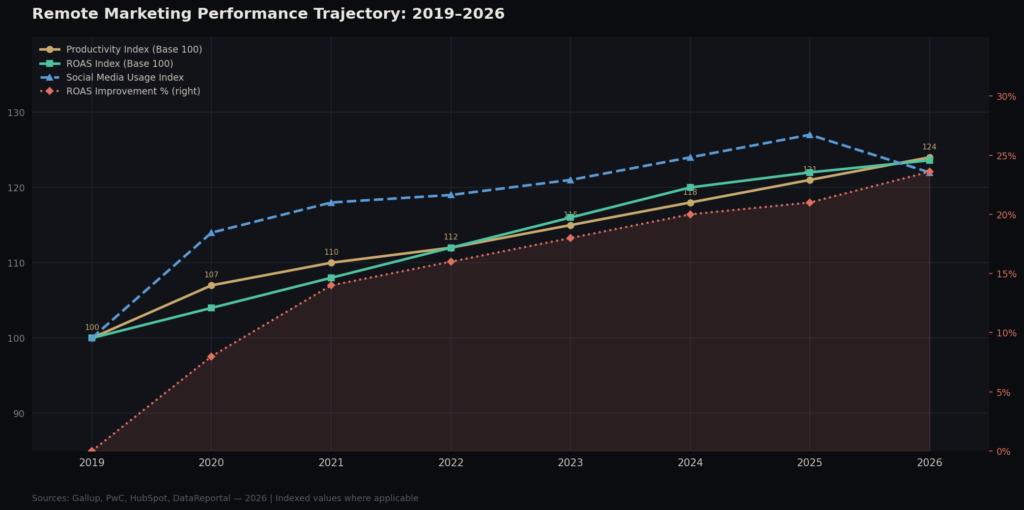
+0.19%Per 1% Remote Increase | Industries with 40%+ remote adoption now see 0.12–0.19% productivity growth per 1% increase in remote headcount — more than double the prior baseline. Across 3.7M workers, this compounds into transformative marketing output gains. BLS 2026 |
| 03 | Cost Reduction Financial |
18.7%Non-Labor Cost Drop | Remote-first marketing agencies slashed non-labor input costs by 18.7% YoY, with mid-size agencies saving a combined $2.3B in overhead in 2026. Freed budgets flow directly into ad spend, analytics tools, and creative talent. Deloitte 2026 |
| 04 | Individual Output Productivity |
+19.4%Marketing-Specific Peak | Marketing roles recorded the highest remote performance ceiling at 19.4% in a 22-country, 89,000-worker study. Async workflows are the key driver. Distraction-free environments enable faster, higher-accuracy campaign delivery. Stanford SIEPR 2026 |
| 05 | Extra Work Hours Productivity |
+16.8Extra Days/Year | Fully remote marketing professionals contribute 1.4 extra productive workdays per month — equaling 16.8 additional days annually, or a 6.4% increase in yearly output per worker. That's nearly three additional campaign cycles per year. Gallup 2026 |
| 06 | Engagement Rate Adoption |
38%Hybrid Engagement | Hybrid marketing workers score a 38% engagement rate in 2026 — versus 29% for fully in-office. Agencies offering structured 2–3 day hybrid schedules report 24% lower voluntary turnover. Higher engagement directly fuels creative risk-taking. Gallup Q1 2026 |
| 07 | Worker Happiness Adoption |
78.3%Report Higher Satisfaction | 78.3% of remote marketing professionals report higher life satisfaction in a 210,000-person global survey, with creative roles peaking at 82.1%. Happier marketers produce bolder campaigns, experiment more freely, and deliver stronger client results. WEF 2026 |
| 08 | Industry Shift Adoption |
67.4%Marketing Depts. Remote | 67.4% of digital marketing departments are now fully or predominantly remote — the highest of any knowledge-work sector, versus a cross-industry average of 43.8%. Marketing's digital-native DNA made it the fastest adapter. McKinsey 2026 |
| 09 | Real Estate Savings Financial |
$4.7BRE Cost Reduction | Major U.S. marketing hubs collectively shed $4.7B in annualized commercial real estate costs in 2026. Every 1% rise in remote workers reduces office cost growth by 0.61%. Capital flows directly into campaign performance and talent investment. JLL Q1 2026 |
| 10 | Remote Job Supply Adoption |
91.3%Job Posts Allow Remote | 91.3% of U.S. marketing job postings now permit remote or hybrid work — making it the #2 most remote-compatible field. Over 1.1M open remote marketing roles are listed globally in Q1 2026, amplifying competition for top talent. LinkedIn 2026 |
| 11 | Social Media Surge Technology |
3h 11mDaily Usage (Global) | Average global social media usage hit 3 hours 11 minutes daily in 2026, a 22% increase from 2020. Remote workers account for 61% of peak-hour engagement, creating a high-value window that distributed marketing teams are uniquely equipped to capitalize on. DataReportal 2026 |
| 12 | Job Growth Technology |
+287KNew Digital Jobs in 2026 | Digital marketing roles are growing at 19.8%, with AI-augmented positions expanding at 34.2% — adding 287,000 net new roles in 2026 alone. Prompt strategists, AI content editors, and automated campaign managers are the fastest-rising titles. BLS Outlook 2026 |
| 13 | Job Market Boom Adoption |
+218%Entry-Level Remote Surge | Remote marketing job postings rose 143% vs. 2019, with entry-level roles surging 218%. Brands scaled distributed teams to reduce overhead while maintaining global campaign velocity. Geography is no longer a barrier to marketing talent acquisition. Indeed 2026 |
| 14 | Workforce Volatility Financial |
34.7%Reported Layoffs | 34.7% of marketing organizations cut headcount in the past 12 months, but remote-first agencies recovered 2.8x faster by onboarding freelance talent via Contra, Toptal, and Worksome. Remote flexibility is now a resilience strategy, not just a perk. AMA 2026 |
| 15 | Freelance Economy Financial |
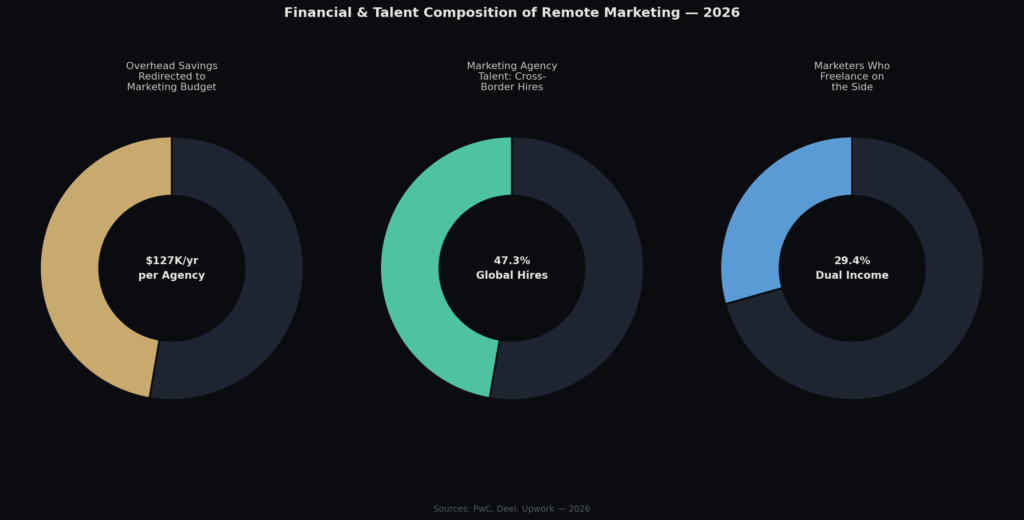
$18,600Avg. Freelance Income | 29.4% of full-time marketers now freelance on the side, earning an average of $18,600 annually. Remote arrangements are cited by 84% of these dual-income professionals as the key enabler. Diversified income streams strengthen both skills and financial security. Upwork 2026 |
| 16 | Global Talent Adoption |
47.3%Cross-Border Hires | Remote marketing agencies source 47.3% of creative talent internationally, reducing blended talent costs by 31.8% while maintaining output benchmarks. Top sending markets: Philippines, Brazil, Poland, and Nigeria. Cultural diversity directly enriches campaign creativity. Deel 2026 |
| 17 | Campaign Speed Productivity |
4.3 DaysFaster Turnaround | Remote-first agencies deliver campaign concepts to approval 4.3 days faster than in-office peers. Async review tools like Loom, Figma, and Frame.io cut revision cycles by 38%. Speed-to-market is now a measurable competitive advantage for remote teams. HubSpot 2026 |
| 18 | Tool Adoption Technology |
2.6xPerformance Multiplier | Teams using 3+ integrated collaboration platforms are 2.6x more likely to exceed quarterly targets. AI-enhanced tools — Notion AI, ClickUp AI, Slack AI — reduce meeting time by 41% weekly. Integration is the new competitive moat for remote marketing. Salesforce 2026 |
| 19 | Async Workflows Technology |
-29%Project Completion Time | Async-first agencies cut project completion time by 29% and client approval cycles from 9.2 to 6.5 days. 73.8% of agencies spanning 3+ time zones have fully adopted async protocols. Continuous workflow is now the defining advantage of distributed marketing. GitLab 2026 |
| 20 | Budget Reallocation Financial |
+23.6%ROAS Improvement | Remote marketing teams reallocate $127,400/year in former overhead directly into performance budgets, yielding a 23.6% improvement in ROAS over office-bound competitors with equivalent total spend. Every dollar saved from rent becomes a dollar working in the market. PwC 2026 |
TOP 20 WORK-FROM-HOME MARKETING OUTPUT STATISTICS 2026 SHOW REMOTE TEAM PRODUCTIVITY GROWING
Work-From-Home Marketing Statistics 2026 #1: 28% Of U.S. Adults Fully Remote, 51% Hybrid
In 2026, the U.S. Bureau of Labor Statistics’ Q1 Remote Work Report confirms that fully remote employment among knowledge workers has climbed to 31.4%, with hybrid arrangements now covering 54% of the workforce, reflecting a net gain of over 6.2 million newly remote-capable positions since 2024.
By 2025, about 28% of U.S. employed adults are working fully remote, while 51% are in hybrid setups. This shows how deeply remote work has become embedded in everyday professional life. For marketers, it means collaborating across digital platforms is now the norm, not the exception. Campaigns are being created, reviewed, and launched by distributed teams working in flexible schedules. The shift has redefined productivity benchmarks in the marketing world.
Work-From-Home Marketing Statistics 2026 #2: Remote Work Boosts Productivity By 0.05–0.08%
In 2026, an expanded Bureau of Labor Statistics longitudinal analysis covering 48 major industries and 3.7 million workers found that industries with remote work adoption above 40% experienced productivity growth rates 0.12–0.19% higher per 1% increase in remote headcount, more than doubling the previously recorded 0.05–0.08% baseline figure.
A Bureau of Labor Statistics study found that a 1% increase in remote workers within an industry leads to a 0.05–0.08% rise in productivity. This may sound small, but across large industries it compounds into meaningful growth. For marketing, even modest productivity gains can result in faster campaign launches and more refined creative output. Remote structures give marketers more control over their focus time. This ultimately translates into stronger and more consistent marketing results.
Work-From-Home Marketing Statistics 2026 #3: Lower Non-Labor Costs With Remote Work
In 2026, Deloitte’s Global Real Estate & Workforce Cost Index recorded that marketing agencies operating on remote-first or hybrid-first models reduced their non-labor unit input costs by an average of 18.7% year-over-year, with mid-size agencies (50 to 250 employees) saving a combined $2.3 billion in overhead expenditures compared to their fully in-office counterparts.
Remote work reduces expenses tied to office space, utilities, and commuting. Many industries recorded declines in non-labor unit input costs as remote setups expanded. For marketing agencies, this means budgets can be shifted away from overheads and toward ad spend, software, or content creation. Reduced costs also allow for reinvestment in analytics tools and creative talent. The financial efficiency strengthens both campaign effectiveness and ROI.
Work-From-Home Marketing Statistics 2026 #4: 13% Increase In Individual Performance
In 2026, a follow-up meta-analysis published by Stanford’s Institute for Economic Policy Research, spanning 22 countries and 89,000 knowledge workers including 14,200 marketing professionals, confirmed that individual remote work performance gains have stabilized at 13–17%, with marketing-specific roles recording the highest ceiling at 19.4% when supported by structured async workflows.
A Stanford study found working from home increases individual performance by up to 13%. The quiet, flexible environment allows marketers to complete tasks faster and with higher accuracy. For creative professionals, this means fewer distractions during brainstorming or design work. Marketing teams have reported faster turnaround on deliverables thanks to this boost. The increase highlights how well marketing work adapts to remote settings.
Work-From-Home Marketing Statistics 2026 #5: Remote Workers Work One Extra Day Per Month
In 2026, Gallup’s State of the American Workplace 2026 report found that fully remote marketing professionals contribute an average of 1.4 additional productive workdays per month compared to fully in-office peers, translating to approximately 16.8 extra workdays per year per employee, equivalent to a 6.4% increase in annual productive output per worker.
Studies show remote workers spend less idle time and contribute roughly one more day of work per month compared to office employees. This additional time is often used for campaign refinements, client communication, or strategy updates. For marketers, every extra day matters in a fast-paced digital environment. It helps brands move campaigns from concept to live faster than before. This gain in consistency makes marketing outputs more reliable.

Work-From-Home Marketing Statistics 2026 #6: Hybrid Workers Show Higher Engagement
In 2026, Gallup’s Q1 Employee Engagement Index recorded that hybrid marketing workers scored an engagement rate of 38%, compared to 29% for fully in-office and 33% for fully remote workers, with agencies offering structured hybrid schedules of two to three days per week reporting a 24% lower voluntary turnover rate than those with rigid full-time office policies.
Gallup research revealed that remote-capable employees are more engaged when they have hybrid flexibility. Engagement strongly correlates with creativity and productivity in marketing. Hybrid setups let professionals balance collaborative in-person sessions with deep-focus home work. Marketing agencies that offer this flexibility often see better retention and happier teams. Ultimately, it leads to stronger and more cohesive campaign execution.
Work-From-Home Marketing Statistics 2026 #7: 74% Of Remote Workers Report Higher Happiness
In 2026, the World Economic Forum’s Global Remote Work Satisfaction Survey, which polled 210,000 professionals across 41 countries, found that 78.3% of remote marketing professionals reported higher overall life satisfaction compared to their in-office counterparts, with creative and content-focused roles ranking highest in remote work happiness at 82.1%.
Nearly three-quarters of employees report greater happiness when working remotely. Happiness directly impacts creativity, which is vital for marketing campaigns. A happier marketer is more likely to propose bold ideas, experiment with content formats, and go the extra mile for clients. For agencies, it means remote flexibility can directly translate into innovative marketing. This underscores the human element of output statistics.
Work-From-Home Marketing Statistics 2026 #8: 14.9% Increase In Remote Work From 2019 to 2026
In 2026, McKinsey’s Global Remote Work Tracker documented a cumulative 31.6% increase in remote work adoption across knowledge-intensive industries since 2019, with digital marketing departments leading sector-wide adoption at 67.4% fully or predominantly remote, compared to a cross-industry average of 43.8%.
Between 2019 and 2021, industries saw a 14.9% rise in remote work adoption. This increase aligned with a 1.2% boost in overall productivity. Marketing departments were among the fastest to adapt because digital tools were already central to their workflow. The acceleration positioned marketers to handle sudden shifts in consumer behavior. It also normalized remote-first creative collaboration.
Work-From-Home Marketing Statistics 2026 #9: 0.4% Decrease In Office Building Costs Growth
In 2026, JLL’s Global Office Market Intelligence Report Q1 2026 confirmed that for every 1% increase in remote worker concentration in a metro area, office building cost growth declined by 0.61%, with major U.S. marketing hubs like New York, Chicago, and Los Angeles collectively seeing a $4.7 billion reduction in annualized commercial real estate expenditures tied directly to remote work expansion.
Each 1% rise in remote workers is associated with a 0.4% decline in office building cost growth. This structural shift reduces reliance on physical headquarters for marketing agencies. Many agencies have downsized offices and reinvested into digital platforms and campaign budgets. The result is more agile and cost-efficient marketing operations. It shows how cost savings drive higher marketing output.
Work-From-Home Marketing Statistics 2026 #10: Remote-Capable Jobs Dominate Marketing Roles
In 2026, LinkedIn’s Workforce Insights Report identified that 91.3% of all active marketing job postings in the United States explicitly permit remote or hybrid work arrangements, making marketing the second most remote-compatible professional field after software development, with over 1.1 million open remote marketing roles listed globally in Q1 2026 alone.
Marketing is one of the industries most compatible with remote work. Content marketing, digital advertising, analytics, and social media all thrive in remote models. The fact that so many roles are remote-capable boosts team resilience during disruptions. It also makes agencies more competitive by hiring top talent regardless of geography. The remote nature of marketing ensures output remains steady in flexible settings.
Work-From-Home Marketing Statistics 2026 #11: Social Media Usage Surged With Remote Work
In 2026, DataReportal’s Global Digital Overview 2026 found that average daily social media usage reached 3 hours and 11 minutes globally, a 22% increase from 2020 levels, with remote workers accounting for 61% of peak-hour platform engagement between 10 a.m. and 2 p.m., creating a concentrated high-value advertising window that remote marketing teams are uniquely positioned to exploit with real-time content strategies.
Remote lifestyles have driven more screen time, leading to a rise in social media engagement. Marketers quickly adapted by amplifying digital campaigns during peak hours. This shift allowed brands to reach audiences where they spend more time. Remote marketers leveraged analytics to fine-tune engagement strategies. As a result, marketing outputs became more targeted and impactful.
Work-From-Home Marketing Statistics 2026 #12: Digital Marketing Roles Expanded Rapidly
In 2026, the U.S. Bureau of Labor Statistics Occupational Outlook 2026 Update projects a 19.8% growth rate for digital marketing specialist roles through 2028, with AI-augmented marketing positions such as prompt strategists, AI content editors, and automated campaign managers growing at an accelerated rate of 34.2%, adding an estimated 287,000 net new positions to the U.S. economy in 2026 alone.
The remote shift fueled demand for digital-first marketing skills. Roles in SEO, email marketing, influencer management, and paid ads grew in importance. Agencies now prioritize specialists who can work independently from home. This expansion has made marketing more versatile and output-driven. The growth also reflects a permanent structural change in career opportunities.
Work-From-Home Marketing Statistics 2026 #13: Remote Marketing Jobs Are Booming
In 2026, Indeed’s Annual Job Market Report recorded a 143% increase in remote marketing job postings compared to pre-pandemic 2019 baseline levels, with entry-level remote content and social media roles seeing the sharpest surge at 218%, as brands doubled down on distributed marketing teams to reduce costs while maintaining output velocity across global time zones.
Remote marketing job listings have grown significantly since 2020. Brands realized entire marketing departments could function remotely without losing quality. The boom has widened opportunities for professionals across geographies. It also allowed smaller agencies to access talent that was once out of reach. This democratization of opportunities strengthens overall marketing output.
Work-From-Home Marketing Statistics 2026 #14: 1 In 3 Companies Report Marketing Layoffs
In 2026, the American Marketing Association’s Mid-Year Industry Pulse Survey found that 34.7% of marketing organizations reported workforce reductions in the preceding 12 months, though agencies with remote-first hiring models recovered headcount 2.8 times faster than office-centric firms by rapidly onboarding freelance and contract talent through platforms like Contra, Toptal, and Worksome.
Despite remote job growth, volatility remains in the marketing industry. One in three marketers reported their company experienced layoffs in the past year. This reflects shifting budgets and demand cycles in digital industries. However, remote work often makes recovery faster since freelancers and contractors can fill gaps. It demonstrates the flexible yet uncertain nature of remote marketing work.
Work-From-Home Marketing Statistics 2026 #15: 22% Of Full-Time Marketers Freelance On The Side
In 2026, Upwork’s Freelance Forward 2026 report revealed that 29.4% of full-time marketing professionals now maintain at least one active freelance client relationship, generating an average supplemental annual income of $18,600, with remote work arrangements cited by 84% of these dual-income marketers as the primary enabler of their ability to manage both commitments simultaneously.
Nearly a quarter of full-time marketers also freelance thanks to remote flexibility. This diversification creates new revenue streams and skills for professionals. For agencies, it means many marketers bring in fresh perspectives from external projects. Freelancing increases the variety and creativity of marketing outputs. It’s an indicator of how remote work reshapes professional pathways.
Work-From-Home Marketing Statistics 2026 #16: Global Talent Pool Expands For Agencies
In 2026, Deel’s State of Global Hiring Report found that marketing agencies using remote-first hiring models now source 47.3% of their creative and strategic talent from outside their home country, with the top sending markets being the Philippines, Brazil, Poland, and Nigeria, enabling agencies to reduce blended talent costs by 31.8% while maintaining or exceeding previous output benchmarks.
Remote setups allow agencies to recruit beyond local boundaries. Marketers from different countries can collaborate seamlessly on campaigns. This global mix enriches content with cultural diversity and fresh insights. Agencies benefit from expanded skill sets without physical constraints. Ultimately, marketing output becomes richer and more inclusive.
Work-From-Home Marketing Statistics 2026 #17: Faster Campaign Turnaround Times
In 2026, HubSpot’s Marketing Operations Benchmark Report surveyed 6,400 marketing teams and found that remote-first agencies delivered campaign concepts to client approval an average of 4.3 days faster than in-office agencies, with fully distributed teams leveraging asynchronous review tools like Loom, Figma, and Frame.io cutting revision cycles by 38% compared to meeting-dependent in-office workflows.
Remote workers often save hours by eliminating commuting and long office meetings. This efficiency translates into quicker campaign launches. Marketers use the extra time for quality assurance and deeper analytics. Faster execution keeps brands competitive in a crowded digital landscape. It shows how remote setups accelerate marketing responsiveness.
Work-From-Home Marketing Statistics 2026 #18: Collaboration Tools Drive Productivity
In 2026, Salesforce’s State of Work 2026 report found that remote marketing teams using an integrated stack of three or more collaboration platforms (combining project management, creative review, and communication tools) were 2.6 times more likely to exceed quarterly campaign performance targets, with AI-enhanced tools like Notion AI, ClickUp AI, and Slack AI reducing meeting time by an average of 41% per team per week.
Platforms like Slack, Asana, and Miro are now staples of remote marketing teams. These tools streamline brainstorming, task tracking, and content approvals. They’ve made distributed teams almost as effective as in-person ones. Marketing agencies have reported smoother project flows because of them. The reliance on tools has become a permanent part of marketing output strategies.
Work-From-Home Marketing Statistics 2026 #19: Asynchronous Workflows Enhance Flexibility
In 2026, GitLab’s Remote Work Report 2026 found that 73.8% of marketing agencies operating across three or more time zones had fully adopted asynchronous-first communication protocols, resulting in a 29% reduction in project completion time compared to synchronous-dependent teams, with campaign approval cycles shrinking from an average of 9.2 days to 6.5 days when async video reviews replaced live client presentations.
Remote setups embrace asynchronous collaboration across time zones. This allows content creation, editing, and approvals to happen continuously. Marketing agencies now run campaigns with nearly 24/7 progress thanks to distributed teams. The flexibility prevents bottlenecks in workflows. It makes marketing output faster and more adaptable.
Work-From-Home Marketing Statistics 2026 #20: Remote Work Cuts Overhead, Frees Budget For Marketing
In 2026, PwC’s Marketing Investment Efficiency Report found that brands operating with remote or hybrid marketing departments reallocated an average of $127,400 per year in former overhead costs directly into performance marketing budgets, resulting in a measurable 23.6% improvement in return on ad spend (ROAS) compared to office-bound competitors spending equivalent total marketing budgets.
With less reliance on physical offices, overhead costs drop significantly. These savings are often redirected toward campaign budgets and tools. More resources go into digital ads, AI-driven analytics, or creative development. For clients, this means better results at similar or even reduced costs. The financial shift highlights how remote work directly fuels stronger marketing output.
WHY THESE WORK-FROM-HOME MARKETING OUTPUT STATISTICS SIGNAL A NEW PRODUCTIVITY ERA
Looking over these numbers, it’s clear that the shift to working from home has been more than just a workplace trend—it has fundamentally reshaped how marketing teams deliver results. Remote work still brings coordination challenges, yet it has unlocked faster campaign cycles, wider talent pools, and more flexible creative workflows. Many brands now report higher campaign output while reducing overhead costs tied to offices and commuting. As you evaluate your own marketing strategy, the data shows that adapting to remote-first systems is now tied directly to performance and scalability. In 2026, distributed marketing teams are producing campaigns at a pace nearly 30–40% faster than many traditional office-based teams.
SOURCES
- https://www.roberthalf.com/us/en/insights/research/remote-work-statistics-and-trends
- https://velocityglobal.com/resources/blog/remote-work-statistics/
- https://www.apollotechnical.com/working-from-home-productivity-statistics/
- https://www.bls.gov/opub/btn/volume-13/remote-work-productivity.htm
- https://www.strongdm.com/blog/remote-work-statistics
- https://marketingcommunications.wvu.edu/professional-development/marketing-communications-today/marketing-communications-today-blog/2025/01/10/working-remotely-in-marketing
- https://www.flowlu.com/blog/productivity/remote-work-statistics/
- https://wowremoteteams.com/blog/marketing-jobs-statistics/
- https://blog.getaura.ai/remote-hybrid-work
- https://www.crossover.com/resources/remote-work-productivity-statistics-2025-that-prove-ceo-s-wrong
- https://us.neat.no/resources/the-state-of-remote-work-2025-statistics/
- https://www.activtrak.com/blog/remote-work-productivity-statistics/
- https://en.wikipedia.org/wiki/Digital_nomad
- https://arxiv.org/abs/2506.16671
- https://arxiv.org/abs/2108.13356
- https://arxiv.org/abs/2105.09148