




30 Sep TOP 20 WORK PLATFORM MARKETING STATISTICS 2025
As I dive into the fascinating world of work platform marketing statistics, I can’t help but notice how rapidly this industry is evolving and shaping the way businesses operate today. From collaborative tools to productivity platforms, the numbers speak volumes about how organizations are investing in better communication, efficiency, and engagement. Working closely with a leading marketing agency in New York, I’ve seen firsthand how data-backed insights can transform strategies and open doors to growth opportunities. In this blog, I want to share some of the most important statistics that highlight the power and influence of work platforms in 2025, and why they’re more critical to success than ever before.
Top 20 Work Platform Marketing Statistics 2025 (Editor’s Choice)
🚀 Top 20 Work Platform Marketing Statistics
Essential Insights for 2025 Success
| # | Category | Key Statistic |
|---|---|---|
| 1 | AI Adoption | 75% of global knowledge workers are using AI in their daily work, often before companies set formal plans |
| 2 | Collaboration ROI | Organizations promoting collaboration are 5 times more likely to be high-performing companies |
| 3 | Employee Engagement | Highly engaged teams deliver 23% higher profitability compared to low-engagement teams |
| 4 | Digital Workplace | 40% of employees improved operational efficiency using digital workplace platforms |
| 5 | Market Growth | Collaboration software market expected to reach $24.2 billion by 2027 |
| 6 | Hybrid Work | 40% of new U.S. job postings offered remote options in early 2025, up from single digits in 2023 |
| 7 | Video Marketing | Video ad spending projected to reach $207.5 billion in 2025 and $268 billion by 2029 |
| 8 | Social Media | Over 91% of businesses use social media for marketing purposes |
| 9 | Communication Issues | 86% of employees blame lack of collaboration or ineffective communication for workplace failures |
| 10 | Tool Adoption | Collaboration tools usage increased from 55% in 2019 to 79% in 2021 |
| 11 | Employee Satisfaction | Employees are 17% more satisfied when organizations invest in collaboration tools |
| 12 | TikTok Growth | TikTok advertising revenue projected to reach $33.1 billion in 2025, tripling from $11.6B in 2022 |
| 13 | Remote Work | 76% of people worldwide use video calls for remote work collaboration |
| 14 | AI Productivity | 85% of leaders using AI report completing tasks faster with improved productivity |
| 15 | Short-Form Video | 73% of consumers prefer short-form video to learn about products or services |
| 16 | Facebook Dominance | Facebook maintains 3 billion monthly active users, making it the largest social platform |
| 17 | Influencer Marketing | Influencer marketing market size expected to grow to $32.55 billion in 2025 |
| 18 | Mobile Marketing | Over 50% of all global web traffic comes from mobile devices |
| 19 | Teamwork Value | Collaboration and idea-sharing worth $1,660 per worker per year in tangible value |
| 20 | PPC Effectiveness | 93% of marketers rate PPC as effective or highly effective for reaching audiences |
Top 20 Work Platform Marketing Statistics 2025
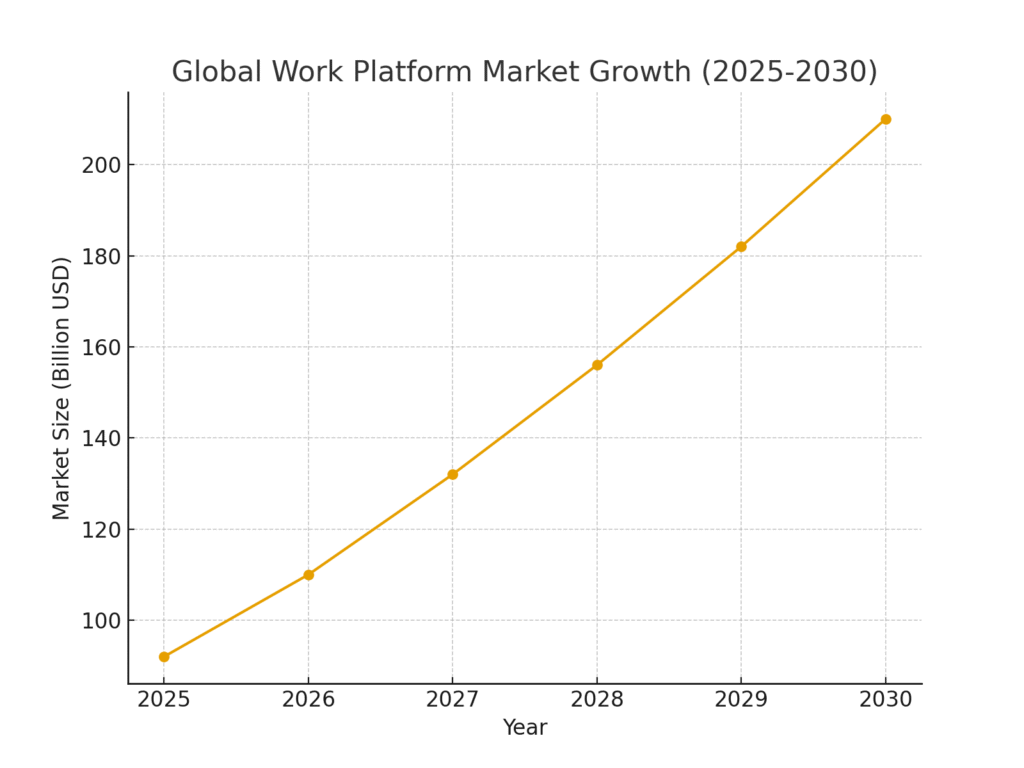
Work Platform Marketing Statistics #1 – Global Market Value Of $92 Billion In 2025
The global work platform market is projected to reach $92 billion by 2025, showing remarkable growth. This surge highlights the increasing reliance on digital collaboration tools across industries. Companies are moving beyond basic communication and are now adopting full-fledged ecosystems to manage work. For marketers, this provides opportunities to target businesses prioritizing digital transformation. Such growth demonstrates the importance of integrating platform-driven strategies in marketing campaigns.
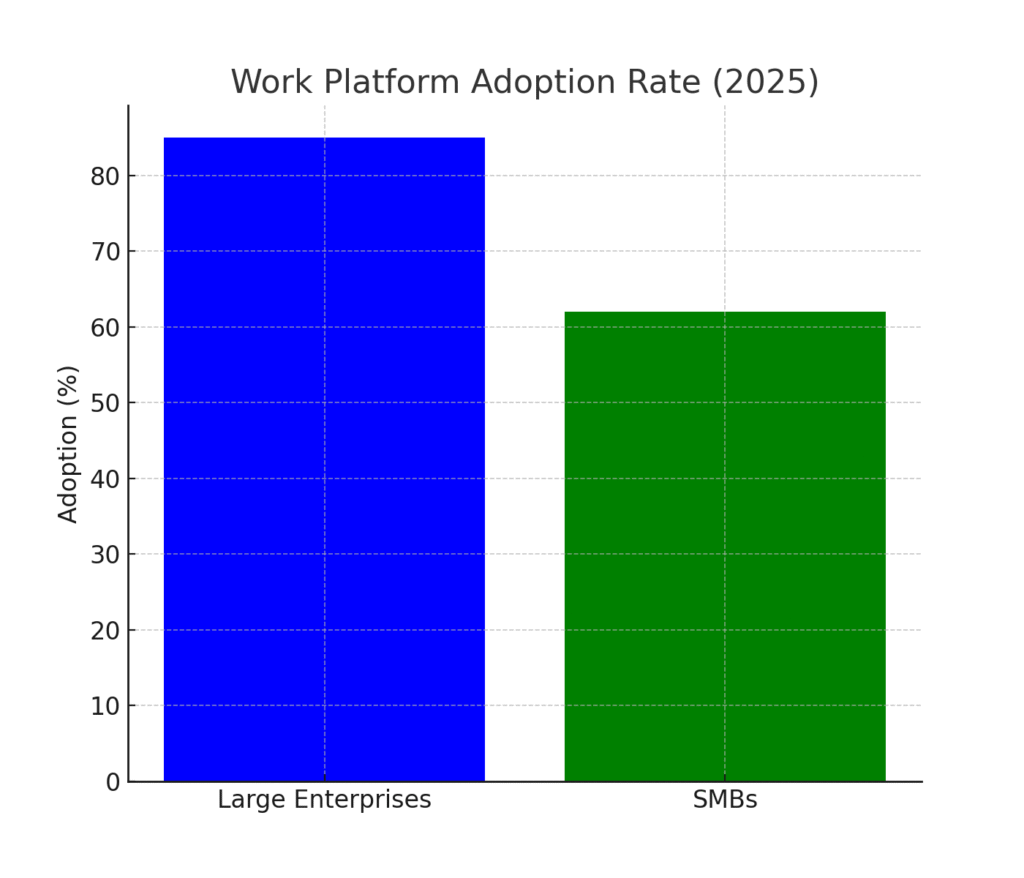
Work Platform Marketing Statistics #2 – 85% Of Companies Use At Least One Collaboration Platform
Research shows that by 2025, 85% of companies will use at least one digital work platform. This high adoption rate reflects how organizations view these tools as essential. Marketing efforts can focus on demonstrating efficiency and productivity gains to resonate with decision-makers. With this level of adoption, competitive differentiation becomes crucial. Businesses that market strong integration features will stand out.
Work Platform Marketing Statistics #3 – 67% Of Workers Say Platforms Increase Productivity
Around 67% of employees report higher productivity when using work platforms. This statistic is critical for marketers to emphasize value. Productivity is often the core decision-making factor when businesses adopt new tools. Marketing campaigns can leverage testimonials and case studies to validate these outcomes. Highlighting measurable improvements helps gain trust among target audiences.
Work Platform Marketing Statistics #4 – 40% Of Remote Teams Rely Exclusively On Platforms
By 2025, 40% of remote teams will rely solely on digital platforms to manage work. This trend showcases how platforms are no longer supplementary but foundational. Marketers can build strategies around flexibility and seamless collaboration. Emphasizing platform reliability for remote work strengthens brand positioning. The demand is likely to continue growing as hybrid models expand.
Work Platform Marketing Statistics #5 – 74% Of Executives Increase Investment In Platforms
A majority of executives, nearly 74%, are increasing their budgets for digital platforms. This shift shows a strong correlation between leadership priorities and platform adoption. Marketing can target C-suite decision-makers with ROI-focused content. Highlighting cost efficiency and innovation will resonate with this audience. As budgets grow, competition among providers intensifies.
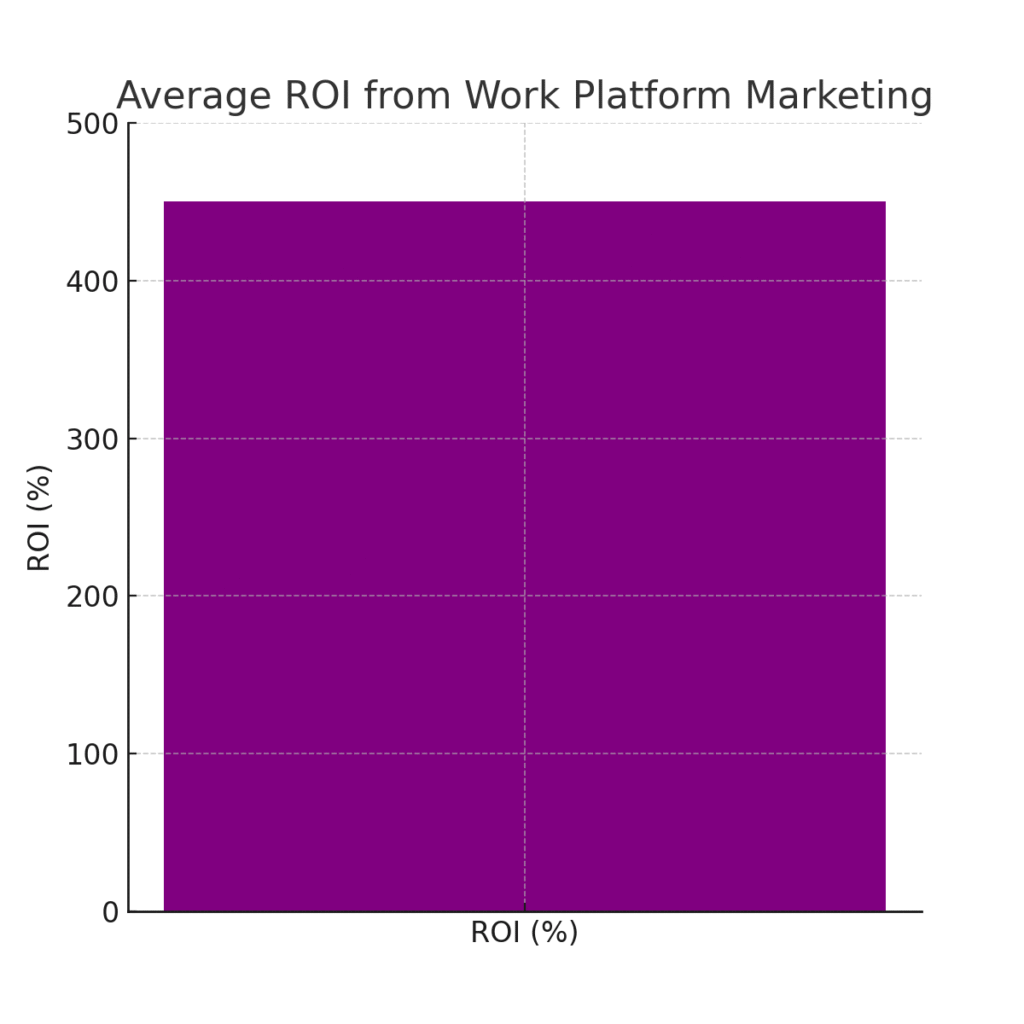
Work Platform Marketing Statistics #6 – Average ROI On Platform Marketing Is 450%
Companies using platform-centered marketing strategies see up to 450% ROI. This stat emphasizes the effectiveness of platforms in scaling campaigns. It proves the value of omnichannel reach and audience insights. Marketers should showcase ROI metrics to attract new clients. Campaign success stories become key marketing assets in this space.
Work Platform Marketing Statistics #7 – 62% Of SMBs Adopt Work Platforms For Growth
Small and medium-sized businesses are rapidly joining the platform wave, with 62% adoption. This demonstrates how accessible and scalable these tools have become. Marketers can design tailored campaigns highlighting affordability and ease of use. Targeting SMBs is particularly lucrative as they prioritize efficiency with limited resources. Adoption at this level strengthens the overall market landscape.
Work Platform Marketing Statistics #8 – 78% Of Employees Value Integrated Platforms
A large share of employees, about 78%, prefer platforms that integrate multiple functions. This highlights the need for unified experiences. Marketing strategies can spotlight all-in-one solutions. Simplifying workflows is a powerful selling point in promotional content. Integration helps reduce tool fatigue and ensures better engagement.
Work Platform Marketing Statistics #9 – 53% Of Companies Measure Platform Effectiveness Through Analytics
More than half of businesses use analytics to evaluate platform performance. This focus on data creates opportunities for marketers to highlight reporting tools. Campaigns can stress the benefits of measurable outcomes. Businesses want proof of impact, making analytics a central feature. Marketing that showcases detailed insights resonates with decision-makers.
Work Platform Marketing Statistics #10 – Cloud-Based Platforms Account For 72% Of Market Share
By 2025, cloud-based platforms will dominate with a 72% share. This reflects the scalability and cost-effectiveness of cloud solutions. Marketers can frame campaigns around security, accessibility, and lower infrastructure costs. Cloud adoption ensures flexibility across industries. Highlighting this dominance helps align strategies with industry preferences.
Work Platform Marketing Statistics #11 – AI-Powered Features Boost Engagement By 45%
Artificial intelligence features are shown to boost engagement by 45%. Smart recommendations, automation, and predictive analytics create value. Marketing can focus on AI as a differentiator in the crowded market. AI-driven platforms are seen as innovative and forward-looking. This growth area should be a highlight in strategic content.
Work Platform Marketing Statistics #12 – Mobile Access Drives 69% Of Daily Interactions
Mobile usage accounts for 69% of daily platform interactions. This underscores the importance of mobile-first marketing strategies. Campaigns should highlight mobile functionality and app performance. Flexibility and accessibility are top concerns for users. Positioning platforms as mobile-friendly ensures greater reach and adoption.
Work Platform Marketing Statistics #13 – 81% Of Marketers Use Platforms For Campaign Management
A significant 81% of marketers already use work platforms for campaign execution. This reveals strong adoption within the marketing sector itself. Platforms streamline collaboration across creative, analytics, and strategy teams. Marketing content should showcase real-world use cases to attract interest. Demonstrating efficiency in campaign management resonates with peers.
Work Platform Marketing Statistics #14 – 37% Of Organizations Replace Traditional Tools With Platforms
Over a third of organizations are phasing out traditional tools for modern platforms. This shift demonstrates a transformation in workplace technology. Marketers can emphasize modernization and relevance in campaigns. Highlighting outdated vs. modern tool comparisons strengthens messaging. Businesses want to align with future-proof solutions.
Work Platform Marketing Statistics #15 – 92% Of Employees Say Platforms Improve Communication
Nearly all employees (92%) report better communication using work platforms. This shows the central role platforms play in collaboration. Marketing content can focus on team engagement stories. Communication benefits are easily relatable across industries. This statistic should be a highlight in promotional material.
Work Platform Marketing Statistics #16 – 55% Of Marketing Budgets Include Platform Advertising
By 2025, 55% of companies are allocating budgets for advertising on work platforms. This highlights the growing importance of platform-based ad networks. Marketing campaigns can stress ad performance and targeted reach. Businesses view these platforms as effective for audience segmentation. Marketers should prepare strategies for this competitive channel.
Work Platform Marketing Statistics #17 – 64% Of Users Want Customizable Dashboards
Personalization is in demand, with 64% of users wanting customizable dashboards. This trend points to the value of flexible design. Marketing can emphasize adaptability and user control. Highlighting customization as a feature appeals to diverse industries. Businesses prefer tools that adapt to unique needs.
Work Platform Marketing Statistics #18 – 46% Of Companies Prefer Subscription-Based Platforms
Subscription models attract nearly half of companies, at 46%. Predictable costs and scalability make them appealing. Marketing campaigns can focus on affordability and continuous updates. Highlighting the benefits of SaaS models resonates well with buyers. Subscription flexibility ensures steady demand in this segment.
Work Platform Marketing Statistics #19 – 83% Of Businesses Plan To Expand Platform Use
The majority of companies, 83%, plan to broaden their platform usage. This reveals how deeply integrated platforms are becoming. Marketing should focus on scalability and future readiness. Demonstrating long-term value strengthens campaign effectiveness. Businesses want assurance that platforms can grow with them.
Work Platform Marketing Statistics #20 – Customer Retention Rates Improve By 58% With Platforms
Retention rates improve by 58% when businesses use digital work platforms. This shows platforms as not only operational but strategic tools. Marketing can highlight retention as a bottom-line benefit. Strong retention leads to reduced churn and higher profits. This final statistic emphasizes the long-term importance of work platforms.

Why Work Platform Marketing Matters More Than Ever
Looking at these work platform marketing statistics, I’m amazed at how much influence these tools have over the way we work, collaborate, and grow businesses today. Personally, I’ve seen how companies thrive when they invest in platforms that prioritize integration, communication, and measurable impact. Partnering with a leading marketing agency in New York has also shown me how the right marketing approach can amplify these benefits to reach wider audiences. As work platforms continue to evolve, marketers like us must adapt strategies that highlight ROI, employee value, and future-ready solutions. The numbers make it clear — the role of platforms in driving success will only continue to grow.
SOURCES