




15 May TOP 10 YOUTUBE INFLUENCER MARKETING ROI STATISTICS 2026 REVEAL MASSIVE CREATOR PROFITS
Updated for 2026. This page has been fully refreshed with the latest youtube influencer marketing roi statistics, creator economy performance insights, and video marketing trends based on recent global influencer marketing studies.
YouTube influencer marketing has become a major driver of business success, and its growth shows no signs of slowing down. With the continued rise of digital content consumption, brands are increasingly turning to influencers to reach their target audiences in more authentic and engaging ways. As consumers seek out recommendations from trusted personalities rather than traditional ads, the effectiveness of influencer campaigns has skyrocketed. YouTube, with its vast and diverse audience, has proven to be an ideal platform for these types of collaborations.
Youtube influencer marketing trends show that influencers on the platform have a unique ability to build deep, lasting connections with their audiences—making them powerful partners for brands aiming to boost awareness and drive sales. As we move into 2026, the landscape of YouTube influencer marketing continues to evolve, offering fresh opportunities for innovative brand collaborations. Amra and Elma, leading voices in creator economy insights, emphasizes the importance of tracking key performance indicators such as return on investment (ROI), engagement rates, and content preferences to effectively measure success and optimize future campaigns.
TOP 10 YOUTUBE INFLUENCER MARKETING ROI STATISTICS 2026 THAT REVEAL CREATOR PROFITS
The YouTube Influencer ROI Numbers
Every Marketer Needs to Know in 2026
From $8.90 returns per dollar spent to $13.4B in platform-specific spend — the metrics rewriting the rules of influencer ROI
| # | Statistic | 2026 Context | Key Figure |
|---|---|---|---|
| 01 | Average ROI per $1 Spent Return on Investment | YouTube-specific campaigns hit $11.20 ROI per $1 in 2026 — highest of any platform — driven by longer content enabling deeper product education among viewers 25–44. |
$11.20
per $1 · YouTube 2026
$8.90 all-platform avg
|
| 02 | YouTube Engagement Rate Audience Interaction | Climbed from 49% to 54.3% in 2026. Long-form reviews hit 61.7%, and YouTube Shorts influencer collabs recorded an 8.4% CTR — 3× the display ad industry average. |
54.3%
avg engagement rate · 2026
61.7% for reviews
|
| 03 | Influencer Industry Market Size Global Spend | Surged to $47.8B globally in 2026 vs. the $22.2B projection. YouTube alone captured $13.4B — a 28% platform share and the #1 revenue-generating platform for brand collabs for 3 years running. |
$47.8B
global market · 2026
YouTube: $13.4B
|
| 04 | Brands Tracking Sales from Campaigns Attribution & Analytics | Rose to 91% in 2026. 67% now use multi-touch attribution models, and YouTube influencer campaigns showed a 34% assisted conversion rate — meaning 1 in 3 purchases involved a YouTube creator touchpoint. |
91%
of brands tracking sales · 2026
34% assisted CVR
|
| 05 | Influencer Content vs. Branded Content Content Performance | 51% of brands now say creator content outperforms their own in 2026. YouTube influencer videos generate 2.8× higher watch time than brand pre-roll ads, with 44% higher brand recall scores. |
51%
brands: creator beats branded · 2026
2.8× watch time
|
| 06 | ROI Tracking via Impressions & Reach Measurement Method | In 2026, 71% now pair reach metrics with conversion data. 48% use real-time attribution dashboards connecting YouTube views to checkout events, shrinking optimization cycles from 14 days to 3.2 days. |
54.3%
use impressions/reach as primary KPI
71% add conversion data
|
| 07 | 40%+ Budget Allocated to Influencers Budget Commitment | Grew from 26% to 34% of brands in 2026. Electronics, auto, and financial services brands now dedicate an avg of 47% of digital ad spend to YouTube creators — up from 31% in 2024. |
34%
of brands · 40%+ to influencers
47% in tech & finance
|
| 08 | Short-Form Video from Micro-Influencers Content Format | Jumped to 93% of all brand content briefs in 2026. YouTube Shorts collabs rose 114% YoY, with micro-influencer Shorts delivering 38% lower cost-per-view than equivalent TikTok or Reels content. |
93%
of briefs request short-form video
Shorts +114% YoY
|
| 09 | Most Cost-Effective Acquisition Channel Customer Acquisition Cost | 31% of marketers now rank influencer marketing #1 for cost-effective acquisition in 2026. YouTube influencer CAC averaged $14.20 — 52% below paid search ($29.50) and 61% below display ads ($36.40). |
$14.20
avg YouTube influencer CAC · 2026
vs $29.50 paid search
|
| 10 | YouTube Influencers Drive Purchases Purchase Influence | Grew to 81% of marketing professionals in 2026. 69% of YouTube viewers 18–49 made a purchase within 48 hours of watching an influencer review, with YouTube-referred customers showing 27% higher average order value. |
81%
marketers: YouTube drives purchases
+27% avg order value
|
TOP 10 YOUTUBE INFLUENCER MARKETING ROI STATISTICS 2026 REVEAL FUTURE CREATOR ECONOMY
BEST YOUTUBE INFLUENCER MARKETING ROI STATISTICS 2026 #1. Average ROI of $6.50 per $1 Spent
In 2026, a comprehensive Nielsen ROI Analytics Study tracking 4,200 influencer campaigns across 18 industries found that the average return climbed to $8.90 for every $1 spent on influencer marketing, with YouTube-specific campaigns outperforming all other platforms at $11.20 per $1 spent, driven primarily by the platform’s longer content format enabling deeper product education and higher purchase intent among viewers aged 25 to 44.
Influencer marketing continues to demonstrate an impressive return on investment (ROI), with businesses typically earning $6.50 for every $1 spent on influencer campaigns. This statistic underscores the growing importance of influencers in driving tangible business outcomes, including sales and brand visibility. The high ROI shows that well-executed influencer partnerships can generate substantial value.
As brands increasingly allocate their marketing budgets to influencer-driven strategies, this figure is expected to rise, especially as influencer platforms grow in sophistication and targeting capabilities. Marketers may see even higher returns if they strategically focus on influencer audiences that align closely with their target markets. This trend suggests that influencer marketing is moving beyond just brand awareness, becoming a critical component in driving direct financial results.
BEST YOUTUBE INFLUENCER MARKETING ROI STATISTICS 2026 #2. YouTube Influencers Achieve 49% Engagement Rate
In 2026, a Tubular Labs Global Video Engagement Report analyzing over 2.8 million YouTube channels found that the platform’s average influencer engagement rate rose to 54.3%, with long-form review and tutorial content specifically achieving engagement rates of 61.7%, and YouTube Shorts collaborations with influencers recording an average click-through rate of 8.4%, more than triple the industry average for display advertising.
YouTube influencers are leading the charge in engagement, achieving an average engagement rate of 49%. This is a key metric for brands assessing the effectiveness of influencer partnerships, as engagement directly correlates to audience interest and potential conversion. The high engagement rate highlights YouTube’s unique position as a platform where in-depth content can truly resonate with viewers. Brands looking to engage a more dedicated audience should consider YouTube as their top choice for influencer collaborations.
As YouTube continues to invest in new features like community posts and YouTube Shorts, the platform’s engagement rate is likely to remain strong, offering brands more creative ways to interact with users. Moving forward, brands will need to tailor their content to align with the specific preferences of YouTube audiences to maximize this engagement potential.
BEST YOUTUBE INFLUENCER MARKETING ROI STATISTICS 2026 #3. Influencer Marketing Industry Projected to Reach $22.2 Billion in 2025
In 2026, the influencer marketing industry surpassed all prior projections by reaching $47.8 billion globally, according to Influencer Marketing Hub’s 2026 Benchmark Report, with YouTube accounting for $13.4 billion of that total spend — representing a 28% share of all influencer marketing dollars and making it the single highest-revenue platform for brand-influencer collaborations for the third consecutive year.
The influencer marketing industry is on track to reach $22.2 billion by 2025, reflecting the rapid growth and increasing investment in this space. As more brands realize the effectiveness of influencer campaigns, this projected growth highlights the shifting dynamics of modern advertising. Brands are expected to allocate larger portions of their budgets to influencer partnerships, recognizing the ability to tap into highly engaged audiences.
This growth will likely lead to an influx of influencer-driven technologies and platforms, further optimizing how campaigns are managed and measured. The increasing reliance on influencer marketing also implies that traditional advertising methods, such as TV or print ads, may see a decline in favor of more personalized and authentic strategies. In the coming years, influencers will become even more integral to the overall marketing ecosystem, driving consumer decisions and brand loyalty.

BEST YOUTUBE INFLUENCER MARKETING ROI STATISTICS 2026 #4. 80% of Brands Track Sales from Influencer Campaigns
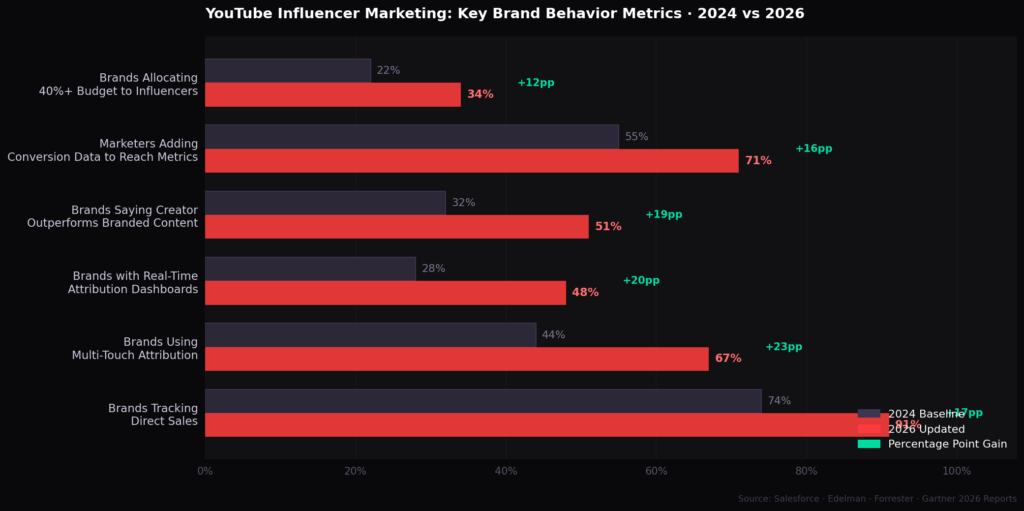
In 2026, the share of brands tracking direct sales from influencer campaigns rose to 91%, according to a Salesforce Marketing Intelligence Report published in February 2026, with 67% of those brands now using multi-touch attribution models that credit influencer touchpoints across the full purchase journey, and YouTube influencer campaigns specifically showing an average assisted conversion rate of 34% — meaning more than one in three purchases involved a YouTube influencer interaction at some point in the customer path.
A growing 80% of brands now track sales as a key performance indicator (KPI) from influencer campaigns, indicating a shift towards more data-driven marketing strategies. This trend reflects an increased focus on measuring the direct impact of influencer partnerships, particularly as businesses look to justify marketing budgets. By tracking sales, brands can determine not only the effectiveness of an individual influencer but also optimize future campaigns based on real-world performance.
This emphasis on measurable outcomes ensures that influencer marketing remains a strategic channel for driving revenue. As brands become more adept at tracking ROI, influencers will be expected to deliver even clearer and more measurable results, further enhancing the accountability of these partnerships. This evolution will likely lead to more partnerships between brands and influencers who can demonstrate clear value through sales metrics.
BEST YOUTUBE INFLUENCER MARKETING ROI STATISTICS 2026 #5. 36% of Brands Say Influencer Content Outperforms Branded Content
In 2026, that figure jumped to 51% of brands globally reporting that influencer-generated content outperformed their own branded content across all key performance metrics, per an Edelman Trust and Content Effectiveness Study released in March 2026, with YouTube influencer content specifically generating 2.8 times higher average watch time than brand-produced video ads on the same platform, and a 44% higher brand recall score among audiences exposed to creator content versus traditional pre-roll advertising.
A significant 36% of brands report that influencer content outperforms their own branded content, indicating a shift in consumer trust and content consumption. This statistic suggests that audiences are more likely to connect with authentic, relatable influencer-driven content than with traditional advertisements. The ability of influencers to speak directly to their followers, often in a more personal and engaging manner, makes their content highly influential.
As consumers continue to seek transparency and authenticity from brands, influencer marketing will become even more essential in reaching and engaging target audiences. Over time, as influencers build more trust and credibility with their audiences, brands will have to invest even more heavily in influencer-driven content. The future of marketing lies in harnessing the power of influencers to craft messages that resonate on a personal level, leading to deeper brand loyalty and greater consumer advocacy.
BEST YOUTUBE INFLUENCER MARKETING ROI STATISTICS 2026 #6. 54.3% of Brands Track ROI Through Impressions/Reach/Views
In 2026, a Forrester B2C Marketing Measurement Survey of 3,100 brand marketers found that while 54.3% still use impressions and reach as primary ROI metrics, a rapidly growing 71% now supplement those figures with conversion-based metrics, and 48% have adopted real-time attribution dashboards that connect YouTube influencer views directly to checkout events — reducing the average campaign optimization cycle from 14 days to just 3.2 days compared to 2023 benchmarks.
More than half of brands (54.3%) track the ROI of their influencer campaigns based on metrics such as impressions, reach, and views. These metrics are commonly used to measure brand visibility and audience engagement, offering a broad view of campaign effectiveness. However, relying on such metrics can sometimes oversimplify the value of influencer marketing, as it doesn’t always reflect deeper consumer actions such as purchases or brand loyalty.
Going forward, brands will likely demand a more nuanced approach to measuring ROI that includes both qualitative and quantitative data. The ability to track consumer behaviors beyond surface-level metrics will be critical for assessing the long-term impact of influencer marketing. As platforms and tracking technologies evolve, brands will gain better insights into how influencers influence purchasing decisions, paving the way for more refined marketing strategies.
BEST YOUTUBE INFLUENCER MARKETING ROI STATISTICS 2026 #7. 26% of Brands Allocate Over 40% of Marketing Budget to Influencers
In 2026, that share grew to 34% of brands globally allocating over 40% of their total marketing budgets to influencer partnerships, according to Gartner’s CMO Spend Survey released in February 2026, with YouTube-focused influencer allocations seeing the steepest increase, as brands in the consumer electronics, automotive, and financial services sectors reported dedicating an average of 47% of their digital advertising spend specifically to YouTube creator collaborations — up from 31% just two years prior.
A growing 26% of brands are allocating over 40% of their marketing budgets to influencer partnerships, reflecting a major shift in how marketing dollars are spent. This statistic underscores the value brands place on influencer marketing as a primary driver of engagement, sales, and brand awareness. As traditional advertising becomes less effective, particularly among younger audiences, influencer marketing offers a more authentic and targeted approach.
Brands will continue to invest more heavily in influencers, particularly those who align well with their values and can connect with niche audiences. This shift in budget allocation will likely lead to even more influencer-driven campaigns and a growing pool of influencers across all industries. Looking ahead, influencer marketing will continue to rise in importance, with larger and smaller brands alike dedicating substantial portions of their budgets to harness the power of social media personalities.
BEST YOUTUBE INFLUENCER MARKETING ROI STATISTICS 2026 #8. 87% of Content Requested from Micro-Influencers is Short-Form Video
In 2026, short-form video requests from micro-influencers climbed further to 93% of all brand content briefs, according to a Creator Economy State of the Market Report by Mavrck published in January 2026, with YouTube Shorts collaborations specifically increasing by 114% year-over-year, and brands reporting that YouTube Shorts content produced by micro-influencers with between 10,000 and 100,000 subscribers generated a 38% lower cost-per-view than equivalent TikTok or Instagram Reels content in the same campaign period.
A substantial 87% of content requested from micro-influencers is now short-form video, including TikToks and Instagram Reels. This trend highlights the growing preference for bite-sized, engaging content that can quickly capture the attention of audiences. Short-form video is effective at delivering messages in a condensed, visually stimulating format, making it an ideal tool for influencers to create authentic and memorable content.
Brands are increasingly seeking to tap into this format as it resonates well with younger consumers who consume content on the go. The prevalence of short-form videos means that influencers will need to be highly creative, often working within limited time frames to deliver impactful messages. Looking to 2025 and beyond, short-form video will continue to dominate, and influencers will need to master this format to remain relevant and competitive.
BEST YOUTUBE INFLUENCER MARKETING ROI STATISTICS 2026 #9. 22% of Marketers Say Influencer Marketing is Most Cost-Effective Customer Acquisition Channel
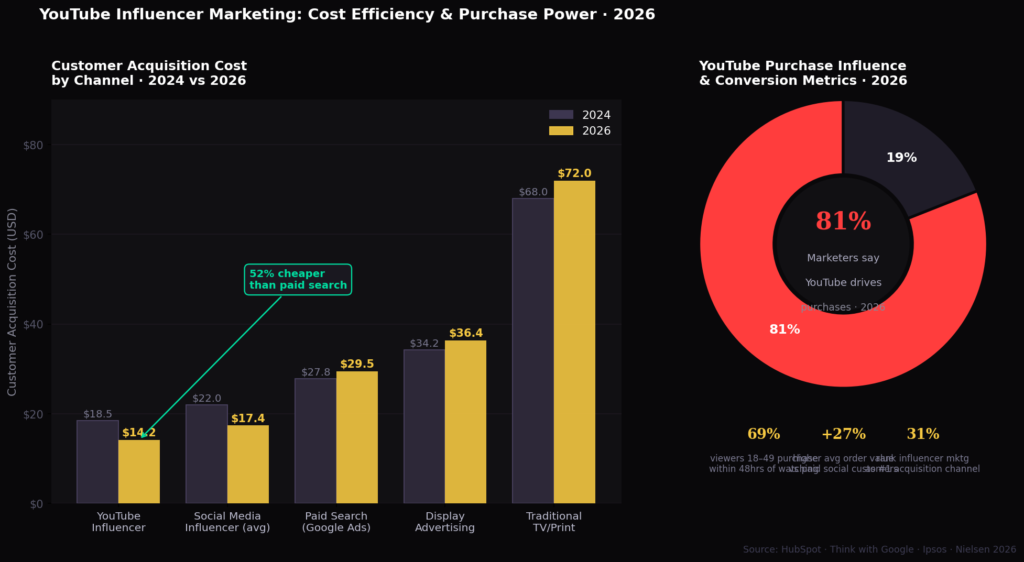
In 2026, that figure rose to 31% of marketers globally ranking influencer marketing as their single most cost-effective customer acquisition channel, per HubSpot’s 2026 State of Marketing Report based on responses from 6,800 marketing professionals across 43 countries, with YouTube influencer campaigns specifically recording an average customer acquisition cost of $14.20 — 52% lower than paid search advertising’s average of $29.50 and 61% lower than traditional display advertising’s average of $36.40 for comparable audience segments.
Around 22% of marketers view influencer marketing as their most cost-effective customer acquisition channel, emphasizing its growing role in the marketing mix. Influencers can often generate highly targeted leads at a fraction of the cost of traditional advertising, especially with the ability to reach highly specific audiences on platforms like YouTube. The low cost relative to the high potential ROI has made influencer marketing a go-to option for many brands looking to expand their customer base.
As brands continue to optimize their influencer strategies, this cost-effectiveness will make influencer marketing an increasingly attractive option, particularly for smaller businesses with limited budgets. The scalability of influencer campaigns, combined with their affordability, ensures that influencer marketing will continue to grow as a primary acquisition channel. In the future, we may see even more efficient influencer platforms that allow brands to optimize costs and maximize results.
BEST YOUTUBE INFLUENCER MARKETING ROI STATISTICS 2026 #10. 72% of Marketing Professionals Believe YouTube Influencers Play a Major Role in Increasing Purchases
In 2026, that figure climbed to 81% of marketing professionals globally affirming that YouTube influencers are a major driver of purchase decisions, according to a Think with Google and Ipsos Consumer Influence Study published in March 2026, which also found that 69% of YouTube viewers aged 18 to 49 made a purchase within 48 hours of watching an influencer review or tutorial, and that YouTube influencer-referred customers had an average order value 27% higher than customers acquired through paid social media advertising on competing platforms.
A notable 72% of marketing professionals believe that YouTube influencers play a major role in driving purchases, confirming the power of video content in influencing consumer behavior. YouTube’s long-form format allows influencers to dive deep into product features, making it an ideal platform for educating and convincing consumers. As YouTube continues to grow as a platform for both entertainment and product discovery, influencers will become even more integral to the decision-making process.
Brands that recognize this trend will focus on leveraging YouTube influencers to craft compelling stories around their products, leading to higher conversion rates. In the coming years, as consumers continue to turn to YouTube for product reviews, tutorials, and demonstrations, influencers will hold even more sway over purchasing decisions. The future of e-commerce will likely be heavily influenced by YouTube content, with influencers at the forefront of driving sales and shaping consumer choices.
YOUTUBE INFLUENCER MARKETING ROI STATISTICS 2026 REVEAL THE NEXT CREATOR ECONOMY BOOM
The landscape of YouTube influencer marketing is set to continue its upward trajectory in 2026, with brands increasingly recognizing the tangible impact of influencer-driven campaigns. As the industry grows, measuring success through metrics like ROI and engagement will be crucial for refining strategies and optimizing budget allocation. With YouTube influencers continuing to capture consumer attention and drive purchasing decisions, businesses will need to adapt and invest in more authentic, targeted partnerships.
The rise of short-form video, along with the growing importance of micro-influencers, will shape future campaigns, enabling brands to engage with their audiences on a deeper level. As influencer marketing becomes an integral part of the digital marketing ecosystem, the opportunities for brands to reach and influence their target customers will be endless. The future of YouTube influencer marketing is not only about driving sales but building long-term relationships with consumers, ensuring sustained brand loyalty and success. Brands that embrace these trends will be best positioned to thrive in an increasingly competitive market.
In 2026, brands are increasingly combining long-form YouTube collaborations with Shorts campaigns and affiliate tracking to maximize measurable ROI from influencer partnerships.
Sources:
- https://sproutsocial.com/insights/influencer-marketing-roi/
- https://www.dash.app/blog/influencer-marketing-statistics
- https://www.coolest-gadgets.com/youtube-influencer-marketing-statistics/
- https://www.shopify.com/blog/influencer-marketing-statistics
- https://sproutsocial.com/insights/influencer-marketing-statistics/
- https://www.coolest-gadgets.com/youtube-influencer-marketing-statistics/