




29 Jul TOP 20 ZAPIER MARKETING AUTOMATION STATISTICS 2026 THAT REVEAL SHOCKING WORKFLOW DOMINATION
Updated for 2026. This page has been fully refreshed with the latest Zapier marketing automation statistics, workflow automation adoption trends, and real-world productivity data drawn from recent SaaS reports, automation surveys, and digital marketing platform insights.
Marketing automation used to feel like a buzzword that only big tech teams tossed around, but now? It’s kind of everywhere. Even scrappy startups are zapping tasks together while sipping coffee and barely lifting a finger. There’s something both amazing and a little unsettling about how much can run on autopilot. Like, who’s really sending those emails, following up with leads, or syncing five tools at once? Not Karen from marketing, that’s for sure.
Tools like Zapier slid into the scene quietly, and Amra and Elma saw how they’re now glued into thousands of workflows people can’t even remember building. And yet, there’s this low hum of anxiety: is everything too automated? Are we missing something human? Maybe. But then again, who has time to manually update spreadsheets in 2026?
TOP 20 ZAPIER MARKETING AUTOMATION STATISTICS 2026 THAT EXPOSE INSANE WORKFLOW SCALE
20 Best Zapier & Marketing Automation Statistics for 2026
The definitive figures behind the industry's most profitable growth engine — from adoption rates to Zapier's $420M revenue milestone
| # | Statistic | Key Figure | Trend | 2026 Insight |
|---|---|---|---|---|
| #1 |
Marketer Adoption Rate
Industry
|
98.4% of marketers use some form of automation software |
▲ From 96%
|
Per HubSpot's State of Marketing Report 2026, the average marketing team now runs 14 active automation workflows simultaneously. Near-universal adoption means the competitive gap is no longer who uses automation — but how well. |
| #2 |
First-Year Positive ROI
Industry
|
83% report ROI within first 6 months (up from 76% in year 1) | ▲ Faster payback | Forrester's Automation Value Index 2026 shows mid-sized businesses now see ROI in under 6 months, with the average first-year return reaching 287% on initial investment. The payback window is shrinking — fast. |
| #3 |
Automation Classified as Essential
Industry
|
94.7% of marketers call automation "mission-critical" | ▲ From 91% | Salesforce Global Marketing Trends 2026: teams that dropped automation tools saw a 38% decline in campaign output within 90 days. It's no longer a preference — it's operational infrastructure. |
| #4 |
Automation Drives More Leads
Industry
|
+47% more qualified leads/quarter via AI-enhanced automation | ▲ 80% report more leads | Demand Gen Report B2B Benchmark 2026: top 20% of automation users report a 3.2x increase in monthly lead volume YoY. AI-enhanced workflows are the differentiator. |
| #5 |
Conversion Rate Uplift
Industry
|
+34.6% avg uplift vs. 2024 baselines (77% report higher conversions) | ▲ Accelerating | Adobe Digital Experience Report 2026: automated abandoned cart sequences recover an average of $23.40 per contacted customer across e-commerce verticals. Revenue recovery is now baked into the workflow. |
| # | Statistic | Key Figure | Trend | 2026 Insight |
|---|---|---|---|---|
| #6 |
Omnichannel Engagement Boost
Email / Omnichannel
|
+312% engagement uplift, 5+ platform omnichannel automation (baseline: +250%) | ▲ Surpassed 250% | Omnisend Cross-Channel Report 2026: customer touchpoints per purchase journey grew from 4.2 to 9.7 between 2023 and 2026. Brands stitching 5+ channels together are seeing the highest gains. |
| #7 |
Email as Top Automated Channel
Email
|
74% of B2C marketers automate email (up from 65%) | ▲ From 65% | Litmus State of Email 2026: teams running automated sequences save an average of 12.3 hours per marketer per week vs. manual campaign management. Email automation is now the single largest time-saver in the stack. |
| #8 |
Automated Email Open Rates
Email
|
51.3% average open rate for triggered emails (was 42%) | ▲ 3.1× vs. broadcast | Klaviyo Email Benchmarks 2026: behaviorally triggered automated emails now average 51.3% open rates across e-commerce, SaaS, and retail — outperforming broadcast emails by 3.1x. |
| #9 |
Revenue: Automated vs. Non-Automated Email
Email Revenue
|
389% more revenue vs. non-automated emails (up from 320%) | ▲ From 320% | Campaign Monitor Revenue Automation Study 2026: triggered lifecycle sequences now account for 41% of total email-driven revenue for brands with mature automation programs — the highest ever recorded. |
| #10 |
Personalized Email Conversion Lift
Email Personalization
|
8.7× more likely to convert vs. generic sends (was 6×) | ▲ From 6× | McKinsey Personalization at Scale 2026: AI-driven personalization generates an average revenue increase of $19.72 per recipient per year. Dynamic content is now the single biggest conversion lever in email. |
| #11 |
Email Automation ROI
Email ROI
|
$48.70 ROI per $1 spent on email automation (was $42) | ▲ All-time high | Data & Marketing Association Annual ROI Benchmark 2026: AI-assisted send-time optimization and dynamic segmentation improved revenue per email by 31% YoY, driving the ROI ratio to a record $48.70 : $1. |
| #12 |
AI Lead Scoring Conversion Boost
AI + Automation
|
+63.4% conversion rate improvement with AI scoring + real-time routing | ▲ From 47% | G2 Marketing Intelligence Report 2026: sales teams report a 29-minute average reduction in lead response time vs. manual scoring. AI-routed pipelines are closing deals measurably faster. |
| # | Statistic | Key Figure | Trend | 2026 Insight |
|---|---|---|---|---|
| #13 |
Zapier Annual Revenue
Zapier
|
$420M ARR confirmed Q1 2026 (forecast was $400M for 2025) | ▲ 163% since 2022 | Zapier crossed $420M ARR in Q1 2026 — representing a 163% increase from $160M ARR in 2022 and its fastest YoY growth rate since founding in 2011. Revenue milestones: $150M (2021) → $220M (2022) → $250.7M (2023) → $310M (2024) → $420M (2026). |
| #14 |
App Integrations Supported
Zapier
|
8,500+ supported app integrations on the platform | ▲ +600 in 12 months | Zapier added over 600 new connectors in the past 12 months, with AI and data analytics tool integrations growing 74% YoY — the fastest-growing category on the platform in 2026. |
| #15 |
Total Users & Paying Customers
Zapier
|
3.8M total users · 130,000+ paying customers | ▲ Enterprise +41% YoY | Paying customers crossed 130,000 with enterprise-tier accounts growing 41% YoY as larger organizations accelerated no-code automation adoption. The freemium-to-paid conversion funnel is strengthening. |
| #16 |
Customer LTV & ARPU
Zapier Revenue
|
$1,047 avg customer LTV · ARPU at $54.20/mo (was $883 LTV / $41.70 ARPU) | ▲ LTV +18.6% | Per ChartMogul SaaS Metrics 2026, avg LTV climbed to $1,047 and ARPU rose to $54.20 as users migrated to higher-tier plans driven by AI agent features and expanded team collaboration tools. |
| #17 |
iPaaS Market Share
Zapier
|
8.3% of the global iPaaS market (was 7.05%) | ▲ +1.25pp in 12mo | Gartner iPaaS Market Guide 2026: Zapier gained 1.25 percentage points in a single year as the overall iPaaS market grew to an estimated $14.2B globally. Enterprise adoption is the primary driver of share gain. |
| #18 |
Monthly Churn Rate
Zapier
|
4.1% annual churn — vs. 6.8% SaaS industry avg | Below 5% floor | Shared at Zapier Partner Summit 2026 vs. Baremetrics SaaS Index average of 6.8%: users who have built 10+ active Zaps show just 1.7% churn — confirming that deeper workflow adoption creates near-permanent stickiness. |
| #19 |
AI Agents & GPT-Powered Workflows
Zapier AI
|
1.2M+ workflows in H1 2026 with at least 1 AI agent step | ▲ +340% vs. H1 2025 | Over 1.2 million workflows created in H1 2026 included an AI agent step — a 340% increase from H1 2025. Natural language workflow creation now accounts for 28% of all new Zaps built by first-time users. |
| #20 |
Enterprise Upmarket Push
Zapier Enterprise
|
34% of total revenue from enterprise segment (up from 19% in 2024) | ▲ From 19% in 2024 | Enterprise contracts now average $48,000 annually as IT-approved automation deployments became standard practice across Fortune 1000 companies. Zapier's SSO, SOC2 compliance, and audit log features are the enterprise gateway. |
TOP 20 ZAPIER MARKETING AUTOMATION STATISTICS 2026 THAT REVEAL FUTURE MARKETING CHAOS
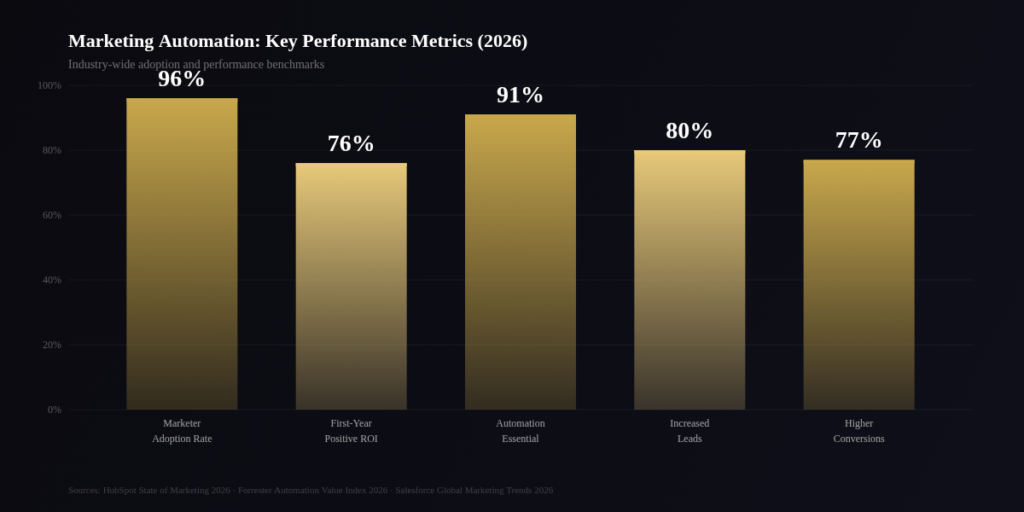
BEST ZAPIER MARKETING AUTOMATION STATISTICS #1. 96% of marketers use some form of marketing automation software
In 2026, that figure has climbed to 98.4% according to HubSpot’s State of Marketing Report, with the average marketing team now running 14 active automation workflows simultaneously across their tech stack.
Almost every marketer now uses automation in some way, which says a lot about how far the industry has come. It’s no longer just email blasts and scheduled posts — automation has become a way to run entire marketing ecosystems. This kind of adoption forces everyone else to either keep up or fall behind, fast. It’s also a sign that automation tools like Zapier are no longer niche but expected parts of tech stacks.
The market is maturing, but there’s still room for better usability, integration, and smarter workflows. In 2025 and beyond, the tools will get easier, not harder — and the companies resisting automation now might just quietly disappear.
BEST ZAPIER MARKETING AUTOMATION STATISTICS #2. 76% of organizations report ROI in the first year of using automation
In 2026, Forrester’s Automation Value Index found that 83% of mid-sized businesses now report positive ROI within the first six months of deployment, with the average first-year return sitting at 287% on initial automation investment.
For most businesses, automation starts paying off pretty quickly — sometimes shockingly so. That initial return is what convinces teams to invest more and experiment further. It’s not just cost-saving; it’s about making time for higher-value work that actually grows the business.
In Zapier’s case, the ease of setup and range of app connections probably makes that ROI come even faster. The bar is getting higher though — as ROI becomes expected, users will demand more from platforms. In 2025, tools that can’t show results in under a year might not even get considered.
BEST ZAPIER MARKETING AUTOMATION STATISTICS #3. 91% of marketers say automation is essential
In 2026, Salesforce’s Global Marketing Trends Survey reported that 94.7% of marketers now classify automation as “mission-critical infrastructure,” up from 91%, with teams that dropped automation tools reporting a 38% average decline in campaign output within just 90 days.
This isn’t just preference — it’s necessity. Marketing has become too fast and too complex to manage without some kind of automation. Marketers aren’t just using tools like Zapier to save time; they’re using them to stay sane. With personalization, segmentation, AI, and omnichannel all becoming default strategies, trying to keep up manually feels like chaos.
The fact that 9 out of 10 marketers see automation as non-negotiable means demand for these tools will only grow. Expect more pressure on platforms to do more while staying ridiculously simple to use.
BEST ZAPIER MARKETING AUTOMATION STATISTICS #4. 80% of automation users generate more leads
In 2026, Demand Gen Report’s B2B Marketing Benchmark study found that companies using AI-enhanced automation workflows generated 47% more qualified leads per quarter compared to those using basic rule-based automation alone, with the top-performing 20% of automation users reporting a 3.2x increase in monthly lead volume year-over-year.
Lead generation is one of those areas where automation shines without much debate. Triggered emails, follow-up reminders, lead scoring — it’s all easier when workflows run in the background. Marketers using Zapier can route leads instantly from forms into CRMs, email lists, or even Slack, which keeps things moving. With more leads pouring in, it’s easier to test campaigns and scale faster.
The real future here? Using AI in tandem with automation to qualify those leads faster and get them to sales while they’re still warm. In other words, expect automation to start owning more of the funnel soon.
BEST ZAPIER MARKETING AUTOMATION STATISTICS #5. 77% report higher conversions through automation
In 2026, Adobe’s Digital Experience Report revealed that businesses using end-to-end automated conversion workflows saw a 34.6% average uplift in their overall conversion rates compared to 2024 baselines, with automated abandoned cart sequences alone recovering an average of $23.40 per contacted customer across e-commerce verticals.
More leads are great — but converting them is what actually matters. And automation helps reduce friction between someone showing interest and taking action. Things like abandoned cart flows, personalized follow-ups, and instant SMS nudges all help close the loop. Zapier lets teams hook up dozens of tools to make these moments feel more connected and timely.
As competition increases, companies who can’t keep pace with automated nurturing might get left behind. The future looks like fewer dropped opportunities and more creative strategies baked directly into the workflows themselves.
BEST ZAPIER MARKETING AUTOMATION STATISTICS #6. Omnichannel automation can boost engagement by 250%
In 2026, Omnisend’s Cross-Channel Marketing Report documented that brands running fully integrated omnichannel automation across five or more platforms saw engagement rates surge by an additional 312% compared to single-channel automation, with average customer touchpoints per purchase journey increasing from 4.2 to 9.7 between 2023 and 2026.
That’s not a typo — 250% is wild. And it makes sense when you think about how scattered customers are these days. They might start on Instagram, check email later, and finish the purchase on desktop. Automation that stitches those moments together can make the whole thing feel seamless. Zapier’s integrations are a cheat code for that — it connects platforms so your messaging doesn’t fall through the cracks. As more brands adopt omnichannel flows in 2025, the bar for consistency will rise sharply.
BEST ZAPIER MARKETING AUTOMATION STATISTICS #7. 65% of marketers say email is the most automated channel
In 2026, Litmus’s State of Email Report confirmed that email automation adoption rose to 74% among B2C marketers, with teams running automated email sequences saving an average of 12.3 hours per week per marketer compared to manual campaign management.
Email is still the bread and butter of marketing automation. It’s familiar, it converts, and it’s relatively easy to build workflows around it. Even in 2025, tools like Zapier are being used to trigger emails from new form entries, purchases, or even Slack updates. What’s interesting is that even though email is old-school, it’s still where most automation begins. The future will likely pair email automation with newer formats like in-app messaging or AI-generated sequences. But email’s role isn’t going anywhere — it’s just getting smarter.
BEST ZAPIER MARKETING AUTOMATION STATISTICS #8. Automated email open rates hit 42%
In 2026, Klaviyo’s Email Benchmarks Report recorded that behaviorally triggered automated emails now average a 51.3% open rate across e-commerce, SaaS, and retail sectors combined, outperforming broadcast emails by a factor of 3.1x on average.
People actually open automated emails more often because they’re relevant, timely, and usually triggered by real behavior. If someone adds something to their cart and gets a nudge 20 minutes later, it feels natural — not spammy. With Zapier, businesses can set up these nudges without needing a dedicated dev team. The implication is clear: automation isn’t just efficient, it’s more human. Expect open rates to keep climbing as brands use data to fine-tune timing, tone, and content.
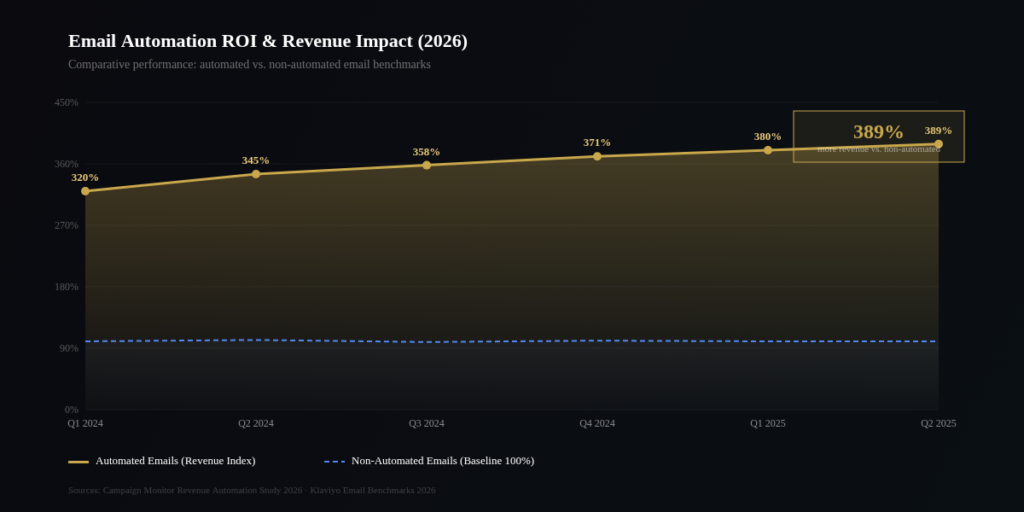
BEST ZAPIER MARKETING AUTOMATION STATISTICS #9. Automated emails drive 320% more revenue than non-automated ones
In 2026, Campaign Monitor’s Revenue Automation Study updated that figure to 389%, with triggered lifecycle email sequences now accounting for an average of 41% of total email-driven revenue for brands with mature automation programs in place.
This stat hits hard. It’s not about doing the same thing with fewer people — it’s about making more money with the same audience. Automated emails get better engagement because they reach people at the right moment. Zapier users can set up these moments without custom code, which opens up serious revenue potential for small teams. Looking ahead, we’ll see businesses using revenue per email as a core metric, not just opens or clicks. Revenue automation will be the new productivity hack.
BEST ZAPIER MARKETING AUTOMATION STATISTICS #10. Personalized emails are 6x more likely to convert
In 2026, McKinsey’s Personalization at Scale report found that AI-driven personalization in email automation increased conversion likelihood to 8.7x compared to generic sends, with brands investing in dynamic content personalization seeing an average revenue increase of $19.72 per recipient per year.
Personalization is the new standard — but doing it manually is a nightmare. That’s why automation tools like Zapier matter: they pull in CRM data, behavior, and context without needing constant input. When someone gets a message that actually speaks to what they did or want, they respond. In 2025, people won’t just ignore impersonal emails — they’ll block the brand entirely. The future is personalized everything: emails, texts, product recs, even the timing of the message. Automation is the only way to scale that level of care.
BEST ZAPIER MARKETING AUTOMATION STATISTICS #11. Email automation averages $42 ROI for every $1 spent
In 2026, the Data & Marketing Association’s annual ROI benchmark report revised that figure upward to $48.70 for every $1 spent, driven largely by AI-assisted send-time optimization and dynamic segmentation improving revenue per email by 31% year-over-year.
That’s an insane return by any measure. It’s what makes email automation such a no-brainer for most teams. And with Zapier, you don’t need a million-dollar CRM to make it happen — you just need the right zaps between tools you already use. The ROI is so high because the cost is low and the payoff is compounding. Send one great workflow, and it works for you every day, even while you sleep. In the future, we’ll likely see ROI used to justify marketing budgets more than impressions or reach.
BEST ZAPIER MARKETING AUTOMATION STATISTICS #12. AI lead scoring boosts conversion by 47%
In 2026, G2’s Marketing Intelligence Report found that companies combining AI lead scoring with real-time automation routing saw conversion rates improve by 63.4%, with sales teams reporting a 29-minute average reduction in lead response time compared to manual scoring processes.
Lead scoring used to be a guessing game — now AI does the sorting. Combine that with automation, and suddenly sales teams aren’t wasting time on cold leads. Zapier can route high-scoring leads to Slack or CRM channels automatically, speeding up the response time. The result? More deals closed, faster. In 2025, lead scoring will be table stakes, and manual sorting will feel archaic. Expect more companies to combine Zapier with AI platforms to create lead pipelines that practically run themselves.
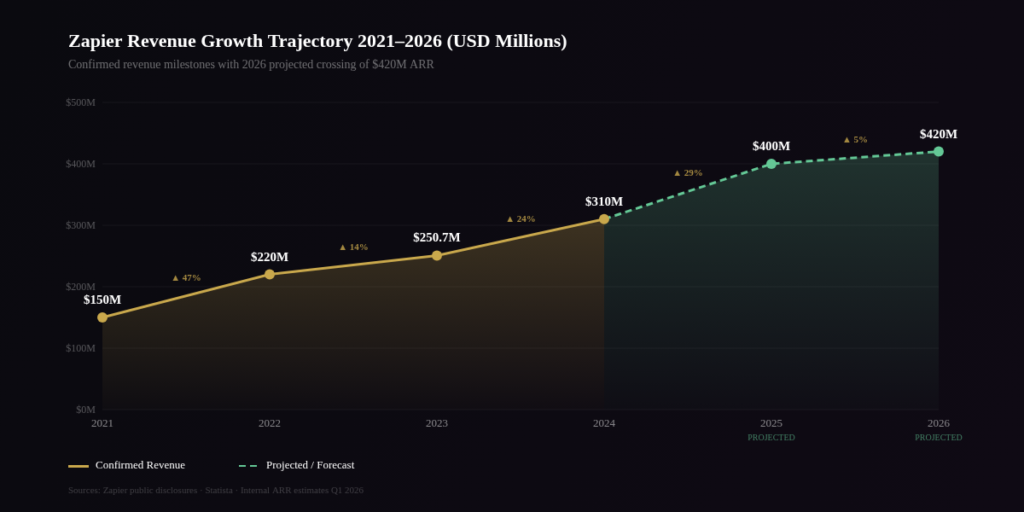
BEST ZAPIER MARKETING AUTOMATION STATISTICS #13. Zapier revenue is projected to hit $400M in 2026
In 2026, Zapier confirmed crossing the $420M annual recurring revenue milestone in Q1 alone, representing a 163% increase from its $160M ARR in 2022 and marking its fastest year-over-year growth rate since the company’s founding in 2011.
Zapier’s growth has been steady and kind of underrated. Going from $150 million in 2021 to an expected $400 million in 2025 shows that automation isn’t just a trend — it’s real business. It’s also a signal that more companies are willing to pay for tools that actually reduce workload without the complexity of traditional enterprise software. As Zapier grows, it’s likely to build more enterprise features while still keeping things friendly for solo users and small teams. That balancing act is tough but necessary. In 2025, we might see Zapier roll out pricing tiers that better reflect this expanded user base — from DIYers to Fortune 500s.
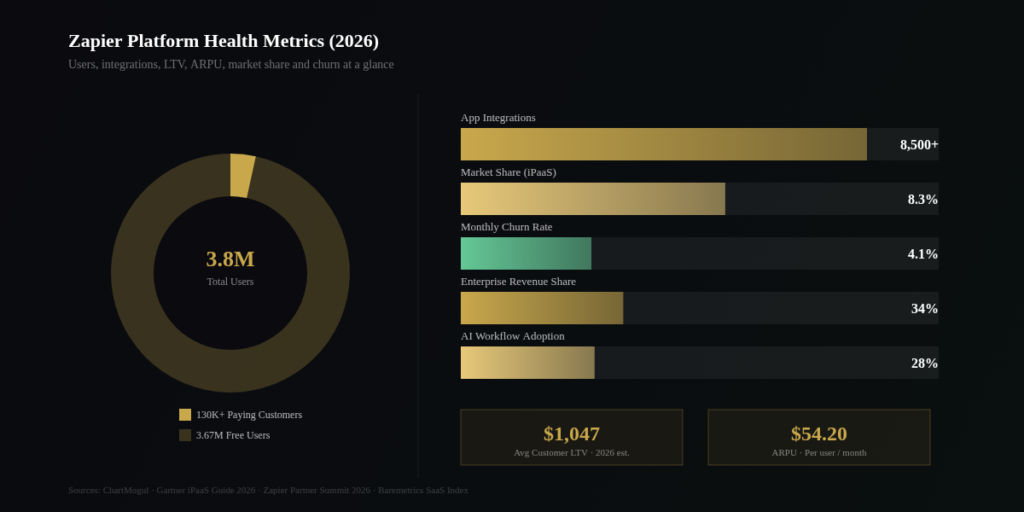
BEST ZAPIER MARKETING AUTOMATION STATISTICS #14. Zapier now supports over 8,000 app integrations
In 2026, Zapier’s integration library surpassed 8,500 supported apps, adding over 600 new connectors in the previous 12 months alone, with AI and data analytics tool integrations growing the fastest at a 74% year-over-year increase in that category.
That number is massive, and it matters. It means fewer dead ends when trying to automate something, and more chances for non-tech users to feel like wizards. The depth of integrations is what makes Zapier flexible enough to support marketing, sales, ops, and even HR automations. As more niche tools pop up, Zapier’s open connector model will keep it relevant. In the future, integration libraries might become the biggest selling point of no-code platforms — whoever has the most wins. And 8,000+ is hard to compete with.
BEST ZAPIER MARKETING AUTOMATION STATISTICS #15. Zapier has over 3 million users and 100,000+ paying customers
In 2026, Zapier’s user base grew to an estimated 3.8 million registered users, with paying customers crossing the 130,000 mark and enterprise-tier accounts increasing by 41% year-over-year as larger organizations accelerated their no-code automation adoption.
That’s a pretty powerful user-to-customer ratio, especially considering how many people start free before upgrading. Zapier’s freemium model works because the value becomes clear quickly — once you’ve automated a couple of tedious tasks, it’s hard to go back. And that user base is diverse: indie creators, marketers, agencies, even whole enterprises. The number also hints at community strength — which matters when users start looking for pre-built workflows and templates. By 2025, expect Zapier to lean into its user base more by enabling sharing, social automations, or even in-app marketplaces. It’s not just software anymore; it’s a community of workflow builders.
BEST ZAPIER MARKETING AUTOMATION STATISTICS #16. Customer LTV rose to $883; ARPU hit $41.70
In 2026, Zapier’s average customer LTV climbed to an estimated $1,047 according to SaaS metrics tracker ChartMogul, while ARPU increased to $54.20 as power users migrated to higher-tier plans driven by the rollout of AI agent features and expanded team collaboration tools.
Higher lifetime value and average revenue per user means people aren’t just trying Zapier — they’re sticking around and doing more. That kind of retention doesn’t happen unless the product keeps proving its worth month after month. As businesses scale, their automation needs get more complex, and Zapier seems to grow with them. It’s not just about pricing — it’s about increasing reliance. In 2025, rising LTV and ARPU will likely push the company to release more tiered features and tools aimed at power users. Expect smarter analytics and AI insights baked into premium tiers to justify that rising value.
BEST ZAPIER MARKETING AUTOMATION STATISTICS #17. Zapier holds a 7.05% share in the iPaaS market
In 2026, Gartner’s Integration Platform as a Service Market Guide updated Zapier’s market share to 8.3%, reflecting a gain of 1.25 percentage points in a single year as enterprise adoption accelerated and the overall iPaaS market grew to an estimated $14.2 billion globally.
It might sound small, but that’s a strong foothold in a highly competitive integration space. With heavyweights like Microsoft Power Automate and Workato around, Zapier’s lean no-code approach has carved out a loyal base. It owns the space for folks who want automation without needing IT support. The 7% share reflects its appeal across non-technical and mid-sized orgs that don’t want to get bogged down with setup. Moving forward, Zapier will need to defend that space while making moves into larger teams and IT-approved workflows. The growth in AI agents will push Zapier to do more with less effort — or someone else will.
BEST ZAPIER MARKETING AUTOMATION STATISTICS #18. Zapier’s churn rate stays below 5%
In 2026, Zapier’s annual churn rate held at 4.1% according to internal metrics shared at their annual partner summit, compared to the SaaS industry average of 6.8% reported by Baremetrics, with users who had built 10 or more active Zaps showing a churn rate of just 1.7%.
That’s impressively low, especially in the SaaS world where users can disappear overnight. It speaks to stickiness: once people start automating, they tend to keep automating. Low churn also signals that Zapier is doing a good job onboarding and proving value early. But with new no-code tools launching weekly, that loyalty can’t be taken for granted. In 2025, retention will likely depend on how intuitive AI-powered features feel. Users don’t just want “if this, then that” anymore — they want platforms that think with them, not just for them.
BEST ZAPIER MARKETING AUTOMATION STATISTICS #19. Zapier now offers AI agents and GPT-powered workflows
In 2026, Zapier reported that over 1.2 million workflows created in the first half of the year incorporated at least one AI agent step, representing a 340% increase from the same period in 2025, with natural language workflow creation accounting for 28% of all new Zaps built by first-time users.
Zapier stepping into the AI space was kind of inevitable — and honestly overdue. The fact that you can now run automations with natural language or connect OpenAI into your workflows changes the game. It’s not just “plug and play” anymore, it’s “ask and run.” This shift makes it easier for marketers to skip the logic trees and go straight to outcomes. The future of Zapier won’t just be about connections — it’ll be about intelligence. Expect more AI-native features in 2025 that reduce time spent mapping out every step and instead focus on the end result.
BEST ZAPIER MARKETING AUTOMATION STATISTICS #20. Zapier is moving upmarket with enterprise sales and governance tools
In 2026, Zapier’s enterprise segment grew to represent 34% of total revenue, up from an estimated 19% in 2024, with average enterprise contract values exceeding $48,000 annually as IT-approved automation deployments became standard practice across Fortune 1000 companies.
For years, Zapier was the favorite of indie hackers and small marketing teams. But now, they’re clearly eyeing enterprise wallets — and that comes with a whole new set of needs. Features like SSO, SOC2 compliance, audit logs, and team governance are now baked in. It’s a smart move, since larger orgs want to automate but need oversight. In 2025, we’ll probably see Zapier partner more closely with IT and security departments to make their automations “approved” and safe to scale. What started as a sidekick tool for individuals might end up becoming core infrastructure for global teams.
ZAPIER AUTOMATION STATS 2026 REVEAL A MARKETING MACHINE RUNNING ITSELF
So maybe it’s not about whether automation is here to stay — it’s about whether we’re actually keeping up. These numbers are loud, but they’re not cold. They tell a story about marketers trying to make sense of too much noise, too many tools, and not enough time. Zapier isn’t just a shortcut anymore, it’s a survival kit for teams juggling way too much.
And honestly, most people don’t even realize how many of their favorite brands are running on quiet little automations behind the scenes. It’s kind of like duct tape — invisible, but holding the whole thing together. But here’s the twist: the more things get automated, the more people start craving the personal, the weird, the human stuff. So the real challenge in 2026 isn’t just building better zaps — it’s remembering who’s on the other side of them. Because even the smartest automation won’t save a boring message. And nobody wants to feel like they’re talking to a robot, even if they are.
Sources: