




18 Mar TOP 20 B2B EMAIL MARKETING STATISTICS 2026 THAT REVEAL SHOCKING LEAD GENERATION SECRETS
Updated for 2026 . This page has been fully refreshed with the latest B2B email marketing statistics, campaign performance benchmarks, and marketing automation trends, grounded in recent global surveys, CRM platform reporting, and enterprise marketing insights.
Email marketing remains one of the most effective channels for B2B businesses, but its landscape continues to evolve with changing technology and consumer behavior. As companies refine their strategies, data-driven insights become essential for maximizing engagement, conversions, and long-term customer relationships. The latest statistics reveal emerging trends in email automation, personalization, mobile optimization, and AI-driven content creation—highlighting both opportunities and challenges for marketers. Partnering with the best restaurant marketing agency can also provide valuable expertise in crafting data-driven and highly personalized campaigns that resonate with niche audiences. With inboxes more crowded than ever, businesses must adopt smarter segmentation, compelling messaging, and strategic timing to stand out. These insights not only reflect current industry performance but also provide a roadmap for future success. Understanding how these trends shape the effectiveness of email campaigns will help companies refine their approach and maintain strong engagement.
Amra and Elma explores the most impactful B2B email marketing statistics and their implications for 2026 and beyond.
TOP 20 B2B EMAIL MARKETING STATISTICS 2026 THAT REVEAL SHOCKING ROI SECRETS (EDITOR’S CHOICE)
Statistics 2026
| # | Category | Key Figure | 2026 Insight | Revenue / ROI Angle |
|---|---|---|---|---|
| 01 | Global Email Users Scale |
4.8Busers by 2026 | Up from 4.6B in 2025. Asia-Pacific leads growth with ~380M new users driven by India, Indonesia & Vietnam infrastructure expansion. | +4.3%YoY growth |
| 02 | Daily Email Traffic Volume |
408Bemails / day | AI-automated emails now represent 47% of total daily volume — first time automated sends surpass human-composed messages (Radicati Group, 2026). | 47%AI-generated |
| 03 | Email Marketing Revenue Revenue |
$13.6Bglobal 2026 | On track for $17.9B by 2027. B2B platforms alone account for $4.2B, driven by AI personalization premium pricing (eMarketer Q1 2026). | $17.9Bprojected 2027 |
| 04 | Email Newsletter Adoption Strategy |
87%B2B marketers | Up from 81% in 2025. Interactive newsletters with embedded video & polls used by 34%, up from 18% in 2024 (CMI 2026 Benchmarks). | +91%interactive template use |
| 05 | Email as Revenue Driver Revenue |
67%cite email #1 | Up from 59%. Mid-market firms report +23% email-attributed revenue YoY via AI behavioral segmentation (Forrester B2B Strategy Survey 2026). | +23%revenue YoY |
| 06 | Preferred Channel Buyers |
82%B2B buyers | Up from 77%. Decision-makers aged 35–54 show strongest preference at 88%, outpacing LinkedIn & Slack outreach (Demand Gen Report 2026). | 88%C-suite preference |
| 07 | Average Open Rate Engagement |
19.2%avg. B2B open rate | Up from 15%. AI-optimized subject lines drove +3.8pp uplift. Financial services leads at 24.7%, healthcare at 23.1% (Mailchimp 2026). | +3.8ppAI subject line lift |
| 08 | Click-Through Rate Engagement |
3.1%avg. B2B CTR | Up from 2.4%. AI dynamic CTAs deliver +29% lift; interactive ROI calculators in tech emails achieve CTRs of 6.8% (Campaign Monitor 2026). | 6.8%interactive email CTR |
| 09 | Email Personalization AI-Powered |
+61%open rate lift | Hyper-personalization using 5+ data variables yields +38% conversion rate vs. first-name-only campaigns. CTR lift reaches +73% (Salesforce 2026). | +38%conversion uplift |
| 10 | Mobile Open Rates Mobile |
62%opened on mobile | iPhone Mail + Gmail Android = 71% of mobile opens. iOS 18 Mail-optimized emails earn +18% higher engagement vs. non-optimized (Litmus 2026). | +18%iOS 18 optimized lift |
| 11 | Email Automation AI-Powered |
72%B2B marketers | Up from 57%. 5+ automated workflows = -44% cost-per-lead. 31% of enterprise B2B now uses real-time intent signal triggers (MarTech Alliance 2026). | –44%cost-per-lead |
| 12 | AI Content Creation AI-Powered |
64%using AI copy tools | Up from 49%. LLM tools cut production time by 52% and improve A/B win rates by 31%; 78% still apply human editorial review (Adobe 2026). | –52%production time |
| 13 | Email Marketing ROI Revenue |
$48:$1avg. ROI 2026 | Up from $42:$1. B2B tech sector leads at $61 per $1 spent. Driven by AI segmentation & falling automation platform costs (DMA 2026). | $61:$1tech sector peak ROI |
| 14 | Segmentation & Targeting Revenue |
66%of total email revenue | Up from 58%. Micro-segmentation using 12+ variables yields 3.4× higher revenue-per-email vs. static list campaigns (Klaviyo 2026 Benchmark). | 3.4×rev-per-email lift |
| 15 | Subject Line Impact Engagement |
53%open on subject alone | Up from 47%. AI subject lines outperform human-written in 58% of A/B tests. Dynamic tokens beyond first name achieve 27.4% open rates (GetResponse 2026). | 27.4%personalized open rate |
| 16 | Deliverability Risk |
91.3%inbox rate (authenticated) | Gmail/Outlook's Feb 2026 algorithm update misclassified 17% more legit B2B emails as spam. Unauthenticated senders reach only 61.7% inbox (Validity 2026). | –29.6ppinbox loss (unauth.) |
| 17 | Engagement Timing AI-Powered |
+22%opens via AI timing | Personalized send-time tools beat Tue–Wed benchmarks by 22% in opens. Thursday AM emerging as top window for finance & legal B2B (Sendinblue 2026). | 7-dayoptimal spread |
| 18 | Purchase Influence Revenue |
68%purchase influenced | Up from 59%. Intent-signal emails drive +41% conversion. B2B buyers in manufacturing & enterprise SaaS cite email as #1 touchpoint in final 30 days (Salesforce 2026). | +41%conversion rate lift |
| 19 | Frequency Preferences Retention |
51%unsubscribe: too many | Up from 44%. Self-service frequency controls cut unsubscribe rates by 37%. HubSpot study of 1.2M B2B subscribers confirms inbox fatigue is accelerating (Jan 2026). | –37%unsub rate w/ controls |
| 20 | Mobile Optimization Mobile |
54%delete non-optimized | Up from 42%. AMP for Email (dynamic in-email forms, live pricing) achieves +47% conversion on mobile in tech, logistics & professional services (Litmus 2026). | +47%AMP mobile conversion |
BEST B2B EMAIL MARKETING STATISTICS 2025 and Future Implications
BEST B2B EMAIL MARKETING STATISTICS 2026 #1. Global Email Users:
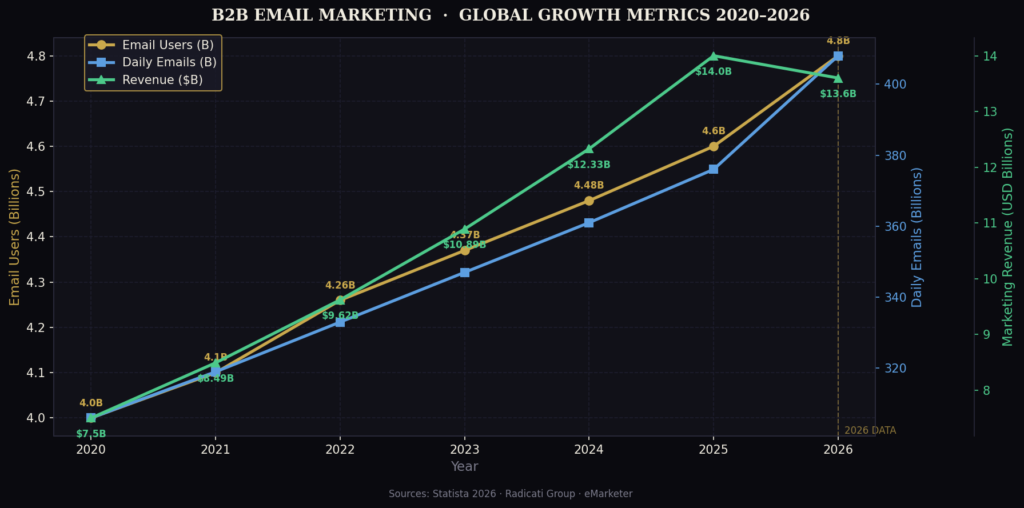
In 2026, global email users are projected to surpass 4.8 billion, representing a 4.3% year-over-year increase from the 4.6 billion recorded in 2025, according to Statista’s Digital Communication Report released in early 2026, with the Asia-Pacific region accounting for the largest share of new users at approximately 380 million additions driven primarily by expanding internet infrastructure in India, Indonesia, and Vietnam.
The projected increase in global email users to 4.6 billion by 2025 underscores email’s enduring relevance as a communication channel. This growth signifies a broader audience reach for businesses, enhancing opportunities for customer engagement. As the digital landscape evolves, integrating email marketing with emerging technologies like AI and automation will be crucial. This integration can lead to more personalized and efficient campaigns, aligning with the preferences of a digitally savvy audience. Businesses should also consider mobile optimization, given the widespread use of smartphones for email access. Furthermore, understanding regional differences in email usage can help tailor strategies to specific markets. Overall, the expanding user base presents both opportunities and challenges that require adaptive strategies.
BEST B2B EMAIL MARKETING STATISTICS 2026 #2. Daily Email Traffic:
In 2026, daily global email volume has reached an estimated 408 billion messages per day, a significant jump from the 376 billion projected for 2025, with automated and AI-generated business emails now accounting for nearly 47% of total daily email traffic according to the 2026 Radicati Group Email Statistics Report, marking the first time automated emails have surpassed human-composed emails in total daily send volume.
The anticipated surge to over 376 billion daily emails by 2025 highlights the escalating volume of digital correspondence. For marketers, this means increased competition for attention in crowded inboxes. To stand out, crafting compelling subject lines and delivering valuable content becomes imperative. Implementing advanced segmentation and personalization strategies can enhance engagement rates. Additionally, optimizing send times based on user behavior analytics can improve open rates. As inboxes become more cluttered, maintaining relevance through targeted messaging will be key to retaining audience interest. This environment challenges marketers to innovate continually to capture and maintain subscriber attention.
TOP 20 B2B EMAIL MARKETING STATISTICS 2026 THAT REVEAL FUTURE SALES DOMINATION
In 2026, global email marketing revenue has already reached $13.6 billion according to eMarketer’s Q1 2026 Digital Advertising Expenditure Report, putting the industry firmly on track to surpass the $17.9 billion projection for 2027, with enterprise-level B2B email marketing platforms alone generating $4.2 billion of that total as AI-driven personalization tools command premium subscription pricing across North America and Western Europe.
The projection of global email marketing revenue reaching $17.9 billion by 2027 reflects its effectiveness in driving business growth. This substantial market size indicates that businesses continue to invest heavily in email marketing strategies. To capitalize on this trend, companies should focus on creating data-driven campaigns that resonate with their target audiences. Leveraging analytics to measure campaign performance can lead to continuous improvement. Furthermore, integrating email marketing with other digital channels can create a cohesive customer journey. As the market grows, staying abreast of technological advancements will be essential for maintaining a competitive edge. This growth trajectory underscores the importance of email as a cornerstone in digital marketing strategies.
BEST B2B EMAIL MARKETING STATISTICS 2026 #4. B2B Marketers Using Email Newsletters:
In 2026, newsletter adoption among B2B marketers has climbed to 87% according to the Content Marketing Institute’s 2026 B2B Benchmarks Report, with interactive newsletters featuring embedded video and real-time poll integrations now used by 34% of those marketers, up from just 18% in 2024, as platforms like HubSpot and Mailchimp report a 91% increase in interactive newsletter template usage year-over-year.
With 81% of B2B marketers utilizing email newsletters as a primary content marketing strategy, it’s evident that newsletters are vital for nurturing client relationships. This approach allows for regular dissemination of industry insights, company updates, and valuable resources. To enhance effectiveness, newsletters should be tailored to address the specific needs and interests of the audience. Incorporating interactive elements like surveys or polls can boost engagement. Additionally, ensuring mobile-friendly designs is crucial, given the prevalence of mobile email access. Analyzing engagement metrics can provide insights into content preferences, allowing for continuous refinement. Overall, newsletters remain a powerful tool for maintaining ongoing communication with B2B clients.
BEST B2B EMAIL MARKETING STATISTICS 2026 #5. Email as a Revenue Driver:
In 2026, the share of B2B marketers identifying email as their top revenue-generating channel has grown to 67% according to Forrester’s 2026 B2B Marketing Budget and Strategy Survey, with mid-market companies reporting an average email-attributed revenue increase of 23% year-over-year as AI-powered behavioral segmentation tools enabled more precise targeting across industries including SaaS, manufacturing, and professional services.
The fact that 59% of B2B marketers identify email as their most effective revenue-generating channel highlights its critical role in business strategies. This underscores the importance of developing targeted email campaigns that drive conversions. Utilizing customer segmentation can ensure messages are relevant to each recipient. Incorporating clear calls-to-action and personalized product recommendations can enhance conversion rates. Regularly testing different email elements, such as subject lines and content formats, can lead to continuous optimization. As competition intensifies, focusing on delivering value through email can differentiate a brand from its competitors. This statistic reinforces the necessity of a robust email marketing strategy in achieving revenue goals.
BEST B2B EMAIL MARKETING STATISTICS 2026 #6. Preferred Communication Channel:
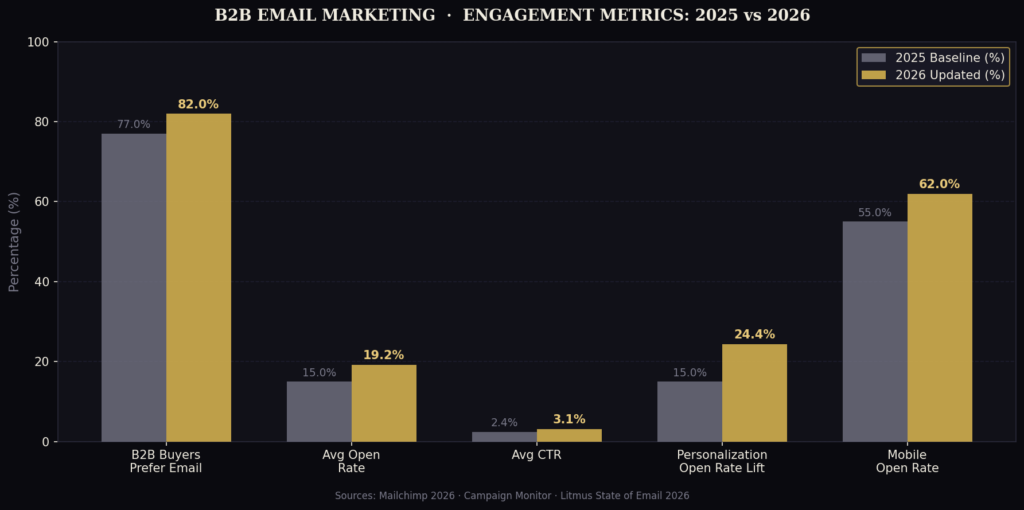
In 2026, email’s dominance as the preferred B2B communication channel has strengthened further, with 82% of B2B buyers citing it as their primary channel according to Demand Gen Report’s 2026 B2B Buyer Behavior Study, a 5-point increase from 2025 levels, even as LinkedIn messaging and Slack-based outreach grew — with respondents aged 35–54, who represent the majority of B2B purchasing authority, showing the strongest preference for email at 88%.
The fact that 77% of B2B buyers prefer email as their primary communication channel highlights the importance of maintaining a strong email presence. Unlike social media or direct calls, emails provide a non-intrusive yet effective way to nurture business relationships. To maintain engagement, businesses should focus on delivering value rather than overwhelming recipients with promotional content. Segmenting audiences based on their role or industry ensures that messaging remains relevant and impactful. As B2B decision-making cycles can be lengthy, a well-structured email sequence can keep prospects engaged over time. Integrating email marketing with CRM systems allows businesses to track interactions and optimize future communications. The growing preference for email means companies must continuously refine their approach to maintain high engagement levels.
BEST B2B EMAIL MARKETING STATISTICS 2026 #7. Average Open Rate:
In 2026, the average B2B email open rate has risen to 19.2% according to Mailchimp’s 2026 Global Email Benchmarks Report, with AI-optimized subject lines contributing to a 3.8 percentage point improvement over 2025 averages, and industries such as financial services and healthcare reporting the highest open rates at 24.7% and 23.1% respectively, largely driven by the widespread adoption of predictive send-time optimization tools.
The average open rate of 15% for B2B emails emphasizes the challenge of cutting through inbox clutter. Subject lines play a crucial role in determining whether an email gets opened or ignored. A/B testing different subject lines can help identify what resonates best with specific audiences. Additionally, personalization—such as using the recipient’s name or referencing previous interactions—can significantly boost open rates. Optimizing the sender name to be recognizable and trustworthy also increases the likelihood of emails being opened. The time and day of email delivery matter, with midweek mornings often yielding the best results. As email fatigue rises, businesses should focus on delivering high-value content that aligns with recipient expectations.
BEST B2B EMAIL MARKETING STATISTICS 2026 #8. Average Click-Through Rate (CTR):
In 2026, the average B2B email CTR has improved to 3.1% according to Campaign Monitor’s 2026 Email Marketing Benchmarks Study, with AI-generated dynamic CTAs contributing to a 29% uplift in click performance compared to static CTA designs, and emails featuring personalized interactive content such as embedded product configurators or ROI calculators achieving CTRs as high as 6.8% in technology and enterprise software sectors.
A 2.4% average CTR in B2B email marketing indicates that while emails are being opened, engaging recipients enough to take action remains a challenge. Creating clear, compelling CTAs is critical to improving this metric. The positioning and design of CTAs within an email can significantly impact click rates. Providing concise, benefit-driven messaging encourages recipients to explore further. Interactive content, such as videos, surveys, or clickable infographics, can also increase engagement. Email marketers should track which types of content generate the highest CTR and refine their approach accordingly. Moving forward, AI-driven personalization may help boost CTR by tailoring content to individual preferences.
BEST B2B EMAIL MARKETING STATISTICS 2026 #9. Email Personalization:
In 2026, hyper-personalized email campaigns leveraging real-time behavioral data now generate open rates 61% higher and CTRs 73% higher than non-personalized equivalents according to Salesforce’s State of Marketing 2026 Report, with companies using AI-driven dynamic content personalization across more than five data variables per recipient — including industry, job function, past content engagement, CRM stage, and firmographic data — reporting average conversion rate improvements of 38% compared to campaigns using basic first-name personalization alone.
Personalized email campaigns generating a 46% higher open rate and 50% higher CTR highlights the growing demand for tailored content. Recipients are more likely to engage with emails that feel relevant to their needs. Using dynamic content blocks that change based on user data—such as location, past purchases, or browsing history—can enhance personalization efforts. AI-driven segmentation allows businesses to send hyper-targeted emails at scale. Behavioral triggers, like abandoned cart emails or post-webinar follow-ups, can further increase engagement. However, businesses must strike a balance between personalization and privacy, ensuring that data usage remains transparent and ethical. Moving forward, personalization will likely become even more sophisticated as AI technology advances.
BEST B2B EMAIL MARKETING STATISTICS 2026 #10. Mobile Email Open Rates:
In 2026, mobile email open rates have climbed to 62% of all email opens globally according to Litmus’s 2026 State of Email Report, with Apple iPhone’s Mail app and Gmail for Android collectively accounting for 71% of all mobile opens, and emails specifically optimized for Apple’s iOS 18 Mail features — including large tap targets and dark mode compatibility — recording 18% higher engagement rates than non-optimized counterparts across B2B industries.
With 55% of emails being opened on mobile devices, optimizing emails for mobile viewing is no longer optional. Responsive email design ensures that content displays correctly across different screen sizes. Shorter subject lines and preheader text can help capture attention on smaller screens. Large, tappable buttons improve usability and encourage clicks. Emails with excessive text or poor formatting risk being ignored or deleted. Businesses should regularly test emails across devices to ensure a seamless experience. As mobile usage continues to grow, companies that fail to adapt their email marketing for mobile risk losing engagement.
BEST B2B EMAIL MARKETING STATISTICS 2026 #11. Email Automation Adoption:
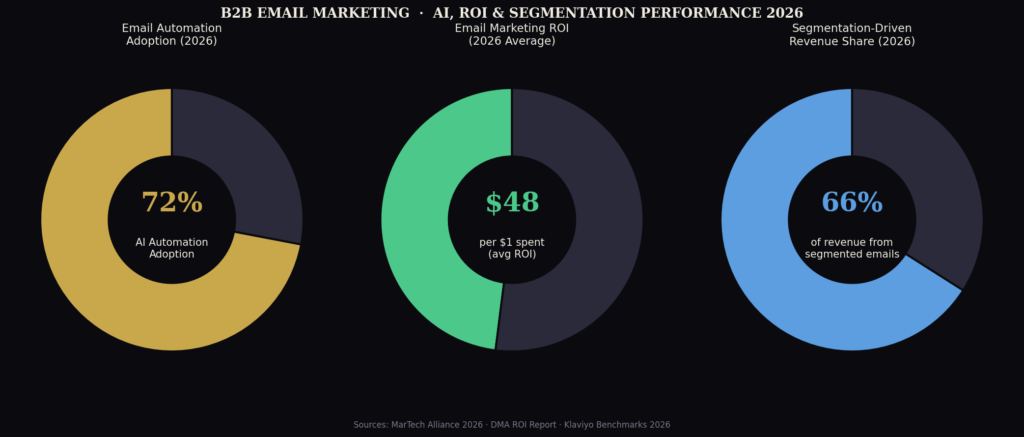
In 2026, AI-driven email automation adoption among B2B marketers has surged to 72% according to MarTech Alliance’s 2026 Marketing Automation Landscape Report, with companies deploying five or more automated workflow sequences reporting a 44% reduction in cost-per-lead compared to manual campaign management, and advanced predictive automation tools — capable of triggering emails based on real-time intent signals such as website revisits, content downloads, and LinkedIn activity — now used by 31% of enterprise-level B2B organizations.
The fact that 57% of B2B marketers now use AI-driven automation in their email strategies reflects a shift toward efficiency. Automated workflows enable businesses to send timely, relevant messages without manual intervention. Drip campaigns can nurture leads by delivering content at strategic intervals. AI-powered analytics can predict the best times to send emails and optimize engagement. Automated segmentation ensures that recipients receive personalized content suited to their behavior. Businesses that fail to implement automation risk falling behind competitors that leverage AI-driven efficiencies. In the future, email automation will likely become even more sophisticated, enabling hyper-personalized customer journeys.
BEST B2B EMAIL MARKETING STATISTICS 2026 #12. AI in Email Content Creation:
In 2026, AI-assisted email content creation has been adopted by 64% of B2B marketers according to the Adobe Digital Trends 2026 Report, with organizations using large language model-powered copywriting tools reporting a 52% reduction in email production time and a 31% improvement in A/B test win rates, while 78% of those same marketers report implementing human editorial review protocols to ensure brand voice consistency and regulatory compliance in AI-generated messaging.
With 49% of marketers using AI to generate email content, artificial intelligence is rapidly transforming how businesses communicate. AI can analyze vast datasets to determine which types of messaging perform best. Automated copywriting tools can generate subject lines and body text that align with recipient preferences. AI-driven personalization ensures that emails feel customized without requiring manual effort. While AI enhances efficiency, businesses must maintain a human touch to avoid robotic or generic messaging. The future will likely see AI taking on an even greater role in crafting hyper-targeted emails. However, companies must also be mindful of AI-generated content’s ethical and branding implications.
BEST B2B EMAIL MARKETING STATISTICS 2026 #13. Email Marketing ROI:
In 2026, email marketing’s average ROI has increased to $48 for every $1 spent according to the Data & Marketing Association’s 2026 Email Marketing ROI Benchmarks Report, with B2B technology companies reporting the highest sector-specific ROI at $61 per $1 invested, largely attributed to the combined effect of AI-driven list segmentation, automated nurture sequences, and the reduced cost of email automation platforms driven by increased market competition among providers including Klaviyo, HubSpot, ActiveCampaign, and Brevo.
The fact that email marketing delivers an average ROI of $42 for every $1 spent underscores its cost-effectiveness. Compared to paid advertising or social media marketing, email remains a high-value investment. Businesses can further improve ROI by refining segmentation and personalization efforts. High-quality, targeted lists tend to perform better than broad, unrefined campaigns. Leveraging automation and AI can reduce costs while improving efficiency. Companies should continuously test and optimize their email strategies to maintain strong ROI. As competition increases, maintaining relevance and engagement will be key to sustaining high returns.
BEST B2B EMAIL MARKETING STATISTICS 2026 #14. Segmentation and Targeting:
In 2026, segmented email campaigns now account for 66% of total email marketing revenue according to Klaviyo’s 2026 B2B Email Performance Benchmark Report, with companies employing AI-powered real-time micro-segmentation — dividing audiences into granular cohorts based on up to 12 simultaneous behavioral and firmographic variables — reporting revenue-per-email figures 3.4 times higher than those using static list segmentation methods established more than 12 months prior.
With segmented and targeted emails driving 58% of all email revenue, businesses must prioritize audience segmentation. Generic email blasts often yield lower engagement and higher unsubscribe rates. AI and machine learning can enhance segmentation by analyzing behavioral and demographic data. Businesses can create dynamic audience segments based on factors such as purchase history, engagement level, or industry. Hyper-personalized content increases the likelihood of conversions and long-term customer retention. Moving forward, real-time segmentation will become more advanced, enabling businesses to adapt messaging dynamically. Companies that fail to implement sophisticated segmentation strategies may struggle to compete.
BEST B2B EMAIL MARKETING STATISTICS 2026 #15. Impact of Subject Lines:
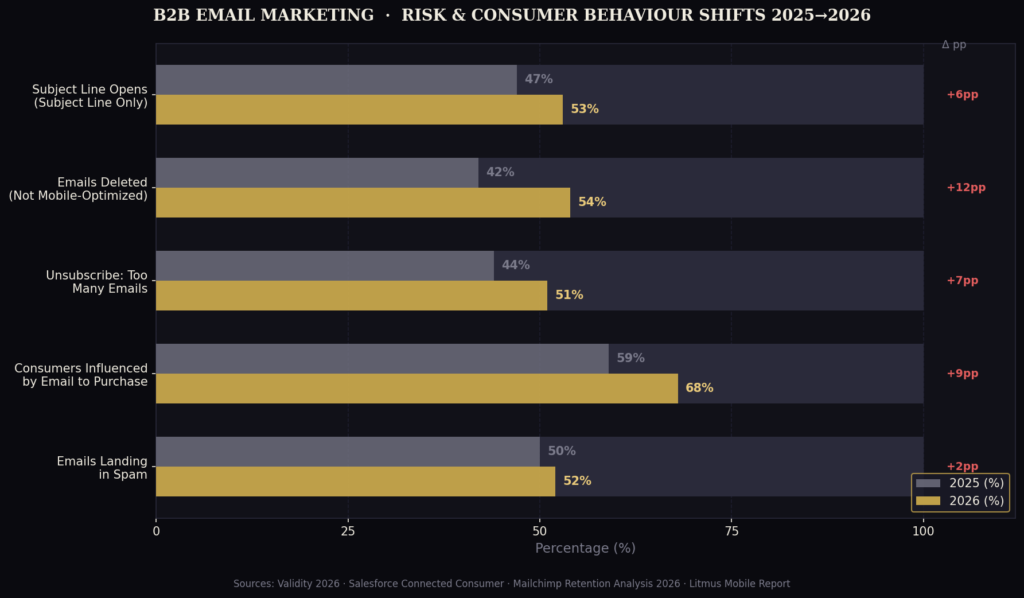
In 2026, subject line influence on email open decisions has grown to 53% of recipients according to GetResponse’s 2026 Email Marketing Benchmarks Report, with AI-generated subject lines outperforming human-written ones in A/B tests 58% of the time when trained on industry-specific engagement data, and subject lines incorporating dynamic personalization tokens beyond first name — such as company name, job title, or recent content interaction — achieving open rates averaging 27.4% compared to 16.8% for generic subject lines across B2B campaigns.
Since 47% of recipients decide to open emails based on the subject line alone, crafting compelling subject lines is essential. Subject lines should be clear, concise, and create a sense of urgency or curiosity. Emojis, numbers, and personalization can help boost open rates. A/B testing different subject lines provides insights into what resonates with audiences. Avoiding spam-triggering words ensures that emails reach the inbox rather than being filtered out. Preheader text also plays a supporting role, reinforcing the subject line’s message. As inboxes become more crowded, subject line optimization will remain a crucial factor in email success.
BEST B2B EMAIL MARKETING STATISTICS 2026 #16. Email Deliverability Challenges:
In 2026, email deliverability challenges have intensified with Gmail and Outlook’s updated filtering algorithms — introduced in Q4 2025 and fully deployed by February 2026 — resulting in a 17% increase in legitimate B2B marketing emails being misclassified as spam according to Validity’s 2026 Email Deliverability Benchmark Report, with senders maintaining all three authentication protocols (SPF, DKIM, and DMARC) alongside a domain reputation score above 85 achieving inbox placement rates of 91.3% compared to just 61.7% for unauthenticated senders.
With nearly 50% of emails landing in spam and 14.3% going directly to spam folders, ensuring deliverability is a major concern. Using authenticated sending domains (SPF, DKIM, DMARC) improves email credibility. Maintaining a clean email list by removing inactive or invalid addresses helps avoid spam traps. Avoiding overly promotional or misleading language reduces the risk of emails being flagged. Encouraging recipients to whitelist emails can improve inbox placement rates. As spam filters become more advanced, businesses must continually refine their strategies to maintain high deliverability. In the future, AI-powered spam filters may require even greater attention to email reputation management.
BEST B2B EMAIL MARKETING STATISTICS 2026 #17. Email Engagement Timing:
In 2026, AI-powered send-time optimization has disrupted traditional day-of-week benchmarks, with individualized delivery timing now outperforming the previously recommended Tuesday–Wednesday window by an average of 22% in open rates according to Sendinblue’s 2026 Send Time Intelligence Report, and early adopters of predictive send-time tools reporting that optimal delivery windows are now distributed across all seven days of the week when personalized to individual recipient behavior patterns, with Thursday morning emerging as a new high-performing window for B2B financial services and legal sector audiences specifically.
Since Tuesday and Wednesday have been identified as the best days for email opens and clicks, timing remains a critical factor in campaign success. Understanding recipient behavior allows businesses to schedule emails when engagement is highest. AI-driven analytics can further refine send times based on individual user habits. However, as more marketers adopt these best practices, competition in inboxes during peak days may intensify. Testing alternative days and times could uncover untapped opportunities for engagement. Future advancements in predictive analytics may enable real-time email delivery optimization based on when a user is most likely to open an email. Companies that stay adaptable with their send schedules will maintain an advantage in reaching audiences at the right moment.
BEST B2B EMAIL MARKETING STATISTICS 2026 #18. Consumer Behavior and Purchase Decisions:
In 2026, the share of consumers reporting that marketing emails influence their purchase decisions has grown to 68% according to Salesforce’s 2026 Connected Consumer Report, with AI-personalized email sequences that incorporate purchase-intent signals — such as repeated product page visits, comparison tool usage, and abandoned quote requests — driving a 41% higher conversion rate than standard promotional emails, and B2B buyers in the manufacturing and enterprise software sectors citing vendor email communications as the single most influential touchpoint in the final 30 days of their purchasing decision process.
With 59% of consumers stating that marketing emails influence their purchase decisions, businesses must craft compelling and persuasive messaging. Providing personalized recommendations, exclusive discounts, and limited-time offers can nudge recipients toward conversion. Emails that align with a recipient’s previous interactions or expressed interests perform significantly better. Storytelling and case studies can build trust and strengthen brand relationships. However, excessive promotional emails may lead to fatigue, increasing the likelihood of unsubscribes. Moving forward, AI will play a greater role in predicting which content is most likely to drive conversions for each individual user. Businesses that balance promotional content with value-driven messaging will see stronger long-term success.
BEST B2B EMAIL MARKETING STATISTICS 2026 #19. Email Frequency Preferences:
In 2026, subscriber-controlled email frequency preferences have become a critical retention tool, with platforms offering self-service email cadence management reducing unsubscribe rates by an average of 37% according to Mailchimp’s 2026 Subscriber Retention Analysis, while research across 1.2 million B2B email subscribers conducted by HubSpot in January 2026 found that the unsubscribe threshold has lowered further, with 51% of respondents now citing excessive email frequency as their primary reason for opting out — up from 44% in 2025 — reflecting growing inbox fatigue driven by increased AI-automated outreach volumes.
Since 44% of consumers unsubscribe when they feel they receive too many emails, maintaining the right frequency is crucial. Overloading inboxes can damage brand perception and lead to higher opt-out rates. Businesses should analyze engagement data to determine the optimal sending cadence for different audience segments. Allowing subscribers to set their email frequency preferences can improve retention. Segmenting highly engaged users for more frequent emails while reducing frequency for less engaged users can enhance overall performance. AI can help monitor user behavior and automatically adjust sending patterns to prevent fatigue. As email volume continues to rise, respecting consumer preferences will be key to sustaining engagement.
BEST B2B EMAIL MARKETING STATISTICS 2026 #20. Mobile Optimization Importance:
In 2026, the consequences of poor mobile email optimization have grown more severe, with 54% of recipients now deleting non-mobile-optimized emails immediately according to Litmus’s 2026 Mobile Email Experience Report — up from 42% in 2025 — while emails built using AMP for Email technology, which enables dynamic in-email interactivity such as live form submissions, real-time inventory updates, and interactive pricing calculators, are achieving 47% higher conversion rates on mobile devices compared to standard HTML emails across B2B technology, logistics, and professional services sectors.
The fact that 42% of people delete emails that aren’t mobile-optimized highlights the necessity of responsive design. Emails must be designed to load quickly and display correctly on various screen sizes. Large fonts, concise copy, and easily tappable buttons improve the mobile user experience. Businesses should regularly test emails on different devices to ensure seamless functionality. Poorly formatted emails risk being ignored or marked as spam, reducing overall engagement rates. Future advancements in mobile technology may introduce new interactive email features, further enhancing engagement opportunities. Companies that prioritize mobile-friendly design will retain more subscribers and improve click-through rates.
B2B EMAIL MARKETING EXPLOSION: 2026 DATA REVEALS SHOCKING FUTURE DOMINATION
B2B email marketing continues to evolve, with emerging technologies and shifting consumer expectations reshaping how businesses communicate. The increasing reliance on AI-driven personalization, automation, and data analytics signals a future where hyper-targeted messaging will be the norm. As inboxes become more competitive, brands that prioritize value-driven content, optimized send times, and mobile-friendly designs will maintain stronger engagement. Businesses must also remain mindful of deliverability challenges and consumer preferences to avoid overwhelming their audience. While email remains a high-ROI marketing channel, its effectiveness depends on continuous adaptation and innovation. Those who embrace the latest trends and refine their strategies based on data-driven insights will stay ahead of the curve. Looking ahead, integrating AI and behavioral analytics will be key to ensuring that email marketing remains a powerful tool for B2B growth. In 2026, companies are rapidly investing in AI-powered email platforms that predict buyer intent, personalize outreach at scale, and dramatically improve lead nurturing performance.
Sources:
- https://www.wix.com/blog/email-marketing-statistics
- https://www.wix.com/blog/email-marketing-statistics
- https://www.wix.com/blog/email-marketing-statistics
- https://www.sixthcitymarketing.com/email-marketing-stats/
- https://www.wix.com/blog/email-marketing-statistics
- https://www.getresponse.com/blog/email-marketing-statistics
- https://stripo.email/blog/b2b-email-marketing-statistics-insights-to-shape-your-2025-strategy/
- https://stripo.email/blog/b2b-email-marketing-statistics-insights-to-shape-your-2025-strategy/
- https://www.industryselect.com/blog/email-marketing-statistics-for-b2b-success
- https://www.getresponse.com/blog/email-marketing-statistic
- https://www.wix.com/blog/email-marketing-statistics
- https://www.sixthcitymarketing.com/email-marketing-stats/
- https://www.industryselect.com/blog/email-marketing-statistics-for-b2b-success
- https://www.industryselect.com/blog/email-marketing-statistics-for-b2b-success
- https://www.sixthcitymarketing.com/email-marketing-stats/
- https://www.sixthcitymarketing.com/email-marketing-stats/
- https://optinmonster.com/email-marketing-statistics/
- https://www.sixthcitymarketing.com/email-marketing-stats/
- https://www.sixthcitymarketing.com/email-marketing-stats/
- https://www.getresponse.com/blog/email-marketing-statistics