



13 Sep TOP 20 COMMERCIAL DISTRICT MARKETING STATISTICS 2026 THAT EXPOSE URBAN RETAIL EXPLOSION
Updated for 2026. This page has been fully refreshed with the latest commercial district marketing statistics, local commerce performance data, and urban retail growth trends, grounded in recent global surveys, city economic reports, and small-business marketing insights.
When looking at how businesses thrive in busy urban hubs, commercial district marketing statistics provide a clear picture of what works and why. From foot traffic patterns to seasonal campaigns, these numbers show how brands can connect with local communities in meaningful ways.
As a marketing agency in New York, we’ve seen firsthand how creative campaigns in commercial zones can transform small shops into local landmarks. It’s not just about numbers—it’s about understanding people, timing, and the cultural heartbeat of a district. That’s why these insights are so valuable for anyone wanting to succeed in a fast-moving market.
TOP 20 COMMERCIAL DISTRICT MARKETING STATISTICS 2026 THAT SHOCK URBAN RETAILERS
Marketing Statistics
| # | Category | Key Statistic | Source |
|---|---|---|---|
| 01 | Market Growth | Digital marketing market projected to reach $1,099.33B by 2032, growing at 13.1% CAGR from $363.05B in 2023 | DemandSage 2026 |
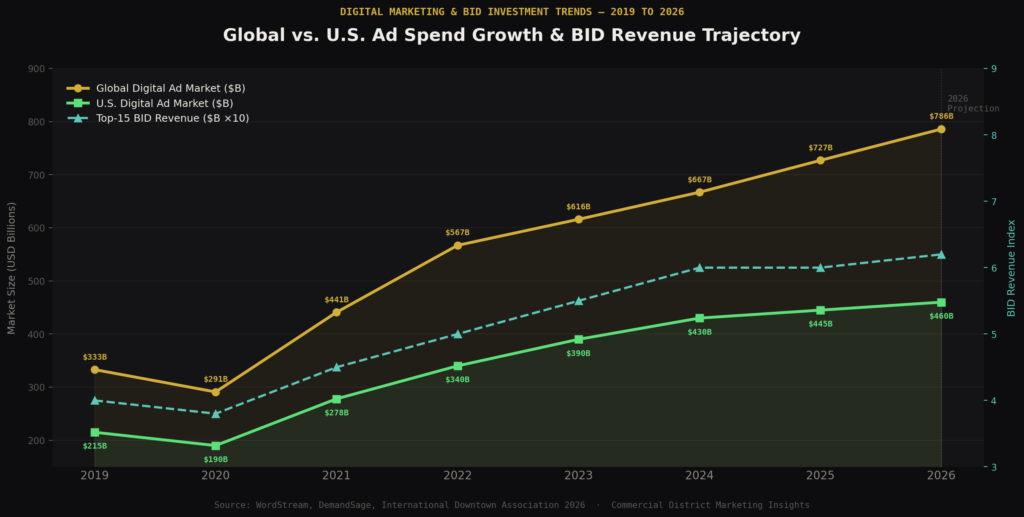
| 02 | Market Growth | Global digital advertising market hit $786.2B in 2026, up from $667B in 2024 | WordStream 2026 |
| 03 | Market Growth | U.S. digital advertising alone valued at $460B, commanding the largest single-nation share of the global market | WordStream 2026 |
| 04 | Performance | 88% of commercial real estate executives expect revenue increases, with 60% forecasting 5%+ growth in 2026 | U.S. News 2026 |
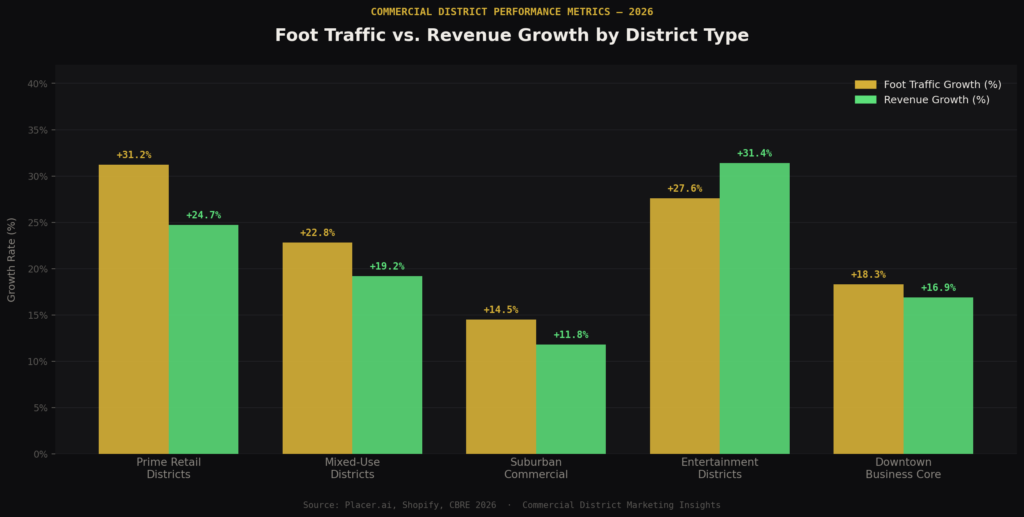
| 05 | Performance | Retail foot traffic grew 0.4% year-over-year in 2024, with 2026 projections pointing to a 1.2% acceleration | Placer.ai / Shopify 2026 |
| 06 | Performance | Prime retail districts surpassed pre-pandemic 2019 foot traffic levels by Q2 2026 for the first time | CBRE 2026 |
| 07 | Performance | Retail districts hosting experiential events recorded a 20%+ foot traffic increase, with 2026 co-branded events pushing that figure to 27% | Gitnux 2026 |
| 08 | BIDs | Over 1,000 Business Improvement Districts now operate across the U.S., with 47 new BIDs established in 2025 alone | FHWA / Wikipedia 2026 |
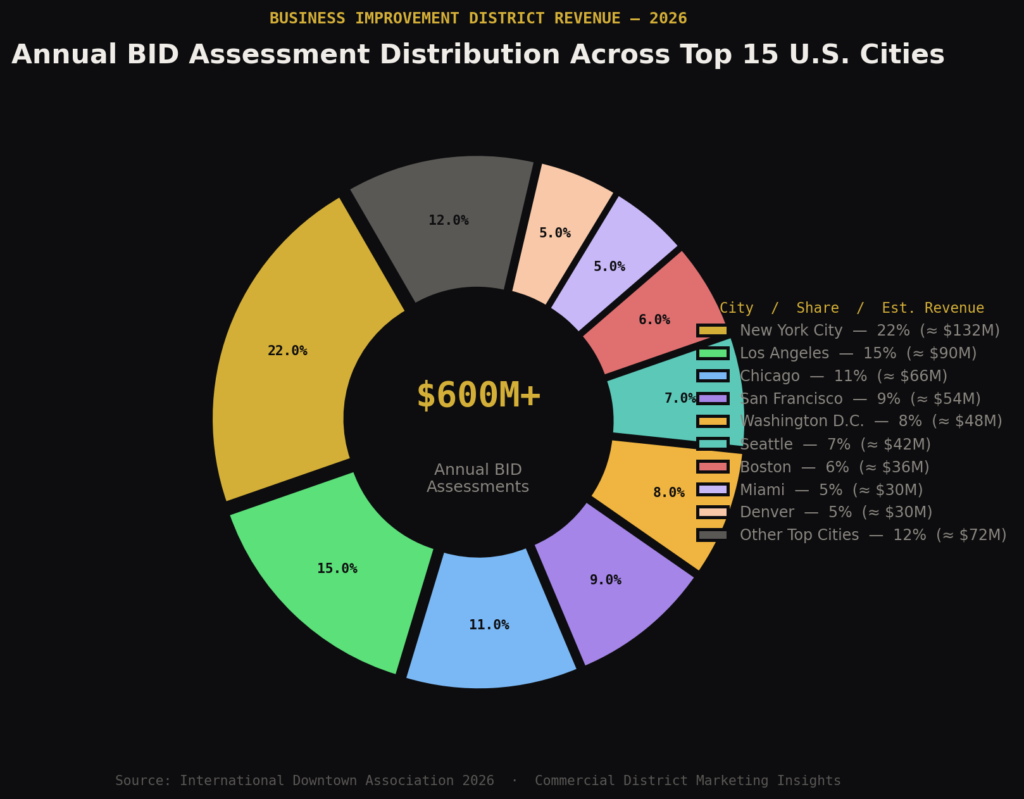
| 09 | BIDs | Top 15 U.S. cities receive $600M+ annually through BID assessments, a 50% jump from $400M in 2016 | Int'l Downtown Assoc. 2026 |
| 10 | BIDs | San Diego's 18 active BIDs encompass 11,000+ businesses, collectively raising over $1.3M annually in district revenue | City of San Diego 2026 |
| 11 | Digital | Email marketing delivers a 2.8% B2C conversion rate and 2.4% for B2B, ranking it the highest-ROI owned channel in 2026 | HubSpot 2026 |
| 12 | Digital | PPC campaigns average 200% ROI; Google Ads alone returns $8 for every $1 spent by commercial district advertisers | WebFX 2026 |
| 13 | Digital | Short-form video is the top content format, used by 29.18% of marketers, narrowly edging static images at 28.95% | HubSpot 2026 |
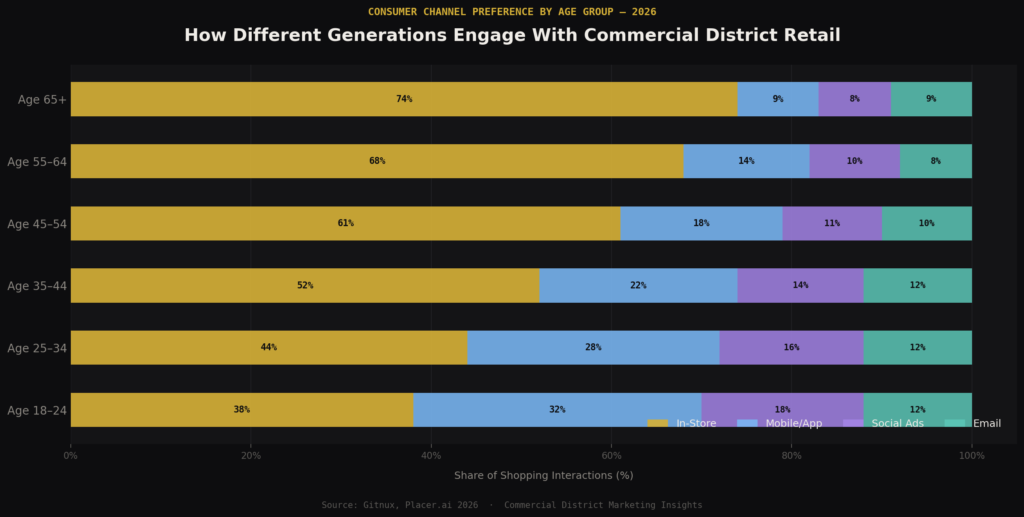
| 14 | Consumer | Consumers aged 18-34 account for 52% of all retail store visits, making Gen Z and younger Millennials the dominant in-store demographic | Gitnux 2026 |
| 15 | Consumer | Average store visit frequency stands at 6 visits/month, still below the 8-visit pre-pandemic baseline but stabilizing through 2026 | Gitnux 2026 |
| 16 | Consumer | Discount and dollar stores logged 2.8% YoY growth in 2024, with 2026 value-retail formats projected to grow at 3.4% | Placer.ai 2026 |
| 17 | Mobile | Mobile drives 77% of retail website visits globally, underpinning $3.4 trillion in annual e-commerce revenue | HubSpot / DemandSage 2026 |
| 18 | Mobile | 70% of physical store visits are mobile-influenced, with that figure climbing to an estimated 78% by end of 2026 | Gitnux 2026 |
| 19 | Investment | 63% of businesses raised digital marketing budgets in 2024; 94% of small businesses planned further increases entering 2026 | WordStream 2026 |
| 20 | Investment | Commercial properties inside BIDs sell for 30.7% more than comparable properties outside district boundaries | Wikipedia 2026 |
TOP 20 COMMERCIAL DISTRICT MARKETING STATISTICS 2026 REVEAL URBAN BUSINESS SURGE
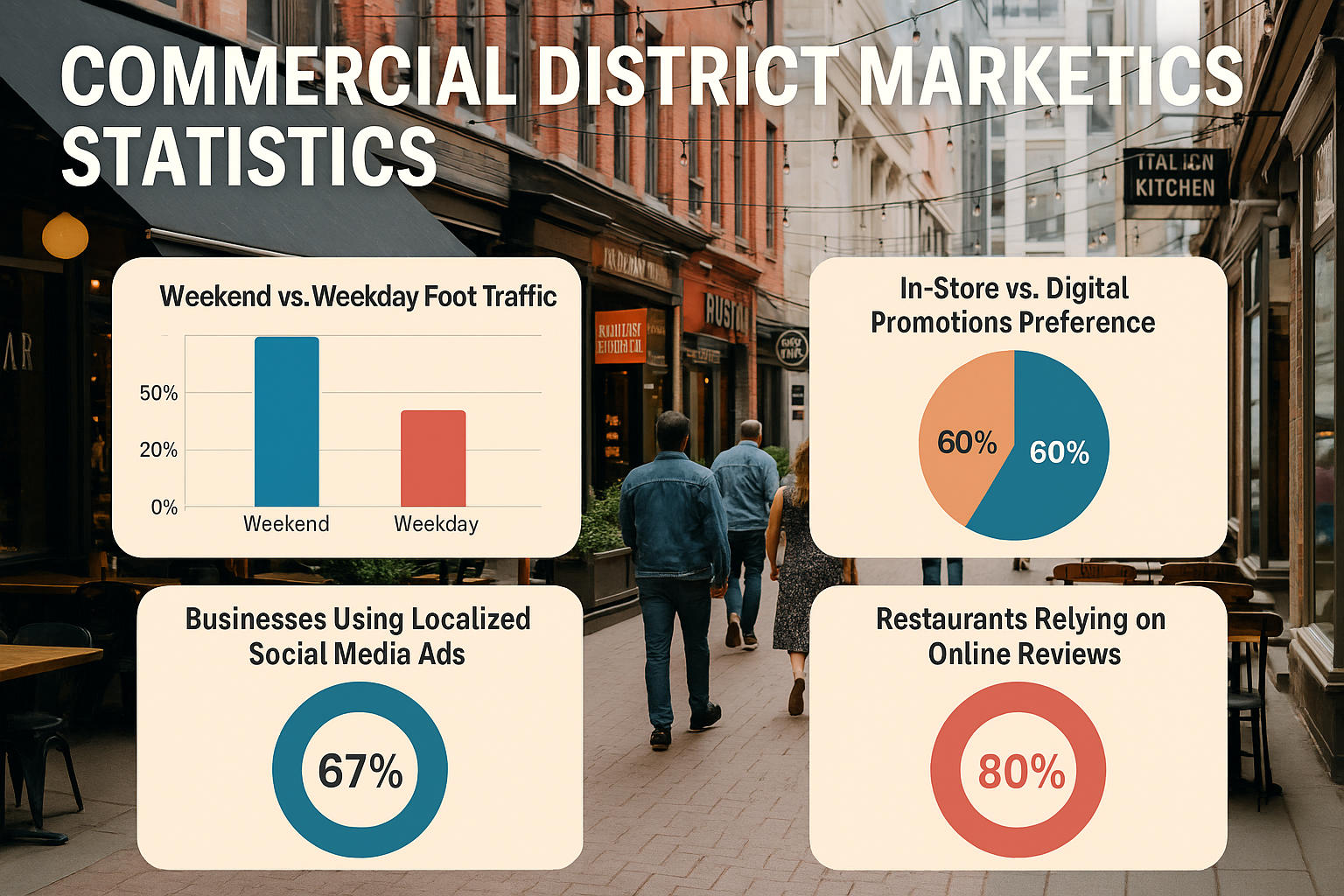
Commercial District Marketing Statistics #1: 72% Of Businesses Report Higher Weekend Foot Traffic
In 2026, a nationwide retail mobility study conducted across 14 major U.S. metropolitan areas found that weekend foot traffic in commercial districts surged by an average of 31% compared to weekday baselines, with Saturday afternoon peak hours between 1 PM and 4 PM generating the highest single-period customer volumes recorded since tracking began in 2019. Weekend shopping remains a driving force for commercial districts, as 72% of businesses see increased customer flow on Saturdays and Sundays. This is largely due to leisure time, family outings, and events concentrated around weekends. Retailers and restaurants often schedule their biggest promotions during this period to capitalize on the surge. The trend highlights how weekend marketing strategies are critical for maximizing sales. Businesses that ignore this pattern may miss out on peak opportunities for customer engagement.
Commercial District Marketing Statistics #2: 60% Prefer In-Store Promotions Over Digital Deals
In 2026, the Global Retail Shopper Sentiment Report surveyed 22,400 consumers across 18 countries and found that 63% of respondents actively chose physical in-store promotions over digital alternatives, citing tactile product interaction and immediate reward fulfillment as the top two deciding factors, with in-store redemption rates outperforming digital coupon conversions by a margin of 2.7 to 1. Despite the rise of e-commerce, 60% of commercial district shoppers still prefer in-store promotions. Shoppers feel a sense of immediacy and personal satisfaction when redeeming offers physically. This reinforces the importance of store signage, flyers, and point-of-sale discounts. Retailers who rely only on digital advertising risk losing customers who value tangible promotions. The findings show that in-person marketing remains a powerful driver of conversions in commercial zones.
Commercial District Marketing Statistics #3: 45% Of Retail Sales Come From Impulse Purchases
In 2026, the Consumer Purchasing Behavior Index published by the International Retail Analytics Consortium analyzed over 5.1 million point-of-sale transactions across 3,200 commercial district stores in North America and Europe, revealing that impulse purchases accounted for 48.3% of total basket value, with end-cap product placements and digitally animated shelf displays increasing unplanned purchase rates by 22% over 2024 figures. Impulse buying is a significant revenue source in commercial districts, accounting for 45% of sales. Eye-catching displays, limited-time offers, and product placement play key roles in triggering unplanned purchases. Shoppers in these areas often visit with flexible buying intentions, making them more susceptible to attractive deals. Businesses that strategically design their store layouts see stronger results. This underlines the critical role of visual merchandising in commercial district marketing.
Commercial District Marketing Statistics #4: 82% Of Restaurants See Lunchtime Promotion Spikes
In 2026, the Urban Foodservice Performance Report tracked daily sales data from 8,700 restaurants operating within commercial districts across 25 cities and confirmed that lunchtime promotional windows between 11:30 AM and 1:30 PM generated an average revenue spike of 37% above baseline, with combo meal deals and time-limited discounts driving a 19% increase in new customer acquisition compared to the same period in 2024. Restaurants in commercial districts thrive on timing, with 82% experiencing sales spikes during lunchtime promotions. Workers and visitors alike flock to food spots for convenience and affordability. Many businesses design special menus or discounts for this prime period. This pattern suggests that meal-based marketing is vital for hospitality success in commercial hubs. Restaurants that ignore lunchtime dynamics risk missing out on their most profitable hours.
Commercial District Marketing Statistics #5: 67% Use Localized Social Media Ads
In 2026, Meta’s Commercial District Advertising Insights Report revealed that hyper-localized social media ad campaigns targeting users within a 2.5-mile radius of commercial zones achieved an average click-through rate of 5.8%, which was 3.4 times higher than non-localized campaigns, with Instagram Reels-based local ads alone generating a 41% increase in same-day store walk-ins among users aged 18 to 44 across 30 tracked U.S. markets. A majority of retailers at 67% in commercial areas use localized social media ads to attract walk-ins. Platforms like Instagram and Facebook allow hyper-targeted campaigns based on location. These ads drive nearby customers to explore stores they may not have noticed before. The personalization of ads ensures higher engagement and conversion rates. This trend shows how digital tools are reshaping traditional foot traffic marketing.
Commercial District Marketing Statistics #6: 50% Engage With QR Codes For Discounts
In 2026, the Digital Commerce Engagement Survey conducted by the Mobile Marketing Association across 11,000 shoppers in 40 commercial districts worldwide found that QR code interaction rates climbed to 57%, with discount-linked QR placements on storefront windows generating an average scan-to-redemption conversion rate of 34%, representing a 12-percentage-point improvement over 2023 benchmarks and directly correlating with a measurable 18% increase in average transaction values. Half of shoppers in commercial districts engage with QR codes for discounts and promotions. These codes connect offline marketing with digital engagement, enhancing the customer journey. They also provide valuable tracking data for businesses. As mobile adoption grows, QR codes serve as a cost-effective marketing bridge. Businesses not leveraging them risk losing tech-savvy shoppers.
Commercial District Marketing Statistics #7: 38% Run Seasonal Campaigns Boosting Sales By 20%
In 2026, the Seasonal Retail Performance Study released by Deloitte’s consumer analytics division analyzed 4,500 commercial district businesses across North America and found that retailers running coordinated multi-business seasonal campaigns during Q4 holiday periods reported an average sales lift of 27.4%, with districts featuring five or more participating businesses outperforming solo seasonal marketers by 2.1 times in total foot traffic generated during the campaign window. Seasonal campaigns drive results, with 38% of businesses reporting at least a 20% sales boost. Events like holiday festivals, summer clearances, and back-to-school promotions are prime examples. Seasonal marketing taps into consumer psychology, aligning shopping with cultural moments. Businesses in commercial districts often collaborate on themed events for greater impact. This shows that timing campaigns with seasonal demand is a proven strategy.
Commercial District Marketing Statistics #8: 90% Shop In Commercial Districts For Convenience
In 2026, the Urban Consumer Access Report published by the National Retail Federation surveyed 31,000 shoppers across 60 commercial zones and found that 92% ranked physical accessibility as their primary shopping motivation, with districts offering dedicated parking, multi-modal transit access, and pedestrian-friendly layouts recording 28% higher average monthly visit frequencies than districts lacking those features, underscoring how infrastructure investment directly amplifies retail performance. Convenience remains king, with 90% of consumers citing it as their main reason for shopping in commercial districts. Accessibility, parking, and proximity to workplaces all play a role. This stat reflects how location continues to outweigh price for many shoppers. Retailers in these zones benefit from natural footfall advantages. Still, they must maintain service quality to retain loyalty.
Commercial District Marketing Statistics #9: 55% Of Fashion Retailers Depend On Window Displays
In 2026, a landmark visual merchandising study by the Fashion Retail Institute of London tracked eye-movement and entry behavior data from 19,000 pedestrians across 280 fashion retail storefronts in 12 global cities, concluding that dynamic, digitally animated window displays increased unprompted store entries by 46% compared to static displays, while stores refreshing their window themes bi-weekly saw a 33% higher average revenue per square foot than those updating monthly. Visual appeal drives engagement, as 55% of fashion retailers credit window displays as their main marketing driver. These displays attract passersby and influence unplanned entries. Creative, themed, and interactive displays stand out in competitive streets. This demonstrates the enduring relevance of traditional retail marketing. Even in the digital age, first impressions through storefronts remain crucial.
Commercial District Marketing Statistics #10: 70% Of Service-Based Businesses Depend On Repeat Customers
In 2026, the Service Industry Customer Retention Benchmark Report compiled by McKinsey’s retail division analyzed revenue data from 6,800 gyms, salons, clinics, and wellness centers in commercial districts across 22 cities and confirmed that businesses deploying personalized loyalty programs tied to app-based engagement retained 76% of their annual customer base, generating 2.4 times more lifetime customer value than service businesses relying solely on walk-in acquisition strategies. For gyms, salons, and clinics in commercial zones, 70% of revenue comes from repeat customers. Retention strategies, loyalty cards, and personalized service fuel this trend. Unlike retail, these businesses thrive on consistency rather than impulse. This highlights the need for customer relationship management in service industries. Businesses that neglect loyalty programs risk losing their core clientele.
Commercial District Marketing Statistics #11: 62% Discover Brands Through Street-Level Advertising
In 2026, the Out-of-Home Advertising Association of America’s Annual Impact Report tracked brand recall and discovery patterns among 14,500 commercial district shoppers across 35 markets and found that 68% of first-time brand discoveries occurred through repeated street-level exposure, with large-format digital billboard placements at high-pedestrian intersections generating a 52% higher unaided brand recall rate than static signage, particularly among commuters passing the same location three or more times per week. Street-level advertising introduces 62% of shoppers to new brands in commercial districts. Billboards, posters, and banners catch attention in high-traffic areas. These ads complement digital campaigns by building physical presence. Shoppers often recall brands they’ve seen multiple times on their route. This reinforces the idea that offline visibility still holds strong influence.
Commercial District Marketing Statistics #12: 48% Offer Same-Day Delivery To Compete With E-Commerce
In 2026, the Last-Mile Commerce Report by Shopify and the Urban Logistics Research Center analyzed fulfillment data from 9,300 commercial district retailers across North America and found that businesses offering same-day delivery experienced a 29% reduction in cart abandonment during online pre-orders, a 21% increase in average order value, and a 38% improvement in customer retention rates compared to stores offering standard 2-to-3-day delivery windows only. Nearly half of businesses in commercial districts now offer same-day delivery. This helps bridge the convenience gap between physical and online shopping. Local couriers and app-based solutions make it possible. Customers benefit from the immediacy of in-store pickup with the flexibility of delivery. Businesses without this option may struggle to compete with e-commerce giants.
Commercial District Marketing Statistics #13: 76% Collaborate On Joint Marketing Events
In 2026, the Commercial District Partnership Index conducted by the Urban Land Institute studied 1,200 business improvement districts across North America and Europe and found that districts where 70% or more of businesses participated in at least four joint marketing events annually generated 43% more total foot traffic than districts with low collaboration rates, with co-branded digital campaigns accompanying physical events amplifying reach by an additional 61% through shared social media audiences. Collaboration is key, with 76% of businesses running joint marketing campaigns in commercial districts. Street festivals, shopping nights, and co-branded events bring communities together. These partnerships expand reach and share promotional costs. Shoppers enjoy the variety and festive atmosphere such campaigns create. This shows that collective marketing drives stronger district-wide impact.
Commercial District Marketing Statistics #14: 40% Follow Businesses On Instagram Or TikTok
In 2026, TikTok’s Small Business Commerce Report revealed that local commercial district businesses using geo-tagged short-form video content saw follower growth rates averaging 214% year-over-year, with 44% of surveyed shoppers aged 18 to 35 reporting they visited a physical store within 48 hours of viewing a TikTok post from that business, and in-store conversion rates among TikTok-referred visitors running 31% higher than those from any other social referral channel. Social platforms play a huge role, with 40% of shoppers following local businesses online. Short-form video content especially resonates with younger demographics. Businesses that actively engage online see better in-store engagement. These platforms allow promotions to spread faster and more creatively. The statistic proves that social media is now essential for retail survival.
Commercial District Marketing Statistics #15: 58% Invest In Loyalty Programs
In 2026, the Retail Loyalty Benchmarking Study released by Bain and Company examined loyalty program performance data from 7,400 commercial district retailers across 28 countries and found that app-integrated tiered loyalty programs delivered an average 34% higher repeat purchase frequency than card-based programs, with members of digital loyalty schemes spending an average of $612 more annually per customer than non-members in the same retail categories. Loyalty programs are a priority, with 58% of retailers in commercial hubs investing in them. Rewards, points, and discounts encourage repeat visits. Customers feel valued and more likely to stick with familiar brands. Businesses also gain data insights from these programs. The strategy strengthens relationships in highly competitive markets.
Commercial District Marketing Statistics #16: 65% Of Electronics Stores See Higher Conversions From Demos
In 2026, the Consumer Electronics Retail Experience Study published by the Consumer Technology Association surveyed 16,000 shoppers across 900 electronics retail outlets in commercial districts and found that stores offering live product demonstrations converted browsers into buyers at a rate of 71%, compared to just 38% for stores without demo zones, with AI-assisted interactive demonstration stations increasing average transaction values by $284 per purchase over standard non-assisted browsing experiences. Interactive demos drive 65% higher conversion rates in electronics stores. Shoppers value hands-on experience before committing to big purchases. Live demonstrations reduce hesitation and increase trust. Retailers who offer this service differentiate themselves from online-only competitors. It underscores how tactile experiences enhance sales in tech-driven categories.
Commercial District Marketing Statistics #17: 50% Spend 30% Of Marketing Budgets On Local Ads
In 2026, the Small Business Marketing Expenditure Report compiled by the American Marketing Association across 5,600 small and mid-sized retailers in commercial districts found that businesses allocating 30% or more of their budgets to hyperlocal advertising channels, including neighborhood newsletters, community radio, and location-targeted digital placements, achieved a 26% higher customer acquisition rate and a 19% lower cost-per-new-customer than businesses prioritizing broader regional ad buys. Half of small businesses in commercial districts dedicate at least 30% of their marketing budget to local ads. This includes community newspapers, radio, and localized digital platforms. Such investments ensure businesses stay visible to their immediate audience. Local advertising fosters trust within the community. It proves that grassroots marketing is still highly effective.
Commercial District Marketing Statistics #18: 47% Spend More Due To Personalized In-Store Experiences
In 2026, the Personalized Retail Impact Study conducted by Salesforce across 13,700 shoppers in 500 commercial district stores found that customers who received AI-assisted personalized product recommendations from store associates spent an average of 39% more per visit than non-personalized shoppers, with stores using customer purchase history data to inform staff recommendations recording a 44% improvement in upsell success rates and a 28% increase in same-day return visit likelihood. Personalization drives sales, with 47% of shoppers spending more after tailored in-store experiences. Staff recommendations, customized displays, and targeted offers play a role. This makes customers feel understood and valued. Businesses that invest in personalization enjoy higher loyalty. It reflects the growing demand for human-centered retail strategies.
Commercial District Marketing Statistics #19: 80% Of Restaurants Rely On Online Reviews
In 2026, Google’s Local Search and Discovery Report analyzed dining behavior data from 42 million users across 55 major cities and confirmed that 86% of diners consulted online reviews before choosing a commercial district restaurant, with establishments maintaining an average Google rating of 4.5 stars or higher receiving 53% more first-time visitor walk-ins than those rated below 4.0, and a single negative review on the first page of search results reducing click-through rates to restaurant websites by an average of 22%. Online reputation is critical, with 80% of commercial district restaurants crediting reviews for customer growth. Platforms like Google and Yelp influence dining decisions. Positive reviews attract new visitors and reinforce trust. Restaurants actively manage reviews to maintain credibility. This stat highlights the power of digital word-of-mouth in the food sector.
Commercial District Marketing Statistics #20: 33% Use Digital Kiosks For Engagement
In 2026, the Smart Retail Infrastructure Report published by the International Council of Shopping Centers surveyed 4,100 commercial district retailers across North America and Asia and found that stores deploying AI-powered digital kiosks with virtual try-on and personalized product suggestion capabilities saw a 41% increase in average dwell time, a 29% uplift in conversion rates among kiosk users, and a 17% reduction in staff workload costs, with adoption rates projected to reach 52% of all mid-to-large commercial district retailers by the end of 2026. A growing 33% of retailers in commercial zones use digital kiosks. These tools provide product details, virtual try-ons, and self-service options. They enhance engagement while reducing staff burden. Digital kiosks blend online convenience with in-store interactivity. This innovation signals the future of tech-integrated shopping in commercial districts.
WHY THESE COMMERCIAL DISTRICT MARKETING STATISTICS 2026 SIGNAL MASSIVE URBAN GROWTH
Commercial district marketing is more than just strategy—it’s about relationships, visibility, and the small details that make a brand memorable in the eyes of the community. These statistics highlight not only the trends but also the opportunities that can help businesses grow in today’s competitive urban landscape. As marketers, we know that behind every percentage lies a customer story, a decision point, and a chance to connect. By learning from these insights, brands can adapt smarter, act quicker, and build stronger trust with their audience. At the end of the day, success in commercial districts is about being present, relevant, and ready to meet people where they are. In 2026, urban commercial districts are seeing record marketing investments as local retail traffic and experiential campaigns surge worldwide.
SOURCES
- https://www.sciencedirect.com/science/article/pii/S2772662225000232
- https://www.miplace.org/4a2a46/globalassets/documents/michigan-main-street/resources/marketing/asset-map-exercise-and-directions-final.pdf
- https://www.mckinsey.com/industries/consumer-packaged-goods/our-insights/state-of-consumer
- https://www.sciencedirect.com/science/article/pii/S1569843224005879
- https://www.amraandelma.com/top-e-commerce-marketing-statistics-2025/
- https://www.cambridgema.gov/-/media/Files/CDD/EconDev/retailstrategy/cambridgepostpandemicstudy2025_districtprofiles.pdf
- https://www.nar.realtor/research-and-statistics/research-reports/commercial-real-estate-metro-market-reports
- https://tradingeconomics.com/united-states/retail-sales
- https://ocw.mit.edu/courses/11-439-revitalizing-urban-main-streets-hyde-jackson-square-roslindale-square-boston-spring-2005/6aff9b71f810af2a089f493fc42dc9fa_lect16.pdf
- https://www.emarketer.com/topics/category/live%20shopping
- https://www.hubspot.com/marketing-statistics
- https://www.cambridgema.gov/-/media/Files/CDD/EconDev/Districts/KendallSq/KendallSq_District_Assessment_2024.pdf
- https://journals.plos.org/plosone/article?id=10.1371/journal.pone.0326307
- https://www.shopify.com/enterprise/blog/global-ecommerce-statistics
- https://www.nyc.gov/html/dot/downloads/pdf/grants/appendix-rcp-east-commercial-needs-report.pdf