



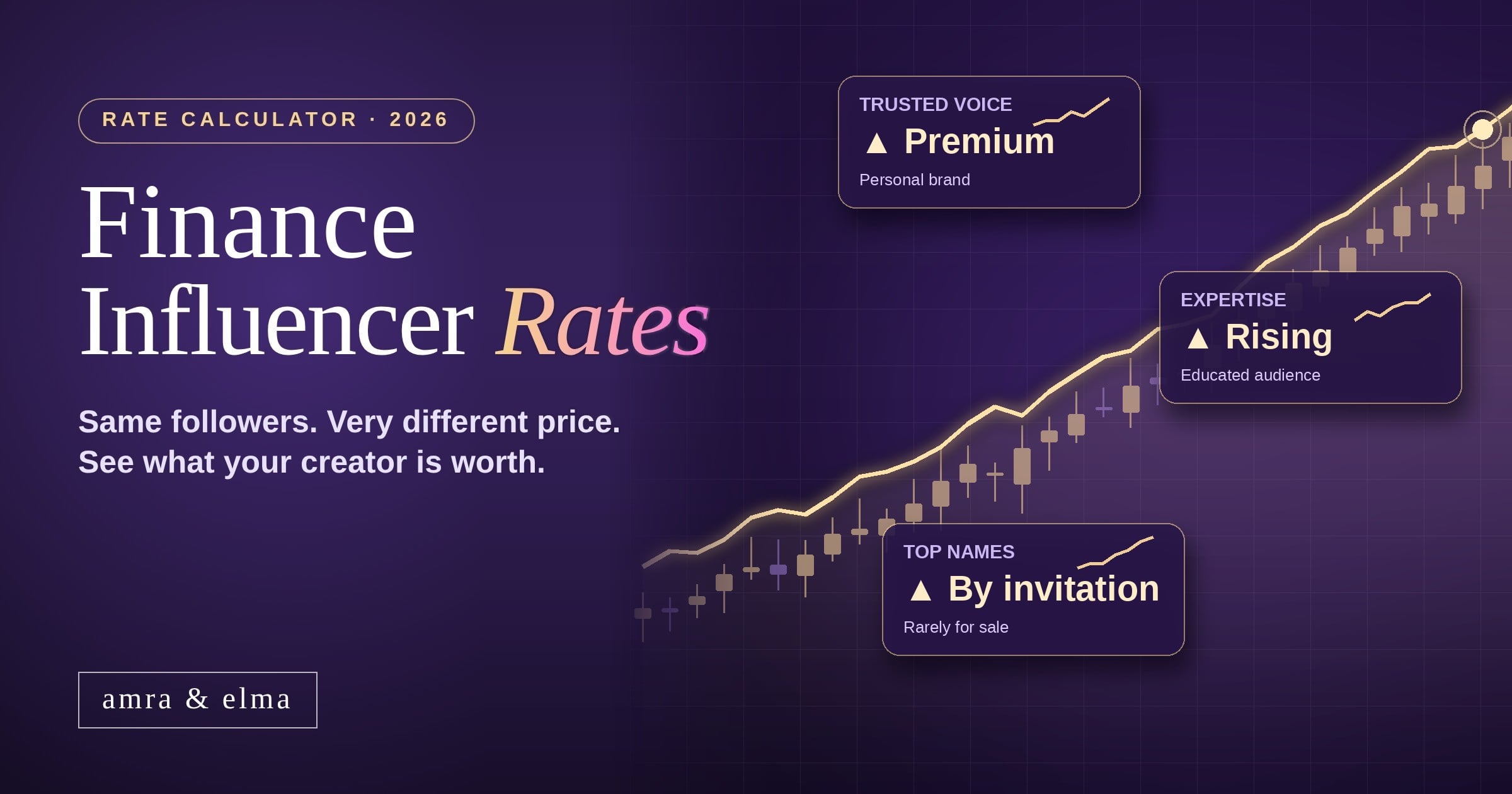
04 Nov Finance Influencer Rate Calculator: What Creators Really Charge (2026)
How much do finance influencers charge?
Use the Amra & Elma finance influencer rate calculator below to estimate any finance creator's fee in seconds.
Amra & Elma Finance Influencer Rate Calculator
Followers open the door. Trust sets the price.
We have been inside this industry since before "influencer" was a job title. In more than 13 years, our team has reviewed and negotiated with thousands upon thousands of creators, and finance is the category where the gap between two accounts of the same size is widest. One finance page can be worth a fraction of what another charges, even with an identical following. The difference is almost never the number on the profile. It is who is speaking, and how much their audience believes them.
Same followers. Several times the price.
What you can't see on the profile is what you pay for
expert
page
Fewer followers. More money. Trust sets the price.
Brands are buying a voice, not a number
Same audience size. Completely different standing.
We built this finance influencer rate calculator on that experience. It does not just count followers. It asks who is behind the account, how established that person has become and which financial brands already trust them, because in finance those signals move the price more than anything else.
What Finance Influencers Really Charge: The Honest Answer
Finance is one of the most valuable categories in influencer marketing, and for a simple reason. A single trusted recommendation for an investing app, a credit card or a bank account can bring in a customer who stays for years. Brands know what that customer is worth, so they pay more to reach the people who can deliver one.
But "finance influencer" covers a huge range, and published industry averages flatten it into one number that fits almost nobody. A page that summarizes market headlines and a former fund manager with the same following are not the same purchase. One reports the news. The other is the news. That is why the finance influencer rate calculator starts with a question no general calculator asks: who is actually behind the account? If you want the general market first, our Instagram influencer rate calculator covers it in depth.
The Biggest Secret: Faceless Pages vs. Personal Brands
Scroll through finance on Instagram or TikTok and you will find enormous accounts with no person behind them at all. They curate business news, repost market charts and summarize headlines. Many are clever and genuinely useful, and people follow them for the quick, curated read. A million followers is not unusual.
Here is what most brands miss: a sponsored post on one of those pages is not a recommendation. Nobody knows who wrote it, so nobody is vouching for the product. The audience trusts the news, not the messenger. Compare that with a finance creator who has built a personal brand. When she tells her audience she uses a product, it lands as advice from someone they know. That is the difference between an ad and an endorsement, and it shows up directly in the price.
Faceless pages still have a place. They are often picky about what they run, especially when well-known names in business follow them, and they can deliver broad awareness quickly. Their rate depends heavily on engagement and on who is actually following. But expect them to price closer to a standard sponsorship, and expect a personal-brand expert of the same size to charge noticeably more.
An ad or an endorsement?
Who is speaking changes everything
Anonymous reach is cheaper. A trusted voice sells.
Why Finance Creators Charge More Than Lifestyle Creators
The creators who talk seriously about money tend to know their subject deeply. Many have worked in banking, investing, accounting or financial planning, and some hold credentials like a CFP, CFA or CPA. Their content takes research, and one careless claim can cost them the trust they have spent years building. That expertise is the product, and it is why a personal-brand finance creator usually charges a clear premium over a fashion or lifestyle creator with the same following.
Their audiences are different too. People who follow finance creators are actively making money decisions: opening accounts, choosing cards, picking where to invest. They are close to a purchase, and that is exactly the audience financial brands compete hardest to reach.
The finance price staircase
Every step up adds trust, and price
page
brand
expert
fintech
heavyweight
The more they know, the more their word is worth.
The Established Finance Creator: Selective by Design
At the top of finance content sit a small number of creators who have become brands in their own right. They have built audiences in the millions, they have been the face of major banks, brokers and fintech apps, and they are selective about who they work with. They mostly partner with large, established financial brands, the kind of names their audience already recognizes and trusts.
Those creators price their recommendation at many times the standard rate, and they rarely negotiate down. A lower price would tell the market their word is worth less. Every partnership has to fit the reputation they have spent years building, because in finance, recommending the wrong product does more than cost a sale. It costs the audience's trust.
Up-and-coming finance creators are a different conversation. They are hungry, they are building their name, and they are far more flexible on price, timing and creative direction. For many brands, especially newer fintech companies, that is where the smartest money goes.
Two finance creators. Two negotiations.
Know which one you're talking to
One sells a name. The other sells momentum.
The Industry Heavyweights: When a Post Is Almost Priceless
Then there is a tier most rate calculators ignore completely. Think of the founder of a well-known investment fund, or the partner who built a private equity firm alongside a household name. These people have spent decades building influence in the industry, and their opinion moves markets, not just followers.
The honest truth is that most of them do not sell sponsored posts at all. Their name is the asset, and they protect it fiercely. When one of them does agree to work with a brand, it is a matter of access as much as money, and the price reflects years of experience and real standing in the industry. The calculator includes this tier so you can see just how far above the market it sits, but for most brands the realistic path is a partnership, an event or a long-term relationship rather than a single post.
Who is buyable, and who isn't
The higher you go, the harder the door
At the very top, you're buying access, not a post.
Why a Finance Influencer Rate Calculator Needs More Than Followers
Follower count sets the floor. It does not set the price. Past a certain size, a bigger audience is simply a broader one, and financial products are specific. A creator whose followers are paying off student loans won't sell a private banking service, and an audience of day traders won't open a retirement account for the long haul. Fit beats size, and rates climb quickly through the mid-tier before flattening at the very top.
The follower mountain
Rates climb fast… then hit a plateau
Past the peak, you pay for fame, not precision.
The Package Finance Creators Actually Sell
On Instagram, the standard package is one in-feed post with three supporting Stories. In finance, the Stories often matter most, because they can walk followers through how a product works, answer questions and point to the sign-up link. Finance creators also tend to build carousel posts that explain a concept slide by slide, which is perfect for products that need a little education.
One post. Three Stories. One price.
The standard finance package
Agree the deliverables before the brief.
Instagram, TikTok or YouTube for Finance?
Finance is the category where the platform matters most, because most financial products need explaining. Instagram is ideal for simple, visual offers and for building trust through a creator's personal story. TikTok is where a younger audience learns money basics in short, punchy tips, usually for a fraction of an Instagram package. YouTube is where serious decisions get made. Long reviews, walkthroughs and "how I invest" videos are watched by people who are close to signing up, and they keep getting found for years, which is why a dedicated video is priced well above Instagram. Our TikTok and YouTube influencer rate calculators go deeper on each.
Quick tip or deep dive?
Pick the platform for the product
Tips spread on TikTok. Decisions get made on YouTube.
Explainer Creators vs. Storyteller Creators
Not every finance creator works the same way, and pushing the wrong format gets you weaker content. After working with thousands of creators, we see two clear camps.
Explainer creators build clean, educational carousels and charts. Every post teaches one idea, and their feed reads like a well-organized textbook their followers save and come back to. Storyteller creators lead with their own life: paying off debt, buying a first home, building wealth in public. Their audiences feel they are on the journey with them. Since a Reel is priced about the same as a feed post, let the creator lead with the format she does best.
Which creator are you hiring?
Match the format to the creator
Let her teach the way she does best.
How the Finance Influencer Rate Calculator Reads Engagement
Few creators know their engagement rate offhand, and media kits go stale fast. Recent posts tell the truth. That is why the finance influencer rate calculator asks for likes and comments on up to three recent posts. One viral post can flatter an account, and one quiet post can undersell it. Three gives you the real picture.
Three posts tell the truth
Why the calculator asks for your last three
engagement
One viral post can fool you. Three can't.
Then read the comments. In finance, real followers ask questions: which account she uses, how a fee works, whether something suits their situation. Rows of emojis and "great post" signal an audience that may not exist at all. It is also worth looking at who follows the account. A page followed by founders, investors and respected names in business carries a weight a bigger but anonymous audience never will.
Real fans or bought ones?
Read the comments. Check the growth.
Real questions, steady growth = a real audience.
Compliance, Usage Rights and Disclosure in Finance
Finance is a regulated category, and that shapes every campaign. Banks, brokers, lenders and investment platforms usually need their compliance team to review creator content before it goes live, and some claims, like promised returns, simply cannot be made. Build that review time into the schedule, and choose creators who are used to working within those rules. It is one more reason experienced finance creators charge more: they make the process smoother.
The rate a creator quotes usually covers posting on her own channels, nothing more. If a brand wants to run that content as a paid ad, feature it on its website or use it in email, those usage rights are negotiated separately, and the longer the period, the higher the fee. Exclusivity works the same way. Asking a finance creator not to work with competing banks, cards or apps limits her income, so she will price that in. And every sponsored post needs a clear disclosure. The FTC's Disclosures 101 for influencers explains what brands and creators are expected to do.
One post. Many places it could live.
Only the first one comes with the rate
Common Mistakes Financial Brands Make
The most expensive mistake is chasing one big name. One post is a moment, and moments fade by tomorrow. The financial brands that break through are the ones that appear everywhere at once, across many trusted voices, until the audience feels everyone is talking about them.
The second mistake is paying personal-brand prices for faceless reach, or expecting a faceless page to deliver the trust only a real expert can. The third is choosing by numbers instead of fit. A creator whose audience isn't ready for your product won't open accounts for you, no matter how big she is.
A moment vs. a movement
Which one gets your brand noticed?
One post is a moment. A thousand posts is a movement.
Getting the Most From the Finance Influencer Rate Calculator
A rate is a starting point, not a final price. Who is behind the account, compliance needs, usage rights and exclusivity all shift the figure. The right expert for the right audience is worth more than a larger account for the wrong one.
Use the finance influencer rate calculator to understand the market, compare creators on equal terms and walk into every negotiation with confidence. Then build a campaign around trust and fit, not just reach, or talk to our team about building one with you.
Finance Influencer Rate Calculator: Frequently Asked Questions
How accurate is the finance influencer rate calculator? It gives a market range based on our campaign pricing data. Final fees still depend on who is behind the account, compliance needs, usage rights and exclusivity.
How much do finance influencers charge? It depends most on who is behind the account. A faceless finance page usually prices close to a standard sponsorship, a personal-brand expert charges a clear premium, and established names charge many times more. Use the calculator above for an estimate based on our campaign data.
Why do finance influencers charge more than lifestyle influencers? Finance creators are usually more knowledgeable about their subject, and their audiences are actively making money decisions. One trusted recommendation can bring a financial brand a long-term customer, so brands pay more to reach them.
Are faceless finance pages worth it? They can deliver broad awareness quickly, but a sponsored post there is not a personal recommendation. Expect them to price closer to a standard sponsorship, depending on their engagement and who follows them.
Can you hire top finance figures for a sponsored post? Rarely. Fund founders and industry heavyweights protect their names and seldom sell posts. When they do work with a brand, it is as much about access and the relationship as the fee.
Should I book finance creators on Instagram, TikTok or YouTube? Instagram for trust and simple offers, TikTok for quick money tips to a younger audience, and YouTube for in-depth reviews and walkthroughs that people watch before they sign up.
Do finance influencer posts need compliance review? Usually, yes. Banks, brokers, lenders and investment platforms often require their compliance team to approve creator content, so build review time into the schedule. Every sponsored post also needs a clear disclosure.
Are finance influencer rates negotiable? Rising finance creators are often flexible. Established names who work with major financial brands rarely move on price, because a lower rate would tell the market their word is worth less.


















influencers posting for one brand.
This is what going viral looks like.
Your brand, everywhere at once. Let's make it happen.
Schedule a Personal Consultation →