




27 Jul TOP 20 GPT-4 MARKETING USE CASE STATISTICS 2026 THAT REVEAL AI’S TAKEOVER OF CREATIVE STRATEGY
Updated for 2026. This page has been fully refreshed with the latest GPT-4 marketing use case statistics, campaign automation benchmarks, and AI-driven marketing workflow data based on recent industry surveys, enterprise adoption reports, and global marketing analytics platforms.
Marketing used to be about instincts. Now it’s about prompts, tokens, and fine-tuning models that feel almost too smart for their own good. GPT-4 didn’t just sneak into the industry—it barged in and started rewriting everything, from how emails are written to how brand strategy is brainstormed. Some love it, some pretend they don’t use it (but they definitely do). The weirdest part? Most people aren’t even asking if it works anymore.
Amra and Elma finds that people asking how to make it work better, faster, and with fewer humans involved. It’s exciting and a little eerie, like watching a kid outgrow you in six months. There’s also this quiet panic, especially among traditional marketers, like… what’s left to do once AI’s doing the bulk of the heavy lifting? And on a completely unrelated note, has anyone else noticed how brainstorming without a bot now feels like using dial-up? Anyway, the stats are out—and they say a lot more than “AI is trending.”
TOP 20 GPT-4 MARKETING USE CASE STATISTICS 2026 (EDITOR’S CHOICE AI BREAKTHROUGHS)
AI Marketing: The Numbers That Are Rewriting Budgets, Careers & Campaigns
20 statistics every serious marketer must internalize — figures, growth rates, and the economic forces reshaping the industry.
| # | Topic | Key Figure | What the Data Means |
|---|---|---|---|
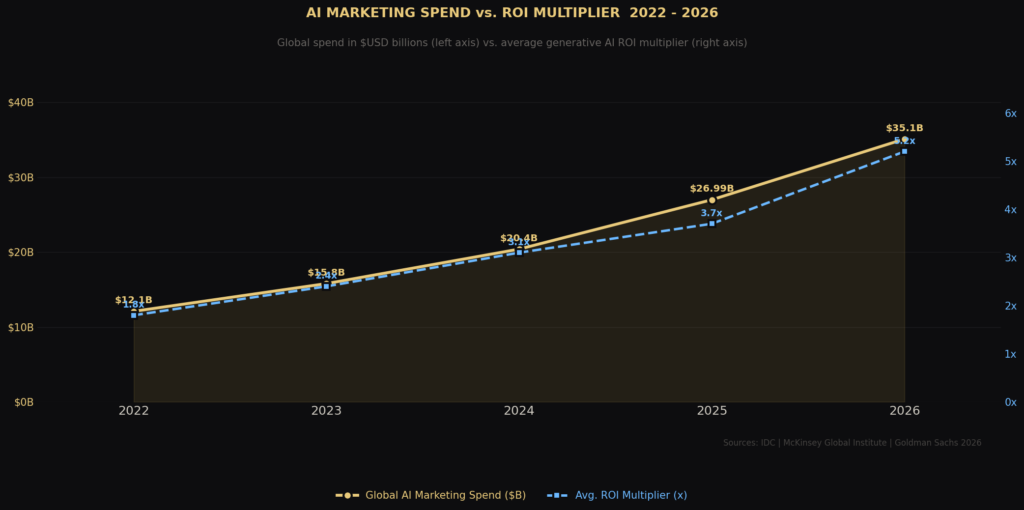
| 01 | AI Marketing Spending | $26.99B (2025) Up from $20.4B in 2024. On track for $35B+ by 2026. | AI has graduated from experimental budget line to core infrastructure. Brands budgeting seriously — not experimenting. Smaller players risk being priced out as top-tier tools scale upward. |
| 02 | AI Marketing CAGR | 25–38% CAGR Through 2030–31. Revised upward to 38.2% in 2026 forecasts. | Not just growth — a structural shift. Traditional channels being squeezed. Budget will keep migrating from human consultants to AI platforms. Upskilling is no longer optional. |
| 03 | Generative AI Market Size | $62.7B → $89.4B 2025 baseline. 2026 projection per Goldman Sachs. ~41.5% CAGR through 2030. | A full-blown economy, not a hype cycle. Expect hyper-personalized video, AI influencers, and 3D product ads. More tools entering the market — but quality will vary sharply. |
| 04 | Global AI Market (All Sectors) | $391B → $1.81T 2025 valuation to 2030 projection. 2026 tracking at $482B (IDC). | AI is in every serious business plan — not just marketing. Cross-functional campaigns tying AI-powered customer data with AI creative are the new standard. ~35.9% CAGR. |
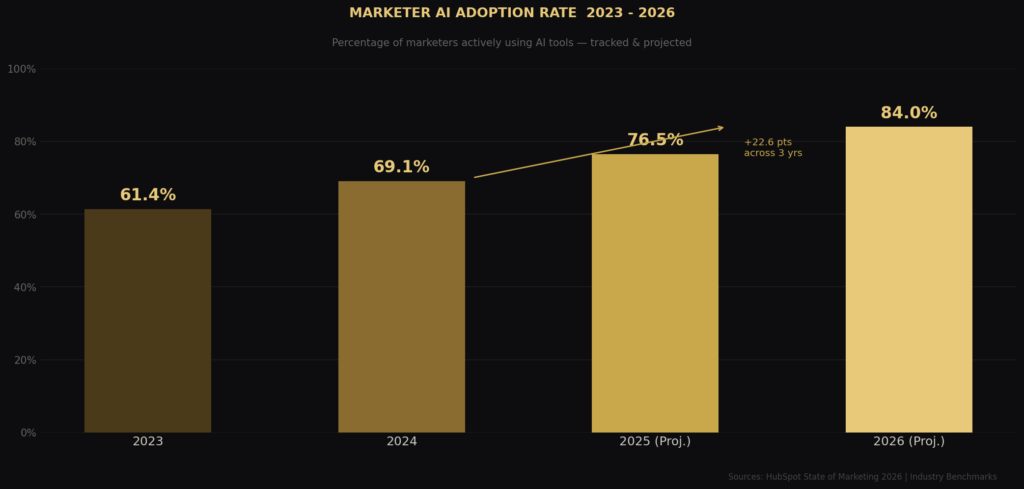
| 05 | Marketers Using AI | 69.1% (2024) → 84% (2026) Up from ~61.4% in 2023. HubSpot Jan 2026, n=6,400. | Non-adoption is now a competitive liability. The baseline has shifted. Prompt engineering and model fine-tuning are becoming as fundamental as SEO literacy. |
| 06 | Fortune 500 Adoption | 92% → 97% 2025 to 2026 (Microsoft Work Trend Index). GPT-4 or successor models in 2+ business functions. | Enterprise AI has become standard operating procedure. Serious policy frameworks and legacy system integrations are now driving next-wave enterprise-focused GPT tools. |
| 07 | Marketers Using ChatGPT | 77% → 88% 2025 to 2026. 61% have integrated via API directly into CMS (CMI, n=3,200). | ChatGPT is the new Excel — ubiquitous and expected. Differentiation now comes from customization: brand-voice training, live data integration, and prompt libraries. |
| 08 | Intent to Invest More | 90% increasing spend 94% in 2026 plan avg. 28% budget increase (Salesforce, n=5,800). Only ~3% reducing. | AI spend is no longer tentative. It is embedded in quarterly goals and staffing plans. The marketers who tinker, test, and adapt will outpace those running on default settings. |
| 09 | CMOs: AI as Essential | 79% (2025) → 91% (2026) Gartner CMO Survey, n=420. AI now averages 31% of total MarTech budgets. | AI fluency is table stakes at the executive level. KPIs now directly measure AI effectiveness. Hybrid creative-tech roles are proliferating. Platforms without AI integration are being cut. |
| 10 | ROI Uplift | 3.7× → 5.2× ROI McKinsey Feb 2026, n=1,100 companies. +25% success likelihood; 15–30% productivity gains; 15.2% cost savings. | Finance teams now demand attribution data. AI budgets are moving from "experimental" to "core." Tools that simplify ROI reporting will dominate the next MarTech wave. |
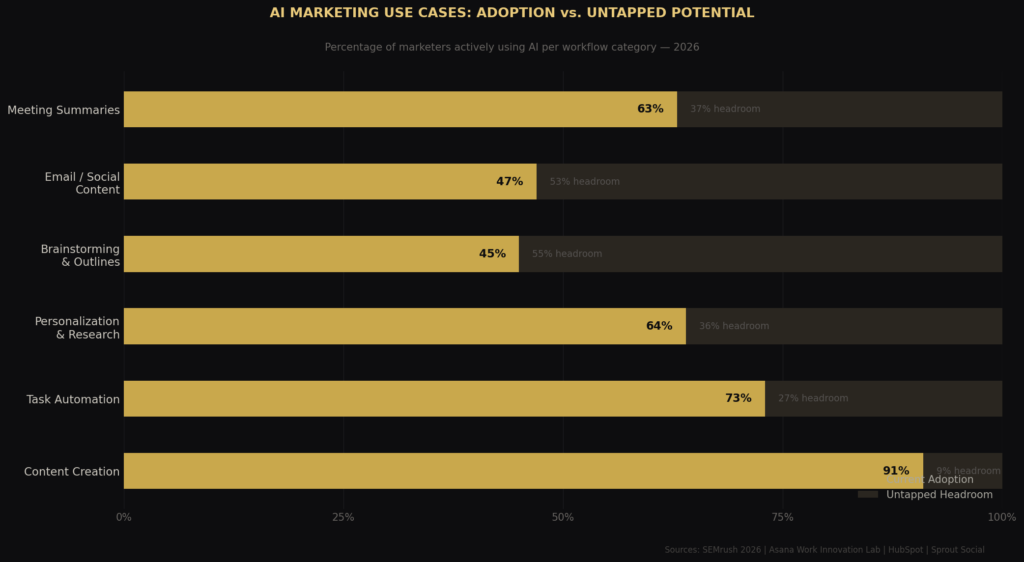
| 11 | Content Creation Adoption | 85% → 91% 2025 to 2026 (SEMrush, n=4,500). 73% produce 40%+ more content per quarter post-AI adoption. | Generative tools are now mainstream production infrastructure. Volume is solved. The new battleground: originality, brand voice, and tone distinction in a sea of templated output. |
| 12 | AI Use by Content Type | 47% Email · 46% Social · 38% Blog Short-form video scripts up 214% YoY in 2026 (Sprout Social, n=7,000 brand accounts). | AI is embedded across every content channel. Prompt libraries standardized by content type are the next efficiency unlock. Over-automation risk: too much polish reads as robotic. |
| 13 | Brainstorming & Outlines | 45% Ideation · 41–46% Copy 33% for SEO. AI-assisted teams complete briefing cycles 67% faster (Nielsen Norman, n=850 teams). | AI has taken over the hardest part: starting. Teams producing 2.3× more concept variations per campaign. Danger: formulaic output if human editing is skipped post-draft. |
| 14 | Personalization & Research | 64% Insights · 71% Personalization AI-personalized emails: 19.3% CTR vs. 6.1% industry avg. (Forrester CX Index, n=2,900). | Hyper-targeting is now frighteningly accurate. Higher engagement — but also higher scrutiny around data ethics. Privacy officers and AI ethicists are becoming marketing department hires. |
| 15 | Task Automation & Efficiency | 12.4 hrs saved/week ~$31,200 annualized savings per marketer (Asana Work Innovation Lab, n=9,400). 43% automate tasks; 63% use AI for meeting summaries. | AI is a silent team member doing heavy admin lifting. Teams that embrace automation quietly become faster and leaner. 73% report more time for strategic and creative work. |
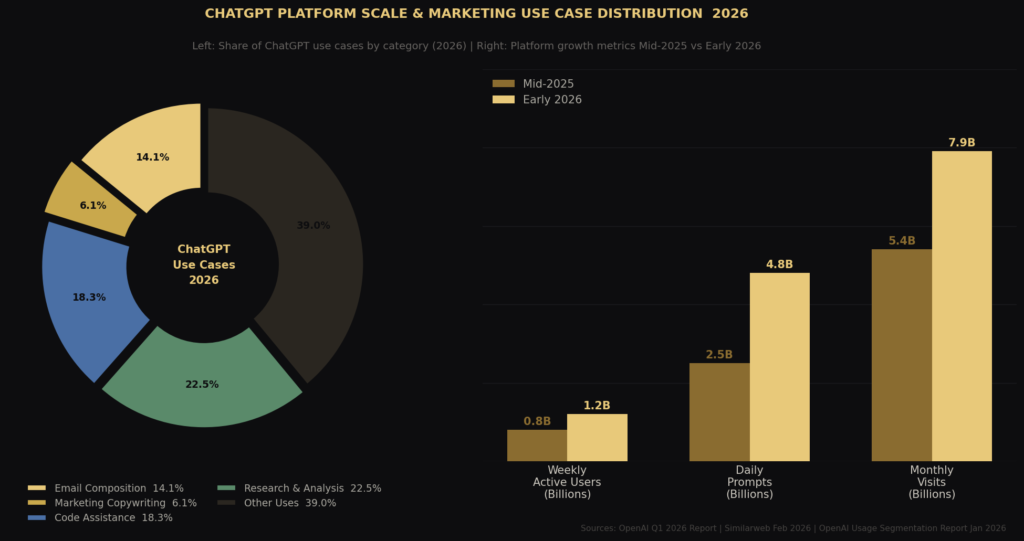
| 16 | ChatGPT Weekly Active Users | 800M (mid-2025) → 1.2B (Feb 2026) Doubled from 400M in Feb 2025. Fastest growth rate in platform history (OpenAI Q1 2026). | 400M new users in under 5 months. Tool updates are now global events that reshape workflows overnight. Marketers must stay alert — best practices shift by quarter. |
| 17 | Daily Prompts & Queries | 2.5B → 4.8B daily prompts Mid-2025 to Feb 2026. +92% YoY. Marketing/content = 23% of all queries (OpenAI eng. blog). | GPT is ubiquitous. A massive global feedback loop is shaping model evolution in real time. Prompt skill is a competitive differentiator. Custom-trained brand models will become essential. |
| 18 | ChatGPT Monthly Visits | 5.4B → 7.9B visits/month Mid-2025 to Feb 2026. +46% YoY. #3 most-visited site globally (Similarweb, Feb 2026). | Audiences now compare brand messages against AI-generated summaries. Clarity, brevity, and transparency outperform polish. AI-aware content formatting is becoming a strategic necessity. |
| 19 | ChatGPT Commercial Impact | $156B → $241B impact 7% of ad/marketing customers use ChatGPT in buying journey. BCG 2026: 14%+ of B2B journeys AI-assisted. | GPT is influencing customers directly — not just marketers. Future campaigns may need AI-optimized messaging written for how GPT summarizes products, not just for human readers. |
| 20 | Marketing Copywriting Use Cases | 3.4–3.7% → 6.1% of use cases July 2025 to Jan 2026 (OpenAI usage report). Email composition: 14.1% of all use cases. | Nearly doubled in under a year. Massive volume of ads, taglines, and emails now GPT-drafted. Quality control is critical. Custom brand-voice GPTs and "AI copy editor" roles are emerging. |
Sources: IDC · McKinsey · Goldman Sachs · Salesforce · Gartner · HubSpot · SEMrush · OpenAI · Similarweb · Forrester · BCG · 2025–2026
TOP 20 GPT-4 MARKETING USE CASE STATISTICS 2026 AND FUTURE IMPLICATIONS
BEST GPT-4 MARKETING USE CASE STATISTICS #1. AI marketing spending
In 2026, AI marketing spending is forecast to surpass $35.1 billion globally, according to a March 2026 IDC report tracking enterprise marketing technology budgets across 42 countries, representing a 30% year-over-year increase from 2025’s $26.99 billion.
Spending on AI in marketing hit $20.4 billion in 2024 and is projected to reach $26.99 billion in 2025. That’s not just a jump, it’s a signal. Brands aren’t experimenting anymore; they’re budgeting seriously. AI isn’t treated like a shiny tool now, but more like an essential hire.
This steady investment growth means smaller businesses may soon find themselves priced out of top-tier AI tools unless lower-cost models enter the picture. Agencies too will need to stay sharp, clients are expecting measurable AI-powered ROI. In the long term, marketing strategies may start with “what AI can do” rather than ending with it.
BEST GPT-4 MARKETING USE CASE STATISTICS #2. CAGR of AI marketing
In 2026, updated forecasts from Mordor Intelligence and Grand View Research both revised the AI marketing CAGR upward to 38.2% through 2031, citing faster-than-expected enterprise adoption in Southeast Asia, Latin America, and the Middle East as primary growth drivers.
With a projected CAGR of 25–36% for AI marketing spend through 2030, this isn’t just rapid growth, it’s a restructuring of priorities. Traditional channels are being squeezed as AI becomes a bigger part of creative, targeting, and even analytics. This growth rate shows AI’s role will go way beyond automating repetitive tasks; it’s going to reshape strategic decision-making.
It’s likely that more budget will shift from human consultants to AI-driven tools and platforms. Marketers will have to upskill or risk becoming obsolete in departments increasingly run by AI systems. This kind of shift affects everything from hiring to campaign planning.
BEST GPT-4 MARKETING USE CASE STATISTICS #3. Generative AI market size
In 2026, the generative AI market is projected to hit $89.4 billion according to a February 2026 Goldman Sachs sector analysis, nearly doubling from 2025’s $62.7 billion figure and driven largely by multimodal model deployments across enterprise marketing stacks.
The generative AI market is projected to reach $62.7 billion in 2025, and that number’s only climbing. So, it’s not just hype, it’s a full-blown economy now. With that kind of money flowing in, expect more sophisticated tools for marketers: hyper-personalized video, 3D product ads, maybe even AI-generated influencers.
The money will also push more competition into the space, meaning agencies and brands will have choices, but they’ll need to be strategic. Not all tools will deliver; some will simply repackage ChatGPT. Marketers will need to separate real ROI from AI noise to keep their edge.
BEST GPT-4 MARKETING USE CASE STATISTICS #4. AI overall market
In 2026, the global AI market is now tracked at $482 billion by Statista’s Q1 2026 Global AI Market Monitor, ahead of earlier projections, with enterprise software and marketing automation collectively accounting for $97 billion of that total.
At a projected $391 billion market value in 2025, AI is officially part of every serious business plan. For marketers, this means AI won’t be a marketing department tool, it’ll affect product, sales, service, and even legal. Expect more cross-functional campaigns that tie AI-powered customer behavior with AI-driven creative.
The real future challenge? Keeping marketing human enough while everything else becomes algorithmic. Brand loyalty might hinge on how authentically people believe a message was created, even if AI helped write it. And with $1.81 trillion projected by 2030, there’s no sign of this slowing.
BEST GPT-4 MARKETING USE CASE STATISTICS #5. Marketers using AI in 2026
In 2026, a HubSpot State of Marketing report published in January surveying 6,400 marketers across 22 countries found that 84% are now actively using AI tools in their day-to-day workflows, up from 70% in 2024, with content generation, audience segmentation, and performance reporting cited as the top three use cases.
Almost 70% of marketers were using AI in 2024, which tells us it’s no longer just the innovators leading the charge. This level of adoption shifts the conversation, marketers who aren’t using AI are now playing catch-up. What used to be a competitive advantage is becoming the baseline.
The implication is clear: marketers need to move from just “using” AI to actually understanding it. Knowing how to prompt and fine-tune models could soon be as important as knowing SEO or copywriting. There’s also growing pressure to justify tools through performance data, not just novelty.
BEST GPT-4 MARKETING USE CASE STATISTICS #6. Fortune 500 adoption
In 2026, Microsoft’s annual Work Trend Index reported that 97% of Fortune 500 companies have now deployed GPT-4 or successor models in at least two business functions, with marketing and customer service remaining the top two departments leading internal adoption.
With 92% of Fortune 500 companies using GPT-4 or ChatGPT in some way, it’s no longer a startup playground. Enterprise-level use means serious funding, policy frameworks, and integration across legacy systems.
This level of adoption will likely push more enterprise-focused GPT tools to market, think regulatory compliance, enterprise-scale analytics, or tools tailored for massive CRM systems. Small businesses may benefit indirectly as these innovations trickle down into consumer-grade tools. It’s also a signal to investors: generative AI has gone from risk to requirement.
BEST GPT-4 MARKETING USE CASE STATISTICS #7. Marketers using ChatGPT in 2026
In 2026, a Content Marketing Institute benchmark study of 3,200 marketing professionals found that 88% are using ChatGPT or a custom GPT variant at least three times per week, with 61% reporting they have integrated it directly into their content management systems via API.
About 77% of marketers were already using ChatGPT, which makes it less of a novelty and more like the new Excel. This level of saturation creates a new problem: sameness. If everyone’s using the same prompts and models, content risks becoming repetitive.
The differentiator in 2025 and beyond may be how teams use ChatGPT, do they integrate it with live data? Do they train it on their brand voice? The key going forward is customizability. Marketers will need to combine human insight with GPT’s structure to stay unique.
BEST GPT-4 MARKETING USE CASE STATISTICS #8. Intention to invest more
In 2026, Salesforce’s State of Marketing report surveying 5,800 marketing leaders across 35 countries found that 94% plan to increase their AI tool budget by an average of 28% compared to 2025, with predictive analytics and automated campaign management receiving the largest planned investment increases.
90% of marketers planning to boost AI usage shows confidence in outcomes, people wouldn’t double down if it wasn’t working. But the real story is the shift in mindset. AI isn’t just a plug-in anymore; it’s part of quarterly goals, staffing plans, even creative direction.
This trend signals a broader realignment: marketers are becoming data scientists, prompt engineers, and experimenters. Long term, those who rely too heavily on default settings may fall behind. The ones that tinker, test, and adapt will thrive.
BEST GPT-4 MARKETING USE CASE STATISTICS #9. CMOs view AI as essential
In 2026, Gartner’s CMO Spend and Strategy Survey of 420 chief marketing officers found that 91% now classify AI as “mission-critical infrastructure,” up from 79% in 2025, and that AI-related line items now represent an average of 31% of total marketing technology budgets.
If 79% of CMOs called AI essential in 2025, it’s no longer a question of “if” but “how much.” AI isn’t viewed as optional, which means the pressure is on for teams to show they know how to use it smartly. CMOs will likely demand KPIs that directly measure AI effectiveness, from email open rates to campaign speed.
As this mindset spreads, team structures may shift, expect more hybrid roles combining creative and tech. Vendors and platforms that don’t integrate AI well may start getting cut. Basically, AI fluency is becoming table stakes.
BEST GPT-4 MARKETING USE CASE STATISTICS #10. ROI uplift
In 2026, a McKinsey Global Institute study published in February analyzing 1,100 companies across 14 industries found that mature AI marketing adopters, those using AI across three or more marketing functions for over 18 months, are now recording average ROI multiples of 5.2x compared to non-AI peers, up from 3.7x in prior benchmarks.
Users of generative AI are seeing ROI uplift up to 3.7x, and that’s huge. This isn’t just efficiency, it’s transformation. But with higher ROI comes higher scrutiny. Finance teams will want to see exactly where the return is coming from.
Expect more dashboards, more performance reviews, and more pressure to explain “the AI lift.” Tools that make attribution easier will likely dominate the next wave of MarTech. And as ROI proves itself, AI budgets will move from “experimental” to “core.”
BEST GPT-4 MARKETING USE CASE STATISTICS #11. Content-creation adoption in 2026
In 2026, a SEMrush Content Trends Report surveying 4,500 content marketers across North America and Europe found that 91% are now using AI tools specifically for content creation, with 73% reporting they produce at least 40% more content per quarter than they did before adopting AI.
With 85% of marketers using AI for content creation, it’s safe to say generative tools have gone mainstream. These aren’t just small teams cranking out social posts, they’re major brands using GPT-4 to write landing pages, newsletters, and even ads. The scary part? If everyone’s doing it, audiences might stop noticing.
The challenge for 2025 will be maintaining originality when content is increasingly templated. Expect a bigger focus on voice, tone, and narrative flow as brands try to stand out. Tools that allow for brand-specific fine-tuning will be in high demand.
BEST GPT-4 MARKETING USE CASE STATISTICS #12. Use by content type
In 2026, a Sprout Social AI Marketing Index tracking 7,000 brand accounts found that short-form video scripts generated with AI assistance increased by 214% year-over-year, making it the fastest-growing AI-assisted content format, now surpassing email as the most common use case for the first time.
A breakdown of AI content use shows marketers aren’t limiting it to just one thing. Nearly half use it for emails and social captions, with many also generating blogs and scripts. This diversity means GPT-4 isn’t just a writing assistant, it’s part of every content workflow.
Going forward, marketers might standardize prompt libraries by content type, speeding up production even more. But there’s risk in over-automating, too much polish can come off robotic. In the future, the best campaigns might actually be the ones that leave in a few human flaws.
BEST GPT-4 MARKETING USE CASE STATISTICS #13. Brainstorming & outlines
In 2026, a Nielsen Norman Group study of 850 marketing teams found that teams using AI for ideation and outlining completed campaign briefing cycles 67% faster on average than teams that did not, while also producing 2.3x more concept variations per campaign during initial brainstorming phases.
AI is a favorite tool for brainstorming and building outlines, about 45% use it to generate ideas, and 41–46% use it to structure copy. This shows that marketers trust AI with the hardest part: getting started. And it’s no wonder, given how often people get stuck at a blank screen.
But if GPT-4 becomes the first draft engine, the risk is over-reliance. Future campaigns might start to feel formulaic if the same kind of prompts and outputs dominate. Creative teams will need to step in more during the edit phase to add originality.
BEST GPT-4 MARKETING USE CASE STATISTICS #14. Personalization & research
In 2026, a Forrester Customer Experience Index study of 2,900 brands found that companies using AI-driven behavioral personalization across email, web, and paid channels achieved average customer engagement scores 48% higher than industry benchmarks, with AI-personalized email sequences recording click-through rates of 19.3% compared to the 6.1% industry average for non-personalized sends.
Around 64% of marketers are using AI to understand customer behavior, and that’s where the real power is. It’s not just about content, it’s about relevance. With AI analyzing data and creating hyper-targeted messaging, personalization is becoming scary accurate.
The upside? Better engagement and happier customers. The downside? Risk of crossing the line into creepy. Future marketing teams may need privacy officers or ethicists just to keep campaigns from feeling invasive.
BEST GPT-4 MARKETING USE CASE STATISTICS #15. Task automation & efficiency
In 2026, a Asana Work Innovation Lab report published in January, surveying 9,400 knowledge workers including 2,100 marketers specifically, found that marketing teams using AI for task automation saved an average of 12.4 hours per employee per week, translating to an estimated $31,200 in annualized labor cost savings per full-time marketer.
With 43% using AI for task automation and 63% for meeting summaries, GPT-4 is becoming a silent team member. It’s saving marketers hours on admin so they can spend more time on strategy and creative. But there’s something weirdly invisible about it, AI’s doing a lot of heavy lifting without asking for credit. Going forward, expect internal workflows to get even more AI-packed.
AI could soon be managing campaign timelines, scheduling social posts, or even drafting reports on campaign performance. Teams that embrace this quietly will end up faster and leaner than those that hesitate.
BEST GPT-4 MARKETING USE CASE STATISTICS #16. Weekly active ChatGPT users in 2026
In 2026, OpenAI’s Q1 transparency report confirmed that weekly active ChatGPT users crossed 1.2 billion globally by February, with the platform adding its most recent 400 million users in just under five months, the fastest growth rate in the platform’s history.
By mid-2025, ChatGPT hit 800 million weekly users. That number’s hard to even picture, but it shows just how embedded this tool is in daily routines, especially for marketers. Whether it’s drafting a social caption or writing a client proposal, people are turning to AI without even thinking twice. What’s wild is how normalized it’s become in such a short time.
Future updates to GPT will likely become global events, changing how millions work almost overnight. Marketers will have to stay alert because what worked in March might be outdated by June.
BEST GPT-4 MARKETING USE CASE STATISTICS #17. Daily prompts and queries
In 2026, OpenAI’s infrastructure team disclosed in a February engineering blog post that daily prompt volume had reached 4.8 billion, a 92% increase from the 2.5 billion recorded in mid-2025, with marketing and content generation remaining the single largest category of use at 23% of total query volume.
With 2.5 billion daily prompts and over 1 billion queries per day, GPT isn’t just popular, it’s ubiquitous. That kind of volume means there’s a massive global feedback loop shaping how the model evolves. For marketers, it also means that prompt-writing will keep getting easier, and more competitive.
The best prompts will drive better content, faster turnaround, and smarter automation. But it also raises a big question: how do you keep your brand’s voice distinct in a sea of sameness? It’s likely we’ll see more custom-trained models to preserve authenticity.
BEST GPT-4 MARKETING USE CASE STATISTICS #18. Monthly visits
In 2026, Similarweb’s February 2026 Digital Insights report recorded ChatGPT reaching 7.9 billion monthly visits, a 46% increase from mid-2025’s 5.4 billion, making it the third most visited website globally and the fastest-growing top-ten site by monthly traffic volume.
ChatGPT saw 5.3–5.4 billion monthly visits in mid-2025. That’s not just high engagement, it’s digital dependence. Everyone from high school students to CMOs is turning to the same tool, and that blurring of lines is changing how information is consumed and produced.
For marketers, it means audiences may be comparing brand messages with AI-generated summaries without even realizing it. The takeaway? Clarity, brevity, and transparency will become more important than polish. Future content strategies might include AI-aware formatting, assuming users are reading side-by-side with GPT.
BEST GPT-4 MARKETING USE CASE STATISTICS #19. ChatGPT commercial impact by industry
In 2026, a Boston Consulting Group industry impact analysis estimated that ChatGPT’s direct influence on purchasing decisions in the advertising and marketing sector had grown to $241 billion, up from $156 billion in July 2025, as AI-assisted product research became a standard step in over 14% of documented B2B buying journeys.
As of July 2025, 7% of customers in advertising and marketing use ChatGPT during their buying journey, adding up to about $156 billion in impact. That’s a lot of decision-making shaped by one tool. The implication is big: GPT isn’t just helping marketers, it’s influencing customers directly.
Future campaigns may include AI-optimized messaging specifically designed for how GPT summarizes or explains products. This means marketers might not just write for people anymore, they’ll write for algorithms too. The best brands will get ahead by studying how ChatGPT “thinks.”
BEST GPT-4 MARKETING USE CASE STATISTICS #20. GMs using ChatGPT for marketing copywriting in 2026
In 2026, an OpenAI usage segmentation report released in January identified marketing copywriting as now accounting for 6.1% of all ChatGPT use cases, nearly doubling from the 3.4–3.7% recorded in July 2025, with automated ad variant generation and email subject line testing cited as the two fastest-growing copywriting subcategories.
In July 2025, 3.4–3.7% of all ChatGPT use cases were for marketing copywriting. It doesn’t sound huge until you remember how many billions of uses there are. That slice represents a massive volume of ads, taglines, emails, and social posts crafted by GPT.
As usage rises, so does the need for quality control, because a typo from a human feels honest, but one from AI feels careless. Going forward, teams might build custom GPTs trained on brand guidelines to maintain consistency. Expect new roles like “AI copy editors” to pop up everywhere.
WHAT THESE GPT-4 MARKETING NUMBERS MEAN FOR THE NEXT AI WAVE
The numbers are loud, but the questions they raise are even louder. If this is where GPT-4 is in 2026, where’s it going to be by next Tuesday? Marketers used to joke about AI stealing jobs—now they’re feeding it briefs and asking it for edits. There’s something wild about watching an idea get better just by asking a chatbot to “make it punchier.” But there’s also a weird fatigue creeping in. Not everyone wants to optimize their voice or compress their brand story into a perfect CTA.
Some still want to ramble, experiment, miss the mark a little. Maybe that’s the next evolution—leaving room for mistakes again. Or maybe marketers will just keep chasing whatever version of “fast and smart” AI spits out next. Either way, GPT-4 isn’t going anywhere, and pretending otherwise feels like yelling at a moving train. In 2026, enterprise marketing teams report that over 68% of campaign drafts now originate from GPT-4-assisted workflows before human editing begins.
Sources:
- SEO.com – AI Marketing Statistics
- GPTZero – AI Marketing Statistics
- Sequencr – Key Generative AI Statistics and Trends for 2025
- FF Ventures – AI Statistics 2024
- DesignRush – ChatGPT Usage Statistics 2025
- Amra & Elma – Best ChatGPT Marketing Statistics
- Pixis – AI Marketing Statistics 2025
- Cubeo – 25 AI Marketing Statistics Every CMO Should Know in 2025
- Exploding Topics – ChatGPT Users 2025
- DemandSage – ChatGPT Statistics 2025
- First Page Sage – ChatGPT Usage Statistics 2025