



05 Mar The Ultimate Guide to Marketing Digital Assets Like the Best Agency in the World
Here’s something nobody in this industry wants to admit: most digital asset marketing is terrible.
Not just mediocre. Genuinely, embarrassingly terrible. You’ve seen it — the robotic Twitter threads, the YouTube ads with guys in rented Lamborghinis, the Discord servers that feel like a hostage situation. Somewhere between the blockchain revolution and the mainstream moment we’re living in right now, the marketing never caught up. And that gap? That’s where the real opportunity lives.
Here at Amra and Elma, a leading marketing agency in New York, we have spent years working with some of the most recognized brands in the world (Fortune 100) — luxury houses, global consumer brands, emerging tech companies — and what we’ve learned applies just as powerfully to digital assets as it does to a $5,000 handbag. People don’t buy products. They buy stories, status, safety, and belonging. The brands that understand this in the digital asset space are the ones quietly printing while everyone else is screaming into the void.
So here’s the playbook. Not theory. The actual steps.
The Ultimate Guide to Marketing Digital Assets (Editor’s Choice)
The Ultimate Guide to Marketing
Digital Assets
Like the Best Agency in the World
Most digital asset brands are leaving millions on the table. Here's the exact 10-step playbook the world's sharpest agencies use — and nobody else is talking about.
Define Your Digital Asset's Core Value Proposition With Ruthless Clarity
Before a single dollar is spent on creative or campaigns, you need one sentence that explains why this exists and why anyone should care. You're not selling blockchain technology. You're selling what it means to someone's life — freedom, access, protection. Bitcoin became Bitcoin because its value proposition was simple enough to tattoo on your arm: digital gold. Find your version. Everything else is built on this.
Know Your Audience Down to Their Bone-Deep Motivations
The crypto audience in 2025 looks nothing like it did five years ago. It's not just tech bros arguing on Reddit. It's a 42-year-old accountant who bought Bitcoin through Fidelity. A 28-year-old in Lagos using stablecoins to protect her savings. Nearly one-third of U.S. investors started through memecoins — meaning emotion and community are the real on-ramps, not white papers. Meet people where they are, not where you wish they were.
Build a Content Infrastructure That Educates Before It Sells
Real content strategy has one job: move someone from confused → curious → convinced. That journey takes time and different content at every stage. Long-form SEO articles that compound over time. YouTube explainers for complex products. Email sequences for your owned audience. Community content in Discord and Telegram. The brands that skip education and go straight to selling wonder why their acquisition costs are astronomical.
SEO Is Your Most Underrated Asset — Use It Like One
Somewhere along the way, the crypto world decided SEO was old-fashioned. That was a mistake costing brands millions in missed organic traffic. SEO traffic is free, qualified, and builds domain authority that protects you from platform algorithm changes. The content that ranks isn't flashy — it's thorough, accurate, and genuinely useful. It answers the questions real people type at midnight when they're trying to figure out if this whole thing is legitimate.
Influencer Marketing Can Make You or Break You — Here's the Difference
The difference between influencer marketing that builds a brand and influencer marketing that destroys one is authenticity and alignment. In no industry is this more true than digital assets, where audiences are sophisticated, skeptical, and have seen enough exit scams to smell inauthentic promotion from miles away. A 50,000-follower creator who genuinely knows what they're talking about will outperform a 5-million-follower celebrity every single time.
Build a Community That Outlasts Any Campaign
A community isn't a Discord server with 10,000 silent members. It's a group of people who feel ownership over something — who show up for each other and recruit on your behalf without being asked. The best digital asset communities have a clear identity, genuine utility, and leadership that actually shows up. Paid acquisition rents you customers. Community builds you owners. And owners become evangelists worth more than any media budget.
Master Paid Advertising — Know the Rules Before You Play
Advertising digital assets is complicated. Platforms have restrictions. Regulations vary by market. What's allowed on Google today may not be tomorrow. The brands that navigate this well lead with education rather than investment returns. They geo-target obsessively because what you can say in Singapore is different from what you can say in the U.S. And they use retargeting like a scalpel — treating a warm audience completely differently from a cold one.
Let Data Tell You What Your Gut Won't
Your instincts about what's working are probably wrong. Not because you're not smart — but because digital marketing generates so much data that intuition alone is no match for the numbers. Track real metrics: cost per qualified lead, conversion rate by traffic source, customer lifetime value. Set up your tracking properly before spending a dollar on distribution. It sounds unsexy. It's the most important thing in this entire guide.
Trust Is Your Most Valuable Currency — Don't Spend It Carelessly
Between $9.9 and $12.4 billion was lost to scams in the digital asset space in 2024. Every person considering your brand has heard a story, knows someone, or has personally been burned. This means trust isn't a nice brand value to put on a website. It's the actual product. Transparency builds it. Vague promises about returns erode it. Deleting negative comments destroys it faster than almost anything else. The brands with lasting equity treated their users like intelligent adults — at moments when hype would have been far more profitable.
Scale What Works — And Have the Discipline to Kill What Doesn't
The final step is the hardest because it requires letting go of things you've worked hard on. Run real experiments. Don't change five things at once and wonder why results shifted. Be willing to kill a creative direction you personally love because the data says your audience doesn't respond to it. The digital asset space rewards boldness — but informed boldness. The brands that capture disproportionate market share in the next five years will be the ones who scaled winners aggressively and cut losers without sentiment.
"The brands that win won't have the biggest budgets.
They'll have the sharpest story."
— Amra & Elma
The Insider Blueprint That Turns Digital Assets Into Empires — While Everyone Else Is Still Guessing
Marketing Digital Assets Step 1: Figure Out What You’re Actually Selling
This sounds obvious. It isn’t. And the graveyard proves it.
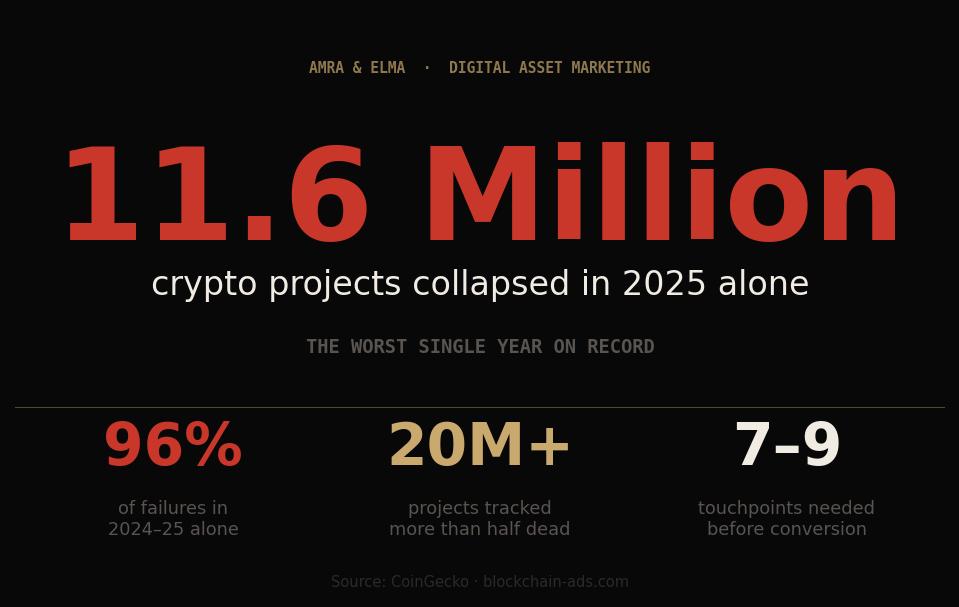
CoinGecko tracked over 20 million crypto projects. More than half are dead. In 2025 alone, 11.6 million collapsed — the worst single year on record. Some had bad technology. Some had genuinely shady people behind them. But most failed for a reason so simple it’s almost painful: nobody knew what they were selling. Or worse — they knew, and it still made no sense to a normal human being.
Think about that number for a second. 11.6 million projects. Gone. Not because the blockchain didn’t work. Not because the tokenomics were off. Because someone, somewhere, wrote a white paper that impressed other developers and meant absolutely nothing to the 42-year-old teacher in Cleveland who just wants her savings to be worth something in ten years.
Here’s the brutal truth: you are not selling blockchain technology. You are not selling decentralization. You are not selling a “next-generation layer-2 scaling solution with cross-chain interoperability.” You are selling what those things mean to someone’s actual life. Freedom from banks that charge you $35 for an overdraft on your own money. A store of value that a government printing press can’t touch. Access to financial systems that used to be locked behind zip codes, credit scores, and the right last name.
The brands that figured this out didn’t just survive. They became worth trillions.
Bitcoin’s entire marketing — organic, earned, and entirely word-of-mouth for years — was built on two words: digital gold. That’s it. No roadmap. No ecosystem language. Two words that a grandmother, a hedge fund manager, and a college student could all understand in their own way. Bitcoin started 2024 at $45,000. By the end of the year it had crossed $100,000 for the first time in history. It did not get there because of a clever ad campaign. It got there because everyone from BlackRock to your neighbor’s nephew understood the pitch.
Ethereum did the same thing differently: programmable money. Three syllables that unlocked an entirely new category of financial product and convinced developers, investors, and institutions to pour in over $438 billion in market cap. Coinbase — now a publicly traded company worth billions — built its entire consumer brand on one line: the easiest place to buy and sell cryptocurrency. Not the most decentralized. Not the most technically advanced. The easiest. That one word — easy — is what turned a niche tool into 110 million verified users.
And then there’s the flip side. In 2024, between $9.9 billion and $12.4 billion was lost to scams — many of which had slick websites, celebrity partnerships, and white papers that could pass a graduate school exam. They had everything except a real answer to the question: what is this, in plain English, and why should I trust it with my money?
So before you write a single word of copy, before you brief a single influencer, before you build a single landing page — sit down and answer this honestly: if you had 30 seconds on an elevator with someone who has never heard of your project, what would you say? Not what would impress them. What would actually make them curious? What would make them take out their phone and look you up the second the doors opened?
If your answer involves the words “ecosystem,” “disruptive,” “next-generation,” or “trustless infrastructure,” you don’t have a value proposition. You have a mood board. Start over.
The average successful crypto conversion in 2025 now takes 7 to 9 touchpoints — compared to 3 to 5 in traditional e-commerce. Every single one of those touchpoints is an opportunity to either sharpen your message or lose the person forever. With 11.6 million projects dying in a single year, you cannot afford to spend even one of those moments being unclear about what you’re actually selling.
Find your two words. Your three syllables. Your elevator line.
Everything else in this guide depends on it.
Marketing Digital Assets Step 2: Know Your Audience Down to Their Bone-Deep Motivations
Here is the assumption that is costing digital asset brands millions of dollars every single day: they think they know who they’re talking to. They picture a 25-year-old guy with three monitors, a Reddit account, and an opinion about Ethereum gas fees. And sure, that person exists. But he is no longer the market. He hasn’t been for a while.
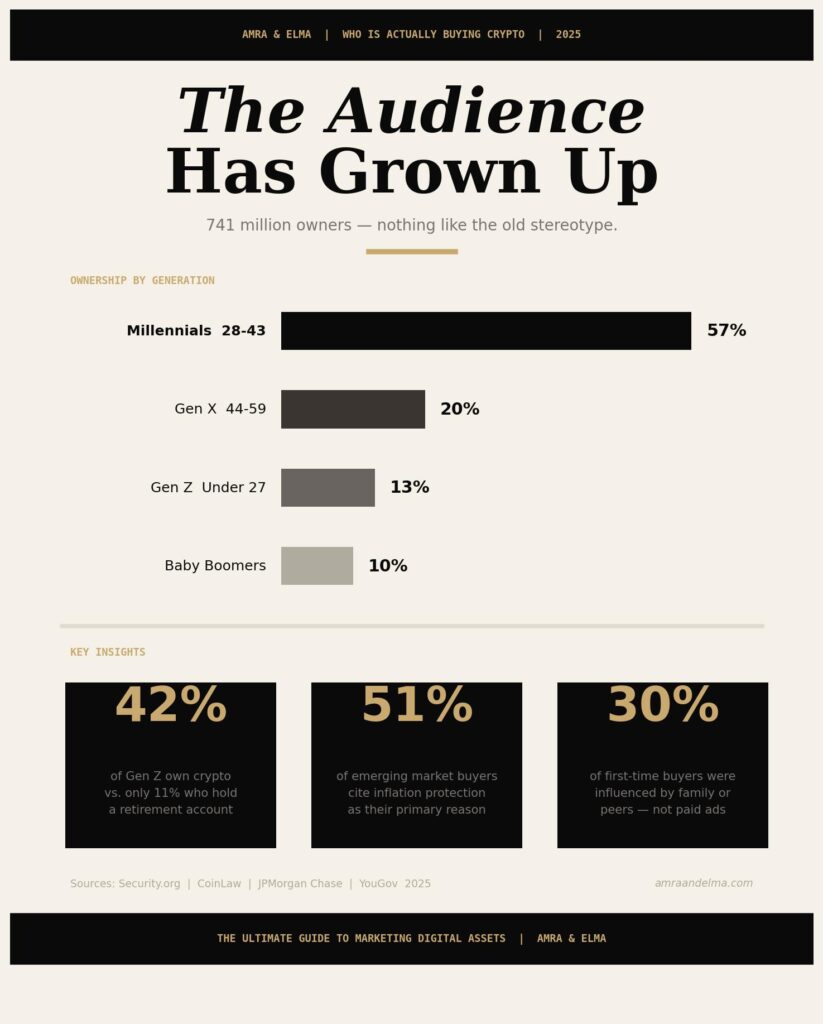
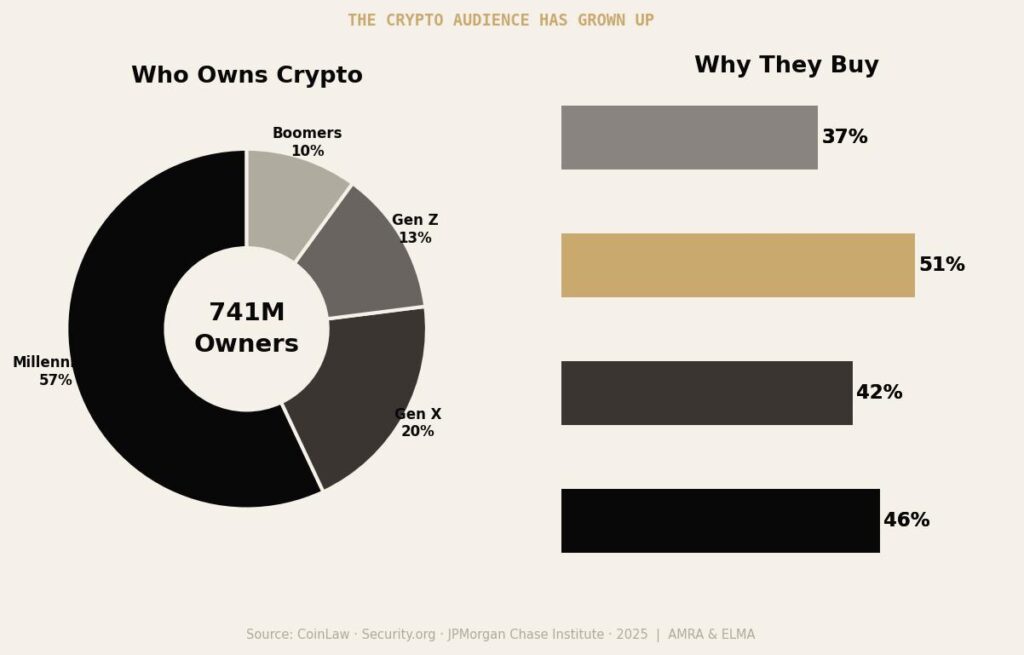
Today, 30% of American adults — 70.4 million people — own cryptocurrency. That’s up from 27% just a year ago. The largest female crypto owner demographic is now women aged 45 to 59. Millennials make up 57% of all crypto investors globally. Gen Z, the supposedly digital-native generation everyone assumes is running this space, actually represents only 13% of crypto owners — far less than most brands assume. And 42% of Gen Z investors own crypto compared to just 11% who hold a traditional retirement account, which tells you something profound about how a generation thinks about wealth, institutions, and the future.
In emerging markets, the psychology is completely different. In Nigeria, over 50% of adults own or have used cryptocurrency — not because they’re tech enthusiasts, but because 51% of users in emerging markets cite inflation protection as their primary reason for investing. In places where the local currency can lose half its value in a year, digital assets aren’t a speculative bet. They’re a survival strategy. That’s a completely different story to tell than the one aimed at a millennial in Manhattan trying to outperform his Schwab portfolio.
Here’s the insight that most brands completely miss: 30% of first-time crypto users say they were influenced by family or peer recommendations. Not YouTube. Not Twitter. Not a Super Bowl ad. A friend. A sibling. A parent. Which means word-of-mouth and community trust are your most powerful acquisition channels, and most brands are spending almost none of their energy on them.
Build audience profiles that go beyond demographics. A DeFi yield farmer has completely different motivations than someone looking how to buy crypto on Kraken with USD for the very first time. They need different messages, different content, different levels of explanation, different reassurance. Trying to speak to everyone means connecting with no one. Pick your people, understand them at a bone-deep level, and talk to them like you actually know them. Because if you’ve done this right, you will.
Marketing Digital Assets Step 3: Build a Content Infrastructure That Educates Before It Sells
Let’s be direct about something. The average successful crypto conversion takes 7 to 9 touchpoints before someone actually commits. That’s compared to 3 to 5 in traditional e-commerce. Which means your buyer needs to encounter your brand — your story, your credibility, your education — multiple times across multiple contexts before they trust you with their money. Content is how you show up for all 9 of those moments without having to pay for every single one.
Chainlink and Polkadot — two of the most successful blockchain infrastructure projects in the world — built their audiences almost entirely on content. Deep technical explainers. Beginner guides. YouTube breakdowns. Newsletter updates that people actually wanted to read. They were boring about it, in the best possible way. Consistent, clear, and relentlessly educational. Both became billion-dollar ecosystems not because they ran the flashiest campaigns, but because they made complex ideas feel accessible to the right people at the right time.
The content stack that actually works looks like this. First: long-form SEO content. Articles and guides that live on your website and get found by people searching for answers at 11pm. This is your highest-ROI investment, full stop — we’ll explain exactly why in Step 4. Second: video, specifically YouTube, which is the second-largest search engine in the world. Complex financial products need visual explanation, and YouTube’s algorithm rewards depth in ways that Instagram’s never will. Third: email. Your owned audience is your only truly defensible marketing asset. Social platforms change algorithms, ban accounts, and shift priorities overnight. Your email list doesn’t. Fourth: community content — the conversations in Discord, Telegram, and Reddit that your most passionate early believers are driving whether you’re involved or not. The smart move is to get involved.
The global content marketing sector is valued at $5.9 billion and is projected to reach $25.4 billion by 2032. The brands investing in content now are building moats that late entrants will spend years and enormous budgets trying to replicate. The ones who skip the educational layer and go straight to selling wonder why their customer acquisition costs are through the roof. Education isn’t nice to have. It’s the funnel.
Marketing Digital Assets Step 4: SEO Is Your Most Underrated Weapon — Treat It Like One
Here’s a fact that should stop every digital asset marketer dead in their tracks: Google bans most cryptocurrency advertising outright. Meta restricts it. Paid channels that work effortlessly in every other industry are heavily restricted or completely unavailable in this one. Which means while other industries are arguing about whether SEO is worth the investment, crypto brands have no choice but to make it work — and the ones that do are seeing results that make paid acquisition look embarrassing by comparison.
A blockchain SEO agency working with enterprise clients generated $1.75 million in influenced revenue from organic search alone — with organic traffic responsible for 50% of all their leads. Another campaign took a crypto education site called LearningCrypto.com from invisible to a 1,275% increase in organic traffic in six months. Not a typo. 1,275%. Using 40 blog posts, 82 backlinks, and a cleaned-up site structure. No paid media budget required. ConsenSys — one of the most respected names in the Ethereum ecosystem — generates over half of its marketing-qualified leads from organic search. Half. From content that keeps working long after it’s published.
The underlying math is almost unfair once you understand it. Crypto keywords in competitive categories can cost $15 or more per click in paid search — on the rare occasions when ad platforms allow it at all. A single well-optimized article targeting one of those terms can generate thousands of clicks a month, indefinitely, at zero marginal cost. The article you publish today is still earning traffic in three years. The ad campaign you run today stops the moment you stop paying.
Organic search generates 44.6% of all revenue in B2B industries, making it the single largest revenue channel — larger than paid search, larger than social, larger than events. The average SEO ROI in B2B SaaS is 702%. There are 22,000+ crypto projects competing for search visibility right now. Most of them are doing SEO badly or not at all. That is not a problem. That is an opportunity so large it barely fits in a single strategy document.
Write the content your audience is searching for at midnight. Answer the questions they’re afraid to ask out loud. Show up in the moments when they’re making decisions. Do it well, do it consistently, and the compounding effect will eventually make your paid competitors look like they’re running on a treadmill while you’re building a business.
Marketing Digital Assets Step 5: Influencer Marketing Can Make You or Destroy You — Here’s the Difference
Let’s start with the most expensive lesson in the history of crypto marketing, because it’s too important to skip.
FTX paid Tom Brady, Gisele Bündchen, Stephen Curry, Naomi Osaka, and Shaquille O’Neal. They put their name on a Miami arena. They ran Super Bowl ads. They signed Larry David. By any traditional influencer marketing metric, it was the most impressive campaign in crypto history. And when FTX collapsed in November 2022, wiping out an estimated $32 billion in value and landing its founder in prison, those same celebrities faced lawsuits for their role in promoting it. The lesson wasn’t that influencer marketing doesn’t work. The lesson was that no amount of star power can save a product that doesn’t deserve to be trusted.
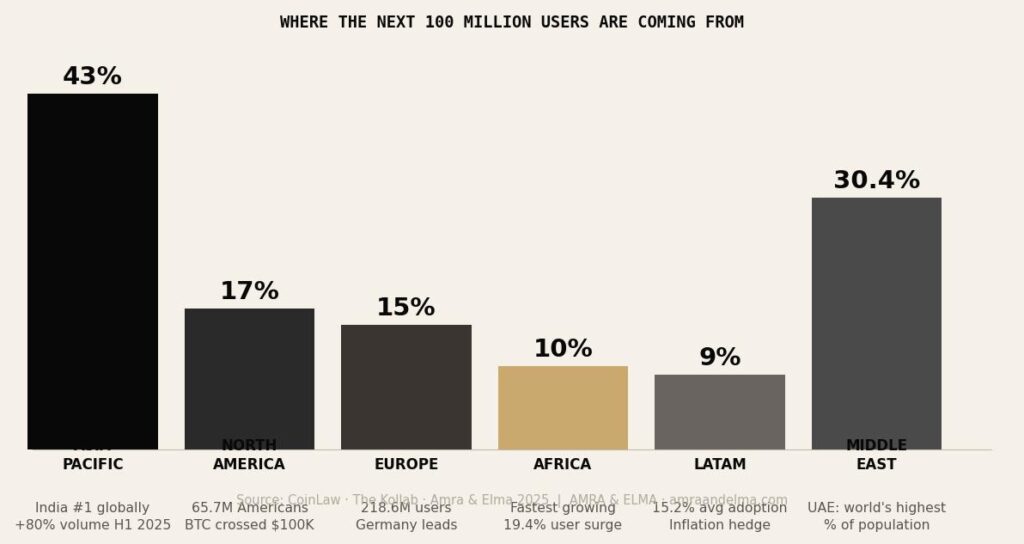
Now look at what actually works. India’s crypto trading surge tells you everything — local influencers in smaller Indian cities drove combined trading volumes on four major exchanges to $1.9 billion in a single quarter of 2024. Not global celebrities. Local voices. People who spoke the language, understood the culture, and had credibility with the communities they served. South Asia grew total transaction volume by 80% in just the first half of 2025. The marketing engine behind that wasn’t billboards. It was authentic, localized influence.
The rule in this industry is simple and has never changed despite how often it gets ignored: a creator with 50,000 engaged followers who genuinely understands and uses your product will outperform a celebrity with 5 million followers every single time. Crypto audiences are among the most sophisticated and skeptical in the world. They can detect inauthenticity in seconds. They share their suspicions at the speed of Twitter. And when they feel manipulated, they don’t just walk away quietly — they warn everyone they know.
What works in 2025: micro-influencers with 10,000 to 100,000 followers and deep niche authority, long-term ambassador relationships where the creator has genuine skin in the game, education-first content that gives the audience real value before asking for anything, and transparent sponsorship disclosures that build rather than erode trust. Kraken has built its influencer strategy around Formula 1 and major football club partnerships — not for the immediate conversions, but for the years-long credibility accumulation that comes from being associated with legitimate, well-loved institutions.
Find the creators your audience already trusts. Pay them fairly for genuine advocacy. Give them time to actually understand what you’ve built. Then get out of the way and let authenticity do what no budget can buy.
Marketing Digital Assets Step 6: Build a Community That Outlasts Any Campaign
Sixty percent of Web3 marketers say community building is their primary strategy, and the data explains why. Token holders aren’t customers — they’re stakeholders. They have financial skin in the game. They recruit on your behalf without being asked. They defend you on social media when critics come after you. They show up to AMAs, create fan content, explain your product to friends, and stick around through bear markets when fair-weather investors have long since moved on.
The numbers back this up at every level. Stablecoins now have $300 billion in total value moving through them monthly — a figure that surpasses Visa’s $1.3 trillion annual volume. AAVE controls 62% of the DeFi lending market with $24.4 billion in TVL across 13 blockchains. These aren’t just impressive financial metrics. They are the result of communities that believed in something long before the numbers justified the belief, and stayed through every test.
The difference between a real community and a Discord server with a pulse is straightforward. Real communities have three things: identity — members know who they are and what they stand for; utility — belonging gives you something real, whether that’s early access, governance rights, exclusive information, or simply the right connections; and leadership that actually shows up. Founders and team members who are present, responsive, honest about setbacks, and willing to engage with criticism rather than delete it.
The collapse of trust in this space is always traceable to one of two failures: either a product that didn’t work, or a team that abandoned its community the moment things got hard. Binance has 170 million registered users not because they ran the best ads, but because they built infrastructure their community could rely on and showed up consistently for years. Ethereum has the deepest developer community in crypto not because Vitalik Buterin is the best marketer in the world, but because the project treated its community like intelligent adults with legitimate stakes in the outcome.
Build that. The campaigns will end. The community, if you build it right, won’t.
Marketing Digital Assets Step 7: Paid Advertising — Know the Rules Before You Play
The advertising landscape for digital assets is unlike anything else in marketing. Google only allows cryptocurrency advertising from certified exchanges in approved regions. Meta restricts crypto promotion to pre-approved advertisers. X permits it with compliance requirements that change without warning. The UK’s Financial Conduct Authority blocked 10,000 misleading financial promotions in a single year. In a space where between $9.9 billion and $12.4 billion was lost to scams in 2024 alone, regulators are not playing around — and the platforms are responding accordingly.
Most brands treat this reality as a wall. The smart ones treat it as a moat.
When your competitors can’t easily run paid ads, the brands that have built strong organic foundations — deep SEO, loyal communities, trusted influencer networks — have a structural advantage that money literally cannot buy overnight. But paid advertising still has a critical role when you approach it correctly, and the brands winning in this space have figured out exactly how.
The first rule is to lead with education, not returns. Ads that explain what something is and how it works get through content review in ways that “10x your money” ads never will — and frankly, they should. The second rule is to geo-target obsessively. Customer acquisition costs in crypto markets range from $50 to $500 per user depending on the vertical and the region. What you can say in Singapore is completely different from what you can say in Germany, which is different again from what you can say in the United States. Running a single global message is not efficiency — it’s laziness dressed up as strategy.
The third rule, and the one most brands consistently underuse, is retargeting. Someone who has read three of your educational articles, watched your explainer video, and spent eight minutes on your pricing page is not the same person as a cold audience member who has never heard of you. Treat them differently. The message, the creative, and the offer should all reflect exactly where they are in their understanding of what you’ve built. A DeFi protocol that deployed targeted paid campaigns based on wallet behavior and precise demographic targeting acquired new retail users at a $21 cost per acquisition — in a category where $200 is considered reasonable. The difference wasn’t budget. It was precision.
The brands that win in paid advertising in this space are the ones who respect the complexity of the regulatory environment instead of fighting it, build creative that genuinely educates rather than hypes, and use retargeting like a scalpel on audiences they’ve already warmed up through content and community. Everything else is setting money on fire in a compliant way.
Marketing Digital Assets Step 8: Data Tells You What Your Gut Won’t
Here is an uncomfortable truth that has cost more digital asset brands more money than any market crash: the things you believe are working probably aren’t, and the things you’ve written off as boring probably are.
Human intuition is genuinely useful in marketing. It helps you read culture, feel timing, sense when something is off. But when you’re operating in a market that processes between $131 billion and $200 billion in trading volume daily, where retail investors now represent the fastest-growing segment at 28.3% annual growth, where 22,000 projects are competing for the same attention — your gut alone isn’t a strategy. It’s a liability.
The brands capturing meaningful market share in this space aren’t guessing. They’re building real measurement infrastructure from day one and making decisions based on what the data actually shows rather than what they hoped it would show.
Real metrics in digital asset marketing are specific. Not followers. Not impressions. Not Discord member count. Cost per qualified lead — meaning someone who has actually demonstrated intent, not just curiosity. Conversion rate broken down by traffic source, so you know whether your YouTube audience converts differently than your organic search audience, which it almost certainly does. Customer acquisition cost versus lifetime value, because acquiring a user at $150 means nothing if they churn in 30 days. Wallet activations and on-chain behavior, which are the only metrics in this industry that prove someone didn’t just click — they actually committed.
The Sprout Social Index found that 65% of senior marketing leaders demand real business impact from their campaigns, yet only 30% of marketers can actually measure ROI effectively. In crypto, that gap is even wider because the attribution is genuinely hard — someone might discover you through an influencer, research you through organic search, join your Discord, and convert six weeks later through a retargeted ad. If you’re only measuring last-click attribution, you’re crediting the wrong channel and defunding the ones that actually started the relationship.
Set up your tracking properly before you spend a dollar on distribution. Build dashboards that show you the full customer journey, not just the final click. Test one thing at a time so you know what actually moved the needle. And when the data tells you something you didn’t want to hear about a creative direction you love — listen to the data. The market is more honest than your instincts, and it’s always right.
Marketing Digital Assets Step 9: Trust Is Your Most Valuable Currency — Don’t Spend It Carelessly
Between $9.9 billion and $12.4 billion was lost to crypto scams in 2024. Let that number sit for a moment. That is the context every single person considering your brand is operating in. They’ve seen headlines. They know someone who lost money. They remember FTX. They remember Terra Luna losing $60 billion in a week. They remember the OneCoin scheme — the “Cryptoqueen” who built a Ponzi operation that defrauded investors worldwide out of an estimated $4 billion before disappearing. And a record 38% of Americans said in 2025 that they don’t understand how cryptocurrency works at all — up from 19% just three years earlier. The sophistication of the average newcomer is going backward even as the market grows forward.
This is the environment your marketing lives in. And in that environment, trust isn’t a nice brand value to put on a website. It’s the actual product.
Look at what Coinbase did that most of their competitors didn’t. They published regulatory compliance information before they were required to. When things went wrong — and things always go wrong — they communicated directly rather than going silent. They built a customer support operation that, while imperfect, at least existed and responded. They went public through a direct listing in April 2021, subjecting themselves to SEC scrutiny and public financial disclosure at a moment when going public was the last thing most crypto companies wanted to do. That transparency cost them something. It also built them something that no competitor could replicate overnight: the benefit of the doubt from millions of customers who had been burned before.
Gemini took the same approach from a different angle. The Winklevoss twins built Gemini on the premise that being the most regulated crypto exchange in the room was a competitive advantage, not a constraint. In an industry where everyone was trying to operate in regulatory gray areas, they went directly to New York state regulators and asked for oversight. That decision made them slower and more expensive to operate. It also made them the exchange that risk-averse institutional investors trusted when they were finally ready to enter the space.
The lesson scales down to every level. Doxxed team members build more trust than anonymous ones. Published audit reports build more trust than promises of security. Honest responses to criticism build more trust than deleted comments. Communicating setbacks directly builds more trust than going quiet and hoping nobody notices. These things feel expensive in the short term. They are the cheapest long-term marketing investment you will ever make — because in a space where 96% of token failures since 2021 occurred in just the last two years, simply being genuinely trustworthy puts you in a category occupied by almost nobody.
Your audience has been burned. They are waiting to be proven right about you being just another scam. Spend every day proving them wrong.
Marketing Digital Assets Step 10: Scale What Works — And Have the Discipline to Kill What Doesn’t
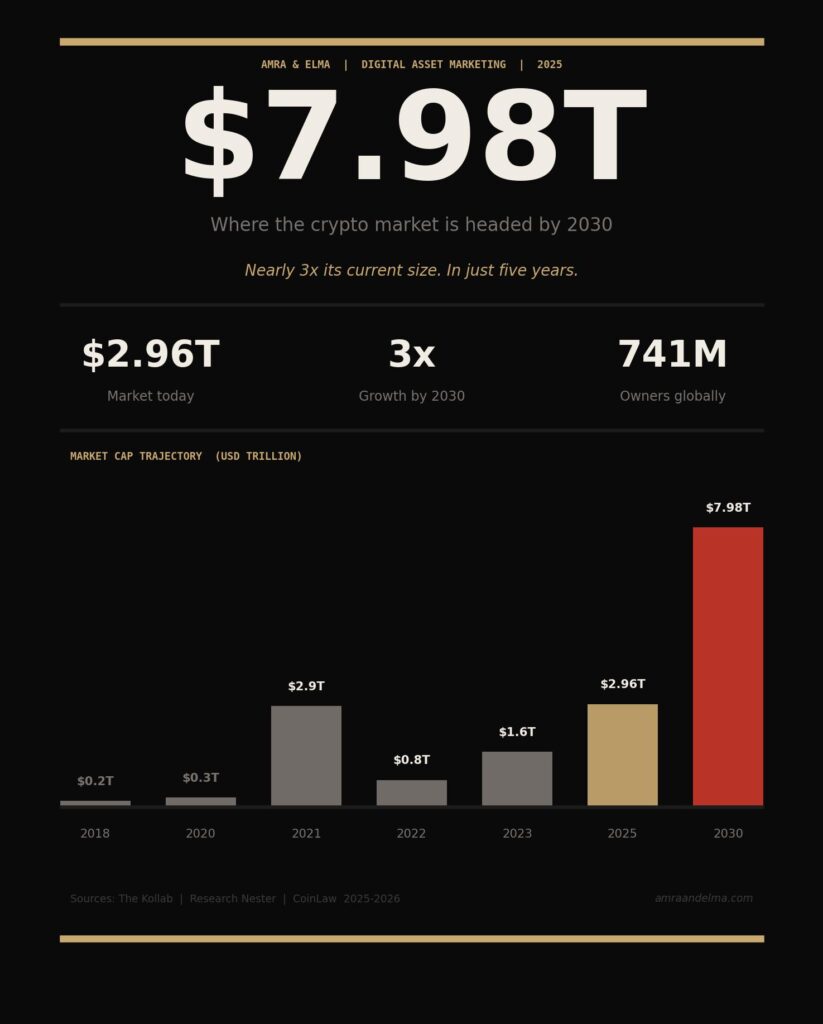
The global crypto market is projected to grow from $2.96 trillion today to $7.98 trillion by 2030. Nearly three times the current size in five years. $2 trillion in assets are on track to be tokenized on-chain by 2030. DeFi is projected to grow at a 26.2% compound annual growth rate through the end of the decade. DEX trading volume grew 67% in a single year — from $6.8 trillion in 2024 to $11.4 trillion in 2025. The tokenized Real World Assets market passed $36 billion in 2025, up 300% from the year before.
These are not incremental numbers. They are category-redefining numbers. And the brands that capture disproportionate market share in that growth window will not be the ones who tried everything. They’ll be the ones who found what worked, committed to it with conviction, and had the discipline — the ruthless, unsentimental discipline — to kill everything else.
This is harder than it sounds. When you’ve spent six months building a content series and it isn’t converting, killing it feels like admitting failure. When a creative direction looks beautiful and the data says your audience isn’t responding, abandoning it feels like betraying the people who made it. When a channel feels culturally exciting but the numbers say it’s generating a fraction of the ROI of a less glamorous one, deprioritizing it feels like being boring.
Do it anyway.
The brands that win in the next phase of this market aren’t the most creative. They’re the most clear-eyed. They run controlled experiments — changing one variable at a time so they know exactly what moved the needle. They build feedback loops between their analytics and their creative teams so that data informs execution and execution generates better data. They distinguish between channels that are underperforming because the strategy is wrong and channels that are underperforming because they haven’t been given enough time or budget to work — because those are completely different problems requiring completely different responses.
And when something works — when a content format starts compounding, when an influencer partnership starts driving real wallet activations, when a community initiative starts generating the kind of organic word-of-mouth that no paid campaign can manufacture — they go all in. Not cautiously. Not with one foot out the door. All in. Because in a market growing this fast, the gap between a brand that scales its winners aggressively and one that hedges is the difference between market leadership and being a case study someone else learns from.
The digital asset space rewards boldness. But it rewards informed boldness — the kind backed by data, grounded in audience truth, executed with the discipline of someone who understands that attention is the scarcest resource in the world, and wasting it is the only unforgivable sin in marketing.
Conclusion
The opportunity in front of digital asset brands right now is genuinely historic. 741 million people are already in the market. Institutional capital has arrived and is accelerating. Regulatory frameworks are taking shape in markets that represent the majority of global GDP. The infrastructure exists. The audience exists. The demand exists.
What’s missing, more often than not, is marketing sharp enough to match the moment.
That’s what this guide is for. Not to be clever. Not to fill a word count. But to hand you the actual map — built from years of working at the intersection of brand-building, digital strategy, and the kind of creative thinking that makes people stop scrolling and start believing.
The brands that win from here won’t be the ones with the biggest budgets. They’ll be the ones who understood their audience deeply enough to tell the truth beautifully.
That’s always been the job. It always will be.
SOURCES
- Security.org — 2026 Cryptocurrency Adoption and Sentiment Report https://www.security.org/digital-security/cryptocurrency-annual-consumer-report/
- JPMorgan Chase Institute — Crypto Investor Waves Report, 2025 https://www.jpmorganchase.com/institute/all-topics/financial-health-wealth-creation/crypto-investor-waves-since-2017-what-retail-investor-behavior-reveals-about-digital-asset-adoption
- The Motley Fool — 2025 Cryptocurrency Investor Trends Survey https://www.fool.com/money/research/study-americans-cryptocurrency/
- CoinLaw — Crypto User Demographics Statistics, 2025 https://coinlaw.io/crypto-user-demographics-statistics/
- CoinLaw — Men vs. Women in Crypto Adoption Statistics, 2025 https://coinlaw.io/men-vs-women-in-crypto-adoption-statistics/
- CoinLaw — Digital Currency Statistics, 2025 https://coinlaw.io/digital-currency-statistics/
- CoinGecko — Token Failure & Crypto Market Data, 2024–2025 https://coinmarketcap.com/yearbook-2024-25/
- The Kollab — Top 30 Crypto Marketing Statistics, 2026 https://thekollab.io/articles/crypto-marketing-statistics/
- Victoria Olsina — Crypto SEO Case Studies, 2025 https://victoriaolsina.com/blog/crypto-seo-case-studies/
- Blockchain-Ads.com — Crypto Marketing Strategies, 2026 https://www.blockchain-ads.com/post/best-crypto-marketing-strategies
- SeoProfy — B2B SEO Statistics, 2026 https://seoprofy.com/blog/b2b-seo-statistics/
- EAK Digital — SEO and Paid Search in Crypto Marketing, 2026 https://eakdigital.com/seo-and-paid-search-crypto-marketing-strategy/
- Blockchain App Factory — Crypto Content Marketing Strategies, 2025 https://www.blockchainappfactory.com/blog/crypto-content-marketing-strategies-2025/
- Blockchain App Factory — Crypto Influencer Marketing Strategies, 2025 https://medium.com/predict/crypto-influencer-marketing-strategies-2025-what-works-what-doesnt-and-why-a6ddaf7f2937
- Amra & Elma — Top 20 Cryptocurrency Marketing Statistics, 2025 https://www.amraandelma.com/cryptocurrency-marketing-statistics/
- Amra & Elma — Top 20 Bitcoin Marketing Statistics, 2025 https://www.amraandelma.com/bitcoin-marketing-statistics/
- Financial Conduct Authority (FCA) — UK Financial Promotions Data, 2024 https://www.fca.org.uk
- AWS — What Is Blockchain Technology https://aws.amazon.com/what-is/blockchain/
- Kraken — How to Buy Crypto with USD https://www.kraken.com/learn/buy-crypto