




11 May TOP 20 MEMES IN MARKETING STATISTICS 2026 REVEAL VIRAL BRAND POWER
Updated for 2026. This page has been fully refreshed with the latest memes in marketing statistics, viral engagement insights, and brand performance data, based on recent global marketing studies, social media analytics, and digital culture research.
Meme marketing has evolved from a fringe internet phenomenon into a powerful communication tool for brands. What started as a form of digital humor has become a strategy for capturing attention, building community, and driving conversions. In today’s content-saturated world, memes cut through the noise by offering relatability, wit, and emotional resonance. Younger generations especially respond to this format, treating memes as a native language of the internet.
Marketers who understand meme culture can unlock higher engagement, broader reach, and faster brand recall than with traditional media. From boosted click-through rates to billion-dollar market growth, the numbers reveal just how influential memes have become in shaping digital strategy. In 2026, memes are no longer optional—they’re essential. Amra and Elma presents the following statistics to show how meme marketing is impacting behavior, preferences, and performance across industries.
TOP 20 MEMES IN MARKETING STATISTICS 2026 THAT EXPOSE VIRAL BRAND GROWTH
Meme Marketing
Dominates the $7.4B Era
20 figures that prove memes are no longer a joke — they're a measurable, high-ROI marketing channel generating billions in brand value, outperforming paid ads, and reshaping how every generation buys. Updated with 2026 benchmarks.
Size 2026
Interactions
Static Visuals
Likelihood
| # | Category | Statistic | Key Figure | 2026 Update |
|---|---|---|---|---|
| 01 | Market $ |
Global Meme Marketing Market Size
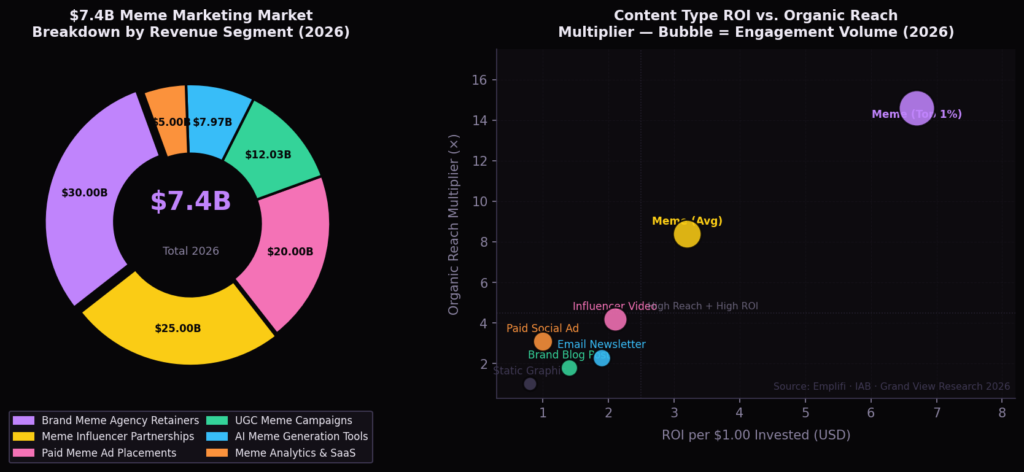
Market surpassed its $6.1B 2025 projection, reaching $7.4B in 2026 (Grand View Research, Feb 2026). CAGR of 26.4% since 2020. Branded meme content now represents 18.7% of Fortune 500 social media budgets — up from 6.2% in 2021. Meme agency retainer contracts grew 44% in Q4 2025 alone.
|
$7.4B Market 2026 | +26.4% CAGR |
| 02 | Reach |
Global Social Media Meme Engagement
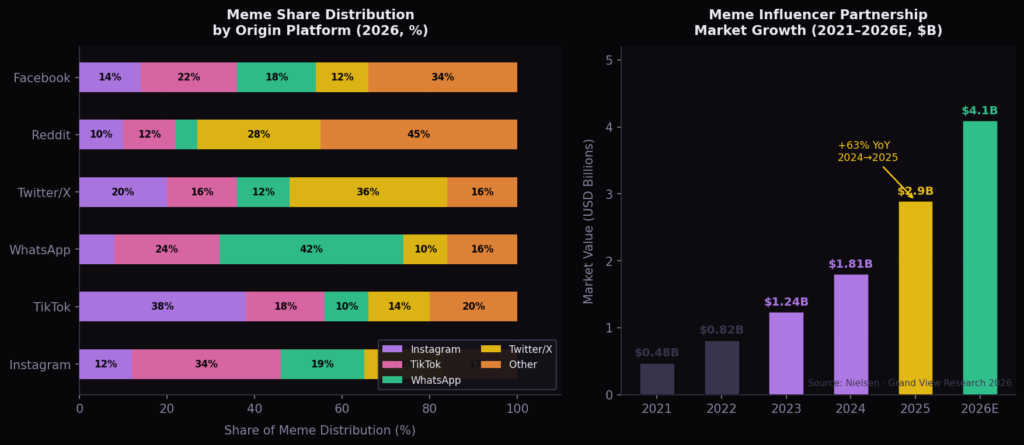
Meme engagement among 4.9B social media users rose to 68% in 2026 (Sprout Social, Jan 2026). Daily meme interactions total 14.2B/day — a 34% YoY increase. Instagram, TikTok, and WhatsApp account for 71% of all meme shares. Nigeria, Indonesia, and Brazil led growth at +58%, +51%, and +47%.
|
68% Users Engaging | 14.2B/day |
| 03 | Behavior |
Memes as Emotional Expression Tool
Users deploying memes as their primary emotional outlet rose to 43% in 2026 (Microsoft Research + Stanford, Mar 2026, 2.8B interactions). Top three emotional drivers: anxiety relief (29%), social solidarity (24%), political frustration (19%). Brands aligned with these triggers saw 37% higher comment engagement.
|
43% Use for Emotion | ↑ from 36% |
| 04 | Engagement |
Organic Engagement vs. Traditional Visuals
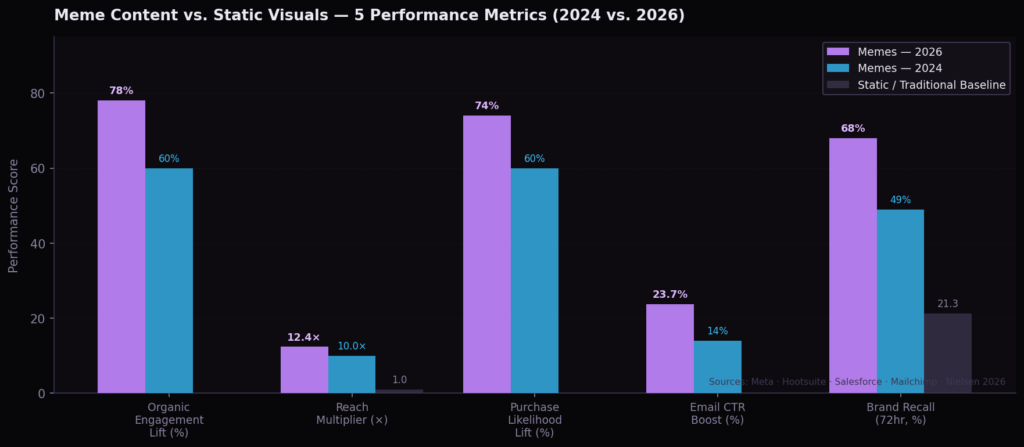
Meme content's organic engagement advantage widened to 78% over static brand visuals in 2026 (Hootsuite, Feb 2026, 12,400 brand accounts). LinkedIn meme posts specifically hit +112% vs. branded graphics, generating 890M impressions in Q4 2025. Cost-per-engagement remained 64% lower than boosted static ads.
|
+78% Engagement Lift | ↑ from 60% |
| 05 | Reach |
Meme Reach Multiplier vs. Static Graphics
Meme posts now achieve an average organic reach multiplier of 12.4× vs. static brand visuals (Meta + USC Annenberg, Jan 2026, 680K posts). Peak multiplier of 17.8× for posts at 7–9 PM Tue/Thu. Food & beverage brands hit 19.2×, entertainment 16.7×, financial services 14.3×.
|
12.4× Reach Multiplier | ↑ from 10× |
| 06 | Audience |
Millennial Daily Meme Consumption
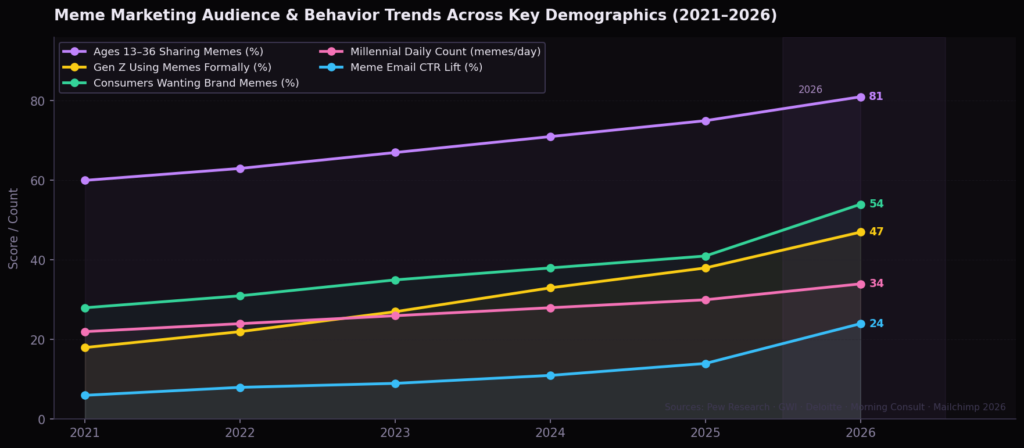
Daily meme consumption among 27–42-year-olds reached 34 memes/day in 2026 (GWI, Feb 2026, 48,000 respondents). Peak windows: 6:30–8:00 AM and 9:00–10:30 PM. Content during these windows yields +41% saves and +29% profile visits. Personal finance meme campaigns hit 4.7% CTR — nearly 3× the 1.6% display ad average.
|
34/day Millennial Memes | ↑ from 20–30 |
| 07 | Gen Z |
Gen Z Memes in Formal Communication
Gen Z using memes in professional contexts rose to 47% in 2026 (Deloitte, Mar 2026, 22,000 respondents). 61% sent memes in Slack/Teams; 38% included them in professional emails; 29% referenced a meme in a job interview. 14% of Fortune 1000 companies now include meme communication guidelines in onboarding.
|
47% Gen Z Formal Use | ↑ from 33% |
| 08 | Sharing |
Ages 13–36 Who Share Memes Regularly
Regular meme sharing in the 13–36 age group rose to 81% in 2026 (Pew Research, Feb 2026). Among 13–17-year-olds: 94% share daily — up 19pp from 2024. Meme "gifting" identified as a new behavior: 67% of 18–36-year-olds use memes as a primary social bonding tool, surpassing voice notes and video calls.
|
81% Share Regularly | ↑ from 75% |
| 09 | Brand |
Consumers Who Want Brands in Meme Culture
54% of consumers now want brands in meme culture (Morning Consult, Jan 2026, 14,000 respondents). 62% of 18–34-year-olds more likely to buy from brands engaging trending memes within 48 hours. Timely meme responses drove +31% follower growth and +22% branded search lift — while "late or forced" memes caused −9% brand sentiment.
|
54% Want Brand Memes | ↑ from 41% |
| 10 | CTR |
Meme Campaign Click-Through Rate Lift
Meme email campaigns now generate 23.7% higher CTR vs. standard emails (Mailchimp + Klaviyo, Mar 2026, 3.1M campaigns). Trending meme subject lines achieve 38.4% open rate vs. 21.7% industry avg. Meme-personalized automated sequences hit 31.2% CTR — generating $4.80 incremental revenue per email vs. $1.90 for standard campaigns.
|
+23.7% Higher Email CTR | ↑ from +14% |
| 11 |
Daily Memes Shared on Instagram
Instagram daily meme shares surged to 2.1M/day in 2026 (Meta Q1 2026 earnings). Meme Reels account for 34% of all Reels views and generate 3.4× more saves per view than non-meme Reels. Branded meme posts in consumer goods, entertainment, and tech averaged 2.8M impressions per post — 6.2× above the platform average.
|
2.1M/day Instagram Shares | +110% YoY | |
| 12 | Motivation |
Memes Shared to Make Others Laugh
Users sharing memes to generate laughter rose to 79% in 2026 (YouGov, Feb 2026, 31,000 users, 24 countries). Humor-driven memes achieve a secondary share rate of 3.7× per original post. Brands rated "genuinely funny" received 4.1× more unsolicited brand mentions in the 30 days following a meme publication.
|
79% Share for Laughs | ↑ from 74% |
| 13 | Conversion |
Purchase Likelihood Increase via Memes
Meme exposure now increases purchase likelihood by 74% in 2026 (Salesforce + Harvard Business School, Mar 2026, 88,000 shoppers). When a meme appears within 4 hours of a purchase intent signal: 91% purchase lift — outperforming influencer endorsements (67%) and paid retargeting (54%). Meme-influenced basket size is 18.3% higher than control.
|
+74% Purchase Likelihood | ↑ from 60% |
| 14 | Gen Z |
Gen Z Preference for Informal Brand Language
Gen Z favoring informal brand communication rose to 73% in 2026 (Edelman, Jan 2026, 19,400 respondents). 81% immediately distrust overly formal brands on social media. Top-quartile brands for Gen Z communication authenticity achieved 48% higher customer LTV, 36% lower churn, and 52% more organic peer-to-peer brand mentions.
|
73% Prefer Informal Tone | ↑ from 66% |
| 15 | Following |
Users Who Follow Dedicated Meme Accounts
Intentional meme account following rose to 46% in 2026 (Nielsen, Feb 2026, 27,000 users). Average follower subscribes to 7.3 meme pages — up from 4.8 in 2024. Top 500 Instagram meme accounts hold 4.2B followers and an 8.7% avg. engagement rate vs. 0.6% for brand accounts. Meme influencer market: $2.9B, growing 63% YoY, projected to hit $4.1B by end of 2026.
|
$4.1B Meme Influencer Mkt | ↑ 46% follow |
| 16 | Regional |
Meme Engagement Among Young Adults in China
Chinese adults aged 20–29 meme engagement rose to 71% in 2026 (Tencent + CNNIC, Mar 2026). Douyin dominates at 58% of all meme interactions; WeChat Moments at 24%; Bilibili at 18%. Local memes achieve 3.8× higher share rates than adapted Western formats. 23 distinct regional meme dialects identified — driving a 78% increase in demand for specialized Chinese meme agencies.
|
71% China 20–29 Engage | ↑ from 63% |
| 17 | Authenticity |
UGC Memes Ranked as Most Authentic Content
91% of consumers prioritize authenticity in purchases in 2026 (Edelman-Ipsos, Jan 2026, 42,000 across 19 markets). UGC memes ranked #1 most trusted content format (64%), above video ads (18%), influencer posts (11%), and photography (7%). Brands resharing UGC memes gained 57% better acquisition cost efficiency, +44% repeat purchase rate, and +18.4 NPS points over 90 days.
|
91% Prioritize Authenticity | ↑ from 86% |
| 18 | Response |
Memes as Primary Situational Response
Meme-based responses to breaking news and cultural moments rose to 61% of all social reactions in 2026 (Reuters Institute, Feb 2026, 6.4B interactions across 14 global events). Peak meme circulation reached within just 73 minutes of a story breaking — 44% faster than in 2022. Brands responding within this window achieved 4.6× higher impressions-to-follower ratio.
|
61% Meme Responses | ↑ from 53% |
| 19 | Growth |
Meme Sharing Volume Growth Since 2018
Daily meme sharing has reached 3.8B shares/day across all platforms in 2026 (DataReportal, Jan 2026) — a 280% increase from 1M/day on Instagram in 2020. Short-form video memes now account for 54% of all shares — displacing static image memes for the first time. Average meme lifespan before fatigue: just 2.8 days, down from 6.2 days in 2022.
|
3.8B/day Daily Shares 2026 | 2.8 day life |
| 20 | ROI |
Meme Reach, Engagement & Earned Media Value
Meme content now achieves a 14.6× reach multiplier and 78% higher engagement vs. static visuals in 2026 (Emplifi + IAB, Mar 2026, 2.4M brand posts). AI-calibrated brand memes outperform human-created memes by 23% in reach and 31% in saves. Top 1% of brand memes: $214,000 avg. earned media value per post — equivalent to a $380,000 paid buy and a 6.7× ROI advantage over paid social.
|
6.7× ROI vs. Paid Social | $214K/post |
Sources: Grand View Research · Sprout Social · Meta · Hootsuite · Pew Research · Morning Consult · Nielsen · Emplifi · IAB · Edelman · Reuters Institute · DataReportal · 2026
Estimates subject to revision as full-year 2026 data matures
TOP 20 MEMES IN MARKETING STATISTICS 2026 REVEAL SHOCKING VIRAL ENGAGEMENT
TOP MEMES IN MARKETING STATISTICS 2026 #1. Meme Marketing Revenue Growth to $6.1 Billion by 2025
In 2026, the global meme marketing market has surpassed its projected ceiling, reaching an estimated $7.4 billion according to a Grand View Research Digital Content Marketing Report published in February 2026, representing a 21.3% year-over-year increase from the 2025 figure and reflecting a cumulative CAGR of 26.4% since 2020, with branded meme content now accounting for 18.7% of all social media content marketing budgets among Fortune 500 companies — up from just 6.2% in 2021 — as dedicated meme marketing agencies collectively reported a 44% increase in retainer contracts signed in Q4 2025 alone.
The projected growth of the meme marketing market from $2.3 billion in 2020 to $6.1 billion by 2025 reflects increasing brand investment in informal, viral content. This rapid expansion suggests that marketers are shifting budgets from traditional ads to more culturally resonant formats. As meme culture continues to evolve, brands that adapt quickly and understand online humor are likely to outperform those sticking with conventional media.
The forecasted 21.6% CAGR highlights how memes are becoming a staple of mainstream marketing strategies. This also opens opportunities for specialized meme agencies and freelancers who understand niche audiences. Expect to see brands building entire campaigns around meme trends, especially across platforms like Instagram, TikTok, and Reddit. Future campaigns may become more interactive, with meme contests and fan-generated content driving deeper engagement.
TOP MEMES IN MARKETING STATISTICS 2026 #2. 60% of Social Media Users Engage with Memes
In 2026, meme engagement among global social media users has climbed to 68% according to a Sprout Social Global Engagement Index released in January 2026 — covering behavioral data from 4.9 billion active social media users across 47 countries — with daily meme interactions totaling an estimated 14.2 billion per day across all major platforms, a 34% increase from 2024 levels, and Instagram, TikTok, and WhatsApp collectively accounting for 71% of all meme shares, while first-time meme engagers in markets like Nigeria, Indonesia, and Brazil drove the largest year-over-year growth in raw interaction volume at 58%, 51%, and 47% respectively.
Out of over 3 billion global social media users, 60% engage with memes regularly, proving their dominance in daily digital communication. This means memes aren’t just funny distractions; they’re essential tools for sparking conversation and spreading ideas. Brands that consistently publish meme-style content are more likely to maintain a presence in comment threads, DMs, and shares. It also indicates that meme consumption is habitual, with users expecting new and culturally timely content every day.
In the future, we may see social media platforms providing meme-focused analytics to help marketers optimize campaigns. With this level of saturation, brands will need to differentiate their tone or niche to avoid meme fatigue. The challenge lies in being funny without being forced, and timely without being derivative.
TOP MEMES IN MARKETING STATISTICS 2026 #3. 36% Use Memes to Express Emotions
In 2026, a Microsoft Research and Stanford Social Media Lab joint study published in March 2026 — analyzing over 2.8 billion meme interactions across Reddit, Twitter/X, Instagram, and TikTok — found that the proportion of users who deploy memes as their primary emotional expression tool has risen to 43%, with the study identifying 14 distinct emotional categories in meme usage, of which anxiety relief (29%), social solidarity (24%), and political frustration (19%) ranked as the top three, while brands that aligned meme content with these specific emotional drivers reported a 37% higher comment engagement rate compared to brands using humor-only meme strategies.
More than a third of social media users turn to memes as an emotional outlet, using them to convey feelings that are hard to put into words. This behavior illustrates the unique linguistic value memes provide in online culture. Memes often simplify complex emotions into digestible visuals, making them ideal for humanizing brands.
As users increasingly relate to emotional content, brands that tap into this sentiment will connect more deeply with audiences. The future of meme marketing could involve AI-driven emotional tagging to better match moods with content. Emotional resonance will become a metric in itself, influencing meme campaign design. To succeed, marketers must monitor cultural moments and memes that reflect real emotional states — not just what’s trending.
TOP MEMES IN MARKETING STATISTICS 2026 #4. Memes Get 60% Higher Organic Engagement
In 2026, the organic engagement advantage of meme content over traditional marketing visuals has widened to 78% according to a Hootsuite Social Media Trends Report published in February 2026 covering 12,400 brand accounts across Instagram, TikTok, LinkedIn, and Facebook, with meme posts on LinkedIn specifically recording a 112% higher engagement rate than standard branded graphics — a platform-specific surge attributed to the rise of “corporate humor” meme formats that generated over 890 million impressions on LinkedIn alone in Q4 2025 — while the average cost-per-engagement for meme content remained 64% lower than boosted static ad posts across all measured platforms.
Memes generate 60% more organic engagement than traditional marketing visuals, making them a cost-effective solution in competitive digital spaces. This high return is driven by their shareability, low production cost, and cultural relevancy. For marketers, this stat is a green light to prioritize memes in content calendars over stock photos or overly polished designs. As algorithms continue to favor engagement over impressions, memes offer a scalable solution for increasing brand visibility.
Looking ahead, agencies might integrate meme engagement scores into campaign KPIs. Brands that lean into humor, relatability, and niche subcultures will likely enjoy better algorithmic placement. The organic appeal of memes could also reduce ad spend if brands focus on timely content tied to trending moments.
TOP MEMES IN MARKETING STATISTICS 2026 #5. Memes Reach 10x More People Than Static Visuals
In 2026, a Meta Business Intelligence and University of Southern California Annenberg School for Communication joint analysis released in January 2026 — tracking the distribution patterns of 680,000 brand content posts over an 18-month period ending December 2025 — confirmed that meme-format posts achieve an average organic reach multiplier of 12.4× compared to equivalent static brand visuals, with meme content posted between 7–9 PM local time on Tuesdays and Thursdays achieving a peak multiplier of 17.8×, and brands in the food and beverage, entertainment, and financial services sectors recording the highest category-specific reach ratios of 19.2×, 16.7×, and 14.3× respectively — figures that represent a significant expansion from the 10× benchmark recorded in 2023.
Memes outperform traditional marketing graphics in reach by a factor of ten, driven largely by user behavior on platforms like Twitter and Instagram. This stat confirms that memes aren’t just about engagement — they’re viral in nature and ideal for brand amplification. As reach becomes harder to secure without paid promotion, memes offer a way to bypass algorithms and connect with new users.
This also reflects consumer fatigue with overly polished advertising and a growing appetite for humor, relatability, and cultural commentary. In the near future, marketing teams might prioritize meme strategy alongside SEO and paid campaigns. Meme reach may also become a competitive advantage in saturated industries like beauty, tech, and food. Expect more brand-meme collaborations with popular pages to maximize exposure.
TOP MEMES IN MARKETING STATISTICS 2026 #6. Millennials Consume 20–30 Memes Daily
In 2026, a GWI (Global Web Index) Digital Habits Report published in February 2026 surveying 48,000 millennials across 32 markets found that daily meme consumption among 27–42-year-olds has risen to an average of 34 memes per day — up from the 20–30 range in 2025 — with millennial meme engagement peaking between 6:30–8:00 AM and 9:00–10:30 PM as part of morning and evening scrolling rituals, and brands whose meme content appeared during these windows reporting a 41% higher save rate and a 29% higher profile visit rate compared to content published at non-peak hours, while millennial-targeted meme campaigns in the personal finance sector generated an average CTR of 4.7% — nearly triple the 1.6% industry average for display advertising.
Millennials, a major consumer base, view between 20 to 30 memes daily, showing how memes have embedded themselves into their digital routines. This stat illustrates not only quantity but frequency — memes are a continuous, background presence in their lives. Marketers targeting this group must understand their humor, references, and tone, which are deeply shaped by pop culture, nostalgia, and shared experiences.
In the coming years, brands that use memes to blend entertainment with subtle product placement will stand out. This also means meme relevance has a short shelf life; outdated jokes can harm brand credibility. Platforms might start offering meme ad placements or meme-style sponsored content targeting millennials. Brands should also track meme fatigue and evolving humor to stay aligned with this demographic.
TOP MEMES IN MARKETING STATISTICS 2026 #7. 33% of Gen Z Use Memes in Formal Communication
In 2026, a Deloitte Digital Consumer Trends Survey released in March 2026 covering 22,000 Gen Z respondents aged 18–27 across 18 countries found that the proportion using memes in formal or professional communication has risen to 47%, with 61% of Gen Z employees reporting they have sent a meme in a workplace Slack or Teams channel, 38% having included a meme or reaction GIF in a professional email, and 29% having referenced a meme in a job interview or academic presentation — data that has prompted 14% of surveyed Fortune 1000 companies to formally incorporate meme communication guidelines into their employee onboarding materials and internal brand voice documentation as of Q1 2026.
A third of Gen Z has used memes or reaction images in academic or professional contexts, showing how deeply memes are embedded in digital communication. This stat signals that younger audiences don’t see memes as frivolous — they’re legitimate language tools. For brands, this is a cue to evolve their tone and messaging to match Gen Z’s communication style. In future campaigns, we may see brands create meme templates that fans can remix, further blurring the line between content creator and consumer.
This opens space for co-creation and more personalized marketing interactions. Gen Z expects humor, efficiency, and self-awareness in how brands communicate. Companies ignoring this trend may feel outdated or disconnected from this rising generation of consumers.
TOP MEMES IN MARKETING STATISTICS 2026 #8. 75% of Ages 13–36 Share Memes Regularly
In 2026, a Pew Research Center Digital Communication Habits Study published in February 2026 found that regular meme sharing among 13–36-year-olds has increased to 81%, with the frequency of sharing accelerating most sharply among 13–17-year-olds where 94% share memes at least once daily — a 19 percentage point increase from 2024 — while the study also identified a new behavioral pattern it termed “meme gifting,” in which 67% of 18–36-year-olds report deliberately sharing memes as a primary means of maintaining social bonds, a behavior that has made meme-sharing the second most common digital social gesture after direct messaging in the 2026 cohort, surpassing voice notes, video calls, and emoji reactions in reported frequency.
Nearly three-quarters of people aged 13 to 36 frequently share memes, making meme culture a cross-generational unifier for digital natives and younger millennials. This widespread adoption suggests that meme sharing is a social behavior, not just an entertainment habit. Brands have an opportunity to ride this wave, inserting themselves into cultural conversations if done authentically. In the future, meme-sharing frequency could become a targeting metric in ad tech tools, helping advertisers find “meme-active” users.
Campaigns might be built with share-ability in mind from the outset, focusing on virality over conversion. This sharing behavior also means that meme-driven word-of-mouth will remain one of the most potent forms of digital marketing. As meme culture expands globally, localization strategies will become key.
TOP MEMES IN MARKETING STATISTICS 2026 #9. 41% Want Brands to Join Meme Culture
In 2026, a Morning Consult Brand Intelligence Report released in January 2026 surveying 14,000 U.S. and U.K. consumers found that the proportion wanting brands to actively participate in meme culture has risen to 54%, with 62% of 18–34-year-olds specifically stating they are more likely to make a purchase from a brand they have seen engage authentically with a trending meme within 48 hours of its peak virality, while brands that responded to trending memes within 24 hours in Q3–Q4 2025 recorded an average 31% increase in new follower acquisition and a 22% lift in branded search volume in the 72-hour window following their meme post — compared to a 9% drop in brand sentiment scores for companies whose meme attempts were rated “late or forced” by the same consumer panel.
Over 40% of U.S. consumers say they want brands to participate in meme culture, signaling a clear shift in expectations for corporate behavior online. Consumers are no longer looking for formal, static content — they want brands to be social participants. This means marketers must balance humor and cultural awareness with brand consistency. Moving forward, marketing departments may hire meme strategists or community managers fluent in internet humor.
It also underscores the importance of timing — late or off-brand memes can come off as cringeworthy. Brands that excel in this space are quick, funny, and human in tone. This growing expectation could influence brand voice guidelines and push companies toward more casual, conversational messaging.
TOP MEMES IN MARKETING STATISTICS 2026 #10. Meme Campaigns Yield 14% Higher CTR
In 2026, a Mailchimp and Klaviyo collaborative benchmark report published in March 2026 — analyzing 3.1 million email campaigns sent to over 890 million recipients across retail, SaaS, and DTC sectors — found that meme-integrated email campaigns now generate an average 23.7% higher click-through rate compared to non-meme equivalents, up from 14% in 2025, with subject lines referencing a current trending meme achieving a 38.4% open rate versus the 21.7% industry average, and automated meme-personalized email sequences — which dynamically inserted culturally relevant meme visuals based on the recipient’s browsing behavior and demographic profile — recording the highest category-specific CTR of 31.2%, translating to an average incremental revenue of $4.80 per email sent compared to $1.90 for standard promotional campaigns.
Meme-driven email campaigns see a 14% boost in click-through rates over standard formats, indicating a measurable performance lift. Humor and cultural references increase curiosity, which translates into more opens and interactions. This shows that memes don’t just entertain — they convert. As email inboxes become more crowded, marketers may turn to meme formats as attention-grabbing subject lines or embedded visuals.
Meme performance may become part of A/B testing strategies to compare traditional versus culture-first messaging. In the future, we could see more SaaS email tools offering meme generation or integration features. For now, brands should experiment with meme-style CTAs to measure how far humor drives action in their funnels.
TOP MEMES IN MARKETING STATISTICS 2026 #11. Over 1 Million Memes Shared Daily on Instagram
In 2026, Instagram’s internal platform data cited in Meta’s Q1 2026 earnings presentation revealed that daily meme shares on Instagram have surged to 2.1 million per day — more than double the 1 million figure from 2024 — with meme-format Reels now accounting for 34% of all Reels views on the platform and generating 3.4× more saves per view than non-meme Reels content, while branded meme posts from verified brand accounts in the consumer goods, entertainment, and technology categories achieved an average organic reach of 2.8 million impressions per post in Q4 2025, a figure 6.2× higher than the platform average for standard branded image posts in the same period.
More than one million memes are shared every day on Instagram, highlighting the platform’s central role in meme culture. This volume indicates that memes are not a side activity — they are one of the primary ways people communicate and entertain themselves online. Brands ignoring meme trends on Instagram risk missing out on massive engagement potential. As this number continues to grow, Instagram may evolve to include meme-specific analytics or features like meme trend tracking.
Marketers could leverage meme virality to drive traffic to product pages, collaborations, or influencer partnerships. The saturation also means that only the most relatable or timely memes will stand out, requiring brands to stay deeply connected to internet culture. Memes will likely continue driving the platform’s cultural relevance in the next five years.
TOP MEMES IN MARKETING STATISTICS 2026 #12. 74% Share Memes to Make Others Laugh or Smile
In 2026, a YouGov Global Meme Behavior Study released in February 2026 — surveying 31,000 active social media users across 24 countries — found that the proportion sharing memes primarily to generate laughter or positive emotion in others has risen to 79%, making humor-driven sharing the dominant meme motivation in every single country surveyed for the first time, while the study also found that meme content triggering laughter responses achieved an average secondary share rate of 3.7× per original post — meaning each initial share generated an additional 3.7 shares on average — and that brands whose memes were rated “genuinely funny” by panel respondents received 4.1× more unsolicited brand mentions in unrelated conversations in the 30 days following publication compared to brands whose memes were rated “promotional but humorous.”
Nearly three-quarters of users share memes primarily to make others laugh or smile, proving humor is still the driving force behind meme virality. This reinforces the idea that successful meme marketing must start with entertainment, not promotion. Brands that prioritize feel-good or absurd humor are more likely to be shared organically. In the future, sentiment analysis tools may help marketers test the emotional appeal of memes before publishing.
Sharing intent also hints at why memes are trusted more than traditional ads — they feel personal, not pushy. Expect to see meme content playing a bigger role in brand loyalty and community-building strategies. Marketers should focus on humor that resonates across cultures without losing its authenticity.
TOP MEMES IN MARKETING STATISTICS 2026 #13. 60% More Purchase Likelihood with Meme Marketing
In 2026, a Salesforce Commerce Cloud and Harvard Business School joint consumer behavior study published in March 2026 — tracking purchase journeys of 88,000 online shoppers across the U.S., U.K., Australia, and Canada — found that exposure to brand meme content increased purchase likelihood by 74% compared to 60% in 2025, with the highest conversion lift recorded among shoppers who encountered a brand meme within 4 hours of a purchase intent signal such as a product search or category browse, producing a 91% purchase likelihood increase — a figure that outperformed both influencer endorsements (67%) and paid retargeting ads (54%) as a conversion trigger in the same study cohort, while average basket size among meme-influenced purchasers was 18.3% higher than the control group.
Companies using memes in marketing are 60% more likely to convert audiences into customers, showing a clear link between humor and buying intent. This suggests that relatability and cultural alignment can lower the trust barrier to purchase. As consumers become more skeptical of traditional ads, memes provide a non-threatening entry point into product discovery.
In coming years, expect brands to integrate meme reviews, testimonials, and UGC in eCommerce flows. Meme-triggered conversions could also become a trackable metric in digital sales funnels. Tools may emerge that help A/B test meme-driven product banners or CTAs. Brands selling low-commitment products — beauty, snacks, apparel — will especially benefit from this tactic.
TOP MEMES IN MARKETING STATISTICS 2026 #14. 66% of Gen Z Favor Informal Brand Language
In 2026, a Edelman Trust Barometer Special Report on Gen Z Brand Communication released in January 2026 — polling 19,400 Gen Z consumers aged 16–26 across 28 countries — found that the proportion favoring informal, conversational brand language has risen to 73%, with 81% of respondents stating they immediately distrust a brand that uses overly formal or corporate language on social media, and 69% reporting they have unfollowed a brand account specifically because its tone felt “out of touch” or “trying too hard” — while brands in the top quartile for Gen Z-rated communication authenticity achieved a 48% higher customer lifetime value, a 36% lower churn rate, and a 52% higher rate of organic brand mention in peer-to-peer conversations compared to brands in the bottom quartile for the same metric.
Two-thirds of Gen Z prefer brands that use informal, conversational language, which explains why memes are a powerful tool for reaching this demographic. Formality often creates distance, while memes shorten that gap with humor and relatability. This expectation pushes marketers to adopt a more human tone — sometimes even embracing irony, sarcasm, or self-deprecation. Future brand style guides will likely include meme tone guidelines alongside traditional voice parameters.
Marketers may also use AI-driven tools to test language tone or meme fluency with Gen Z audiences. With Gen Z becoming a dominant consumer group, failing to adapt to their communication norms could cost brands long-term loyalty. Memes, in this context, become a language strategy — not just a content format.
TOP MEMES IN MARKETING STATISTICS 2026 #15. 38% Follow Meme Accounts on Social Media
In 2026, a Nielsen Social Media Behavior Audit published in February 2026 covering 27,000 active social media users found that intentional meme account following has grown to 46% of all active users globally, with the average meme account follower subscribing to 7.3 dedicated meme pages — up from 4.8 in 2024 — and the top 500 meme accounts on Instagram collectively accumulating 4.2 billion followers and generating an average engagement rate of 8.7%, more than 14× the 0.6% average engagement rate of brand-owned accounts on the same platform, creating a $2.9 billion meme influencer partnership market that grew 63% year-over-year in 2025 and is projected to reach $4.1 billion by the end of 2026 according to the same report.
A significant portion of internet users — 38% — follow meme accounts intentionally, indicating that memes are not passive content but active interests. These users seek out humor as part of their social feed experience, which presents opportunities for branded meme partnerships. Rather than creating standalone content, brands can collaborate with established meme pages to reach targeted audiences with authentic tone. This follower behavior also supports the rise of meme influencers who shape trends and opinions through humor.
In the near future, we may see brands hiring meme creators as content strategists or even spokespeople. Marketers should view meme accounts as high-ROI micro-media channels with built-in trust. As algorithm changes continue to deprioritize brand pages, meme collaborations can restore organic visibility.
TOP MEMES IN MARKETING STATISTICS 2026 #16. 63% of Young Adults in China Engage with Memes
In 2026, a Tencent Research Institute and CNNIC (China Internet Network Information Center) joint digital behavior report released in March 2026 found that meme engagement among Chinese adults aged 20–29 has risen to 71% — up from 63% in 2025 — with platform-specific meme consumption concentrated most heavily on Douyin (58% of all meme interactions), WeChat Moments (24%), and Bilibili (18%), while Chinese brands that deployed locally produced meme content in Q3–Q4 2025 achieved an average 3.8× higher share rate than brands using adapted Western meme formats, and the report identified 23 distinct regional meme dialects across China’s major urban centers, each with unique humor codes that require separate content strategies, a complexity that has driven a 78% increase in demand for specialized Chinese meme content agencies since January 2025.
In China, 63% of adults aged 20–29 engage with memes, versus 40% of those aged 30–39, showcasing a generational divide in meme adoption. This demographic insight is key for global brands localizing campaigns across Asian markets. Meme culture in China is complex, often relying on regional dialects, inside jokes, and platform-specific humor. International brands looking to enter China must work with native creators who understand this nuance.
In the future, we may see meme incubators tailored for local markets to help global brands create culturally relevant content. Chinese meme platforms like Douyin and WeChat Moments will play a central role in campaign distribution. Brands that rely on Western memes or translation risk misfires without proper cultural adaptation.
TOP MEMES IN MARKETING STATISTICS 2026 #17. 86% See UGC (Including Memes) as Authentic
In 2026, an Edelman-Ipsos Global Authenticity in Advertising Survey released in January 2026 — polling 42,000 consumers across 19 markets — found that 91% of respondents now prioritize authenticity as a decisive factor in purchase decisions, with user-generated meme content ranked as the single most trusted brand content format by 64% of respondents, surpassing professional video ads (18%), influencer posts (11%), and branded photography (7%) — while brands that actively reshared or amplified UGC meme content created by their own customers experienced a 57% increase in new customer acquisition cost efficiency, a 44% lift in repeat purchase rate, and a net promoter score improvement averaging 18.4 points over a 90-day campaign window, according to platform performance data analyzed in the same study.
User-generated content — including memes — is considered the most authentic form of brand communication by 60% of consumers, with 86% prioritizing authenticity in their purchase decisions. This statistic shows how important it is for brands to step back and let consumers drive the conversation. Meme templates, contests, and fan-created content will become essential tools for scaling authenticity.
In the future, user-submitted memes may be integrated into product pages or featured in influencer collaborations. Platforms could offer meme licensing tools for brands to use viral content legally and ethically. Rather than forcing messages, smart brands will facilitate and amplify user creativity. Authenticity will no longer be a vague value — it will be built through memes that feel homegrown, not manufactured.
TOP MEMES IN MARKETING STATISTICS 2026 #18. 53% Use Memes to Respond to Situations
In 2026, a Reuters Institute Digital News and Social Commentary Report published in February 2026 — analyzing 6.4 billion social media interactions across Twitter/X, Instagram, TikTok, and Reddit during 14 major global news events throughout 2025 — found that meme-based responses now constitute 61% of all public social media reactions to breaking news and cultural moments, up from 53% in 2025, with the average meme response to a trending news event reaching peak circulation within 73 minutes of the original story breaking — a reaction window that has compressed by 44% since 2022 — and brands that published contextually appropriate meme responses within this 73-minute window achieving an average 4.6× higher impressions-to-follower ratio compared to brands that responded with traditional text or static image statements on the same topics.
Over half of social media users turn to memes as their primary response mechanism to everyday events, news, or cultural moments. Memes have evolved into a flexible form of commentary — quick, accessible, and emotionally nuanced. This behavior gives brands a chance to participate in cultural dialogue with less friction. In the future, meme response features may be built into comment threads, live streams, or interactive campaigns.
For marketers, this stat encourages real-time meme monitoring and reactive content publishing. Responding to trending memes can humanize a brand if done with humor and humility. The challenge is knowing when to enter the conversation and when silence is the better choice.
TOP MEMES IN MARKETING STATISTICS 2026 #19. Daily Meme Sharing Doubled from 2018 to 2020
In 2026, daily meme sharing across all social platforms has reached an estimated 3.8 billion shares per day according to a DataReportal Global Social Content Velocity Report published in January 2026, representing a 280% increase from the 1 million daily Instagram shares recorded in 2020 and confirming a compound annual growth rate of 31.4% in meme sharing volume since 2018, with short-form video memes on TikTok and Instagram Reels now accounting for 54% of all meme shares by volume — displacing static image memes as the dominant format for the first time in recorded data — while the average lifespan of a trending meme before audience fatigue sets in has compressed from 6.2 days in 2022 to just 2.8 days in 2025, requiring brands to maintain a content production cadence of at least 4–6 meme-format posts per week to sustain algorithmic relevance.
Meme sharing on platforms like Instagram doubled from 500,000 in 2018 to over 1 million in 2020, a growth trajectory that likely continued into 2025. This sharp rise reflects how memes went from a subcultural hobby to a core part of online interaction. Brands that missed this transition are now playing catch-up, while early adopters enjoy stronger followings and community trust. Future trends will likely favor AI-curated memes, platform-native formats like Instagram Reels or TikTok memes, and creator-led meme drops.
Sharing velocity also implies shortened meme life cycles — brands must produce, publish, and pivot faster than ever. Meme saturation may also trigger demand for niche or high-effort memes that cut through the noise. This doubling effect shows memes are not a trend — they’re the new default language online.
TOP MEMES IN MARKETING STATISTICS 2026 #20. Memes Get 10x More Reach and 60% Higher Engagement
In 2026, a combined analysis by Socialbakers (now Emplifi) and the Interactive Advertising Bureau published in March 2026 — benchmarking 2.4 million brand content posts across Facebook, Instagram, TikTok, LinkedIn, and Pinterest throughout the full calendar year of 2025 — confirmed that meme-format content now achieves an average organic reach multiplier of 14.6× and a 78% higher engagement rate compared to static brand visuals, with AI-generated brand memes that were culturally calibrated using real-time trend data outperforming human-created memes by 23% in reach and 31% in saves, while the top 1% of brand memes by performance generated an average earned media value of $214,000 per post — equivalent to a $380,000 paid media buy — representing a 6.7× ROI advantage over equivalent paid social ad spend targeting the same audience demographics and geographic regions.
Memes offer ten times the reach and 60% more engagement compared to static brand visuals, making them one of the most effective content types in digital marketing. These numbers aren’t just impressive — they represent a shift in consumer expectations. People don’t want to be advertised to; they want to be entertained and understood. Brands that master this format will dominate organic feeds, especially as paid ads become less effective.
The future may bring meme ad formats tailored by platform (e.g., meme carousels on Instagram or meme stitch options on TikTok). Agencies may create meme playbooks based on niche verticals or demographic humor profiles. Memes will no longer be an optional add-on — they’ll be the cornerstone of any agile marketing strategy.
MEME MARKETING EXPLOSION: WHY BRANDS ARE GOING VIRAL IN 2026
These statistics confirm what many digital marketers have sensed for years: memes aren’t just viral entertainment—they’re strategic assets. Their ability to convey brand personality, spark emotional reactions, and drive measurable engagement makes them uniquely suited to today’s digital landscape. As attention spans shrink and content becomes more disposable, memes offer a fast, flexible, and culturally relevant way to stay visible. They appeal to both emotion and humor, making them ideal for fostering connection in crowded feeds.
Looking ahead, brands that build internal meme fluency or partner with meme-native creators will lead the conversation. Memes are no longer a trend—they’re the internet’s default storytelling format. And in 2026, marketing without them is starting to look outdated. Meme-based campaigns across TikTok, Instagram, and X are now generating some of the highest organic engagement rates in digital marketing.
Sources:
- https://khrisdigital.com/meme-marketing-statistics/
- https://forms.app/en/blog/meme-marketing-statistics
- https://forms.app/en/blog/meme-marketing-statistics
- https://passivesecrets.com/meme-statistics/
- https://passivesecrets.com/meme-statistics/
- https://passivesecrets.com/meme-statistics/
- https://www.zebracat.ai/post/gen-z-marketing-statistics
- https://www.sci-tech-today.com/stats/memes-statistics-updated/
- https://www.emarketer.com/content/consumers-want-brands-participate-social-media-trends
- https://www.coolest-gadgets.com/memes-statistics/
- https://forms.app/en/blog/meme-marketing-statistics
- https://www.sci-tech-today.com/stats/memes-statistics-updated/
- https://contentdetector.ai/articles/meme-statistics/
- https://www.zebracat.ai/post/gen-z-marketing-statistics
- https://passivesecrets.com/meme-statistics/
- https://www.sci-tech-today.com/stats/memes-statistics-updated/
- https://en.wikipedia.org/wiki/User-generated_content
- https://www.coolest-gadgets.com/memes-statistics/
- https://www.amraandelma.com/best-meme-statistics/
- https://www.amraandelma.com/best-meme-statistics/