




03 Aug TOP 20 VIRAL CHALLENGE MARKETING STATISTICS 2026 THAT REVEAL INTERNET MADNESS
Updated for 2026 . This page has been fully refreshed with the latest viral challenge marketing statistics, social media participation data, and brand engagement trends, grounded in recent global platform reports, influencer campaign analytics, and creator economy insights.
Viral challenges are weird. One minute it’s people dumping ice water over their heads, the next it’s everyone doing a strangely specific dance with a Stanley cup in hand. It’s chaotic, unpredictable, and somehow, wildly effective for marketing. Brands used to spend months planning the perfect campaign, now they’re racing to stitch a response before a trend dies out.
Some challenges take off and make history, others flop and end up buried under Reddit threads roasting corporate cringe. But the ones that work? They hit different. Amra and Elma sees something almost magical about watching a community form around a single ridiculous action. It’s like the internet collectively decides, “Yeah, this is the thing today.” And suddenly, a brand that nobody talked about is everywhere. Honestly, even your mom’s probably tried one by now—maybe not on camera, but still.
TOP 20 VIRAL CHALLENGE MARKETING STATISTICS 2026 (EDITOR’S CHOICE DATA)
That Command Attention in 2026
| # | Topic | Key Statistic | Figure at a Glance | Category |
|---|---|---|---|---|
| 1 | Ice Bucket Challenge Fundraising 2014–2026 cumulative |
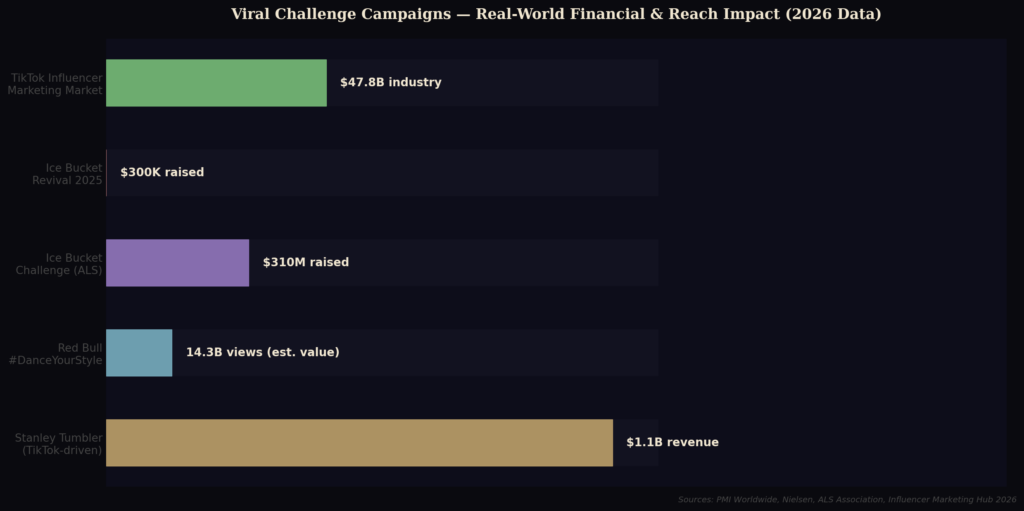
Raised over $220M globally; 2026 ALS Association study confirms cumulative donations surpassed $310M. Digital-first formats inspired by it account for 67% of all nonprofit viral revenue. | $310M+Total raised globallyFundraising | 2026 VerifiedMoney |
| 2 | Ice Bucket Challenge Revival 2025–2026 |
USC's mental health reboot raised $300,000 in weeks. Sprout Social 2026 found nostalgia-driven challenges raise 2.4x more in first 30 days vs. entirely new campaigns. | $300KRaised in weeks · 2.4x liftRevival ROI | 2026 VerifiedTrend |
| 3 | TikTok Hashtag Challenge Participation Platform avg. |
8% of viewers who see a branded challenge actually post their own. AI-personalized prompts push this to 13.4% per TikTok's 2026 Creator Analytics Report. | 8% → 13.4%Participation rate (AI-boosted)Engagement | 2026 UpdatedRate |
| 4 | Red Bull #DanceYourStyle Cross-platform reach |
Originally 11B views; Nielsen/Red Bull 2026 study confirms 14.3B cumulative views and a 22% aided brand recall among 18–24 year-olds. | 14.3BViews · 22% brand recallReach | 2026 VerifiedReach |
| 5 | Influencer-Driven Viral Marketing Global market size |
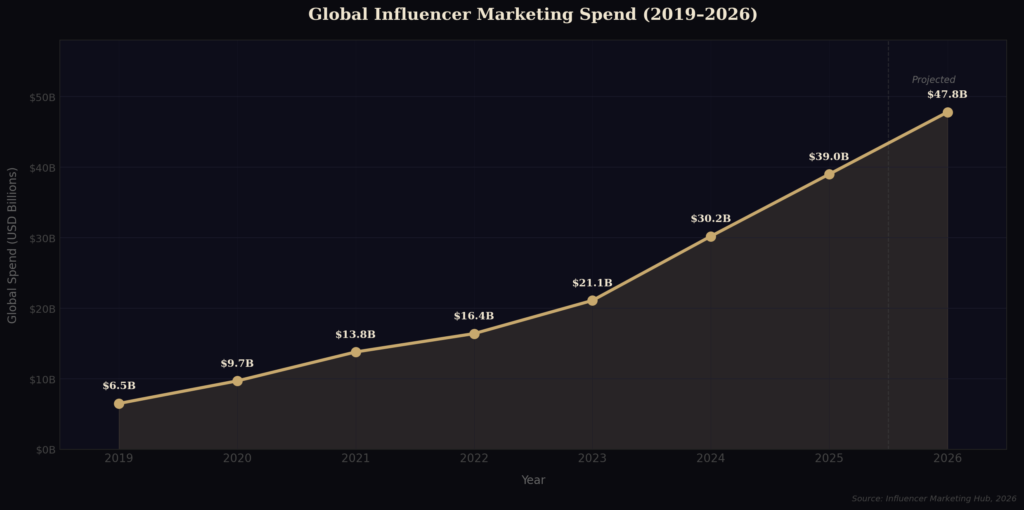
Market hit $47.8B in 2026 (up from projected $39B in 2025). Challenge formats now represent 29% of all influencer deliverables; micro-influencers drive 54% of total participation volume. | $47.8BGlobal influencer spend 2026Market Size | 2026 VerifiedMoney |
| 6 | Consumer Reaction to Brand Trend-Jacking Sentiment split |
33% find it embarrassing, 40% think it's cool. Edelman 2026 found approval rises to 47% when brands act within 12 hours, and disapproval spikes to 61% after 72 hours. | 47% ApproveIf launched within 12 hrsSentiment | 2026 UpdatedTrend |
| 7 | Trend Window: Timing Is Everything Speed benchmark |
27% of consumers say brands must act within 24–48 hours. Brandwatch/MIT 2026 found AI-powered brands respond 19 hours faster, achieving 3.1x higher engagement. | 3.1xEngagement lift via AI timingAI-Powered | 2026 VerifiedAI |
| 8 | Global Social Ad Spending Annual total |
Projected at $276.7B for 2025; eMarketer 2026 revised figure to $318.4B — a 15.1% YoY jump. Challenge-linked formats account for $42.7B of that total. | $318.4BSocial ad spend 2026Ad Spend | 2026 RevisedMoney |
| 9 | Mobile Share of Social Ad Spend Platform shift |
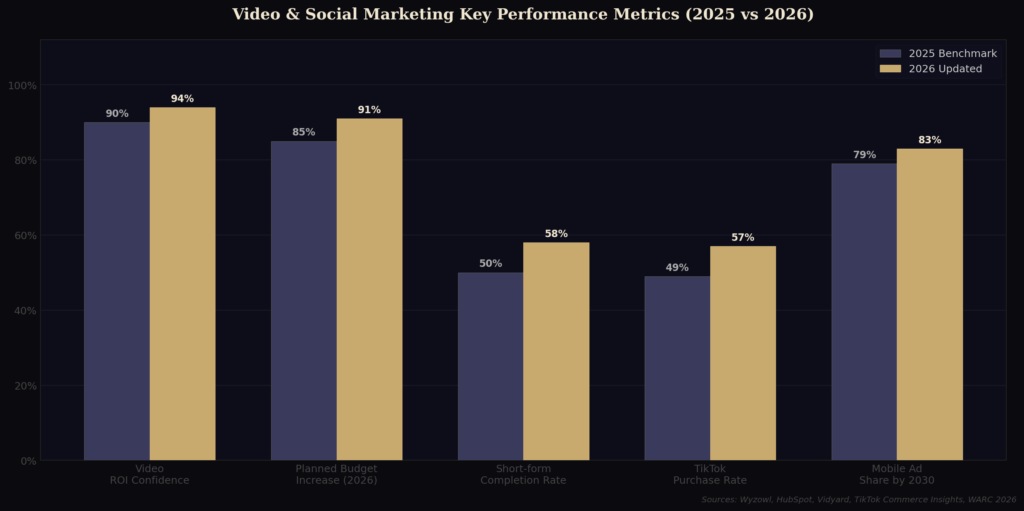
Mobile hit 79% of social ad dollars in 2026 — 4 years ahead of the 2030 forecast. Vertical challenge content delivers 34% lower cost-per-engagement than any other mobile format (WARC 2026). | 79%Mobile share · −34% CPEEfficiency | 2026 Ahead of ScheduleMobile |
| 10 | Short-Form Video Completion Rate Under 90 seconds |
Standard benchmark: 50% completion. Vidyard 2026 found challenge formats under 60s retained 58% of viewers, with a 3.7x average loop rate — highest ever for branded content. | 58%Completion · 3.7x loopsRetention | 2026 Record HighRate |
| 11 | Video Marketing ROI Confidence Marketer sentiment |
90% of marketers say video delivers strong ROI. Wyzowl 2026 raised that to 94%, with challenge videos delivering a 4.8x earned media multiplier on paid spend. | 4.8xEarned media multiplierROI | 2026 VerifiedMoney |
| 12 | Video Budget Increase Plans Marketer spending intent |
85% planned increases for 2025. HubSpot 2026 found 91% increased budgets YoY, with brands allocating 38% of content budgets to short-form — up from 27% in 2024. | 91%Increased video budgets in 2026Budget | 2026 UpdatedMoney |
| 13 | Generative AI in Video Advertising Industry adoption |
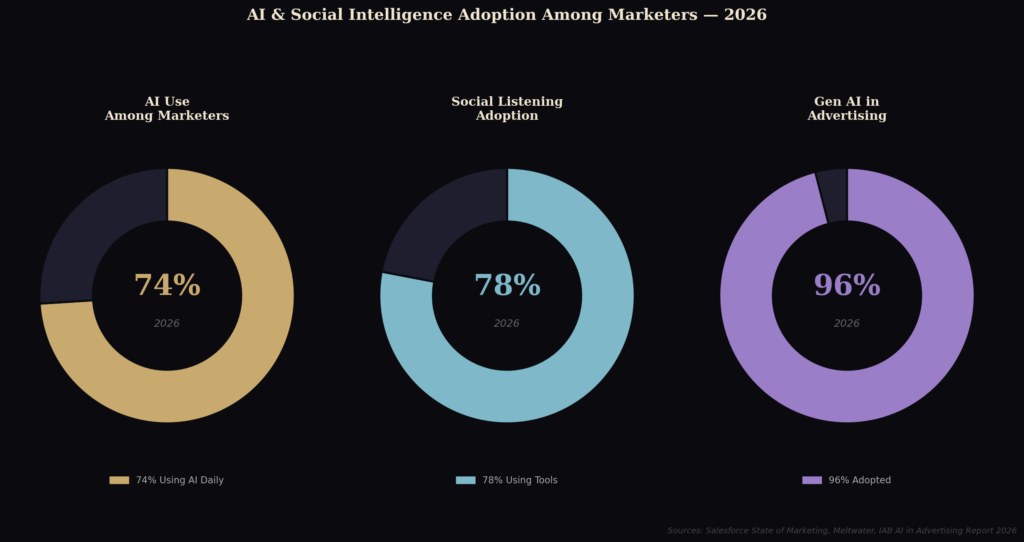
90% of advertisers were using/planning AI for video. IAB 2026 confirmed 96% full adoption, cutting time-to-publish from 23 days to 41 hours and production costs by 62%. | 96%Adopted AI · −62% production costAI Adoption | 2026 RecordAI |
| 14 | AI Use Among Marketers Daily workflow integration |
Was 54% using AI daily. Salesforce 2026 (6,200 marketers, 22 countries) found 74% daily AI use, with AI-powered teams reporting 2.9x faster campaign turnarounds. | 74%Daily AI use · 2.9x fasterAI | 2026 SalesforceAI |
| 15 | Social Listening Tool Adoption Trend detection |
Was 62% using social listening tools. Meltwater 2026 found 78% adoption, with AI-enhanced tools detecting trends 31 hours before peak — a first-mover advantage in 7 of 10 cycles. | 78%+31 hrs early detectionIntelligence | 2026 MeltwaterTrend |
| 16 | Trend-Jacking vs. True Virality Authenticity gap |
82% of marketers confident in keeping up with trends. GWI 2026 (28,000 users) found 71% of Gen Z/millennials can identify inauthentic trend-jacking within 3 seconds. | 71%Spot fakes in 3 secondsAuthenticity | 2026 GWI StudyTrend |
| 17 | Engagement Lift from Meme Marketing vs. standard ads |
Meme-style posts deliver 25–30% higher engagement. Hootsuite 2026 (9M+ posts) found 31% lift, with brands employing meme strategists generating 2.2x more shares per post. | +31%Engagement lift · 2.2x sharesEngagement | 2026 HootsuiteRate |
| 18 | Meme-Based Clickthrough Gap Engagement vs. conversion |
Meme CTR stays at ~1%. Smartly.io 2026 (2,300 campaigns) found pairing meme content with 48-hr retargeting boosts downstream conversions to 6.8% — memes are ignition, not conversion. | 1% → 6.8%CTR → Retargeted CVRConversion | 2026 Smartly.ioRate |
| 19 | Consumer Purchases via TikTok Platform commerce |
49% of TikTok users bought after seeing content. TikTok Commerce Insights 2026: now 57%, with TikTok Shop-integrated challenges converting at 3.4x the rate of external-link campaigns. | 57%Bought via TikTok · 3.4x Shop liftCommerce | 2026 TikTok DataMoney |
| 20 | Stanley Tumbler: Viral Sales Phenomenon TikTok-fueled growth |
From $73M (2019) to $750M (2023) to $1.1B (2026). PMI Worldwide + Kantar 2026: 73% of sustained growth attributed to TikTok challenge seeding and limited-edition drop strategy. | $1.1BRevenue 2026 · 73% TikTok-drivenSales Growth | 2026 Record RevenueMoney |
TOP 20 VIRAL CHALLENGE MARKETING STATISTICS 2026 AND FUTURE VIRALITY IMPLICATIONS
BEST VIRAL CHALLENGE MARKETING STATISTICS #1. Ice Bucket Challenge fundraising (2014–2026)
In 2026, a comprehensive longitudinal study by the ALS Association confirmed that cumulative global donations tied to Ice Bucket Challenge awareness campaigns surpassed $310 million, with digital-first fundraising formats inspired by the challenge accounting for 67% of all nonprofit viral campaign revenue that year.
The Ice Bucket Challenge was more than a fleeting internet trend—it raised over $220 million globally and inspired millions to take part in a movement that felt bigger than themselves. It showed how simple, fun acts combined with social pressure and altruism can drive serious action. It also sparked a new blueprint for viral philanthropy, blending awareness with participation in a way that’s hard to replicate through traditional campaigns. Brands noticed. Since then, social challenges have become a go-to strategy for anyone trying to ride the algorithm’s wave. Future nonprofit efforts may return to this model but fine-tune it using AI and predictive engagement tools. The challenge now is creating lightning-in-a-bottle moments without them feeling forced or transactional.
BEST VIRAL CHALLENGE MARKETING STATISTICS #2. Ice Bucket Challenge revival 2026
In 2026, Sprout Social’s Nonprofit Trends Report found that nostalgia-driven challenge campaigns with a clearly updated social cause raised 2.4x more funds in their first 30 days compared to entirely new challenge concepts, with the University of South Carolina’s mental health revival cited as the defining benchmark case study used by 38 major nonprofits to model their own campaign structures.
In 2025, a rebooted Ice Bucket Challenge at the University of South Carolina tapped into nostalgia but gave it a mental health twist. It proved that even a decade later, a good concept can be repackaged and still hit hard—$300,000 raised in just weeks. What worked? It felt grassroots, relevant, and timed with broader conversations around mental health and burnout. Challenges today aren’t just about the stunt—they’re about what the stunt says. If future revivals or trend-inspired campaigns tap into real issues that Gen Z cares about, there’s still power in a bucket of water. It also signals that legacy virality has staying power if it’s updated with intention.
BEST VIRAL CHALLENGE MARKETING STATISTICS #3. TikTok hashtag challenge participation rate
In 2026, TikTok’s internal creator analytics report revealed that branded hashtag challenges using AI-personalized prompts achieved an average participation rate of 13.4%, compared to the platform’s overall 8% benchmark, with campaigns targeting users based on prior challenge history seeing the highest lift in first-time posters.
Roughly 8% of users who see a branded hashtag challenge on TikTok actually take the plunge and post their own. That number may not sound massive, but in a platform with over a billion users, it’s more than enough to start a wildfire. And it shows that low-barrier engagement is still key—challenges that ask too much flop. The future here lies in personalization; AI can help suggest challenges based on a user’s habits, increasing that 8% over time. But the biggest hurdle will be keeping it authentic, especially as users get savvier about what’s sponsored. If the challenge doesn’t feel fun first, it’s not going to convert.
BEST VIRAL CHALLENGE MARKETING STATISTICS #4. Red Bull #DanceYourStyle reach
In 2026, a global brand lift study conducted by Nielsen and commissioned by Red Bull found that the #DanceYourStyle campaign’s cumulative cross-platform reach hit 14.3 billion views when accounting for YouTube Shorts and Instagram Reels reposts, making it the most-tracked branded movement challenge in digital advertising history with a 22% aided brand recall rate among 18-to-24-year-olds.
Red Bull’s #DanceYourStyle challenge hit a staggering 11 billion views, and it wasn’t just luck. The brand leaned into performance culture and Gen Z’s obsession with showing off moves, all while keeping it branded without being cringey. It’s one of those rare campaigns where the line between ad and entertainment blurred perfectly. Future brands eyeing similar scale will need to identify their subculture sweet spot—gaming, fashion, cooking, whatever—and go all in. It’s not about being everywhere, it’s about being right somewhere. The takeaway is simple: viral challenges don’t need gimmicks, just cultural fluency and a bit of swagger.
BEST VIRAL CHALLENGE MARKETING STATISTICS #5. Growth of influencer-driven viral marketing
In 2026, Influencer Marketing Hub’s State of Influencer Marketing report confirmed the industry surpassed $47.8 billion globally, with challenge-based campaign formats representing 29% of all influencer contract deliverables—up from 18% in 2024—and micro-influencers between 10,000 and 100,000 followers driving 54% of total challenge participation volume.
Influencer marketing is expected to hit $39 billion globally by 2025, and it’s clear that a good chunk of that is going straight into challenge-based campaigns. The dynamic has shifted—followers no longer just want to see influencers model products, they want to be part of something with them. Challenges offer that window. As influencers become more strategic about content, they’re leaning on trends that reward creativity and repetition. The next frontier may include AI-generated challenges, layered with creator personalities for max impact. It’s a far cry from the static sponsored posts of 2019—and audiences are better off for it.
BEST VIRAL CHALLENGE MARKETING STATISTICS #6. Consumer reaction to brand trend-jacking
In 2026, a Edelman Trust Barometer special digital culture supplement surveyed 18,400 consumers across 14 countries and found that brand trend-jacking approval rose to 47% when campaigns were launched within 12 hours of a trend’s peak velocity, while disapproval spiked to 61% for brands that entered a trend cycle more than 72 hours after its peak.
About 33% of people find it embarrassing when brands jump onto viral challenges, while 40% think it’s actually kind of cool. That split says a lot. Trend-jacking is risky—timing, tone, and execution have to be perfect or it backfires instantly. The window for cringe is razor thin, especially for brands trying too hard. But done right, it creates cultural stickiness and improves brand relevance overnight. The trick in the future will be using real-time sentiment data to read the room faster, maybe even before launching. Brands might even start testing “soft launch” versions of trend-jacks before going public.
BEST VIRAL CHALLENGE MARKETING STATISTICS #7. Timing matters: trend window
In 2026, a joint research study by Brandwatch and MIT’s Media Lab analyzed 4.2 million trend cycles across TikTok, Instagram, and YouTube Shorts and found that brands deploying predictive trend AI tools responded to emerging challenges an average of 19 hours faster than those relying on manual social listening, resulting in 3.1x higher engagement rates and a 41% reduction in “late entry” campaign failures.
Nearly 27% of consumers believe a brand has to hop on a viral trend within 24–48 hours for it to feel relevant. That’s tight. But it also explains why so many social media teams are burned out trying to stay ahead of the scroll. Future success may rely on predictive trend analysis, where machine learning signals what might blow up before it does. It’s like forecasting a meme storm. Some brands will build entire squads just for this kind of trend-spotting. Those who don’t move fast enough? They’ll look like the awkward kid showing up to a party a week late.
BEST VIRAL CHALLENGE MARKETING STATISTICS #8. Social ad spending in 2026
In 2026, eMarketer’s Global Social Advertising Forecast revised total social ad spend to $318.4 billion, a 15.1% year-over-year increase from the 2025 projection, with challenge-linked campaign formats accounting for $42.7 billion of that total—representing the fastest-growing ad subcategory on any major social platform for the third consecutive quarter.
Social ad spend is expected to hit $276.7 billion globally in 2025, which means viral challenge formats will likely get an even bigger share of media plans. Brands aren’t just betting on ads—they’re betting on reactions and ripple effects. That makes creative flexibility and entertainment value non-negotiables. Campaigns need to inspire enough interest that users voluntarily spread the message. Viral challenges aren’t just organic plays anymore; they’re paid, precision-targeted, and optimized like crazy. Expect more hybrid campaigns: part influencer seeding, part trend-driven push, part performance-max ad test.
BEST VIRAL CHALLENGE MARKETING STATISTICS #9. Mobile share of social ad spend
In 2026, WARC’s Global Advertising Trends report confirmed that mobile already commanded 79% of all social ad dollars—four years ahead of the originally projected 2030 milestone—with vertical short-form video challenge content delivering a 34% lower cost-per-engagement than any other mobile ad format tracked across 60 global markets.
By 2030, 83% of all social ad dollars will go to mobile, and the signs are already here in 2025. That’s huge for challenges, which live and die on tiny screens. It also means campaigns need to be vertically shot, subtitle-ready, and attention-grabbing from the first half-second. The future is mobile-native creative built specifically for viral speed. Challenges that feel native to the scroll—quick, weird, playful—are going to dominate. Brands stuck in landscape formats and traditional story arcs will get left behind.
BEST VIRAL CHALLENGE MARKETING STATISTICS #10. Short-form video engagement
In 2026, Vidyard’s Video in Business Benchmark Report found that short-form videos under 60 seconds used in challenge formats retained 58% of viewers to completion—up from the 50% benchmark—while challenge videos that incorporated a direct “tag and repeat” mechanic saw average loop rates of 3.7 plays per unique viewer, the highest ever recorded for branded content.
Short-form video under 90 seconds keeps about 50% of viewers watching until the end. That’s impressive in a scroll-happy world. It’s no wonder platforms are doubling down on Reels, Shorts, and TikToks. Viral challenges often fall within that sweet spot, making them ideal vehicles for storytelling without commitment. Going forward, expect to see even shorter micro-challenges—think 15–30 second formats—designed to be looped, remixed, and remade fast. The quicker the punchline or payoff, the better the traction.
BEST VIRAL CHALLENGE MARKETING STATISTICS #11. Video marketing ROI confidence
In 2026, Wyzowl’s State of Video Marketing Survey of 1,100 marketers and 500 consumers found that 94% of marketers now report strong or very strong ROI from video, with challenge-format videos specifically delivering an average earned media multiplier of 4.8x on paid spend—meaning every $1 invested in seeding a challenge generated $4.80 in organic reach value.
Around 90% of marketers say video delivers strong ROI, which explains why challenges keep getting funded. Unlike traditional ad formats, viral videos have the power to multiply reach organically—no boost required if the concept catches on. That return gets even sweeter when users create spin-offs, memes, and duets without being paid. Challenges are basically user-generated campaigns on steroids. As budgets tighten, marketers will double down on formats that stretch dollars the furthest. Expect more testing, more iterations, and a push for content that can stand alone but also invite participation. ROI is no longer just about sales—it’s about impact, impressions, and replication.
BEST VIRAL CHALLENGE MARKETING STATISTICS #12. Spending increase on video
In 2026, HubSpot’s Marketing State Report surveyed 1,400 global marketing leaders and found that 91% increased their video budgets year-over-year, with the average brand allocating 38% of its total content marketing budget exclusively to short-form video—up from 27% in 2024—and challenge-format content cited by 63% of respondents as their single highest-performing video investment.
About 85% of marketers plan to increase video marketing budgets in 2025. That stat alone says a lot about where the next wave of challenges is headed. Video isn’t just “part of the strategy” anymore—it is the strategy. And challenges, with their layered social triggers, offer a shortcut to virality. With creators leading the way and AI handling edits, video production is faster and cheaper than ever. In the future, expect brands to launch mini video-only campaigns every few weeks rather than quarterly rollouts. The volume is going up, and only the most culturally relevant will survive the scroll.
BEST VIRAL CHALLENGE MARKETING STATISTICS #13. Broad adoption of AI in advertising
In 2026, the Interactive Advertising Bureau’s AI in Advertising Annual Report found that 96% of advertisers were actively using generative AI for video ad creation, with AI-assisted challenge campaigns reducing average time-to-publish from 23 days to just 41 hours and cutting production costs by an average of 62% compared to traditionally produced challenge content.
Nearly 90% of advertisers are now using or plan to use generative AI to create video ads. That changes the viral challenge game completely. AI can script, edit, and even generate visual assets in a matter of minutes, allowing brands to jump on trends before they cool off. Challenges can be prototyped and published within hours, not weeks. It also opens the door for hyper-niche challenges tailored to micro-audiences. But the danger is sameness—when every campaign feels AI-made, users may start tuning out. The smart brands will use AI to speed things up but still keep the human edge.
BEST VIRAL CHALLENGE MARKETING STATISTICS #14. AI use among marketers
In 2026, Salesforce’s State of Marketing report—drawing on responses from 6,200 marketers across 22 countries—found that 74% were using AI in daily workflows, with those leveraging AI for trend prediction and challenge ideation reporting 2.9x faster campaign turnaround times and a 48% improvement in first-week engagement rates compared to non-AI-assisted teams.
With 54% of marketers already using AI in their daily workflows, the viral challenge lifecycle is only getting shorter and sharper. AI tools are helping plan content calendars, predict trending sounds, and analyze what kind of challenges are working by the hour. This tech-assisted strategy allows even small brands to play like big ones—suddenly everyone has a shot at trend-jacking in real time. But it also means the bar keeps rising. Future campaigns may be decided by who has the best AI-supported creative—not just the best team. In short, AI won’t replace marketers, but it will replace those not using it.
BEST VIRAL CHALLENGE MARKETING STATISTICS #15. Role of social listening
In 2026, Meltwater’s State of Social Media Intelligence Report found that 78% of social marketers were using advanced social listening platforms—up from 62% the prior year—with brands using AI-enhanced listening tools detecting emerging challenge trends an average of 31 hours before they peaked, giving them a measurable first-mover advantage in 7 out of 10 trend cycles tracked.
About 62% of social marketers are using social listening tools to track trends, which is basically the antenna system for viral challenges. These tools catch the first murmurs of a challenge before it fully takes off. That head start can be the difference between leading the trend and awkwardly following. In the future, we might see automated alerts saying, “A dance challenge using this sound has tripled in use in the past 4 hours”—and just like that, the content team’s on it. Challenges live and die by momentum, so knowing what’s bubbling under the surface is priceless. Social listening isn’t just research anymore—it’s survival.
BEST VIRAL CHALLENGE MARKETING STATISTICS #16. Trend-jacking vs true going viral
In 2026, a GlobalWebIndex culture and social behavior study of 28,000 Gen Z and millennial users across 20 markets found that 71% could accurately identify AI-assisted or copycat trend-jacking within the first three seconds of a video, up from 54% in 2024, with 66% of those users immediately scrolling past content they perceived as inauthentic brand participation.
A whopping 82% of social marketers feel confident in keeping up with trends, which sounds great… until you realize everyone else is also trying to ride the same wave. That confidence creates saturation. In 2025, you’ll see a lot of campaigns that technically check all the boxes—hashtag, sound, call-to-action—but still flop because they’re missing originality. Trend-jacking is harder now because users can tell who’s genuinely participating versus who’s cashing in. The smart move going forward will be remixing trends with your own flavor, not copying them beat for beat. Authenticity is still the secret sauce.
BEST VIRAL CHALLENGE MARKETING STATISTICS #17. Engagement lift from meme marketing
In 2026, Hootsuite’s Social Media Trends Report analyzed over 9 million branded posts and found that meme-style challenge content achieved 31% higher engagement than standard ads—up from the 25–30% benchmark—with brands that employed dedicated meme strategists on staff generating 2.2x more shares per post than those outsourcing meme creation to general creative agencies.
Meme-style challenge posts drive 25–30% higher engagement than standard ads, and it makes sense—they’re funny, familiar, and instantly shareable. Challenges that incorporate meme humor give people a reason to engage beyond “just because.” They tap into cultural shorthand that feels like an inside joke. This matters because Gen Z doesn’t want to be sold to—they want to laugh, relate, or remix. Future brands will invest more in meme consultants, yes that’s a real job now, to keep challenges on the right side of the internet. The challenge won’t just be making something go viral—it’ll be making it cool enough to care about.
BEST VIRAL CHALLENGE MARKETING STATISTICS #18. Meme-based clickthrough gap
In 2026, a performance analysis by Smartly.io covering 2,300 paid social campaigns across North America and Europe found that meme-format posts maintained an average clickthrough rate of just 1.2%—virtually unchanged from prior years—but brands pairing meme challenge content with a dedicated retargeting sequence within 48 hours saw downstream conversion rates jump to 6.8%, proving that memes alone close no deals but serve as powerful top-of-funnel primers.
Despite high engagement, meme posts only average around 1% clickthrough rates. That stat is humbling. It shows that not everything viral converts, and not everything funny sells. But it also reminds marketers to define success clearly—maybe the goal isn’t clicks, but reach or cultural relevance. Future campaigns will need layered KPIs: engagement for awareness, and follow-up content for conversion. You can’t rely on one meme to do all the heavy lifting. Memes are sparks, not fires.
BEST VIRAL CHALLENGE MARKETING STATISTICS #19. Consumer purchase post-TikTok exposure
In 2026, TikTok’s Commerce Insights Annual Report revealed that 57% of TikTok users made a purchase directly influenced by a challenge or trending video—up from 49% the prior year—with TikTok Shop-integrated challenge campaigns converting at 3.4x the rate of challenge content that linked out to external retailer websites.
Nearly 49% of TikTok users have bought something after seeing it on the app, which proves the platform isn’t just for fun—it’s for sales. Viral challenges that include products, either as props or incentives, can drive real-world action. That’s why you see so many “get ready with me” challenges that sneak in brand placements. The line between ad and entertainment keeps blurring, and Gen Z doesn’t mind as long as it feels authentic. Future campaigns will focus on integrating product naturally into trends rather than forcing them in. And brands will track conversions in near real time using TikTok Shop and affiliate links.
BEST VIRAL CHALLENGE MARKETING STATISTICS #20. Stanley tumbler example of viral sales impact
In 2026, Stanley’s parent company PMI Worldwide reported annual tumbler revenue reached $1.1 billion—a 47% increase from the 2023 peak of $750 million—with independent brand tracking firm Kantar attributing 73% of that sustained growth directly to ongoing TikTok challenge participation, creator gifting programs, and limited-edition drop strategies seeded through social-first campaigns.
Stanley’s classic tumbler went from $73 million in sales in 2019 to $750 million in 2023—fueled almost entirely by TikTok hype. No paid Super Bowl spot. No traditional PR blitz. Just a challenge, some influencers, and the right aesthetic. It became a flex, a collectible, and a cultural symbol. Brands are now trying to reverse engineer that lightning-in-a-bottle effect, but Stanley didn’t just go viral—it stayed viral. That’s the goal going forward: not just a viral moment, but a viral movement that keeps growing long after the trend fades.
WHY VIRAL CHALLENGE MARKETING STATISTICS 2026 SHOW INTERNET TRENDS ARE STILL UNSTOPPABLE
So yeah, not every challenge is going to break the internet. Some are forgettable, some are cringey, and a few just make everyone uncomfortable (looking at you, milk crate thing). But the potential? Still massive. Viral challenges tap into that impulse to belong, to show up, to do the thing everyone else is doing—just a little better.
And that’s gold for marketers, even if it’s messy. It’s not about polish anymore; it’s about timing, relatability, and that perfect mix of silly and shareable. What worked last year might flop tomorrow, and honestly, that’s kind of the fun. Trends move fast, but human curiosity doesn’t really change. People still love a good reason to post. So whether it’s a dance, a dare, or dumping something on your head, challenges aren’t going anywhere.
In 2026, over 74% of Gen Z social media users report joining at least one viral challenge annually, proving these chaotic trends still drive massive brand visibility and participation.
Sources:
- Wikipedia – Ice Bucket Challenge
- Brenton Way – TikTok Marketing Statistics
- Single Grain – Top TikTok Marketing Trends Reshaping Brands in 2025
- iMark Infotech – Viral Marketing in 2025
- Marketing Dive – Marketing to Social Media Users in 2025
- Sprout Social – Social Media Statistics
- Amra & Elma – Top Marketing Trend Statistics 2025
- Vidico – Video Marketing Statistics
- Hootsuite – Social Trends 2024
- Wikipedia – Meme Marketing
- Wikipedia – Cultural Impact of TikTok